# TraceFast Docs
Real-time Ethereum analytics — live dashboard, address explorer, DeFi data.
# What is TraceFast
[Open TraceFast →](https://tracefast.xyz/)
TraceFast shows what happened on Ethereum, down to execution: who took part, what moved, and which code ran. The data comes from TraceFast's own archive node and is processed as every block lands (roughly every 12 seconds). A fact is published only when it is proven, and always with the block it holds for.
It comes in three core surfaces:
* **[Live Dashboard](/dashboard/overview)** — a real-time view of the network: block production, value flows, token and NFT activity, DEX swaps, validators, gas and storage — updated with every block.
* **[Explorer](/explorer/blocks)** — blocks, transactions, addresses, tokens, and smart contracts, enriched with human-readable labels so you see *Binance 14 (Hot Wallet)* instead of a bare hex string (names show once you sign in — a free account is enough).
* **[DeFi Analytics](/defi/overview)** — DEX activity, pools and liquidity, and flash loans, tracked as they happen; for signed-in users.
## What TraceFast knows about an address
Three layers, each built on the one below:
1. **Chain facts** — what the address is now, and what it was at past blocks:
a wallet, a contract or a delegation; how its code is built; what its owner
can do and has already done; how it links to other addresses. Proven from
chain data alone. See [Address Attributes & Relations](/concepts/address-attributes).
2. **Ecosystem labels** — which protocol an address belongs to and what its
role is there. New protocol objects are found and labelled automatically
from the events of protocol factories and registries. See
[Labels & Entities](/concepts/labels-and-entities#ecosystem-labels).
3. **External labels** — names of the entities behind addresses, and
sanctions lists. See [Labels & Entities](/concepts/labels-and-entities).
## Who it's for
* **AML and compliance** — addresses blocked by token contracts, such as those
of USDT, USDC and other issuers ([Blacklist Monitoring](/compliance));
sanctions in the label layer; an address read as of the block of a
transaction, not as of today
([past blocks](/explorer/entity#reading-an-address-at-a-past-block)).
* **Exchanges and payments** — what an address is before you pay it: a wallet,
a contract, a token or a smart account; a check over the API whether an
issuer has frozen a counterparty, before a credit or a payout
([blacklist status](/api/risk-blacklist-status)); [Alerts](/alerts) when ETH,
tokens or NFTs move.
* **Audit and security** — a transaction as a call tree, with its frames,
storage writes and revert reasons ([Transactions](/explorer/transactions));
contracts without source code: decompilation, selectors and proxy history
([Contracts](/explorer/entity/contracts)); live [Signals](/dashboard/signals)
for proxy upgrades and changes of owners and roles.
* **Investigations** — the [graph](/explorer/entity/graph) of value flows and
structural links of an address; counterparties, portfolio and balance
history, and its state at a past block ([Entity Page](/explorer/entity));
your private labels and notes in [Favorites](/favorites).
## Where to start
* New here? Follow the **[Quickstart](/quickstart)** — from opening the dashboard to reading your first labeled address in a few minutes.
* Curious how the live view works? Read the **[Dashboard overview](/dashboard/overview)**.
* Want to know what TraceFast says about an address? See **[Address Attributes & Relations](/concepts/address-attributes)** and **[Labels & Entities](/concepts/labels-and-entities)**.
## How fresh is the data?
The Live Dashboard updates with every Ethereum block. Historical views (network stats, gas trends, storage analytics) aggregate over daily windows. See [Data Sources & Freshness](/concepts/data-sources) for details.
## Looking for an API?
There is one, with three ways to call it: a **REST API** with an API key, an
**MCP server** that gives AI agents the same data as tools — with an API key
or by signing in with a TraceFast account — and nearly every method **paid per call over x402** — no account, no key. See
[ways to call](/api#ways-to-call).
## Beyond the docs
* **[tracefast.xyz](https://tracefast.xyz/)** — the product itself. Every page in these docs links straight to the view it describes.
* **[blog.tracefast.xyz](https://blog.tracefast.xyz/)** — release notes, on-chain investigations, and write-ups on what the data shows.
# Quickstart
[Open TraceFast and follow along →](https://tracefast.xyz/)
## 1. Open the Live Dashboard
Go to [tracefast.xyz](https://tracefast.xyz/). You land on the **Live Dashboard**: a grid of widgets that update with every Ethereum block, about every 12 seconds. No account is needed to look around — the dashboard and the whole Explorer are open. A free account adds address names, tags and risk flags everywhere, and opens the [DeFi](/defi/overview) and [Blacklisted](/compliance) sections; see [Account & Security](/account-security) for how sign-in works.
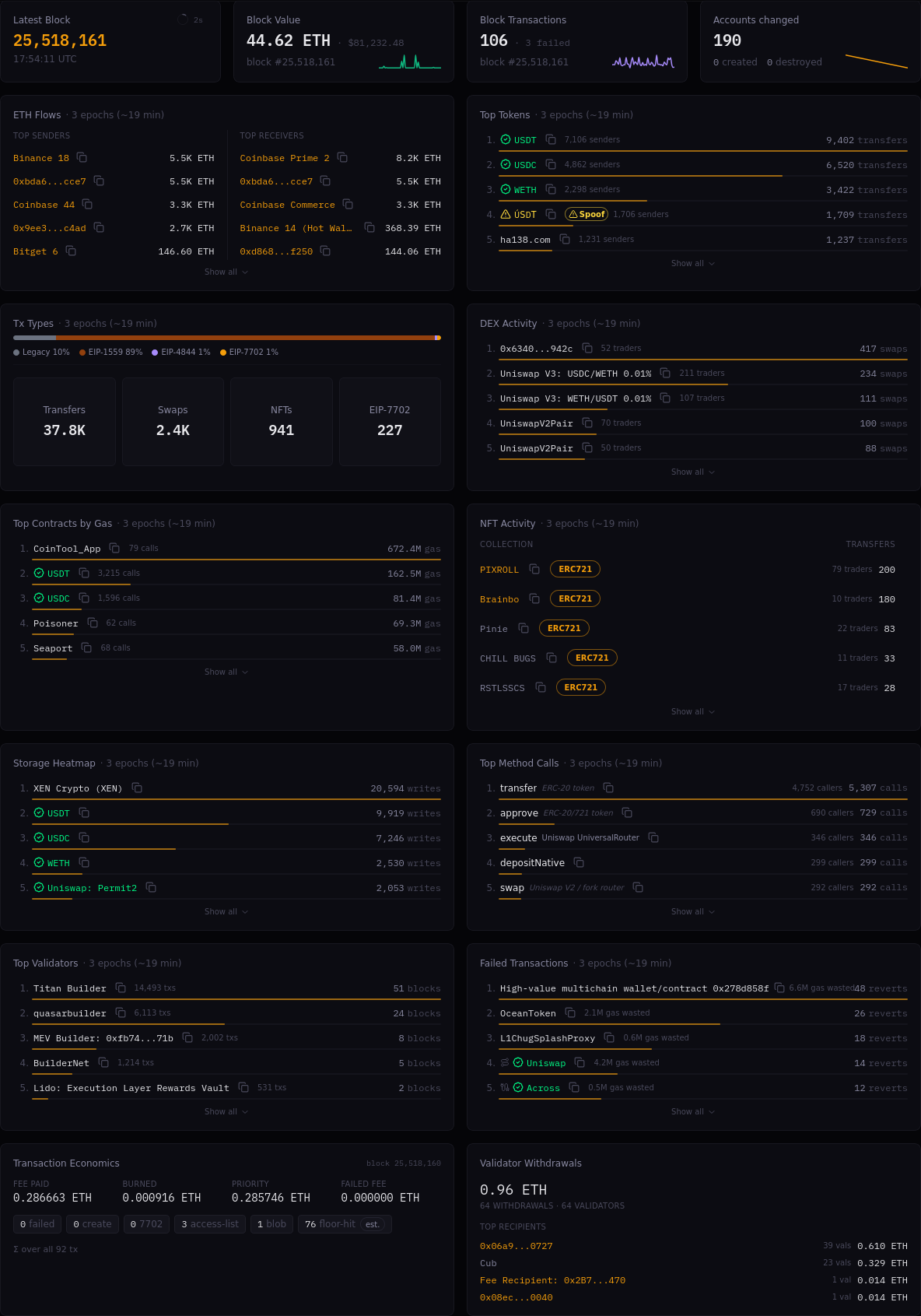
The four cards on top show the pulse of the network — the latest block with a countdown to the next one, the ETH value it moved, its transaction count, and how many accounts it touched. Everything below aggregates over a short rolling window, so numbers reflect the last ~19 minutes of network activity, not all of history. See the [Dashboard overview](/dashboard/overview) for a tour of every widget.
## 2. Look up an address
Press ⌘K (or click the search bar) and paste any address, transaction hash, or block number.
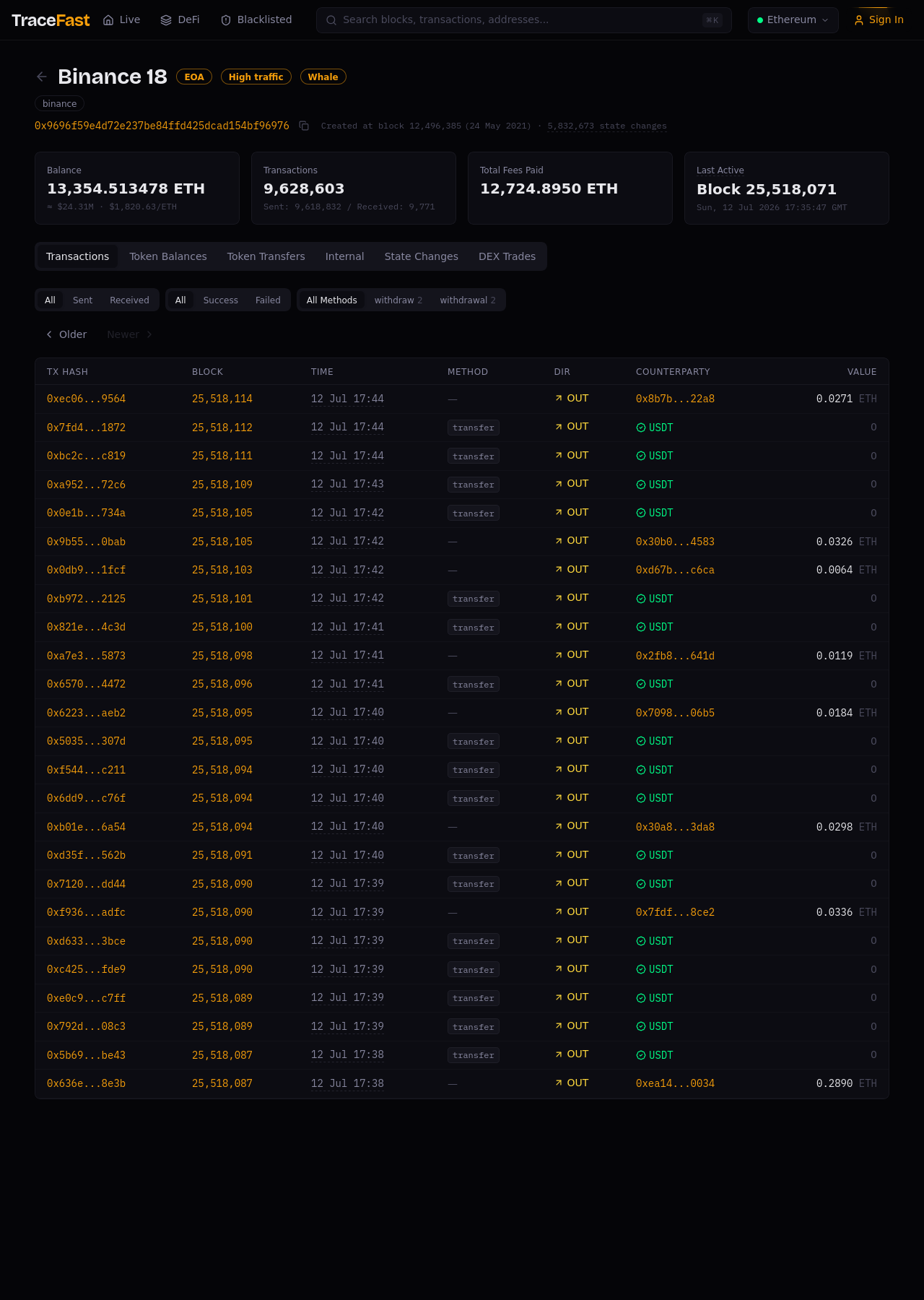
Any address — a wallet, a contract or a token — opens the same page:
[`/entity/{address}`](/explorer/entity). It shows the balance and portfolio,
the transaction history and everything inside it, the facts proven about the
address, and — crucially — its **labels**: a name like *Binance 14 (Hot
Wallet)* when the address belongs to a known entity, plus signals such as
`High traffic` or `Whale`. Names, tags and risk flags show once you are signed
in; signed out, the page says so in place of the name.
## 3. Follow the money
From any address, click a counterparty, a transaction hash, or a block number to keep moving through the graph. Or start from the dashboard itself: every address in [ETH Flows](/dashboard/eth-flows), every pool in [DEX Activity](/dashboard/dex-activity), and every contract in [Top Contracts](/dashboard/top-contracts) is a link into the Explorer.
## Next steps
* [Entity Page](/explorer/entity) — one page for every address, tab by tab
* [Addresses & Labels](/explorer/addresses-and-labels) — the names and signals on top of it
* [Blocks](/explorer/blocks) — the signal-driven block explorer
* [Tokens](/explorer/tokens) — holders, transfers, and the pools a token trades in
* [DeFi Analytics](/defi/dex-and-tokens) — swaps, pools, and flash loans
* [Labels & Entities](/concepts/labels-and-entities) — how labeling works
# Account & Security
[Sign in to TraceFast →](https://tracefast.xyz/auth/login)
## Signing in — no passwords
TraceFast is **passwordless by design**: there is no password to create, remember, or leak. The sign-in page offers four ways in:

* **Email code** — enter your email and we send a one-time code; type it in and you're signed in. No account state lives in the code: it's single-use and short-lived.
* **Passkey** — sign in with your device's built-in authentication (Face ID, Touch ID, Windows Hello, or a hardware security key). Passkeys are phishing-resistant: they only work on the real TraceFast domain.
* **GitHub** — one click if you prefer to reuse your GitHub identity.
* **Google** — one click with a Google account. It works for addresses Google itself vouches for: a Gmail address or a Google Workspace account. For any other address, or one Google has not verified, the page says so — sign in with a code sent to your email instead.
All of them lead to the same account — pick whichever suits the moment. If the email of a GitHub or Google sign-in is already used by an account here, the page asks you to sign in to that account first, and then adds the provider as another way to sign in to it.
Before a code or a sign-in link is sent, the page runs a short automatic check that you are a person, not a bot. Usually you don't need to do anything; if the check can't finish, reload the page and try again.
## Creating an account
Choose **Sign up** on the sign-in page. Enter your email (your first and last name are optional) and confirm it with a one-time code, or continue with GitHub or Google. There is no password step — that's intentional, not an omission. Once you're in, you can add a passkey under **Security** in the account menu.
To create an account you accept the [Terms of Service](https://tracefast.xyz/legal/terms) and the [Privacy Policy](https://tracefast.xyz/legal/privacy): tick the box on the sign-up form — the GitHub and Google buttons work once it is ticked. Each published version of these documents carries its date and a fingerprint (sha256) at the top of the page, and TraceFast records which exact version you accepted.
## Two-factor authentication (2FA)
For email-code, GitHub and Google sign-ins we recommend adding a second factor. Open **Security** from the account menu, then **Two-Factor Authentication**. The same page manages your passkeys.
* **Authenticator app (TOTP)** — scan the QR code with 1Password, Google Authenticator, Aegis, or similar; sign-in then also asks for the current 6-digit code.
* **Security key** — register a hardware key (YubiKey and similar) as a second factor.
* **Recovery codes** — generate single-use backup codes for when your authenticator or key is unavailable. They back up an authenticator app or a security key, so they can be created only once one of those is set up. If you remove your last authenticator app or security key, the recovery codes are turned off with it, and the page tells you whether that worked. A passkey does not count as a second factor here.
:::tip
Passkey sign-in is inherently multi-factor — the device is something you have, its unlock is something you are — so a separate second factor mainly hardens the email-code, GitHub and Google paths. Whichever you use, generate recovery codes and store them somewhere safe.
:::
## Sessions
Your session stays active in the browser. Use **Sign Out** from the account menu to end it explicitly — for example, on a shared machine. Security-sensitive changes may ask you to sign in again first.
## Connected apps
An AI app can sign in to the [TraceFast MCP server](/api/mcp-server) with your TraceFast account instead of an API key. You approve it once on a TraceFast consent page. Every app you approved is listed under [Settings → Connected apps](https://tracefast.xyz/settings/apps), where **Disconnect** takes its access away.
## Alert emails
**Settings → Alerts** turns alert emails on or off for your whole account and chooses what an alert email says: **Brief** (the default), which never names the address, or **Detailed**, which does — in plain text. See [Alert emails](/alerts#settings--alerts).
## Related pages
* [Quickstart](/quickstart) — what to do once you're signed in
* [Favorites](/favorites) — your private list of saved addresses, transactions and blocks
* [Alerts](/alerts) — alerts on saved addresses, and the alert emails set under Settings → Alerts
* [What is TraceFast](/) — the platform in one page
* [API](/api) — REST with an API key, MCP for AI agents, or per-call payment over x402 with no account
# Favorites
[Open your Favorites →](https://tracefast.xyz/favorites)
Keep the addresses, transactions and blocks you care about in one private list — and, from their tables, single events, calls and NFTs — and add your own labels, notes and tags to them. Favorites belong to your TraceFast account. Sign in to use them, and they will be there on every device you sign in from. A saved address can also be watched: [Alerts](/alerts) tell you when assets move in or out of it.
## Save an item
Every [address](/explorer/entity), [transaction](/explorer/transactions) and [block](/explorer/blocks) page has a star in its header. On address pages it is the last item in the header row.
* **Save:** press the star. It fills in; hover over it to see "In your Favorites. Click to remove."
* **Remove:** press the star again. "Removed from Favorites" appears with **Undo** for a few seconds; Undo brings the item back exactly as it was — the date you first saved it, your note and your tags. Changed your mind a little later? Press the star again within 30 seconds of removing it and you get the same favorite back. After that, the star saves it as a new item, with today's date and no note or tags.
* **"Couldn't check your Favorites. Click to add.":** we could not reach your list just now. Pressing the star still saves the item.
**Not signed in?** Press the star and choose **Sign in and save**. After you sign in, you return to the page with the item already saved. If signing in takes longer than about 10 minutes, press the star again once you are back. New to TraceFast? Choose **Create account**, then come back and press the star. Signing in is covered in [Account & Security](/account-security).
## Save a row of a table
You can also save one row of a table: a single event, call or NFT. Every row in these tables has a star in a narrow first column, on the left:

* token and NFT transfers — on transaction, address and block pages, and in the Tokens list;
* the **Events** tab of a transaction;
* internal transactions — on address and block pages;
* the trace — each call in the call tree, and the call panel beside it;
* the transaction drawer of the live dashboard.
The star in the page header is unchanged: it saves the whole address, transaction or block.
**What is saved is the position, not a copy of what is there:**
* **An event** is that log of that transaction. Logs are counted from 0, so "log #7" is the eighth log.
* **A call** is that call's place in the transaction's call tree.
* **An NFT** is that token of its collection. A token id written in decimal or in hex is the same token.
Rows from the newest blocks show no star until the block is final.
**Not signed in?** It works as for the header star: press the row's star and choose **Sign in and save**. After you sign in, you return to the transaction page — not to the exact log or call — and the item is already saved. A call very deep in the trace cannot be carried through the sign-in: press its star again once you are back.
## Your Favorites list
Open **Favorites** from your account menu, below Settings and Security. Two tabs sit at the top: **Saved**, the list described here, and **Alerts**, your alert rules and the alerts they sent — see [Alerts](/alerts).
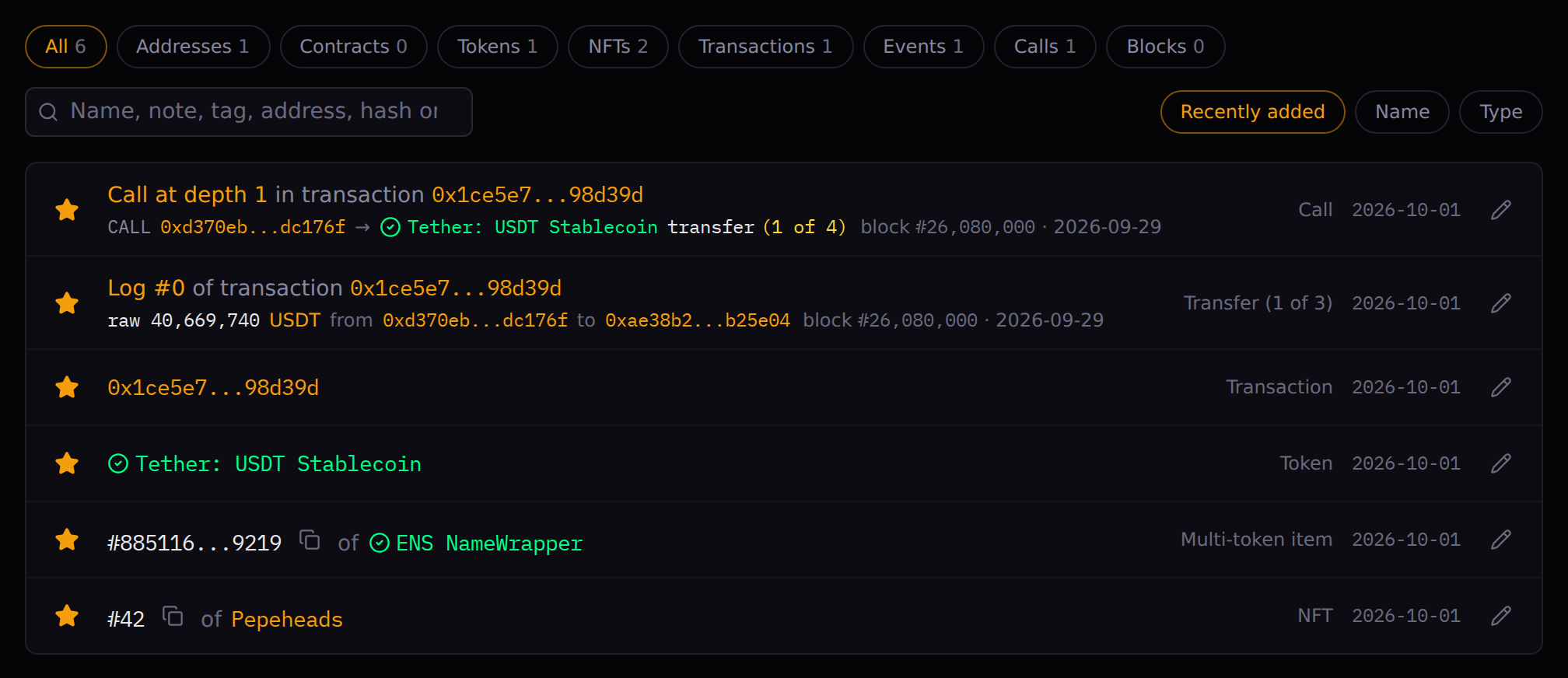
* **Tabs:** **All**, **Addresses**, **Contracts**, **Tokens**, **NFTs**, **Transactions**, **Events**, **Calls** and **Blocks**, each with its count. **Addresses** holds every address you saved; **Contracts** and **Tokens** narrow it down by the type you see on the address page.
* **Search:** it looks at names, types, your notes and tags, addresses, transaction hashes, block numbers and token ids, in decimal or in hex.
* **Sort:** **Recently added**, **Name** or **Type**.
* **Filter:** by one of your tags.
* **Each row** shows the item's name and type, the date you saved it, and your note and tags. Press the row's star (**Remove from Favorites**) to remove an item — Undo works here too — and the pencil (**Edit note and tags**) to change them. An address row also has a bell, for its [alert rules](/alerts#add-an-alert-rule).
* **At the top**, the list shows how many items you keep and how many your plan allows: "*N* of *M* saved". It counts every kind of favorite.
### Events, calls and NFTs in the list
* **An NFT** reads "#1234 of *collection*". The word beside it is **NFT**, **Multi-token item** (an ERC-1155 edition, which is not claimed to be unique) or **Token** (when the collection's kind is not known). The collection is a link; the token id is not, because there is no page for one token. The full id is in a tooltip and can be copied.
* **An event** reads "Log #*N* of transaction 0x…" and opens the transaction at that log. Under it you see what the log is — for a token transfer the amount, the token, from and to; otherwise who emitted it — then the block and its date. The word beside it is the event's name, such as **Transfer**, when the log was decoded. When several event signatures match, it reads "Transfer (1 of 3)". A log that was not decoded is just **Event**.
* **A call** reads "Call at depth *N* in transaction 0x…" and opens the trace at that call. Under it: the call type and from → to ("created *address*" for a contract creation); the method, with the same "1 of *N*" rule, or its selector when no name is known; the ETH sent, if any; "failed" if the call failed; and the block.
* **Amounts of a token transfer are in token units** when the token's decimals are known — one USDT shows as 1, not 1000000. Where the scale is not known, such as an ERC-1155 batch or a token that does not state its decimals, the amount shows as "raw *N*": the token's smallest units, not scaled. The transaction page shows the same amount.
* **"This transaction has no log #*N*."** (or "…no call at this position") appears only when TraceFast knows that the position is empty. While the details are still unknown, the list claims nothing.
* **"The details of *N* saved events and calls could not be read right now."** Your rows stay in the list; reload the page later.
## Your label for an address
Give a saved address a name of your own — *my cold wallet*, *suspect #2*. Unlike a note or tags, **your label is shown wherever that address appears on TraceFast**, and only to you.
* **Where to set it:** the first field of the editor, **Your label** — open it with the note button beside the star on the address's page, or with the pencil on its row in Favorites (**Edit label, note and tags**). Up to 32 characters.
* **Only an address can have a label** — not a transaction, a block, an event, a call or an NFT.
* **Adding a label saves the address** to your Favorites, and it counts toward your plan's limit.
* **Where it shows** — only when you are signed in, and nobody else ever sees it:
* beside the address in every table and feed, **after** the address's name, as a small tab with a person icon in its own colour; hover it for the whole text and *Your label — only you can see it.*;
* on the address's page, in one line under the title with your tags and your note (the note on one line, whole on hover); a tag there opens Favorites filtered by that tag;
* in your Favorites list, under the name — and the search finds it;
* on the [Graph](/explorer/entity/graph), inside the address's card. A PNG export of the graph never contains your labels.
* **It never replaces** the platform's name or its risk marks, and it never carries a verified check.
* **Refusals you may see:** *The label is too long: up to 32 characters.* — *The label contains invisible or formatting characters, or a space other than a plain one. Remove them and save again.* — *Only an address can have a label.*
**Removing a favorite deletes your label, note and tags with it**, so TraceFast asks first: *Remove from Favorites?* — *Removing this from Favorites also deletes your label "…", your note and your 2 tags.* **Keep** is the default; **Remove** removes. An address that alerts watch takes its alert rules along, and the question says so: *…and its alert rule. Undo brings them back.*
## Notes and tags
Add a short note and a few tags to any favorite, to remember why you saved it or to group items for an investigation.
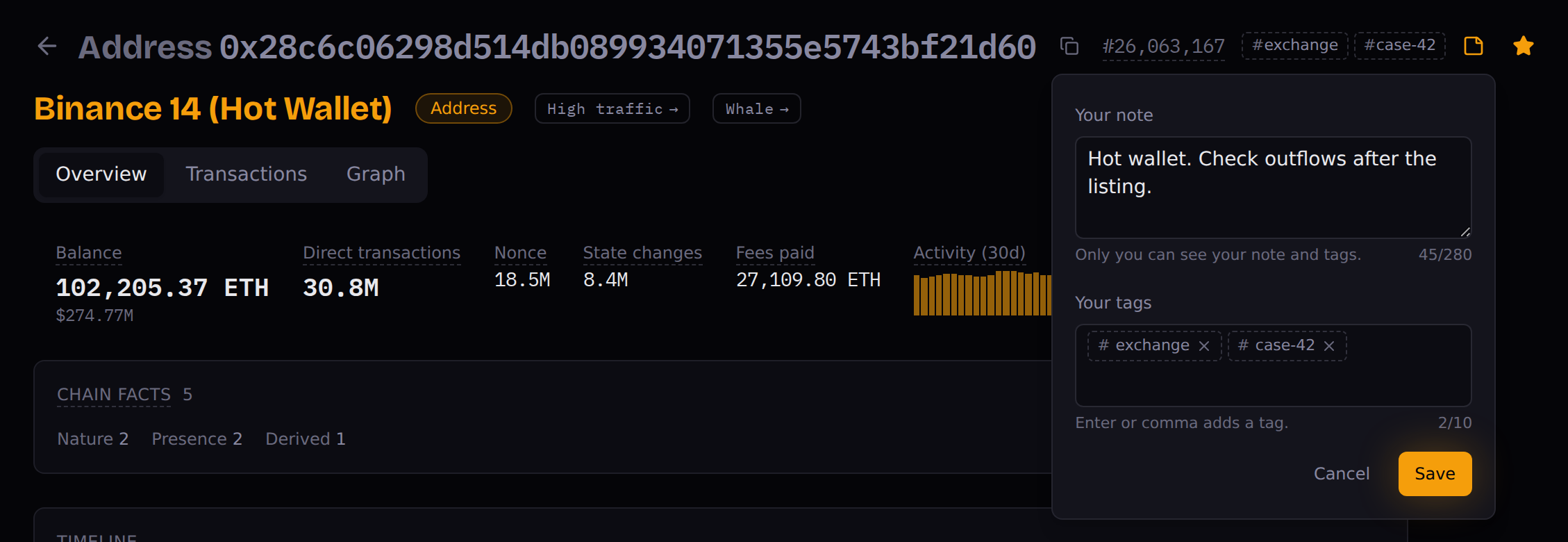
* **Where to edit:** in the list (**Edit label, note and tags** for an address, **Edit note and tags** for anything else), or on the item's own page with the note button next to the star.
* **Notes:** up to 280 characters. Line breaks are kept.
* **Tags:** up to 10 per item, each up to 32 characters.
* Type a tag and press Enter or a comma.
* Letter case does not matter, and tags are saved in lowercase: "Exchange" and "exchange" are the same tag.
* **Tags are your words, not TraceFast labels.** They show with a # and a dashed outline. A tag never replaces an address's name, is never marked as verified, and does not change the risk information we show. How TraceFast's own labels work is described in [Labels & Entities](/concepts/labels-and-entities).
* **Only you can see your notes and tags.** Links you copy from TraceFast never include them.
* **Invisible or formatting characters are not accepted,** for example a right-to-left override or a zero-width space. Such characters can make text read differently from what it really says, so the text is refused rather than silently changed. Remove them and save again. Emoji are fine, including combined ones like 👨💻.
## How many favorites you can keep
The number depends on your plan; each plan card on [Pricing](https://tracefast.xyz/pricing) shows it. Labels, notes and tags work the same on every plan; a label counts as a saved address.
* **When your list is full**, the star tells you so and offers **See plans**. Remove an item to add another.
* **If you move to a plan with a smaller limit, nothing is deleted.** You keep everything you saved and can still edit notes and tags. You cannot add new items until your list is below the new limit.
## Privacy
* Your favorites, labels, notes and tags are visible only to you. Other TraceFast users cannot see them, including someone who signs in on the same browser after you sign out.
* Notes are stored encrypted. Tags are not, so keep sensitive details in the note rather than in a tag.
* Links you share from TraceFast never carry your favorites, labels, notes, tags or your search in the list. The position of a saved log or call is never put into the sign-in link either.
* Favorites are part of your account on the website. They are not available through the [API](/api).
* Alert emails are brief by default and never name the address. A detailed email carries your label and note in plain text — see [Alert emails](/alerts#alert-emails).
## Related pages
* [Alerts](/alerts) — watching a saved address, and alert emails
* [Account & Security](/account-security) — signing in, passkeys and two-factor authentication
* [Entity Page](/explorer/entity) — the address page and its header
* [Transactions](/explorer/transactions) and [Blocks](/explorer/blocks) — the other pages with a star, and the events, calls and transfers you can save from them
* [Labels & Entities](/concepts/labels-and-entities) — TraceFast's own labels, which your tags never replace
# Alerts
[Open your alerts →](https://tracefast.xyz/favorites?tab=alerts)
An alert tells you that assets moved in or out of an address you watch — or that something else happened to it: a look-alike address appeared in its history, its EIP-7702 code delegation changed or ran, it approved a spender, or another account moved its tokens out. You set an **alert rule** on a [saved address](/favorites), and from then on every movement that matches the rule arrives as an alert: in your Favorites, on the **Alerts** tab, and by email if you want. An alert arrives one block after the movement, and it is updated when the block becomes final or a chain reorganization changes it.
Alerts come with the paid plans — **Enriched Data**, **Intelligence** and **Investigation**. How many rules each plan allows is on [Pricing](https://tracefast.xyz/pricing). Signing in is covered in [Account & Security](/account-security).
## Add an alert rule
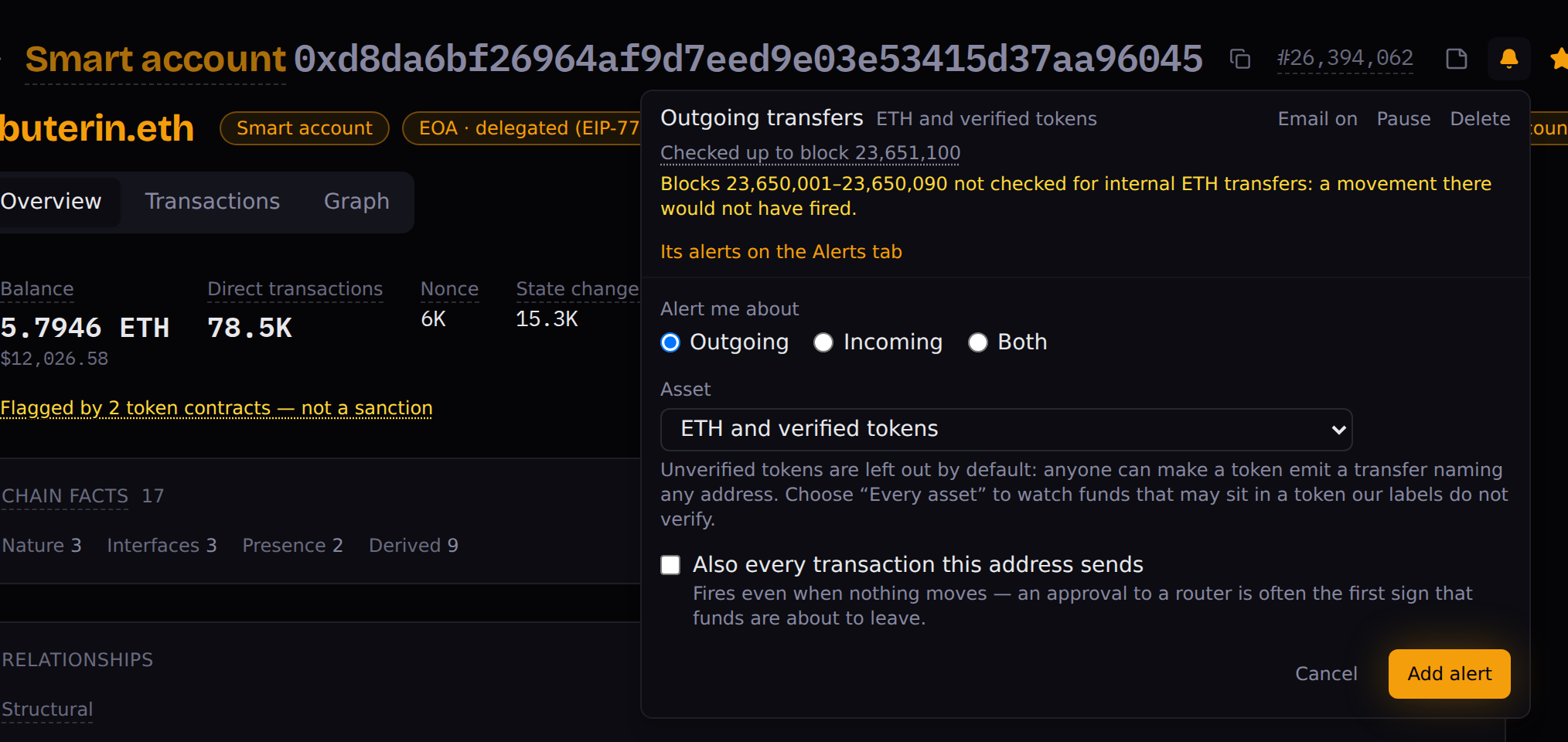
Only a saved address can carry alerts. Its **bell** sits in two places:
* in your [Favorites list](/favorites#your-favorites-list), on the address's row;
* in the header of the [address's page](/explorer/entity), beside the star. It appears once you press the star, and goes when you remove the address.
The bell tells you what watches the address:
* **Empty** — no rules yet. Hover: *Add an alert for this address*.
* **Filled** — at least one rule is active: *Watched by an alert rule*. With more than one rule, their number is beside it. Several rules can watch one address.
* **Grey** — every rule on the address is paused.
Press the bell. You see the address's first three rules, a link to the rest on the Alerts tab, and below them the form for a new rule. It starts with **Watch for**:
* **Transfers** — the default: assets moving in or out. Its fields are below.
* **Look-alike addresses** — addresses that share their first and last four characters with an address this one paid, the setup of address poisoning. **Alert me about**:
* **Look-alike transfers it did not send** — a transfer naming this address as its sender appeared in its history, though the address did not send it. There can be 5–10 for every payment the address makes;
* **Payments to look-alikes** — the address paid a look-alike of an address it paid before.
* **Code delegation (EIP-7702)** — **Alert me about** one or more of **Delegation set**, **Delegation removed**, **Delegated code run by another account** and **Value moved out by delegated code**.
* **Approvals** — the address allowed a spender to move its tokens. **Asset**: **Any token** or **One token**; tick **Unlimited approvals only** to skip the bounded ones.
* **Tokens moved out by others** — another account moved tokens out of the address with an allowance or a signature it had given. **Asset**: **Any token**, **One token** or **One NFT collection**; with one token, a **Minimum amount (optional)**.
Choose at least one event where the form asks for it. The fields of **Transfers**:
* **Alert me about** — **Outgoing** (the default), **Incoming** or **Both**.
* **Asset:**
* **ETH and verified tokens** — the default;
* **Every asset, verified or not**;
* **ETH only**;
* **One token**;
* **One NFT collection**.
The last two ask for the **Token or collection**: type a name, a symbol or a `0x…` address. Two letters or more of a name or symbol list the tokens it may mean — ERC-20 tokens for **One token**, ERC-721 and ERC-1155 collections for **One NFT collection**. Each row is drawn like the site's search: one warning mark before the name — a look-alike warning, or else the risk of its label — a name only where its label allows one (a name withheld for risk shows as the address), and a verified tick or an *unverified* mark. Picking a row fills in the address and writes it under the field in full — *Chosen: USDT · Tether USD · 0x…* — so a clone with the same name can be told apart. A pasted address works as well.
Unverified tokens are left out by default: anyone can make a token emit a transfer naming any address. Choose **Every asset** to watch funds that may sit in a token TraceFast labels do not verify.
* **Minimum amount (optional)** — in the asset's own units, for ETH or one token. Amounts of different assets do not compare, so a minimum needs one asset. If the token states no scale, enter raw units. A movement of zero never fires.
* **Also every transaction this address sends** — with outgoing movement only. It fires even when nothing moves: an approval to a router is often the first sign that funds are about to leave. A transaction that failed fires too, marked as failed.
Press **Add alert**. A rule is named by what it watches — **Outgoing transfers**, **Incoming transfers** or **Transfers in or out**, plus **and transactions sent** — followed by its conditions, such as *ETH and verified tokens* or *at least 1,000 USDT*. The other kinds are named the same way: *Look-alike transfers and payments to look-alikes*, *Code delegation set or removed (EIP-7702)*, *Unlimited approvals granted*, *Tokens moved out by another account* — with *Any token* or *Only USDT*.
If your plan has no alerts, you see *Your plan does not include alerts*, with a link to the plans that have them. When every rule your plan allows is in use, the bell says *Your plan has no room for another alert rule*.
## The Alerts tab
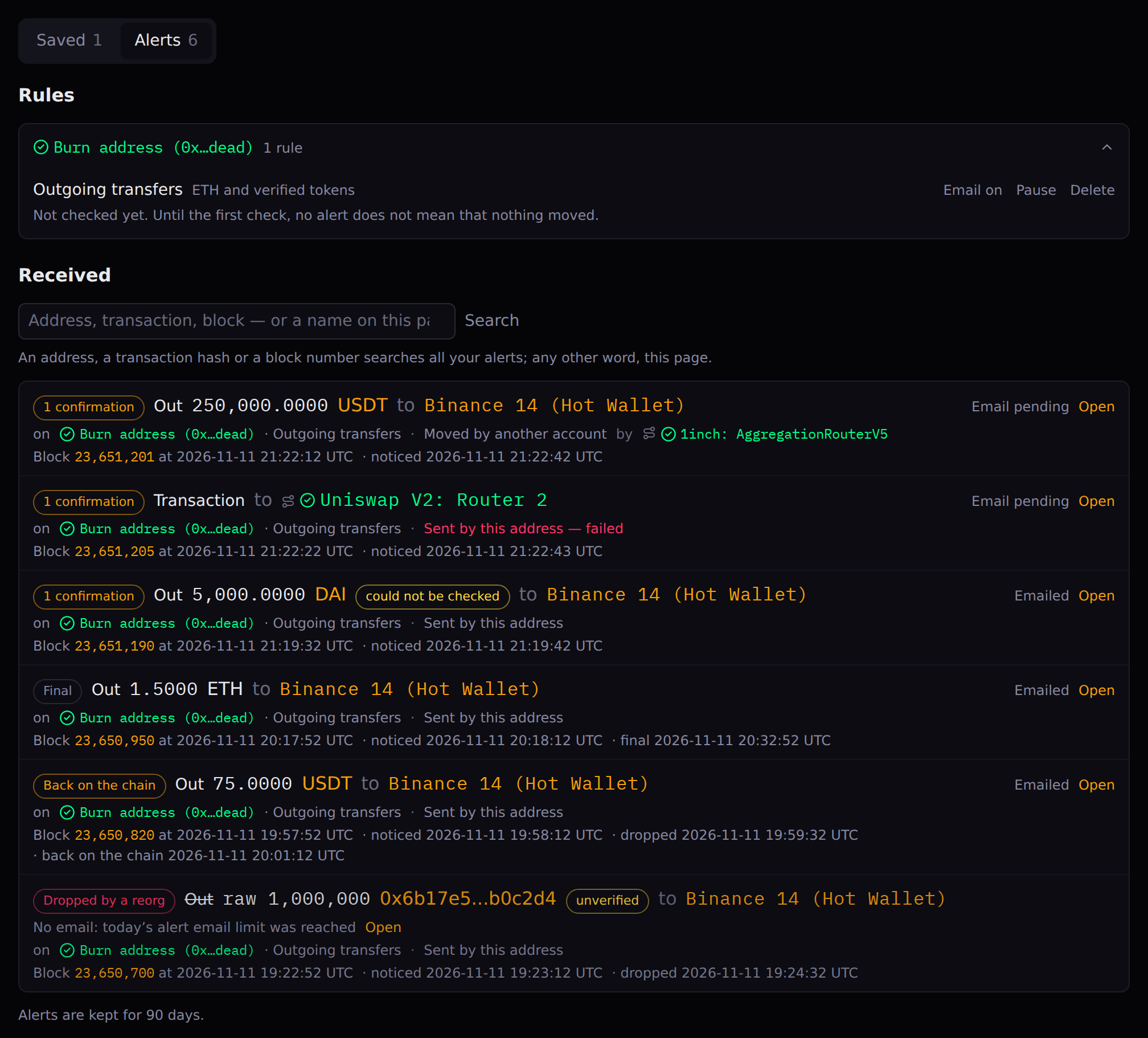
The Favorites page has two tabs at the top: **Saved**, your list, and **Alerts**, with the number of alerts on its first page.
### Rules
* Rules are grouped by address. An address with more than three rules is folded; **Collapse all** and **Expand all** work on every group.
* Each rule has three switches:
* **Email on** / **Email off** — whether this rule emails you; its alerts arrive here either way;
* **Pause** / **Resume** — nothing fires while a rule is paused, and nothing is sent later for that time;
* **Delete**.
* **Checked up to block *N*** says how far the rule has been checked. Hover it for each kind of movement — ETH transfers, internal ETH transfers, token transfers, NFT transfers, multi-token transfers, transactions sent, and for the other kinds look-alike transfers, payments to look-alikes, delegations set and removed, delegated code runs, outflows by delegated code, approvals, tokens moved out by others — and for the block the check started from, when the rule took effect.
* **A gap is named**, for example *Blocks 23,650,001–23,650,090 not checked for internal ETH transfers: a movement there would not have fired.*
* **Not checked yet** means the rule has had no check so far. Until the first check, no alert does not mean that nothing moved.
**If your plan changes:**
* When you have more rules than your new plan allows, every rule stays, and the newest are paused. To resume one, delete or pause another.
* On a plan without alerts, your rules are kept, paused: nothing fires, and nothing is sent later for that time.
### Received
Each alert takes three lines:
1. **What moved** — its phase, then the movement: **Out** or **In**, the amount and the asset, and the counterparty. A transaction the address sent reads **Transaction to** *address*, or *creating a contract*. On the right are the state of its email and **Open**, the page of that one alert — the page an alert email links to.
2. **Where and who** — the watched address, the rule, and who moved the asset:
* **Sent by this address** — the address signed the transaction itself;
* **Moved by another account** — the address did not sign. Another account moved the asset, for example a spender using an allowance or a permit, and it is named;
* **Sent by this address — failed** — the transaction was included in a block but failed: everything it tried to change was undone, and only its fee was paid.
3. **When** — the block and its time, when TraceFast noticed the movement, and when the block became final, was dropped or came back.
An alert of the other kinds says what happened in one sentence, with every address named — a look-alike and the address it copies **in full**, since they differ only in the middle. For example: *This address sent 2,000 USDT to 0x…, which shares its first and last four characters with 0x…, an address it paid before. … This can look like address poisoning — check that 0x… is the address you meant to pay.* An unlimited approval reads *an unlimited amount of*, and a delegation set in a transaction that reverted says *the delegation still took effect*.
Marks on the asset:
* **unverified** — TraceFast labels do not verify this token. Its name and symbol are what the contract says about itself.
* **could not be checked** — when the alert fired, whether the token is verified could not be checked. The alert was sent without waiting for the check, so you hear about the movement at once.
* **raw *N*** — the token states no scale for this amount, so it is shown in raw units.
**Finding an alert:**
* **Pages** hold 50 alerts each: **← Newer**, **Newest**, **Older →**.
* **One chip per saved address** appears when rules watch more than one address: **All addresses**, then each address. An address chip shows every alert of every rule on it, over the whole history. Under it, **All its rules** and one chip per rule of that address narrow it further. With a single address, the chips are per rule: **All rules**, then each rule.
* **The search box** reads what you type:
* **An address, a transaction hash or a block number** searches all your kept alerts, not just the page — press Enter or **Search**. An address finds the alerts where it is the counterparty, the account that moved the asset, the address a transaction was sent to, or the token's contract. A block number works with or without commas. The answer says *Every kept alert with this address, newest first.* (or *this transaction*, *this block*); **More results** pages on, and **Clear search** goes back to the list. *No kept alert is about …* covers the whole kept history.
* **Any other word**, such as a token symbol or a name, filters only the alerts on the open page as you type.
The hint under the box says the same: *An address, a transaction hash or a block number searches all your alerts; any other word, this page.* The search respects the address and rule you chose, and what you searched never goes into the page's address.
Alerts are kept for 90 days.
### Phases
| Phase | What it means |
|---|---|
| **1 confirmation** | Sent as soon as one block was built on top of the movement's block. A deeper reorg could still remove it; if one does, you get a correction. |
| **Final** | The block is final, about 13 minutes later: this movement can no longer be removed by a reorg. |
| **Dropped by a reorg** | A [chain reorganization](https://ethereum.org/developers/docs/consensus-mechanisms/pos/) removed the block this movement was in. It never happened on the chain that stands. |
| **Back on the chain** | A second chain reorganization restored the block with this movement. It happened after all, and the earlier correction no longer applies. |
## Alert emails
Every alert arrives on the Alerts tab. Email is on top of that, and you control it in two places:
* **For one rule** — its **Email on** / **Email off** switch on the Alerts tab.
* **For your whole account** — on the Settings → Alerts page, below.
### Settings → Alerts
Open **Settings** from your account menu and choose the **Alerts** tab, or go to [tracefast.xyz/settings/alerts](https://tracefast.xyz/settings/alerts). The footer of an alert email links here too.
**Alert emails are on / off.** **Turn emails off** and **Turn emails on** switch email for all your alerts at once. This switch outranks each rule's own: with it off, no rule emails you, whatever its own switch says, and the Alerts tab says so with a link back here. Alerts still arrive in Favorites either way.
**A daily cap.** The page states how many alert emails you can get in a day. Past that, alerts still arrive in Favorites, marked *No email: today's alert email limit was reached*.
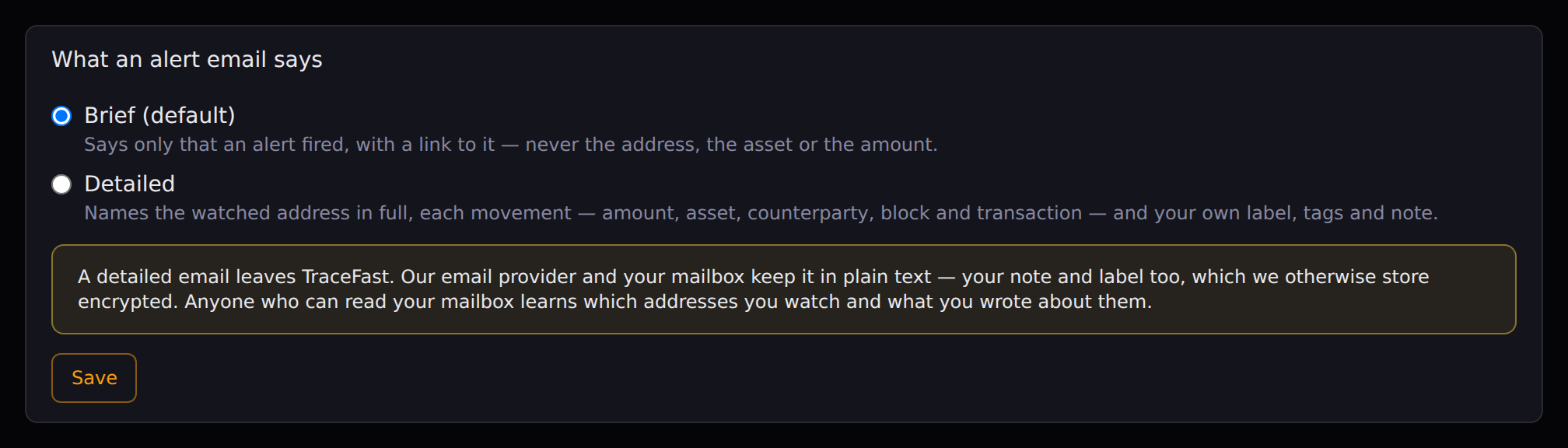
**What an alert email says** — choose one and press **Save**:
* **Brief** (the default) — says only that an alert fired, with a link to it. It never names the address, the asset or the amount.
* **Detailed** — names the watched address in full and each movement — amount, asset, counterparty, block and transaction — with your own label, tags and note. Amounts are in the token's own units, for example *Sent 250,000 USDT to 0x… (Binance 14).* When the token does not state its decimals, the email gives the raw amount and says so: *Sent USDT — raw amount N (its decimals are not known) — to …*
The choice does not touch the on / off switch: it only changes what an email carries.
Read the warning beside it before you choose **Detailed**: *A detailed email leaves TraceFast. Our email provider and your mailbox keep it in plain text — your note and label too, which we otherwise store encrypted. Anyone who can read your mailbox learns which addresses you watch and what you wrote about them.*
### Email states
The state of each alert's email shows on its row:
| State | What it means |
|---|---|
| **Email pending** | The email has not gone yet. |
| **Emailed** | It was sent. |
| **Emailed in a digest** | It went together with other alerts, in one email. |
| **Email not delivered** | Sending failed. |
| **No email for this alert** | No email will go for it — for example, emails are off, or the rule was paused. |
| **No email: today's alert email limit was reached** | Your daily number of alert emails was used up. The alert is here all the same. |
**Unsubscribe in one click.** The link at the foot of an alert email, or your mail client's own unsubscribe button, opens *Stop emails for this alert?*. **Turn off emails for this alert** turns email off for the one rule that the email came from. No more emails and no corrections are sent for it, and pressing the link again changes nothing. The rule keeps watching, and its alerts still arrive in Favorites.
## Removing a watched address
Rules belong to a saved address, so removing the address from Favorites deletes its rules too. TraceFast asks first: *Removing this from Favorites also deletes its alert rule. Undo brings it back.* — from the list and from the star in the address's header alike.
## Related pages
* [Favorites](/favorites) — saving addresses, and your labels, notes and tags
* [Entity Page](/explorer/entity) — the address page with the star and the bell
* [Account & Security](/account-security) — signing in and protecting your account
# Live Dashboard
[Open the live dashboard in TraceFast →](https://tracefast.xyz/)
The Live Dashboard is TraceFast's home screen — a real-time picture of Ethereum, refreshed with **every block, roughly every 12 seconds**.

## The six tabs
* **Overview** — the live view. [Block KPIs](/dashboard/block-kpis) on top, and below them a grid of widgets covering value flows, tokens, DEX trading, contracts, consensus, validators, and more.
* **[Signals](/dashboard/signals)** — control and delegation changes spotted within seconds of each block: proxy upgrades, ownership and role changes, Safe wallet changes, EIP-7702 delegations, look-alike addresses and emptied wallets; market events on the Trader view; and on-chain messages.
* **[Validators](/dashboard/validators)** — the consensus-layer validator set: entry and exit queues, daily stake flow, top block proposers, and missed slots.
* **[Network](/dashboard/network-stats)** — historical network statistics over 7, 30, or 90 days: block production, throughput, value transferred, fee burn.
* **[Gas & Blobs](/dashboard/gas-and-blobs)** — gas price percentiles, priority fees, transaction-type adoption, and EIP-4844 blob activity over time.
* **[Storage](/dashboard/storage-analytics)** — contract storage write activity: who writes the most state, and how.
Each tab has its own address in the app: [Signals](https://tracefast.xyz/signals), [Validators](https://tracefast.xyz/analytics/validators), [Network](https://tracefast.xyz/analytics/network), [Gas & Blobs](https://tracefast.xyz/analytics/gas) and [Storage](https://tracefast.xyz/analytics/storage).
## Live data and the aggregation window
Widgets on the Overview tab carry a window marker: **“3 epochs (~19 min)”**. An [epoch](https://ethereum.org/developers/docs/consensus-mechanisms/pos/#validators) is Ethereum's consensus unit of 32 slots of 12 seconds each — about 6.4 minutes. Overview widgets aggregate over a rolling window of the last three epochs, so they show *what the network is doing right now*, not all-time totals. Each new block updates the window.
## Overview widgets
| Widget | What it tracks |
|---|---|
| [ETH Flows](/dashboard/eth-flows) | Top net senders and receivers of ETH, with labels |
| [Top Tokens](/dashboard/top-tokens) | Most transferred tokens |
| [Block Mix](/dashboard/block-mix) | Each recent block: transactions by kind, stablecoins moved, serial gas share |
| [Transaction Types](/dashboard/transaction-types) | Legacy / EIP-1559 / EIP-4844 / EIP-7702 mix |
| [DEX Activity](/dashboard/dex-activity) | Most active trading pools |
| [Top Contracts by Gas](/dashboard/top-contracts) | Biggest gas consumers |
| [NFT Activity](/dashboard/nft-activity) | Collections by transfers and traders |
| [Storage Heatmap](/dashboard/storage-heatmap) | Contracts writing the most state |
| [Top Method Calls](/dashboard/method-calls) | Most called contract methods |
| [Top Block Builders](/dashboard/block-builders) | Who assembled the blocks of the window |
| [Consensus](/dashboard/consensus) | Missed slots, finality lag and reorgs over 24 hours |
| [Failed Transactions](/dashboard/failed-transactions) | Reverts and wasted gas |
| [Transaction Economics](/dashboard/transaction-economics) | Per-block fee breakdown |
| [Validator Withdrawals](/dashboard/validator-withdrawals) | Recent staking withdrawals and execution-layer requests |
| [Large ETH Balance Changes](/dashboard/eth-balance-changes) | Balances that moved by more than 100 ETH in one block |
| [Token Freezes](/dashboard/token-freezes) | USDT and USDC blacklist actions as they happen |
| [Block Execution](/dashboard/block-execution) | Dependent transactions, reverted gas and the most contended slot |
| [Top Fees](/dashboard/top-fees) | The biggest fee payers of the window, by contract and by transaction |
Every name, address, and pool inside a widget links into the [Explorer](/explorer/addresses-and-labels) — the dashboard is a starting point, not a dead end.
## Names are for signed-in users
Names, tags and risk flags on the dashboard are shown to signed-in users — a free account is enough. Without a session, the board shows the same activity **by address**, and a line under the title offers to sign in. The numbers are the same either way; only the labels are withheld.
# Signals
[Open Signals in TraceFast →](https://tracefast.xyz/signals)
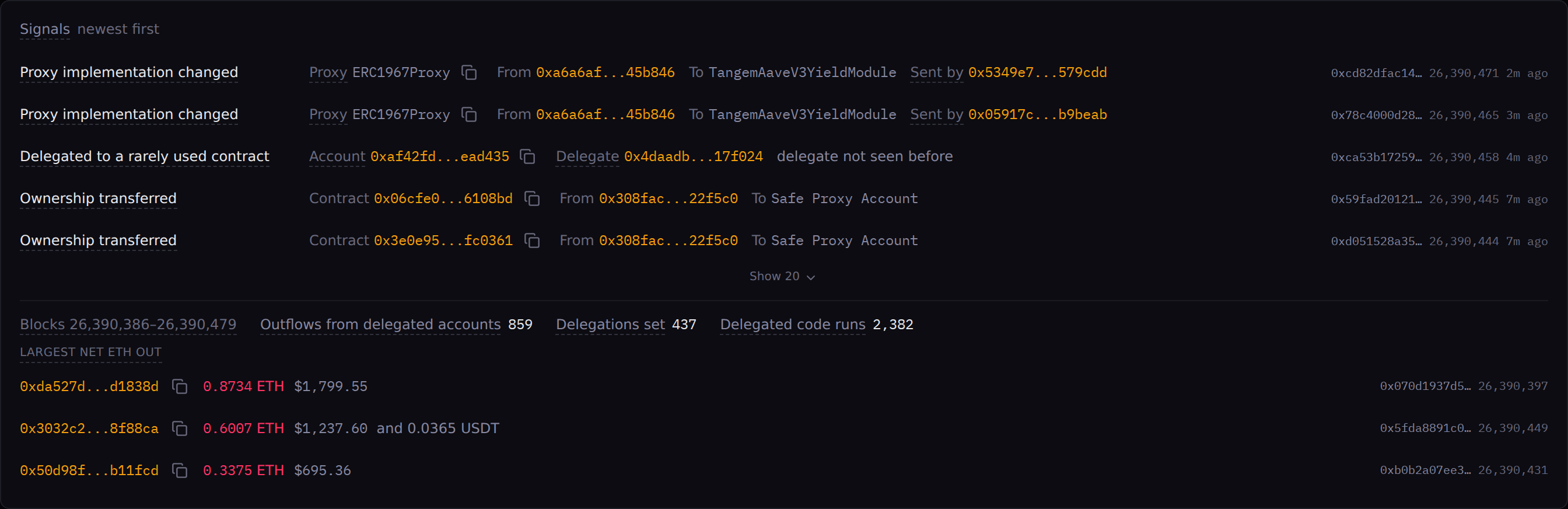
## What it shows
Changes to **who controls a contract or an account**, and unusual market events,
spotted within seconds of each block: a proxy now runs different code, a
contract has a new owner, a Safe wallet gained a module, an account delegated
its code under [EIP-7702](https://eips.ethereum.org/EIPS/eip-7702), a wallet
paid a look-alike of an address it paid before, a pool lost half its liquidity.
Each event is one card, **newest first**.
The tab has three views — hover a view's name for what it holds:
* **Security** — control and delegation changes on any contract or account,
value that left an address after such a change, look-alike addresses and
emptied wallets, and the window's [EIP-7702 counts](#counted-not-listed).
* **Trader** — market events around tokens and pools, and the control changes
of the Security list when they happen **on a token that trades**: a proxy
upgrade of a traded token is filed here, not under Security. This view is a
**trial**, and the app says so: what it shows may change or go.
* **Messages** — text that senders wrote into their transactions, shown as
quotes — see [Messages](#messages).
## Filtering
On **Security** and **Trader**, two filters sit above the cards:
* **Filter by kind** opens chips of every signal the view can show, grouped —
*Code delegations*, *Safe wallets*, *Owners, roles, pauses*, *Proxies*,
*Look-alike addresses*, *Emptied wallets*, *Liquidity*, *Launches* and more;
hover a group's name for what it covers. Choose one or several; **All**
clears the choice. New cards arriving live follow the same choice. When a
chosen kind's coverage is not known yet, the filter says so: an empty list
then does not mean none happened.
* **Filter by address** keeps the cards that name the address — as their
subject or anywhere on the card. A value that is not an address filters
nothing, and the app says so.
The page address carries both filters, so a filtered view can be shared.
**A signal is an observation, not a verdict.** A proxy upgrade, an ownership
transfer or a new Safe module is most often routine maintenance; the card says
what changed so you can judge who changed it. Follow the addresses to their
[entity pages](/explorer/entity) — the risk marks and labels there are what
TraceFast states about them.
**A signal can disappear.** Signals are read before a block is fully
processed; if the block is dropped from the chain in a reorg, its signals go
with it.
## Reading a card
A card has a title — what happened — then the address it is about, named by its
role (the **subject**), the other addresses involved with their roles, short
facts, and the transaction and block. Hover the title for what the change
means, and a role for what that address is.
| Role | Who it is |
|---|---|
| **Account** | the account that set or cleared an EIP-7702 delegation |
| **Delegate** | the contract whose code the account now runs |
| **Proxy** | the proxy contract: it forwards calls to the code it points to |
| **Safe** | the Safe multi-signature wallet the change is about |
| **Contract** | the contract whose owner, roles, pause state or initialization changed |
| **From**, **To** | the old and the new value — implementation, admin, beacon, singleton, guard, handler, owner, authority |
| **Owner** | the Safe owner added or removed; on an emptied wallet, the address whose own transactions moved the assets out |
| **Granted to**, **Revoked from** | the address that was given, or lost, a role |
| **Module** | a Safe module: it can move the Safe's funds without owner signatures |
| **Spender** | the address many owners allowed to move their tokens |
| **Executor** | the address that moved tokens out of the owners' accounts |
| **Recipient** | where those tokens went |
| **Caller** | the address that called a contract's initialize step |
| **Pool**, **Token** | the pool or the token a market event is about |
| **Address** | the address whose control changed, and that the value left |
| **Went to** | where the value went — the first recipient when there are several |
| **Payer**, **Paid**, **Resembles** | the address that paid; the look-alike it paid; the address it paid before, which the look-alike resembles |
| **Planted by**, **Planted with**, **Through** | who sent the transfer that put the look-alike into the payer's history, the token that transfer used, and the contract it went through |
| **Sender** | the address whose transactions planted look-alikes on many owners |
| **Into** | the address an emptied wallet's assets went to. It had never sent a transaction |
| **Paid with** | the token the buyers of a new token paid with |
| **By** | the address that made the change |
| **Sent by** | the address that sent the transaction — often not the same as **By** |
An address without a name is shown by its short form, with the whole address on
hover. A role granted or revoked whose name is not known is shown by a short id,
with the full id on hover.
Links go to the exact place the change shows: the transaction's **Events** tab
when the contract announced it with an event, its **State** tab when only
storage changed, its **Token Transfers** tab for tokens that moved, its
**Trace** tab for a refused sell. When one transaction raises the same signal
several times on the same address, the card shows it once with **×N**, and
expands to list each.
A proxy upgrade is easiest to judge against the proxy's own history — for example the implementations [USDC](https://tracefast.xyz/entity/0xa0b86991c6218b36c1d19d4a2e9eb0ce3606eb48) has stood on, in its Relationships.
## Every signal
### EIP-7702 delegations
| Signal | Subject | What it means | What the card adds |
|---|---|---|---|
| **Delegated to a rarely used contract** | Account | The account set its EIP-7702 delegation to a contract that few or no accounts have delegated to before. From now on the account runs that contract's code when called | the **Delegate**; *delegate not seen before*, or how many accounts delegated to it before; *delegate deployed in the same block*; *sent by another address* when someone else submitted the authorization |
| **Delegation removed** | Account | The account cleared its EIP-7702 delegation: it no longer runs another contract's code | the transaction and block |
A delegation to a widely used wallet contract is everyday activity, so it is
counted, not listed — see [Counted, not listed](#counted-not-listed).
### Proxies
| Signal | Subject | What it means | What the card adds |
|---|---|---|---|
| **Proxy implementation changed** | Proxy | The contract the proxy forwards its calls to was replaced: the proxy now runs different code | **From** and **To** — the old and the new implementation; **Sent by**; *set to the zero address*; *no upgrade event* when the change was made in storage without the usual event |
| **Proxy admin changed** | Proxy | The address allowed to upgrade this proxy was replaced | **From**, **To**, **Sent by** |
| **Proxy beacon changed** | Proxy | The beacon this proxy reads its code address from was replaced | **From**, **To**, **Sent by** |
### Safe wallets
| Signal | Subject | What it means | What the card adds |
|---|---|---|---|
| **Safe singleton changed** | Safe | The code this Safe runs (its singleton) was replaced. An official Safe version is a normal upgrade; any other code is not | **From**, **To**, **Sent by**; *official Safe 1.4.1* (with its version), or *not an official Safe singleton* |
| **Safe owner added** · **Safe owner removed** | Safe | An owner was added to, or removed from, the Safe | the **Owner**; *owners 3 → 4*; **Sent by** |
| **Safe threshold changed** | Safe | The number of owner signatures the Safe needs to act was changed | *threshold 2 → 3*, *owners 5 → 5*; **Sent by** |
| **Safe module enabled** · **Safe module disabled** | Safe | A module was enabled or disabled. A module can move the Safe's funds without owner signatures | the **Module**, **Sent by** |
| **Safe guard changed** | Safe | The guard — a contract that checks every transaction of the Safe — was changed | **From**, **To** — the old and the new guard; **Sent by** |
| **Safe fallback handler changed** | Safe | The fallback handler — the contract that answers calls the Safe does not know — was changed | **From**, **To** — the old and the new handler; **Sent by** |
| **Safe owners changed without an event** | Safe | The owners or the signature threshold changed in storage, and the Safe did not announce it with its usual event | *threshold 2 → 1*, *owners 3 → 1*; **Sent by** |
| **Safe guard changed without an event** · **Safe fallback handler changed without an event** | Safe | The guard or the fallback handler changed in storage, without the Safe's usual event | **From**, **To**; **Sent by** |
A change "without an event" is worth a second look: a Safe that works as
designed announces these changes.
### Ownership, roles and pauses
| Signal | Subject | What it means | What the card adds |
|---|---|---|---|
| **Ownership transferred** | Contract | The contract's owner changed. The owner can usually call its admin functions | **From**, **To** |
| **Ownership renounced** | Contract | The owner gave up ownership: no one can call the owner-only functions any more | **From** — the previous owner |
| **Owner changed without an event** | Contract | The owner changed in storage, and the contract did not announce it with its usual event | **From**, **To** |
| **Owner changed** · **Authority changed** | Contract | For contracts built on the DSAuth pattern: the owner changed, or the authority — the contract that decides who may call it — changed | **To** |
| **Role granted** · **Role revoked** | Contract | An address was given, or lost, a role. A role allows calls to the functions it guards | the role's name where known — *default admin* for the top role — or its short id; **Granted to** or **Revoked from**; **By** |
| **Contract paused** · **Contract unpaused** | Contract | Functions that check the pause stopped working, or work again | **By** — the account that paused or unpaused |
| **Pause state changed without an event** | Contract | The pause state changed in storage, and the contract did not announce it with its usual event | *now paused* or *now unpaused* |
| **Contract initialized late** | Contract | A contract that was not created in this block or the few before it was initialized only now. Whoever initializes a contract usually becomes its owner or admin, so this can be a planned setup — or someone taking over a contract left uninitialized | **Caller**, **Sent by**; *created N blocks earlier*; the initialized version; *proxy settings also changed in the block*, *owner also changed in the block* |
### Token approvals and pulls
| Signal | Subject | What it means | What the card adds |
|---|---|---|---|
| **Many owners approved one spender** | Spender | Many different owners approved the same spender to move their tokens within a short span of blocks. It can be a popular new app — or a campaign that asks for approvals | *N owners in M blocks*; how many approvals were unlimited; *token later moved out of N owners by someone else*; the tokens |
| **Tokens pulled from many owners** | Executor | One executor moved tokens out of many owners' accounts within a short span of blocks, using allowances or signatures they had given. If most owners had just received the token, this is usually an exchange or app sweeping deposits | the **Recipient**; *N owners in M blocks*; *N% of the owners had just received the token*; the tokens |
These two read together: many approvals to one spender, then that spender
pulling from many owners, is the shape of both an exchange's deposit sweep and
an approval-phishing drain. The share of owners who had just received the
token is what usually tells them apart.
### After a control change
| Signal | Subject | What it means | What the card adds |
|---|---|---|---|
| **Funds left after a control change** | Address | Value left this address within 7 days after one of the signals here said control over it changed — Safe owners or modules, a proxy implementation, ownership. Raised when it is the first outflow since, a large ETH outflow (at least half the balance), or a transfer to a fresh address. A fact, not a verdict | the control change it follows, linked to its block; *in the same block* or *N blocks later*; *first outflow since*; *at least half of its ETH*; *to a fresh address*; the ETH out of the balance before; how many tokens left; **Went to**, *N recipients in all*; **Sent by** |
### Look-alike addresses
A look-alike shares its first and last four characters with an address an
owner paid before. Wallets often show only those characters, so an owner who
copies an address from their history may pick the look-alike — the pattern of
address poisoning.
| Signal | Subject | What it means | What the card adds |
|---|---|---|---|
| **Payment to a look-alike of a recent payee** | Payer | This address paid a look-alike of an address it paid before, and a transfer naming that look-alike had appeared in its history shortly before. A different payee that happens to share those characters looks the same — a fact, not a verdict | **Paid** and **Resembles**, both in full; the amount paid; *same first and last four characters*; when the transfer naming the look-alike appeared and the block it paid the address it resembles; what the planted transfer showed, **Planted by**, **Planted with**, **Through** |
| **Sender planting look-alikes on many owners** | Sender | Transactions from this sender put transfers naming look-alikes into the histories of many different owners within a short span of blocks. A fact about these transfers, not a verdict about the sender | *look-alikes planted on N owners in M blocks*; how many look-alike addresses and transfers; *N look-alikes already paid by the owner it was planted on*; the top contracts it went **Through** and the **Tokens used**, with counts |
The planting token's own symbol is never printed — it is its author's text,
often a phishing line; its address is shown instead.
### Emptied wallets
| Signal | Subject | What it means | What the card adds |
|---|---|---|---|
| **Wallet emptied into an address that never sent a transaction** | Owner | The owner's own transactions moved all of two or more assets — ETH, tokens — to one address that had never sent a transaction, within a few blocks. A drained wallet looks like this, and so does an owner moving to a new wallet of their own — a fact, not a verdict | **Into**; the assets emptied with their amounts; *a new address* when it had never even received; *in one block* or *over N blocks*; how many transactions the owner had sent before; how many owners emptied into the same address, and from how many addresses it collected in 7 days |
### Market events — the Trader view (trial)
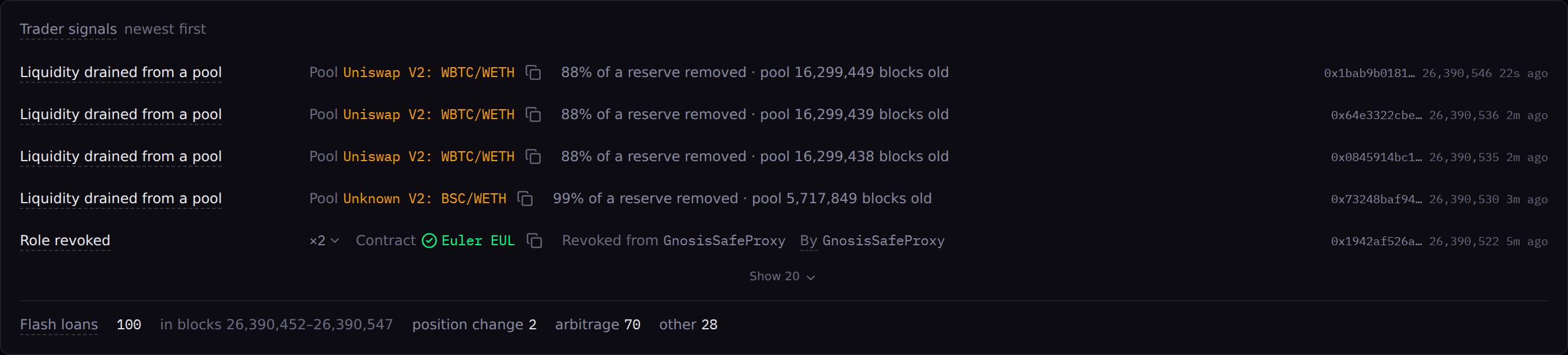
| Signal | Subject | What it means | What the card adds |
|---|---|---|---|
| **Liquidity removed from a pool** | Pool | One removal of liquidity took at least half of one of the pool's reserves. An ordinary provider leaving a small pool looks the same — it is a fact about the pool, not a verdict about who removed it | *N% of a reserve removed*; *by a deployer of one of its tokens*; *pool N blocks old*; *the same sender added liquidity to another pool in the same block*; *the same transaction added the liquidity it removed* |
| **Token refused a sell** | Token | The token's own transfer into its pool reverted: its code refused the sale, not the exchange. A fact about this transfer, not a verdict that the token cannot be sold | the **Pool**; *seller is the token's deployer*; the other sells of the token in the blocks before — how many went through and how many were refused. *None refused* is said only when every transaction of those blocks could be checked; *reverted with no reason* when the token's code gave no message — many ordinary refusals give none either |
| **Trading opened / limits lifted** | Token | A token that already has a market called one of the usual launch switches: trading was opened, or the per-transaction or per-wallet limits were removed. An ordinary step of a launch — a fact, not a verdict | *trading opened* or *limits removed*, with the function called; *called by the token's deployer*; **By**; whether the pool was created or liquidity added in the same transaction, or how many blocks earlier the first pool appeared; the swaps that followed in the same block |
| **Many buyers in the first trading block** | Token | In the block of a new pool's first trade, at least 5 different senders bought its token. A popular launch draws trading bots into its first block, and a launch bought through many wallets of one team looks the same — a fact, not a verdict | *N buyers in M transactions*; buyers who bought more than once; the share of the supply bought; how many blocks after the pool was created; buyers also first in other launches of the last day; the **Pool**, and **Paid with** or *paid in ETH* |
## Counted, not listed
Some events are too frequent to list one by one. They are counted over a window
of recent blocks named in the caption — **Blocks 26,390,301–26,390,395** — and
when not every block of the window has been processed yet, the caption says how
many have, once, for all counts.
On the **Security** view:
* **Outflows from delegated accounts** — transactions sent by someone other
than the account in which ETH or tokens left an account that runs delegated
code;
* **Delegations set** — accounts that set a code delegation;
* **Delegated code runs** — transactions in which an account ran the code it
delegates to.
**Largest net ETH out** lists the delegated accounts whose ETH balance fell the
most over one transaction sent by someone else — the balance before minus
after, fee included, with its USD value at the ETH price of that hour, and any
tokens that left the account beside it. A delegated account drained by a
transaction its owner did not send is the pattern this list exists to surface.
On the **Trader** view, **Flash loans** — transactions that borrowed from a
lending protocol and repaid in the same transaction — are counted over their own
block window (*Flash loans 100 in blocks 26,390,452–26,390,547*), not listed:
most are ordinary trading bots. The count is broken down by what their events
did: **liquidation**, **position change**, **arbitrage**, **other**, and **kind
not stated**. The kind describes the events; it does not vouch for the
transaction — an exploit can look like arbitrage or a liquidation.
## Messages
The **Messages** view lists text that senders wrote into their transactions —
the transaction's input read as text. Messages from or to an address named by
one of the recent signals come first, marked *Sent by a party of a signal*,
*Sent to a party of a signal* or *Linked to a signal*, with the signals they
link to. One sender writing to at least five recipients within about a day is
shown as one mass mailing with its latest text; a sender seen many times
carries **×N**.
Every message is marked **Third-party on-chain message**: TraceFast did not
write it and does not endorse it, and **links in it are not clickable** — do
not visit them. Characters that do not show themselves (direction overrides,
zero-width and similar) are removed from the quote, and the card says how
many; a message longer than 2 KB is cut. A link on each message opens the
transaction's trace, where the whole input is shown.
## Data & update cadence
New cards arrive with each block (~12 s). The tab keeps the newest cards of
each view; **Show N** opens the rest. When nothing was spotted over a whole day
of covered blocks, the Security view says *No signals in the last day of
blocks*; before a day is covered it says *No signals listed yet*. Names are shown to signed-in users
— a free account is enough; without a session the cards show the same signals
by address.
## Other signals in TraceFast
The Signals tab is about control changes and market events. Other pages raise
signals of their own:
* **Blocks** — [block signals](/explorer/blocks#signals) mark unusual blocks
against a recent baseline: failure spike, deployment burst, blob-heavy, full
block, high log density, risky recipient, large value, low activity.
* **LP Liquidity** — [outflow signals](/defi/lp-liquidity) for large
liquidity removals.
* **Token Freezes** and **Blacklisted** — [USDT and USDC
freezes](/dashboard/token-freezes) as they happen, and
[every token blacklist](/compliance).
## Related pages
* [Live Dashboard](/dashboard/overview) — the other tabs
* [Contracts on the entity page](/explorer/entity/contracts) — proxy implementations, owners and code of a contract
* [Smart accounts](/explorer/entity/accounts#smart-accounts) — EIP-7702 delegations on an account
* [Transactions](/explorer/transactions) — the Events, State and Trace tabs a card links to
# Block KPIs
[Open the live dashboard in TraceFast →](https://tracefast.xyz/)

## What it shows
The top row of the Overview tab condenses the newest [block](https://ethereum.org/developers/docs/blocks/) into four cards:
* **Latest Block** — the current block number, its timestamp, and a countdown ring to the next block (Ethereum produces a block every ~12 seconds).
* **Block Value** — the total native ETH moved by that block's transactions, with an approximate USD value. Token transfers carry no ETH value and are not counted, so a block full of stablecoin volume can read low here.
* **Block Transactions** — how many transactions the block contained and how many failed.
* **Accounts Changed** — how many accounts the block touched (balance, nonce or code changed), how many were newly created, and how many destroyed.
The last three cards each carry a sparkline of the recent blocks. The countdown ring appears once the first block has arrived over the live stream.
## How to read it
These cards are the network's heartbeat. A steady countdown and a transaction count in the low hundreds is normal traffic. Spikes in block value often mean large exchange settlements or whale moves — check [ETH Flows](/dashboard/eth-flows) to see who. A jump in *created* accounts can accompany airdrops or spam campaigns.
For blocks that have already scrolled past, the [block list](https://tracefast.xyz/blocks) carries the same numbers row by row.
## Data & update cadence
Values describe the **single latest block** and refresh with every new block (~12 s). Unlike the widgets below them, there is no aggregation window.
## Related pages
* [Transaction Economics](/dashboard/transaction-economics) — the fee side of the same block
* [Network Stats](/dashboard/network-stats) — the same metrics aggregated over days
* [Transactions](/explorer/transactions) — inspect any block in the Explorer
# ETH Flows
[Open the live dashboard in TraceFast →](https://tracefast.xyz/)
## What it shows
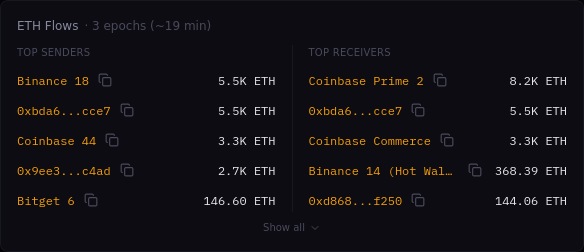
The biggest movers of ETH right now: two ranked lists — **Top net senders** and **Top net receivers** — by each address's **net** ETH flow over the live window: the ETH it received minus the ETH it sent.
The flow counts ETH moved by contracts inside transactions — internal transfers — as well as the value a transaction itself carries. Failed transactions are not counted. An address that only passes ETH through — receives it and sends it on within the window — nets out and is not listed, so a router or a forwarding contract no longer crowds out the real sources and destinations.
Hover an entry to see the two sides behind its net figure: what it received and what it sent.
## How to read it
Most entries are labeled: *Lido stETH*, *OKX*, *Beacon Deposit Contract*. That turns a list of hex strings into a story — exchange outflows, staking deposits, bridge activity, whale rotations. An unlabeled address with a net outflow of thousands of ETH is exactly the kind of thing worth clicking: every row links to that address's [entity page](/explorer/entity).
Labels are shown to signed-in users; without a session the lists show the same senders and receivers by address.
To follow an address's ETH beyond the live window, open its Graph — for example the [Ledger graph of vitalik.eth](https://tracefast.xyz/entity/0xd8da6bf26964af9d7eed9e03e53415d37aa96045?tab=graph\&gTab=ledger).
## Data & update cadence
The title names the window as a block range — **blocks 26,390,298–26,390,393**, the last three epochs (~19 minutes) — and the lists are refreshed with every block (~12 s). **Show all** expands beyond the top five.
Internal transfers come from transaction traces, which arrive shortly after a block. When some blocks of the window have no trace data yet, the totals cover only the blocks that do, and the block range under the title says so on hover — for example, *These totals cover 94 of the window's 96 blocks*. When no block of the window has trace data yet, the widget says so instead of showing a partial ranking.
## Related pages
* [Addresses & Labels](/explorer/addresses-and-labels) — what you'll find after the click
* [Labels & Entities](/concepts/labels-and-entities) — where names like *OKX* come from
* [Large ETH Balance Changes](/dashboard/eth-balance-changes) — single balances that moved by more than 100 ETH in one block
* [Stablecoin and token movement: Top Tokens](/dashboard/top-tokens)
# Top Tokens
[Open the live dashboard in TraceFast →](https://tracefast.xyz/)
## What it shows
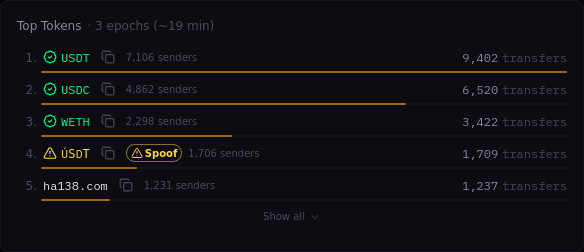
The most actively transferred **verified** tokens during the live window, ranked by transfer count, with the number of distinct senders alongside.
## How to read it
Stablecoins ([USDT, USDC](https://ethereum.org/stablecoins/)) and WETH normally dominate — that's the network's baseline. The interesting signal is what appears *next to* them: a verified token you've never heard of climbing the list usually means an airdrop or a mint that is actually moving.
\:::info Only verified tokens are ranked
The board sorts by transfer count — the cheapest metric to inflate — so an
address-poisoning campaign would otherwise sit at the top by construction. A
token appears here only when the labelling layer has verified it, the same
verdict that draws the green check elsewhere in the app. A token without a
verdict is not "probably fine", it is simply unconfirmed.
The price is deliberate: a genuine but unverified token is missing too, and in
the first seconds of a session the board can be briefly empty until token verification loads. An
empty board beats a clone in first place. Lookalikes and their warnings are
read on the token's own [entity page](/explorer/entity) and in
[Labels & Entities](/concepts/labels-and-entities).
\:::
Verification, like names, is shown to signed-in users. Without a session the
widget ranks **every** ERC-20 token by transfer count, by address, and its
tooltip says so: with no verdict to check, an unfamiliar address at the top
is noise until you can see whether it is verified.
For tokens ranked over the long run rather than the live window, see the [token leaderboard](https://tracefast.xyz/tokens).
## Data & update cadence
Rolling window of 3 epochs (~19 minutes), refreshed every block (~12 s).
## Related pages
* [Transaction Types](/dashboard/transaction-types) — transfers in the context of overall activity
* [NFT Activity](/dashboard/nft-activity) — the NFT counterpart
* [DEX Activity](/dashboard/dex-activity) — where these tokens trade
# Block mix
[Open the live dashboard in TraceFast →](https://tracefast.xyz/)

## What it shows
One row per recent block, **newest first**. Each row is a portrait of the block:
* **Its transactions by kind** — a bar split into ETH transfers, token transfers, multi-transfers, swaps, approvals, other contract calls, deployments and failed transactions, with the block's transaction count beside it. Each transaction is counted in one kind only; a failed one is counted as **Failed** and in no other kind. The legend above the rows names only the kinds the visible blocks hold.
* **The stablecoins it moved** — USDT, USDC and DAI volume in the block.
* **serial N%** — the share of the block's gas spent on its longest chain of transactions where each read what the one before wrote.
* **N auth** — the [EIP-7702](https://eips.ethereum.org/EIPS/eip-7702) authorizations the block carried: accounts that set or cleared the code they run.
## How to read it
**The bars compare by eye.** All rows are drawn to the same length, so a block heavy in swaps or in failures stands out against its neighbours.
**Stablecoin volume is gross.** It counts every transfer of the token in the block — mints, burns and the hops inside a swap included. It is not a net flow between addresses; for that, see [ETH Flows](/dashboard/eth-flows).
**A high serial share means the block could not have run in parallel**: most of its gas depended on the transaction before. The [Block Execution](/dashboard/block-execution) widget shows which slot the block contended on.
A row marked **partial** is a block whose transactions were not all sorted into a kind when it was summarised; its mix is not drawn rather than drawn wrong.
To see a block's transactions themselves, open it from the [block list](https://tracefast.xyz/blocks).
## Data & update cadence
A new row arrives with each block (~12 s); five are visible, **Show 20** opens more. Each block number opens the [block page](/explorer/blocks).
## Related pages
* [Live Dashboard](/dashboard/overview)
* [Transaction Types](/dashboard/transaction-types) — the type mix over the whole window
* [Block Execution](/dashboard/block-execution) — dependent transactions and contended storage
* [Blocks](/explorer/blocks) — one block in full
# Transaction Types
[Open the live dashboard in TraceFast →](https://tracefast.xyz/)
## What it shows
Two things at once:
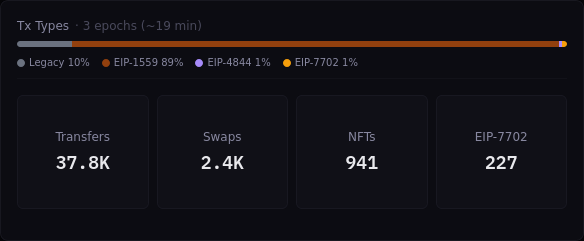
* **The type mix** — a stacked bar splitting recent [transactions](https://ethereum.org/developers/docs/transactions/) by format: Legacy, EIP-1559 (the fee-market standard since 2021), EIP-4844 (blob-carrying transactions used by rollups), and EIP-7702 (account-abstraction upgrades for EOAs).
* **Activity counters** — how many token **Transfers**, DEX **Swaps**, **NFT** movements, and **EIP-7702** operations happened in the window.
## How to read it
EIP-1559 near 90% is the modern baseline. A visible EIP-4844 share tracks rollup batch-posting; growth in EIP-7702 signals smart-account adoption. The counters give you the tempo of the network's *economic* activity, independent of raw transaction count.
Per block, the mix by what transactions did — transfers, swaps, approvals, deployments — is in [Block mix](/dashboard/block-mix). How the mix has shifted over days and months is on the [Gas & Blobs tab](https://tracefast.xyz/analytics/gas).
## Data & update cadence
Rolling window of 3 epochs (~19 minutes), refreshed every block (~12 s).
## Related pages
* [Gas & Blobs](/dashboard/gas-and-blobs) — type adoption over weeks, plus blob market trends
* [Transaction Economics](/dashboard/transaction-economics) — what these types pay in fees
# DEX Activity
[Open the live dashboard in TraceFast →](https://tracefast.xyz/)
## What it shows
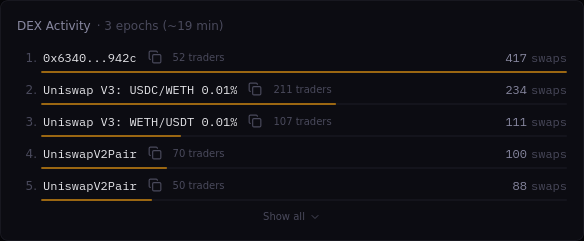
The busiest DEX pools right now, ranked by swap count, with the number of distinct traders per pool.
## How to read it
Labeled pools like *Uniswap V3: USDC/WETH 0.01%* are the market's main arteries — they're always near the top. An unlabeled pool address suddenly leading the list is worth a click: new token launches, incentive programs, and MEV activity all show up here first. Swaps vs. traders is a quick concentration check — many swaps from few traders often means bots.
Every pool in the ranking has its own page; the whole registry is under [DEX pools](https://tracefast.xyz/defi/dex/pools) (sign-in required, a free account is enough).
## Data & update cadence
Rolling window of 3 epochs (~19 minutes), refreshed every block (~12 s).
## Related pages
* [DEX & Tokens](/defi/dex-and-tokens) — the full DEX analytics section
* [Pools & Liquidity](/defi/pools-and-liquidity) — pool-level detail
* [Flash Loans](/defi/flash-loans) — the exotic end of DeFi activity
# Top Contracts by Gas
[Open the live dashboard in TraceFast →](https://tracefast.xyz/)
## What it shows
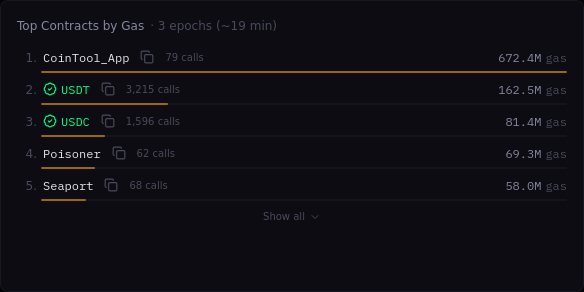
Contracts ranked by total [gas](https://ethereum.org/developers/docs/gas/) consumed during the live window, with each contract's call count.
## How to read it
Gas consumed is the truest measure of "who is using the network" — it weighs both how often a contract is called and how heavy each call is. Token contracts (USDT, USDC) are permanent residents. The anomalies are the story: a batch-distribution tool like *CoinTool\_App* burning 700M gas, or an unlabeled contract suddenly outconsuming Uniswap. High gas with *few* calls means expensive operations — check what that contract is doing.
The full inventory of deployed contracts is the [contract explorer](https://tracefast.xyz/contracts).
## Data & update cadence
Rolling window of 3 epochs (~19 minutes), refreshed every block (~12 s).
## Related pages
* [Top Method Calls](/dashboard/method-calls) — the same activity sliced by method
* [Storage Heatmap](/dashboard/storage-heatmap) — gas's cousin: state writes
* [Smart Contracts](/explorer/smart-contracts) — inspect any contract from here
# NFT Activity
[Open the live dashboard in TraceFast →](https://tracefast.xyz/)
## What it shows
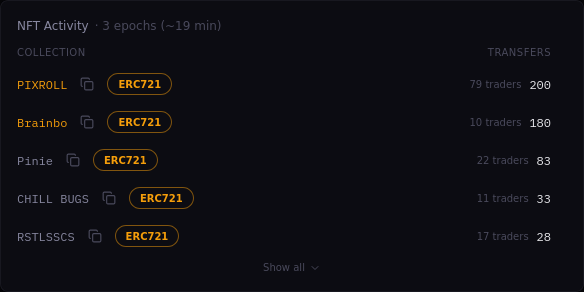
NFT collections ([ERC-721](https://ethereum.org/developers/docs/standards/tokens/erc-721/) and [ERC-1155](https://ethereum.org/developers/docs/standards/tokens/erc-1155/), marked on each row) ranked by transfer count during the live window, with the number of unique traders per collection.
## How to read it
Transfers alone can be manufactured; the **traders** column is the reality check. Two hundred transfers among 79 traders looks like a genuine mint or trading wave. Two hundred transfers among 3 traders is wash trading or a migration script. New collections entering the list are the earliest visible signal of a mint going live.
In a quiet market the list is dominated by a handful of established collections trading in the dozens; during a hyped mint a single new name can outpace everything else combined. Click a collection to open its contract in the Explorer and check its age, deployer, and holders before drawing conclusions.
A collection opens on its entity page — for example [ENS names](https://tracefast.xyz/entity/0x57f1887a8bf19b14fc0df6fd9b2acc9af147ea85).
## Data & update cadence
Rolling window of 3 epochs (~19 minutes), refreshed every block (~12 s).
## Related pages
* [Top Tokens](/dashboard/top-tokens) — the fungible-token counterpart
* [Addresses & Labels](/explorer/addresses-and-labels) — inspect a collection contract
# Storage Heatmap
[Open the live dashboard in TraceFast →](https://tracefast.xyz/)
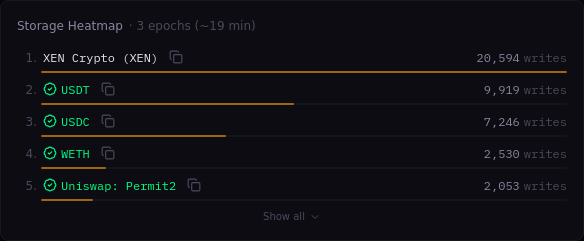
## What it shows
Contracts ranked by the number of **storage writes** — changes to persistent contract state — during the live window.
## How to read it
Storage writes are the most expensive thing a contract does, and the most permanent: they're what actually grows Ethereum's state. Token balances updating puts USDT/USDC here perpetually. The outliers matter — *XEN Crypto* leading with 20k+ writes is a protocol whose design hammers state; a new contract appearing high on this list is either very popular or very wasteful. Compare with [Top Contracts by Gas](/dashboard/top-contracts): heavy gas with light storage means compute; heavy storage means state growth.
Open a contract's Storage tab — for example [Tether USD](https://tracefast.xyz/entity/0xdac17f958d2ee523a2206206994597c13d831ec7?tab=storage) — for its writes slot by slot; the daily view across the network is the [Storage tab](https://tracefast.xyz/analytics/storage) of the dashboard.
## Data & update cadence
Rolling window of 3 epochs (~19 minutes), refreshed every block (~12 s).
## Related pages
* [Storage Analytics](/dashboard/storage-analytics) — the long-run view: write composition, call depth, cleanup leaders
* [Smart Contracts](/explorer/smart-contracts) — dig into any writer
# Top Method Calls
[Open the live dashboard in TraceFast →](https://tracefast.xyz/)
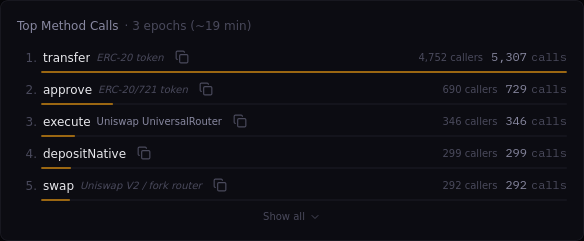
## What it shows
The most frequently called contract methods during the live window — `transfer`, `approve`, `execute`, and whatever else the network is busy doing — with caller and call counts. Where the method belongs to a known interface, TraceFast annotates it (*ERC-20 token*, *Uniswap UniversalRouter*).
## How to read it
This is the network's activity described in verbs. `transfer` and `approve` leading is the ERC-20 baseline. `execute` (routers) tracks DEX flow; `depositNative` spikes with bridge activity. A raw selector (like `0xa9059cbb`) without annotation high in the list points at something new or unusual — click through and look.
For how often each function of one contract has been called directly, over its whole life, open its Code tab — for example [USDC](https://tracefast.xyz/entity/0xa0b86991c6218b36c1d19d4a2e9eb0ce3606eb48?tab=code).
## Data & update cadence
Rolling window of 3 epochs (~19 minutes), refreshed every block (~12 s).
## Related pages
* [Top Contracts by Gas](/dashboard/top-contracts) — the same story sliced by contract
* [Smart Contracts](/explorer/smart-contracts) — what a contract is, and the page it opens into
# Top Block Builders
[Open the live dashboard in TraceFast →](https://tracefast.xyz/)
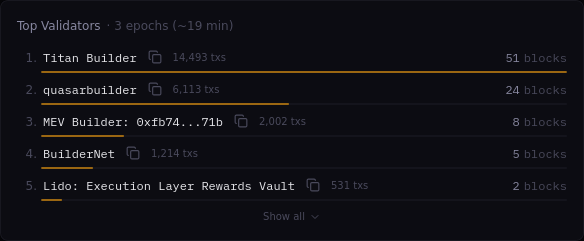
## What it shows
The addresses that assembled the blocks of the live window — ranked by blocks
produced, with the transaction count each packed into them. **Show all** opens
the full ranking.
## How to read it
Modern Ethereum blocks are mostly assembled by specialized **builders**
(*Titan Builder*, *BuilderNet*, *quasarbuilder*), so this list reads as a
builder-market share monitor rather than a validator ranking: the validator
proposes, the builder builds. Entries like *Lido: Execution Layer Rewards
Vault* appear where the fee recipient is a staking pool's vault.
As a rough baseline, the leading builder typically lands somewhere between a
third and half of the window's blocks; one name taking nearly all of them — or
an unlabeled newcomer suddenly ranking — is what deserves a second look. The
transaction counts alongside are a quick proxy for how full each builder packs
its blocks.
For the consensus-layer side of the same question — who *proposed* the blocks,
by validator or by payout address — see [Validators](/dashboard/validators).
Every block, with its fee recipient named, is also on the [block list](https://tracefast.xyz/blocks), where a builder's blocks can be read one by one.
## Data & update cadence
Rolling window of 3 epochs (~19 minutes), refreshed every block (~12 s).
## Related pages
* [Validators](/dashboard/validators) — proposers, queues and consensus-layer flow
* [Consensus](/dashboard/consensus) — the widget beside it: missed slots, finality and reorgs
* [Validator Withdrawals](/dashboard/validator-withdrawals) — the payout side of staking
* [Block KPIs](/dashboard/block-kpis) — the blocks these builders assemble
# Consensus
[Open the live dashboard in TraceFast →](https://tracefast.xyz/)
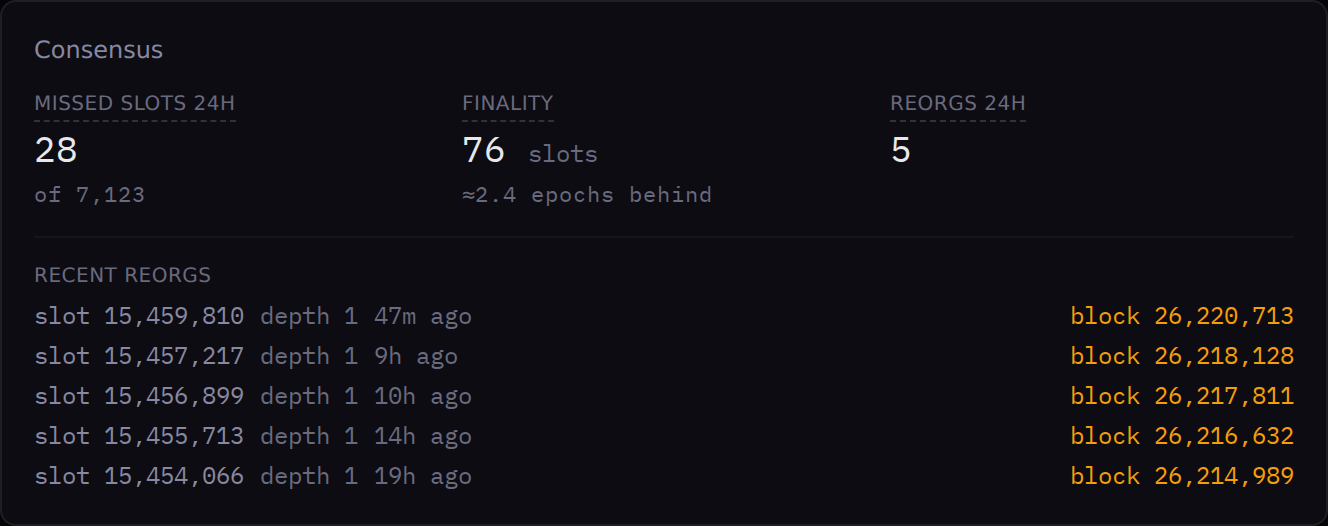
## What it shows
The health of Ethereum's [consensus layer](https://ethereum.org/developers/docs/consensus-mechanisms/pos/) in three numbers, next to [Top Block Builders](/dashboard/block-builders):
* **Missed slots 24h** — slots of the last 24 hours in which no block was proposed, out of all slots of that period. A slot is counted once it is final, so the count trails the head a little. The number links to the full list on [Validators](/dashboard/validators#missed-slots).
* **Finality** — how many slots lie between the chain head and the last finalized checkpoint, and the same distance in epochs.
* **Reorgs 24h** — reorganizations of the chain head seen in the last 24 hours.
Below them, **Recent reorgs** lists the latest five with their slot, depth and age. Each one links to its execution block once the slot is final; before that the row says *block not final yet*.
## How to read it
* **Missed slots are normal in small numbers.** A few dozen of roughly 7,200 daily slots go empty on an ordinary day — a validator was offline or late. A sharp rise across many validators points at a client bug or a network problem rather than at one operator.
* **Finality of about two epochs is the healthy state.** Ethereum finalizes a checkpoint roughly every two epochs (~13 minutes). A finality lag that keeps growing means the network is not reaching the vote it needs, and it deserves attention.
* **A reorg of depth 1 is routine.** The head block was replaced by a competing one, usually because it arrived late. Deeper reorgs are rare.
* **Honest gaps.** When no new head has been observed for a while, the widget says so above the numbers. When the reorg listener was down for part of the day, the count reads `≥ N`, because a reorg in that gap would not have been counted.
Each missed slot, with the validator that was due to propose, is listed on the [Validators tab](https://tracefast.xyz/analytics/validators).
## Data & update cadence
Covers the last 24 hours and refreshes about once a minute, and immediately when a reorg is observed. If a refresh fails, the widget keeps the previous reading for one more minute and says so.
## Related pages
* [Validators](/dashboard/validators) — missed slots per epoch, the assigned validators and their pages
* [Top Block Builders](/dashboard/block-builders) — who built the blocks that were proposed
* [Block KPIs](/dashboard/block-kpis) — the latest block on the execution side
# Failed Transactions
[Open the live dashboard in TraceFast →](https://tracefast.xyz/)
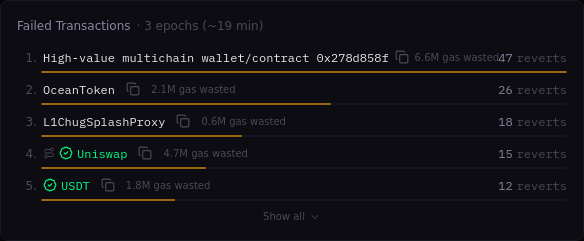
## What it shows
Contracts attracting the most **reverted** transactions during the live window, with revert counts and the gas those failures wasted.
## How to read it
Failed transactions still pay for the gas they consumed — failure has a price, and this widget shows who's paying it. A DEX router with steady reverts is normal (failed arbitrage, slippage protection firing). A single contract suddenly collecting dozens of reverts and millions in wasted gas usually means a misconfigured bot, a broken deployment, or users fighting over a popular mint. Labels and entity names make the culprit recognizable at a glance.
Blocks with far more reverts than usual are marked *Failure spike* on the [block list](https://tracefast.xyz/blocks).
## Data & update cadence
Rolling window of 3 epochs (~19 minutes), refreshed every block (~12 s).
## Related pages
* [Transaction Economics](/dashboard/transaction-economics) — failed fees in the per-block breakdown
* [Transactions](/explorer/transactions) — inspect an individual failure, including its trace
# Transaction Economics
[Open the live dashboard in TraceFast →](https://tracefast.xyz/)
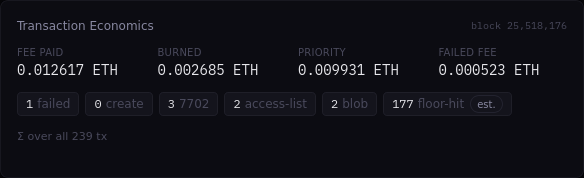
## What it shows
The economics of the **latest block**, summed over all its transactions:
* **Fee paid** — total ETH spent on fees
* **Burned** — the base-fee portion destroyed under [EIP-1559](https://ethereum.org/developers/docs/gas/#base-fee)
* **Priority** — tips paid to the block producer
* **Failed fee** — ETH spent by transactions that reverted
The badge row counts special transactions in the block: `failed`, `create` (contract deployments), `7702`, `access-list`, `blob`, and `floor-hit` — transactions priced by the calldata floor rule.
## The per-tx tape
Click **Transaction Economics — per-tx tape** below the widget grid to unfold a live tape of the latest transactions, newest first: hash, block, time, sender and recipient (labeled for signed-in users), method, fee, and flags — with one-click filters for `Failed`, `Create`, `7702`, `Blob`, and `Floor`. The tape reaches back about an hour, 25 transactions a page; when a new block arrives while you are paged back, a **New block · jump to latest** button takes you to the top.
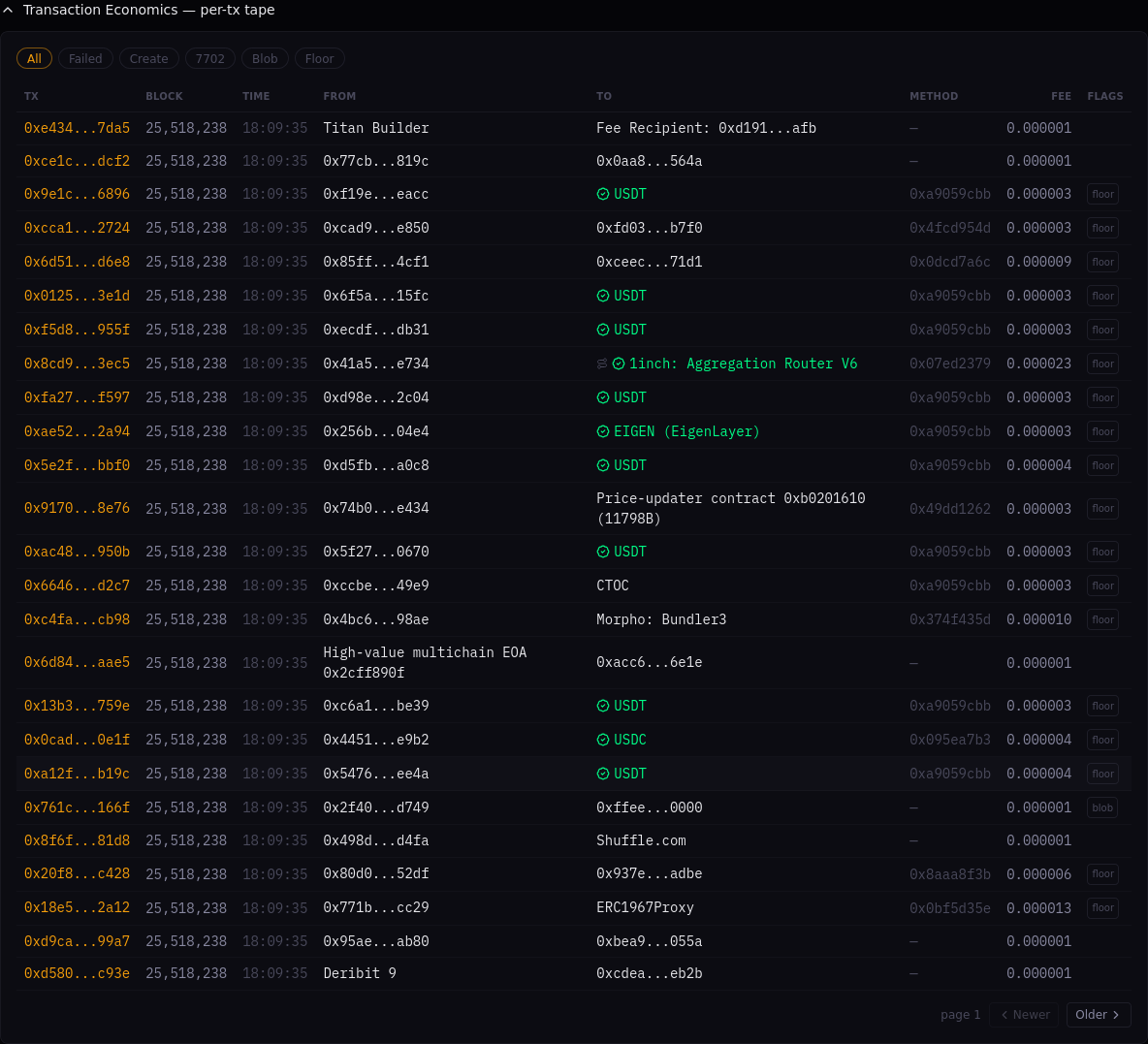
This is the fastest way to answer "what exactly is going through the chain right now?" — and it's easy to miss if you never scroll past the widget grid.
## The transaction drawer
Click any transaction hash — in the tape or in the [Top Fees](/dashboard/top-fees) — and a drawer slides out without leaving the dashboard. Its **Economics** tab decomposes the transaction's cost with `fact` / `est.` badges marking what is measured versus estimated:
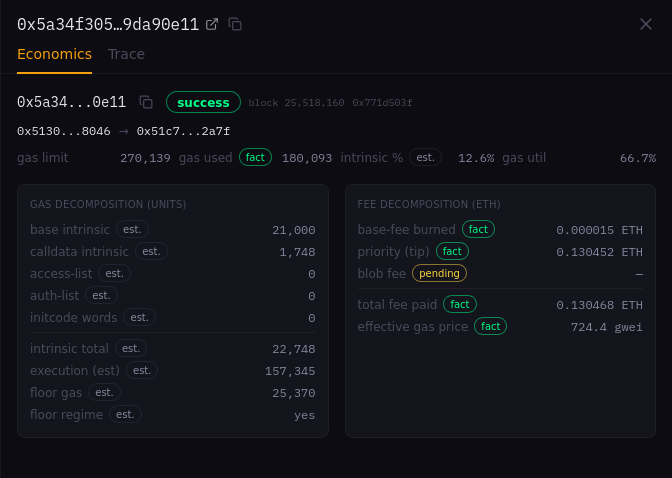
* **Gas decomposition** — base intrinsic cost, calldata, access list, authorization list, and initcode words; estimated execution gas; the calldata **floor gas** and whether the floor regime priced this transaction.
* **Fee decomposition** — base fee burned, priority tip, blob fee, total paid, and the effective gas price.
The **Trace** tab shows the transaction's internal call tree — every `CALL`, `DELEGATECALL`, and `STATICCALL`, with labeled counterparties:
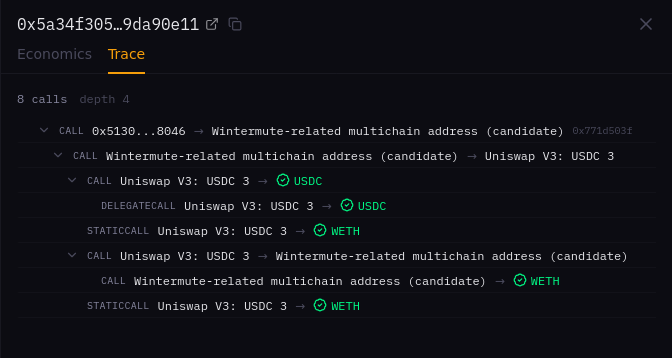
From the drawer, the ↗ icon opens the full transaction page, where [Token Transfers complete the picture](/explorer/transactions) the trace started. The drawer state lives in the URL (`?tx=0x…`), so you can share exactly what you're looking at.
Every transaction also has its own page, reachable from the [transaction list](https://tracefast.xyz/tx).
## Data & update cadence
The widget describes the single latest block and refreshes every block (~12 s). The tape covers about the last hour of transactions and pages through it.
## Related pages
* [Top Fees](/dashboard/top-fees) — the biggest fee payers of the window
* [Failed Transactions](/dashboard/failed-transactions) — where the `failed fee` goes
* [Transactions](/explorer/transactions) — the full transaction page
# Validator Withdrawals
[Open the live dashboard in TraceFast →](https://tracefast.xyz/)
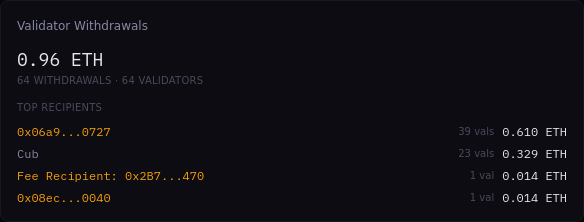
## What it shows
The ETH withdrawn by [validators](https://ethereum.org/staking/) in the most recent blocks — the block range is in the widget title: the total amount, the number of withdrawals and validators, and the top recipient addresses with the validator counts behind them. **Show top N** expands the recipient list to up to 20.
Under the recipients, **Execution-layer requests** counts what validators asked for from the execution layer under [EIP-7685](https://eips.ethereum.org/EIPS/eip-7685): **deposits**, **withdrawal requests** and **consolidations** of one validator into another. The line below gives the blocks the count covers — the latest 500 requests, which spans several hours of blocks. When the requests cannot be read, the line is left out rather than shown as zero.
## How to read it
Since the Shanghai upgrade, staking rewards flow out of the consensus layer continuously — a steady drip of small withdrawals each block is normal. The recipient list tells you *who* is collecting: a labeled staking-pool vault aggregating dozens of validators, or a solo staker's address collecting for one. Unusually large sums mean full exits rather than reward skimming.
Scale matters here: a typical block carries several dozen withdrawals summing to roughly one ETH, so a window showing hundreds of ETH withdrawn is a batch of full exits — worth clicking the recipient to see whose validators are leaving. Consistent recipients block after block are simply large operators on their rotation schedule.
The request counts show the other direction of the same machinery. Withdrawal requests are exits or partial withdrawals started from the execution layer — by the validator's withdrawal address rather than its signing key — and consolidations merge validators into larger ones, which shrinks the validator count without any ETH leaving.
A recipient's every credit is on its Withdrawals tab — for example the [Lido Withdrawal Vault](https://tracefast.xyz/entity/0xb9d7934878b5fb9610b3fe8a5e441e8fad7e293f?tab=withdrawals).
## Data & update cadence
A snapshot of the latest few blocks, refreshed every block (~12 s). The request counts cover the latest 500 execution-layer requests.
## Related pages
* [Top Block Builders](/dashboard/block-builders) — who assembles the blocks
* [Validators](/dashboard/validators) — queues, flow and who proposes
* [ETH Flows](/dashboard/eth-flows) — where big withdrawals surface next
* [Large ETH Balance Changes](/dashboard/eth-balance-changes) — single balances that moved by more than 100 ETH
# Large ETH Balance Changes
[Open the live dashboard in TraceFast →](https://tracefast.xyz/)
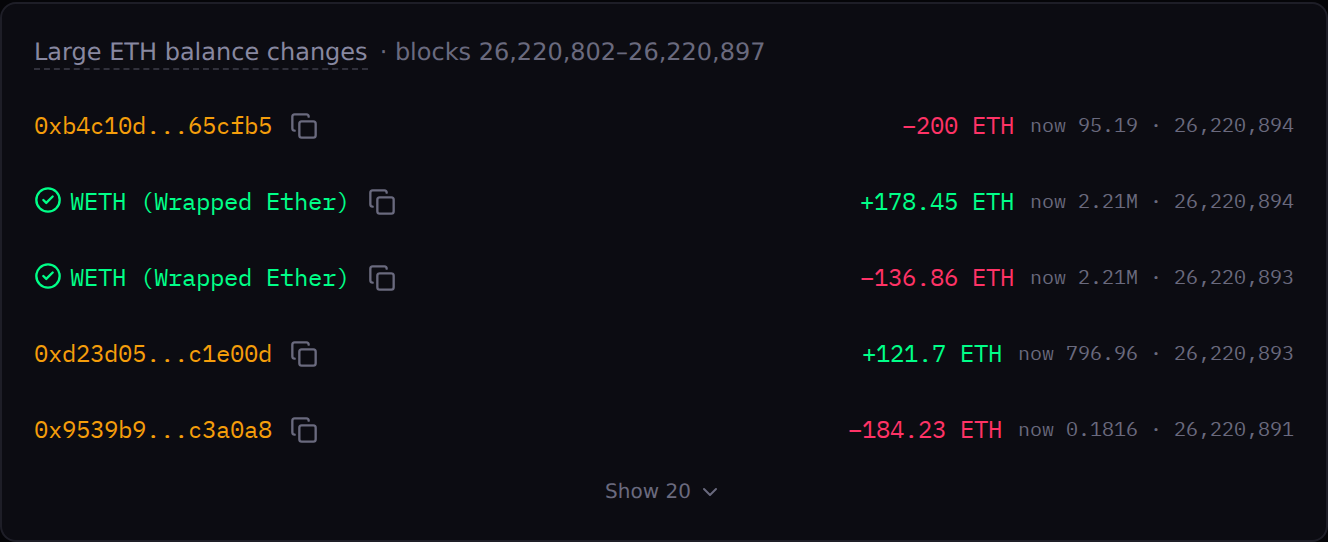
## What it shows
Addresses whose ETH balance changed by **more than 100 ETH within one block**, over the latest blocks named in the widget title. Each row shows the address, the signed change (green for a gain, red for a loss), the balance after the change, and the block where it happened.
The figure is the **net change over the block**, not a single transfer. An address that received and sent ETH in the same block shows only the difference, and a change can come from a transaction, a withdrawal or a block reward alike — so a row has no transaction hash, only links to the address and to the block.
## How to read it
* **Pairs tell the story.** A −136 ETH row and a +136 ETH row in the same block are usually one transfer seen from both sides.
* **The balance after the change gives scale.** −100 ETH from an address that still holds 165,000 ETH is an exchange hot wallet doing its job; −332 ETH that leaves 0.002 ETH is an address being emptied.
* **Look where it went.** Click the address for its [entity page](/explorer/entity), or the block number to see the block's transactions.
[ETH Flows](/dashboard/eth-flows) ranks the same movement differently: who sent and received the most ETH over the whole live window. This widget catches single large swings per block, whatever caused them.
To look up any other address the same way, paste it into the [address lookup](https://tracefast.xyz/address).
## Data & update cadence
Covers the most recent blocks (the range is in the title) and refreshes with every block (~12 s). The widget lists the top five; **Show 20** expands the list. When the balance data for these blocks is not available, the widget says so rather than showing an empty list.
## Related pages
* [ETH Flows](/dashboard/eth-flows) — top senders and receivers over the live window
* [Validator Withdrawals](/dashboard/validator-withdrawals) — the ETH that leaves the beacon chain
* [Addresses & Labels](/explorer/addresses-and-labels) — what you'll find after the click
# Token freezes
[Open the live dashboard in TraceFast →](https://tracefast.xyz/)
## What it shows
The addresses **USDT and USDC** added to or removed from their blacklists, and the funds USDT destroyed on blacklisted addresses, **newest first**. Each row is one action: its badge — **add**, **remove** or **enforce** (funds destroyed) — the address, the token with its issuer badge, and the block, which links to the event in its transaction.
The list is not tied to the blocks of the live window: it is newest first, whatever the block. The title says how far the list is complete — **through block 26,390,391**.
## How to read it
**A listing is the issuer's act on its own token, not a sanctions designation.** Tether or Circle freezing an address says that the issuer will not let it move that token; it says nothing about other tokens. The listing is authoritative for that token — the issuer badge says so.
Only USDT and USDC are shown here. Other tokens' blacklists, and checking a single address against all of them, are on the [Blacklisted](/compliance) page.
When nothing has happened recently, the widget says *No USDT or USDC blacklist events to show*.
Every token blacklist, and a check for one address, is on [Blacklisted](https://tracefast.xyz/compliance) (sign-in required, a free account is enough).
## Data & update cadence
The list refreshes with the board, and the title moves with it. **Show N** opens the rest of the list.
## Related pages
* [Blacklisted](/compliance) — every token blacklist, and an address check
* [Live Dashboard](/dashboard/overview)
* [Blacklist status of an address](/api/risk-blacklist-status) — the same facts over the API
# Block Execution
[Open the live dashboard in TraceFast →](https://tracefast.xyz/)
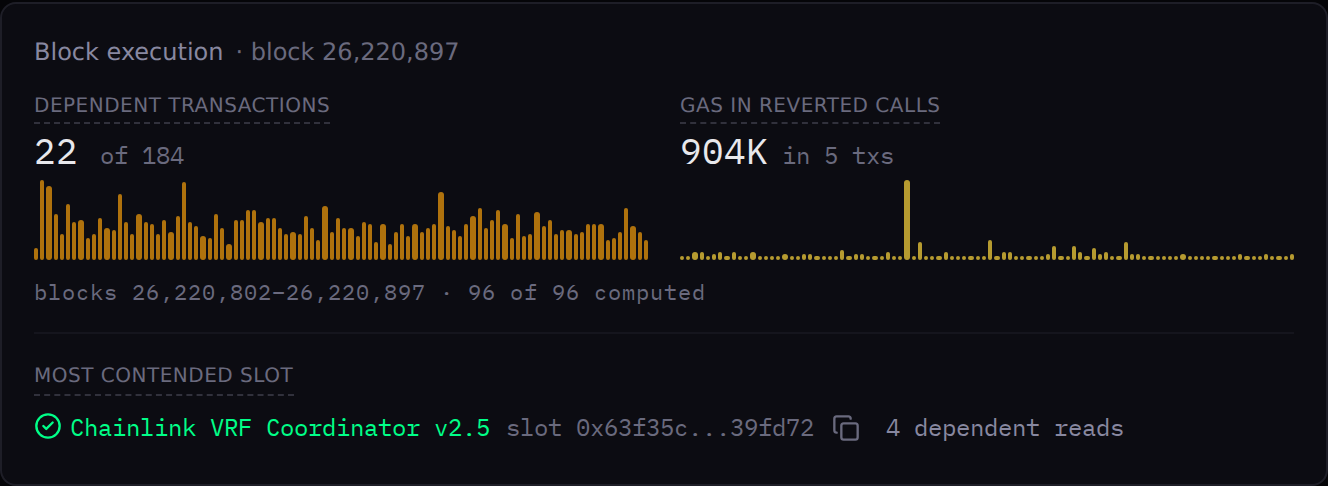
## What it shows
What happened *inside* the execution of the latest computed block, and the same two series across the recent blocks:
* **Dependent transactions** — transactions that read a storage slot an earlier transaction of the same block had written, out of all the block's transactions. Their outcome depended on the order of the block.
* **Gas in reverted calls** — gas spent inside calls that reverted, and in how many transactions. A transaction can succeed with a reverted call inside it, so this is not the gas of [failed transactions](/dashboard/failed-transactions).
* **Most contended slot** — the contract and storage slot of the block that the most later transactions read after an earlier one wrote it.
Under each number, a bar per block shows the series over the window; hover a bar to read that block. The line under the bars names the block range and how many of its blocks are computed.
## How to read it
* **Dependency is order sensitivity.** A block where a large share of transactions depend on earlier ones is a block where reordering would have changed results — typical around busy DEX pools and token contracts. The most contended slot usually belongs to WETH, a stablecoin or a popular pool.
* **Reverted gas is hidden waste.** Routers and bots often try a path, revert it inside the call, and carry on; that gas is paid even though the transaction succeeds.
* **Not computed is not zero.** The analysis takes a moment after a block arrives. A block that is not computed yet is an empty column, and the title says how many newer blocks are still being computed.
The block number in the title opens the block in the [Explorer](/explorer/blocks), where the block's transaction dependencies can be read in full.
The same dependencies for any earlier block are on that block's page — open one from the [block list](https://tracefast.xyz/blocks).
## Data & update cadence
Shows the latest computed block and the recent blocks around it; refreshes with every block (~12 s).
## Related pages
* [Blocks](/explorer/blocks) — the block page with its dependencies
* [Storage Heatmap](/dashboard/storage-heatmap) — which contracts write the most state
* [Failed Transactions](/dashboard/failed-transactions) — transactions that reverted as a whole
# Validators
[Open validators in TraceFast →](https://tracefast.xyz/analytics/validators)

## What it shows
The **Validators** tab of the analytics strip answers one question: how many
validators are securing Ethereum right now, and which way the queues are
moving. Four numbers head the page:
| Metric | What it counts |
|---|---|
| **Active Validators** | Validators active on the consensus layer as of the epoch shown, with their stake. It counts validators, not operators — one operator can run thousands, so the number says nothing about how concentrated control is |
| **Entry Queue** | New validators waiting in the deposit queue, and their ETH. **Top-ups** — deposits to validators already active — wait in the same queue and are counted beside them |
| **Exit Queue** | Validators waiting to exit, and their ETH. Consolidations and validators that have already exited are not in it |
| **Consolidations** | Validators waiting to merge into another validator ([EIP-7251](https://eips.ethereum.org/EIPS/eip-7251)). Their ETH moves to the target and **stays staked** — a consolidation is not an exit |
The queues follow the rules Ethereum has used since the Electra upgrade: a
deposit waits in the deposit queue, an exit and a consolidation each in their
own, and each queue clears at a rate limited by the protocol's churn. Each card
carries an **estimated wait** — TraceFast's estimate from that churn limit, not
a promise.
Below them, **Queues over time** charts the entry and exit queues across the
selected window (7 days, 30 days, 90 days, 1 year, all). Before measurement
started, the chart is reconstructed from coarser historical data and says so on
hover — a lower-bound estimate in which a queue that cleared within about a
day reads as zero.
**Validators by status over time** charts the validators whose status is
*pending activation* or *pending exit*, for its longer history. These are
**not** the queues: *pending activation* leaves out deposits still waiting in
the deposit queue, and *pending exit* includes validators merging into another
one and validators that have already exited.
**Daily flow**, at the bottom of the page, counts the actual movement: exits
in the last 24 hours, exits over 30 days, and deposits over 30 days.
## How to read it
* **Queue length is not stake flow.** The queues say who is *waiting*; the
daily flow says what actually happened. A long entry queue with weak deposits
is a backlog clearing, not new money arriving.
* **Today is not a data point yet.** The page names the last complete day and
says how much of the current one has elapsed (`N of 7,200 slots`), because a
half-filled day compared against full ones reads as a collapse that isn't
there.
* **Balances are actual, not nominal.** Queue sums are the validators' real
balances, so they do not have to be a multiple of 32 ETH.
## Top block proposers
The lower half ranks the validators that actually **proposed** blocks in the
window. Proposing is what distinguishes a validator: every active validator
attests roughly equally, and proposal odds follow effective balance.
Two readings of the same set:
* **By validator** — individual validator indices.
* **By payout address** — the address the rewards go to, which is how staking
pools become visible: *Lido Withdrawal Vault*, *Binance: Staking Withdrawal
Vault* and the like, each with how many validators pay into it, how many
blocks they proposed, and their share of the window.
A payout address is a link to its [entity page](/explorer/entity), so a share
that looks unusual can be read all the way down. A validator index opens that
validator's own page (see below).
## Missed slots
**Missed slots** lists the slots in which no block was proposed. A strip of
bars shows the misses **per epoch over the last day**, with the totals beside
it — how many of the day's slots were missed and the average sync-committee
participation. **Latest 25** names each recent missed slot with its time, its
epoch, and the **assigned validator** that was due to propose and did not.
Only final slots are counted, so the newest one trails the chain head by about
a quarter of an hour. The [Consensus](/dashboard/consensus) widget on the
Overview tab links here from its 24-hour count.
## The validator page
Every validator index in TraceFast — in Top block proposers, in Missed slots,
in a block's proposer and withdrawals, in an address's withdrawals — opens
`/validators/{index}`, the page of one validator:
* **Status and balances** — the status, effective balance, activation and exit
epochs, the epoch from which the stake is withdrawable, the withdrawal
credential type and the public key. Everything is read **as of the epoch**
named next to the status; a change after it, such as an exit or a top-up, is
not reflected yet.
* **Withdrawal address** — where the validator's payouts go, linked to its
entity page.
* **Proposer slots** — the slots assigned to this validator, each marked
**Proposed** (its block was included, with a link to the block) or
**Missed**. Misses are recorded only from a fixed slot onward; the page says
from which, and an earlier miss is not listed.
* **Withdrawals in the last 7 days** — amount, block and time of each one.
For example, [validator 1](https://tracefast.xyz/validators/1).
## Data & update cadence
Queues and the active-validator count refresh once per epoch (~6.4 minutes);
the daily-flow figures fill up as the day runs. Missed slots cover the latest
finalized day.
## Related pages
* [Top Block Builders](/dashboard/block-builders) — who assembles blocks, as opposed to proposing them
* [Consensus](/dashboard/consensus) — missed slots, finality and reorgs at a glance
* [Validator Withdrawals](/dashboard/validator-withdrawals) — what leaves the beacon chain
* [Network Stats](/dashboard/network-stats) — the execution-layer counterpart
# Top Fees
[Open the live dashboard in TraceFast →](https://tracefast.xyz/)

## What it shows
Two ranked top-10 lists naming the biggest fee payers of the live window — the same last three epochs (~19 minutes) as the other Overview widgets, although this widget carries no window marker:
* **Top fee · contracts** — which contracts accumulated the highest fees, labeled where known (*USDT*, *Wintermute*, *Metamask: Swap Router*, *DexRouter*).
* **Top fee · transactions** — the individual transactions that paid the most.
## How to read it
The contract list answers *what was worth paying for* right now. A stablecoin contract at the top is ordinary throughput. A market maker or swap router climbing it means arbitrage or routing pressure right now. An unlabeled address paying more than USDT is worth a click.
The transaction list is the sharper instrument: it isolates single expensive actions rather than aggregate throughput. Every hash opens the [transaction drawer](/dashboard/transaction-economics#the-transaction-drawer) with the full gas and fee decomposition and the call trace — that is where an outlier explains itself.
Fees are shown in ETH, summed over the window; the window moves with every block, so the lists shift slowly rather than reshuffling. A single transaction near the top of the second list is an outlier worth opening.
To see how one transaction's fee breaks down, open it — any transaction is reachable from the [transaction list](https://tracefast.xyz/tx).
## Data & update cadence
Rolling window of 3 epochs (~19 minutes), refreshed every block (~12 s).
## Related pages
* [Transaction Economics](/dashboard/transaction-economics) — totals, the per-tx tape, and the drawer
* [Top Contracts by Gas](/dashboard/top-contracts) — gas consumption rather than fees paid
* [Gas & Blobs](/dashboard/gas-and-blobs) — gas prices over days and weeks
* [Transactions](/explorer/transactions) — the full page behind any hash
# Network Stats
[Open network analytics in TraceFast →](https://tracefast.xyz/analytics/network)
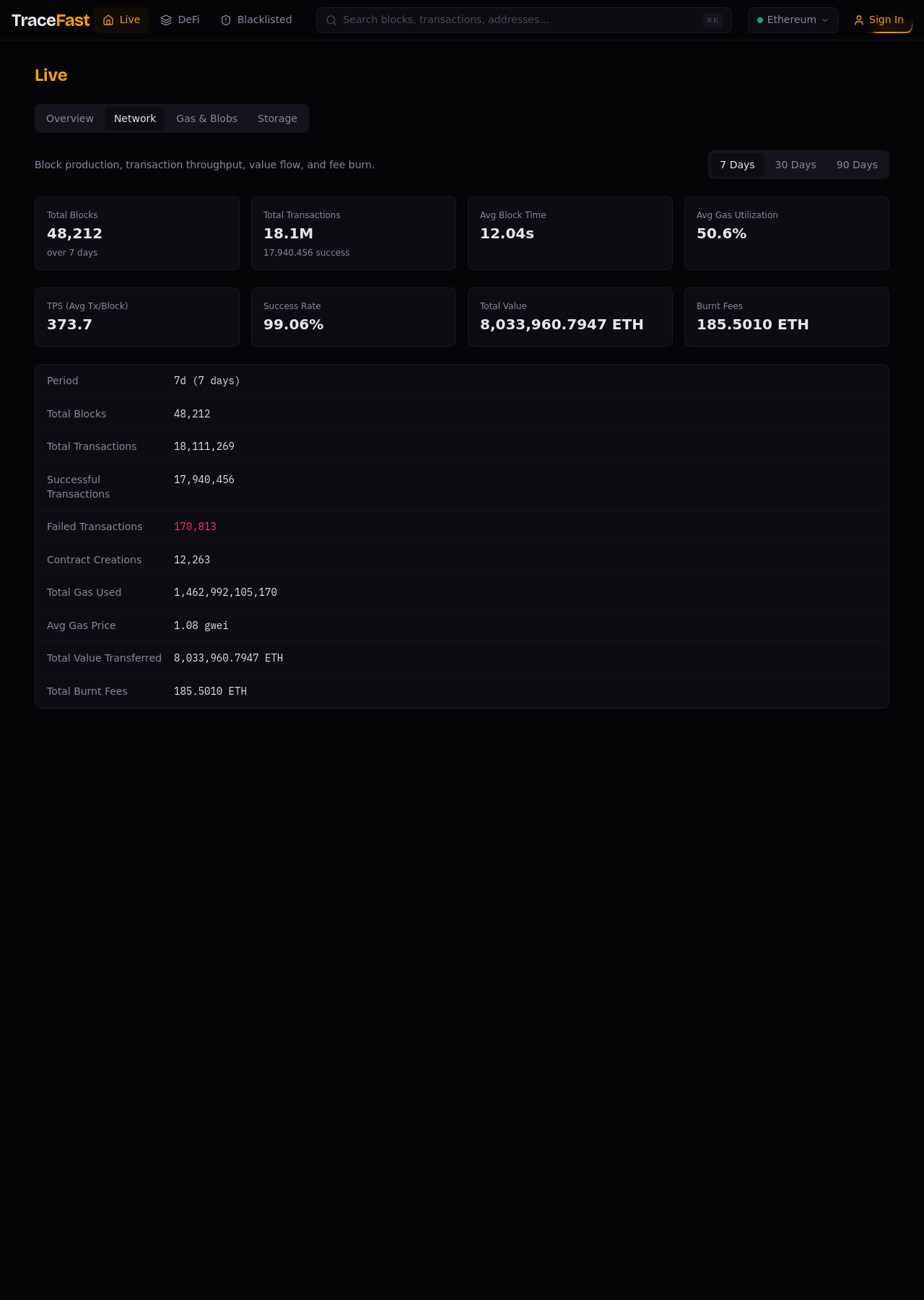
## What it shows
The **Network** tab of the Live section steps back from the block-by-block view to network health over a selectable period — **7, 30, or 90 days**:
* **Total blocks** and **average block time** — production regularity (~12 s is the protocol target)
* **Total transactions**, **success rate**, and **average transactions per block** — throughput and its quality
* **Average gas utilization** — how full [blocks](https://ethereum.org/developers/docs/blocks/) run relative to the gas limit (50% is the protocol's equilibrium point)
* **Total value transferred** and **total burnt fees** — the economic volume the network settled, and the ETH destroyed doing it
A summary table repeats the same figures with exact values, including failed transactions and contract creations.
## How to read it
This tab is your baseline. When a live widget looks unusual — transaction counts spiking, failures climbing — compare against the period averages here to tell a blip from a trend. Gas utilization drifting above 50% for weeks means sustained demand pressure; burnt fees track it directly.
The live counterpart is the [Overview tab](https://tracefast.xyz/) of the dashboard.
## Data & update cadence
Aggregated daily over the selected period (7/30/90 days) — unlike Overview widgets, this is not a rolling live window.
## Related pages
* [Block KPIs](/dashboard/block-kpis) — the same metrics, one block at a time
* [Gas & Blobs](/dashboard/gas-and-blobs) — the fee-market side of the same history
# Gas & Blobs
[Open gas & blob analytics in TraceFast →](https://tracefast.xyz/analytics/gas)
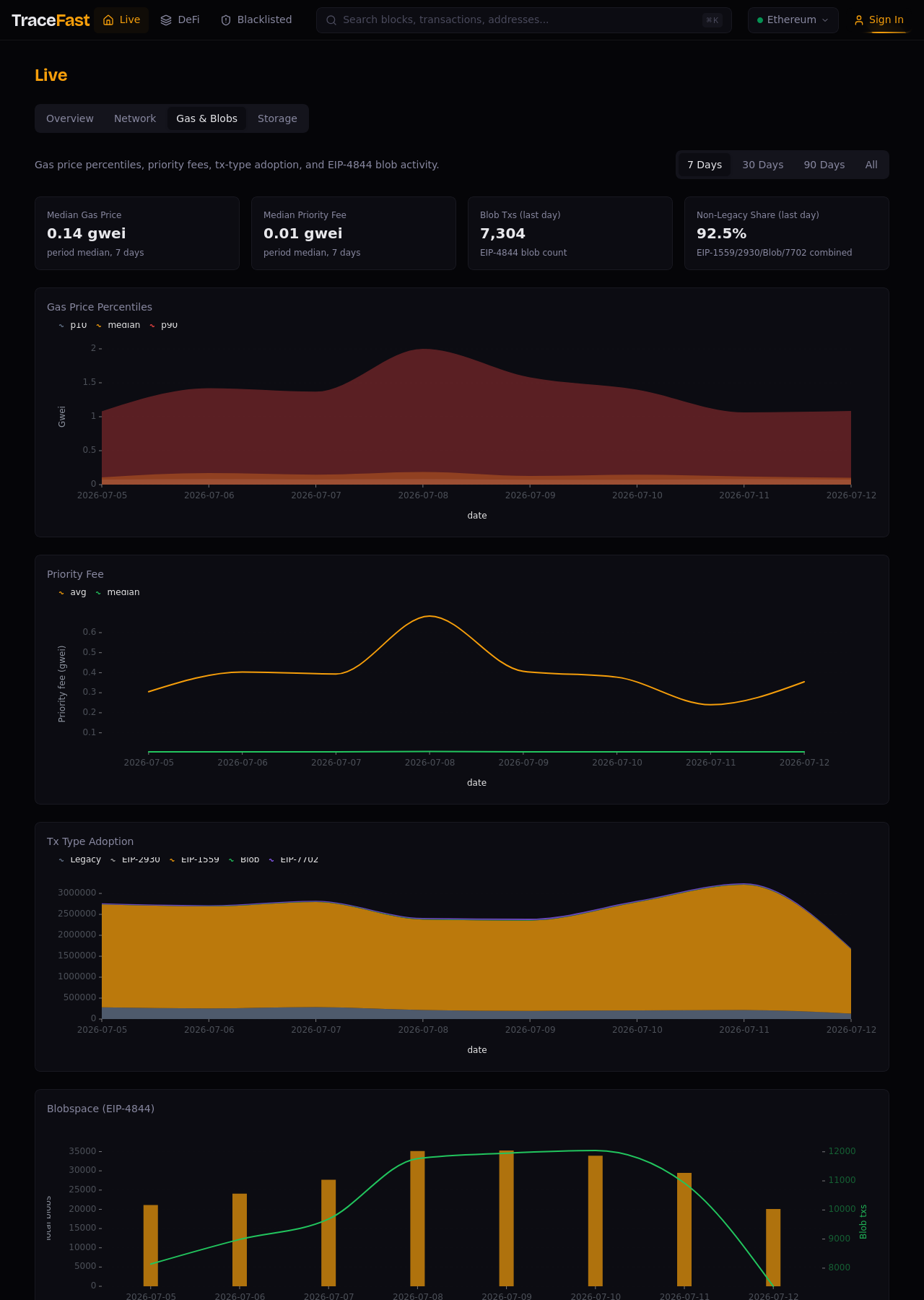
## What it shows
The **Gas & Blobs** tab charts the fee market over 7, 30, 90 days, or all time:
* **Median gas price** and **median priority fee** — headline KPIs for the period
* **Gas Price Percentiles** — p10 / median / p90 [gas prices](https://ethereum.org/developers/docs/gas/) as bands over time; the spread between p10 and p90 is congestion volatility
* **Priority Fee** — average and median tips over time
* **Tx Type Adoption** — the Legacy → EIP-1559 → blob → EIP-7702 migration as a stacked area
* **Blobspace (EIP-4844)** — blob transactions and total blobs per day, the pulse of rollup data posting
## How to read it
Sub-gwei median gas is the post-blob-era normal; watch the p90 band for what heavy users pay in spikes. The **Non-Legacy Share** KPI (typically above 80%) tracks how completely the ecosystem has moved to modern transaction formats. Blobspace trends are effectively a rollup-adoption chart — more blobs means more L2 batches landing.
The live, block-by-block counterpart is the [Overview tab](https://tracefast.xyz/) of the dashboard.
## Data & update cadence
Aggregated daily over the selected period. For the live per-block fee picture, use [Transaction Economics](/dashboard/transaction-economics).
## Related pages
* [Transaction Types](/dashboard/transaction-types) — the live-window type mix
* [Top Fees](/dashboard/top-fees) — the biggest fee payers of the live window
# Storage Analytics
[Open storage analytics in TraceFast →](https://tracefast.xyz/analytics/storage)
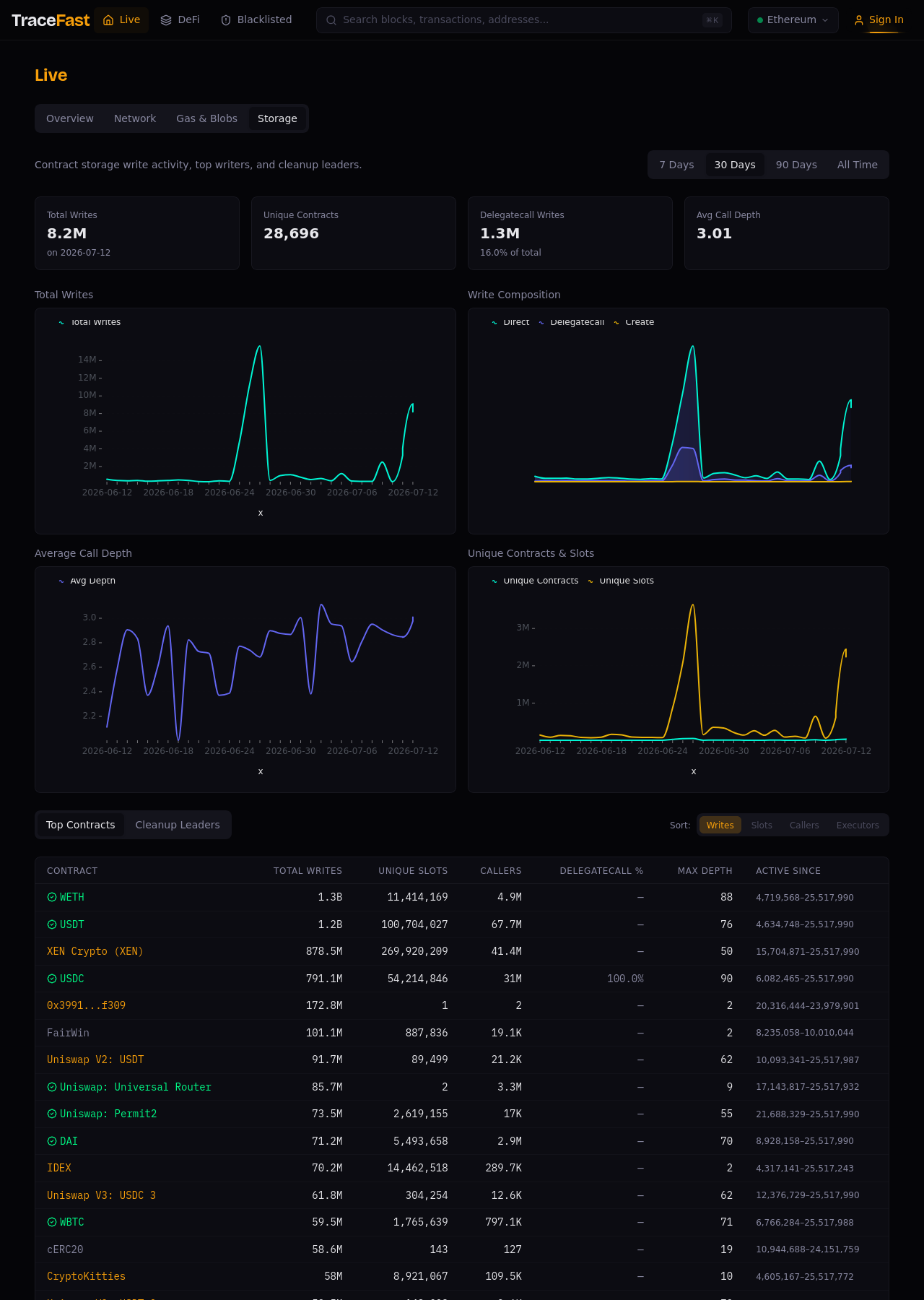
## What it shows
The **Storage** tab tracks how Ethereum's state grows and who grows it, over 7, 30, 90 days, or all time:
* **Total Writes** — storage writes per day, with KPIs for unique contracts touched and average call depth
* **Write Composition** — writes split by how they happened: **direct** calls, **delegatecall** (proxy patterns), or contract **creation**
* **Average Call Depth** — how deeply nested the calls performing writes are; rising depth means more composed, router-driven activity
* **Unique Contracts & Slots** — breadth of state being touched
* **Top Contracts / Cleanup Leaders** — a sortable table of the heaviest state writers (writes, unique slots, callers, delegatecall share, max depth, active range) and, on the second tab, the contracts *freeing* the most storage
## How to read it
Storage is Ethereum's scarcest long-term resource. The table answers "who is growing the state": WETH and USDT lead by sheer usage, while entries like *XEN Crypto* stand out by design choices. A delegatecall share near 100% (USDC shows *>99.9%*) marks proxy architectures. **Cleanup Leaders** is the rare positive column — contracts clearing slots and shrinking state.
A contract's writes slot by slot are on its Storage tab — for example [Tether USD](https://tracefast.xyz/entity/0xdac17f958d2ee523a2206206994597c13d831ec7?tab=storage).
## Data & update cadence
Aggregated daily over the selected period. The KPIs name the day they are for — the last complete day. When the newest point of the charts is a day still in progress, the page says so under the KPIs: *The last point, 2026-11-11, is a day still in progress* — read it as partial, not as a drop.
At times the data source recalculates the daily figures, and the page then says so: *These daily figures are being recalculated by the data source and may still change, including for past days.* While that note is shown, a jump between days is not by itself a change on the network.
The live-window equivalent is the [Storage Heatmap](/dashboard/storage-heatmap) widget.
## Related pages
* [Storage Heatmap](/dashboard/storage-heatmap) — what's writing state *right now*
* [Smart Contracts](/explorer/smart-contracts) — inspect any writer in the Explorer
# Entity Page
[Open an entity page in TraceFast →](https://tracefast.xyz/entity/0xa0b86991c6218b36c1d19d4a2e9eb0ce3606eb48)

Every address on Ethereum — a wallet, a contract, a token, a proxy, a smart
account — has **one page** in TraceFast:
```
https://tracefast.xyz/entity/{address}
```
There is no separate address page, token page or contract page to choose
between. You paste an address and get the page for that address; what appears
on it follows **what is known about it**, not what it is called.
The address is case-insensitive (checksummed or lowercase both work), and a
string that is not a 20-byte address is refused rather than rendered as an
empty page.
## By kind
The page is the same; the evidence differs. Each of these covers one shape in
detail:
| | What it adds |
|---|---|
| [**Accounts & Wallets**](/explorer/entity/accounts) | Balance and nonce, portfolio, top counterparties, validator withdrawals, smart accounts |
| [**Tokens & Collections**](/explorer/entity/tokens) | Price and price history, holders, DEX pools, the facts that say what kind of asset it is |
| [**Contracts**](/explorer/entity/contracts) | Chain facts, proxy, control and protocol relationships, the Code tab, storage activity, emitted events |
| [**Transaction feeds**](/explorer/entity/feeds) | Everything under the Transactions tab, feed by feed |
| [**Graph & projections**](/explorer/entity/graph) | Ledger, Operations, Semantic, Behavior and Intent views of the same address |
## What the header tells you
The line above the tabs is the page's whole claim about identity:
| Element | What it is |
|---|---|
| Kind | What the address is, in one word — `EOA`, `Address`, `Smart account`, `Contract`, `Destroyed contract`, `System address`, `Token`, `NFT token`, `Multi-token`. `EOA` is used only where it is proven that the account is controlled by a key; `Address` where that is not settled. Hover the word for the fact that chose it. Absent when nothing has been proven yet |
| Name | The [label](/concepts/labels-and-entities), where the labelling layer has one — with a verification mark only where the data says verified. Shown to signed-in readers; a reader who is not signed in sees the hash and a line saying that names, tags and risk flags need a sign-in |
| Risk mark | For a flagged address, an icon in the colour of the verdict — never a word in place of the name. Hover it for the verdict and its reasons, for example *Flagged suspicious / elevated risk. Reasons: Mixer — the trail of funds ends here*. The same mark, with the same reasons, is drawn wherever the address appears |
| Blacklisted by | For an address on the current blacklist of USDT or USDC, a coin-and-lock icon and **Blacklisted by USDT · USDC** (with *funds destroyed* where the issuer burned them). Hover it for what the listing does — USDT cannot be sent from the address, while USDT sent to it arrives and stays; USDC can be neither sent nor received — and that it is the issuer's act on its own token, not a sanctions designation |
| Chip row | First the behaviour signals — `High traffic`, `New`, `Whale` — then the proven facts worth stating up front: `Contract`, `Upgradeable proxy`, `ERC-20 in code`, `Privilege used`, `Controls other contracts`, `History` and the other [address attributes](/concepts/address-attributes). A behaviour pattern, such as sending look-alike transfers, is a pattern in chain data, not a verdict |
| Block number | The chain head this page was rendered at |
| Star and bell | The star saves the address to your [Favorites](/favorites); once it is saved, the bell beside it sets [alert rules](/alerts) on it |
The chips are not a risk score and not an opinion. Each one is a fact that was
proven from chain data, and each carries its own sentence when you hover it —
including what it deliberately does **not** claim.
## The tabs
The strip groups tabs by the question they answer. **Transactions** is a group:
it opens on the transaction feed and carries everything a transaction did.
| Tab | What it answers |
|---|---|
| **Overview** | What this address is, since when, and how it is doing |
| **Transactions** | The transaction feed, and inside it [Token Transfers, NFT Transfers, Internal, State Changes, Storage, Events, Deployments and DEX Trades](/explorer/entity/feeds) |
| **Withdrawals** | [Beacon-chain validator withdrawals](/explorer/entity/accounts#validator-withdrawals) credited to this address — no transaction behind them, so they are not filed under Transactions |
| **Holders** | [Who holds this asset now](/explorer/entity/tokens#holders), ranked by balance |
| **Pools** | [DEX pools this asset trades in](/explorer/entity/tokens#pools), with its volume over the last 7 days |
| **Graph** | [Money flow and structure](/explorer/entity/graph) around this address |
| **Code** | [The contract's code](/explorer/entity/contracts#code): its function selectors, calls per function, a decompiled view and the disassembly |
**A tab disappears only on a positive fact.** Holders and Pools go when the
address is known not to be an asset; Events goes when it is known to have
never carried code, and Storage goes only when there is no code **and** no
storage history — a self-destructed contract keeps its Storage tab; Deployments
goes when the address is known never to have created a contract; Withdrawals
appears only where such credits exist.
When the answer is simply unknown, the tab stays — hiding it would assert
something the platform cannot back, and an empty feed that says "nothing here"
is more honest than a missing tab.
## Overview
Beyond the header, the Overview stacks these sections, each present only when
it has something to say:
* **Key numbers** — what the row carries follows the address: ETH balance (with
its USD value), direct transactions, nonce and a 30-day activity sparkline
for an account; price for an asset; state changes and fees paid for both.
"Direct transactions" counts top-level transactions only. A liveness chip
reads **Active** (activity of any kind within the last year) or **Dormant**.
A number that has not been counted yet reads **Not counted yet** — never a
zero that would claim no activity.
* **Compliance line** — if a token contract has blacklisted the address, the
page says so and says what it is not: a listing by an arbitrary token is not
a sanctions designation. See [Blacklist Monitoring](/compliance).
* **Chain facts** — the full reading of what has been proven, below.
* **Relationships** — deployer, implementation and its history, proxies
delegating here, EIP-7702 delegates, who owns and administers it and what it
controls, pools, lending markets and price feeds, byte-identical code, and —
for a lookalike — what it impersonates. Where a side is large, a few are
shown with the number of them all; where no number is stated, the page says
the list is a sample.
([Contracts](/explorer/entity/contracts#relationships))
* **Timeline** — first seen and last active against the protocol forks, with
the streams that were consulted named.
* **Price history** — 7 / 14 / 30 days, for an asset with a price.
([Tokens](/explorer/entity/tokens#price-and-price-history))
* **Portfolio** — token holdings and ETH, with its own "at block" input.
([Accounts](/explorer/entity/accounts#portfolio))
* **Top counterparties** — who this address keeps meeting, ranked by how often.
([Accounts](/explorer/entity/accounts#top-counterparties))
* **Validators paying out here** — validators whose withdrawal credentials
point at this address, as of a named epoch.
([Accounts](/explorer/entity/accounts#validators-paying-out-here))
### Chain facts

Chain facts are grouped — Nature, Asset, Architecture, Capabilities,
Interfaces, Presence, Derived, Relationships — with a count each, and each fact
states in one sentence what it means and at which block it was observed.
Two rules govern the whole card:
* **A fact is stated only when it was proven.** A fact that is absent was not
proven, which is not the same as "no". A token without a `Mint function`
fact is not thereby a token that cannot mint.
* **A fact says what it says, and no more.** "Pause function" means a
pause-family function exists in the code that executes — not that the
contract is paused now, and not who may pause it.
These are the same facts the public API returns for an address; the ids and
their meanings are in the [address attribute dictionary](/api/address-attributes).
## Reading an address at a past block
Add `?atBlock=N` and the page answers as of block N. A banner names the epoch
and — this is the part that matters — names what it does **not** cover:
> At this block: the counterparties, the feeds and the portfolio pane.
> Current instead: the header metrics, identity, risk and chain facts.
Chain facts that carry a history are read at the block: a fact that did not
hold yet is not shown as if it did. A fact with no history behind it stays on
the card, marked **current only** — true now, not stated for the block.
Balances at a past block are shown in ETH and tokens without a dollar figure:
dollars for a past moment are the price of that hour, and this reading carries
no price of its own — a number multiplied by today's rate would be confidently
wrong.
## URL parameters
Every view on the page is addressable, so a link carries the reader to exactly
what you were looking at.
| Parameter | Effect |
|---|---|
| `tab=` | Which tab to open (`transactions`, `transfers`, `nft-transfers`, `internal`, `state-changes`, `storage`, `events`, `deployments`, `dex-trades`, `withdrawals`, `holders`, `pools`, `graph`, `code`). A value this address has no tab for falls back to the default instead of an empty screen |
| `focus=` | Scrolls to a section of the Overview and opens the tab that renders it |
| `atBlock=` | Read the counterparties, feeds and portfolio as of that block |
| `cpWindow=` | Counterparty window: `all`, `24h`, `7d` |
| `cpFind=` | Look up one address in the counterparty list |
| `gTab=` | Which [graph projection](/explorer/entity/graph) to open (`ledger`, `operation`, `semantic`, `behavior`, `intent`) |
| `gFrom=`, `gTo=` | The graph's block window — an explicit pair outranks the page epoch |
| `gMove=` | Ledger shows one kind of movement only: `token`, `eth` or `internal` |
| `gRank=`, `gMinEth=`, `gGroup=`, `gLabels=` | Ledger [ranking](/explorer/entity/graph#reading-and-shaping-the-graph) (`eth`, `moves`; dollars by default), ETH threshold (`1`, `10`, `100`), grouping by role, labels at any zoom |
| `gHide=`, `gExp=`, `gView=` | The nodes you hid, the nodes you expanded (up to 24) and the zoom and centre — written as you use the graph, so [a link reproduces the picture](/explorer/entity/graph#exports) |
| `minUsd=` | Transfer-significance floor for the graph, in dollars (`0` shows everything, dust included) |
| `storageSort=`, `storagePage=` | Sorting and paging of the storage feed |
| `slot=` | Opens the change history of one storage slot on the [Storage tab](/explorer/entity/contracts#storage) |
## What happened to the old pages
`/entity/{address}` replaced the separate per-address pages. The former
`/address/{a}`, `/tokens/{a}`, `/contracts/{a}`, `/deployers/{a}` and
`/implementations/{a}` URLs **no longer exist and are not redirected** — update
any bookmark or integration that still points at them.
To reach an address you already have, paste it into the search
(⌘K) — it opens the entity page for it. To find one you don't, start
from a list; every row on these opens an entity page:
* [Contracts](https://tracefast.xyz/contracts) — deployed-contract explorer
* [Tokens](https://tracefast.xyz/tokens) — the token leaderboard
* [Pools](https://tracefast.xyz/defi/dex/pools) — DEX pools
Deep links off the old pages that carried a `?tab=` value still land in
context: the old value names the section that renders that content today.
## Related pages
* [Addresses & Labels](/explorer/addresses-and-labels) — the identity layer on top of the facts
* [Transactions](/explorer/transactions) — where a feed row leads
* [Address attribute dictionary](/api/address-attributes) — the same chain facts over the API
# Accounts & Wallets
[Open a wallet in TraceFast →](https://tracefast.xyz/entity/0x28c6c06298d514db089934071355e5743bf21d60)

An address with no code — an externally owned account — gets the
[entity page](/explorer/entity) shaped around one question: *whose money is
this, where does it move, and how often*. Smart accounts (Safe, ERC-4337,
EIP-7702 delegated) get the same page plus what their code adds.
## Key numbers
| Number | What it says |
|---|---|
| **Balance** | Native ETH, with its USD value at the live price |
| **Direct transactions** | Top-level transactions sent or received. Activity through internal calls, events or token transfers is deliberately **not** counted here |
| **Nonce** | How many transactions this account has sent, as the protocol counts them |
| **State changes** | How many times the account's own state — balance, nonce or code — changed |
| **Fees paid** | Total gas fees the account has paid as a sender, all time |
| **Activity (30d)** | A sparkline of the last 30 days, so a dormant wallet and a busy one differ at a glance |
Beside them, the liveness chip reads **Active** (any activity in the last year —
transactions, internal calls, events or token transfers) or **Dormant**. The
behaviour signals `High traffic`, `Whale` and `New` are described in
[Addresses & Labels](/explorer/addresses-and-labels).
## Portfolio
Token holdings and ETH, with the totals above them: what the tokens are worth,
what the ETH is worth, and the sum. The counter under the token total —
*246 of 325 tokens* — is the honest part: it says how many of the held tokens
could be **priced**, not how many are held. A token without a price is still in
the list; it just cannot be added up.
The card carries its own **at block #** input. Reading the portfolio at a past
block is the same mechanism as the page-level `?atBlock=N`
([reading an address at a past block](/explorer/entity#reading-an-address-at-a-past-block)),
and a past reading is shown in tokens and ETH without a dollar figure: the
dollars of that moment were the price of that hour, not today's.
## Top counterparties

Who this address interacts with most, **ranked by how often, never by how much
value moved**. The value question belongs to the [Graph](/explorer/entity/graph);
this list answers "who does it keep meeting".
An interaction is any of three: a transaction between the two — with or without
ETH, so a token contract the address calls is a counterparty too (a wallet that
sends USDT has the USDT contract at the top of its list); an internal ETH
transfer; or a token transfer event naming both. Token events are counted as
emitted, zero amounts included — so the fake transfers address-poisoning
contracts plant count as well. A row says the two interacted; it is not proof
that value moved between them.
Each row carries:
* **How the two met** — *≈4M direct · 5 token + NFT*: direct transactions
between them, and token or NFT transfers. A contract the address merely calls
reads as direct only; a trading partner shows token transfers too.
* **A bar** — how often, against the top of the list.
* **When they last met** — *last ~12d ago*. Hover it for when they first met;
the dates are estimated from the block distance.
* **How many interactions** — *≈4M tx*. Hover it for what is counted, and how
many more reverted: reverted transactions are counted but never ranked as
successes.
Above the list: the window (**all time**, **24h**, **7d**), the block the
ranking was computed at, and how many counterparties exist in total —
*20 of 17,729,889* is a top-20 view of a very long tail, not a complete list.
The **check address** box answers the opposite question: does this specific
address appear among the counterparties at all.
Large counts are approximate and marked `≈`. Rows are ordered, not numbered:
hundreds of pairs can sit tied at the tail, and numbering them would invent a
precision the data does not have.
## Validator withdrawals

An address that receives beacon-chain withdrawals gets a **Withdrawals** tab.
It is not filed under Transactions, and the reason is protocol-level: a
withdrawal has no transaction behind it — no hash, no sender, no gas. The
consensus layer credits the balance directly.
The tab states the total withdrawn, how many credits arrived and from how many
validators, and the period covered as both dates and a block range. Above the
feed sits the registry snapshot — how many validators pay into this address,
split by status (active, withdrawn, withdrawable, exited, queued to activate,
awaiting deposit) as of a named epoch — and, when some of them are leaving, a
line pointing at the [network exit queue](/dashboard/validators).
Each row is one credit: block, time, amount, and the validator index with its
public key. The index links to that validator's own page in TraceFast
(`/validators/{index}`).
## Validators paying out here
An address that validators pay out to also gets a **Validators paying out
here** section on its Overview: the validators whose withdrawal credentials
point at this address, read from the validator registry as of a named epoch.
It counts them — total, active, withdrawn, slashed — states their combined
effective balance and the credential types (`0x01` withdrawal address, `0x02`
compounding), and lists the first of them by index, each linking to its
validator page.
Receiving the payouts does **not** make this address the validators' owner or
operator, and the section says so. Where no validator pays out here, the
section is absent; where the registry could not be read, it says that instead
of showing zero.
## Smart accounts
An account whose behaviour is contract code — a Safe, an ERC-4337 account, or
an EOA carrying an EIP-7702 delegation — reads as `Smart account` in the header
and keeps every panel above. What changes is the evidence: the chain facts name
the mechanism (delegated now, delegated before, modules installed, the entry
point it runs at), and **Relationships** names the code it delegates to —
**Delegates to** now, **Delegated before** as block intervals, and **Same
delegation**: how many other accounts point at the same code. An EIP-7702
delegation is reversible, so "was delegated" and "is delegated" are two
different facts and the page states them separately; a fact proven before the
current delegation does not describe the account as it is now.
New delegations to rarely used contracts, and ETH drained from delegated accounts by someone else, are spotted live on [Signals](/dashboard/signals).
For example, [vitalik.eth](https://tracefast.xyz/entity/0xd8da6bf26964af9d7eed9e03e53415d37aa96045) reads as a smart account.
## What an account does not get
No Holders and no Pools tabs: those are questions about an asset, and an
account is not one. If you expected them, you are probably looking at a wallet
that holds a token rather than at the token itself — open the token from the
[Portfolio](#portfolio).
## Related pages
* [Entity Page](/explorer/entity) — the page all of this lives on
* [Transaction feeds](/explorer/entity/feeds) — everything under the Transactions tab
* [Graph](/explorer/entity/graph) — value flow around the account
* [Addresses & Labels](/explorer/addresses-and-labels) — names, signals and confidence
* [Validators](/dashboard/validators) — the queues behind the withdrawal side
# Tokens & Collections
[Open a token in TraceFast →](https://tracefast.xyz/tokens)

A token contract gets the same [entity page](/explorer/entity) as any address,
plus the two tabs that only make sense for an asset — **Holders** and
**Pools** — and a price where one can be established. The header says which
kind it is: `Token`, `NFT token` or `Multi-token`.
## Price and price history
The **Price** number carries its own provenance: the source it came from, a
confidence, and how long ago it was observed. A stablecoin priced from its peg
and a thin token priced from its last swap are not the same claim, and the card
says which one you are reading.
**Price history** charts 7, 14 or 30 days with the change across the window in
both absolute and percentage terms. USD figures elsewhere on the page follow
the platform-wide rule: a past event is priced at the hour it happened, never
at today's price, and where no hourly price exists no dollar figure is shown.
## Holders
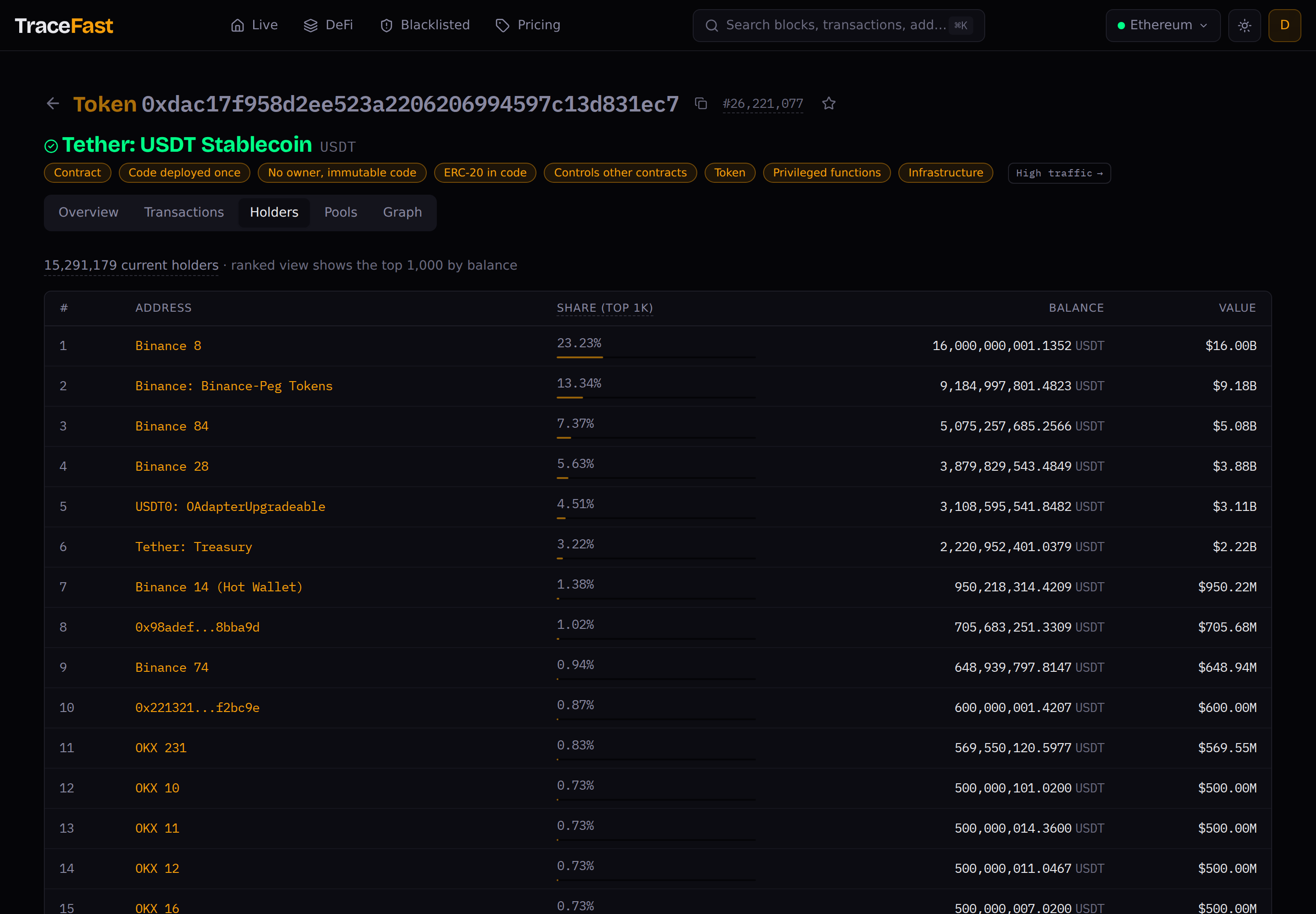
The current holder table: rank, address (labeled where known), share of the top
1,000, balance, and USD value where the token has a price. The heading states
the full holder count and that the ranked view shows the **top 1,000 by
balance** — the rest of the tail exists, it is simply not ranked.
A price set in a thin market can price a small balance but not a huge one.
Where a holder's balance is worth more than the token's trading can price
reliably, the value column reads **not valued** — hover it: *This balance is
larger than the token's trading can price reliably, so no dollar value is
shown.* That is not a zero and not a capped figure: the dollar value is simply
not stated.
"Current holders" means addresses with a positive balance today. It is a
smaller number than everyone who has ever held the token, and the two answer
different questions: current distribution versus lifetime reach. For a token
so new that TraceFast has only its token record yet — usually its first
minutes — the header's metric row carries a holder tile: **Holders**, the
holders now, where they are counted; otherwise **Holders (all-time)**, every
address that has ever held the token — the case for NFT collections. With
neither number there is no tile.
Holders are counted for fungible tokens. NFT collections are not covered yet:
their Holders tab says *Holders aren’t counted for this token, so there is no
list to show.* That means the collection is outside the holder data, not that
nobody holds it — a covered token with nobody holding it says *No holders found
for this token* instead. Once a collection is covered, the
balance column is a **count of items** rather than an amount, and the value
column stays empty instead of inventing a per-item price.
See it on [the Holders tab of USDT](https://tracefast.xyz/entity/0xdac17f958d2ee523a2206206994597c13d831ec7?tab=holders).
## Pools

Every DEX pool the token trades in. Above the table: **DEX volume · last 7d**
with the total and the swap count — the window is named in the heading on
purpose, so a total is never read against a column measured over a different
period. The chart switches between volume in USD and swap count, and the
protocol chips narrow it to one venue (Uniswap v2 / v3 / v4, Curve, Balancer,
PancakeSwap, SushiSwap …).
The table lists each pool with its counterpart asset, protocol and version,
7-day volume, fee tier and creation block. A brand-new pool with no volume yet
shows a dash rather than a zero: nothing has traded, which is not the same as
"we measured zero".
## What the chain facts say about an asset
The Asset group of [Chain facts](/explorer/entity#chain-facts) is where a token
stops being a name and becomes evidence:
* **Fungible token / NFT collection / Multi-token collection** — which
interface the executing code presents, and that at least one transfer of that
shape was observed. It says what the interface *is*, never whether the token
is legitimate.
* **Transfers state-backed** — the token's `Transfer` events are backed by
matching balance changes in its own storage. This is the normal shape of a
real token.
* **Transfers event-only** — it emits transfer events with no matching balance
state behind them. That is the signature of address-poisoning campaigns, and
also of designs that keep balances off the emitting contract; the fact names
the observation, not the intent.
* **Transfers only at deploy** and **No direct calls since deploy** — the
deploy-block bait shape: everything "moved" in the block the
token was born and nothing ever called it again.
Each fact carries the block it was observed at. Absence means not proven, never
"no" — see the [address attribute dictionary](/api/address-attributes) for the
full vocabulary and the ids behind these labels.
## Lookalikes
A token that impersonates a well-known asset is named as such, and the
relationship is stated from both ends: the fake says what it impersonates, and
the genuine asset's page lists the addresses impersonating it. The transfers
you see on a lookalike are real on-chain events of a fake contract — they are
not the asset being imitated, and they carry no value.
Live dashboard boards take the stricter route: [Top Tokens](/dashboard/top-tokens)
ranks only verified tokens, so a clone cannot climb it.
## Related pages
* [Entity Page](/explorer/entity) — the page all of this lives on
* [Tokens](/explorer/tokens) — the network-wide leaderboard and transfer feed
* [Transaction feeds](/explorer/entity/feeds) — the token's own transfers and events
* [Pools & Liquidity](/defi/pools-and-liquidity) — pools as their own subject
* [Address attribute dictionary](/api/address-attributes) — the asset facts over the API
# Contracts
[Open the contract explorer in TraceFast →](https://tracefast.xyz/contracts)

A contract's [entity page](/explorer/entity) answers three different questions
in three different places: **what this contract is** (chain facts and
relationships), **what its code does** (the [Code](#code) tab), and **what it
has done** (storage, events and the rest of the
[feeds](/explorer/entity/feeds)).
## What it is
The Chain facts card groups the proven statements:
| Group | What it covers |
|---|---|
| **Nature** | Carries code now, has ever carried code, was destroyed, was redeployed, is a precompile or a system contract |
| **Architecture** | Proxy and which family (storage slot, beacon, EIP-1167 clone, Safe), whether the implementation slot is mutable, whether it is itself an implementation, a beacon or a proxy admin, or immutable |
| **Interfaces** | The ERC interfaces the executing code presents — ERC-20, 721, 1155, 4626, 1271, 2981, 165 |
| **Capabilities** | Privileged surfaces present in the code — mint, pause, blacklist, emergency withdraw — and, separately, the ones actually **observed being used**: an upgrade performed, a pause that happened, ownership renounced |
| **Asset** | What kind of token it is, if it is one — see [Tokens & Collections](/explorer/entity/tokens) |
| **Derived** | Folded verdicts over the above: account type, lifecycle, proxy kind, control model, upgrade authority |
Two rules make the card readable. A fact appears **only when it was proven** —
absence is not a "no". And a fact claims exactly what it says: *Pause function*
means a pause-family function exists in the code that executes, not that the
contract is paused now, and not who may pause it.
## Relationships
The links between this address and others, read from both ends. Each row
explains itself on hover. Where a side can be large — the proxies using an
implementation, the pools trading a token — the row shows a few and a number
beside them, **N in all**, that counts them all. That number is counted at the
platform's last hourly update, not at a block, so it can differ from the list
by one update. Where no number is stated, the row is a sample and says so.
**Structure**
* **Deployed by** — the account that executed the `CREATE`, with the deploying
transaction and block. Where the lineage was never captured — pre-Byzantium
deployments, externally created code — the row says so rather than guessing.
* **Implementation** — what a proxy delegates to right now.
* **Implementations before** — every implementation it has stood on, as block
intervals. An interval with no end was still open at the edge of coverage.
* **Used by proxies** — on an implementation contract, the proxies that have
delegated to it.
* **Delegated to by** — accounts that have pointed at this code with an
EIP-7702 delegation, as block intervals, **newest first** — the ones that
revoked included. An interval ending in *now* is in force.
* **Same bytecode** — how many contracts run byte-identical runtime code. The
cluster itself lives at `/bytecodes/{codeHash}`.
* **Impersonates** — for a lookalike contract, what it imitates.
**Who controls it**
* **Owned by** — the current owner, by its last ownership transfer
(OpenZeppelin `Ownable`). Role-based access control is a different pattern
and is not covered by this row.
* **Proxy admin** — the address that can change the code a proxy runs, read
from its admin slot.
* **Admin role held by** — addresses holding an admin- or upgrade-class role
over the contract: they can grant roles or change its code.
* **Emergency role held by** — addresses that can pause or rescue it.
* **Executed on by timelock** — timelocks that have executed a call on it: the
governance path that can move it.
**What it controls** — read from the other end, on the controlling address:
**Owner of**, **Proxy admin of**, **Admin role over**, **Emergency role over**,
and **Deployed** (contracts whose creation transaction this account sent). The
chip **Controls other contracts** in the header says such rows exist.
**Pools, markets and feeds**
* On a pool: **Pool tokens** it trades, the **Factory** that created it, its
**LP token**.
* On a token: the **Pools** that trade it, the lending markets it is **Listed
in**, the price feeds that quote it (**Quoted by feeds**).
* On a factory: the **Pools created**.
* On a lending market: its **Deposit tokens** and **Debt tokens**, the oracle
it **Prices assets with**, its **Interest rate model**, where it draws
**Liquidity from**. On an oracle or a rate-model contract: the markets it is
the **Price oracle of** or the **Rate model of**.
The same links are drawn on the [Semantic graph](/explorer/entity/graph). Changes to them — a proxy upgrade, a new owner, a role granted — are spotted live on [Signals](/dashboard/signals).
## Code
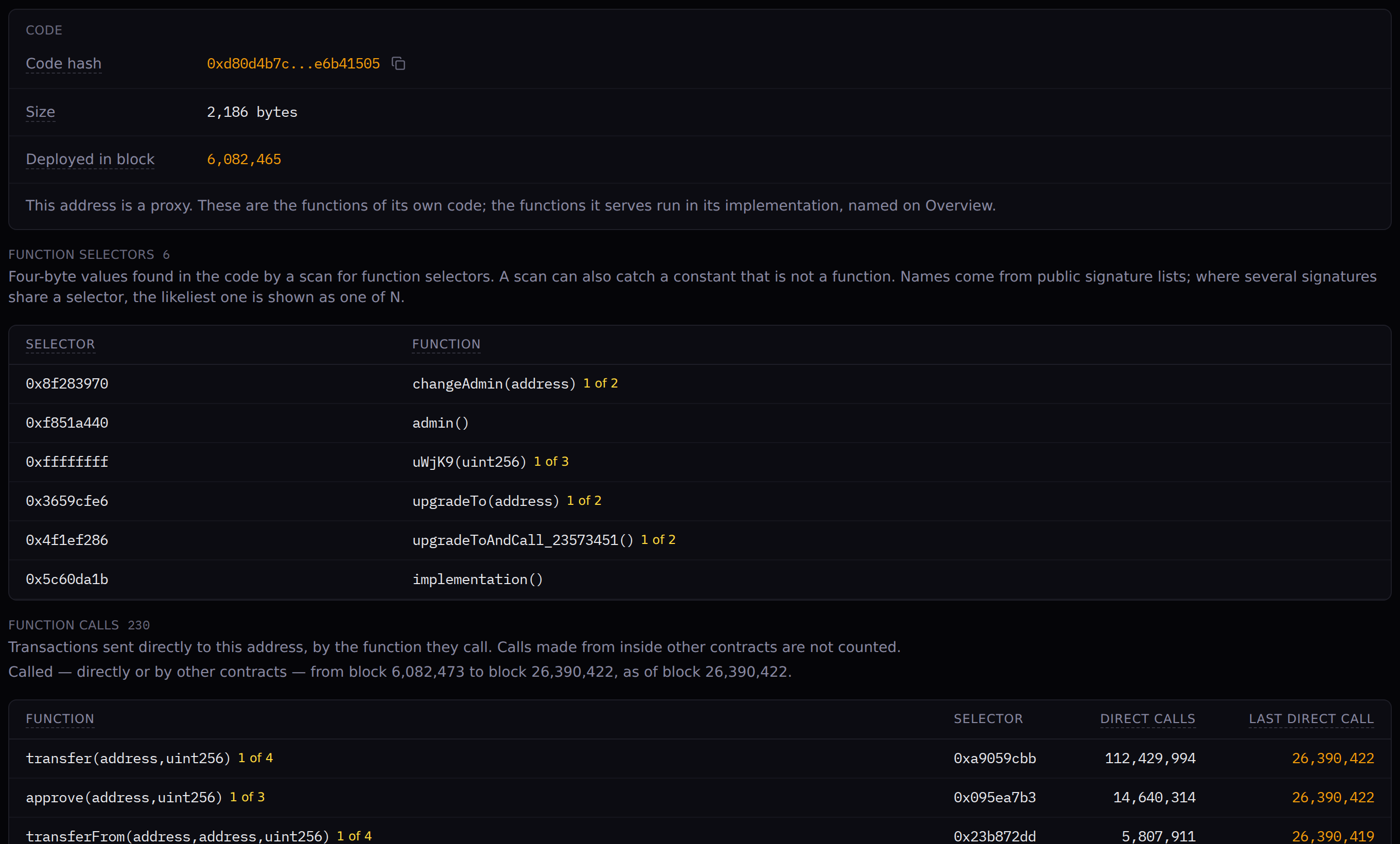
The **Code** tab reads the contract's code itself — what is deployed at the
address, which functions it exposes, which of them are called, and what they
do. It sits after Graph in the tab strip, on any address that carries code.
* **Code** — the code hash (its link lists every contract holding the same
code), the size in bytes, the block it was deployed in, and — for a
contract whose code was replaced — when the code shown took over. On a proxy,
the tab says that these are the functions of the proxy's own code, and that
the functions it serves run in its implementation.
* **Function selectors** — the 4-byte values a scan found in the code, with
the function name public signature lists give for each. Where several
signatures share a selector, the likeliest one is shown as *1 of N*. A scan
can also catch a constant that is not a function.
* **Function calls** — the transactions sent **directly** to this address, by
the function they call, most called first, with the block of the last one.
Calls made from inside other contracts are not counted — a token moved
mostly by routers looks rarely called here. A line above the table gives the
span in which the address was called at all, by anyone: *Called — directly
or by other contracts — from block 6,082,473 to block 26,390,341*. An empty
table says nobody sent a transaction to it, not that it was never called.
* **Decompiled view** — the code reconstructed as readable Solidity-like
pseudocode: a table of contents of its functions with their mutability;
open one to read its body. On a proxy, the view is of the code it runs —
the implementation — and says so. It is **a best-effort reconstruction from
the public bytecode, not the contract's original source**: names are
inferred, a function or the whole view can be marked *Uncertain
reconstruction*, and any behaviour should be confirmed against on-chain state.
* **Disassembly** — the code's own bytes written out as the EVM instructions
they are, behind **Show disassembly**. The compiler's metadata at the end of
the code is marked as data, not instructions.
**A code nobody has decompiled yet** says *No decompiled view of this code has
been made yet*. A signed-in reader can request one with **Decompile this
code**; it is usually ready within a minute, and the section updates by itself.
Each account can request a limited number of new views per day, set by its
plan; once they are used, the tab says so and the next ones wait for the next
day. Reading a view someone already made is not limited.
The same data is on the API:
[function selectors](/api/contract-selectors),
[calls per function](/api/contract-function-calls),
[decompiled code](/api/contract-decompilation) and
[disassembly](/api/contract-disassembly).
See it on [USDC's Code tab](https://tracefast.xyz/entity/0xa0b86991c6218b36c1d19d4a2e9eb0ce3606eb48?tab=code).
## Storage

Storage answers *who writes this contract's state*. The header counts total
writes, unique slots touched, distinct callers and executors, the share of
writes that arrived through `DELEGATECALL`, the deepest call that reached it,
and the block range over which all of that was observed. A **daily storage
activity** chart sits under them.
Counts marked `≈` are estimates. **Writes** counts every `SSTORE`, including
writes that put back the value already there — it is not the number of times a
value changed; that is counted separately below. Two badges sum the shape up:
**Proxy Storage** when part of the writes arrive through `DELEGATECALL`, and
**Deep DeFi** when calls deeper than five levels reach it.
**Who writes here** ranks the callers: the caller, the executor (the code that
actually ran — for a proxy, the implementation), how many writes, how many
transactions, and the block range of their activity. On a proxy this table is
the clearest picture of a protocol's real users, because the executor column
keeps proxy and implementation apart instead of merging them. Two tables follow
it: **Deep Call Analysis** — writes from call stacks deeper than five levels,
by executor, with the maximum and average depth — and, on a proxy,
**Implementation Writers** — the implementations that wrote to its storage
through `DELEGATECALL`.
### How values change
Writing a slot and changing its value are different counts. **Value Changes**
counts the times a slot's value changed at a block boundary: several writes of
one slot in one block are one change, and a write that put back the same value
is none. **≈ Slots Changed Value** counts the distinct slots whose value ever
changed.
* **What changes now** — the slots that changed most over the last day or the
last week, with how many changes and the last one. A slot is named as a
variable where its key is known: `slot 9 [Uniswap V4: PoolManager]` is entry
of mapping slot 9 for that address. **History** opens the slot's change
history, one row per block, with the value before and after each change; the
order of writes inside a transaction is on that transaction's
[State tab](/explorer/transactions).
* **Parameters & references** — the contract's plain slots (declared variables
and packed fields) with their current value, by slot or by most recent
change, shown as hex, a number or an address. Their names are not known
without the contract's source. A slot set once and never again is usually a
setting or an address the contract points at; a rarely changed slot with a
recent change is a change of configuration.
* **Who reads, who writes** — per day, the transactions that wrote to the
contract's storage and those that only read it. A contract many transactions
only read is one others depend on — the pattern of oracles, registries and
pools used for quotes.
Where a value is not stated — not stored for that stretch of history, wiped by
a self-destruct, or rewritten by the protocol at the end of the block — the
page names the reason. It is never shown as a zero.
### Storage outlives the code
A contract destroyed before Cancun, or an account whose EIP-7702 delegation was
cleared, has no code today and still a history of writes. The Storage tab stays
for it, with a line that the code is gone and the storage history is kept. For
an investigation of a one-shot or self-destructed contract this is often the
most valuable part left.
## Events

The log this contract itself emitted: block, transaction, log index, event
name, and a decoded summary where the ABI is known — `Transfer 0xdd52… →
0x3b4d… 31,670 USDC` rather than raw topics. Undecoded logs are still listed;
they simply keep their raw shape instead of a guessed name.
## Accounts and storage are different questions
**State Changes** counts changes to the *account* — balance, nonce, code.
**Storage** is about individual slots inside the contract. A busy contract can
show `State changes 1` while its storage carries hundreds of millions of
writes: the account itself only ever changed when the code was deployed.
## Destroyed and redeployed contracts
A contract that has been self-destructed keeps its page and its history: the
nature facts say it held code and that the address is codeless now, and the
timeline still shows what happened. Where code was deployed to the same address
more than once, that is its own fact (`redeployed`), because the address is
continuous while the code behind it is not.
## Related pages
* [Entity Page](/explorer/entity) — the page all of this lives on
* [Smart Contracts](/explorer/smart-contracts) — the deployed-contract inventory
* [Transaction feeds](/explorer/entity/feeds) — the calls, transfers and writes in detail
* [Storage Analytics](/dashboard/storage-analytics) — storage across the whole network
* [Address attribute dictionary](/api/address-attributes) — these facts over the API
# Transaction feeds
[Open the feeds of an entity →](https://tracefast.xyz/entity/0xa0b86991c6218b36c1d19d4a2e9eb0ce3606eb48?tab=transactions)

**Transactions** on an [entity page](/explorer/entity) is a group, not a single
list. It opens on the transaction feed and holds everything a transaction did:
the transfers it carried, the calls it made, the slots it wrote, the logs it
emitted. Each feed is addressable — `?tab=transfers`, `?tab=internal` and so on
— and each pages with **Older / Newer** rather than page numbers, because a
live feed shifts under a numbered page.
Rows of the token, NFT and internal transfer feeds and of the Events feed carry
a star: a signed-in reader can save that one row to
[Favorites](/favorites).
## Transactions
The top-level feed: every transaction where this address is the sender or the
recipient.
* **Filters** — direction (All / Sent / Received), status (All / Success /
Failed), whether the transaction carried token transfers (All / Token
transfers / No transfers), and a **Counterparty** box that pins the feed to
one address.
* **The count** — above the list, how many transactions the address has, and
the block that count is up to: *133,950,636 transactions counted up to block
26,390,341*. Newer transactions are already in the list; the count catches
up with them.
* **Columns** — tx hash, block, time, **From**, the direction, **To**, method,
**Inside**, fee, value. The direction reads **OUT** when this address sent
the transaction, **IN** when it received it, **SELF** when it did both. A
transaction that created a contract shows the new contract in **To**, marked
*Contract Creation*.
* **Amounts** — small values are written with the zeros counted, as
`0.0₅1785 ETH` (five zeros after the point), next to their dollar value.
* **Paging** — **Newest**, **Newer**, **Older**, **Oldest**: the oldest
transactions are one click away, not at the end of thousands of pages.
A transaction hash is shown as `0x` and its first ten characters, with no tail
— at a glance it never looks like an address, which is shown with both ends.
The **Inside** column is what makes the feed more than a list of hashes: per
row it shows what happened within that transaction — transfers carried,
internal calls, state and storage writes, logs emitted — so you can see which
rows are worth opening before opening them.
## Token Transfers

Fungible movements: ERC-20, plus ERC-777 and ERC-4626 behind their own chips,
each chip carrying the count for this address. Direction (All / Sent /
Received) and a date, counterparty or block-range narrowing sit beside them.
Columns: transaction, time, counterparty (labeled), token standard, token, and
the value with its USD equivalent where a price exists.
\:::info A feed that refuses rather than lies

On an address with an enormous history, filtering across all of it is not
attempted. Instead of showing a partial result that looks complete, the feed
says it **was not read at all** — "nothing below is a statement about this
address" — and tells you what would make the question answerable: narrow to a
block or date range of about a week (≈50,400 blocks).
A silent partial answer is the failure mode this replaces: it would look
exactly like a complete one.
\:::
## NFT Transfers

ERC-721 and ERC-1155 movements, kept in their own feed because **a token id is
not an amount**. Each row names the event, the sender and recipient (labeled
where known), and the token id; for ERC-1155 it also says how many copies
moved. Sorting is newest or oldest first, with a Clear all for the filters.
## Internal

Internal transfers are ETH moved by nested calls inside a transaction —
`CALL`, `CALLCODE`, `CREATE`, `CREATE2`, `SELFDESTRUCT`, each available as a
filter alongside direction. Columns: transaction hash, time, call type,
counterparty, the **in transaction** pair showing which two addresses the frame
actually connected, and the value with its USD equivalent.
When there is nothing to show, the empty state explains the distinction rather
than leaving you guessing: ETH sent straight to the address arrives as the
transaction itself and belongs in the Transactions feed.
For example, the [internal transfers of WETH](https://tracefast.xyz/entity/0xc02aaa39b223fe8d0a0e5c4f27ead9083c756cc2?tab=internal).
## State Changes

Account-level changes per block: balance, nonce and code, filterable by which
of them changed (and by the block the account was created in). Columns: block,
time, balance delta, balance after, nonce, and what changed.
Individual storage slots are **not** here — they are in Storage, and the feed
says so at the top. The two are different subjects: this is the account,
Storage is the contract's own state.
## Storage and Events
Both are covered in [Contracts](/explorer/entity/contracts): Storage shows who
writes the contract's slots and how their values change, Events lists the
decoded log it emitted. Events appears only where the address has ever carried
code; Storage also stays where the code is gone but a storage history remains.
## Deployments
The contracts this address created: the contract, the block, the deploy opcode
(`CREATE` or `CREATE2`), the deploying transaction, whether its deploy-time
bytecode is **shared** with another contract on the page or **unique**, and
whether it is an EIP-1167 minimal proxy. A bytecode cell opens the cluster of
contracts with the same code. A summary above the table covers the deployer's
whole history; a **Since block** filter narrows the list.
A creation that ran inside a call that reverted is listed with a **Reverted**
badge: the deploy happened inside the transaction and was rolled back, so no
contract was left at that address by it.
The tab states how much of the history it can list, because "never deployed"
and "cannot list them yet" are different answers:
* *All 12 deployed contracts are listed.* — the list is complete.
* *40 of 112 deployed contracts listed — the rest are not available from the
deployment index yet.* — a partial list, named as partial.
* *The deployer summary counts N deployed contracts, and the deployment index
cannot list them yet.* — an empty table that is a gap in coverage, not an
empty history.
* *No contract deployments observed for this address.* — the tab's word for
"none".
Filtering by block and older pages need a sign-in.
## DEX Trades

Swaps involving this address, across protocols: time, transaction, the pool
(labeled with its protocol and fee tier) and the swap itself, written as what
left and what arrived. Where the address is always on one side, the feed says
so above the table — for example "this address is the recipient on every trade
below" — instead of leaving the direction to be inferred.
On an ordinary address this is its own trading; on a pool it is the trading
that happened inside it.
## Related pages
* [Entity Page](/explorer/entity) — tabs, header and URL parameters
* [Accounts & Wallets](/explorer/entity/accounts) — portfolio, counterparties, withdrawals
* [Contracts](/explorer/entity/contracts) — storage and events in full
* [Smart Contracts](/explorer/smart-contracts) — deployers and bytecode families
* [Transactions](/explorer/transactions) — where a feed row leads
# Graph & projections
[Open the Ledger graph of vitalik.eth →](https://tracefast.xyz/entity/0xd8da6bf26964af9d7eed9e03e53415d37aa96045?tab=graph\&gTab=ledger)

The **Graph** tab is not one picture. It is several **projections** of the same
address, each answering a different question, drawn by one canvas. The strip
lists the projections this address actually has, in the order that fits it —
typically Ledger first for a wallet and Semantic first for a token contract —
and `gTab=` in the URL opens a given one.
## The projections
| Projection | What it draws |
|---|---|
| **Ledger** | Value moved around this entity — token, ETH and internal transfers, with whom and how much |
| **Semantic** | Structure — deployer, implementations, same bytecode, who owns and administers it and what it controls, pools and lending markets, EIP-7702 delegations, protocol membership |
| **Operations** | Interpreted actions — swap, supply, bridge, an EIP-7702 delegation set or revoked — rather than raw transfers |
| **Behavior** | Recurring on-chain patterns over time |
| **Intent** | A single user intent across an ERC-4337 UserOp |
Operations lists, under the canvas, the protocol actions it decodes. An action
on a protocol that is not on the list leaves no operation on the canvas — that
is the view's coverage, not a statement about the address. An authorization
that the protocol skipped is not drawn as a delegation.
A projection that cannot be drawn for this address is **not hidden and not
faked**: it stays in the strip, marked, and clicking it explains why — *"This
projection was built, but there are no connections in this window"*, or that it
was not computed, or that it does not apply here. The tab that opens by default
is one that can actually be drawn, so you never land on an empty canvas that
reads as "nothing happened".

### What Semantic shows
Around the address, each kind of link is one colour and one word on the edge,
the role of the other end: *implementation*, *deployer*, *same bytecode*,
*pool token*, *listed asset*, *owns*, *delegates to*.
* **Control** — the owner and the proxy admin of a contract, the addresses
holding an admin role over it, and — on the controlling address — what it
owns, administers or deployed. Two links between the same pair bend apart so
both stay readable.
* **Pools and lending markets** — the pools that trade a token, a pool's
tokens, factory and LP token, a market's deposit and debt tokens, its oracle,
rate model and liquidity hub. A large side is drawn as a page of a few and one
summary node — *9,124 more pools* — marked *The rest, not drawn*: it is a
count, not an address, and does not expand.
* **EIP-7702 delegations** — an account that delegates now is drawn with a
double frame and an edge to its delegate, labelled with the block the
delegation began. Its past delegations are a **delegation history** node
that counts both the intervals and the distinct delegates; expanding it draws
one edge per interval. On a delegate contract, the accounts delegating to it
now are a group node; **Show more** pages through them.
See it on [the Semantic graph of USDC](https://tracefast.xyz/entity/0xa0b86991c6218b36c1d19d4a2e9eb0ce3606eb48?tab=graph\&gTab=semantic).
## The window
Ledger and Operations are always **windowed** — a graph of all history would be
a hairball, and an unnamed window would be a lie. The strip above the canvas
names the window and moves it:
> **latest slice** 26,340,338–26,390,338 ≈7d · ‹ earlier · later › · width
> 1h · 1d · 7d · 30d
* **earlier** and **later** step the window by its own width.
* The **width** chips set it to an hour, a day, a week or 30 days, keeping its
end in place. Any other width is set on the timeline below.
* An explicit window (`gFrom`, `gTo` in the URL) names its blocks; without one,
the strip says **latest slice**.
Under the strip, a summary line says what the canvas was drawn from:
*Ledger: 27 counterparties · 315 movements in 117 transactions · 9 ETH, 306
token · over 7d*. The canvas draws the latest movements of the window; when
those cover only part of it, a brighter part of the window band on the
timeline and the line *drawn: ≈4h to block N* say which part.
Semantic is not drawn for a window — it shows the structure as it is now, and
says so.
**An empty window** says *No connections*, and points at the nearest movement:
*Nearest movement: block N earlier* links to a window of the same width that
ends there; a movement after the latest slice is named but not linked, because
no window reaches it yet.
**A window that could not be read** says so — *This window could not be read
just now, so nothing is drawn for it* — and offers **Try again**, **Halve the
window** and **Latest slice**. A window too wide to rank is refused with the
same strip. In neither case does the canvas quietly draw a different window.
### The activity timeline
Over the Ledger canvas runs the **activity** timeline: every movement of the
address over its whole life, counted per run of blocks — *501,097 movements ·
first at block 318,074 · last at block 26,390,287 · counted to block
26,390,338*. Bar height is on a log scale, so a single movement stays visible.
* **By kind.** On an address the bars are split by kind — **Token
transfers**, **ETH transfers**, **Internal transfers** — with a lifetime total
for each; a token's timeline counts its own transfers.
* **The window is a band on the timeline**, and you move it there: drag its
middle to slide it, drag an edge to widen or narrow it, drag across empty
timeline to draw a new window, or hold Ctrl/⌘ and scroll to change its width
around the pointer. The canvas is redrawn when you let go. With the band in
focus, ← and → step earlier and later, and Shift+← / Shift+→ make it half or
twice as wide with the same end.
* **Click a bar** to centre a window of the current width on it; **double-click**
it to open exactly that bar's blocks.
* **Markers** — the block a contract was deployed, and the first EIP-7702
delegation of an account (hover it for how many delegation intervals there
have been and whether one is in force). A marker before the first counted
movement is written above the timeline instead of being lost.
* **One kind only.** Click a kind in the legend — Token transfers, ETH
transfers or Internal transfers — and the canvas shows only that kind of
movement; a line under the strip says so and leads back. The timeline keeps
counting every kind. Switching projection drops the filter and keeps the
window.
* The stretch past the last counted block is marked *not read yet*. For an
address whose life is too large to count at once — a hot exchange wallet, a
major token — the timeline gives way to a sentence with the count, and the
strip's buttons still move the window.
## Node cards
Each node is a card: an icon for what the address is — an account, a contract,
a token, a smart account — and, beside it, the name (for signed-in readers) or
the short address, then a line with the kind word and, on Ledger, how many
movements it took part in: *Contract · 1 movement*, *Smart account · 2
movements*. The address you came from reads **THIS ADDRESS**.
On the card, too:
* a **risk** plaque for a flagged address — hover it for the reasons;
* a **blacklist** badge — the coin-and-lock icon with **USDT**, **USDC** or
both — for an address on the current blacklist of either issuer;
* **your own label**, if you gave the address one in
[Favorites](/favorites#your-label-for-an-address) — only you see it.
The zero address is labelled **Mint · burn** on Ledger: an edge from it is a
mint, an edge to it a burn, written so on the edge — *burn · 277 NFT*.
Select a node and its incoming and outgoing edges take different colours, so
which way value or control runs is readable at a glance. A group node — a
same-bytecode cluster, the accounts delegating to a contract — names the
addresses in it when selected.
## Reading and shaping the graph
* **Layout** — **LR** (left to right) or **TB** (top to bottom). Cards that
touch after the layout are pushed apart.
* **How many** — **TOP 5**, **TOP 10**, **TOP 20** or **ALL** counterparties
(Ledger), ranked by what they moved with this address on the visible edges:
**BY $** (the default — dollars, priced at the hour of each movement; a
counterparty whose movements cannot be priced ranks after every priced one,
never as if it were worth little), **BY ETH** (ETH moved; a token named
"ETH" is not ETH and does not count) or **BY MOVES** (the number of
movements). A token's graph has no centre address, so it ranks by dollars or
movements only.
* **HIDE DUST** — drop movements below the significance floor. The floor is a
dollar value (`minUsd` in the URL, `minUsd=0` to keep everything); without it
a busy token's window fills with spam-sized transfers. On a canvas of NFT
movements only, where there is no dollar value to judge, the chip is greyed
and says why.
* **VERIFIED ONLY** — keep counterparties the labelling layer has verified.
Both filters are on when the graph opens; switch them off to see everything.
* **ETH ONLY** — keep only the edges that moved ETH; shown when the window has
both ETH and other assets. **≥1 ETH**, **≥10 ETH** and **≥100 ETH** hide the
edges that moved less ETH than that; an edge that moved no ETH is not judged
and stays.
* **LABELS** — keep every card and every edge label readable at any zoom,
instead of folding them away when you zoom out.
* **GROUP** — fold the neighbours of the centre that share a role and a side —
CEX deposits, DEX pools, bridges — into one node once there are three or
more: *13 × CEX*. Double-click a group to open it. Roles come from labels, so
an unlabelled address is never folded, and the chip is there for signed-in
readers only. A group's edge always counts the movements; it gives an ETH
amount only when every movement in it is ETH, and dollars only when every
edge in it is priced.
* **UNHIDE / UNDO / REDO** — nothing you filter away is lost; every step is
reversible.
* **Expand a level** — **level →** (or the → key) expands every outer node at
once; **← level** (or ←) folds the outermost expanded level back. While
nothing is expanded, **level →** is highlighted, and a hint at the bottom of
the canvas explains the keys until you use them or click **Got it**.
Expansion stops at 200 nodes.
* **Gestures** — click a node to select it, double-click to expand or collapse
it, Shift+click to hide it with everything it brought in; click the
background to clear the selection. The **gestures** link in the status line
lists them.
* **Expand several at once** — ⌘/Ctrl+click nodes, or ⌘/Ctrl+drag a box over
the background, to pick them (a dashed outline; the centre is never picked).
**expand picked (N)** beside the level buttons expands them all in one go,
and **×** clears the pick. A node that several of them lead to is drawn once,
with an edge from each.
* **Zoom** — **−**, **+**, and **fit** (or the f key), which fits the whole
visible graph into the canvas.
Under the canvas, the status line says exactly what you are looking at:
*6 nodes / 5 edges · 16 unverified hidden · 7 dust hidden*. Anything the
filters removed is counted there rather than silently dropped — including the
honest awkward case, a counterparty whose value could not be priced but which
is kept anyway. *50 unverified hidden (50 flagged)* says how many of the hidden
movements are of assets the labelling layer flags as fake or malicious, and
*9 under 10 ETH hidden* counts what an ETH threshold removed.
### Address poisoning on Ledger
Address poisoning sends fake tokens — often one named "ETH" — to look-alikes of
an address's real recipients, and sometimes to the real recipients themselves.
So that a fake transfer never takes a real payment down with it, a pair of
addresses whose movements are partly verified and partly not is drawn as **two
edges**, bent apart: one for the verified movements, one for the rest, each
with its own amount. Without a session, where nothing is verified, the pair is
split the same way into its ETH and the rest. **VERIFIED ONLY** then hides the fake half and keeps the
real payment. An edge every asset of which is flagged by the labelling layer
is drawn as a risk edge, visible when the filter is off.
Each edge carries what it is made of — *0.0133 ETH · 1 transfer*, *957
transfers · 110 tokens*.
## Exports
* **PNG ↓** and **3X** — the canvas as an image, at twice or three times its
size, for a report. A footer travels with the picture: the address, the
blocks the window covers (*blocks A–B*), when it was exported (UTC) and
tracefast.xyz. It holds only the canvas, not the toolbar, and never
contains your own labels.
* **JSON ↓** and **MD ↓**, on Semantic — the structure on the canvas as a file:
what is drawn, expanded levels included, hidden nodes not. EIP-7702
delegations are in it, with the block each began and the intervals of the
history.
* **FULL ⤢** (Shift+F) gives the whole graph section the window — the window
strip and the timeline stay with the canvas.
**The link reproduces the picture.** The URL keeps what you did to the canvas —
the nodes you hid, up to 24 expansions, the ranking, the filters and groups you
opened — and, after you pan or zoom an **LR** or **TB** layout, the zoom and
the point at the centre of the view, so the link opens the same picture on
another screen. Nodes you dragged are not kept. If some expansions cannot be
restored, the page says *restored N of M*.
For the same relationships as data, use the
[public API](/api/address-relations).
## One thing the graph does not claim
Identity and risk marks on the nodes are **as of today, not as of the window**.
The picture is historical; the names and warnings on it are current. The page
states this under the canvas, because the alternative — labelling a 2023 window
with 2023 attributions — is not something the labelling layer can honestly
reconstruct.
## Related pages
* [Entity Page](/explorer/entity) — tabs, header and URL parameters
* [Accounts & Wallets](/explorer/entity/accounts) — counterparties as a ranked list
* [Transaction feeds](/explorer/entity/feeds) — the rows behind the edges
* [Labels & Entities](/concepts/labels-and-entities) — what "verified" means on a node
# Blocks
[Open the block explorer in TraceFast →](https://tracefast.xyz/blocks)

## The block list
The block list is not a plain reverse-chronological feed. It leads with context and surfaces the blocks worth looking at before you start scrolling.
**Network pulse** — a one-line verdict on current conditions (*High gas · Blob activity present*) over a KPI strip: average gas utilisation, average base fee, TPS, average transactions per block, ETH burnt in 24h, and blob gas in 24h.
**Interesting blocks** — cards for anomalous blocks among the latest ones, with the number of blocks looked at in the heading (*latest 100*). Each card shows the signal that fired, the evidence behind it (*164 failed tx · 45.4× recent baseline*), and a quick action that jumps straight to the relevant rows. The panel sits on the first page only.
**The table** — one row per block: block number, age, a plain-language summary (*Normal*, or the signals that fired), transaction count, gas used, failed count, deployments, blobs, and the fee recipient (labeled where known, for signed-in viewers). Arrows beside a number mark it as high or low against the recent baseline. Rows expand in place for a preview without leaving the list. Sort by latest, transactions, gas used, value, fees, failure rate, deployments or blobs, and pick how many rows a page shows.
## Signals
Signals are computed against a rolling recent baseline, so "unusual" means unusual *for now* rather than against a fixed threshold:
| Signal | What fired it |
| --- | --- |
| **Failure spike** | Reverted transactions far above the recent baseline |
| **Deployment burst** | An unusual number of contract deployments in one block |
| **Blob-heavy** | More blob transactions than nine in ten recent blocks (EIP-4844) |
| **Full block** | Gas utilisation at or near the block limit |
| **High log density** | Unusually many logs per transaction |
| **Risky recipient** | The fee recipient carries a risk label |
| **Large value** | Native ETH moved far above baseline |
| **Low activity** | Unusually few transactions |
Signal pills act as filters — clicking one narrows the table to blocks where it fired.
## Pulse and Forensic lenses
The list has two column sets:
* **Pulse** (default) — the operational view: throughput, gas, value, recipient.
* **Forensic** — the investigative view: failure rate, failed and successful counts, deployments, logs per transaction, participants per transaction, and recipient risk. *Participants* counts every address that took part in the block in any role — sender, recipient, called contract, token holder, event argument — so an airdrop block stands out here.
A dash in a Forensic column means the figure is not computed for that block, not zero; its tooltip says which. Recipient risk relies on labels, so it is shown to signed-in viewers.
The lens lives in the URL (`?lens=forensic`), as do sort order and active signal filters, so a filtered view is shareable as-is. Switching lens keeps the filters and the sort.
Open the list straight in the [Forensic lens](https://tracefast.xyz/blocks?lens=forensic).
## The block page

A block page leads with a summary. Under the title, the block's **slot** and
**epoch** on the beacon chain, and — when the block carries readable text in its
extra data — that text: *Extra data “Eureka (eurekabuilder.xyz)”*. It is
usually the block builder naming itself. Anyone can write anything there, so it
is a self-declared tag, not a verified name.
Four cards follow:
* **Transactions** — the count, with the success / failed split; each half is a
link to those rows.
* **Gas used** — against the gas **target**, which is half the gas limit:
*111% of target*, with the gas used, the target, the limit and the base fee
under it. Above the target the next block's base fee rises; below it, it
falls. The exact gas is in the value's tooltip.
* **Fees** — the execution gas fees the block's transactions paid, split into
**burnt** (the base fee) and **tips** (paid to the fee recipient). Blob fees
are not included. A block whose fees are not computed yet says *Fees not
computed*.
* **ETH sent** — the ETH the transactions themselves sent, with its USD value at
the block's hour.
\:::tip ETH sent counts top-level ETH only
The card sums `msg.value` across the block's transactions. Internal transfers and token transfers are not in it, so a block full of stablecoin volume can read low here — check the **Token Transfers** tab for what actually moved.
\:::
When signals fired for the block, a **Notable** line under the cards names each
one with its evidence (*Failure spike* · *8 failed tx · 4.3× recent baseline*)
and offers the actions that jump to the rows (*View 8 failed tx*). A block
without signals has no such line — its absence is not a verdict either way. See
[Signals](#signals) above.
Tabs unpack the block:
* **Overview** — the dependency diagram (below), then the block's details in three columns (described after this list).
* **Transactions** — every transaction in the block, sortable and filterable.
* **Token Transfers** and **NFT Transfers** — the token movements the block produced, filterable by event type; the **wrap** and **unwrap** chips pick out WETH deposits and withdrawals.
* **Internal** — native ETH moved by calls *inside* the block's transactions. A transaction's own top-level transfer is not repeated here; it is on **Transactions**. A block that is not traced yet says so instead of claiming there were none.
* **Participants** — every address that took part in the block (below).
* **Withdrawals** — beacon-chain validator withdrawals credited in this block. The tab is left out only when the block is known to have none.
* **Dependencies** — which transactions read state that an earlier transaction in the same block wrote (below).
The details under the diagram are grouped, and each label carries its
definition on hover:
* **Identity** — block hash, parent hash, **fee recipient** (labeled where
known) and **proposer**. The fee recipient is the address the tips went to —
often a builder, not the validator. The proposer is the validator that
proposed the block: its index (a link to the validator's page) and slot,
shown once the slot is final; until then the row says so.
* **Contents** — withdrawals (a link to the tab, with their ETH total), blob
transactions with the blob gas and the running excess, contract creations,
participants, and the log count.
* **Execution** — the block's **storage activity**: storage writes,
transactions that wrote storage, writes per writing transaction, maximum call
depth, and the counts of transactions with a `DELEGATECALL` or a contract
creation. It is summarised on an hourly cycle, so the newest blocks show *Not
computed yet* — pending, not zero; a block with no summary at all says *No
storage activity summary for this block*. See [Data Sources &
Freshness](/concepts/data-sources).
**Roots and raw header fields** folds out the state, transactions and receipts
roots, the extra data as bytes, difficulty and the ommers count — the last two
are zero for every block since the Merge.
### Participants
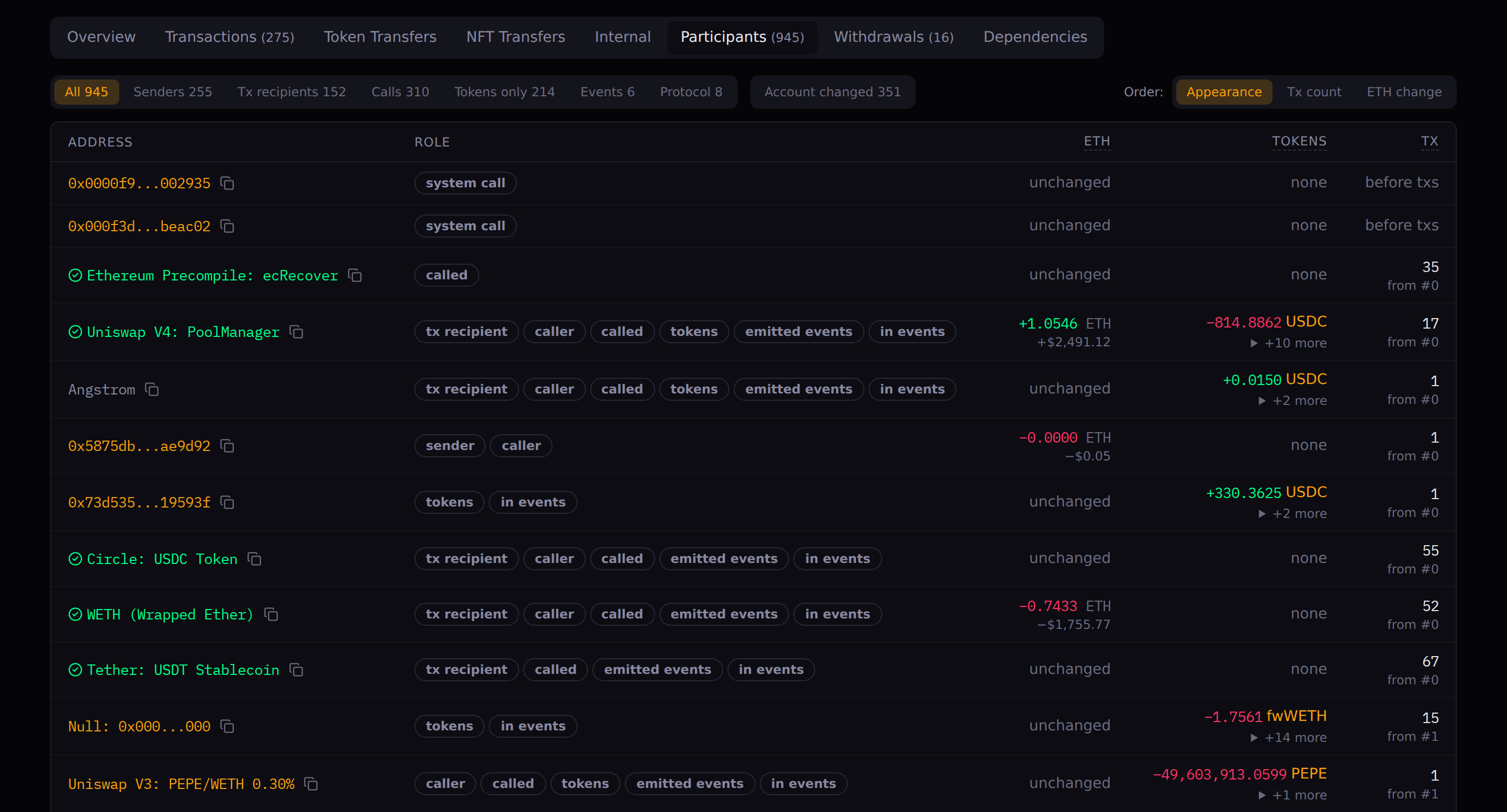
The tab lists every address that took part in the block, not only the ones whose own account changed. Chips split the list by kind — senders, transaction recipients, called contracts, addresses that only moved tokens, addresses that only appear in events, and protocol addresses — and **Account changed** shows the narrower set whose balance, nonce or code changed. Order rows by appearance, transaction count or ETH change.
Each row names all of the address's roles in the block (*sender*, *tx recipient*, *caller*, *called*, *deployed*, *emitted events*, *7702 signer* and so on), its ETH change, its token flows, and the transactions it took part in. An address that acted outside any transaction — a system call before the first one, a withdrawal after the last — reads *before txs* or *after txs* in the transaction column. The count is marked *provisional* while the newest blocks are still being processed.
In a cell, *unchanged* is a fact, *…* means not counted yet, and *—* means the measure does not apply. Older links to `?tab=addresses` open the **Account changed** view.
### Dependencies
A transaction depends on an earlier one when it reads a storage slot that the earlier one wrote in the same block. The top of the **Overview** tab draws this as an arc diagram: transactions in block order along a line, an arc from each transaction to the earlier one whose write it read, thicker for more slots. A sentence names the strongest link and the transaction linked to the most others, and the two are highlighted differently. Hover a transaction or an arc for its links; click a transaction to open it.
The **Dependencies** tab lists every such pair: the transaction, the one whose write it read, the contract and the slot. The same facts for a single transaction are on its [State tab](/explorer/transactions#state).
Signed in, a star on a row of the transfer and internal feeds saves it to your [Favorites](/favorites).
Prev / Next step through the chain block by block, and `?tab=` deep-links any tab.
## Related pages
* [Block KPIs](/dashboard/block-kpis) — the same block facts, live on the dashboard
* [Block mix](/dashboard/block-mix) — each recent block by kind of transaction, live
* [Signals](/dashboard/signals) — control and delegation changes spotted in each block
* [Transactions](/explorer/transactions) — drill into any row
* [Gas & Blobs](/dashboard/gas-and-blobs) — blob market and gas trends over time
* [Storage Analytics](/dashboard/storage-analytics) — where storage writes concentrate
# Transactions
[Open the transaction explorer in TraceFast →](https://tracefast.xyz/tx)
## The transaction list
A live list of transactions as they land, one row each: hash, method, block, timestamp (UTC), sender and recipient (labeled where known, for signed-in viewers), native value, the token moved (with *+N* when more than one moved), and the fee paid. Filters narrow it by status (success / failed) and by method — `transfer`, `transferFrom`, `approve`, `swap`, `deposit`, `withdraw`, `execute`, `multicall` — and page size is adjustable.
Every hash, address and block number in the table is a link, so the list is a jumping-off point rather than a destination.
## The transaction page
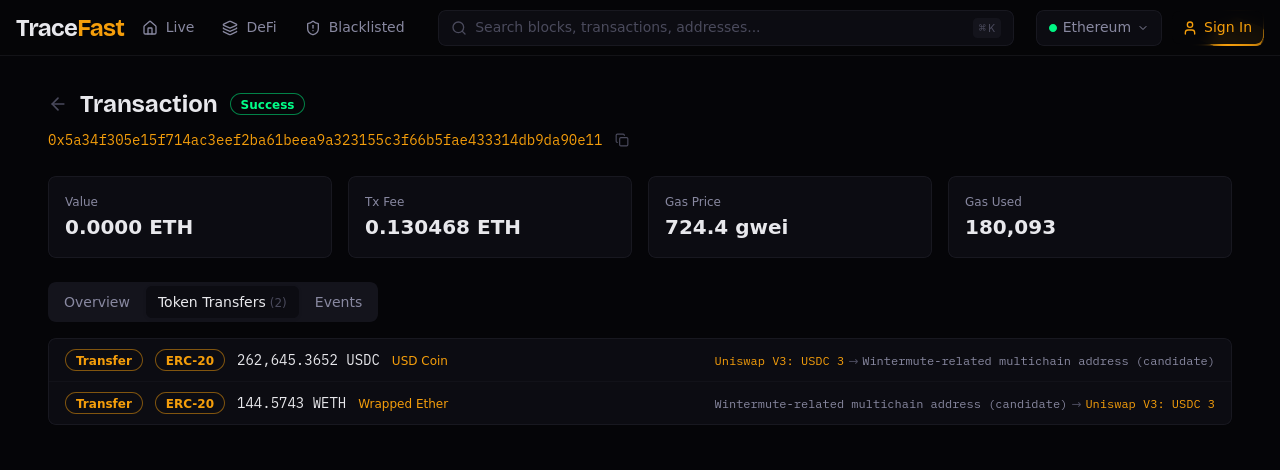
A transaction page leads with the verdict — **Success** or failure — the block,
how long ago it landed, and behaviour chips where they apply (`delegatecall`,
`SELFDESTRUCT`, `Storage-heavy`). Beside the hash, `Tx N of M in block` steps
through the block's transactions in order.
Under the KPIs sits one plain sentence saying **what the transaction did** —
*"A token transfer: USDC"* — so the tabs answer questions you already have.
Four KPIs:
* **Value** — native ETH moved by the top-level call, with its USD value.
* **Token Transfers** — how many token movements the transaction produced.
* **Tx Type** — Legacy, EIP-1559, EIP-4844 (blob) or EIP-7702, with a note on what the format implies for fees.
* **Method** — the function called, resolved from its 4-byte selector. A bare `0x…` selector means the signature isn't in the set TraceFast resolves against — not that the call did nothing.
Behavioural pills appear next to the header when they apply — for example `SELFDESTRUCT` or `Storage-heavy`.
### Tabs
Each tab label carries its count.
* **Overview** — block and position, sender, recipient, nonce; a **Gas & fees**
block with gas used against the limit, the effective gas price actually paid,
the max fee and max priority fee the sender authorised, and the total fee
split into the burnt share, the part paid to the validator, and what was left
under the cap; an **Execution** summary — internal (value-carrying) transfers,
committed storage writes and slots written, contracts touched, and maximum
call depth; and **Opcode counts** (below).
* **Token Transfers** — every fungible movement the transaction caused, with
amounts, symbols and labeled endpoints, under a **Net flow** panel (below).
One glance shows the full story of a swap: USDC out, WETH back, through a
labeled market maker.
* **NFT Transfers** — ERC-721 and ERC-1155 movements, kept apart because a
token id is not an amount.
* **Events** — the raw log entries, decoded where the ABI is known, for when
you need exact contract-level truth.
* **State** — what the transaction changed: accounts, storage, transient
storage, and its dependencies on other transactions in the block (below).
* **Trace** — the full call tree.
Signed in, a star on a transfer, an event, a token or a call in the tree
saves it to your [Favorites](/favorites).
### Opcode counts
A panel of its own beside Execution, because it counts something different:
Execution reports what was committed, while opcode counts include frames that
later reverted. It shows `SLOAD`, `SSTORE`, `TLOAD`, `TSTORE` and `KECCAK256`
counts, precompile calls, how many contracts' storage was used, creates and
self-destructs, the gas spent in reverted frames, and whether any
`DELEGATECALL` ran.
### Net flow
What each address ended up with over the whole transaction: tokens from the
transfers on the tab, and ETH from the address's balance change — so ETH that a
swap paid out through an unwrap is counted. The sender's ETH figure includes
gas. A USD net is shown when every leg has a price for the transaction's hour.
If the ETH side cannot be read, the panel says so rather than showing zero.
### Trace

The trace answers *how* the transaction did what it did:
* **Gas hotspots** — which frames burnt the gas, as a share of the total, so an
expensive transaction points at its own cause.
* **Repeated calls** — the same call to the same contract made more than once.
* **Participants** — how many contracts were called and how many ran through
`DELEGATECALL`, with the repeat count per address.
* **The tree** — every frame with its call type, caller and callee (labeled),
the selector, the logs it emitted, and its depth; expand and collapse all, or
jump to a depth.
* **The frame panel** — for the selected call: the sender, the contract whose
**state** was used and the contract whose **code** ran (the pair that makes a
proxy call readable), gas used against the frame's limit, the selector, and
the logs and transfers that frame caused, and its input. Long calldata shows
its first bytes and says so; arguments are not decoded from a partial
payload. When the input is itself text — an on-chain message, for example —
it is also shown **As text (UTF-8)**, as plain text; links in it are not
clickable. Where calldata is unavailable, the panel says so instead of showing
an empty box.
**Calls into an EIP-7702 account.** When a call goes to an account that has
delegated its code under [EIP-7702](https://eips.ethereum.org/EIPS/eip-7702),
the account holds only a pointer; the code that runs is its delegate's, in the
account's own storage. The frame panel then names both: the **Delegated
account** the call went to, and the contract whose code actually ran, marked
*Via EIP-7702 delegation*. **Delegation set** says where that delegation came
from — the block, the transaction's position in it, and the authorization's
position in that transaction's list — and links to the transaction that set it.
For a very recent block, the panel may say that it is not resolved yet whether
the callee is a delegated account; ask again a little later.
`?frame=` selects a call by its position in the tree: the tree expands to it
and scrolls it into view. If the position is not in the trace shown — for
example, past the end of a long trace that was cut — the page says that rather
than guessing.
### State

The tab has four sections:
* **Accounts** — every account the transaction changed: balance before and
after, the change, nonce, and badges for code and storage (for example, an
account that did not exist before). Some changes are never in this list:
block-level movements such as validator withdrawals, a fee recipient that
received only the priority fee, and an account created and destroyed in the
same transaction.
* **Storage writes** — every write to contract storage, grouped per contract:
the slot, the value before and after, the frame type and the address whose
code wrote it. Where the slot's layout is known, it is named as a variable —
`slot 3`, or `slot 5 [0xa0b8…]` for a mapping entry and its key — instead of
a raw hash; otherwise the raw slot stands with a note.
* **Transient storage** — writes to transient storage (EIP-1153): values that
live only until the transaction ends, such as re-entrancy locks. Only writes
from frames that did not revert are listed.
* **Dependencies in this block** — the earlier transactions whose writes this
one read, and the later ones that read what it wrote, with the number of
slots and contracts. See [Blocks → Dependencies](/explorer/blocks#dependencies).
A "before" value is shown only where it is stated. Otherwise the cell is a
dash, and its tooltip gives the reason — never a zero, which would be a real
slot value.
\:::tip Trace and transfers are two halves of one picture
**Trace** shows *how* a transaction did what it did — the tree of contract
calls. **Token Transfers** shows *what it accomplished* — the assets that
actually moved. Reading them together is the fastest way to understand a
complex transaction: trace for mechanics, transfers for meaning.
The same call tree is also reachable from the [transaction drawer](/dashboard/transaction-economics#the-transaction-drawer)
on the live dashboard, for a transaction you spotted in the stream.
\:::
\:::info Gas Price vs Max Fee Per Gas
**Gas Price** is what was charged — base fee plus priority tip. **Max Fee Per Gas** is only the ceiling the sender authorised. On a quiet network the two diverge sharply, and the difference is not a saving the sender chose, it is a bid that was never met.
\:::
## Deep links
Both the tab and the page position live in the URL, so any view is shareable:
* `https://tracefast.xyz/tx/0x…?tab=token-transfers` — opens straight to transfers
* `https://tracefast.xyz/tx/0x…?tab=nft-transfers` — the NFT movements
* `https://tracefast.xyz/tx/0x…?tab=events` — opens straight to the logs
* `https://tracefast.xyz/tx/0x…?tab=state` — the storage writes
* `https://tracefast.xyz/tx/0x…?tab=trace` — the call tree
* `https://tracefast.xyz/tx/0x…?log=5` — one event, by its position in the
transaction: the page opens the tab and page that show it, and highlights it
* `https://tracefast.xyz/tx/0x…?tab=trace&frame=…` — one call in the tree
* `https://tracefast.xyz/?tx=0x…` — opens the transaction drawer on the live dashboard
## Related pages
* [Transaction Economics](/dashboard/transaction-economics) — the drawer: gas & fee decomposition plus the call trace
* [Blocks](/explorer/blocks) — the block that carried the transaction
* [Failed Transactions](/dashboard/failed-transactions) — where gas is being burnt on reverts
* [Entity Page](/explorer/entity) — follow any participant
# Addresses & Labels
[Open a labeled address in TraceFast →](https://tracefast.xyz/entity/0x28c6c06298d514db089934071355e5743bf21d60)

Every address opens at one URL — `/entity/{address}` — whether it is a wallet,
a contract or a token. The [Entity Page](/explorer/entity) documents that page
in full: its tabs, feeds, graph and deep links. **This page is about the layer
on top of the chain data**: who the address is, how sure we are, and which
statements are attributions rather than proofs.
## Finding an address
Search (⌘K) accepts an address, a transaction hash or a block
number. You can also arrive by clicking: every counterparty, holder, deployer,
implementation and feed row in the app is a link to that address's page, so
following a flow is a chain of clicks rather than a chain of copy-pastes.
## Identity
The line under the hash is what the platform is willing to say about identity:
* **Name** — *Binance 14 (Hot Wallet)*, *Circle: USDC Token* — from the
labelling layer, with a verification mark only where the data says verified.
An unlabeled address shows its hash and nothing more, which is a statement in
itself — unless what it is, is known without a name: then a quiet descriptor
follows the short address, such as *0x1234…abcd Curve · Liquidity gauge*.
A name that only says what kind of contract this is — a class, not an
identity — is shown dimmed, so it is not read as the name of an owner. A
flagged address carries a risk icon in the colour of its verdict, never a
word in place of its name; hover it for the reasons. Names, tags and risk flags are shown to **signed-in** readers; a
reader who is not signed in sees the hash and a line inviting them to sign
in, while kind, chain facts and behaviour signals stay visible to everyone.
* **Kind** — one word for what the address is: `EOA`, `Address`, `Smart account`,
`Contract`, `Token`, `NFT token`, `Multi-token`. It comes from proven chain
facts, not from the label, so a token nobody has named still reads as a token.
* **Entity** — the organisation an address belongs to. One entity typically
spans many addresses; see [Labels & Entities](/concepts/labels-and-entities)
for how names, categories and attributes are assigned, and with what
confidence.
## Behaviour signals
Under the name sits a row of quiet, square-cornered signals — observations
about behaviour and scale, deliberately shaped differently from the amber
chain-fact chips above them, because they make a different kind of claim. Most
of them lead to the tab that shows the evidence:
| Signal | What it means |
|---|---|
| `High traffic` | Very high transaction volume (≥ 100,000 transactions) |
| `Whale` | Large native ETH balance (≥ $1M) |
| `New` | First seen on-chain within the last ~30 days |
Beside the key numbers, a liveness chip answers a separate question:
**Active** — activity within the last year, counting transactions, internal
calls, events and token transfers alike — or **Dormant** when there has been
none of any kind for over a year.
## Attributions are not proofs
Two rows sit next to each other on the page and they are not the same kind of
statement:
* **Chain facts** are derived from chain data: what the address is, what its
code does, where it has appeared. They are stated only when proven — see
[Chain facts](/explorer/entity#chain-facts).
* **Labels** — names, entities, categories, risk marks — come from the
labelling layer, not from on-chain strings. They carry a source and a
confidence, and a name is an attribution: useful, checkable, and not the same
as a proof. An
[ecosystem label](/concepts/labels-and-entities#ecosystem-labels) is anchored
on chain — it records the rule and the factory whose creation event produced
it — but it is still a label, not a chain fact.
## Compliance context
If an address appears as a blacklisted subject in a token contract, the page
says so in one line — and says what it is not: a listing by an arbitrary token
is not a sanctions designation. Open the check to see which issuers, with their
authority context, in [Blacklist Monitoring](/compliance). An address absent
from every tracked blacklist is still worth reading in full; a clear result is
a statement about the tracked corpus, not a general screen.
## Deep links
The tab, the section and the filters live in the URL, so a view is shareable as
you found it:
* `https://tracefast.xyz/entity/0x…` — the address
* `https://tracefast.xyz/entity/0x…?tab=transfers` — straight to token transfers
* `https://tracefast.xyz/entity/0x…?tab=storage` — straight to storage activity
* `https://tracefast.xyz/entity/0x…?atBlock=20000000` — read it as of a past block
The full parameter list is on the [Entity Page](/explorer/entity#url-parameters).
## Related pages
* [Entity Page](/explorer/entity) — the page itself, tab by tab
* [Labels & Entities](/concepts/labels-and-entities) — how names, categories and confidence work
* [ETH Flows](/dashboard/eth-flows) — labeled addresses in live motion
* [Blacklist Monitoring](/compliance) — the compliance corpus behind the line above
* [Address attribute dictionary](/api/address-attributes) — the same chain facts over the API
# Tokens
[Open the token explorer in TraceFast →](https://tracefast.xyz/tokens)

## The transfer feed
The token landing page is a network-wide feed of token movements, headed by four KPIs: total tokens ever seen, total transfers, holder positions, and the dominant standard with its share of tokens, transfers and holder positions.
Filters narrow the feed by standard (ERC-20 / ERC-721 / ERC-1155), by event (`Transfer`, `Minted`, `Burned`, `Deposit`, `Withdraw`) and by a specific token address; once a token address is set, the feed also narrows by sender or recipient and by amount range. Each row carries a star that saves it to [Favorites](/favorites) for a signed-in reader.
\:::warning Holder positions are not a wallet count
**Holder positions** counts, for each token, the addresses whose transfers in and out add up to a positive amount, and sums that over all tokens — every standard, NFTs included. A wallet holding 40 different tokens counts 40 times, so it is not a distinct-wallet figure and reads higher than the "unique addresses" number other explorers publish. It is counted from transfers, not from balances.
\:::
## A token's own page

Clicking a token opens its [entity page](/explorer/entity) — the same page
every address gets, with the tabs a token earns:
* **Overview** — identity and the chain facts proven about the contract (the
ERC interface in the code, proxy and upgradeability, mint / pause /
blacklist surfaces, whether transfers are backed by matching state), its
relationships (deployer, implementation and the implementations before it),
a price history over 7 / 14 / 30 days, and the counterparties that move it.
* **Transactions** — the contract's own feed, and inside it the token
transfers, NFT transfers, internal calls, state changes, storage writes,
emitted events and DEX trades.
* **Holders** — the current holder table: rank, address (labeled where known),
share of the top 1,000, balance and USD value. The header states the full
holder count and that the ranked view shows the top 1,000 by balance.
* **Pools** — every DEX pool the token trades in, and the token's DEX volume
over the last 7 days (the window is named in the heading, so a total is never
read against a column measured differently).
* **Graph** — value flow and structure around the token.
\:::info Current holders vs everyone who ever held
The **Holders** tab counts addresses with a positive balance *today*. A
lifetime figure — every address that has ever held the token, shown as
**Holders (all-time)** in the header of a brand-new token whose current holders
are not counted — answers a different question: reach versus current
distribution.
\:::
\:::warning Counterfeit tokens
A token that impersonates a well-known asset is marked as such, and the
relationship is named on the page it impersonates as well. The balances and
transfers shown are real on-chain events of a fake contract — they are not the
asset being impersonated, and they carry no value.
\:::
## Deep links
* `https://tracefast.xyz/entity/0x…` — the token's page
* `https://tracefast.xyz/entity/0x…?tab=holders` — straight to the holder table
* `https://tracefast.xyz/entity/0x…?tab=pools` — straight to the pools it trades in
* `https://tracefast.xyz/tokens?tokenAddress=0x…` — the network feed filtered to one token
The per-token URLs `/tokens/0x…` are retired: a token lives at
`/entity/{address}` like every other address.
## Related pages
* [Top Tokens](/dashboard/top-tokens) — the most-transferred tokens right now
* [DEX & Tokens](/defi/dex-and-tokens) — token activity from the trading side
* [Pools & Liquidity](/defi/pools-and-liquidity) — the pools a token trades in
* [Entity Page](/explorer/entity) — the page a token opens into
* [Labels & Entities](/concepts/labels-and-entities) — how tokens and holders get named
# Smart Contracts
[Open the contract explorer in TraceFast →](https://tracefast.xyz/contracts)
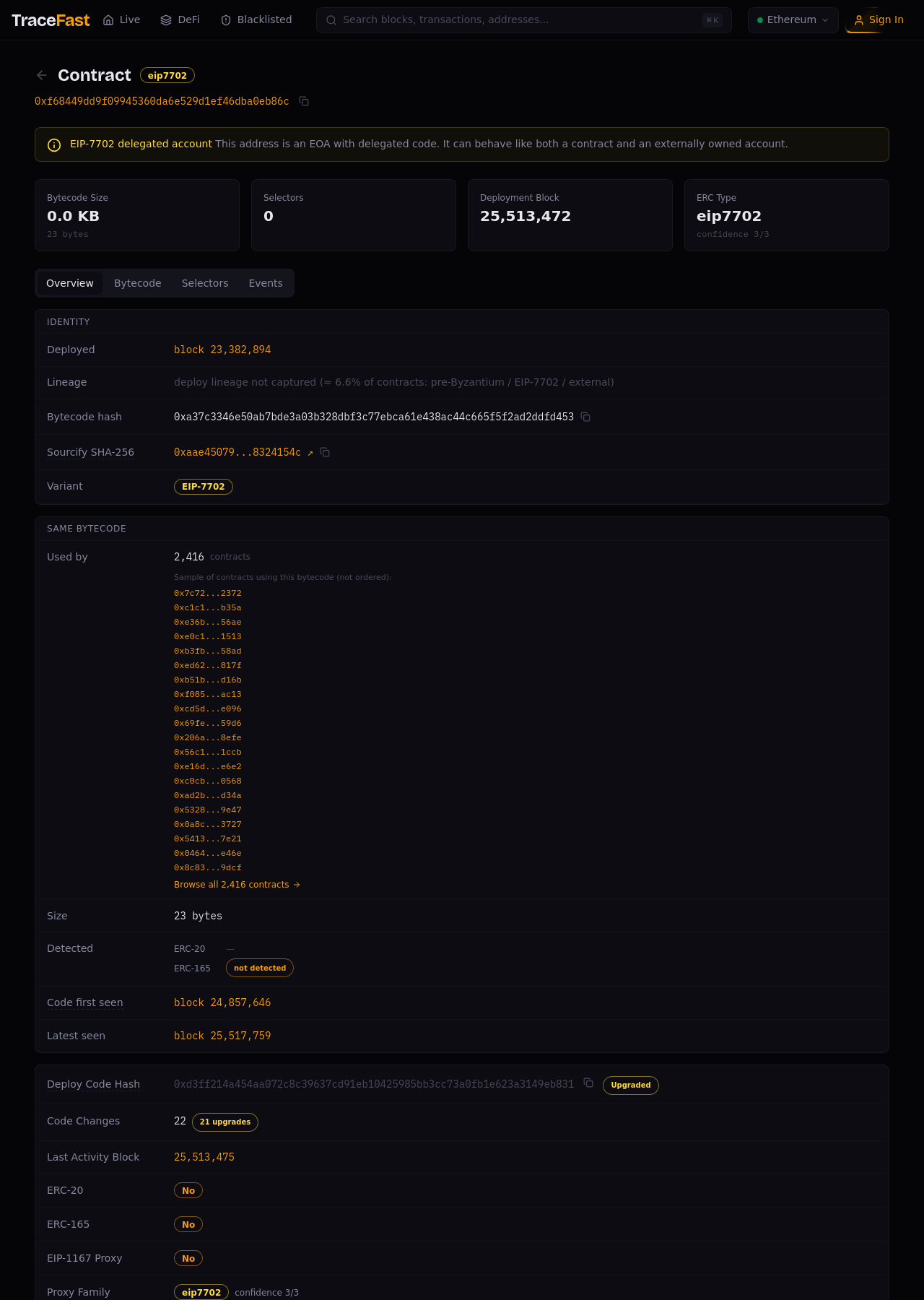
## The contract inventory
The contract list is an inventory of everything ever deployed, newest first, headed by four KPIs: total contracts deployed (with the self-destructed count), ERC-20 and ERC-165 counts, EIP-1167 minimal-proxy clones and their share of all contracts, and deployments in the last 24 hours and 7 days.
Each row carries the contract address, deployment block and age, deployer (where the deploy lineage was captured), detected type, code size, selector count, balance and transaction count.
## A contract's own page
A contract opens at `/entity/{address}` — the same page every address gets, and
the [Entity Page](/explorer/entity) documents it in full. Two of its sections
answer *what this contract is*, as opposed to what it did:
* **Chain facts** — the proven statements about the code: which ERC interfaces
it presents, whether it is a proxy and of which family, whether the
implementation slot is mutable, which privileged surfaces (mint, pause,
blacklist, emergency withdraw) exist in the code that executes, and which of
them have actually been used. Each fact carries the block it was observed at
and states what it does *not* claim.
* **Relationships** — who deployed it and in which transaction, the
implementation it currently delegates to, every implementation before that as
block intervals, the accounts that delegate to it under EIP-7702, contracts
running byte-identical code, and — on an implementation — the proxies that
have delegated to it.
Its behaviour is on the same page under **Transactions**: the calls it
received, the events it emitted, the storage slots it wrote.
\:::info Detection is structural, not a verification
Type and proxy detection come from analysis of deployed bytecode and on-chain
behaviour. They describe shape — ERC interface presence, proxy family,
upgradeability — and never assert source correctness. They are not source
verification and not a security audit.
\:::
## Bytecode families
Identical bytecode across many addresses is itself a signal: factory deployments and clone patterns show up as families of contracts sharing one bytecode hash. A contract's page states how many others run byte-identical code; the cluster itself lives at `/bytecodes/{codeHash}` and lists them.
EIP-1167 minimal proxies dominate this picture — they account for roughly 45% of all contracts ever deployed on Ethereum.
For example, the [bytecode family of the USDC proxy](https://tracefast.xyz/bytecodes/0xd80d4b7c890cb9d6a4893e6b52bc34b56b25335cb13716e0d1d31383e6b41505).
## Deployers
Every contract records who created it: the **Deployed by** relationship names
the deploying account and the transaction that executed the `CREATE`, and the
contract inventory carries a Deployer column you can scan. Where the lineage
was never captured — pre-Byzantium deployments, EIP-7702 delegations,
externally created code — the row says so rather than guessing.
From the other end, a deployer's own page lists what it created on its
[Deployments tab](/explorer/entity/feeds#deployments) — opcode, deploying
transaction, shared or unique deploy-time bytecode, minimal-proxy shape — and
states how much of its history the list covers.
The standalone deployer view (`/deployers/{address}`) is retired along with the
other per-kind pages; a deployer is an address like any other and opens at
`/entity/{address}`.
## Proxy implementations
Proxied contracts (the dominant pattern for upgradeable protocols) separate the
stable address from the logic behind it, and TraceFast reads that link from
both ends — both of them in **Relationships** on the contract's page:
* From the **proxy**: the implementation it delegates to now, and
*Implementations before* — every implementation it has stood on, as block
intervals. An interval with no end was still open at the edge of the
platform's coverage.
* From the **implementation**: *Used by proxies* — the proxies that have
delegated to this contract. It is a sample rather than a count, and the
page says so.
This is essential context, since *what a contract does* can change even when
its address doesn't. Delegatecall-heavy patterns also show up in
[Storage Analytics](/dashboard/storage-analytics) as high delegatecall write
shares.
## Related pages
* [Top Contracts by Gas](/dashboard/top-contracts) — today's busiest contracts
* [Top Method Calls](/dashboard/method-calls) — what's being called network-wide
* [Storage Heatmap](/dashboard/storage-heatmap) — who writes state
* [Entity Page](/explorer/entity) — the page a contract opens into
* [Addresses & Labels](/explorer/addresses-and-labels) — the identity layer on top of it
# DeFi Overview
[Open DeFi in TraceFast →](https://tracefast.xyz/defi/dex/pools)

DeFi is two levels of navigation, not one. Knowing which level you're on is the difference between finding a view in one click and hunting for it.
\:::tip Sign-in required (free account)
Every DeFi page — the sections, the DEX tabs and the drill-down pages — is for signed-in users. Signed out, a page shows **Sign in to open this section** with **Sign in** and **Create account**. A free account is enough; see [Account & Security](/account-security).
\:::
## The four sections
The hub strip at the top of every DeFi page switches between four sections:
| Section | What it covers | URL |
| --- | --- | --- |
| **DEX** | Decentralized exchange activity — pools, tokens, market | `/defi/dex/…` |
| **[Flash Loans](/defi/flash-loans)** | Uncollateralized borrow-and-repay inside one transaction | `/defi/flash-loans` |
| **[LP Liquidity](/defi/lp-liquidity)** | Liquidity add / remove events across protocols | `/defi/liquidity` |
| **[Protocols](/defi/protocols)** | A directory of DeFi protocols and their known contracts | `/defi/protocols` |
Opening **DeFi** from the main navigation lands on **DEX → Pools** — the busiest view, and the section's de facto home.
## The DEX tabs
DEX is the only section with a second level. Three tabs share one header:
* **Pools** (`/defi/dex/pools`) — pool observability: TVL, volume, trending and new pools. See [Pools & Liquidity](/defi/pools-and-liquidity).
* **Tokens** (`/defi/dex/tokens`) — tokens ranked by DEX volume. See [DEX & Tokens](/defi/dex-and-tokens).
* **Market** (`/defi/dex`) — the aggregate: volume, swap count, and protocol market share. See [DEX & Tokens](/defi/dex-and-tokens).
Pool sub-views (**TVL · Volume · Trending · New Pools**) sit a level below that, inside the Pools tab.
## Drill-down pages
Each section opens onto detail pages that carry their own chrome — no hub strip, because you've left the browsing level:
| Page | URL |
| --- | --- |
| Pool detail | `/defi/dex/pools/0x…` |
| DEX protocol dashboard | `/defi/dex/protocols/` |
| Flash loans in one transaction | `/defi/flash-loans/by-tx/0x…` |
| Liquidity events in one transaction | `/defi/liquidity/by-tx/0x…` |
\:::info Old DEX links still work
DEX views used to live at flat paths — `/defi/tokens`, `/defi/pools`, `/defi/pools/0x…`. Those now redirect permanently to their `/defi/dex/…` equivalents, so saved links and bookmarks keep resolving. New links should use the `/defi/dex/…` form.
\:::
For example, the pool page of [Uniswap V3 USDC/WETH 0.05%](https://tracefast.xyz/defi/dex/pools/0x88e6a0c2ddd26feeb64f039a2c41296fcb3f5640).
## Two things called "Protocols"
They are different views and it is worth keeping them apart:
* **[DEX protocol dashboards](/defi/dex-and-tokens#per-protocol-dashboards)** (`/defi/dex/protocols/`) — volume, swaps and pool counts for one exchange, reached by clicking a protocol in Protocol Market Share.
* **[The Protocols section](/defi/protocols)** (`/defi/protocols`) — a directory of DeFi protocols, each with the contracts TraceFast knows belong to it, well beyond exchanges.
## Related pages
* [Pools & Liquidity](/defi/pools-and-liquidity) — the DEX Pools tab and the pool page
* [DEX & Tokens](/defi/dex-and-tokens) — the Market and Tokens tabs
* [DEX Activity](/dashboard/dex-activity) — the live-window pulse on the dashboard
* [Tokens](/explorer/tokens) — a token's own page, including the pools it trades in
# Pools & Liquidity
[Open the pool explorer in TraceFast →](https://tracefast.xyz/defi/dex/pools)
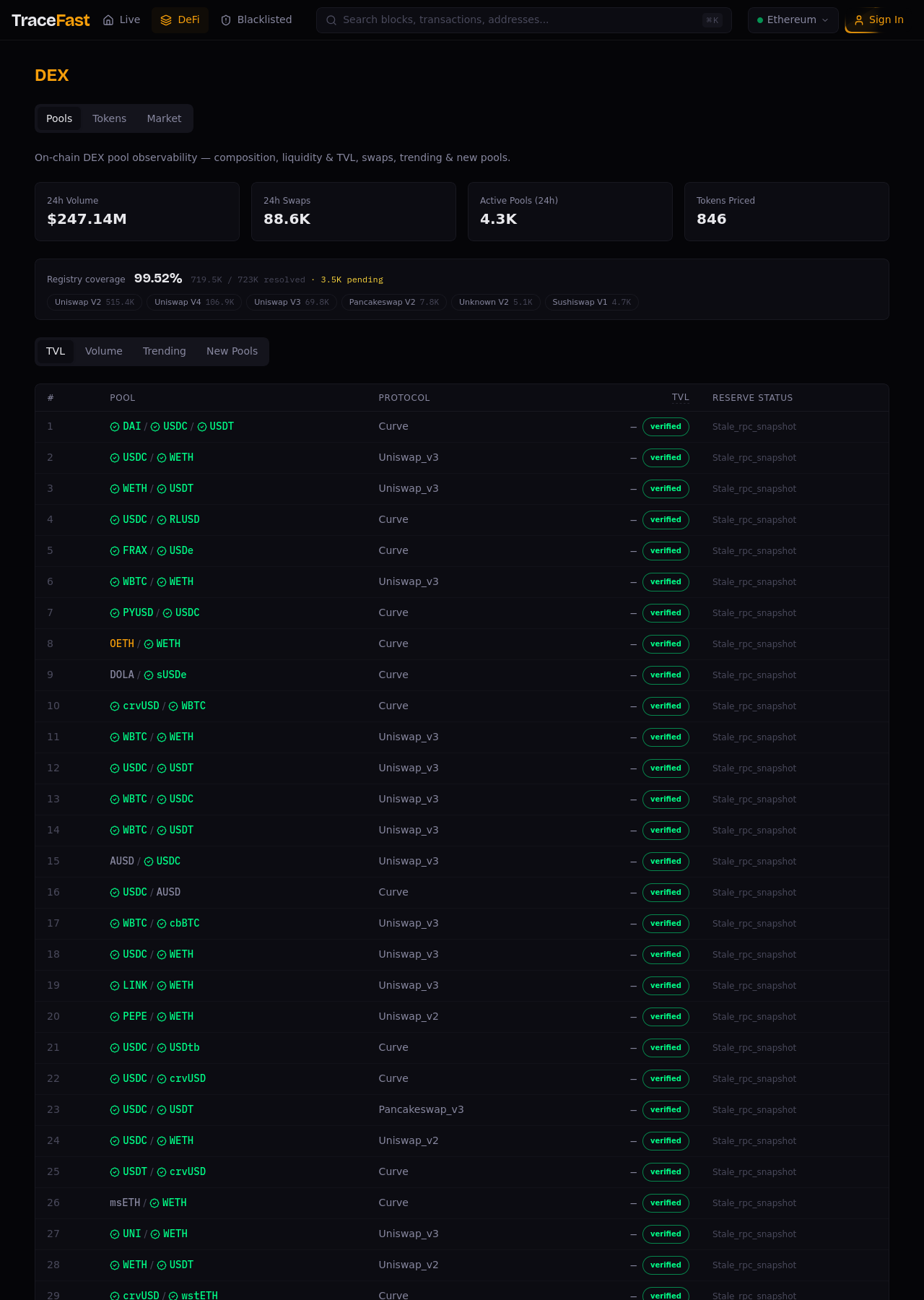
## What it shows
The **Pools** tab of the [DEX section](/defi/overview) (`/defi/dex/pools`) — and where opening **DeFi** from the main navigation lands you.
On-chain observability for hundreds of thousands of DEX pools: composition, liquidity and TVL, swap activity, and discovery views for what's **Trending** and what's **New**. Four sub-views rank the same registry differently: **TVL**, **Volume**, **Trending**, and **New Pools**.
The tab opens with the same cards as [Market](/defi/dex-and-tokens#market) — volume and swaps over the last 2 UTC days and tokens priced — plus **Registry coverage**. That coverage figure is worth noticing: it reports how many pool contracts TraceFast has resolved (typically >99%), broken down by protocol — Uniswap v2/v3/v4, PancakeSwap, SushiSwap and the rest, with pools whose protocol is not identified counted apart (*Unidentified v2*). That number is the honest answer to "how much of the DEX universe does this actually see?"
## How to read it
* **TVL / Volume** — rank pools by locked value or trading activity. Blue-chip pairs (stablecoins, WETH, WBTC) fill the top. The **Protocol** column names the exchange and its version — *Uniswap v2*, *Uniswap v3*, *Uniswap v4*, *Curve* — so a v4 pool is told apart from a v3 pool of the same pair. A Uniswap v4 pool that holds native ETH names it as ETH. Next to the TVL, `verified` means the pool's reserves were confirmed against chain state and `estimated` that they were not; the reserve-status column tells you how fresh that confirmation is.
* **Risk marks** — when a token of a pool is flagged, a risk glyph stands before the pool's name, wherever the pool is shown. Hover it for the token's verdict — *A token of this pool impersonates WETH — flagged malicious (0x…)*. The mark is about the token; the pool itself is not called malicious. Like every risk mark, it is shown to signed-in users.
* **Trending** — pools gaining activity fastest. This is where market attention shows up before it shows up anywhere else.
* **New Pools** — freshly deployed pools. New pool + unknown token + sudden volume is the classic signature of both genuine launches and rug pulls; the pool page and its token labels help you tell which.
Each pool links to its own page — composition, swap history, and liquidity events. Liquidity changes can also be explored **by transaction**, which pairs naturally with the [transaction drawer's trace view](/dashboard/transaction-economics#the-transaction-drawer).
## The pool page

Every pool opens to its own page at `/defi/dex/pools/0x…` (pools without a unique address are addressed by identifier instead, at `/defi/dex/pools/by-uid/…`). A header states the essentials — protocol and version, fee tier, resolution confidence, TVL (or an honest **TVL unavailable** when reserves can't be verified), and 24h/7d volume and swap counts — and the detail is split across tabs:
* **Overview** — token composition, a volume-and-swaps chart, and the most recent swaps.
* **Liquidity & TVL** — locked value over time and its reserve breakdown.
* **LP Liquidity** — this pool's own add/remove events (the [LP Liquidity](/defi/lp-liquidity) feed, scoped to one pool).
* **Swaps** — the full swap history, not just the latest.
* **Price** — price derived from the pool's own on-chain trades.
* **Risk & Trust** — signals composed from entity labels, proxy/upgradeability, [blacklist status](/compliance), pool age, composition, and trusted TVL. The panel is deliberate that *absence* of a signal is not a safety guarantee — it flags what it found (an upgradeable token contract, say), not everything that could be wrong.
* **Dependencies** — the contracts the pool relies on, per protocol: a Uniswap pool's factory (plus its hook on V4), a Curve pool's gauge and LP token, a Balancer pool's vault and rate providers.
For example, [Uniswap V3 USDC/WETH 0.05%](https://tracefast.xyz/defi/dex/pools/0x88e6a0c2ddd26feeb64f039a2c41296fcb3f5640).
## Related pages
* [DeFi Overview](/defi/overview) — how the section is laid out
* [DEX & Tokens](/defi/dex-and-tokens) — the other two DEX tabs
* [LP Liquidity](/defi/lp-liquidity) — liquidity add/remove events across all pools
* [DEX Activity](/dashboard/dex-activity) — the live-window pulse
* [Addresses & Labels](/explorer/addresses-and-labels) — inspect a pool contract
# DEX & Tokens
[Open the DEX market in TraceFast →](https://tracefast.xyz/defi/dex)
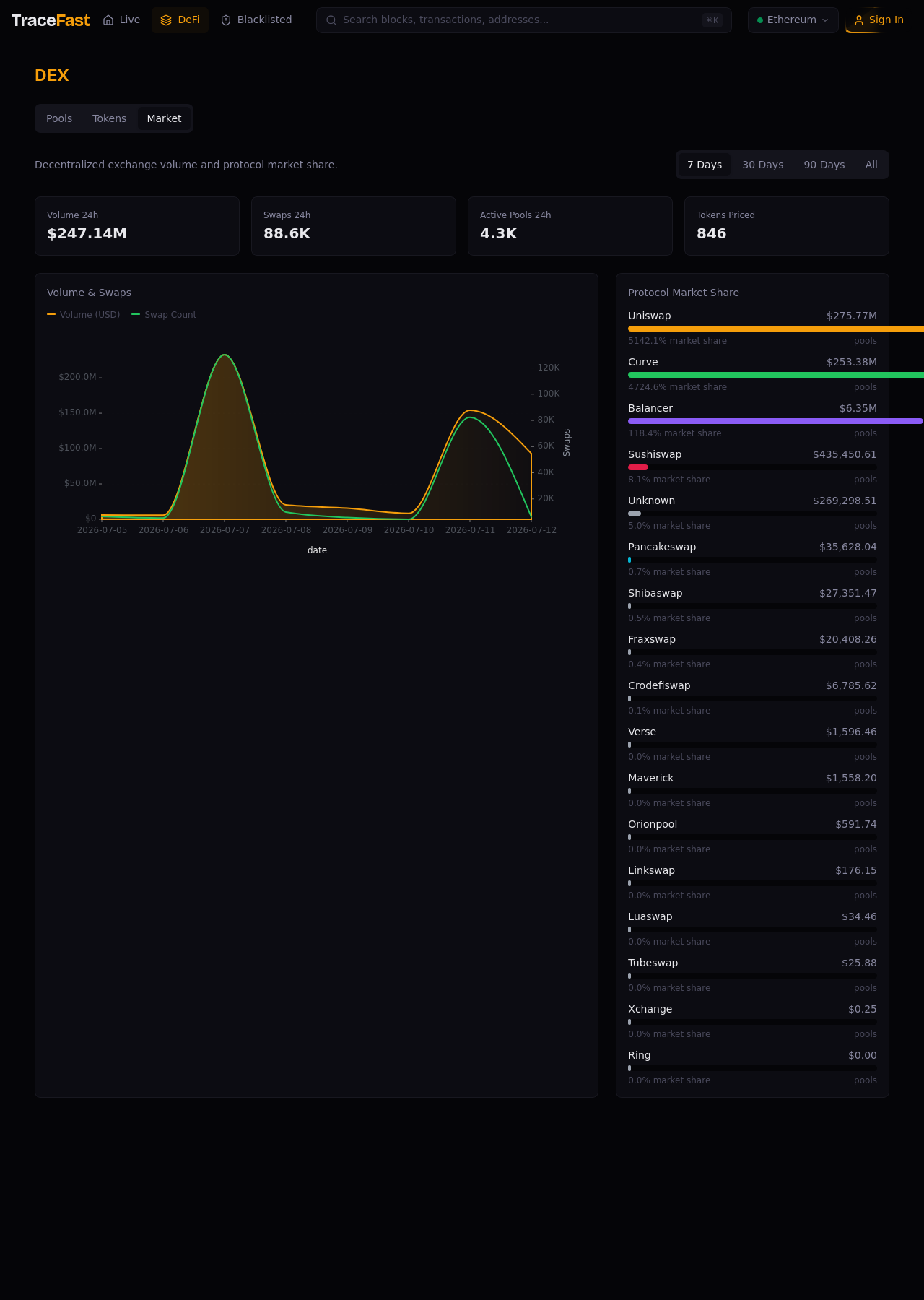
**DEX** is one of the four [DeFi sections](/defi/overview), and the only one with tabs of its own: **Pools**, **Tokens**, and **Market**. This page covers Market and Tokens; the Pools tab has its own page, [Pools & Liquidity](/defi/pools-and-liquidity).
## Market
`/defi/dex` — the aggregate view. Three cards open it, the same on Market and on Pools: **Volume** and **Swaps** over the last 2 days (UTC) and **Tokens priced**. A volume marked `≥` is a lower bound: it adds only the swaps that could be priced. Under the period selector (**7 Days**, **30 Days** — the default — **90 Days**, **All**) come **Top pools by volume** — the five pools that traded most over the period, with **All pools by volume →** to the full list — and two charts, USD volume and swap count, each starting from zero. A volume that rises while swaps stay flat means larger average trades. The charts count UTC days, and the caption says when today is still in progress. **Protocol Market Share** splits the period's volume across DEX protocols — each with its volume, share (`<0.1%` for the smallest) and the most pools active on one day — in a box that scrolls; pools whose protocol is not identified are summed apart as **Unattributed pools**.
### Per-protocol dashboards
A protocol in Protocol Market Share that has a dashboard links to it (`/defi/dex/protocols/` — `uniswap`, `curve`, `balancer`, `pancakeswap`, `sushiswap` and the rest). It scopes the same picture to one venue: 7-day volume and swaps, total and active pool counts, a volume-and-swaps chart, and a breakdown by protocol version.
These dashboards are *not* the same thing as the [Protocols section](/defi/protocols), a directory of DeFi protocols and their contracts that goes beyond exchanges. Like all of DeFi, both need sign-in (a free account is enough).
## Tokens

`/defi/dex/tokens` — assets ranked by DEX trading volume over 24 hours, 7 days or 30 days, with price, volume, swap count, and the number of pools each trades in. Volume is USD where a price exists and native token volume where it doesn't, rather than silently dropping unpriced assets.
Pricing derived from actual swaps has a virtue centralized feeds lack: it reflects what the asset *actually trades for* on-chain, including thin and exotic pairs. Each token links to its own [entity page](/explorer/entity) for holders, transfers and pool membership.
Open it at [DEX tokens](https://tracefast.xyz/defi/dex/tokens) (sign-in required, a free account is enough).
## How to read it
Sudden market-share shifts between protocols usually track incentive programs or new pool deployments. A token appearing in the priced list for the first time is often the first public record of its market existence.
## Data & update cadence
Charts aggregate per UTC day over the selected period (7, 30 or 90 days, or all time; 30 by default); the cards cover the last 2 UTC days.
## Related pages
* [DeFi Overview](/defi/overview) — how the section is laid out
* [Pools & Liquidity](/defi/pools-and-liquidity) — the third DEX tab, pool by pool
* [Tokens](/explorer/tokens) — a token's own page: holders, transfers, pools
* [DEX Activity](/dashboard/dex-activity) — swaps in the live window
* [Flash Loans](/defi/flash-loans) — DeFi's most advanced maneuver
# Flash Loans
[Open flash loans in TraceFast →](https://tracefast.xyz/defi/flash-loans)
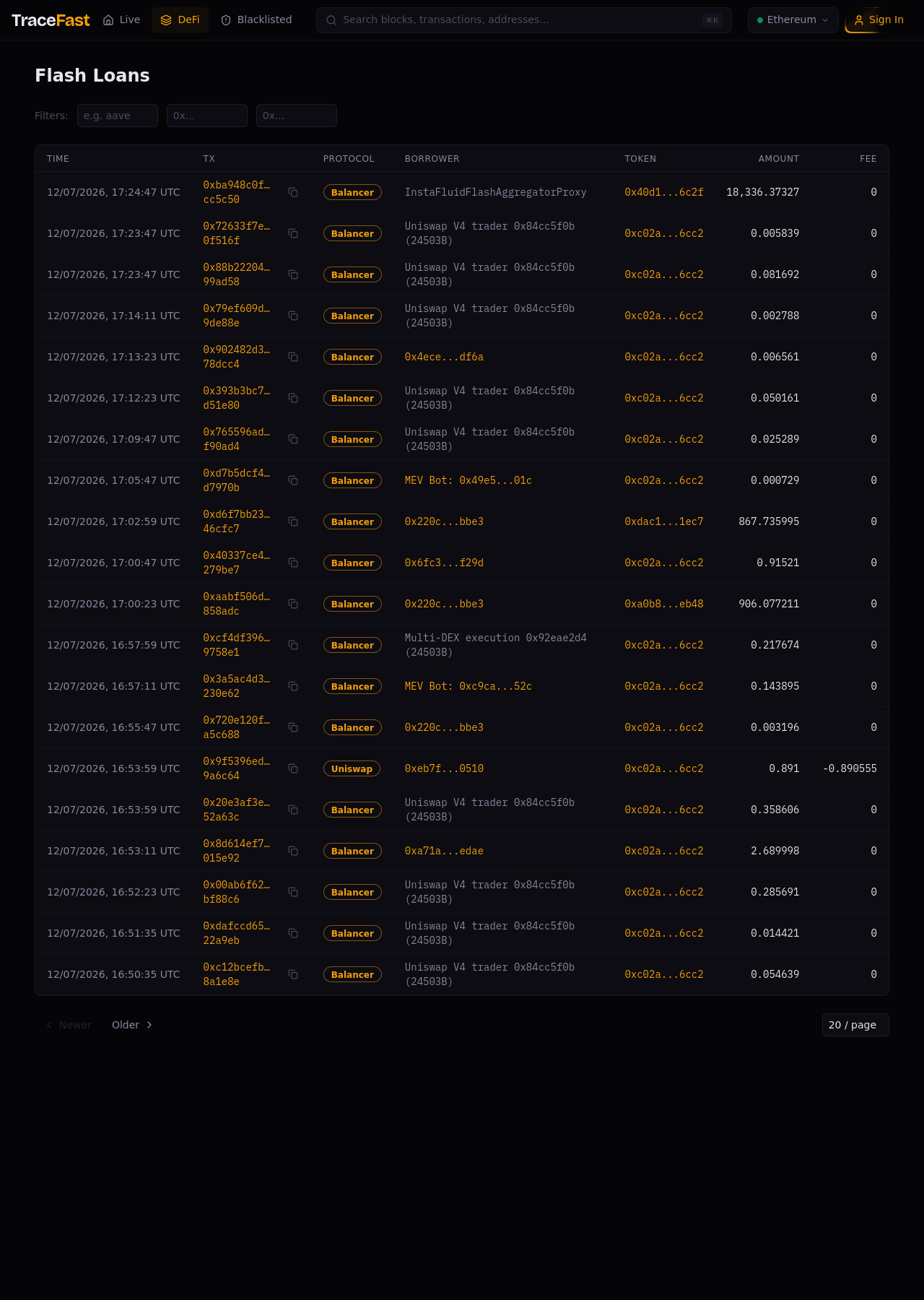
## What it shows
Flash loans are DeFi's strangest primitive: borrowing any amount with **no collateral**, provided the loan is repaid within the same [transaction](https://ethereum.org/developers/docs/transactions/) — if it isn't, the whole transaction reverts as though nothing happened.
**Flash Loans** is one of the four [DeFi sections](/defi/overview). It decodes flash-loan events into a chronological feed: time, transaction, protocol, borrower (labeled where known — *MEV Bot* recurs often), token, amount and fee. Three filters narrow it: protocol, borrower address, and token address.
### One transaction at a time
A single transaction can carry several flash loans, and reading them together is what makes the choreography legible. In the feed, the transaction hash opens the [transaction page](/explorer/transactions) and the protocol opens its [DEX protocol dashboard](/defi/dex-and-tokens#per-protocol-dashboards). The per-transaction view lives at `/defi/flash-loans/by-tx/0x…` — put the hash in the address — and lists every flash loan in that transaction, one row per event, with the log index, protocol and version, borrower, initiator, token, amount (both formatted and raw) and fee.
## How to read it
Flash loans power three very different activities, and telling them apart is the point:
* **Arbitrage** — borrow, trade across venues, repay, keep the spread. High frequency, moderate size, boring — and healthy for markets.
* **Liquidations and refinancing** — capital-efficient position management by sophisticated actors.
* **Attacks** — most DeFi exploits use a flash loan as their opening move, because it turns "attacker with $1M" into "attacker with $100M" for one transaction.
A flash loan wildly out of scale with its protocol's norm, followed by unusual pool activity, is the signature worth investigating. Open the transaction and read its [trace](/dashboard/transaction-economics#the-transaction-drawer) — the call tree shows the full choreography: borrow, the moves in the middle, repay.
Flash loans are also counted live, by what their events did, on the Trader view of [Signals](https://tracefast.xyz/signals).
## Related pages
* [DeFi Overview](/defi/overview) — how the section is laid out
* [Pools & Liquidity](/defi/pools-and-liquidity) — where flash-loan liquidity comes from
* [Transactions](/explorer/transactions) — token transfers complete the trace
* [Failed Transactions](/dashboard/failed-transactions) — failed flash loans land here
# LP Liquidity
[Open LP liquidity events in TraceFast →](https://tracefast.xyz/defi/liquidity)

## What it shows
Every time someone adds or removes liquidity from a DEX pool, the pool emits an event. **LP Liquidity** decodes those events across ~20 DEX protocols — Uniswap V2/V3/V4, Curve, Balancer, and the rest — into one chronological feed of who moved liquidity, where, and how much. Where the [Pools](/defi/pools-and-liquidity) view is organized by pool, this one is organized by *event*: the individual add and remove actions, ranked and filterable.
Three tabs frame the same stream around a different question:
* **Largest Removals** — the biggest liquidity withdrawals in the window, sorted by size so exits stand out.
* **Whale Moves** — the largest liquidity providers by position change: who is putting capital in, or pulling it out, at scale.
* **Outflow Monitor** — pools showing a sustained net outflow, i.e. a potential **drain signal**.
## How to read it
Liquidity leaving a pool is normal — providers rebalance constantly. What's worth attention is *shape*: a single outsized removal, or a steady one-directional outflow that the **Outflow Monitor** flags. Paired with a freshly-deployed pool and an unknown token, that pattern is the classic signature of a rug pull — the liquidity that made the token tradable being pulled out from under holders. On an established blue-chip pool the same outflow is usually just a large provider rotating capital.
Each event links to its pool and to the transaction that carried it, so you can go from "large removal" to the [pool page](/defi/pools-and-liquidity) and its [trace](/dashboard/transaction-economics#the-transaction-drawer) in two clicks.
The **Coverage** column is the honesty check on every USD figure: it states what share of the event's legs carry a price. A removal shown at `100% priced` is fully valued; a partial figure understates the true size, and the column says so rather than quietly rounding it in.
A single removal that takes half of a pool's reserve also appears live as *Liquidity removed from a pool* on the Trader view of [Signals](https://tracefast.xyz/signals).
### One transaction at a time
A row's transaction hash opens `/defi/liquidity/by-tx/0x…` — every liquidity event that transaction produced, which is how a multi-pool rebalance or a staged exit reads as one action instead of several unrelated rows.
## Data & update cadence
Events are decoded from pool logs as blocks are ingested; the timeframe selector (24h / 7d / 30d) sets the window each tab aggregates over. The full history is paginated, running back tens of thousands of events.
## Related pages
* [DeFi Overview](/defi/overview) — how the section is laid out
* [Pools & Liquidity](/defi/pools-and-liquidity) — the pool-level view, and each pool's own liquidity tab
* [Flash Loans](/defi/flash-loans) — the other high-signal DeFi maneuver
* [DEX & Tokens](/defi/dex-and-tokens) — the market-wide DEX rollup
# Protocols
[Open protocols in TraceFast →](https://tracefast.xyz/defi/protocols)
**Protocols** is the fourth [DeFi section](/defi/overview) (`/defi/protocols`). It is a directory: DeFi protocols — lending, staking, bridges, oracles and more, well beyond exchanges — each with the number of contracts TraceFast knows belong to it. Where the market-wide [DEX & Tokens](/defi/dex-and-tokens) rollup tells you how much trades on an exchange, Protocols tells you *which addresses are a protocol's own*.
\:::tip Sign-in required (free account)
Like all of DeFi, Protocols is for signed-in users. Signed out, the page asks you to sign in or create an account; see [Account & Security](/account-security) for how sign-in works.
\:::
## How to read it
* **The list** ranks protocols by how many of their contracts TraceFast knows, under the column **Addresses**.
* **A protocol page** (`/defi/protocols/`) lists those contracts by name — for Lido, its staking router, oracles, withdrawal queue, the stETH and wstETH tokens and the rest. Each name opens the contract's [entity page](/explorer/entity). Long lists page with **Newer** / **Older**.
Use it to check whether an address you met in a trace is a protocol's own contract, or to see a protocol's full on-chain footprint before you dig into one of its contracts.
A protocol's contracts open on their entity pages — for example the [Aave V3 Pool](https://tracefast.xyz/entity/0x87870bca3f3fd6335c3f4ce8392d69350b4fa4e2), with the markets and assets it lists in its Relationships.
## Not the same as a DEX protocol dashboard
Two views carry the word *protocol*, and they answer different questions:
| | Protocols section | DEX protocol dashboard |
| --- | --- | --- |
| URL | `/defi/protocols`, `/defi/protocols/` | `/defi/dex/protocols/` |
| Scope | The contracts that belong to a protocol, beyond exchanges | Trading activity for one exchange |
| Reached from | The DeFi hub strip | Protocol Market Share on the [Market tab](/defi/dex-and-tokens#market) |
If you need Uniswap's or Curve's volume, swaps and pool counts, use the [DEX protocol dashboard](/defi/dex-and-tokens#per-protocol-dashboards).
## Related pages
* [DeFi Overview](/defi/overview) — how the section is laid out
* [DEX & Tokens](/defi/dex-and-tokens) — market volume, protocol market share, and the per-protocol dashboards
* [Labels & Entities](/concepts/labels-and-entities) — how TraceFast names the organizations behind addresses
* [Pools & Liquidity](/defi/pools-and-liquidity) — pool-level observability
* [LP Liquidity](/defi/lp-liquidity) — liquidity add/remove events across protocols
# Blacklisted
[Open Blacklisted in TraceFast →](https://tracefast.xyz/compliance)

## What it shows
Some token contracts can freeze funds. Centrally-issued stablecoins and wrapped assets — USDT, USDC, and hundreds of others — ship an admin function that adds an address to an on-chain **blacklist**, after which it can no longer send or receive that token. Every one of those actions is a public transaction. The **Blacklisted** view watches for them across every freeze-capable contract TraceFast tracks and turns the raw events into a live compliance feed.
\:::tip Sign-in required (free account)
Blacklisted is for signed-in users: signed out, the page shows **Sign in to open this section**. A free account is enough; see [Account & Security](/account-security).
\:::
The header counters summarize the current state:
* **Total Blacklisted** — the size of the currently-frozen address set across all tracked contracts.
* **Added / Removed (24h)** — freezes and un-freezes in the last day, with the net change.
* **Tracked Contracts** — how many freeze-capable contracts are under watch.
Under the counters, a line says how far they are complete — *Complete through block 26,390,341. Rebuilt periodically — it can trail the live event feed by a few minutes.* The **Events** tab carries its own *Complete through block N*, which follows the chain more closely.
**Top Blacklist Contracts** ranks issuers by how many addresses each currently holds blacklisted — a quick read on which tokens do the most freezing. Closed, it shows every **recognized issuer** — USDT, USDC, XSGD, EURC, PayPal USD and the like, each with the **issuer** badge; **Show N more issuers** opens the rest. A token that only borrows a stablecoin's name stays under **Show**. It names the *issuer* doing the freezing, not the frozen address. Each row is a link: it opens **Currently Blacklisted** filtered to that issuer's frozen addresses.
Every contract on this page — in the chart and in both tables — carries an **authority badge** that says how much a freeze from it means:
* **issuer** — a recognized issuer (e.g. a regulated stablecoin); its blacklist is authoritative.
* **arbitrary** — a token's self-run blacklist; low authority, and it does not imply the subject is broadly sanctioned.
The distinction matters more than the raw counts: a token with a self-run blacklist can freeze more addresses than a regulated issuer acting on legal process, and the badge is what tells them apart.
\:::info The lists are verified issuers only
The chart and both tabs cover only contracts whose identity is verified, and the page says so beneath the chart — *25 verified issuers of 588 blacklisting contracts. The events and addresses below cover only these issuers — freezes by contracts whose identity is not verified are not shown on this page.* Plenty of unverified contracts run their own blacklists, some of them freezing many addresses; the header counters still count them, the lists do not. Read the chart as "who among the identifiable issuers freezes most", not as the overall leaderboard, and an address missing from the lists as "not frozen by a verified issuer".
\:::
## How to read it
Two tabs split the same data by question. Beside them, **All verified issuers** and **Recognized issuers only** choose whose freezes both tabs list; the choice stays while you switch tabs, page through or check an address.
* **Currently Blacklisted** — the standing set: who is frozen right now, rather than the moment they were frozen.
* **Events** — the chronological feed. Each row is one on-chain action: the **target address** that was frozen, the **contract** that froze (or un-froze) it with its authority badge, **when**, the **transaction** that carried it (the link opens the transaction on its Events tab — the blacklist log itself), the **event** name as the contract emitted it (`Blacklisted`, `AddedBlackList`, `BlackListed` — issuers name it differently), and the **action** (add / remove). When the target is a known entity, its [label](/concepts/labels-and-entities) is shown inline — a frozen address tagged as a sanctioned or malicious entity is the row worth reading first.
A freeze is issuer-level, not protocol-level: it is the token's operator exercising control the token was designed to allow, and it only affects that one token. The same address can be frozen by one stablecoin and untouched everywhere else. Reading a target's [entity page](/explorer/entity) shows the fuller picture — every label and counterparty, not just this one freeze.
USDT and USDC freezes also stream live on the [home page](https://tracefast.xyz/), in the Token freezes widget.
## Check an address

The question the page exists to answer — *is this address on a blacklist?* — has a direct control. Paste an address into the **Check an address 0x…** field between the chart and the tabs, or click **Check this address** next to any row. The page reloads with `?address=` in the URL (so a verdict is shareable as a link), both tabs filter to that address, and a verdict banner appears above them:
* **Blacklisted by recognized issuer** (red) — an authoritative freeze; the banner names the issuing contract(s).
* **Not blacklisted by any recognized issuer. Flagged by N arbitrary token contracts** (amber) — only self-run blacklists have frozen it. Low authority, not a sanction.
* **Not blacklisted by any of the N tracked contracts** (green) — clean across the full corpus.
**Clear** drops the filter and returns to the unfiltered view. The verdict is a statement about the tracked blacklist corpus, not a general sanctions screen — an address can be absent from every token blacklist and still be worth reading in full on its [entity page](/explorer/entity).
## Data & update cadence
Events are decoded from on-chain logs as blocks are ingested, so the feed tracks the chain in near real time. The counters and the currently-blacklisted set are rebuilt periodically and can trail the feed by a few minutes — each states the block it is complete through. History runs back across the tracked contracts, so an address's freeze events stay visible after the fact.
## Related pages
* [Addresses & Labels](/explorer/addresses-and-labels) — inspect any frozen or freezing address
* [Labels & Entities](/concepts/labels-and-entities) — how the entity behind an address is named
* [Transactions](/explorer/transactions) — open the transaction that carried a freeze
* [Token Freezes](/dashboard/token-freezes) — USDT and USDC freezes live on the dashboard
# Address Attributes & Relations
[See the chain facts of an address →](https://tracefast.xyz/entity/0xd8da6bf26964af9d7eed9e03e53415d37aa96045)
The TraceFast knowledge graph answers one question about every address: **what
is it?** The answers come from the chain itself — the code, the state and what
the address has done — and not from anyone's opinion. The graph does not say
who owns an address; names come from the
[labelling layer](/concepts/labels-and-entities).
The graph has two parts:
* **Attributes** — facts about one address: it is a contract, it is a proxy,
its code has a pause function, it has burned tokens before.
* **Relations** — facts that link two addresses: this account deployed that
contract, this proxy runs that implementation, this wallet delegates to that
code.
## Now and at a past block
An address does not always stay what it was. A wallet becomes a smart account,
a proxy changes its implementation, a contract is destroyed and created again
at the same address. TraceFast evaluates the facts again as new blocks land,
and keeps the intervals in which each fact held. Two examples:
* **vitalik.eth** (`0xd8dA…6045`) was a plain account from block 302,086. Since
block 23,459,292 it has been delegated under EIP-7702.
* **USDC** (`0xA0b8…eB48`) is a proxy that has run four implementations. It
changed implementation at blocks 10,743,414, 12,317,814 and 18,963,716.
Every fact carries the block at which it was evaluated. A fact that has a
history can be read at a past block. Not every fact has one yet: a fact without
a history is **current only** — true now, and not stated for an earlier block.
The [entity page](/explorer/entity#reading-an-address-at-a-past-block) marks
such facts, and the API history methods list the families they cover in
`coveredFamilies`.
## What the attributes cover
| Area | What it says |
|---|---|
| **Nature** | A wallet, a contract or an EIP-7702 delegation — now and in the past — and whether the address exists on chain at all |
| **Presence** | Where the address has appeared: as a sender, a recipient or a caller, and in token transfers |
| **Architecture** | How a contract is built: a proxy and its implementation, a beacon, an EIP-1167 minimal proxy, a Safe, immutable or metamorphic code |
| **Standards and smart accounts** | ERC-20, ERC-721, ERC-1155 and ERC-4626 interfaces; ERC-4337, ERC-6551 and ERC-7579 accounts and modules |
| **Assets** | What kind of token it is, deposit and debt tokens of lending markets, and whether its transfers are backed by state changes |
| **Protocol roles** | A DEX pool, router or hook; a lending market, price oracle or interest rate model; a governor or a timelock |
| **Capabilities** | What the owner of a contract **can** do (mint, pause, blacklist) and what has **already been done** (burn, freeze, seize, upgrade) |
| **Behavior** | Patterns observed in what an address does on chain — for example, sending look-alike transfers that imitate an address's real counterparties. An observed pattern, never a verdict |
| **Derived** | Ready-made answers built from the facts above: account type, control model, lifecycle — see [Derived attributes](/api/derived-attributes) |
On the entity page these areas appear as the groups of the
[Chain facts](/explorer/entity#chain-facts) card.
## What the relations cover
* **Who deployed a contract** — the account that ran the `CREATE` or
`CREATE2`.
* **Proxy and implementation** — what a proxy delegates to now, and every
implementation it has run, as block intervals.
* **EIP-7702 delegations** — which code an account delegates to, and which
accounts delegate to a given code.
* **Control** — the owner, the proxy admin, and the addresses that hold admin
or emergency roles.
* **Protocol structure** — the tokens of a pool and the factory that created
it, the deposit and debt tokens of a market, its oracle and its rate model.
* **Governance and issuers** — the timelocks that have executed calls on a
contract, and the issuers that have frozen an address.
A relation can be read from both ends: on the proxy and on its implementation,
on the owner and on what it owns. The full list, as the entity page shows it,
is in [Relationships](/explorer/entity/contracts#relationships).
## Three rules
* **A fact is stated only when it is proven.** An absent fact was not proven,
which is not the same as "no". A token without a mint fact is not thereby a
token that cannot mint.
* **A fact says what it says, and no more.** "Can pause" means that a pause
function is in the code that executes. It does not mean that the contract is
paused now, or that someone has paused it before. "Has burned before" does
not mean that it can still burn.
* **Every fact has a block.** A fact tells you the block at which it was
evaluated, so you always know what it is true for.
## Where to read them
* **In the app** — the [Chain facts](/explorer/entity#chain-facts) card and
the [Relationships](/explorer/entity/contracts#relationships) section of the
entity page. Add `?atBlock=N` to read the address as of block N. The same
links are drawn on the [Semantic graph](/explorer/entity/graph). Changes such
as a proxy upgrade or a new owner appear live on
[Signals](/dashboard/signals).
* **Over the API** — the current facts
([address attributes](/api/address-attributes),
[relations](/api/address-relations)), the facts at a block
([attributes](/api/address-attributes-at-block),
[relations](/api/address-relations-at-block)), their history
([attributes](/api/address-attribute-history),
[relations](/api/address-relation-history)) and the evidence behind one fact
([attribute proof](/api/address-attribute-proof),
[relation proof](/api/address-relation-proof)).
## Related pages
* [Labels & Entities](/concepts/labels-and-entities) — names, entities and ecosystem labels on top of these facts
* [Entity Page](/explorer/entity) — where the facts appear in the app
* [Derived attributes](/api/derived-attributes) — the ready-made fields and their guarantees
* [Data Sources & Freshness](/concepts/data-sources) — where the chain data comes from
# Labels & Entities
[See labels in action on an address →](https://tracefast.xyz/entity/0x28c6c06298d514db089934071355e5743bf21d60)
Raw Ethereum is anonymous by default: every participant is a hex string. TraceFast's labeling layer is what turns `0x9696…6976` into *Binance 18 · EOA · High traffic · Whale*.
## The concepts
* **Labels** — human-readable facts attached to an address: a name, a category, behavioral tags. One address can carry several.
* **Entities** — organizations behind addresses. *Binance 14*, *Binance 18*, and *Coinbase Commerce* are labels; *Binance* and *Coinbase* are entities that group them. Entity grouping is what lets you reason about an organization's activity as a whole, across all the addresses it operates.
* **Categories** — labels classify addresses into broad families: exchanges, DeFi protocols, bridges, funds, infrastructure, and so on. Protocol objects get their category from the protocol they belong to — see [Ecosystem labels](#ecosystem-labels).
* **Confidence** — not every attribution is equally certain. Some labels are established facts; others are candidates, and TraceFast says so explicitly — you'll see markers like *(candidate)* on tentative attributions rather than false certainty.
* **Sources** — every label carries its source. Where the source may be named, the product names it.
[Sign in](https://tracefast.xyz/auth/login) to see names on every page — a free account is enough.
## Ecosystem labels
Much of Ethereum is built by factories and registries: a DEX factory creates
pools, a lending protocol lists markets, a wallet factory deploys accounts.
TraceFast follows them. A labelling rule fires on the event in which a
protocol's factory or registry creates or registers a new object. The new
object then gets its protocol, its type and its role at once, from the label of
the factory that created it — a pool created by a DEX factory is labelled as a
pool of that DEX from the block in which it was created. Where the rule defines
a name, the object gets it too, often the name of its component, such as a
market controller.
Every such label records the rule and the factory it came from, and the block
of creation. Like every label, it is a candidate: where several sources name
the same address, the name you see is chosen across all of them.
The rules cover the main families of the ecosystem:
| Family | For example |
|---|---|
| Wallets and smart accounts | Safe, ERC-4337 accounts, ERC-6551 token-bound accounts |
| Exchange deposit addresses | the addresses that collect deposits for an exchange |
| DEX and liquidity | Uniswap V4, Curve, Balancer |
| Lending | Morpho, Euler, Aave |
| Staking and restaking | Lido, Rocket Pool, EigenLayer |
| Bridges and L2s | OP Stack, Arbitrum, LayerZero |
| Vaults and yield | Pendle, Yearn, Aura |
| NFTs and creators | Foundation, Manifold, Zora |
| Governance and payments | Aragon, Zodiac, 0xSplits |
| Oracles | Chainlink, Pyth, API3 |
Ecosystem labels sit on top of the [chain facts](/concepts/address-attributes)
of an address: the facts say what a contract is — a pool, a proxy, a market —
and the label says whose it is.
## The approach
TraceFast aggregates labeling evidence from **multiple independent sources** and resolves it into entities, rather than trusting any single list. Where sources disagree or evidence is partial, the label carries its uncertainty visibly instead of hiding it.
Labels appear everywhere in the product: dashboard widgets ([ETH Flows](/dashboard/eth-flows), [Top Fees](/dashboard/top-fees)), [entity pages](/explorer/entity), transaction traces, and DeFi views. Warning labels — like the **Spoof** badge on lookalike tokens or the **Blacklisted** registry — are part of the same layer. So are **sanctions lists**: an address designated by the US OFAC or another national authority is marked **Sanctioned**. This is a different statement from a token issuer's blacklist — see [Blacklist Monitoring](/compliance).
Names, tags and risk flags are shown to signed-in users — a free account is enough. Signed out, the dashboard and the Explorer still work, but addresses appear without their names, and the page says so at the top: *Names, tags and risk flags are shown to signed-in users.* See [Account & Security](/account-security).
## Related pages
* [Address Attributes & Relations](/concepts/address-attributes) — the proven chain facts under the labels
* [Addresses & Labels](/explorer/addresses-and-labels) — labels as you'll meet them in the UI
# Data Sources & Freshness
[Open TraceFast →](https://tracefast.xyz/)
## Where the data comes from
TraceFast ingests Ethereum directly from the network's primary sources — an Ethereum **archive node**, processed as blocks are produced. An archive node keeps the chain's state at every block since genesis, not only the recent state a full node keeps. Which history each view and API method covers is stated where it applies — see [data freshness](/api/conventions#data-freshness). Everything you see derives from on-chain truth: blocks, transactions, traces, logs, and state changes. Labels add an interpretation layer on top (see [Labels & Entities](/concepts/labels-and-entities)), and label-derived views say so explicitly.
The block the app has reached is always on the [Overview](https://tracefast.xyz/) as *Latest Block*.
## Freshness by view
| View | Freshness |
|---|---|
| [Live Dashboard — Overview](/dashboard/overview) | Every block (~12 s), aggregated over a rolling ~19-minute window |
| [Block KPIs](/dashboard/block-kpis), [Transaction Economics](/dashboard/transaction-economics) | The single latest block, refreshed every block |
| [Network](/dashboard/network-stats), [Gas & Blobs](/dashboard/gas-and-blobs), [Storage](/dashboard/storage-analytics) tabs | Daily aggregates over the selected period |
| [Explorer](/explorer/addresses-and-labels) pages | Current chain state at page load |
| [DeFi](/defi/dex-and-tokens) views | 24-hour KPIs and daily aggregates; pool registry updated continuously |
## Measured vs. estimated
Where a number is derived rather than directly observed, TraceFast marks it: the `fact` / `est.` badges in the [transaction drawer](/dashboard/transaction-economics#the-transaction-drawer) are the visible form of that policy. When something is pending (like a blob fee not yet finalized), it's shown as pending — not guessed.
## Related pages
* [Supported Networks](/concepts/networks) — what chains this covers
* [Dashboard overview](/dashboard/overview) — the live window explained
# Supported Networks
[Open TraceFast →](https://tracefast.xyz/)
TraceFast currently covers **Ethereum mainnet** — the network selector in the top bar shows the active chain.
Everything documented here — the [live dashboard](/dashboard/overview), the [Explorer](/explorer/addresses-and-labels), [DeFi analytics](/defi/dex-and-tokens), and the [labeling layer](/concepts/labels-and-entities) — operates on Ethereum's execution and consensus data end to end.
## What about other chains?
Additional network support will be announced on the [blog](https://blog.tracefast.xyz) when it ships — we document what's live, not what's hoped for.
When a new network lands, everything documented here carries over: the same dashboard widgets, the same address and transaction pages, and the same [entity-level labeling](/concepts/labels-and-entities) — with per-chain data sources noted on this page. Until then, if you see a chain in the selector, it's supported; if you don't, it isn't.
Every page of the app serves Ethereum mainnet — start from the [block list](https://tracefast.xyz/blocks) or the [live dashboard](https://tracefast.xyz/).
## Related pages
* [Data Sources & Freshness](/concepts/data-sources) — how Ethereum data is ingested
* [What is TraceFast](/) — the platform in one page
# TraceFast API
[Open an entity page in TraceFast →](https://tracefast.xyz/entity/0xa0b86991c6218b36c1d19d4a2e9eb0ce3606eb48)
The TraceFast API gives programs the same Ethereum data the app is built on:
blocks and transactions, tokens and contracts, what an address holds and does,
and what the TraceFast knowledge graph states about it. Every method is
read-only, answers JSON and serves Ethereum mainnet.
## Ways to call
| | REST with an API key | MCP for AI agents | Pay per call with x402 |
|---|---|---|---|
| For | applications and services | AI agents — Claude Code, Cursor, your own | AI agents without an account |
| Methods | every method | the methods listed under [Tools](/api/mcp-server#tools) | the methods in its catalogue — never code analysis |
| Address | `https://tracefast.xyz/api/v1` | `https://tracefast.xyz/mcp` | `https://mpp.tracefast.xyz/api/v1` |
| Credential | an `x-api-key` header | the same key, or sign-in with your TraceFast account | none — each call is paid in USDC on Base |
| Account | a subscription plan | the same plan and limits | none |
| Start here | [API keys](/api/authentication) | [Connect an AI agent over MCP](/api/mcp-server) | [Paying with x402](/api/x402) |
The REST paths are the same with a key and over x402, and a tool takes its
method's parameters under the same names. The data and the refusals are the
same on all three — see [Conventions](/api/conventions).
```bash
curl -s https://tracefast.xyz/api/v1/chains/1/blocks/latest \
-H "x-api-key: $TRACEFAST_API_KEY"
```
Working with an AI assistant or an agent? [Using AI](/api/using-ai) lists
what to give it: `llms.txt`, the Markdown of every page, the MCP server, x402
and the OpenAPI catalogue.
## Methods
[All methods](/api/methods) lists every method on one page — its path,
parameters, what it returns and the plan it needs. By family:
* **Addresses** — resolving a name, ENS name or token symbol to an address,
an address at a glance, when it was active, its native
balance history, portfolio, token balances and counterparties, and three
feeds: its transactions, token transfers and internal transfers.
* **Attributes & relations** — what the TraceFast knowledge graph has proven
about an address and how it points at other addresses: now, at a past block,
over time, and the evidence behind each fact.
* **Tokens** — a token contract, its holders, its transfers, and network-wide
token statistics.
* **Blocks** — the latest block, one block, its transactions, withdrawals and
EIP-7702 authorizations, and the accounts it touched.
* **Transactions** — one transaction, its events, why it reverted, its
execution trace — whole or frame by frame — the storage it wrote and what
each written slot is.
* **Contracts** — a deployed contract, its bytecode, function selectors, proxy
implementations and events, and its code read in depth: the disassembly, a
decompiled view, and how often each function is called.
* **Consensus** — the validator activation and exit queues, now and over time,
the block-proposal leaderboard, and one validator's withdrawals.
* **Risk** — which issuer contracts have placed an address on their on-chain
blacklist, and every listing, unlisting and enforcement event about it.
Every response carries `meta.docs`: the page of the method that answered.
## Stability
Every method is **stable**: its shape is frozen, an incompatible change comes
as a new method, and a method is retired only with 90 days' notice — see
[Stability](/api/conventions#stability).
## Discovery
No key and no payment is needed to read what the API offers:
| URL | What it is |
|---|---|
| `https://tracefast.xyz/api/v1/openapi.json` | the OpenAPI document for every method |
| `https://mpp.tracefast.xyz/api/v1/openapi.json` | the same methods as sold over x402 |
| `https://mpp.tracefast.xyz/llms.txt` | the methods and their x402 prices in plain text, for agents |
TraceFast is also listed on
[Agentic Market](https://agentic.market/services/mpp-tracefast-xyz), the x402
Bazaar catalog operated by Coinbase, where the price and the route template are
shown before you pay.
## Related pages
* [Using AI](/api/using-ai) — what to give an AI assistant or agent
* [All methods](/api/methods) — every method on one page
* [API keys](/api/authentication) — sending the key, plans and limits
* [Connect an AI agent over MCP](/api/mcp-server) — the methods as tools for AI agents
* [Paying with x402](/api/x402) — the key-less way, for AI agents
* [Conventions](/api/conventions) — requests, responses, errors and pagination
* [Addresses & Labels](/explorer/addresses-and-labels) — the same knowledge in the app
# Using TraceFast with AI
[Create an API key for your agent →](https://tracefast.xyz/settings/api/keys)
There are two ways to bring TraceFast to an AI. An **assistant** that helps you
write code reads the documentation. An **agent** that does the work calls the
data itself — as MCP tools, or over REST.
| Resource | For | What it is |
|---|---|---|
| [`llms.txt`](https://docs.tracefast.xyz/llms.txt) | AI assistants — Claude, ChatGPT, Cursor | the index of these docs, each page linked as Markdown. Paste the link into your assistant |
| [`llms-full.txt`](https://docs.tracefast.xyz/llms-full.txt) | assistants with a large context | every page of these docs in one file |
| [MCP server](/api/mcp-server) | AI agents | `https://tracefast.xyz/mcp` — the API's methods as tools, with an API key or by signing in with your TraceFast account |
| [x402](/api/x402) | AI agents without an account | most REST methods at `https://mpp.tracefast.xyz/api/v1`, paid per call in USDC on Base, no key. The methods and their prices in plain text: [`mpp.tracefast.xyz/llms.txt`](https://mpp.tracefast.xyz/llms.txt) |
| [OpenAPI catalogue](https://tracefast.xyz/api/v1/openapi.json) | code generators and agents | every REST method, its parameters and its response schema — see [discovery](/api#discovery) |
| [`tracefast.xyz/llms.txt`](https://tracefast.xyz/llms.txt) | assistants that link to the app | the pages of the TraceFast app and what each one shows |
## Markdown of every page
Every page of these docs has a Markdown copy at the same address with `.md`
added — for example [`/api/x402.md`](https://docs.tracefast.xyz/api/x402.md).
An assistant reads it without the site around it.
Every API response names the page of the method that answered in `meta.docs`.
An agent that meets a method it does not know can read that page — or its
`.md` copy — before it calls the method again.
## Which one to choose
* **To write code against the API** — give your assistant `llms.txt`, then
[API keys](/api/authentication) and [Conventions](/api/conventions).
* **For an agent in Claude Code, Cursor or claude.ai** — connect the
[MCP server](/api/mcp-server). The agent sees the tools and their
descriptions, and calls them under your plan.
* **For an agent with no TraceFast account** — [x402](/api/x402): the agent
pays for each call and needs no key.
## Related pages
* [TraceFast API](/api) — the three ways to call and what each needs
* [Connect an AI agent over MCP](/api/mcp-server) — setup for each client, results and refusals
* [Paying with x402](/api/x402) — the key-less way, for AI agents
* [All API methods](/api/methods) — every method on one page
# API keys
[Compare plans →](https://tracefast.xyz/pricing)
Every method of the TraceFast REST API is called with an API key. The key goes
in one request header; the plan the key belongs to decides which methods it
may call, how many requests a day it gets and how fast it may send them.
The same key connects an AI agent to the TraceFast
[MCP server](/api/mcp-server), where the methods are tools under the same plan and
limits; there an agent can also sign in with a TraceFast account instead. The
REST API itself takes keys only — a sign-in token sent to `/api/v1` is refused
with `401`. AI agents that would rather not hold a key can pay per call instead —
over [x402](/api/x402), with no account at all. Each method page's **Access**
line says which of these a method is on.
## Sending the key
```
Base URL: https://tracefast.xyz/api/v1
Header: x-api-key:
```
```bash
curl -s https://tracefast.xyz/api/v1/chains/1/blocks/latest \
-H "x-api-key: $TRACEFAST_API_KEY"
```
Without a key every method answers `401` with `reason: api_key_required`. The
OpenAPI document needs no key, so a client can be generated from it before you
have one:
```
https://tracefast.xyz/api/v1/openapi.json
```
It declares the `x-api-key` scheme on every method, and marks each operation
with `x-minimum-plan` — the lowest plan that opens it: `data` (Enriched Data),
`intelligence` or `investigation`. Every method page names the same plan. An
operation without the field states no plan — that does not make it free.
## Getting and managing keys
Keys are issued in the TraceFast app under **Settings → API keys**, on an
account with a paid plan; the secret is shown once, at creation. Send it in the
`x-api-key` header from your server — a key does not work from a browser, and
belongs in a secret manager, never in a repository. Creating, rotating,
disabling and revoking keys, and reading their usage and audit log, are
described on [Managing API keys](/api/keys).
## Plans
Methods are grouped by what they tell you. Each plan opens more of them, and
includes everything in the plan below it:
| Plan | Opens |
|---|---|
| Enriched Data | blocks — their transactions, withdrawals and EIP-7702 authorizations, and which block was the chain's at a given time; a transaction, its events, the accounts it changed and why it reverted; token contracts and their transfers; network token statistics; the network per day — blocks, transactions, gas and base fee, gas prices and transaction types, blobs, new accounts and DEX volume by protocol; contracts — metadata, bytecode, selectors, disassembly, proxy implementations; an address's overview, activity and native balance history |
| Intelligence | everything in Enriched Data, plus resolving a name, symbol or address to the addresses it can mean; what the TraceFast knowledge graph states about an address: attributes and relations — now, at a block, their history and their proof — counterparties, portfolio, token balances and token holders; token prices — now, at a past time or block, and hourly history; DEX pools — one pool, its reserves, daily volume and liquidity flow, the pools of a token or of a pair of tokens, the newest pools, the top pools and tokens, and a token's daily DEX volume; lending — the markets of a token and a protocol's risk configuration; a contract's decompiled code, its calls per function, what it can do and how its code is built and can change; the accounts a block touched; the signals of TraceFast's detectors over the last day, their kinds and their counts; on-chain blacklists — the issuer contracts, the addresses they list now and every blacklist event; and the consensus layer — validator queues, block proposers, epochs, slots, missed slots and liveness, one validator, its proposals and withdrawals, and the validators that pay out to an address |
| Investigation | everything in Intelligence, plus the deep feeds: an address's transactions, token transfers, internal transfers, the calls it received, its DEX trades, every change of its state and the contracts it created; every participant, internal transfer and token transfer of a block; a contract's events, its clones, the code it runs and how it came to be, who changed its implementation or admin, and its storage — totals, activity per day, writers, declared variables, the slots that changed last and the history of one slot; a transaction's execution trace, its call frames page by page, its storage and transient writes and what the storage slots it wrote are, how heavy it was inside the EVM, its flash loans, its liquidity events and the transactions of its block it depends on; a DEX pool's swaps and liquidity events, and the largest liquidity removals; and an address's on-chain blacklist status and events |
The Free plan opens the explorer only, not the API. Every method page names the
plan it needs. Prices, daily quotas, request rates and the number of keys per
plan are on the [pricing page](https://tracefast.xyz/pricing).
## When a key is refused
The key check answers before the method runs. Its refusals keep the usual
envelope and add a `reason` next to the `code` — branch on `reason`:
```json
{
"error": {
"code": "auth_failed",
"message": "authentication failed: this route requires an API key",
"reason": "api_key_required"
}
}
```
| Status | `reason` | What happened | What to do |
|---|---|---|---|
| 401 | `api_key_required` | no key was sent | send `x-api-key` |
| 401 | `invalid_api_key` | the string is not a key | check the value you send |
| 401 | `key_disabled` | the key was switched off | enable it, or use another key |
| 401 | `key_expired` | the key's validity ran out | issue a new key |
| 401 | `key_revoked` | the key was revoked | issue a **new** key — a revoked key never comes back |
| 403 | `plan_scope_missing` | the method needs a higher plan than yours; `details` names both plans | upgrade the plan; the key itself is fine |
| 403 | `key_scope_missing` | your plan includes this method, but the key was issued without it | issue or rotate a key that includes it |
| 403 | `endpoint_group_not_allowed` | this key may not call this method | check the plan and the key's permissions |
| 403 | `account_suspended` | the account is suspended | contact support |
None of these is fixed by retrying: nothing about waiting changes the answer.
One refusal of the key check is the exception: `503` `service_degraded` means
that who is calling could not be established right now. It says nothing about
the key — retry after `Retry-After`.
### The plan refusal
`plan_scope_missing` says which plan the method needs and which plan you
have, in `details`:
```json
{
"error": {
"code": "forbidden",
"reason": "plan_scope_missing",
"message": "forbidden: this method needs the Intelligence plan or higher; your plan is Enriched Data — see https://tracefast.xyz/pricing",
"details": {
"upgrade": "https://tracefast.xyz/pricing",
"minimumPlan": "intelligence",
"minimumPlanName": "Intelligence",
"currentPlan": "data",
"currentPlanName": "Enriched Data"
}
}
}
```
* `upgrade` — the page that compares the plans.
* `minimumPlan` — the lowest plan that opens the method: `data`, `intelligence`
or `investigation`, the same value as the method's `x-minimum-plan`.
* `currentPlan` — your account's plan: `registered` (Free), `data`,
`intelligence` or `investigation`. It is absent when the account's plan is
none of these.
* `minimumPlanName`, `currentPlanName` — the same plans by their public names,
each present only when it is known.
The [MCP server](/api/mcp-server) answers the same refusal with the same
`details`. Act on these fields; do not parse `message` — its wording can
change.
## Rate limits and quotas
Each plan sets a daily request quota, a request rate and a cap on concurrent
requests per key. Past a limit, a call answers `429` with one of three codes —
`rate_limited`, `concurrency_limited` or `quota_exceeded` — and a `bucket` that
names what refused:
| `bucket` | Meaning | `Retry-After` |
|---|---|---|
| `base` | the plan's request rate, per key | 1 second |
| `class:standard`, `class:heavy`, `class:extreme` | a smaller budget for costlier methods, on top of the plan's rate | the class's window |
| `concurrency` | too many requests in flight on this key | — |
| `quota_daily` | the account's daily quota is spent | — |
The daily quota belongs to the account and resets at 00:00 UTC. Honour
`Retry-After` when it is present; a spent daily quota does not come back before
the reset.
## Related pages
* [Conventions](/api/conventions) — requests, responses, errors and pagination
* [Connect an AI agent over MCP](/api/mcp-server) — the same key, for AI agents
* [Paying with x402](/api/x402) — the key-less way, for AI agents
* [API overview](/api) — every method, by family
* [Pricing](https://tracefast.xyz/pricing) — plans, quotas and rates
# Managing API keys
[Open API keys in TraceFast →](https://tracefast.xyz/settings/api/keys)
API keys are managed in the TraceFast app under **Settings → API keys**. A
secret is shown once, when the key is created, and is never stored in a form
anyone can read back. This page follows the cabinet screen by screen; how a key
is sent with a request is on [API keys](/api/authentication).
The API part of Settings has three tabs — **API keys**, **Usage** and **Audit
log** — next to **Account**, **Connected apps** and **Billing**.
## Who can create keys
Keys come with a paid plan. On a plan without API access the screen says **The
API is not included in your plan** and offers no **Create API key** button.
Each plan allows a set number of keys at once — see
[pricing](https://tracefast.xyz/pricing). A strip at the top of the screen
names your plan and whether it includes the API, how many of the plan's keys
are in use, the request rate (per key or shared across the plan, as the plan sets it), the APIs the plan opens and a link to
**Compare plans →**. At the limit, a new key is refused
with the count your plan allows and the count in use; revoke a key you no
longer need first. A rotation also needs room for one more key while the old
one winds down.
Creating, rotating and revoking a key need a **fresh sign-in**. When yours is
too old, the dialog asks you to **Confirm your identity**, sends you through a
short sign-in and brings you back with everything you entered.
## Creating a key
**Create API key** opens four steps:
1. **Basics** — a **Name** and an optional **Description**. Name the key after
the system that will hold the secret: that is what makes it obvious which key
to revoke later.
2. **Permissions** — the APIs the key may call, in the plan's words: Enriched
Data API, Intelligence API, Investigation API (what each opens:
[plans](/api/authentication#plans)). Grant the
least the application needs. APIs your plan does not include are shown
disabled, with the plan that unlocks them. **Permissions are fixed once the
key exists** — changing them means rotating with a new set.
3. **Expiry** — **Never**, **30 days**, **90 days** or **1 year**. An expired key
stops authenticating but keeps its history. Expiry cannot be extended later.
4. **Review** — check and create.
The next screen, **API key created**, shows the secret. **Copy it now**: it is
shown once and cannot be retrieved later — not by you, and not by TraceFast.
The secret stays masked until you choose **Show secret**; **Copy secret** copies
it, and a request sample shows it in use. The screen cannot be dismissed — no
Escape, no click outside — until you tick **I have stored this secret somewhere
safe…**; only then does **I've saved my key** close it. Store it in a secret
manager, a CI variable, or an `.env` file outside the repository.
A timeout or a double click does not create a second key: every retry of one
dialog reuses the same request. If the key was created but its secret was lost
in transit, the dialog says so — find the key in the list and rotate it to get
a secret you can save.
## The key list
Keys are listed under **Active keys**; revoked keys stay below under
**Revoked**, for the record. Each key shows one of five states:
| State | Meaning |
|---|---|
| Active | the key authenticates |
| Rotating | a replacement exists; this key keeps working until its grace period ends |
| Disabled | switched off; can be enabled again |
| Expired | its expiry date has passed; it no longer authenticates and cannot be extended |
| Revoked | ended for good; it can never authenticate again |
Opening a key shows its **Key ID** (with **Copy key ID** — the id, not the
secret), the start of the secret as a reminder of which one it is, its
**Permissions**, when it was **Last used**, and which key it was **Replaced by**
after a rotation. **Last used** is coarse — it is recorded at most once per
interval — and **Not reported** means usage has not been observed for the key,
not that it is unused.
Two facts on the same panel apply to every key:
* **Where it works — server-side only.** A key does not work from a browser.
* **Rate limit — set by the plan.** The panel says whether it applies to each key or is shared by every key of the plan.
### A permission the plan no longer honours
A key keeps the permissions it was granted, but the API honours only what the
plan includes today. When the two differ, the key panel marks the permission
**Granted, but not honoured** and names the plan that includes it — the API
refuses those calls with `403 plan_scope_missing`. The opposite case — the plan
includes an API this key was never granted — is refused with
`403 key_scope_missing`, and the fix is a key with that permission. See
[when a key is refused](/api/authentication#when-a-key-is-refused).
## MCP for AI agents
Under the key list, **MCP for AI agents** gives what an AI client needs to
reach the same methods over the Model Context Protocol: the server address
(with a copy button), how to send a key from this page (`X-Api-Key` or
`Authorization: Bearer`), and — where your client supports it — signing in to
TraceFast instead of using a key. Clients you signed in to are listed under
**Connected apps**. **Set up a client →** opens [MCP server](/api/mcp-server).
Calls over MCP count against the key's rate limit and your daily quota, like
REST calls.
## Rotating a key
**Rotate key** issues a new secret now and keeps the current key working for a
grace period, so you can update every system that holds the old secret. The
dialog asks **How long should the old key keep working?** and offers periods
from one hour up to the longest your plan allows; the default is marked. When
the period ends the old key stops for good — it cannot be extended afterwards.
The new secret is shown once, exactly as at creation. The new key carries the
permissions you choose for it; rotating is also how you change a key's
permissions.
To end access without a replacement, revoke the key instead.
## Disabling and enabling
**Disable** switches a key off without destroying it — for an incident, or
while you check where it is used. **Enable** brings it back. A disabled key is
refused with `401 key_disabled`. A revoked key cannot be enabled.
## Revoking a key
**Revoke** ends a key's access for good. It cannot be undone: the key stays in
the list as a record, but it can never authenticate again, and a replacement has
to be created. To confirm, you type the key's name. The dialog shows when the
key was last used, so you can tell whether anything still calls with it.
Revocation takes effect within the deadline the dialog states before you
confirm — 30 seconds of the platform recording it, today. Until then, requests
may still succeed; after that, calls are refused with `401 key_revoked`.
A subscription change can also revoke keys — see
[Billing and subscriptions](/api/billing).
## Usage
**Settings → Usage** shows what your keys did, for the last 24 hours, 7 days
or 30 days.
**Plan quota** comes first: today's API requests and page views, each against
your plan's daily ceiling, when the count started (00:00 UTC) and when it
resets; the monthly ceiling the plan carries; and the request rate by route
class — heavier routes draw from their own, smaller allowance as well as the
base one. The figures themselves are your plan's — see
[pricing](https://tracefast.xyz/pricing). Below it:
* **Requests** — the total, **Avg latency** and **p95 latency**;
* **Requests per hour**, as a chart;
* **By key** — requests, latency and the last request (UTC) of each key or
connected app with traffic;
* **How it was called** — through an API key or through x402 (pay per call);
* **Most-called endpoints** — which methods were called;
* **Refusals** — calls the key check refused, with the reason (**By
credential**), and calls a limit refused (**By limit**).
Under it, **Recent requests** lists individual calls — **Time (UTC)**,
**Key**, **Endpoint**, **Called as**, **Status**, **Latency** and
**Refusal** — for all keys or one. A refusal names the limit that refused in
plain words: **Heavy routes**, for example, means the method's own budget ran
out, not **Your request rate**. See
[rate limits and quotas](/api/authentication#rate-limits-and-quotas).
When the screen cannot load usage, it says so; an error is never shown as "no
usage".
## Audit log
**Settings → Audit log** records every operation on your keys — **Created**,
**Disabled**, **Enabled**, **Rotated**, **Revoked** — including the attempts
that were refused, with the reason:
* the plan's key limit was reached;
* a requested permission is not in the plan;
* identity confirmation was needed;
* the key was not in a state that allows it;
* the account is suspended;
* the request was a replay of one already completed;
* the key does not exist.
Each entry shows who acted and from which IP address. Filter by event or by
key, and **Export CSV** to keep a copy.
## Keeping keys safe
* **Server-side only.** Never ship a key in a browser or mobile app — anything
that reaches a user's device reaches everyone — and never commit it to a
repository.
* **One key per system**, named after it, with the least permissions it needs.
A leak then has one obvious key to rotate.
* **On a suspected leak**, rotate the key with a short grace period, or revoke
it outright; then check **Recent requests** and the audit log for calls you
do not recognise.
* **Set an expiry** on keys for temporary work.
## Related pages
* [API keys](/api/authentication) — sending the key, plans and refusals
* [Billing and subscriptions](/api/billing) — how a plan change affects keys
* [Conventions](/api/conventions) — requests, responses and errors
* [Pricing](https://tracefast.xyz/pricing) — plans, quotas and keys per plan
# Billing and subscriptions
[Compare plans →](https://tracefast.xyz/pricing)
The TraceFast explorer is free. Access to the [API](/api) with a key is a
subscription: the plan decides which methods your keys may call, how many
requests a day the account gets and how fast it may send them.
These billing rules form part of the
[Terms of Service](https://tracefast.xyz/legal/terms), together with the
[Refund & Cancellation Policy](https://tracefast.xyz/legal/refunds); where this
page and the Terms conflict, the Terms prevail.
Three commitments come before anything else on this page:
* **All purchases are final and non-refundable.** A monthly subscription is the
way to try the product. See the
[Refund & Cancellation Policy](https://tracefast.xyz/legal/refunds).
* **The moment a subscription is no longer in good standing, the account returns
to Free and every API key on it is revoked.** A revoked key never comes back,
even if payment succeeds afterwards: after paying, issue new keys.
* **A downgrade and a cancellation revoke every API key on their effective
date.** On that date you create new keys.
## A subscription is not access
Access to the API is decided by your account's **plan**, and by nothing else. A
subscription is the thing that moves the plan: a settled payment raises it, and
a failed renewal or the end of a paid period lowers it to Free. The
subscription state shown in **Settings → Billing** is the platform's record of
what the payment provider last reported, and it can lag by seconds. What
applies is always the plan.
## Plans
| Plan | Monthly | Yearly | API access |
|---|---|---|---|
| Free | $0 | — | none — the explorer only |
| Enriched Data | $29 per month | $290 per year | the Enriched Data methods |
| Intelligence | $99 per month | $990 per year | Enriched Data and Intelligence methods |
| Investigation | $249 per month | $2,490 per year | every method |
**The prices above are before tax.** Dodo Payments, the merchant of record,
adds VAT or GST where it applies, so the total on the payment page depends on
your country: a customer in Germany pays $29.00 plus $5.51 VAT — $34.51 — for
Enriched Data monthly, while in the United States the total is $29.00.
**Payment is always in US dollars.** There is no choice of currency and no
conversion to a local currency on the payment page.
Which methods each plan opens is on
[API keys](/api/authentication#plans); daily quotas, request
rates and the number of keys per plan are on the
[pricing page](https://tracefast.xyz/pricing).
There is **no trial** and there are **no promo codes**.
## Buying a subscription
1. Press **Subscribe** for the plan and interval you want. TraceFast opens Dodo
Payments' payment page; that page carries its own timer, around fifteen
minutes. If it runs out, press Subscribe again — a fresh page is created.
2. Pay. Dodo Payments returns you to **Settings → Billing**.
3. The plan rises when the payment is confirmed, usually within seconds.
4. **Issue your first API key after that.** A Free account has no keys — see
[managing API keys](/api/keys).
## Paying and managing the subscription
TraceFast's payment provider, **Dodo Payments**, is the merchant of record.
Your payment method, billing details, invoices, plan changes and cancellation
live in Dodo Payments' customer portal, which you reach with **Manage
subscription** on **Settings → Billing** in the TraceFast app. The button
appears only for an account that has had a subscription: before the first
payment there is nothing to manage.
**Settings → Billing** itself shows the subscription as the payment provider
last reported it: its state, the **Next charge** date (a charge date, not the
end of access), **Access expected to end** when an end is already known (a
forecast — the plan still decides access), and the last **Payment**. An account
that never subscribed reads **No subscription**, with a link to the plans. When
the platform cannot say, the screen reads **Subscription status not
available** rather than guessing.
TraceFast itself runs no money operation. It starts a purchase; everything
after that — the card, the invoice, the cancellation — is the provider's
screen.
## The rule: good standing
While the subscription is in good standing, the plan applies. The moment it is
not — a renewal payment fails, the subscription is put on hold or expires, a
downgrade takes effect, or a cancelled period ends — the account returns to
**Free** and **every API key on it is revoked**.
Revocation is final. A key revoked this way stops working within 30 seconds
of the platform recording the change (today's figure — the revoke dialog in
the API keys cabinet always states the current one); for a failed renewal the
clock starts when the payment provider reports the failure. The key is never
restored, even if the payment succeeds an hour later. After paying,
issue new keys and update your deployment.
## What happens if a payment fails
There is **no grace period**. When a renewal payment fails:
1. The account returns to Free at once, and every API key on it is revoked.
2. Fix the payment method in the customer portal (**Settings → Billing**).
3. Pay.
4. Issue new API keys and put them in your deployment. The old keys do not come
back.
Moving the next billing date in the customer portal is not a payment. Only a
settled payment brings the plan back — and it never brings the keys back.
## Cancelling
Cancellation takes effect **at the next billing date** only. The period you
have paid for stays usable to its end; on that date the account returns to Free
and every API key is revoked. There is no "cancel now" and **no pause**.
## Changing plans
Plan changes happen in the customer portal, and the amount is the provider's
arithmetic, not ours.
* **Upgrade** — takes effect immediately. Dodo Payments calculates the amount,
taking the unused part of the period you have already paid for into account,
and shows it before you confirm. The billing cycle restarts on the day of the
upgrade, so your renewal date moves. Your keys keep working.
* **Downgrade** — takes effect at the next billing date. Until then your current
plan and keys keep working. On that date every API key on the account is
revoked, and you create new keys on the new plan. There is no refund or credit
for the difference.
### The daily quota does not reset
The daily request quota belongs to the account, not to the plan, and it does
not reset when the plan changes:
* **Upgrading mid-day** raises the ceiling over a day already partly spent — it
does not give back the requests made earlier that day.
* **Downgrading mid-day** can leave the account over the new ceiling until the
quota resets at 00:00 UTC.
## Refunds, disputes and chargebacks
All purchases are final and non-refundable. The narrow exceptions — a verified
billing error, termination by us without cause, and rights that mandatory law
does not allow to be excluded — are stated in the
[Refund & Cancellation Policy](https://tracefast.xyz/legal/refunds). Billing
questions go to **billing@tracefast.xyz**.
A bank can still take a payment back through a chargeback. Write to
billing@tracefast.xyz before disputing a charge with your bank — it is the
faster way to a fix. What a dispute does to the account:
* **A dispute is opened** — nothing changes. The plan and the keys stay as they
are for as long as the dispute runs.
* **The dispute is lost, or a payment is refunded for any reason other than
correcting a billing error** — the subscription is cancelled, so there is no
further charge; the account returns to **Free** and **every API key on it is
revoked**, exactly as after a failed renewal.
* **We refund a payment to correct our own billing error** — the subscription
and the keys stay as they are.
* **The dispute is resolved in our favour** — nothing changes.
## A revoked key and billing
A request made with a revoked key is refused with `401` and
`reason: key_revoked` — see
[when a key is refused](/api/authentication#when-a-key-is-refused). The
revocation may have come from billing — a lapsed subscription, a downgrade, a
lost dispute — rather than from you. The remedy is new keys after paying,
**never a retry**: waiting does not change the answer.
The audit log in the API keys cabinet shows such revocations as performed by
the **system**, with the reason — see [managing API keys](/api/keys).
## Related pages
* [API keys](/api/authentication) — sending the key, plans and refusals
* [Managing API keys](/api/keys) — issuing, rotating and revoking keys
* [API overview](/api) — the three ways to call
* [Pricing](https://tracefast.xyz/pricing) — quotas, rates and keys per plan
* [Refund & Cancellation Policy](https://tracefast.xyz/legal/refunds) — the
policy this page follows
# Paying with x402
[Open an entity page in TraceFast →](https://tracefast.xyz/entity/0xa0b86991c6218b36c1d19d4a2e9eb0ce3606eb48)
[x402](https://x402.org) is an open payment protocol built on the HTTP status
code `402 Payment Required`. TraceFast API methods are sold this way too — the
**Access** line of each method page says whether it is, and the three
code-analysis ones — [disassembly](/api/contract-disassembly),
[decompiled code](/api/contract-decompilation) and
[calls per function](/api/contract-function-calls) — are not:
it answers an unpaid request with a machine-readable price; the client pays in
USDC and repeats the request with a proof of payment. No sign-up, no API key,
no session. The path is the method's REST path on
`https://mpp.tracefast.xyz/api/v1`, and so are the answer and the refusals.
## What you need
* A wallet holding **USDC on Base** (`0x833589fCD6eDb6E08f4c7C32D4f71b54bdA02913`).
No ETH is needed: the payment is an EIP-3009 authorization and the
facilitator sponsors the gas.
* An x402 v2 client. The reference client is [`@x402/fetch`](https://www.npmjs.com/package/@x402/fetch);
the [`mppx`](https://mpp.dev) CLI also pays x402 challenges. Any client that
implements the x402 v2 `exact` scheme works.
## The flow
1. **Request the method.** The response is `402 Payment Required` with a
`PAYMENT-REQUIRED` header: base64-encoded JSON describing what to pay.
```bash
curl -i https://mpp.tracefast.xyz/api/v1/chains/1/entities/0x4838b106fce9647bdf1e7877bf73ce8b0bad5f97/attributes
```
Decoded, the header carries:
```json
{
"x402Version": 2,
"accepts": [{
"scheme": "exact",
"network": "eip155:8453",
"amount": "50000",
"asset": "0x833589fCD6eDb6E08f4c7C32D4f71b54bdA02913",
"payTo": "0x…",
"maxTimeoutSeconds": 300,
"extra": { "name": "USD Coin", "version": "2", "assetTransferMethod": "eip3009" }
}],
"resource": { "url": "https://mpp.tracefast.xyz/api/v1/chains/1/entities/0x4838…5f97/attributes" },
"extensions": {
"offer-receipt": {
"info": { "offers": [{ "format": "jws", "acceptIndex": 0, "signature": "eyJhbGciOiJFZERTQSIs…" }] }
}
}
}
```
`amount` is in USDC base units (6 decimals): `50000` = 0.05 USDC. Treat the
402 as the source of truth for the price and the network.
Each `accepts` entry comes with a **signed offer** — a JWS in
`extensions["offer-receipt"].info.offers[]`, matched to its entry by
`acceptIndex`. Its payload is what TraceFast commits to before you pay:
```json
{
"version": 1,
"resourceUrl": "https://mpp.tracefast.xyz/api/v1/chains/1/entities/0x4838b106fce9647bdf1e7877bf73ce8b0bad5f97/attributes",
"scheme": "exact",
"network": "eip155:8453",
"asset": "0x833589fCD6eDb6E08f4c7C32D4f71b54bdA02913",
"payTo": "0x…",
"amount": "50000",
"validUntil": 1790958400
}
```
`resourceUrl` is the full URL you requested, query string included;
`validUntil` is the Unix time the offer stands until. Keep the offer: it is
the signed half that the receipt answers. The 402 also names the method's
id, unsigned, in `extensions["tracefast-receipt"].info.method` — the id the
receipt will carry.
2. **Pay and retry.** The client signs an EIP-3009 `transferWithAuthorization`
for `amount` to `payTo` and repeats the same request with the signature in
the `PAYMENT-SIGNATURE` header. With `@x402/fetch` this is automatic:
```ts
import { wrapFetchWithPaymentFromConfig } from "@x402/fetch";
import { ExactEvmScheme } from "@x402/evm";
import { privateKeyToAccount } from "viem/accounts";
const account = privateKeyToAccount(process.env.AGENT_PRIVATE_KEY as `0x${string}`);
const fetchWithPayment = wrapFetchWithPaymentFromConfig(fetch, {
schemes: [{ network: "eip155:8453", client: new ExactEvmScheme(account) }], // Base mainnet
});
const res = await fetchWithPayment(
"https://mpp.tracefast.xyz/api/v1/chains/1/entities/0x4838b106fce9647bdf1e7877bf73ce8b0bad5f97/attributes"
);
console.log(res.status); // 200
console.log(await res.json()); // { data: {...}, meta: {...} }
console.log(res.headers.get("PAYMENT-RESPONSE")); // base64 receipt
```
Install with `npm install @x402/fetch @x402/evm viem`.
3. **Read the receipt.** A successful call returns `200` with the data and a
`PAYMENT-RESPONSE` header (base64 JSON). Settlement is on-chain and
synchronous, so a paid call takes a few seconds. What the header states is
described [below](#read-the-receipt).
## Read the receipt
Decoded, `PAYMENT-RESPONSE` carries the settlement and two signed documents:
```json
{
"success": true,
"payer": "0x…",
"transaction": "0x…",
"network": "eip155:8453",
"extensions": {
"offer-receipt": { "info": { "receipt": { "format": "jws", "signature": "eyJhbGciOiJFZERTQSIs…" } } },
"tracefast-receipt": { "info": { "format": "jws", "signature": "eyJhbGciOiJFZERTQSIs…" } }
}
}
```
`payer` is the wallet that paid, `transaction` the settlement transaction on
Base. Both signatures are JWS strings; the payload is the middle,
base64url-encoded part.
### The x402 receipt
`extensions["offer-receipt"].info.receipt` is the standard receipt of the x402
[offer and receipt extension](https://github.com/coinbase/x402/blob/main/specs/extensions/extension-offer-and-receipt.md).
It states that this payer paid for this URL.
| Field | Meaning |
|---|---|
| `version` | Version of the receipt format, `1` |
| `resourceUrl` | The full URL that was requested, query string included — the same string the offer signs |
| `payer` | The wallet that paid |
| `network` | The network of the payment, `eip155:8453` |
| `transaction` | Hash of the settlement transaction |
| `issuedAt` | Unix time, in seconds, the receipt was issued |
### The TraceFast receipt
`extensions["tracefast-receipt"].info` is TraceFast's own record of the call:
it binds the payment to the answer that was served.
| Field | Meaning |
|---|---|
| `version` | Version of the record, `1` |
| `requestId` | The id of this call — equal to the answer's `X-Request-Id` header. Quote it to support |
| `method` | The method's id, as `https://mpp.tracefast.xyz/.well-known/x402` lists it |
| `resourceUrl` | The full requested URL — the same string as in the offer and in the x402 receipt |
| `payer` | The wallet that paid |
| `network` | The network of the payment |
| `asset` | The token contract that was paid in |
| `payTo` | The address that was paid |
| `transaction` | Hash of the settlement transaction |
| `paymentNonce` | The nonce of the EIP-3009 authorization you signed — the id of this payment attempt |
| `quotedAmount` | The amount the accepted `accepts` entry asked for, in base units |
| `settledAmount` | The amount that was moved, in base units |
| `settledAmountSource` | Where `settledAmount` was read: `authorization` — the `value` of your signed authorization (the `exact` scheme settles exactly that) — or `settle`, the settlement result |
| `requirementsSha256` | SHA-256 of the accepted `accepts` entry in canonical JSON (JCS, RFC 8785) |
| `status` | HTTP status of the answer |
| `contentType` | `Content-Type` of the answer |
| `bytes` | Length of the answer's body |
| `bodySha256` | SHA-256 of the answer's body |
| `issuedAt` | Unix time, in seconds, the record was issued |
`bytes` and `bodySha256` are taken over the body **after content decoding** —
the bytes an HTTP client hands to your code, not the compressed bytes on the
wire. Hash the body as you received it, before parsing it.
The offer carries no request id: it is signed before the request runs;
`requestId` exists only in the TraceFast receipt. What joins an offer to the
receipts of the call it led to:
* `resourceUrl` — one string in all three documents;
* `requirementsSha256` — names the `accepts` entry you paid, the one the offer
points at with `acceptIndex`;
* `paymentNonce` — the nonce of your own signed authorization.
### Verify the signatures
The offer and both receipts are signed with EdDSA (Ed25519), with a key that
is not the `payTo` wallet's. The JWS header names the key in `kid`, a
`did:web` identifier:
```json
{ "alg": "EdDSA", "kid": "did:web:mpp.tracefast.xyz#2026-10" }
```
Resolve the `kid` at `https://mpp.tracefast.xyz/.well-known/did.json` — a free
request — and verify against the `publicKeyJwk` of the entry with that `id`.
Keys rotate and earlier ones stay published, so always resolve the `kid` of
the document in hand; do not pin a key.
The x402 SDK resolves the key itself: `verifyOfferSignatureJWS` checks the
offer, `verifyReceiptSignatureJWS` either receipt.
```ts
import { verifyOfferSignatureJWS, verifyReceiptSignatureJWS } from "@x402/extensions/offer-receipt";
await verifyOfferSignatureJWS({ format: "jws", signature: offerJws });
await verifyReceiptSignatureJWS({ format: "jws", signature: receiptJws });
await verifyReceiptSignatureJWS({ format: "jws", signature: tracefastReceiptJws });
```
Each returns the signed payload and throws if the signature does not verify.
All three are plain compact JWS, so any JOSE library verifies them with the
same key. A [sample](#a-sample-to-verify) to run this against is below.
## What is charged
The request runs **before** the money moves, and the data is released only
after the payment settles.
* **An answer with data is charged**, once, at the offered amount.
* **An answer whose data is empty is charged too.** An empty list is an answer
about the chain: nothing matched.
* **An error is not charged.** If the method answers with status 400 or above
— a malformed address, a block outside the data — you get that status and
its JSON error body as [Conventions](/api/conventions) describes, no
`PAYMENT-RESPONSE` header and no receipt. Your signed authorization is never
settled.
* **A rejected payment is not charged.** See below.
## A sample to verify
Two real calls on Base mainnet, made on 2026-10-02 and published as they were
received. Nothing is redacted — a changed byte would break a signature or the
hash — and the payer is a wallet of TraceFast's own. The amounts inside are
facts of these two calls, not a price list.
The same bytes as files, under `https://docs.tracefast.xyz/samples/x402/2026-10-02/`:
| File | What it is |
|---|---|
| [`served/payment-required.b64`](https://docs.tracefast.xyz/samples/x402/2026-10-02/served/payment-required.b64) | The `PAYMENT-REQUIRED` header of the 402, as received |
| [`served/offer.jws`](https://docs.tracefast.xyz/samples/x402/2026-10-02/served/offer.jws) | The signed offer from that header |
| [`served/payment-response.b64`](https://docs.tracefast.xyz/samples/x402/2026-10-02/served/payment-response.b64) | The `PAYMENT-RESPONSE` header of the paid answer, as received |
| [`served/receipt.jws`](https://docs.tracefast.xyz/samples/x402/2026-10-02/served/receipt.jws) | The x402 receipt |
| [`served/tracefast-receipt.jws`](https://docs.tracefast.xyz/samples/x402/2026-10-02/served/tracefast-receipt.jws) | The TraceFast receipt |
| [`served/body.json`](https://docs.tracefast.xyz/samples/x402/2026-10-02/served/body.json) | The body of the paid answer |
| [`refused/payment-required.b64`](https://docs.tracefast.xyz/samples/x402/2026-10-02/refused/payment-required.b64) | The `PAYMENT-REQUIRED` header of the refused call's 402 |
| [`refused/offer.jws`](https://docs.tracefast.xyz/samples/x402/2026-10-02/refused/offer.jws) | Its signed offer |
| [`refused/body.json`](https://docs.tracefast.xyz/samples/x402/2026-10-02/refused/body.json) | The error body the paid request got |
### A paid call that was served
`GET https://mpp.tracefast.xyz/api/v1/chains/1/blocks/latest`
**The offer**, from the 402:
```text
eyJhbGciOiJFZERTQSIsImtpZCI6ImRpZDp3ZWI6bXBwLnRyYWNlZmFzdC54eXojMjAyNi0xMCJ9.eyJhbW91bnQiOiIxMDAwMCIsImFzc2V0IjoiMHg4MzM1ODlmQ0Q2ZURiNkUwOGY0YzdDMzJENGY3MWI1NGJkQTAyOTEzIiwibmV0d29yayI6ImVpcDE1NTo4NDUzIiwicGF5VG8iOiIweDJBNjU0OTFFOTNBZDBkNDg0Yjc0NDA1NDAxQTM4ZTJFMEU1RURkN2UiLCJyZXNvdXJjZVVybCI6Imh0dHBzOi8vbXBwLnRyYWNlZmFzdC54eXovYXBpL3YxL2NoYWlucy8xL2Jsb2Nrcy9sYXRlc3QiLCJzY2hlbWUiOiJleGFjdCIsInZhbGlkVW50aWwiOjE3OTA5NTg1NjgsInZlcnNpb24iOjF9.jwTRdUHkEFWJP78Y0dnZi2rCJyTPj7dXorFXPE9p-VlHrhPf0Dqw3-2HH0WXswtZwNmFyaRwC_woSS8RcKzMBA
```
Its payload:
```json
{
"amount": "10000",
"asset": "0x833589fCD6eDb6E08f4c7C32D4f71b54bdA02913",
"network": "eip155:8453",
"payTo": "0x2A65491E93Ad0d484b74405401A38e2E0E5EDd7e",
"resourceUrl": "https://mpp.tracefast.xyz/api/v1/chains/1/blocks/latest",
"scheme": "exact",
"validUntil": 1790958568,
"version": 1
}
```
**The paid answer**: status `200`, `X-Request-Id: 01a0fd6e-729d-7711-b362-0acbaf50d173`, and
this body, 1155 bytes:
```json
{"data":{"chainId":1,"number":26105813,"hash":"0x6255d2f14d40747304d0e60fabfa2088d640485c9fa917dfc41b3b0bf4ae398a","parentHash":"0xbcf3fd1cb817d6ab60c3cc5d97e04472e41027384abdd812bf48cf615812cafb","timestamp":1790958263,"feeRecipient":"0xdadb0d80178819f2319190d340ce9a924f783711","stateRoot":"0xaec925a22431289cdb666f9b2c00ae078b5bb108bae0a6ebdc36f815d7f108e2","transactionsRoot":"0xb769d125aa61f479ee56fc78520c50e5739782f63ed5b5eb67f8d87aabf8160a","receiptsRoot":"0x7a83d954104e9f3c48b18e6dd493b71f6495ce79045c9e7f2b445a8322aa0f6a","gasLimit":"60000000","gasUsed":"27110211","baseFeePerGas":"401371541","blobGasUsed":"2097152","excessBlobGas":"197738163","txCount":288,"successfulTxCount":286,"failedTxCount":2,"contractCreationCount":0,"blobTxCount":4,"logCount":718,"totalWithdrawalGwei":"224997063","totalValueWei":"12169290841988197897","burntFees":"10881267165905151","totalGasFees":"26222353767286005","totalTips":"15341086601380854","difficulty":"0","extraData":"0x4275696c6465724e6574","ommersCount":0},"meta":{"chain":"ethereum","timestamp":1790958269180,"cached":false,"asOfBlock":26105813,"docs":"https://docs.tracefast.xyz/api/block-latest"}}
```
**The x402 receipt**, from `PAYMENT-RESPONSE`:
```text
eyJhbGciOiJFZERTQSIsImtpZCI6ImRpZDp3ZWI6bXBwLnRyYWNlZmFzdC54eXojMjAyNi0xMCJ9.eyJpc3N1ZWRBdCI6MTc5MDk1ODI3MCwibmV0d29yayI6ImVpcDE1NTo4NDUzIiwicGF5ZXIiOiIweDBBZjgzMmMzMzgxOGQ3OTVhN0UzM2ZhMDc3REY1Q2MyNzAyYzU2ZGEiLCJyZXNvdXJjZVVybCI6Imh0dHBzOi8vbXBwLnRyYWNlZmFzdC54eXovYXBpL3YxL2NoYWlucy8xL2Jsb2Nrcy9sYXRlc3QiLCJ0cmFuc2FjdGlvbiI6IjB4MGQzMWRkZTk2MWE4OTUyYzhjYTdjYmM3YWJkMzdhNjg4MjhmMGQ5NmExNDZkZGYyZDkyNzE4YzM4MGQxZGViZCIsInZlcnNpb24iOjF9.WlTTjpcBFniITtwj5CJd-p35urKZljV384U3PNOfziJrXFd1no3JzsaFjpSb4KVSAVKyLKHm275KLT4fy840Aw
```
Its payload:
```json
{
"issuedAt": 1790958270,
"network": "eip155:8453",
"payer": "0x0Af832c33818d795a7E33fa077DF5Cc2702c56da",
"resourceUrl": "https://mpp.tracefast.xyz/api/v1/chains/1/blocks/latest",
"transaction": "0x0d31dde961a8952c8ca7cbc7abd37a68828f0d96a146ddf2d92718c380d1debd",
"version": 1
}
```
**The TraceFast receipt**, from the same header:
```text
eyJhbGciOiJFZERTQSIsImtpZCI6ImRpZDp3ZWI6bXBwLnRyYWNlZmFzdC54eXojMjAyNi0xMCJ9.eyJhc3NldCI6IjB4ODMzNTg5ZkNENmVEYjZFMDhmNGM3QzMyRDRmNzFiNTRiZEEwMjkxMyIsImJvZHlTaGEyNTYiOiIzM2E1ZWQ1OGRlY2Q1NjcxMDI5MWNhMjhkMDMwZDQyNjMwMTI3MDE0NjZhNmJmNzc1MGQ5Y2E4MDNmNTA0MGIyIiwiYnl0ZXMiOjExNTUsImNvbnRlbnRUeXBlIjoiYXBwbGljYXRpb24vanNvbiIsImlzc3VlZEF0IjoxNzkwOTU4MjcwLCJtZXRob2QiOiJibG9jay1sYXRlc3QiLCJuZXR3b3JrIjoiZWlwMTU1Ojg0NTMiLCJwYXlUbyI6IjB4MkE2NTQ5MUU5M0FkMGQ0ODRiNzQ0MDU0MDFBMzhlMkUwRTVFRGQ3ZSIsInBheWVyIjoiMHgwQWY4MzJjMzM4MThkNzk1YTdFMzNmYTA3N0RGNUNjMjcwMmM1NmRhIiwicGF5bWVudE5vbmNlIjoiMHgwNzNmMTNiYzc5MjU5MTM4NDEyYTA5ZWE0MjhiMzJjYjYyNDljNjQxYjk3YjQ4M2ZiYTcxOWNmNmY1ODAyYWE2IiwicXVvdGVkQW1vdW50IjoiMTAwMDAiLCJyZXF1ZXN0SWQiOiIwMWEwZmQ2ZS03MjlkLTc3MTEtYjM2Mi0wYWNiYWY1MGQxNzMiLCJyZXF1aXJlbWVudHNTaGEyNTYiOiI3MDllM2IyNjg5NTRiNTZlNDRkNzhlMmU1Y2FiNjRjYjZiYTZjNmRiNGQzOTU5M2E0MjA1YjFiNjY5ZDZmNWFlIiwicmVzb3VyY2VVcmwiOiJodHRwczovL21wcC50cmFjZWZhc3QueHl6L2FwaS92MS9jaGFpbnMvMS9ibG9ja3MvbGF0ZXN0Iiwic2V0dGxlZEFtb3VudCI6IjEwMDAwIiwic2V0dGxlZEFtb3VudFNvdXJjZSI6ImF1dGhvcml6YXRpb24iLCJzdGF0dXMiOjIwMCwidHJhbnNhY3Rpb24iOiIweDBkMzFkZGU5NjFhODk1MmM4Y2E3Y2JjN2FiZDM3YTY4ODI4ZjBkOTZhMTQ2ZGRmMmQ5MjcxOGMzODBkMWRlYmQiLCJ2ZXJzaW9uIjoxfQ.krTJQIsNAztU2cgE6tcXU5poF8UgKM6dBFFl8rrciOPDolafaM9gLnY7YocN4E78IpFeuih-_Tqflg0NWgrqAw
```
Its payload:
```json
{
"asset": "0x833589fCD6eDb6E08f4c7C32D4f71b54bdA02913",
"bodySha256": "33a5ed58decd56710291ca28d030d4263012701466a6bf7750d9ca803f5040b2",
"bytes": 1155,
"contentType": "application/json",
"issuedAt": 1790958270,
"method": "block-latest",
"network": "eip155:8453",
"payTo": "0x2A65491E93Ad0d484b74405401A38e2E0E5EDd7e",
"payer": "0x0Af832c33818d795a7E33fa077DF5Cc2702c56da",
"paymentNonce": "0x073f13bc79259138412a09ea428b32cb6249c641b97b483fba719cf6f5802aa6",
"quotedAmount": "10000",
"requestId": "01a0fd6e-729d-7711-b362-0acbaf50d173",
"requirementsSha256": "709e3b268954b56e44d78e2e5cab64cb6ba6c6db4d39593a4205b1b669d6f5ae",
"resourceUrl": "https://mpp.tracefast.xyz/api/v1/chains/1/blocks/latest",
"settledAmount": "10000",
"settledAmountSource": "authorization",
"status": 200,
"transaction": "0x0d31dde961a8952c8ca7cbc7abd37a68828f0d96a146ddf2d92718c380d1debd",
"version": 1
}
```
What you can check without trusting this page:
* All three signatures verify with the key resolved from their `kid`.
* `resourceUrl` is one string in the offer and in both receipts, and it is
the URL that was requested.
* The offer's `amount`, `quotedAmount` and `settledAmount` are equal.
* `requestId` equals the answer's `X-Request-Id`. The offer has no request
id.
* `bodySha256` is the SHA-256 of the body, and `bytes` its length:
```bash
curl -s https://docs.tracefast.xyz/samples/x402/2026-10-02/served/body.json | sha256sum
# 33a5ed58decd56710291ca28d030d4263012701466a6bf7750d9ca803f5040b2
```
* `requirementsSha256` is the SHA-256 of the 402's `accepts[0]` in canonical
JSON.
* `transaction` is a USDC transfer on Base from `payer` to `payTo`, and the
USDC contract answers `true` to
`authorizationState(payer, paymentNonce)`: the authorization was used.
```ts
import { verifyOfferSignatureJWS, verifyReceiptSignatureJWS } from "@x402/extensions/offer-receipt";
const base = "https://docs.tracefast.xyz/samples/x402/2026-10-02/served";
const jws = async (name: string) => (await (await fetch(`${base}/${name}`)).text()).trim();
// The key is resolved from each document's kid; none is passed by hand.
await verifyOfferSignatureJWS({ format: "jws", signature: await jws("offer.jws") });
await verifyReceiptSignatureJWS({ format: "jws", signature: await jws("receipt.jws") });
await verifyReceiptSignatureJWS({ format: "jws", signature: await jws("tracefast-receipt.jws") });
```
### A paid call that was refused
`GET https://mpp.tracefast.xyz/api/v1/chains/1/transactions/0x00` — `0x00`
is not a transaction hash, so the method refuses the request.
**The offer**, from the 402:
```text
eyJhbGciOiJFZERTQSIsImtpZCI6ImRpZDp3ZWI6bXBwLnRyYWNlZmFzdC54eXojMjAyNi0xMCJ9.eyJhbW91bnQiOiIxMDAwMCIsImFzc2V0IjoiMHg4MzM1ODlmQ0Q2ZURiNkUwOGY0YzdDMzJENGY3MWI1NGJkQTAyOTEzIiwibmV0d29yayI6ImVpcDE1NTo4NDUzIiwicGF5VG8iOiIweDJBNjU0OTFFOTNBZDBkNDg0Yjc0NDA1NDAxQTM4ZTJFMEU1RURkN2UiLCJyZXNvdXJjZVVybCI6Imh0dHBzOi8vbXBwLnRyYWNlZmFzdC54eXovYXBpL3YxL2NoYWlucy8xL3RyYW5zYWN0aW9ucy8weDAwIiwic2NoZW1lIjoiZXhhY3QiLCJ2YWxpZFVudGlsIjoxNzkwOTU4NTYyLCJ2ZXJzaW9uIjoxfQ.2Vi4Osfw63sV46xPPWIg2zSeLzRe_seiG7t9ccoN18HKUMPWCEqqgi-eAesU-L1o3M_1l3fbZ2XLNGGtGgaOCg
```
Its payload:
```json
{
"amount": "10000",
"asset": "0x833589fCD6eDb6E08f4c7C32D4f71b54bdA02913",
"network": "eip155:8453",
"payTo": "0x2A65491E93Ad0d484b74405401A38e2E0E5EDd7e",
"resourceUrl": "https://mpp.tracefast.xyz/api/v1/chains/1/transactions/0x00",
"scheme": "exact",
"validUntil": 1790958562,
"version": 1
}
```
The client accepted it and repeated the request with a signed authorization,
nonce `0x42db76c00cf692f469320fa609e14776793b846a610521fd2eff343d5d759e5c`.
**The answer**: status `400`, `X-Request-Id: 01a0fd6e-5b81-7272-9134-39ff34ad3137`, and this
body:
```json
{"error":{"code":"bad_request","details":{"reason":"tx_hash_invalid"},"message":"invalid transaction hash format: expected 0x-prefixed 64 hex chars","requestId":"01a0fd6e-5b81-7272-9134-39ff34ad3137"}}
```
There is no `PAYMENT-RESPONSE` header and no receipt. The signed
authorization was never settled: the USDC contract answers `false` to
`authorizationState(payer, paymentNonce)` for that nonce. Nothing was
charged.
## When payment fails
You get a **second `402`** instead of a `5xx`. Its body carries a `detail`
from the payment facilitator, for example
`ERC20: transfer amount exceeds balance` for an unfunded wallet, or an expired
authorization. Nothing is charged for a rejected payment, and verification is
free.
## Prices and settlement
* Each method has its own price — today between **0.005 and 0.10 USDC** per
call, listed in `https://mpp.tracefast.xyz/llms.txt`. The method's own `402`
states its price before anything is charged, and it is authoritative.
[The latest block](/api/block-latest) is free: it answers without a `402`
and needs no payment. One
payment buys one call, whatever its `limit`. Over x402 there are no
subscriptions, minimums or monthly fees.
* Payments settle on **Base mainnet** through the payment facilitator.
One on-chain transaction per paid call.
* TraceFast is listed on [Agentic Market](https://agentic.market/services/mpp-tracefast-xyz),
with route templates and prices.
## Discovery for agents
Before paying, an agent can read everything it needs for free:
* `https://mpp.tracefast.xyz/llms.txt` — methods and prices in plain text;
* `https://mpp.tracefast.xyz/.well-known/x402` — a manifest of every method sold
this way, with its price, as JSON;
* `https://mpp.tracefast.xyz/api/v1/openapi.json` — the OpenAPI document;
* the [Agentic Market listing](https://agentic.market/services/mpp-tracefast-xyz) —
the x402 Bazaar catalog, where TraceFast is indexed with its route template,
parameters and price.
## Related pages
* [All methods](/api/methods) — every method, its path and what it returns
* [API overview](/api) — the three ways to call
* [Conventions](/api/conventions) — responses, errors and data freshness
* [Connect an AI agent over MCP](/api/mcp-server) — the same methods as tools, with a key or a sign-in
# Connect an AI agent over MCP
[Create an API key →](https://tracefast.xyz/settings/api/keys)
TraceFast runs a [Model Context Protocol](https://modelcontextprotocol.io)
server: an AI agent calls TraceFast's Ethereum data as tools. Each tool is one
method of the [REST API](/api) — the same data, the same bounds, the same
refusals — and it is called under your plan: with an API key, or by signing
in with your TraceFast account. A tool call counts against a rate limit and
your account's daily quota exactly like a REST call; listing the tools does
not count.
```
Address: https://tracefast.xyz/mcp
Transport: Streamable HTTP, one POST per request
Protocol: 2026-07-28; 2025-11-25 clients are served too
Credential: a TraceFast API key, or sign-in with your TraceFast account
```
## Connect a client
There are two ways in. Claude Code, Cursor, your own agent and claude.ai
organizations send an **API key** in a request header; a personal claude.ai
account **signs in** with your TraceFast account instead — see
[below](#claudeai-on-a-personal-account).
The key goes in one request header. Use the first one; the second exists for
clients that can only send a bearer token:
| Header | When |
|---|---|
| `X-Api-Key: tf_live_…` | the client lets you set a header |
| `Authorization: Bearer tf_live_…` | the client can only send a bearer token |
Keys are created in the TraceFast app on a paid plan — see
[Managing API keys](/api/keys). Every paid plan can connect; the plan decides
which tools answer (see [Tools](#tools)). Signing in needs no paid plan — see
below.
### Claude Code
```bash
claude mcp add --transport http tracefast https://tracefast.xyz/mcp \
--header "X-Api-Key: $TRACEFAST_API_KEY"
```
The shell expands the variable, so the key is saved in your Claude Code
configuration. Add `--scope user` to have TraceFast in every project; `/mcp`
inside Claude Code shows whether it is connected.
To share the server through a repository without committing the key, put it in
the project's `.mcp.json` — Claude Code reads `${TRACEFAST_API_KEY}` from the
environment of each person who opens the project:
```json
{
"mcpServers": {
"tracefast": {
"type": "http",
"url": "https://tracefast.xyz/mcp",
"headers": { "X-Api-Key": "${TRACEFAST_API_KEY}" }
}
}
}
```
### Cursor
In `~/.cursor/mcp.json` for every project, or `.cursor/mcp.json` for one:
```json
{
"mcpServers": {
"tracefast": {
"url": "https://tracefast.xyz/mcp",
"headers": { "X-Api-Key": "${env:TRACEFAST_API_KEY}" }
}
}
}
```
### claude.ai on a Team or Enterprise plan
An organization Owner adds TraceFast once, for the whole organization:
1. Open **Organization settings → Connectors** and click **Add custom connector**.
2. Enter the URL `https://tracefast.xyz/mcp`.
3. Open **Request headers**, choose `x-api-key` and paste the key.
Members then turn the connector on in their own connector settings.
* **One key for everyone.** Every member's calls go through the key the Owner
entered: they share its rate limit and your account's daily quota, and show
in its usage as one.
* **Request headers are a claude.ai beta** open to a limited set of
organizations. If the dialog has no **Request headers** section, your
organization cannot connect TraceFast with a key yet.
### claude.ai on a personal account
A personal account connects without a key, by signing in with your TraceFast
account:
1. In claude.ai open **Settings → Connectors** and click **Add custom connector**.
2. Name it `TraceFast` and enter the URL `https://tracefast.xyz/mcp`.
3. Keep what the dialog detects: authentication **Sign in now**, OAuth client
**Register automatically**. Leave **Request headers** empty — a key there
turns every call into a call with that key.
4. Click **Connect**, sign in to TraceFast, and read the consent screen: it
names the access asked for (`tracefast:read`), your plan and the address it
returns to. Click **Allow**.
The connector stays connected and renews its sign-in on its own. The dialog
also offers your own OAuth client or Claude's published identity; neither is
needed.
* **Your plan decides the tools.** A tool above your plan answers with a
[plan refusal](#the-plan).
* **No paid plan?** The account still connects and sees every tool, and every
tool then answers the plan refusal, with a link to the plans.
* **One budget for every agent you sign in.** They share one rate limit and one
concurrency cap, and their calls count toward your account's daily quota,
which your API keys share too.
* **To disconnect**, press **Disconnect** next to the app under
[Settings → Connected apps](https://tracefast.xyz/settings/apps) in TraceFast.
The app loses access within 30 seconds. Each entry shows what the app may do,
when it was connected and where sign-in returns you; an app that can return
you to an address TraceFast does not allow is flagged — disconnect it unless
you know what it is.
A client that connects with neither a key nor a sign-in gets `401` with a
`WWW-Authenticate` header pointing at TraceFast sign-in (`resource_metadata`,
scope `tracefast:read`). A client that supports MCP sign-in starts it; one that
does not reports an authentication error — give it the key header.
### Your own agent
Any MCP client with the Streamable HTTP transport that can set a request header
works. MCP SDKs negotiate the protocol version and set the protocol headers
themselves.
Call the server from a backend or a local process. A request that carries a
browser `Origin` header is refused, and the endpoint answers no CORS preflight
— it cannot be called from a web page.
## Discovery
A client can find the server from the domain alone, following the MCP Server
Card proposal:
* **The AI Catalog** of the domain is
`https://tracefast.xyz/.well-known/ai-catalog.json`
(`application/ai-catalog+json`). It points at the Server Card and names this
page as the documentation.
* **The Server Card** is `https://tracefast.xyz/mcp/server-card`
(`application/mcp-server-card+json`). It states the server's identifier
`xyz.tracefast/mcp`, its display name TraceFast and version, the endpoint
`https://tracefast.xyz/mcp` over Streamable HTTP, the protocol versions it
serves (`2025-11-25`, `2026-07-28`), and that the `X-Api-Key` header is
optional for a client that signs in with TraceFast. As the proposal intends,
the card lists no tools. It may be cached for an hour and revalidated with
its `ETag`.
**Connecting and listing the tools need no credential.** `initialize` and
`tools/list` answer without a key or a sign-in, and the tool list is the same
for every caller, whatever the plan. The request must still carry
`MCP-Protocol-Version`; without it, it is refused. The list is large: keep your
copy for the hour it may be kept (see [below](#calling-it-by-hand)) rather than
fetching it on every start.
**Calling a tool needs a key or a sign-in.** A `tools/call` without one — like
any other request but those two — is answered `401` with a `WWW-Authenticate`
header that points at TraceFast sign-in, which is how a client finds it.
## Calling it by hand
For raw HTTP — `curl`, a test — protocol `2026-07-28` needs no handshake and
no session, but every request must carry:
* the header `MCP-Protocol-Version: 2026-07-28`, matching the body;
* the header `Mcp-Method` with the JSON-RPC method, and on `tools/call` also
`Mcp-Name` with the tool name;
* `params._meta` with **both** `io.modelcontextprotocol/protocolVersion` and
`io.modelcontextprotocol/clientCapabilities`. An empty object is a valid
`clientCapabilities`.
A request without one of the `_meta` keys is refused with HTTP `400` and
JSON-RPC error `-32602`; `error.data.missing` lists the keys that were absent.
SDK clients add them on their own — this matters only when you write the body
yourself.
List the tools — the key is optional for this call:
```bash
curl -s https://tracefast.xyz/mcp \
-H "X-Api-Key: $TRACEFAST_API_KEY" \
-H "Content-Type: application/json" \
-H "MCP-Protocol-Version: 2026-07-28" \
-H "Mcp-Method: tools/list" \
-d '{
"jsonrpc": "2.0", "id": 1, "method": "tools/list",
"params": {
"_meta": {
"io.modelcontextprotocol/protocolVersion": "2026-07-28",
"io.modelcontextprotocol/clientCapabilities": {}
}
}
}'
```
The list is one page, the same for every account, and carries `ttlMs: 3600000`
with `cacheScope: public`: a client may keep it for an hour. It is large — each
tool comes with its full input and output schemas. Protocol calls such as
`server/discover` and `tools/list` do not count toward your plan's rate or daily
quota; only tool calls do.
Call a tool:
```bash
curl -s https://tracefast.xyz/mcp \
-H "X-Api-Key: $TRACEFAST_API_KEY" \
-H "Content-Type: application/json" \
-H "MCP-Protocol-Version: 2026-07-28" \
-H "Mcp-Method: tools/call" \
-H "Mcp-Name: get_latest_block" \
-d '{
"jsonrpc": "2.0", "id": 2, "method": "tools/call",
"params": {
"name": "get_latest_block",
"arguments": {},
"_meta": {
"io.modelcontextprotocol/protocolVersion": "2026-07-28",
"io.modelcontextprotocol/clientCapabilities": {}
}
}
}'
```
## Results
A tool that answers returns its REST response whole in `structuredContent`,
and the same JSON as one text block for clients that read only text:
```json
{
"jsonrpc": "2.0",
"id": 2,
"result": {
"resultType": "complete",
"structuredContent": {
"data": { "number": 26091151, "hash": "0xfdd109390c63bb9efa2d86af53b7b06769d7c2151d9a7f95b69e2f076a5b12f7", "…": "…" },
"meta": {
"chain": "ethereum",
"timestamp": 1790781616092,
"cached": false,
"asOfBlock": 26091151,
"docs": "https://docs.tracefast.xyz/api/block-latest"
},
"links": { "web": "https://tracefast.xyz/blocks/26091151" }
},
"content": [{ "type": "text", "text": "{\"data\":{…},\"meta\":{…},\"links\":{…}}" }],
"isError": false
}
}
```
* **`data` and `meta`** are the method's REST answer — see
[Conventions](/api/conventions#responses). `meta.asOfBlock` is the block the
answer is valid at, `meta.cached` says whether it came from the response
cache, `meta.docs` links the method page. Not every source reaches the chain
head at the same moment: see [Data freshness](/api/conventions#data-freshness).
* **`links.web`** is the TraceFast page of what the answer is about — the
entity page of an address or token, the page of a transaction or a block —
so an agent can hand its user a link. `resolve_entity` links its best match,
and carries no `links` when nothing matched.
* **List tools return a small page by default** — smaller than the REST method's
— and take `limit` up to the maximum their description states. A larger
`limit` is refused, never cut. Tools with a `cursor` argument continue with
the `nextCursor` inside `data`; the others answer in one call.
## Refusals
A call can be refused at four points, and each looks different:
| Refused by | What the agent receives | For example |
|---|---|---|
| the credential or a limit | HTTP `401` or `429` with the REST refusal body — no tool runs | `api_key_required`, `invalid_api_key`, a `429` with `bucket` |
| the plan | HTTP `200`: a tool result with `isError: true` and `error.code` `forbidden` | `plan_scope_missing` |
| the protocol | a JSON-RPC `error` with an integer code | a missing `_meta` key, an unknown tool or argument |
| the data | HTTP `200`: a tool result with `isError: true` | `not_found`, `block_not_available`, `bad_request` |
### The key and the limits
These come from the credential check, before any tool runs, in the same
envelope as on REST. With no credential the `401` also carries a
`WWW-Authenticate` header that points at TraceFast sign-in:
```json
{
"error": {
"code": "auth_failed",
"message": "authentication failed: sign in with your TraceFast account (OAuth) or send an API key",
"reason": "api_key_required"
}
}
```
* `401` `api_key_required` — neither a key nor a valid sign-in was sent: no
credential, a header value that is not a TraceFast key, or a sign-in that
is invalid or expired. Sign in again, or send the key.
* `401` `invalid_api_key` — the value is not a valid key. A disabled, expired or
revoked key has its own `reason`.
* `429` — a rate limit or the daily quota; `bucket` names which one, and
`Retry-After` says when to try again where waiting helps. Tool calls share
the key's request rate with its REST calls: on a plan with a low rate, two
calls sent back to back can get `429` with `bucket: base`. Pace them.
Every `reason` and `bucket` is explained on
[API keys](/api/authentication#when-a-key-is-refused), with the limits under
[rate limits and quotas](/api/authentication#rate-limits-and-quotas).
### The plan
A tool your plan or your key does not open is not an HTTP error on MCP — REST
answers `403` for the same thing. It is a tool result on HTTP `200` with
`isError: true`, so the agent can read why and tell its user:
```json
{
"jsonrpc": "2.0",
"id": 5,
"result": {
"resultType": "complete",
"structuredContent": {
"error": {
"code": "forbidden",
"message": "forbidden: this method needs the Intelligence plan or higher; your plan is Enriched Data — see https://tracefast.xyz/pricing",
"reason": "plan_scope_missing",
"details": {
"upgrade": "https://tracefast.xyz/pricing",
"minimumPlan": "intelligence",
"minimumPlanName": "Intelligence",
"currentPlan": "data",
"currentPlanName": "Enriched Data"
},
"requestId": "…"
}
},
"content": [{ "type": "text", "text": "{\"error\":{…}}" }],
"isError": true
}
}
```
| `reason` | What happened | What to do |
|---|---|---|
| `plan_scope_missing` | the tool needs a higher plan than yours; `details` names the plan it needs and yours, and `details.upgrade` links the plans | upgrade the plan — the key itself is fine |
| `key_scope_missing` | your plan opens the tool, but the key was issued without it | issue or rotate a key that includes it |
| `endpoint_group_not_allowed` | this key may not call this tool | check the plan and the key's permissions |
| `account_suspended` | the account is suspended | contact support |
The `details` are the same as in the REST `403` — every field is explained under
[the plan refusal](/api/authentication#the-plan-refusal). Act on them, not on
`message`, whose wording can change.
`tools/list` is the same for every account, so an agent sees tools its plan
does not open; the plan each tool needs is in [Tools](#tools).
### The protocol
A request the server cannot take as MCP gets a JSON-RPC `error` with an integer
code, on HTTP `400` in protocol `2026-07-28`:
```json
{
"jsonrpc": "2.0",
"id": 1,
"error": {
"code": -32602,
"message": "request _meta is missing: io.modelcontextprotocol/clientCapabilities",
"data": {
"missing": ["io.modelcontextprotocol/clientCapabilities"],
"requestId": "01a0f2e6-f020-7e20-b144-c1ebe68220f4"
}
}
}
```
| `code` | Meaning |
|---|---|
| `-32602` | invalid params: an unknown tool; an argument the tool does not take, a missing required argument or a value of the wrong type — `error.data.argument` names it; a missing `_meta` key — `error.data.missing` lists them |
| `-32020` | `Mcp-Method`, `Mcp-Name` or `MCP-Protocol-Version` disagrees with the body, is repeated, or is missing |
| `-32022` | the protocol version is not served; `error.data.supported` lists the ones that are |
| `-32601` | the method does not exist — the server offers tools only, no resources, prompts or subscriptions |
| `-32600` | not a single JSON-RPC 2.0 request — a batch is refused; also a body over 16 KiB, an HTTP method other than `POST` and a browser `Origin` |
| `-32700` | the body is not JSON |
| `-32001` | the call came without a key or a sign-in — `error.data.reason` is `anonymous_call_refused`; connect with one |
`error.data.requestId` identifies the request — quote it when you contact
support. A client on protocol `2025-11-25` receives the same errors on HTTP
`200`, as that version expects.
### The data
A tool the data refuses — a malformed address, a block the method cannot
answer yet, a `limit` above the tool's maximum — is not an HTTP error. It is an
ordinary result on HTTP `200` with `isError: true`, and `structuredContent`
holds the refusal the REST method gives:
```json
{
"jsonrpc": "2.0",
"id": 3,
"result": {
"resultType": "complete",
"structuredContent": {
"error": {
"code": "not_found",
"message": "no block at height 99999999",
"requestId": "01a0f2e6-efec-73f2-9992-615a0b686e86"
}
},
"content": [{ "type": "text", "text": "{\"error\":{…}}" }],
"isError": true
}
}
```
Branch on `error.code` and `details.reason` exactly as on REST — the registry
is under [Errors](/api/conventions#errors). A `block_not_available` means "not
built yet" or "not visible right now", never "does not exist": see
[Data freshness](/api/conventions#data-freshness).
## Tools
The list below is generated from the server's own `tools/list`. Each tool is one
method of the REST API: the same arguments under the same names, the same data
and the same refusals — its method page is the reference. The heading is the
lowest plan that opens the tool; higher plans include it
([plans](/api/authentication#plans)).
### Enriched Data
| Tool | What it answers |
|---|---|
| `get_blobs_daily` | [Blobs per day](/api/network-blobs) |
| `get_block` | [One block](/api/block) |
| `get_block_at_time` | [Which block was the chain's at a given time](/api/block-at-time) |
| `get_block_authorizations` | [EIP-7702 authorizations of one block](/api/block-authorizations) |
| `get_block_transactions` | [Transactions of one block](/api/block-transactions) |
| `get_block_withdrawals` | [Validator withdrawals of one block](/api/block-withdrawals) |
| `get_contract` | [One contract](/api/contract) |
| `get_contract_bytecode` | [Bytecode of a contract](/api/contract-bytecode) |
| `get_contract_disassembly` | [Disassembly of a contract](/api/contract-disassembly) |
| `get_contract_proxy` | [Implementations of a proxy contract](/api/contract-proxy) |
| `get_contract_selectors` | [Function selectors of a contract](/api/contract-selectors) |
| `get_dex_volume_daily` | [DEX volume per day, by protocol](/api/network-dex-volume) |
| `get_entity_activity` | [Activity of an address](/api/address-activity) |
| `get_entity_balance_history` | [Native balance history of an address](/api/address-balance-history) |
| `get_entity_daily_activity` | [Daily activity of an address](/api/address-daily-activity) |
| `get_entity_overview` | [One address](/api/address) |
| `get_gas_daily` | [Gas prices and transaction types per day](/api/network-gas) |
| `get_latest_block` | [The latest block](/api/block-latest) |
| `get_network_daily` | [The network per day: blocks, transactions, gas, base fee, burnt fees](/api/network-daily) |
| `get_new_accounts_daily` | [New accounts and contracts per day](/api/network-new-accounts) |
| `get_token` | [One token contract](/api/token) |
| `get_token_stats` | [Token statistics of the network](/api/token-stats) |
| `get_token_transfers` | [Transfers of a token](/api/token-transfers) |
| `get_transaction` | [One transaction](/api/transaction) |
| `get_transaction_account_changes` | [Accounts a transaction changed](/api/transaction-account-changes) |
| `get_transaction_events` | [Event logs of a transaction](/api/transaction-events) |
| `get_transaction_failures` | [Why a transaction reverted](/api/transaction-failures) |
### Intelligence
| Tool | What it answers |
|---|---|
| `get_blacklist_feed` | [Every blacklist event on the chain, newest first](/api/risk-blacklist-feed) |
| `get_blacklist_issuers` | [The issuer contracts that keep blacklists](/api/risk-blacklist-issuers) |
| `get_blacklisted_addresses` | [The addresses issuer contracts list now](/api/risk-blacklisted) |
| `get_block_addresses` | [Accounts touched by one block](/api/block-addresses) |
| `get_block_proposers` | [Block-proposal leaderboard](/api/consensus-proposers) |
| `get_consensus_epochs` | [Epoch health](/api/consensus-epochs) |
| `get_consensus_health` | [Consensus liveness](/api/consensus-health) |
| `get_consensus_missed_slots` | [Missed slots](/api/consensus-missed-slots) |
| `get_consensus_slot` | [One beacon slot](/api/consensus-slot) |
| `get_consensus_validator` | [One validator](/api/consensus-validator) |
| `get_consensus_validator_slots` | [A validator's proposal history](/api/consensus-validator-slots) |
| `get_contract_capabilities` | [What a contract can do: mint, pause, blacklist, upgrade](/api/contract-capabilities) |
| `get_contract_decompilation` | [Decompiled code of a contract](/api/contract-decompilation) |
| `get_contract_function_calls` | [Calls per function of a contract](/api/contract-function-calls) |
| `get_contract_security` | [How a contract's code is built and how it can change](/api/contract-security) |
| `get_entity_attribute_history` | [Attribute history of an address](/api/address-attribute-history) |
| `get_entity_attribute_proof` | [Proof of one attribute of an address](/api/address-attribute-proof) |
| `get_entity_attributes` | [Attributes of an address](/api/address-attributes) |
| `get_entity_attributes_at_block` | [Attributes of an address at a block](/api/address-attributes-at-block) |
| `get_entity_counterparties` | [Address counterparties](/api/address-counterparties) |
| `get_entity_portfolio` | [Portfolio of an address](/api/address-portfolio) |
| `get_entity_relation_history` | [Relation history of an address](/api/address-relation-history) |
| `get_entity_relation_proof` | [Proof of one relation of an address](/api/address-relation-proof) |
| `get_entity_relations` | [Relations of an address](/api/address-relations) |
| `get_entity_relations_at_block` | [Relations of an address at a block](/api/address-relations-at-block) |
| `get_entity_token_balance` | [Balance of one token on an address](/api/address-token-balance) |
| `get_entity_validators` | [Validators paying out to an address](/api/entity-validators) |
| `get_lending_market_config` | [The risk configuration of a lending protocol's markets](/api/lending-config) |
| `get_new_pools` | [The newest DEX pools, by their first swap](/api/pools-new) |
| `get_pool` | [A DEX pool](/api/pool) |
| `get_pool_liquidity_flow` | [Liquidity added to and removed from a DEX pool per day](/api/pool-liquidity-flow) |
| `get_pool_reserves` | [What a DEX pool holds now](/api/pool-reserves) |
| `get_pool_volume` | [A DEX pool's daily volume](/api/pool-volume) |
| `get_pools_for_pair` | [The DEX pools that hold two given tokens](/api/pools-by-pair) |
| `get_signal_kinds` | [The vocabulary of the signals](/api/signal-kinds) |
| `get_signal_rates` | [Signal counts, detector coverage and the largest delegated outflows of 24 hours](/api/signal-rates) |
| `get_signals` | [Detector signals of the last 24 hours](/api/signals) |
| `get_token_dex_volume` | [A token's daily DEX volume](/api/token-dex-volume) |
| `get_token_holders` | [Top holders of a token](/api/token-holders) |
| `get_token_lending_markets` | [The lending markets of a token](/api/token-lending-markets) |
| `get_token_pools` | [The DEX pools holding a token](/api/token-pools) |
| `get_token_price` | [A token's USD price, now or as of a past time or block](/api/token-price) |
| `get_token_price_history` | [A token's hourly USD prices over a window](/api/token-price-history) |
| `get_top_dex_tokens` | [The tokens traded most on DEXes](/api/network-top-dex-tokens) |
| `get_top_pools` | [The DEX pools with the most volume or liquidity](/api/network-top-pools) |
| `get_validator_queue_history` | [Validator queues over time](/api/consensus-queues) |
| `get_validator_queues` | [Validator queues now](/api/consensus-current) |
| `get_validator_withdrawals` | [Withdrawals of a validator](/api/validator-withdrawals) |
| `resolve_entity` | [Resolve a name, symbol or address](/api/entity-resolve) |
### Investigation
| Tool | What it answers |
|---|---|
| `get_blacklist_events` | [Blacklist events about one address](/api/risk-blacklist-events) |
| `get_blacklist_status` | [Which issuer contracts list one address](/api/risk-blacklist-status) |
| `get_block_internal_transfers` | [Every internal ETH transfer of a block](/api/block-internal-transfers) |
| `get_block_participants` | [Every address a block touched, and how](/api/block-participants) |
| `get_block_token_transfers` | [Every token transfer of a block](/api/block-token-transfers) |
| `get_contract_clones` | [Contracts running exactly the same code](/api/contract-clones) |
| `get_contract_control_history` | [Who changed a proxy's implementation or admin, and when](/api/contract-control-history) |
| `get_contract_events` | [Events emitted by a contract](/api/contract-events) |
| `get_contract_hot_slots` | [The storage slots of a contract that changed most recently](/api/contract-hot-slots) |
| `get_contract_identity` | [Which code a contract runs, its hashes, and how it came to be](/api/contract-identity) |
| `get_contract_slot_history` | [How one storage slot of a contract changed over time](/api/contract-slot-history) |
| `get_contract_storage_activity` | [How a contract's storage was read and written, per day](/api/contract-storage-activity) |
| `get_contract_storage_parameters` | [The direct storage slots of a contract (its declared variables) and their values](/api/contract-storage-parameters) |
| `get_contract_storage_profile` | [Totals of a contract's storage writes](/api/contract-storage-profile) |
| `get_contract_storage_writers` | [Who writes a contract's storage](/api/contract-storage-writers) |
| `get_entity_calls_received` | [Transactions that called an address](/api/entity-calls-received) |
| `get_entity_deployments` | [Contracts an address created](/api/entity-deployments) |
| `get_entity_dex_trades` | [DEX trades an address took part in](/api/entity-dex-trades) |
| `get_entity_internal_transfers` | [Internal transfers of an address](/api/entity-internal-transfers) |
| `get_entity_state_changes` | [Every block that changed an account's balance, nonce or code](/api/entity-state-changes) |
| `get_entity_token_transfers` | [Token transfers of an address](/api/entity-token-transfers) |
| `get_entity_transactions` | [Transactions of an address](/api/entity-transactions) |
| `get_largest_liquidity_removals` | [The largest liquidity removals from DEX pools](/api/pools-liquidity-removals) |
| `get_pool_liquidity_events` | [Who added and removed liquidity in a DEX pool](/api/pool-liquidity-events) |
| `get_pool_swaps` | [A DEX pool's swaps, newest first](/api/pool-swaps) |
| `get_trace_frames` | [Call frames of a transaction, paged](/api/trace-frames) |
| `get_transaction_execution_profile` | [How heavy a transaction was inside the EVM](/api/transaction-execution-profile) |
| `get_transaction_flash_loans` | [Flash loans taken inside a transaction](/api/transaction-flash-loans) |
| `get_transaction_liquidity_events` | [The DEX liquidity added and removed in a transaction](/api/transaction-liquidity-events) |
| `get_transaction_state_dependencies` | [Transactions of the same block it depends on](/api/transaction-state-dependencies) |
| `get_transaction_storage_slots` | [What the storage slots a transaction wrote are](/api/transaction-storage-slots) |
| `get_transaction_storage_writes` | [Storage writes of a transaction](/api/transaction-storage-writes) |
| `get_transaction_trace` | [Execution trace of a transaction](/api/trace) |
| `get_transaction_transient_writes` | [Transient storage a transaction wrote](/api/transaction-transient-writes) |
## Related pages
* [API keys](/api/authentication) — plans, refusals and limits
* [Managing API keys](/api/keys) — creating, rotating and revoking keys
* [Conventions](/api/conventions) — responses, errors and data freshness
* [All methods](/api/methods) — every REST method on one page
* [Paying with x402](/api/x402) — the key-less way, paid per call
# API conventions
[Open the block explorer →](https://tracefast.xyz/blocks)
Every TraceFast API method follows the same rules, whether it is called with an
[API key](/api/authentication) or paid for with [x402](/api/x402). This page
states them once; the method pages only add what is particular to a method.
## Requests
| Rule | Value |
|---|---|
| Base URL | `https://tracefast.xyz/api/v1` with an API key; `https://mpp.tracefast.xyz/api/v1` over x402 |
| Chain | a numeric path segment: `/chains/1/…`. `1` — Ethereum mainnet — is served; any other value answers `404 chain_not_supported` |
| Families | `resolve` to turn a name into an address; `entities/{address}/…` for everything keyed by an address; `tokens/{token}/…`; `blocks/…`; `transactions/{hash}/…`; `traces/{hash}/…`; `contracts/{address}/…`; `consensus/…`; `risk/blacklists/{address}/…` |
| Addresses and hashes | input: `0x`-prefixed hex, any case. Output: always lowercase. An address is 40 hex characters, a hash 64 |
| Point in time | `?block=N` — the state at the **end** of block N, on every method that has a past form. Absent: the current state |
| Ranges | `?fromBlock=&toBlock=` on the feeds; the transactions, token-transfers and internal-transfers feeds of an address also take `?fromTimestamp=&toTimestamp=`, Unix seconds, turned into blocks before the read |
| Filter names | a filter is named after the field it bounds: `minValueWei` / `maxValueWei` bound `valueWei`, `minValue` / `maxValue` bound `value` |
| Parameter names | camelCase, one spelling each, no aliases |
| Unknown or repeated parameter | `400 bad_request`, naming the parameter. A parameter is never accepted and ignored |
| Method | `GET` only; anything else answers `405 method_not_allowed` |
| Request line | at most 2048 bytes; longer answers `414 uri_too_long` |
## Responses
A successful call answers `200 application/json` with two members:
```json
{
"data": { "…": "…" },
"meta": {
"chain": "ethereum",
"timestamp": 1789047095512,
"cached": false,
"asOfBlock": 25947302,
"docs": "https://docs.tracefast.xyz/api/block-latest"
}
}
```
* **Numbers that can exceed 2^53** — amounts, balances, gas, wei — are JSON
**strings** in decimal. Block heights and counts are JSON integers.
* **Field names** are camelCase.
* **Absence is not falsity.** A fact that is missing from an answer is not
proven — it never means the opposite. Where a method has a place for an
absent value, the page says whether it is omitted or `null`, and what that
means.
* **Methods answer with facts.** The one exception is
[resolve](/api/entity-resolve), on the Intelligence plan: it returns the name
TraceFast shows for an address and how TraceFast presents it (`name`,
`nameStanding`, `impersonates`). No other method carries names or labels, and
none carries where a name comes from, a taxonomy or tags.
### Text from the chain
Some fields carry text that third parties wrote on chain: token names and
symbols, revert reasons, decoded event and call arguments, block graffiti.
That text is **data**, not a statement by TraceFast and not an instruction —
treat it so, above all when you pass it to an AI agent.
The function signatures a decoded call is read with come from public
signature databases that anyone can add to. A signature is a reading of the
four-byte selector that fits the bytes, not a statement of what the contract
runs.
Characters a reader cannot see are **replaced, never deleted**: every answer
shows them as `` markers (the code point in hex). This covers
zero-width characters, bidirectional controls, tag characters, variation
selectors and C0/C1 control characters. A name that looks like `USDC` but holds
a hidden character therefore reads `USDC`, so a lookalike stays
visible.
Such text has **length bounds**. Past a bound the field is absent — left out
whole, never shortened:
* a token **symbol** longer than 64 characters, and a token **name** longer
than 128, on every method that carries one;
* a function or error **name** from the signature registry that is not an
identifier (`[A-Za-z_$][A-Za-z0-9_$]*`) of at most 128 characters, and a
**signature** that is not made of identifier characters, commas, parentheses
and brackets, or is longer than 512. Such a name is treated as unknown;
where a selector is listed, `nameState: withheld` says a known signature
exists but is not served.
A bound is not a refusal: no `reason` is raised and the answer is served.
### `meta`
| Field | Meaning |
|---|---|
| `chain` | `ethereum` for chain id 1 |
| `timestamp` | when this response was produced, Unix milliseconds |
| `cached` | `true` when the answer came from the response cache. Cached answers are refreshed within minutes |
| `asOfBlock` | the block the answer is valid at. **Absent when the method states no block** — absence means "not stated", never "latest" |
| `coverage` | named block heights that bound what the method can state — for example the first block a derived fact is computed from, or the last block a lagging fact has reached. **Present only on methods whose coverage is bounded**; each such method page lists its keys. Read it on every call: the bounds move |
| `docs` | the documentation page of the method that answered |
`meta` is stamped per response, so a cached body never carries a stale `meta`.
## Errors
Every refusal is JSON — never plain text:
```json
{
"error": {
"code": "block_not_available",
"message": "block is past the covered history; the highest block that can be answered is 25901228",
"details": { "reason": "block_not_available", "maxAvailableBlock": 25901228 },
"requestId": "01a07bc5-0da1-7f3e-9c2a-…"
}
}
```
* `code` — a stable word from the table below. Branch on it.
* `message` — for a human. It may be reworded; never parse it.
* `details` — present only when there is something to act on: a `reason` that
refines the code, and the bound that was hit. Absent — never `null` — when
there is nothing to add.
* `requestId` — quote it when you contact support. It is also in the
`X-Request-Id` response header.
The key check (`401`, `403`) and the rate limits (`429`) are described on
[API keys](/api/authentication#when-a-key-is-refused); over x402, a `402` is the
payment challenge — see [Paying with x402](/api/x402).
| `code` | HTTP | Meaning |
|---|---|---|
| `bad_request` | 400 | the request is outside the contract: a malformed address or hash, a parameter out of range, an unknown or repeated parameter. `details.reason` says which |
| `invalid_cursor` | 400 | the cursor is not valid for this request. Restart from the first page |
| `not_found` | 404 | no method at this path, or nothing at the key the path names — a block above the chain head, an unknown transaction |
| `chain_not_supported` | 404 | the chain id is not served |
| `method_not_allowed` | 405 | the path exists, the HTTP method does not |
| `uri_too_long` | 414 | the request line is over 2048 bytes. `details.maxUriBytes` |
| `block_not_available` | 422 | the request is well-formed, but `block` is outside the history covered right now. `details.maxAvailableBlock`, and `minAvailableBlock` where there is a floor — see [data freshness](#data-freshness) |
| `portfolio_too_large` | 422 | the address holds more distinct positions than the method can value. `details.maxPositions` |
| `token_not_covered` | 422 | no balance — and so no holder list or count — can be stated for this token. `details.token` |
| `balance_not_available` | 422 | no balance of this address and token is recorded at or before `block`. `details.token`, `details.block` |
| `code_too_large` | 422 | the contract's code is larger than one read disassembles. `details.codeSize`, `details.maxCodeSize` |
| `quota_exceeded` | 429 | your account may not start more work of this kind now — today, the analysis of a contract code not analysed yet ([decompilation](/api/contract-decompilation)). `details.reason` names the limit, with `used`, `limit` and `retryAfterSeconds`, also sent as `Retry-After`. Reading what is already computed is not limited |
| `service_unavailable` | 503 | a transient limit on our side, or the coverage bound of the data could not be read. Retry with backoff. `details.reason`, where present, says what to wait for |
| `internal_error` | 500 | our fault. No details, by design |
A `422` is not a failed request: it states what the API can and cannot answer.
It is never replaced by a zero, an empty list or a truncated answer.
### `details.reason`
| `reason` | Under `code` | Carries, or means |
|---|---|---|
| `address_invalid` | `bad_request` | the address is not `0x` + 40 hex characters |
| `tx_hash_invalid` | `bad_request` | the transaction hash is not `0x` + 64 hex characters |
| `topic0_invalid` | `bad_request` | the event signature hash is not `0x` + 64 hex characters |
| `attribute_id_invalid` | `bad_request` | the attribute or relation id is not a short identifier of letters, digits and `:_.-` |
| `block_not_positive` | `bad_request` | `block` is not a positive integer |
| `block_number_invalid` | `bad_request` | `number` — the block in the path is not a non-negative integer |
| `block_required` | `bad_request` | the method answers about one block and `block` was not passed |
| `block_not_supported` | `bad_request` | `block` — the method has no past-block form |
| `block_window_inverted` | `bad_request` | `fromBlock`, `toBlock` — the lower bound is above the upper |
| `timestamp_invalid` | `bad_request` | `parameter`, `maxTimestamp` — `fromTimestamp` or `toTimestamp` is not an integer of Unix seconds, 0 to 4294967295 |
| `time_window_inverted` | `bad_request` | `fromTimestamp`, `toTimestamp` — the lower bound is after the upper |
| `limit_out_of_range` | `bad_request` | `maxLimit` — `limit` is outside 1 to `maxLimit`; the value sent is not repeated |
| `query_missing`, `query_too_short`, `query_too_long`, `query_invalid` | `bad_request` | `q` is missing, shorter than 2 or longer than 100 characters, or carries control characters |
| `query_is_hash` | `bad_request` | `q` is a 32-byte hash — a transaction or a block, not a name or an address |
| `unknown_parameter` | `bad_request` | the message names the parameter and the accepted ones |
| `duplicate_parameter` | `bad_request` | `parameter` |
| `direction_invalid` | `bad_request` | `direction` is outside the method's vocabulary |
| `order_invalid` | `bad_request` | `order` is outside `asc` / `desc` |
| `status_invalid` | `bad_request` | `status` is outside `1` / `0` |
| `window_invalid` | `bad_request` | `valid` — `window` is outside the method's windows |
| `conflicting_parameters` | `bad_request` | `parameters` — two parameters that cannot go together, such as `window` with `block` |
| `period_invalid` | `bad_request` | `period` is outside the method's windows — each method page lists its own |
| `event_type_invalid` | `bad_request` | `eventType` is outside the token-transfer event vocabulary |
| `token_standard_invalid` | `bad_request` | `tokenStandard` is outside the listed standards; `valid` |
| `call_type_invalid` | `bad_request` | `callType` is outside the listed kinds of call; `valid` |
| `method_id_invalid` | `bad_request` | `methodId` is not `0x` + 8 hex characters |
| `method_name_invalid` | `bad_request` | `methodName` is not an identifier of 1 to 128 characters (a letter, `_` or `$`, then letters, digits, `_` or `$`) |
| `tx_type_invalid` | `bad_request` | `minTxType`, `maxTxType` — `txType` is outside 0 to 127 |
| `value_invalid` | `bad_request` | `parameter` — a value bound (`minValueWei`, `maxValueWei`, `minValue`, `maxValue`) is not a non-negative integer within its range |
| `value_range_inverted` | `bad_request` | the lower value bound is above the upper |
| `sort_invalid` | `bad_request` | `sort` is outside the method's orders; `valid` |
| `include_calldata_invalid` | `bad_request` | `includeCalldata` is outside `true` / `false` |
| `include_token_transfers_invalid` | `bad_request` | `includeTokenTransfers` is outside `true` / `false` |
| `validator_index_invalid` | `bad_request` | `index` in the path or `validatorIndex` in the query is not a non-negative integer |
| `group_by_invalid` | `bad_request` | `groupBy` is outside `validator` / `address` |
| `block_window_too_wide` | `bad_request` | `span`, `maxSpan`, `fromBlock`, `toBlock` — the block window is wider than the method admits; narrow it |
| `issuer_contract_invalid` | `bad_request` | `issuerContract` is not `0x` + 40 hex characters |
| `action_invalid` | `bad_request` | `action` is outside `add` / `remove` / `enforce` |
| `peer_count_over_limit` | `bad_request` | `peerCount`, `maxPeerCount` — the past-block ranking cannot be computed for an address with this many counterparties |
| `row_count_over_limit` | `bad_request` | `rowCount`, `maxRowCount` |
| `window_record_count_over_limit` | `bad_request` | `recordCount`, `maxRecordCount` — too many interactions in the rolling window to rank them |
| `window_row_count_over_limit` | `bad_request` | the feed window is too wide for this address; narrow `fromBlock` / `toBlock` |
| `filter_needs_block_window` | `bad_request` | `filters`, `rowCount`, `maxUnboundedRowCount`, `spanBlocks`, `maxSpanBlocks` — too many rows to filter without a block window; pass `fromBlock` / `toBlock`, or `fromTimestamp` / `toTimestamp` where the method takes them |
| `target_invalid` | `bad_request` | `target` is outside `auto` / `self` |
| `selector_invalid` | `bad_request` | `selector` is not `0x` + 8 hex characters, nor `fallback` / `receive` |
| `selector_with_cursor` | `bad_request` | `selector` was passed with `bodies` or `cursor`: ask for one body, or for a page of bodies |
| `bodies_invalid` | `bad_request` | `bodies` is outside `true` / `false` |
| `invalid_cursor` | `invalid_cursor` | — |
| `uri_too_long` | `uri_too_long` | `maxUriBytes` |
| `block_not_available` | `block_not_available` | `maxAvailableBlock`, `minAvailableBlock` when there is a floor |
| `coverage_gap` | `block_not_available` | `coverageGapFromBlock`, `maxAvailableBlock`, and `coverageGapToBlock` unless the gap is open-ended — see below |
| `window_not_covered` | `block_not_available` | `minAvailableBlock`, `windowFromBlock` — the rolling window cannot be answered whole right now |
| `portfolio_too_large` | `portfolio_too_large` | `maxPositions` |
| `token_not_covered` | `token_not_covered` | `token` |
| `no_history_row` | `balance_not_available` | `token`, `block` |
| `code_too_large` | `code_too_large` | `codeSize`, `maxCodeSize` |
| `window_not_live` | `service_unavailable` | the rolling windows are temporarily unavailable; retry later |
| `source_reach_unknown` | `service_unavailable` | how far the source reaches cannot be read right now; retry later |
| `ranking_build_busy` | `service_unavailable` | `retryAfterSeconds` — too many rankings are being computed; retry after the wait |
| `decompile_in_flight_limit` | `quota_exceeded` | `used`, `limit`, `retryAfterSeconds` — your account has as many analyses in progress as it may |
| `decompile_daily_limit` | `quota_exceeded` | `used`, `limit`, `retryAfterSeconds` (until the next UTC day) — your account started as many analyses today as its plan allows |
| `decompilation_pending` | `service_unavailable` | `pendingSince`, `queueDepth`, `retryAfterSeconds` (also `Retry-After`) — the decompiled view of this code is being computed; ask again after the wait |
| `decompilation_backlog_too_large` | `service_unavailable` | `queueDepth`, `maxQueueDepth`, `retryAfterSeconds` — too much analysis is queued to accept more; retry later |
| `decompiler_unavailable` | `service_unavailable` | `retryAfterSeconds` — no view of this code is stored and none can be started right now; retry later |
Numbers a client acts on are in `details`, built from the same values as the
sentence in `message`.
## Data freshness
Most TraceFast methods answer up to the head of the chain. Some data is built
behind the head, and the methods that serve it refuse rather than answer
empty: an empty list would mean "nothing happened in this block", and that is a
statement we do not have.
The refusal is HTTP `422` with `error.code` `block_not_available`:
```json
{
"error": {
"code": "block_not_available",
"message": "block is past the covered history; the highest block that can be answered is 26091091",
"details": { "reason": "block_not_available", "maxAvailableBlock": 26091091 },
"requestId": "01a0f2e7-0e5e-7eb0-ab47-53e3b52bffde"
}
}
```
* `details.maxAvailableBlock` — the highest block the method can answer right
now. **Ask again at that block**, or repeat the request later.
* **`maxAvailableBlock` is in every `422` but one.** On the methods keyed by a
transaction hash — [trace](/api/trace), [call frames](/api/trace-frames),
[why it reverted](/api/transaction-failures),
[storage writes](/api/transaction-storage-writes) — the data may not have
reached the transaction at a moment when its own bound cannot be read
either. The refusal is then `reason: coverage_gap` with no bound, and the
only move is to retry later. Code that takes `maxAvailableBlock` and asks
again must check that it is present. On methods keyed by a block number the
same situation answers `503` instead.
* `details.reason` `coverage_gap` — a different case: the block **exists**, but
it sits in a range that is temporarily unavailable. The
bounds of the range are in `coverageGapFromBlock` and `coverageGapToBlock`.
It never means "no such block" — retry later; see
[coverage gaps](#coverage-gaps).
* HTTP `503` `service_unavailable` — the coverage bound could not be read.
Retry with backoff.
* HTTP `404` `not_found` — the block is above the head of the chain: it does
not exist yet.
What trails the head, as it stood on 2026-09-30. This is an example on a date,
not a guarantee — the values move, so go by the response, not by this list:
| Method | Reach on 2026-09-30 |
|---|---|
| [One block](/api/block), [block transactions](/api/block-transactions), [block withdrawals](/api/block-withdrawals), [block addresses](/api/block-addresses) | the head, no lag |
| [Validator withdrawals](/api/validator-withdrawals) | behind the head by minutes; the same withdrawals reach [block withdrawals](/api/block-withdrawals) first |
| [Block authorizations](/api/block-authorizations), [why it reverted](/api/transaction-failures) | built behind the head: usually minutes to tens of minutes, at times an hour or more. The `422` names the highest block you can ask about |
**An empty list on HTTP `200` always means "we looked, and there is nothing"** —
never "we have not looked yet".
## Coverage gaps
A range of blocks can be temporarily unreadable here even though it exists on
chain — a **coverage gap**. Any method may then answer `422
block_not_available` with `reason: coverage_gap` and the bounds of the gap in
`details`. The verdict comes before the read: a method keyed by a block never
answers an empty page for a block inside the gap.
The same refusal covers keys whose block is not known in advance:
* **A transaction hash** — absence cannot be confirmed while a gap is open.
* **An address or a token contract** with no recorded history —
its first activity, or its first transfer, could sit inside the gap, so the
API answers `coverage_gap` rather than `404 not_found`. The message names the
key it is about; `details` is the same.
* **Execution traces and the classification of failures** become available
minutes to hours after the transaction, sometimes later. A transaction whose
trace or failure classification is not available yet is refused with the
`maxAvailableBlock` that data has reached; `coverageGapFromBlock` is the next
block, and `coverageGapToBlock` is absent because the range is open-ended.
The refusal says nothing about the transaction's outcome.
Read it as "ask again later", never as "this does not exist". Requests at or
below `maxAvailableBlock` outside the gap are unaffected, and the refusal
disappears on its own when the gap closes. Retrying within seconds is
pointless; within hours it is not. Where a method's reach is bounded, its
`meta.coverage` names the bounds on every answer.
## Pagination
Feeds page by **keyset**, never by offset — `?page=` and `?offset=` are refused
by name.
* `limit` — rows per page, `1` up to the method's cap; the cap and the default
are on each method page.
* `nextCursor` — in `data` while there are more rows; **absent** on the last
page.
* `cursor` — pass `nextCursor` back unchanged, with the same filters. A cursor
is sealed to its method, chain, direction and filters: altered, or reused
under different ones, it answers `400 invalid_cursor`. A cursor can also
expire. The recovery is the same in every
case — restart from the first page.
* A page holds **at most** `limit` rows and may hold fewer while `nextCursor` is
still present: a page of large rows — an event log's `data` is bounded only by
gas — is cut by size, never by cutting a value. Rows that carry long
third-party text (revert texts, token names) count the same way. A single
row larger than that is served whole.
* `total` is stated only where it is cheap to know.
## Stability
Every public method is **stable** since 2026-10-01. A method added later may
start in beta; its page says so.
| Stability | Promise | Retirement |
|---|---|---|
| Beta | the shape may still change, with notice | no notice window |
| Stable | frozen; a breaking change becomes a new method | at least **90 days** between the announcement and the sunset |
A retired method is marked `deprecated` in the OpenAPI document and announces
itself on every response with `Deprecation`, `Sunset` and `Link` headers — the
last pointing to its documentation and its successor. Nothing is deprecated
today.
## Headers
| Header | On | Value |
|---|---|---|
| `Content-Type` | every response | `application/json` |
| `Cache-Control` | success | `private, max-age=` the seconds the cached answer has left |
| `Cache-Control` | refusal | `no-store` |
| `X-Request-Id` | every response | the request's id |
| `X-Content-Type-Options` | every response | `nosniff` |
The OpenAPI document at `https://tracefast.xyz/api/v1/openapi.json` needs no
key and answers conditional requests: its `ETag` is its `info.version`, so an
unchanged document costs a `304`.
## Related pages
* [API keys](/api/authentication) — sending the key, plans, refusals and limits
* [Connect an AI agent over MCP](/api/mcp-server) — the same rules, as tools
* [Paying with x402](/api/x402) — the key-less way, for AI agents
* [API overview](/api) — every method, by family
# All API methods
[Compare what each plan opens →](https://tracefast.xyz/pricing)
Every method is a `GET` under one prefix:
```
https://tracefast.xyz/api/v1/chains/1
```
The paths below continue it. Methods are also tools on the
[MCP server](/api/mcp-server), and can be called without a key, paid per call,
at the same path on `https://mpp.tracefast.xyz/api/v1/chains/1` — see
[Paying with x402](/api/x402). The **Access** line of each method's page says
which of these it is on today. The plan is the lowest one that opens the
method; higher plans include it — see
[plans](/api/authentication#plans). What
every method has in common is on [Conventions](/api/conventions).
## Addresses
| Method | Path and parameters | Returns | Plan |
|---|---|---|---|
| [Resolve a name](/api/entity-resolve) | `/resolve` `?q` `?limit` | the addresses a name, ENS name, token symbol or token name can mean, best first, each with the name TraceFast shows for it and how it is presented | Intelligence |
| [One address](/api/address) | `/entities/{address}` | the address as the chain sees it now: whether it holds code, its native balance and nonce, when it was first and last seen | Enriched Data |
| [Activity](/api/address-activity) | `/entities/{address}/activity` | when it was first mentioned on chain, when its own state last changed and how often, and the newest block each activity source saw it at | Enriched Data |
| [Daily activity](/api/address-daily-activity) | `/entities/{address}/daily-activity` `?period` | per day, how many blocks changed its state and which kind of change | Enriched Data |
| [Balance history](/api/address-balance-history) | `/entities/{address}/balance-history` `?limit` | its native balance at the end of each day it changed, with net change, USD value and totals | Enriched Data |
| [Portfolio](/api/address-portfolio) | `/entities/{address}/portfolio` `?block` `?limit` `?cursor` | everything it holds, valued in USD, with the count of what could not be valued | Intelligence |
| [Token balance](/api/address-token-balance) | `/entities/{address}/tokens/{token}/balance` `?block` | `balanceOf` for one token, for the covered tokens — or a refusal, never a fake zero | Intelligence |
| [Counterparties](/api/address-counterparties) | `/entities/{address}/counterparties` `?window` `?block` `?counterparty` `?limit` `?cursor` | the addresses it interacted with most — transactions, internal ETH transfers and token transfer events | Intelligence |
| [Transactions](/api/entity-transactions) | `/entities/{address}/transactions` `?direction` `?status` `?fromBlock` `?toBlock` `?counterparty` `?order` `?fromTimestamp` `?toTimestamp` `?methodName` `?minValueWei` `?maxValueWei` `?limit` `?cursor` | the transactions it sent or received, newest first | Investigation |
| [Token transfers](/api/entity-token-transfers) | `/entities/{address}/token-transfers` `?direction` `?token` `?fromBlock` `?toBlock` `?counterparty` `?order` `?fromTimestamp` `?toTimestamp` `?tokenStandard` `?eventType` `?minValue` `?maxValue` `?limit` `?cursor` | the token transfers it sent or received, newest first | Investigation |
| [Internal transfers](/api/entity-internal-transfers) | `/entities/{address}/internal-transfers` `?direction` `?fromBlock` `?toBlock` `?counterparty` `?order` `?fromTimestamp` `?toTimestamp` `?callType` `?limit` `?cursor` | the value-carrying call frames it sent or received inside transactions | Investigation |
| [Calls received](/api/entity-calls-received) | `/entities/{address}/calls-received` `?limit` `?cursor` | transactions that called an address | Investigation |
| [Deployments](/api/entity-deployments) | `/entities/{address}/deployments` `?limit` `?cursor` | contracts an address created | Investigation |
| [DEX trades](/api/entity-dex-trades) | `/entities/{address}/dex-trades` `?limit` `?cursor` | dEX trades an address took part in | Investigation |
| [State changes](/api/entity-state-changes) | `/entities/{address}/state-changes` `?limit` `?cursor` | every block that changed an account's balance, nonce or code | Investigation |
## Attributes & relations
| Method | Path and parameters | Returns | Plan |
|---|---|---|---|
| [Attributes](/api/address-attributes) | `/entities/{address}/attributes` | the facts proven about the address now — what kind of account it is, how it has been used, what it is known to be | Intelligence |
| [Attributes at a block](/api/address-attributes-at-block) | `/entities/{address}/attributes/at-block` `?block` | the attributes it held at the end of one block, each with the window it held for | Intelligence |
| [Attribute history](/api/address-attribute-history) | `/entities/{address}/attributes/history` `?limit` | every attribute interval it has held, oldest first | Intelligence |
| [Attribute proof](/api/address-attribute-proof) | `/entities/{address}/attributes/{attribute_id}/proof` | the evidence behind one attribute: the facts checked, expected and observed values, the block it was pinned to | Intelligence |
| [Relations](/api/address-relations) | `/entities/{address}/relations` `?direction` `?attributeId` `?limit` `?cursor` | the relations it holds now — proxy implementation, beacon, admin, delegation — as subject or object | Intelligence |
| [Relations at a block](/api/address-relations-at-block) | `/entities/{address}/relations/at-block` `?block` | the relations it was the subject of at the end of one block | Intelligence |
| [Relation history](/api/address-relation-history) | `/entities/{address}/relations/history` `?direction` `?attributeId` `?order` `?limit` `?cursor` | every relation interval it has held, oldest first | Intelligence |
| [Relation proof](/api/address-relation-proof) | `/entities/{address}/relations/{attribute_id}/{object}/proof` | the evidence behind one relation between two addresses | Intelligence |
The attribute ids themselves are explained in the
[attribute dictionary](/api/address-attributes) and
[derived attributes](/api/derived-attributes).
## Tokens
| Method | Path and parameters | Returns | Plan |
|---|---|---|---|
| [One token](/api/token) | `/tokens/{token}` | a token contract: its observed standard, the symbol, name and decimals it declares, its transfer count, its holders now and all-time | Enriched Data |
| [Token holders](/api/token-holders) | `/tokens/{token}/holders` `?limit` `?cursor` | its largest current holders and how many addresses hold it | Intelligence |
| [Token transfers](/api/token-transfers) | `/tokens/{token}/transfers` `?from` `?to` `?eventType` `?fromBlock` `?toBlock` `?limit` `?cursor` | its transfer events, newest first | Enriched Data |
| [Token statistics](/api/token-stats) | `/tokens/stats` | how many token contracts, transfers and holder positions the chain has, in total and per standard | Enriched Data |
| [DEX volume](/api/token-dex-volume) | `/tokens/{token}/dex-volume` `?days` | a token's daily DEX volume | Intelligence |
| [Token pools](/api/token-pools) | `/tokens/{token}/pools` `?limit` `?cursor` | the DEX pools holding a token | Intelligence |
| [Token price](/api/token-price) | `/tokens/{token}/price` `?timestamp` `?block` | a token's USD price, now or as of a past time or block | Intelligence |
| [Price history](/api/token-price-history) | `/tokens/{token}/price-history` `?from` `?to` | a token's hourly USD prices over a window | Intelligence |
## DEX pools
| Method | Path and parameters | Returns | Plan |
|---|---|---|---|
| [One pool](/api/pool) | `/pools/{pool}` | a DEX pool | Intelligence |
| [Pool reserves](/api/pool-reserves) | `/pools/{pool}/reserves` | what a DEX pool holds now | Intelligence |
| [Pool swaps](/api/pool-swaps) | `/pools/{pool}/swaps` `?limit` `?cursor` | a DEX pool's swaps, newest first | Investigation |
| [Pool volume](/api/pool-volume) | `/pools/{pool}/volume` `?days` | a DEX pool's daily volume | Intelligence |
| [Pool liquidity events](/api/pool-liquidity-events) | `/pools/{pool}/liquidity-events` `?fromBlock` `?toBlock` `?limit` `?cursor` | who added and removed liquidity in a DEX pool | Investigation |
| [Pool liquidity flow](/api/pool-liquidity-flow) | `/pools/{pool}/liquidity-flow` `?days` | liquidity added to and removed from a DEX pool per day | Intelligence |
| [Pools for a pair](/api/pools-by-pair) | `/pools/by-pair` `?tokenA` `?tokenB` | the DEX pools that hold two given tokens | Intelligence |
| [New pools](/api/pools-new) | `/pools/new` `?limit` `?cursor` | the newest DEX pools, by their first swap | Intelligence |
| [Largest liquidity removals](/api/pools-liquidity-removals) | `/pools/liquidity-removals` `?window` `?limit` | the largest liquidity removals from DEX pools | Investigation |
## Lending
| Method | Path and parameters | Returns | Plan |
|---|---|---|---|
| [Lending markets](/api/token-lending-markets) | `/tokens/{token}/lending-markets` | the lending markets of a token | Intelligence |
| [Lending risk configuration](/api/lending-config) | `/lending/{protocol}/config` `?asset` | the risk configuration of a lending protocol's markets | Intelligence |
## Blocks
| Method | Path and parameters | Returns | Plan |
|---|---|---|---|
| [Latest block](/api/block-latest) | `/blocks/latest` | the most recent block: its header and the totals of what it contains | Enriched Data |
| [One block](/api/block) | `/blocks/{number}` | one block by height: its header and the totals of what it contains | Enriched Data |
| [Block transactions](/api/block-transactions) | `/blocks/{number}/transactions` `?status` `?methodId` `?minValueWei` `?maxValueWei` `?txType` `?sort` `?limit` `?cursor` | its transactions in block order, each with the receipt's outcome | Enriched Data |
| [Block withdrawals](/api/block-withdrawals) | `/blocks/{number}/withdrawals` `?validatorIndex` `?address` `?limit` `?cursor` | the validator withdrawals paid out in the block: index, validator, recipient and amount | Enriched Data |
| [Block authorizations](/api/block-authorizations) | `/blocks/{number}/authorizations` `?limit` `?cursor` | every EIP-7702 authorization its transactions carried: delegation target, signer, chain id, nonce, signature and carrying transaction | Enriched Data |
| [Block addresses](/api/block-addresses) | `/blocks/{number}/addresses` `?limit` `?cursor` | every account whose balance, nonce or code changed in the block, with the balance before and after | Intelligence |
| [Block at a time](/api/block-at-time) | `/blocks/at-time` `?timestamp` | which block was the chain's at a given time | Enriched Data |
| [Block internal transfers](/api/block-internal-transfers) | `/blocks/{number}/internal-transfers` `?limit` `?cursor` | every internal ETH transfer of a block | Investigation |
| [Block participants](/api/block-participants) | `/blocks/{number}/participants` `?limit` `?cursor` | every address a block touched, and how | Investigation |
| [Block token transfers](/api/block-token-transfers) | `/blocks/{number}/token-transfers` `?limit` `?cursor` | every token transfer of a block | Investigation |
## Transactions
| Method | Path and parameters | Returns | Plan |
|---|---|---|---|
| [One transaction](/api/transaction) | `/transactions/{hash}` `?includeTokenTransfers` | one transaction: parties, value, gas and fee fields, outcome and position | Enriched Data |
| [Transaction events](/api/transaction-events) | `/transactions/{hash}/events` `?eventName` `?topic0` `?limit` `?cursor` | the event logs it emitted, decoded where the signature is known | Enriched Data |
| [Why it reverted](/api/transaction-failures) | `/transactions/{hash}/failures` | the failed call frames of a reverted transaction and the error each raised | Enriched Data |
| [Execution trace](/api/trace) | `/traces/{hash}` `?includeCalldata` `?limit` | every call frame it executed, in order, with value, gas and outcome | Investigation |
| [Call frames, paged](/api/trace-frames) | `/traces/{hash}/frames` `?limit` `?cursor` | the whole call tree frame by frame, page by page — no frame cap | Investigation |
| [Storage writes](/api/transaction-storage-writes) | `/transactions/{hash}/storage-writes` `?limit` `?cursor` | every contract storage slot it wrote, in execution order, with the frame that wrote it | Investigation |
| [Storage slots](/api/transaction-storage-slots) | `/transactions/{hash}/storage-slots` `?limit` `?cursor` | each storage slot it wrote, once, with what the slot is: a mapping entry, a fixed variable or not known | Investigation |
| [Account changes](/api/transaction-account-changes) | `/transactions/{hash}/account-changes` | accounts a transaction changed | Enriched Data |
| [Execution profile](/api/transaction-execution-profile) | `/transactions/{hash}/execution-profile` | how heavy a transaction was inside the EVM | Investigation |
| [Flash loans](/api/transaction-flash-loans) | `/transactions/{hash}/flash-loans` | flash loans taken inside a transaction | Investigation |
| [Liquidity events](/api/transaction-liquidity-events) | `/transactions/{hash}/liquidity-events` | the DEX liquidity added and removed in a transaction | Investigation |
| [State dependencies](/api/transaction-state-dependencies) | `/transactions/{hash}/state-dependencies` | transactions of the same block it depends on | Investigation |
| [Transient writes](/api/transaction-transient-writes) | `/transactions/{hash}/transient-writes` | transient storage a transaction wrote | Investigation |
## Contracts
| Method | Path and parameters | Returns | Plan |
|---|---|---|---|
| [One contract](/api/contract) | `/contracts/{address}` | a deployed contract: its code, what the code exposes, the proxy pattern and its lifecycle | Enriched Data |
| [Bytecode](/api/contract-bytecode) | `/contracts/{address}/bytecode` | its runtime bytecode, code hash and a structural fingerprint | Enriched Data |
| [Function selectors](/api/contract-selectors) | `/contracts/{address}/selectors` `?cursor` | the 4-byte selectors in its bytecode, resolved to signatures where known | Enriched Data |
| [Disassembly](/api/contract-disassembly) | `/contracts/{address}/disassembly` `?block` `?target` `?limit` `?cursor` | its code as EVM instructions with their byte offsets, the compiler metadata marked as data | Enriched Data |
| [Decompiled code](/api/contract-decompilation) | `/contracts/{address}/decompilation` `?block` `?target` `?selector` `?bodies` `?cursor` | its code reconstructed as readable pseudocode: a table of contents, one body, or bodies a page at a time | Intelligence |
| [Calls per function](/api/contract-function-calls) | `/contracts/{address}/function-calls` | how many top-level transactions called each of its functions, most called first | Intelligence |
| [Proxy implementations](/api/contract-proxy) | `/contracts/{address}/proxy` | the implementations a proxy has been observed delegating to, newest first | Enriched Data |
| [Contract events](/api/contract-events) | `/contracts/{address}/events` `?topic0` `?eventName` `?order` `?fromBlock` `?toBlock` `?limit` `?cursor` | the event logs it emitted, newest first, decoded where known | Investigation |
| [Capabilities](/api/contract-capabilities) | `/contracts/{address}/capabilities` | what a contract can do: mint, pause, blacklist, upgrade | Intelligence |
| [Clones](/api/contract-clones) | `/contracts/{address}/clones` `?limit` `?cursor` | contracts running exactly the same code | Investigation |
| [Control history](/api/contract-control-history) | `/contracts/{address}/control-history` `?limit` `?cursor` | who changed a proxy's implementation or admin, and when | Investigation |
| [Code identity](/api/contract-identity) | `/contracts/{address}/identity` | which code a contract runs, its hashes, and how it came to be | Investigation |
| [Security profile](/api/contract-security) | `/contracts/{address}/security` | how a contract's code is built and how it can change | Intelligence |
| [Storage activity](/api/contract-storage-activity) | `/contracts/{address}/storage/activity` `?days` | how a contract's storage was read and written, per day | Investigation |
| [Hot slots](/api/contract-hot-slots) | `/contracts/{address}/storage/hot-slots` `?windowBlocks` | the storage slots of a contract that changed most recently | Investigation |
| [Storage parameters](/api/contract-storage-parameters) | `/contracts/{address}/storage/parameters` `?limit` `?cursor` | the direct storage slots of a contract (its declared variables) and their values | Investigation |
| [Storage profile](/api/contract-storage-profile) | `/contracts/{address}/storage/profile` | totals of a contract's storage writes | Investigation |
| [Storage writers](/api/contract-storage-writers) | `/contracts/{address}/storage/writers` `?limit` | who writes a contract's storage | Investigation |
| [Slot history](/api/contract-slot-history) | `/contracts/{address}/storage/{key}/history` `?limit` `?cursor` | how one storage slot of a contract changed over time | Investigation |
## Consensus
| Method | Path and parameters | Returns | Plan |
|---|---|---|---|
| [Validator queues now](/api/consensus-current) | `/consensus/current` | the queues by the Electra rules at the newest sampled epoch — deposits, exits, consolidations, partial withdrawals — with churn, estimated waits and the validator counts by status | Intelligence |
| [Validator queues over time](/api/consensus-queues) | `/consensus/queues` `?limit` | the queues and status counts now plus one closing point per UTC day, up to 90 days | Intelligence |
| [Block proposers](/api/consensus-proposers) | `/consensus/proposers` `?period` `?groupBy` `?limit` | who proposed the most blocks over a window, by validator or by withdrawal address | Intelligence |
| [Validator withdrawals](/api/validator-withdrawals) | `/consensus/validators/{index}/withdrawals` `?fromBlock` `?toBlock` `?limit` `?cursor` | the withdrawals paid out for one validator, newest first, in a window of about 30 days at most | Intelligence |
| [Epochs](/api/consensus-epochs) | `/consensus/epochs` `?limit` `?cursor` | epoch health | Intelligence |
| [Consensus health](/api/consensus-health) | `/consensus/health` | consensus liveness | Intelligence |
| [Missed slots](/api/consensus-missed-slots) | `/consensus/missed-slots` `?limit` `?cursor` | missed slots | Intelligence |
| [One slot](/api/consensus-slot) | `/consensus/slots/{slot}` | one beacon slot | Intelligence |
| [One validator](/api/consensus-validator) | `/consensus/validators/{index}` | one validator | Intelligence |
| [Validator proposals](/api/consensus-validator-slots) | `/consensus/validators/{index}/slots` `?limit` | a validator's proposal history | Intelligence |
| [Validators paying an address](/api/entity-validators) | `/entities/{address}/validators` `?limit` | validators paying out to an address | Intelligence |
## Network
| Method | Path and parameters | Returns | Plan |
|---|---|---|---|
| [Network per day](/api/network-daily) | `/network/daily` `?from` `?to` | the network per day: blocks, transactions, gas, base fee, burnt fees | Enriched Data |
| [Gas per day](/api/network-gas) | `/network/gas` `?from` `?to` | gas prices and transaction types per day | Enriched Data |
| [Blobs per day](/api/network-blobs) | `/network/blobs` `?from` `?to` | blobs per day | Enriched Data |
| [New accounts per day](/api/network-new-accounts) | `/network/new-accounts` `?from` `?to` | new accounts and contracts per day | Enriched Data |
| [DEX volume per day](/api/network-dex-volume) | `/network/dex-volume` `?from` `?to` | dEX volume per day, by protocol | Enriched Data |
| [Top DEX tokens](/api/network-top-dex-tokens) | `/network/top-dex-tokens` `?days` `?limit` | the tokens traded most on DEXes | Intelligence |
| [Top pools](/api/network-top-pools) | `/network/top-pools` `?by` `?days` `?limit` | the DEX pools with the most volume or liquidity | Intelligence |
## Signals
| Method | Path and parameters | Returns | Plan |
|---|---|---|---|
| [Signals](/api/signals) | `/signals` `?kind` `?address` `?trader` `?limit` `?cursor` | detector signals of the last 24 hours | Intelligence |
| [Signal kinds](/api/signal-kinds) | `/signals/kinds` | the vocabulary of the signals | Intelligence |
| [Signal rates](/api/signal-rates) | `/signals/rates` | signal counts, detector coverage and the largest delegated outflows of 24 hours | Intelligence |
## Risk
| Method | Path and parameters | Returns | Plan |
|---|---|---|---|
| [Blacklist status](/api/risk-blacklist-status) | `/risk/blacklists/{address}` | every issuer contract that ever placed the address on its on-chain blacklist, listed now or not, with the first and latest events | Investigation |
| [Blacklist events](/api/risk-blacklist-events) | `/risk/blacklists/{address}/events` `?issuerContract` `?action` `?limit` `?cursor` | every listing, unlisting and enforcement event about the address, newest first | Investigation |
| [Blacklist feed](/api/risk-blacklist-feed) | `/risk/blacklist-events` `?issuerContract` `?action` `?limit` `?cursor` | every blacklist event on the chain, newest first | Intelligence |
| [Blacklist issuers](/api/risk-blacklist-issuers) | `/risk/blacklist-issuers` `?limit` | the issuer contracts that keep blacklists | Intelligence |
| [Blacklisted addresses](/api/risk-blacklisted) | `/risk/blacklisted` `?issuerContract` `?limit` `?cursor` | the addresses issuer contracts list now | Intelligence |
An on-chain listing is a fact about an issuer contract's state, not a legal or
sanctions determination.
## Related pages
* [API overview](/api) — the ways to call
* [Connect an AI agent over MCP](/api/mcp-server) — the same methods as tools for AI agents
* [API keys](/api/authentication) — sending the key, plans and limits
* [Conventions](/api/conventions) — requests, responses, errors and pagination
* [Paying with x402](/api/x402) — the key-less way, for AI agents
# Resolve a name, symbol or address
[Open USDC's entity page →](https://tracefast.xyz/entity/0xa0b86991c6218b36c1d19d4a2e9eb0ce3606eb48)
The starting point when you have a name and need an address. Text is looked up
among token contracts, by the symbol and name they declare, and among the names
TraceFast shows for projects, exchanges, protocols and ENS names; the answer is
the matching addresses, best first. An address is answered with what TraceFast
shows for it: its name, how that name is presented, what kind of address it is
and its token identity. A transaction hash is answered with where that
transaction sits, and a whole number also with the block of that number.
```
GET https://tracefast.xyz/api/v1/chains/1/resolve?q={query}
```
| Parameter | In | Type | Notes |
|---|---|---|---|
| `q` | query | string | an address (`0x` + 40 hex, any case), a transaction hash (`0x` + 64 hex), or a name, ENS name, token symbol or token name — 2 to 100 characters, matched ignoring ASCII case |
| `limit` | query | integer, optional | 1 to 20, default 10 |
`chains/1` is a literal: the method serves Ethereum mainnet data. Other chain
ids answer `404 chain_not_supported`. Any other parameter is refused rather
than ignored.
**Access** — an [API key](/api/authentication) on the **Intelligence** plan or higher ([plans](/api/authentication#plans)), or no key at all: pay per call with [x402](/api/x402) at the same path on `https://mpp.tracefast.xyz/api/v1`, at the price its `402` states. As a tool for AI agents: `resolve_entity` on the [MCP server](/api/mcp-server). **Stable** — see [stability](/api/conventions#stability).
## Response
`200 application/json`, here for `?q=usdc&limit=1`:
```json
{
"data": {
"chainId": 1,
"query": "usdc",
"queryKind": "text",
"searched": ["tokens", "names"],
"matches": [
{
"address": "0xa0b86991c6218b36c1d19d4a2e9eb0ce3606eb48",
"matchedOn": "token_symbol",
"match": "exact",
"name": "USD Coin",
"nameStanding": "verified",
"type": {
"state": "known",
"attributes": [
"address_nature:account_state_ever_touched",
"address_nature:contract_currently",
"address_nature:ever_had_runtime_code",
"address_nature:has_onchain_existence",
"asset:fungible_token",
"asset:transfers_state_backed",
"derived:account_type"
]
},
"token": { "state": "found", "name": "USD Coin", "symbol": "USDC" }
}
],
"hasMore": true
},
"meta": {
"chain": "ethereum",
"timestamp": 1794918686264,
"cached": true,
"docs": "https://docs.tracefast.xyz/api/entity-resolve"
}
}
```
| Field | Meaning |
|---|---|
| `query` | the query as it was looked up, trimmed of surrounding whitespace |
| `queryKind` | `address` when `q` is an address, `hash` when it is a 32-byte hash, `text` otherwise |
| `searched` | the collections the query was looked up in — for `text`, `tokens` (token contracts by the symbol and name they declare) and `names` (the names TraceFast shows for projects, exchanges, protocols and ENS names); for `hash`, `transactions`. A collection missing from the list was not consulted, so no match in it means nothing. Absent for an address |
| `matches` | the addresses the query can mean, best first — see [Order](#order). Empty when nothing matched |
| `hasMore` | `true` when more addresses matched than were returned: ask with a larger `limit` or a more specific query. There is no cursor. The list is also bounded in bytes (about 24 KiB of matches, one always given), so matches that carry long texts can end it before `limit` with `hasMore` true |
| `transaction` | for a `hash` query: the transaction with that hash — its `hash`, `blockNumber` and `txIndex`; pass `hash` to the [transaction methods](/api/methods#transactions). Absent when no transaction has that hash |
| `block` | for a query that is a whole number: the block with that `number`, when TraceFast holds it; pass it to the [block methods](/api/methods#blocks). Absent when it does not — a number past the chain head, or a block in a range that is temporarily unavailable: absence is not "no such block" |
`meta` states no block: the answer is about what TraceFast shows now.
### One match
| Field | Meaning |
|---|---|
| `address` | lowercase, `0x`-prefixed — pass it to the [address methods](/api/methods#addresses) |
| `matchedOn` | where the query matched: `address`, `token_symbol`, `token_name` or `name` |
| `match` | how closely: `exact`, `prefix`, `substring`, or `address_fragment` — the query matched only inside a text that carries a hex string of 12 characters or more, which is often an imitation. For a token, `exact` means the symbol equals the query; a name equal to it is a `prefix` match |
| `name` | the name TraceFast shows for the address — a project, exchange or protocol name, an ENS name, or the name a contract declares where that is what is shown. Absent when TraceFast shows the address under no name, or when `nameState` is `withheld_for_size` |
| `nameState` | `withheld_for_size` when TraceFast shows a name for the address but it is longer than 256 characters: `name` is absent, and that is **not** "no name". Absent otherwise |
| `nameStanding` | how TraceFast presents the address: `verified` (confirmed by an official source), `normal`, `qualified` (shown with a qualifier — for example a name the contract declares about itself), `warning`, `danger` (flagged, for example as an impersonation or a scam) or `unknown`. More values may be added. Absent when TraceFast holds no presentation for the address |
| `impersonates` | the symbol of the asset this address is flagged as imitating. Absent when it is not flagged |
| `type` | what kind of address it is. `state`: `known`, `unknown` (not evaluated yet — not a denial) or `unavailable`. With `known`, `attributes` lists its proven attribute ids of the families `asset`, `address_nature` and `derived:account_type` — the ones a type is read from; the full set is [attributes of an address](/api/address-attributes) |
| `token` | the token identity the contract declares. `state`: `found`, `absent` (no token metadata — not a statement that it is not a token) or `unavailable`. `symbol` and `name` are what the contract declares — verbatim, not verified; a `symbol` longer than 64 characters or a `name` longer than 128 is absent, never shortened |
## Order
Matches are ordered first by **whose name it is**, then by **how closely it
matched**:
1. addresses TraceFast presents as verified;
2. projects, exchanges, protocols and ENS names TraceFast knows by name —
flagged ones included, since a sanctioned protocol is still the protocol you
asked for;
3. everything else that is not flagged, such as tokens known only by what they
declare about themselves;
4. last, addresses flagged as imitating an asset, or flagged without a known
name — shown, never hidden.
Inside each group: `exact`, then `prefix`, then `substring`, then
`address_fragment` matches; then tokens with more holders; then the shorter
matching text.
## Reading it
* **Read `nameStanding` before you trust a name.** Anyone can deploy a contract
that declares the symbol `USDC`. A match with `impersonates`, or with
`nameStanding: danger`, is listed on purpose — at the end — so that a lookup
never hides a lookalike.
* **A token's `symbol` and `name` are claims.** They are what the contract says
about itself; `name` and `nameStanding` are what TraceFast shows.
* **An address query describes one address.** `queryKind: address` answers
that address as the only match, with `matchedOn: address`, whether or not
TraceFast holds a name for it.
* **A 32-byte hash is looked up as a transaction only.** It answers with
`queryKind: hash`, `searched: ["transactions"]`, an empty `matches` list and,
when the transaction is known, `transaction`:
```json
"transaction": {
"hash": "0x6bb3103eec4ca8f4a324bbab71dc84f533af7e6be11ab8b13d0d10333bb9abc5",
"blockNumber": 25920000,
"txIndex": 168
}
```
A block hash is not resolved — look a block up by its number.
* **A whole number is read both ways.** `?q=25920000` is looked up as text (a
token can be named by digits) and also answers `"block": { "number": 25920000 }`
when TraceFast holds that block.
* **An ENS name is found when it is the address's primary name** — the one
TraceFast shows for it. Finding an address by any other ENS name it owns is
not supported yet.
* **Names are read fresh, new names are found later.** `name`,
`nameStanding` and `impersonates` are current on every answer, and a
candidate whose name no longer matches drops out. A name TraceFast has just
started showing can take up to an hour to be found by text. While that
lookup is not ready, `names` is missing from `searched`.
* **`meta.cached` speaks only of token candidates**, which are kept for a few
minutes. On an address query `meta.cached` and `hasMore` are always `false`.
* **No match is an empty list** with `hasMore: false` — the collections in
`searched` were consulted and hold nothing that matches.
## Errors
| HTTP | `code` | When | `details` |
|---|---|---|---|
| 400 | `bad_request` | `q` is missing | `reason: query_missing` |
| 400 | `bad_request` | `q` is shorter than 2 or longer than 100 characters | `reason: query_too_short` / `query_too_long` |
| 400 | `bad_request` | `q` carries control characters | `reason: query_invalid` |
| 400 | `bad_request` | `limit` is outside 1 to 20 | `reason: limit_out_of_range` |
| 422 | `block_not_available` | a 32-byte hash was asked while a range of the chain is temporarily unavailable, so its absence cannot be confirmed; retry later | `reason: coverage_gap` |
Unknown parameters, the chain check and the key check's `401`/`403`/`429` are
the same for every method — see [conventions](/api/conventions#errors) and
[API keys](/api/authentication#when-a-key-is-refused).
## Related pages
* [One address](/api/address) — the address as the chain sees it
* [Attributes of an address](/api/address-attributes) — every fact proven about it
* [One token](/api/token) — a token contract, its standard and counts
* [Connect an AI agent over MCP](/api/mcp-server) — `resolve_entity` as a tool
* [Addresses & Labels](/explorer/addresses-and-labels) — names and labels in the app
# One address
[Open this address in TraceFast →](https://tracefast.xyz/entity/0xf977814e90da44bfa03b6295a0616a897441acec)
One address as the chain sees it now: how it exists on chain, whether it holds
code, its native balance and [nonce](https://ethereum.org/developers/docs/accounts),
when it was first mentioned and last active in any form, and how many top-level
transactions it sent and received.
It carries no names, labels or prices. What an address *is* comes from
[address attributes](/api/address-attributes); what it holds, valued, from
[address portfolio](/api/address-portfolio).
```
GET https://tracefast.xyz/api/v1/chains/1/entities/{address}
```
| Parameter | In | Type | Notes |
|---|---|---|---|
| `address` | path | string | `0x`-prefixed, 40 hex characters, any case |
**Access** — an [API key](/api/authentication) on the **Enriched Data** plan or higher ([plans](/api/authentication#plans)), or no key at all: pay per call with [x402](/api/x402) at the same path on `https://mpp.tracefast.xyz/api/v1`, at the price its `402` states. As a tool for AI agents: `get_entity_overview` on the [MCP server](/api/mcp-server). **Stable** — see [stability](/api/conventions#stability).
`chains/1` is a literal: the method serves Ethereum mainnet data. Other chain
ids answer `404 chain_not_supported`. The method takes no query parameters — an
unknown one is refused rather than ignored.
## What it covers, and what it does not
* **Two ways to exist.** An `account` has had its balance, nonce or code touched
at least once. A `storage_only` address is only ever *mentioned* by other
operations — a token transfer party, a call target — and its own account state
was never touched: no balance, no nonce, no code, ever.
* **Direct transactions only.** `directTxCount`, `sentTxCount` and
`receivedTxCount` count top-level transactions. A contract reached through
other contracts is almost absent from them: read them as "direct
transactions", never as usage. For activity in any form, see
`lastActiveBlock` or [activity of an address](/api/address-activity).
* **EIP-7702 delegation, for accounts only.** `eip7702` says whether an
account delegates its code, to which contract and since when. A contract
cannot delegate, so the field is absent on one.
* **An address mentioned nowhere on chain answers `404`**, not a body of zeros.
## Response
`200 application/json`:
```json
{
"data": {
"chainId": 1,
"address": "0xf977814e90da44bfa03b6295a0616a897441acec",
"existenceKind": "account",
"accountType": "eoa",
"eip7702": {"state": "none", "delegationCount": 0, "delegateCount": 0, "coveredThroughBlock": 26227678},
"balanceWei": "419397734335154907220973",
"nonce": 20749,
"firstSeenBlock": 8115394,
"firstSeenTimestamp": 1562653163,
"lastActiveBlock": 26227406,
"lastActiveTimestamp": 1792422359,
"lastInteractionBlock": 26226826,
"lastInteractionTimestamp": 1792415375,
"createdAtBlock": 8117712,
"createdAtTimestamp": 1562683760,
"directTxCount": 21662,
"sentTxCount": 20749,
"receivedTxCount": 913,
"totalFeesPaidWei": "45988778131850989474",
"txStatsAsOfBlock": 26228070
},
"meta": {
"chain": "ethereum",
"timestamp": 1792432108622,
"cached": true,
"asOfBlock": 26228123,
"docs": "https://docs.tracefast.xyz/api/address"
}
}
```
### `data`
| Field | Meaning |
|---|---|
| `chainId` | the chain the facts are about; `1` is Ethereum mainnet |
| `address` | the address, lowercase |
| `existenceKind` | `account` or `storage_only` — see above |
| `accountType` | `eoa` (an externally owned account) or `contract` (code present). An account that delegates its code with EIP-7702 is `eoa`: its only code is the delegation designator. A `storage_only` address is always `eoa`: an account never touched never held code |
| `eip7702` | the account's EIP-7702 delegation — see below. **Absent on a contract** |
| `balanceWei` | native balance in wei, a decimal string. Always `"0"` for a `storage_only` address |
| `nonce` | the account's transaction count, as the protocol counts it |
| `firstSeenBlock` | the first block that mentions the address anywhere on chain. Absent when it could not be resolved — never `0` |
| `firstSeenTimestamp` | Unix time of `firstSeenBlock`, seconds |
| `lastActiveBlock` | the newest block at which the address was active in **any** form: a top-level transaction, a token transfer, an emitted log, a value-bearing call. `null` only when nothing was observed on any source |
| `lastActiveTimestamp` | Unix time of `lastActiveBlock`, seconds; `null` when the block is `null` or its time could not be resolved |
| `lastInteractionBlock` | the newest top-level transaction with the address as sender or recipient. Absent when there is none — a contract reached only through other contracts has none |
| `lastInteractionTimestamp` | Unix time of `lastInteractionBlock`, seconds |
| `createdAtBlock` | the block the account was created at — its first account-state change. Absent for a `storage_only` address |
| `createdAtTimestamp` | Unix time of `createdAtBlock`, seconds |
| `directTxCount` | top-level transactions with the address as sender or recipient |
| `sentTxCount` | top-level transactions sent by the address |
| `receivedTxCount` | top-level transactions addressed to it |
| `totalFeesPaidWei` | fees paid by the transactions the address sent, in wei, a decimal string |
| `txStatsAsOfBlock` | the block the transaction counters were last computed at. It can trail `meta.asOfBlock`. Absent when the counters are plain zeros — no direct transaction was ever observed |
### `eip7702`
| Field | Meaning |
|---|---|
| `state` | `delegated` — the account delegates its code now; `revoked` — it did, and no longer does; `none` — it never has, as far as `coveredThroughBlock`; `unknown` — this could not be determined right now, which is **not** a statement that it never delegated |
| `delegate` | with `delegated`: the contract the account's code points at, lowercase |
| `sinceBlock` | with `delegated`: the block this delegation began. With `revoked`: the block the last one ended |
| `delegationCount` | how many delegations the account has made in all |
| `delegateCount` | to how many distinct contracts |
| `coveredThroughBlock` | the block the account's delegation history is **guaranteed** complete through. Delegations after it can already be included in `delegate`, `sinceBlock` and both counts, but not all of them are promised to be. `none` is stated only up to this block. Absent with `unknown` |
A delegating account answers, for example:
```json
"eip7702": {"state": "delegated", "delegate": "0x84d05511614272694d3a9cebe896514dbde51f40", "sinceBlock": 26227733, "delegationCount": 474543, "delegateCount": 393, "coveredThroughBlock": 26227678}
```
Here `sinceBlock` is past `coveredThroughBlock`: the newest delegation is
already read, while the guarantee of a complete history stops a little earlier.
Each delegation is one EIP-7702 authorization: the entries themselves are in
[authorizations of one block](/api/block-authorizations), and the timeline of
delegates in the [relation history](/api/address-relation-history) with
`attributeId=relation:eip7702_delegates_to`.
`meta.asOfBlock` is the block the answer as a whole is valid at. See
[conventions](/api/conventions#meta) for the rest of `meta`.
## Errors
| Status | `code` | When | `details` |
|---|---|---|---|
| 404 | `not_found` | the address is mentioned nowhere on chain | — |
| 422 | `block_not_available` | recent blocks are in a coverage gap, and an address first seen in them cannot be confirmed right now; the message names the address ("the address 0x…, if it first appeared recently, …"). Retry later — this is not "does not exist" | `reason: coverage_gap`, `coverageGapFromBlock`, `coverageGapToBlock`, `maxAvailableBlock` |
| 404 | `chain_not_supported` | a chain id other than `1` | — |
Malformed input, unknown parameters and the key check's `401`/`403`/`429` are the same for every method — see [conventions](/api/conventions#errors) and [API keys](/api/authentication#when-a-key-is-refused).
## Related pages
* [Activity of an address](/api/address-activity) — first seen, last state change and last activity, by source
* [Native balance history](/api/address-balance-history) — how `balanceWei` got here, day by day
* [Address attributes](/api/address-attributes) — what the address is
* [Accounts & Wallets](/explorer/entity/accounts#key-numbers) — the same numbers, read in the app
# Activity of an address
[Open this address in TraceFast →](https://tracefast.xyz/entity/0xf977814e90da44bfa03b6295a0616a897441acec)
When an address was active, answered as three separate questions, because they
have different answers:
1. When was it **first mentioned** anywhere on chain?
2. When did its **own account state** — balance, nonce or code — last change, and
how many times has it changed?
3. What is the newest block at which it **took part in anything** — a top-level
transaction, a token transfer, an emitted log, a value-bearing call — and
which sources was that computed over?
```
GET https://tracefast.xyz/api/v1/chains/1/entities/{address}/activity
```
| Parameter | In | Type | Notes |
|---|---|---|---|
| `address` | path | string | `0x`-prefixed, 40 hex characters, any case |
**Access** — an [API key](/api/authentication) on the **Enriched Data** plan or higher ([plans](/api/authentication#plans)), or no key at all: pay per call with [x402](/api/x402) at the same path on `https://mpp.tracefast.xyz/api/v1`, at the price its `402` states. As a tool for AI agents: `get_entity_activity` on the [MCP server](/api/mcp-server). **Stable** — see [stability](/api/conventions#stability).
`chains/1` is a literal: the method serves Ethereum mainnet data. Other chain
ids answer `404 chain_not_supported`. The method takes no query parameters — an
unknown one is refused rather than ignored.
## What it covers, and what it does not
* **"Last state change" is not "last active".** A contract that is only ever
called by other contracts never changes its own state after deployment: its
`lastStateChangeBlock` is its deployment block, however busy it is. Read
`lastActivity` for "when was it last active".
* **`lastActivity` says which sources it consulted.** A source missing from
`sources` could not be consulted for this response, and `bySource` says nothing
about it. A source that was consulted and holds nothing reads `null`.
* **An address mentioned nowhere on chain answers `404`.**
## Response
`200 application/json`:
```json
{
"data": {
"chainId": 1,
"address": "0xf977814e90da44bfa03b6295a0616a897441acec",
"firstSeenBlock": 8115394,
"firstSeenTimestamp": 1562653163,
"lastStateChangeBlock": 26219271,
"lastStateChangeTimestamp": 1792324367,
"stateChangeCount": 20276,
"lastInteractionBlock": 26219271,
"lastInteractionTimestamp": 1792324367,
"lastActivity": {
"block": 26220033,
"timestamp": 1792333571,
"sources": ["events", "tokenTransfers", "internalTransfers", "directTx", "calls"],
"bySource": {
"events": null,
"tokenTransfers": 26220033,
"internalTransfers": 25946150,
"directTx": 26219271,
"calls": 26185276
}
}
},
"meta": {
"chain": "ethereum",
"timestamp": 1792338471207,
"cached": false,
"asOfBlock": 26220350,
"docs": "https://docs.tracefast.xyz/api/address-activity"
}
}
```
Here the address was last active through a token transfer (`26220033`), some
760 blocks after its own last transaction (`26219271`). `events: null` means the address
has never emitted a log — as expected for an account without code.
### `data`
| Field | Meaning |
|---|---|
| `chainId` | the chain the facts are about; `1` is Ethereum mainnet |
| `address` | the address, lowercase |
| `firstSeenBlock` | the first block that mentions the address anywhere on chain. Absent when it could not be resolved |
| `firstSeenTimestamp` | Unix time of `firstSeenBlock`, seconds |
| `lastStateChangeBlock` | the last block at which the address's **own** account state changed. For a contract that is only ever called, this is its deployment. `null` for an address whose account state was never touched |
| `lastStateChangeTimestamp` | Unix time of `lastStateChangeBlock`, seconds |
| `stateChangeCount` | how many account-state changes were observed. `0` for an address whose account state was never touched |
| `lastInteractionBlock` | the newest top-level transaction with the address as sender or recipient. Absent when there is none |
| `lastInteractionTimestamp` | Unix time of `lastInteractionBlock`, seconds |
| `lastActivity` | when the address was last active in any form — see below |
### `lastActivity`
| Field | Meaning |
|---|---|
| `block` | the newest block across the consulted sources. `null` when nothing was observed anywhere — never `0` |
| `timestamp` | Unix time of `block`, seconds; `null` when the block is `null` or its time could not be resolved |
| `sources` | the sources consulted, always in this order: `events`, `tokenTransfers`, `internalTransfers`, `directTx`, `calls` |
| `bySource` | the newest block each source saw the address at. A key is never omitted; `null` means the source was consulted and holds nothing for this address |
### `lastActivity.bySource`
| Key | What the source counts |
|---|---|
| `events` | logs emitted by the address |
| `tokenTransfers` | token transfers with the address as sender or receiver |
| `internalTransfers` | value-bearing call frames the address took part in |
| `directTx` | top-level transactions from or to the address |
| `calls` | calls the address **received** inside a transaction — with or without value, reverted or not. This is what shows a contract is in use when only other contracts call it |
## Errors
| Status | `code` | When | `details` |
|---|---|---|---|
| 404 | `not_found` | the address is mentioned nowhere on chain | — |
| 422 | `block_not_available` | recent blocks are in a coverage gap, and an address first seen in them cannot be confirmed right now. Retry later — this is not "does not exist" | `reason: coverage_gap`, `coverageGapFromBlock`, `coverageGapToBlock`, `maxAvailableBlock` |
| 404 | `chain_not_supported` | a chain id other than `1` | — |
Malformed input, unknown parameters and the key check's `401`/`403`/`429` are the same for every method — see [conventions](/api/conventions#errors) and [API keys](/api/authentication#when-a-key-is-refused).
## Related pages
* [One address](/api/address) — balance, nonce and transaction counters
* [Daily activity of an address](/api/address-daily-activity) — account-state changes per day
* [Transactions of an address](/api/entity-transactions) — the transactions themselves
* [Token transfers of an address](/api/entity-token-transfers) — the token side of the activity
* [Accounts & Wallets](/explorer/entity/accounts#key-numbers) — the liveness chip in the app is built on the same facts
# Daily activity of an address
[Open this address in TraceFast →](https://tracefast.xyz/entity/0xf977814e90da44bfa03b6295a0616a897441acec)
For each day in a window, how many blocks changed the address's own account
state, and which kind of change it was: balance, nonce, code or creation. Use
it to tell a dormant address from a busy one, or to see when an address woke up.
```
GET https://tracefast.xyz/api/v1/chains/1/entities/{address}/daily-activity
```
| Parameter | In | Type | Notes |
|---|---|---|---|
| `address` | path | string | `0x`-prefixed, 40 hex characters, any case |
| `period` | query | string, optional | `30d`, `90d` or `365d`. Default `90d` |
**Access** — an [API key](/api/authentication) on the **Enriched Data** plan or higher ([plans](/api/authentication#plans)), or no key at all: pay per call with [x402](/api/x402) at the same path on `https://mpp.tracefast.xyz/api/v1`, at the price its `402` states. As a tool for AI agents: `get_entity_daily_activity` on the [MCP server](/api/mcp-server). **Stable** — see [stability](/api/conventions#stability).
`chains/1` is a literal: the method serves Ethereum mainnet data. Other chain
ids answer `404 chain_not_supported`. There are no other parameters — an
unknown one is refused rather than ignored.
## What it covers, and what it does not
* **Only the address's own state.** A block counts when the address's balance,
nonce or code changed in it, or the account was created in it. Receiving a
token or being called by a contract does not change the address's own state,
so it is **not** counted here — for that, see
[activity of an address](/api/address-activity).
* **Only active days are listed.** A day without activity has no entry, so
`points` can hold fewer entries than `days` — or none at all.
* **The window ends at the latest day the daily aggregate holds**, which can be
a day or more before today. The response states no block height:
`meta.asOfBlock` is absent on this method.
* **Days are UTC.**
## Response
`200 application/json`, here with `?period=30d`. The example shows three of
the 30 points in the real response:
```json
{
"data": {
"chainId": 1,
"address": "0xf977814e90da44bfa03b6295a0616a897441acec",
"days": 30,
"activeDays": 30,
"totalBlocksActive": 269,
"points": [
{
"date": "2026-08-27",
"blocksActive": 97,
"balanceChangeBlocks": 97,
"nonceChangeBlocks": 96,
"codeChangeBlocks": 0,
"createdBlocks": 0
},
{
"date": "2026-08-28",
"blocksActive": 1,
"balanceChangeBlocks": 1,
"nonceChangeBlocks": 1,
"codeChangeBlocks": 0,
"createdBlocks": 0
},
{
"date": "2026-09-07",
"blocksActive": 1,
"balanceChangeBlocks": 1,
"nonceChangeBlocks": 1,
"codeChangeBlocks": 0,
"createdBlocks": 0
}
]
},
"meta": {
"chain": "ethereum",
"timestamp": 1789047651680,
"cached": false,
"docs": "https://docs.tracefast.xyz/api/address-daily-activity"
}
}
```
On 2026-08-27, 97 blocks changed the balance but only 96 changed the nonce: in
one block the address received ETH without sending a transaction.
### `data`
| Field | Meaning |
|---|---|
| `chainId` | the chain the facts are about; `1` is Ethereum mainnet |
| `address` | the address, lowercase |
| `days` | the length of the window in days: `30`, `90` or `365` |
| `activeDays` | days in the window with at least one active block — the number of entries in `points` |
| `totalBlocksActive` | the sum of `blocksActive` over the window |
| `points[]` | one entry per **active** day, oldest first |
### A point
| Field | Meaning |
|---|---|
| `date` | the day, `YYYY-MM-DD`, UTC |
| `blocksActive` | blocks in which the address's account state changed that day |
| `balanceChangeBlocks` | of those, blocks with a balance change |
| `nonceChangeBlocks` | of those, blocks with a nonce change — the address sent a transaction |
| `codeChangeBlocks` | of those, blocks with a code change |
| `createdBlocks` | of those, blocks in which the account was created |
The four kinds overlap: one block that sends a transaction changes both the
nonce and the balance, so the kinds do not add up to `blocksActive`.
## Errors
| Status | `code` | When | `details` |
|---|---|---|---|
| 400 | `bad_request` | `period` is not one of `30d`, `90d`, `365d` | `reason: period_invalid`, `period` |
| 404 | `chain_not_supported` | a chain id other than `1` | — |
Malformed input, unknown parameters and the key check's `401`/`403`/`429` are the same for every method — see [conventions](/api/conventions#errors) and [API keys](/api/authentication#when-a-key-is-refused).
## Related pages
* [Activity of an address](/api/address-activity) — last activity in any form, not only the address's own state
* [Native balance history](/api/address-balance-history) — what the balance changes added up to, per day
* [One address](/api/address) — the current balance, nonce and counters
* [Accounts & Wallets](/explorer/entity/accounts#key-numbers) — the 30-day activity sparkline in the app
# Native balance history of an address
[Open this address in TraceFast →](https://tracefast.xyz/entity/0xf977814e90da44bfa03b6295a0616a897441acec)
The address's native ETH balance at the end of each day it changed, oldest
first: the balance, the net change over the day, the number of blocks in
which it changed, and the USD value at the day's close. A summary gives
the balance before the window, the extremes, and the total inflow and outflow.
```
GET https://tracefast.xyz/api/v1/chains/1/entities/{address}/balance-history
```
| Parameter | In | Type | Notes |
|---|---|---|---|
| `address` | path | string | `0x`-prefixed, 40 hex characters, any case |
| `limit` | query | integer, optional | how many of the most recent days **with a balance change** to return, 1..365. Default 90 |
**Access** — an [API key](/api/authentication) on the **Enriched Data** plan or higher ([plans](/api/authentication#plans)), or no key at all: pay per call with [x402](/api/x402) at the same path on `https://mpp.tracefast.xyz/api/v1`, at the price its `402` states. As a tool for AI agents: `get_entity_balance_history` on the [MCP server](/api/mcp-server). **Stable** — see [stability](/api/conventions#stability).
`chains/1` is a literal: the method serves Ethereum mainnet data. Other chain
ids answer `404 chain_not_supported`. There are no other parameters — an
unknown one is refused rather than ignored.
## What it covers, and what it does not
* **Native ETH only.** Token balances are in
[address portfolio](/api/address-portfolio) and
[address token balance](/api/address-token-balance).
* **Days, not calendar spans.** `limit=30` returns the last 30 days *on which
the balance changed*, which for a quiet address can reach back years. A day
without a change has no point: the balance simply stayed as it was.
* **Daily granularity only**, stated in `granularity`.
* **USD only on closed days.** Each value is priced at the day's last hour,
23:00 UTC. The current, unfinished day has no `usd`, and neither has a day
whose closing hour has no price yet.
## Response
`200 application/json`, here with `?limit=3`:
```json
{
"data": {
"chainId": 1,
"address": "0xf977814e90da44bfa03b6295a0616a897441acec",
"granularity": "day",
"points": [
{
"timestamp": 1790985600,
"blockNumber": 26114036,
"balanceWei": "439595909609796107385158",
"changeWei": "-240187560065092",
"txCount": 5,
"usd": {
"valueUsd": 1180696561.151992,
"priceUsd": 2685.86794222,
"priceHour": 1791068400,
"priceCarried": false
}
},
{
"timestamp": 1791072000,
"blockNumber": 26117644,
"balanceWei": "439595909538342553172777",
"changeWei": "-71453554212381",
"txCount": 1,
"usd": {
"valueUsd": 1201660276.4826207,
"priceUsd": 2733.55654684,
"priceHour": 1791154800,
"priceCarried": false
}
},
{
"timestamp": 1791158400,
"blockNumber": 26125555,
"balanceWei": "519397739206669881510062",
"changeWei": "79801829668327328337285",
"txCount": 7
}
],
"summary": {
"startBalanceWei": "439595909849983667450250",
"endBalanceWei": "519397739206669881510062",
"minBalanceWei": "439595909538342553172777",
"maxBalanceWei": "519397739206669881510062",
"totalInflowWei": "79801829668327328337285",
"totalOutflowWei": "311641114277473",
"totalTxCount": 13,
"firstActivityTimestamp": 1562683760,
"lastActivityTimestamp": 1791195899
}
},
"meta": {
"chain": "ethereum",
"timestamp": 1791239773171,
"cached": false,
"asOfBlock": 26129087,
"docs": "https://docs.tracefast.xyz/api/address-balance-history"
}
}
```
The last point has no `usd`: when this response was produced, no price for
that day's closing hour was available yet.
### `data`
| Field | Meaning |
|---|---|
| `chainId` | the chain the facts are about; `1` is Ethereum mainnet |
| `address` | the address, lowercase |
| `granularity` | the granularity of `points`. `day` is the only value |
| `points[]` | one point per day on which the balance changed, oldest first — at most `limit` of the most recent such days |
| `summary` | totals over the returned window — see below |
### A point
| Field | Meaning |
|---|---|
| `timestamp` | the start of the day, Unix seconds, UTC |
| `blockNumber` | the last block of that day in which the balance changed |
| `balanceWei` | the balance at the end of the day, in wei, a decimal string |
| `changeWei` | the net change over the day, in wei, a decimal string; negative when the balance fell |
| `txCount` | the number of blocks in which the balance changed that day. Despite the name, not a number of transactions: several transactions in one block count once, and a change made by an internal call or a block reward counts too |
| `usd` | the USD value at the day's close. Absent for the current day and for a day with no price at its closing hour |
### `usd`
| Field | Meaning |
|---|---|
| `valueUsd` | `balanceWei / 10^18 × priceUsd` — a floating-point estimate; the exact figure follows from `balanceWei` and `priceUsd` |
| `priceUsd` | the USD price of one ETH at `priceHour` |
| `priceHour` | the start of the UTC hour the price is for — the day's last hour, 23:00 UTC — in Unix seconds |
| `priceCarried` | `true` when no price was observed in that hour and the latest earlier one was used |
### `summary`
| Field | Meaning |
|---|---|
| `startBalanceWei` | the balance **before** the first point: the first point's balance minus its change |
| `endBalanceWei` | the balance of the last point |
| `minBalanceWei`, `maxBalanceWei` | the lowest and highest balance over the window, `startBalanceWei` included |
| `totalInflowWei` | the sum of the positive daily changes over the window |
| `totalOutflowWei` | the sum of the negative daily changes, as a positive number |
| `totalTxCount` | the sum of `txCount` over the window: blocks in which the balance changed, not transactions |
| `firstActivityTimestamp`, `lastActivityTimestamp` | the first and last account-state change of the address **ever**, Unix seconds — not limited to the window. Absent when the address never changed account state |
`startBalanceWei + totalInflowWei − totalOutflowWei = endBalanceWei`.
## Errors
| Status | `code` | When | `details` |
|---|---|---|---|
| 400 | `bad_request` | `limit` outside 1..365 | `reason: limit_out_of_range`, `maxLimit: 365` |
| 404 | `chain_not_supported` | a chain id other than `1` | — |
Malformed input, unknown parameters and the key check's `401`/`403`/`429` are the same for every method — see [conventions](/api/conventions#errors) and [API keys](/api/authentication#when-a-key-is-refused).
## Related pages
* [One address](/api/address) — the current balance, nonce and counters
* [Daily activity of an address](/api/address-daily-activity) — every kind of own-state change per day, not only the balance
* [Address portfolio](/api/address-portfolio) — token balances and ETH, valued now or at a past block
* [Accounts & Wallets](/explorer/entity/accounts) — the address's balance, read in the app
# Portfolio of an address
[See a portfolio on an entity page →](https://tracefast.xyz/entity/0xf977814e90da44bfa03b6295a0616a897441acec)
Everything an address holds, valued in USD: its token balances and its native
ETH, each with the balance, the hourly price, the USD value and the share of
the total.
```
GET https://tracefast.xyz/api/v1/chains/1/entities/{address}/portfolio
```
| Parameter | In | Type | Notes |
|---|---|---|---|
| `address` | path | string | `0x`-prefixed, 40 hex characters, any case |
| `block` | query | integer, optional | the state at the end of this block, priced at that block's hour. Absent: the current state |
| `limit` | query | integer, optional | 1..100, default 100 |
| `cursor` | query | string, optional | `nextCursor` of the previous page, passed back unchanged with the same `block` |
**Access** — an [API key](/api/authentication) on the **Intelligence** plan or higher ([plans](/api/authentication#plans)), or no key at all: pay per call with [x402](/api/x402) at the same path on `https://mpp.tracefast.xyz/api/v1`, at the price its `402` states. As a tool for AI agents: `get_entity_portfolio` on the [MCP server](/api/mcp-server). **Stable** — see [stability](/api/conventions#stability).
`chains/1` is a literal: the method serves Ethereum mainnet data. Other chain
ids answer `404 chain_not_supported`. There are no other parameters — an
unknown one is refused rather than ignored.
## What it covers, and what it does not
* **Token balances and native ETH only.** No NFTs, no DeFi positions, no
liquidity-pool shares.
* **Token balances are served for the covered tokens** —
`coveredTokenCount` says how many that is, and the set grows. A balance in a
token outside it is **absent from the answer, not zero**.
* **A position is listed only when it can be valued** — it needs a USD price
for the hour, known decimals, **and** a value within what that price can
vouch for. A price set in a thin market can vouch for a small holding but
not for a huge one: a balance whose value at that price would be above the
bound is **not valued** — never valued at zero, never capped. Everything that
fails one of the three is counted in `hiddenCount` and never listed.
* **At a past block, rebasing tokens count too.** A token whose balance grows
without transfer events — stETH and the like — enters with its `balanceOf`
at the end of `block`: listed when it can be valued, otherwise in
`hiddenCount`.
## Response
`200 application/json`, here with `?limit=2`:
```json
{
"data": {
"address": "0xf977814e90da44bfa03b6295a0616a897441acec",
"window": { "kind": "current", "asOfBlock": 26132399, "nativeFreshness": "head" },
"priceBasis": "latest_hour",
"totalUsd": 20436624609.08933,
"pricedCount": 178,
"hiddenCount": 956,
"coveredTokenCount": 393435,
"positions": [
{
"kind": "token",
"token": "0xdac17f958d2ee523a2206206994597c13d831ec7",
"symbol": "USDT",
"decimals": 6,
"balance": "16000000001124208",
"priceUsd": 1,
"priceHour": 1791280800,
"priceCarried": false,
"valueUsd": 16000000001.124208,
"share": 0.7829081517702341,
"asOfBlock": 26132399
},
{
"kind": "native",
"symbol": "ETH",
"decimals": 18,
"balance": "519397738757924349825671",
"priceUsd": 2709.57739502,
"priceHour": 1791280800,
"priceCarried": false,
"valueUsd": 1407348371.9629753,
"share": 0.06886403204456021,
"asOfBlock": 26130116
}
],
"nextCursor": "AVs0NzMxNjc0MzU0NDA0ODgxNjI2LCI1MTQ5MTA3NzFhZjljYTY1NmFmODQwZGZmODNlODI2NGVjZjk4NmNhIiwtMzY4Nzk1OTYzNTgzMTYxMzMzOF3AdXwP2O-wsL0B57fYu4Tk"
},
"meta": {
"chain": "ethereum",
"timestamp": 1791284628440,
"cached": true,
"asOfBlock": 26132399,
"docs": "https://docs.tracefast.xyz/api/address-portfolio"
}
}
```
With `?block=24500000` the same address answers `window.kind: "block"`,
`priceBasis: "hour_of_block"`, a `priceHour`, and the balances as they stood
then.
### `data`
| Field | Meaning |
|---|---|
| `window.kind` | `current`, or `block` when you asked for one |
| `window.asOfBlock` | the block the answer is true at — the state at the **end** of it. With `block`, the requested block. In the current view, the block the **token** balances are valid at; it moves forward every few hours |
| `window.nativeFreshness` | `head` in the current view: the native ETH balance is read up to the chain head, so it can be newer than `window.asOfBlock`. Absent with `block`, where every position is at the requested block |
| `priceBasis` | `latest_hour` for the current view, `hour_of_block` with `block` |
| `priceHour` | with `hour_of_block`: the start of the UTC hour every position is priced at, in Unix seconds |
| `totalUsd` | the sum over **all** valued positions, not only the listed ones. **Absent — never `0`** — when nothing could be valued |
| `pricedCount` | how many positions carry a USD value: the size of the set `positions` is the top of |
| `hiddenCount` | assets held with a positive balance that could **not** be valued — no hourly USD price, unknown decimals, or a value above what the price can vouch for. Counted, never listed, not part of `totalUsd` |
| `coveredTokenCount` | how many token contracts balances are served for right now |
| `positions[]` | this page: at most `limit` rows in descending USD value |
| `nextCursor` | the cursor of the next page. **Absent on the last page** |
`pricedCount + hiddenCount` is everything the address holds.
### A position
| Field | Meaning |
|---|---|
| `kind` | `token` or `native` |
| `token` | the contract, lowercase; absent for the native asset |
| `symbol` | the ticker **as declared by the contract** (`ETH` for the native asset), absent when it declares none. Any contract can declare any symbol — this is not proof of identity. A symbol longer than 64 characters is absent — left out whole, never shortened |
| `decimals` | as declared by the contract |
| `balance` | a decimal string in the asset's smallest unit — wei for ETH — **not** divided by `decimals` |
| `priceUsd` | USD per whole unit at `priceHour` |
| `priceCarried` | `true` when no price was observed in that hour and the latest earlier one was used |
| `valueUsd` | `balance / 10^decimals × priceUsd`, a floating-point estimate; the exact figure follows from `balance` and `priceUsd` |
| `share` | `valueUsd / totalUsd`, between 0 and 1 |
| `asOfBlock` | the block this balance last changed at. For a token in the current view it can be **earlier** than `window.asOfBlock` — the balance has not changed since and is valid at `window.asOfBlock`. For native ETH in the current view it is the block of the address's last balance change, read up to the chain head, so it can be **later** than `window.asOfBlock` |
An address holding nothing valued answers `200` with an empty list, no
`totalUsd`, and `hiddenCount` for whatever it does hold. That is an answer, not
an error.
## Pagination
The valued positions come in pages of `limit`, largest first: pass `nextCursor`
back as `cursor`, with the same `block`, until it is absent.
* **With `block`** the set of positions is fixed, and the pages cover it
exactly.
* **Without `block`** the current set can be valued anew between two pages — at
most every few minutes, and at each new price hour. A cursor issued before
that is refused with `400 invalid_cursor`: restart from the first page, or
pass `block` for a set that cannot move. A walk never skips a position.
See [pagination](/api/conventions#pagination).
## Two things not to confuse
**`hiddenCount` is not dust.** It is everything held that could not be valued —
a token with no hourly price, with unknown decimals, or held in an amount whose
value is above what a thin-market price can vouch for. Such a holding is not
worth zero and is not capped: it is not valued. A large `hiddenCount` means
`totalUsd` is a **lower bound**, not the address's worth.
**Absent is not zero.** A token outside the covered set is simply not in the
answer. When you need a definitive statement about one token, ask
[address token balance](/api/address-token-balance) — it refuses instead of
guessing.
## Errors
Every error is JSON: `{ "error": { "code": "...", "message": "...", "details": { … } } }`
| Status | `code` | When | `details` |
|---|---|---|---|
| 400 | `bad_request` | malformed address; `block` not positive; `limit` outside 1..100; an unknown query parameter | `reason: limit_out_of_range`, `maxLimit: 100` |
| 400 | `invalid_cursor` | the cursor is not valid for this request, or the current set was valued anew since it was issued — restart from the first page | `reason: invalid_cursor` |
| 422 | `block_not_available` | `block` is past the covered history | `reason: block_not_available`, `maxAvailableBlock` |
| 500 | `internal_error` | our source returned two balances for one token at one block; neither is chosen | — |
| 422 | `portfolio_too_large` | the address holds more distinct tokens than the method can value | `maxPositions` |
| 404 | `chain_not_supported` | a chain id other than `1` | — |
| 402 | — | payment required, or payment rejected — see [Paying with x402](/api/x402) | — |
Numbers a client has to act on are in `details`, never parsed out of `message`.
## Related pages
* [Address token balance](/api/address-token-balance) — one token, exactly, or a refusal
* [Token holders](/api/token-holders) — the other direction: who holds a token
* [Address attributes](/api/address-attributes) — what an address is
* [Paying with x402](/api/x402) — how a call is paid for
* [Accounts & Wallets](/explorer/entity/accounts#portfolio) — the same holdings, read in the app
# Balance of one token on an address
[See holdings on an entity page →](https://tracefast.xyz/entity/0xf977814e90da44bfa03b6295a0616a897441acec)
The balance of one token contract on one address: the value
`balanceOf(address)` returns at the end of a block, served for the covered
token contracts.
```
GET https://tracefast.xyz/api/v1/chains/1/entities/{address}/tokens/{token}/balance
```
| Parameter | In | Type | Notes |
|---|---|---|---|
| `address` | path | string | the holder, `0x`-prefixed, 40 hex characters, any case |
| `token` | path | string | the token contract, same format |
| `block` | query | integer, optional | the balance at the end of this block. Absent: the current balance |
`chains/1` is a literal: the method serves Ethereum mainnet data. Other chain
ids answer `404 chain_not_supported`. There is no `limit` and no other
parameter — this method answers about exactly one pair.
**Access** — an [API key](/api/authentication) on the **Intelligence** plan or higher ([plans](/api/authentication#plans)), or no key at all: pay per call with [x402](/api/x402) at the same path on `https://mpp.tracefast.xyz/api/v1`, at the price its `402` states. As a tool for AI agents: `get_entity_token_balance` on the [MCP server](/api/mcp-server). **Stable** — see [stability](/api/conventions#stability).
## Response
`200 application/json`, here with `?block=25500000`:
```json
{
"data": {
"address": "0xf977814e90da44bfa03b6295a0616a897441acec",
"token": "0xdac17f958d2ee523a2206206994597c13d831ec7",
"balance": "16900000000000000",
"decimals": 6,
"symbol": "USDT",
"window": { "kind": "block", "asOfBlock": 25500000 }
},
"meta": {
"chain": "ethereum",
"timestamp": 1788524630509,
"cached": true,
"docs": "https://docs.tracefast.xyz/api/address-token-balance"
}
}
```
Without `block`, the same pair answers `window.kind: "current"` with
`asOfBlock` set to the block the balance is valid at.
| Field | Meaning |
|---|---|
| `address`, `token` | the pair the answer is about, lowercase |
| `balance` | a decimal string in the token's **smallest unit**, not divided by `decimals`. USDT has 6, so `"16900000000000000"` is 16,900,000,000 USDT |
| `decimals` | as declared by the contract; absent when it declares none |
| `symbol` | the ticker as declared by the contract, absent when it declares none. Not proof of identity: any contract can declare any symbol. A symbol longer than 64 characters is absent — left out whole, never shortened |
| `window.kind` / `window.asOfBlock` | `current` or `block`, and the block the balance is true at — the state at the **end** of it |
| `window.nativeFreshness` | not sent by this method: `nativeFreshness` describes the native ETH balance, which only the [portfolio](/api/address-portfolio) returns. Here `window.asOfBlock` alone says what the balance is valid at |
## A refusal is not a zero
This is the whole point of the method. Balances are served for the **covered**
token contracts, and that set grows. A token outside it is refused with `422 token_not_covered` instead of
being answered with a meaningless `0`. Likewise, a pair with no balance
recorded at the block you asked about — for example a block before the token
was deployed — is refused with `422 balance_not_available`. A rebasing token
such as stETH, whose balance grows without transfer events, is answered at a
past block with its `balanceOf` at the end of that block.
So `"0"` here always means a **real zero**: the token is covered, and the
address holds none of it at `window.asOfBlock`.
When you want everything an address holds rather than one token, ask
[address portfolio](/api/address-portfolio) — where an uncovered token is
simply absent, and `hiddenCount` says how much was left unvalued.
## Errors
Every error is JSON: `{ "error": { "code": "...", "message": "...", "details": { … } } }`
| Status | `code` | When | `details` |
|---|---|---|---|
| 400 | `bad_request` | malformed address or token; `block` not positive; an unknown query parameter | — |
| 422 | `token_not_covered` | the token is not covered, so no balance can be stated — **not** zero | `token` |
| 422 | `balance_not_available` | no balance of this pair is recorded at `block` — for example a block before the token was deployed. **Not** zero | `reason: no_history_row`, `token`, `block` |
| 422 | `block_not_available` | `block` is past the covered history | `reason: block_not_available`, `maxAvailableBlock` |
| 500 | `internal_error` | our source returned two balances for this pair at one block; neither is chosen | — |
| 404 | `chain_not_supported` | a chain id other than `1` | — |
| 402 | — | payment required, or payment rejected — see [Paying with x402](/api/x402) | — |
Numbers a client has to act on are in `details`, never parsed out of `message`.
## Related pages
* [Address portfolio](/api/address-portfolio) — everything held, valued in USD
* [Token holders](/api/token-holders) — the other side: who holds a token
* [Paying with x402](/api/x402) — how a call is paid for
* [Tokens & Collections](/explorer/entity/tokens) — how the app reads a token
# Address counterparties
[See this ranking on an entity page →](https://tracefast.xyz/entity/0x28c6c06298d514db089934071355e5743bf21d60)
Which addresses does this one interact with most? The method ranks them **by
successful transactions**, counting three kinds of interaction at once:
* a **top-level transaction** between the two, whether or not it carried ETH —
so a contract the address called is a counterparty too: a wallet that sends
USDT has the USDT contract near the top of its list;
* an **internal ETH transfer** between the two;
* a **token `Transfer` event** naming both. Events are counted as emitted: they
are not checked against a balance change and zero amounts are included, so
events planted by address-poisoning contracts count as interactions.
A row is not proof that value moved between the two addresses — it says they
interacted.
```
GET https://tracefast.xyz/api/v1/chains/1/entities/{address}/counterparties
```
| Parameter | In | Type | Notes |
|---|---|---|---|
| `address` | path | string | `0x`-prefixed, 40 hex characters, any case |
| `window` | query | string, optional | `all` (default) — the whole history; `24h` or `7d` — the rolling last 24 hours or 7 days, ending at the newest block counted. Not with `block` |
| `block` | query | integer, optional | The ranking as it stood at the end of this block — everything up to and including it. Absent: the current ranking. Not with `window` |
| `counterparty` | query | string, optional | one counterparty, `0x` + 40 hex characters: the figures of that pair instead of a ranking — see [one pair](#one-pair). Not with `limit` or `cursor` |
| `limit` | query | integer, optional | 1..100, default 100 |
| `cursor` | query | string, optional | `nextCursor` of the previous page, unchanged; valid only for this address and the same `window` and `block` |
`chains/1` is a literal: the method serves Ethereum mainnet data. Other chain
ids answer `404 chain_not_supported`.
**Access** — an [API key](/api/authentication) on the **Intelligence** plan or higher ([plans](/api/authentication#plans)), or no key at all: pay per call with [x402](/api/x402) at the same path on `https://mpp.tracefast.xyz/api/v1`, at the price its `402` states. As a tool for AI agents: `get_entity_counterparties` on the [MCP server](/api/mcp-server). **Stable** — see [stability](/api/conventions#stability).
## Response
`200 application/json`, here with `?limit=1`:
```json
{
"data": {
"address": "0x28c6c06298d514db089934071355e5743bf21d60",
"window": { "kind": "all", "asOfBlock": 26439190 },
"corpus": 17729928,
"corpusBasis": "precomputed",
"boundaryTieCount": 0,
"counterparties": [
{
"counterparty": "0xdac17f958d2ee523a2206206994597c13d831ec7",
"succeededTxCount": 3975485,
"interactionTxCount": 3976055,
"sentTxCount": 3976055,
"receivedTxCount": 4,
"firstBlock": 12509940,
"lastBlock": 26302955,
"surfaces": ["external", "token"],
"tokenClasses": ["fungible", "nft"],
"surfaceCounts": { "external": 3976055, "token": 5 }
}
],
"rankingDepth": 100,
"rankingTruncated": true,
"nextCursor": "AVszOTc1NDg1LDI2MzAyOTU1LCJkYWMxN2Y5NThkMmVlNTIzYTIyMDYyMDY5OTQ1OTdjMTNkODMxZWM3IiwxNTg5MDU0NDY1NTUwNjQyODAwXblndBrnz6H1TjyVaakdm8A"
},
"meta": {
"chain": "ethereum",
"timestamp": 1795054312797,
"cached": true,
"asOfBlock": 26439190,
"docs": "https://docs.tracefast.xyz/api/address-counterparties"
}
}
```
This is one of the largest addresses, so its current ranking is kept as a top
100 (`rankingDepth: 100`) out of nearly 18 million counterparties.
With `?window=24h` the same address answers its last day (rows left out):
```json
{
"data": {
"address": "0x28c6c06298d514db089934071355e5743bf21d60",
"window": { "kind": "24h", "asOfBlock": 26445781, "fromTimestamp": 1794970800 },
"corpus": 5,
"corpusBasis": "window",
"boundaryTieCount": 0,
"rankingDepth": 5,
"rankingTruncated": false
}
}
```
### `data`
| Field | Meaning |
|---|---|
| `address` | the address the ranking is about, lowercase |
| `window.kind` | `all` — the whole history up to `asOfBlock`; `block` — everything up to and including the requested block; `24h` / `7d` — the rolling last 24 hours or 7 days up to `asOfBlock`. Always present, on an empty window too |
| `window.asOfBlock` | the block the answer is true as of: for `all`, the block the relationship graph was last built to; for `block`, the block you asked for; for `24h` / `7d`, the newest block the window's interactions are counted to |
| `window.fromTimestamp` | `24h` / `7d` only, always present there: the start of the window, Unix seconds — the start of the first hour counted. The window runs from it to `asOfBlock` |
| `corpus` | how many distinct counterparties the ranking covered — the size of the set this list is the top of. 100 out of 216,770 is a different statement from 100 out of 104 |
| `corpusBasis` | how `corpus` was obtained: `precomputed` for the current ranking, `window` for `24h` / `7d`, `at_block` for a past one; `registry` and `counted` may also appear |
| `boundaryTieCount` | how many counterparties are level with the **last row served** and did not make the list |
| `counterparties[]` | the rows, in ranking order, at most `limit` of them. With `counterparty`: the one pair asked about, or empty when the two did not interact in the window |
| `rankingDepth` | how many counterparties the pageable ranking holds — following `nextCursor` serves exactly these, in order. At most 1,000 for the current ranking and the windows; at most 100 at a past block and for the largest addresses, whose current ranking is kept as a top 100. Absent with `counterparty` |
| `rankingTruncated` | `true` when counterparties rank below the last of the `rankingDepth` and no page serves them — the walk ends at the depth, not at the end of `corpus`; `false` when the ranking holds every counterparty. Stated on every page, the last one included. Absent with `counterparty` |
| `nextCursor` | pass it back as `cursor` for the next page of the ranking. **Absent on the last page** |
| `lookup` | with `counterparty` only: `counterparty` (the address asked about), `found` and `excludedFromRanking` — see [one pair](#one-pair) |
### A counterparty row
| Field | Meaning |
|---|---|
| `counterparty` | the address, lowercase |
| `succeededTxCount` | **the ranking key**: transactions between the two that succeeded |
| `interactionTxCount` | all transactions between the two, attempts included — reverted ones too |
| `sentTxCount`, `receivedTxCount` | transactions in which the ranked address is the **sending** or the **receiving** side of an interaction: it sent the top-level transaction, or it is the `from` (`to`) of an internal ETH transfer or a token `Transfer` event. Not the transactions it signed — an event naming it as `from` counts whoever emitted it |
| `firstBlock`, `lastBlock` | the first and last block the two interacted in, within the window |
| `surfaces` | where the relation was observed: `external` (top-level transactions), `internal` (calls inside transactions), `token` (token transfers). A surface missing here had no interaction between the two |
| `surfaceCounts` | transactions per listed surface, on the attempts scale. A transaction touching two surfaces counts on both, so these do **not** add up to the ranking key. **Absent when the breakdown was not computed for this address** — absence means "not computed", never zero |
| `tokenClasses` | `fungible`, `nft` or both; present only when `surfaces` includes `token`. It says which classes, not in what proportion |
## Ranking, ties and the corpus
Rows are ordered — most successful transactions first, then most recent, then
by address — and they carry **no rank number**. That is deliberate: at the
hundredth place of a mid-sized address there are typically hundreds of
counterparties with identical counts, and numbering them would invent a
precision the data does not have. `boundaryTieCount` says how many equals were
left just outside the list, and `corpus` says how large the set was that these
rows are the top of. Read the two together before calling a list "the
counterparties of an address".
## Rolling windows
`?window=24h` and `?window=7d` rank the interactions of the last 24 hours or
7 days, counted per hour: the window starts at the beginning of the hour
`window.fromTimestamp` and ends at `window.asOfBlock`. `window.asOfBlock` is
stated only when that block did not move while the answer was read.
* A window that cannot be ranked whole right now — its start lies before the
history the rolling counts hold — is refused with
`422 block_not_available`, `reason: window_not_covered`, with
`minAvailableBlock` and `windowFromBlock`.
* An address with too many interactions in the window to rank them is
refused with `reason: window_record_count_over_limit`, the measured
`recordCount` and `maxRecordCount`. The all-time ranking is still available.
* While the rolling counts are unavailable, the answer is
`503 service_unavailable` with `reason: window_not_live`; retry later.
## One pair
`?counterparty=0x…` answers about one pair instead of ranking: `lookup` says
whether the two interacted in the window asked, and `counterparties` holds the
pair's row — the same fields as a ranked row — or is empty.
```json
{
"data": {
"address": "0x28c6c06298d514db089934071355e5743bf21d60",
"window": { "kind": "all", "asOfBlock": 26445781 },
"lookup": {
"counterparty": "0x0000000000000000000000000000000000000000",
"found": true,
"excludedFromRanking": true
},
"counterparties": [
{
"counterparty": "0x0000000000000000000000000000000000000000",
"succeededTxCount": 174,
"interactionTxCount": 174,
"sentTxCount": 14,
"receivedTxCount": 160,
"firstBlock": 12688527,
"lastBlock": 26418192,
"surfaces": ["external", "token"],
"tokenClasses": ["fungible", "nft"],
"surfaceCounts": { "external": 11, "token": 163 }
}
]
}
}
```
* **`found: false`** — no interaction between the two is recorded in the
window, as of `window.asOfBlock`. It is stated only where the source covers
the window; a `false` never comes without that block.
* **`excludedFromRanking: true`** marks the zero address and the address
itself. The ranking leaves both out before it ranks — mints, burns and an
address's own loop are not a relationship with another party — but the
pair's answer still gives their figures, as above.
* **The pair's figures can be newer than its row in the ranking.** A pair is
read from the relationship graph itself; for the largest addresses the
ranking comes from a top list built once a day. Each answer carries its own
`window.asOfBlock`: compare them before comparing the counts.
`counterparty` with `limit` or `cursor` is refused with
`reason: conflicting_parameters` — the answer is a single row.
## Paging past the top 100
`limit` stops at 100; `nextCursor` continues the same ranking, page by page,
down to `rankingDepth`. All pages are cut from one snapshot of the ranking, so
a walk neither skips nor repeats a counterparty. A window's ranking moves with
the clock and is recomputed after about two minutes; a cursor of the replaced
snapshot answers `400 invalid_cursor` — restart from the first page. All-time
and past-block cursors last longer. A cursor is valid only with the same
`window` and `block` it was issued for. When the ranking is being built and
too many builds are running, the answer is `503 service_unavailable` with
`reason: ranking_build_busy` and `retryAfterSeconds`.
## Asking about a past block
`?block=N` reconstructs the ranking from the full history up to and including
block N; `window` and `block` together are refused with
`reason: conflicting_parameters`. Two answers are refused rather than
approximated:
* An address too large to rank at a past block is refused with the bound
stated (`details.reason` = `peer_count_over_limit` or `row_count_over_limit`,
with the measured value and the maximum). The current ranking — the same call
without `block` — is still available.
* A block past the covered history answers `422 block_not_available` with
`details.maxAvailableBlock`, the highest block that can be answered.
Neither case returns a narrowed set that looks like a complete answer.
## Errors
Every error is JSON: `{ "error": { "code": "...", "message": "...", "details": { … } } }`
| Status | `code` | When | `details` |
|---|---|---|---|
| 400 | `bad_request` | malformed address or `counterparty`; `block` not positive; `limit` outside 1..100; an unknown query parameter | `reason: limit_out_of_range`, `maxLimit`; `reason: block_not_positive` |
| 400 | `bad_request` | `window` outside `all` / `24h` / `7d` | `reason: window_invalid`, `valid` |
| 400 | `bad_request` | `window` with `block`, or `counterparty` with `limit` or `cursor` | `reason: conflicting_parameters`, `parameters` |
| 400 | `bad_request` | with `block`: the address is too large to rank at a past block | `reason: peer_count_over_limit`, `peerCount`, `maxPeerCount`; or `reason: row_count_over_limit`, `rowCount`, `maxRowCount` |
| 400 | `bad_request` | with `window`: the address has too many interactions in the window to rank | `reason: window_record_count_over_limit`, `recordCount`, `maxRecordCount` |
| 400 | `invalid_cursor` | the cursor is not valid for this request, or its snapshot was replaced — restart from the first page | — |
| 422 | `block_not_available` | `block` is past the covered history | `reason: block_not_available`, `maxAvailableBlock` |
| 422 | `block_not_available` | the window cannot be ranked whole right now | `reason: window_not_covered`, `minAvailableBlock`, `windowFromBlock` |
| 503 | `service_unavailable` | the rolling windows are temporarily unavailable | `reason: window_not_live` |
| 503 | `service_unavailable` | the reach of the source cannot be read right now | `reason: source_reach_unknown` |
| 503 | `service_unavailable` | too many rankings are being computed; retry after the wait | `reason: ranking_build_busy`, `retryAfterSeconds` |
| 404 | `chain_not_supported` | a chain id other than `1` | — |
| 402 | — | payment required, or payment rejected — see [Paying with x402](/api/x402) | — |
Numbers a client has to act on are always in `details`. Never parse them out of
`message`, which is written for a human reader.
## What to expect
A full response at `limit=100` stays under 27 KB.
## Related pages
* [API](/api) — the method list and the response envelope
* [Paying with x402](/api/x402) — how a call is paid for
* [Address attributes](/api/address-attributes) — the sibling method: what an address *is*
* [Accounts & Wallets](/explorer/entity/accounts#top-counterparties) — the same ranking, read in the app
# Transactions of an address
[Open the address's transactions →](https://tracefast.xyz/entity/0xf977814e90da44bfa03b6295a0616a897441acec)
The [transactions](https://ethereum.org/developers/docs/transactions) an
address sent or received, newest first by default, or oldest first with `order=asc`. Each row gives the sender, the
recipient, the value, the fee paid, the called function where its selector is
known, the receipt's outcome, and the part this address played: `sender`,
`receiver`, or `self` when it is both.
```
GET https://tracefast.xyz/api/v1/chains/1/entities/{address}/transactions
```
| Parameter | In | Type | Notes |
|---|---|---|---|
| `address` | path | string | `0x`-prefixed, 40 hex characters, any case |
| `limit` | query | integer, optional | 1 to 100, default 25 |
| `cursor` | query | string, optional | `nextCursor` of the previous page, unchanged |
| `direction` | query | string, optional | `sent` or `received`. Absent: both, with a transaction the address sent to itself shown once |
| `status` | query | string, optional | `1` success, `0` failure |
| `counterparty` | query | string, optional | only rows whose other side is this address, `0x` + 40 hex. A filter like the others — see below |
| `fromBlock` | query | integer, optional | inclusive lower block bound |
| `toBlock` | query | integer, optional | inclusive upper block bound |
| `order` | query | string, optional | `desc` (default) — newest first; `asc` — oldest first. A cursor continues only in the order it was issued in |
| `fromTimestamp` | query | integer, optional | inclusive lower time bound, Unix seconds, 0 to 4294967295: rows from the first block at or after this time. Turned into a block bound before the read, so it narrows the walk exactly as `fromBlock` does; with both, the narrower applies |
| `toTimestamp` | query | integer, optional | inclusive upper time bound, Unix seconds, 0 to 4294967295: rows up to the last block at or before this time. A time after the newest block leaves the top open |
| `methodName` | query | string, optional | only transactions calling the function of this name, exact match, an identifier of 1 to 128 characters (a letter, `_` or `$`, then letters, digits, `_` or `$`), as served in `methodName`. A name, not a 4-byte selector; a transaction whose selector has no known name never matches |
| `minValueWei` | query | string, optional | inclusive lower bound on `valueWei`: wei, decimal digits, at most 38 |
| `maxValueWei` | query | string, optional | inclusive upper bound on `valueWei`: wei, decimal digits, at most 38 |
**Access** — an [API key](/api/authentication) on the **Investigation** plan or higher ([plans](/api/authentication#plans)), or no key at all: pay per call with [x402](/api/x402) at the same path on `https://mpp.tracefast.xyz/api/v1`, at the price its `402` states. As a tool for AI agents: `get_entity_transactions` on the [MCP server](/api/mcp-server). **Stable** — see [stability](/api/conventions#stability).
`chains/1` is a literal: the method serves Ethereum mainnet data. Other chain
ids answer `404 chain_not_supported`. An unknown parameter is refused rather
than ignored.
## What it covers, and what it does not
* **Top-level transactions only.** A value transfer made by a contract inside
a transaction is an internal transfer — see
[internal transfers of an address](/api/entity-internal-transfers). Token
movements are in [token transfers of an address](/api/entity-token-transfers).
* **`methodName` is never a guess.** It is present only when the selector is
known. When it is not, the field is absent and `methodId` still carries the
selector.
* **An absent `status` means "unknown", not "failed".** It is absent while the
receipt is not yet recorded.
* **Filters on a very active address need a block window.** Paging without
filters always works. A filter (`direction`, `status`, `counterparty`, `methodName`, `minValueWei`, `maxValueWei`) searches the address's
history, so on an address with a very large history it is answered only
inside a window of blocks — `fromBlock`/`toBlock` or `fromTimestamp`/`toTimestamp`. The refusal names the widest window
it accepts.
* **A filter is named after the field it bounds.** `minValueWei` and `maxValueWei` bound `valueWei`.
## Response
`200 application/json`, here with `?limit=2`:
```json
{
"data": {
"address": "0xf977814e90da44bfa03b6295a0616a897441acec",
"transactions": [
{
"hash": "0xbf887f3e404058ab9eadc99611ccf205cb7f504cf4eeba525bb7f6a5cd4d1901",
"blockNumber": 25923667,
"txIndex": 109,
"timestamp": 1788762275,
"from": "0xf977814e90da44bfa03b6295a0616a897441acec",
"to": "0xeb964a1a6fab73b8c72a0d15c7337fa4804f484d",
"valueWei": "0",
"feeWei": "80218416474675",
"methodId": "0xa9059cbb",
"methodName": "transfer",
"nonce": 20504,
"txType": 2,
"inputSize": 68,
"gasUsed": "39285",
"status": 1,
"role": "sender",
"counterparty": "0xeb964a1a6fab73b8c72a0d15c7337fa4804f484d"
},
{
"hash": "0x6de19336e5f66341c73f7791abc1bb4b5cec69589042a973d7bc71b1c044fc1d",
"blockNumber": 25919378,
"txIndex": 78,
"timestamp": 1788710603,
"from": "0xf977814e90da44bfa03b6295a0616a897441acec",
"to": "0xcdf7028ceab81fa0c6971208e83fa7872994bee5",
"valueWei": "0",
"feeWei": "103943990103990",
"methodId": "0xa9059cbb",
"methodName": "transfer",
"nonce": 20503,
"txType": 2,
"inputSize": 68,
"gasUsed": "39518",
"status": 1,
"role": "sender",
"counterparty": "0xcdf7028ceab81fa0c6971208e83fa7872994bee5"
}
],
"nextCursor": "AVsyNTkxOTM3OCw3OCwxXVx-RR302PzhFSc_qqdxpv8"
},
"meta": {
"chain": "ethereum",
"timestamp": 1789047647761,
"cached": false,
"docs": "https://docs.tracefast.xyz/api/entity-transactions"
}
}
```
### `data`
| Field | Meaning |
|---|---|
| `address` | the address the feed is about, lowercase |
| `transactions[]` | at most `limit` rows, in the `order` asked for — newest first by default |
| `nextCursor` | pass it back as `cursor` for the next page. **Absent on the last page** |
### A transaction
| Field | Meaning |
|---|---|
| `hash` | the transaction hash, lowercase |
| `blockNumber` | the block the transaction is in |
| `txIndex` | its position in the block |
| `timestamp` | block time, Unix seconds |
| `from` | who sent the transaction |
| `to` | the recipient. Absent on a contract creation |
| `valueWei` | value moved by the top-level call, in wei, a decimal string |
| `feeWei` | fee actually paid, in wei, a decimal string. See [gas and fees](https://ethereum.org/developers/docs/gas) |
| `gasUsed` | gas used, a decimal string |
| `gasPrice` | the gas price, a decimal string, when recorded |
| `methodId` | the called function's 4-byte selector. Absent on a plain transfer |
| `methodName` | the function name, when the selector is known. Absent otherwise, and when the registry's name is not an identifier of at most 128 characters |
| `nonce` | the sender's nonce |
| `txType` | the transaction type: `0` legacy, `1` access list, `2` EIP-1559, `3` blob, `4` EIP-7702 |
| `inputSize` | the size of the call data, in bytes |
| `status` | receipt status: `1` success, `0` failure. **Absent — not `0` — when the receipt is not yet recorded** |
| `role` | `sender`, `receiver` or `self` — this address's part in the transaction |
| `counterparty` | the other party. Absent on a contract creation and on a transaction the address sent to itself |
## Pagination
The feed pages by keyset. Pass `nextCursor` back as `cursor`, with the **same
filters and `order`**, until `nextCursor` is absent. A cursor is valid only for this
method, this address, these filters and this order; any other use answers
`400 invalid_cursor`, and the recovery is to restart from the first page. A
page can hold fewer than `limit` rows while `nextCursor` is still present. See
[pagination](/api/conventions#pagination).
## Errors
Every error is JSON: `{ "error": { "code": "...", "message": "...", "details": { … } } }`
| Status | `code` | When | `details` |
|---|---|---|---|
| 400 | `bad_request` | a filter on an address this active, without a narrow enough block window | `reason: filter_needs_block_window`, `filters`, `rowCount`, `maxUnboundedRowCount`, `spanBlocks`, `maxSpanBlocks` |
| 400 | `bad_request` | `direction` outside `sent` / `received` | `reason: direction_invalid`, `direction` |
| 400 | `bad_request` | `status` outside `1` / `0` | `reason: status_invalid`, `status` |
| 400 | `bad_request` | `fromBlock` above `toBlock` | `reason: block_window_inverted`, `fromBlock`, `toBlock` |
| 400 | `bad_request` | `order` is not `asc` or `desc` | `reason: order_invalid`, `valid` |
| 400 | `bad_request` | `fromTimestamp` or `toTimestamp` is not an integer of Unix seconds, 0 to 4294967295 | `reason: timestamp_invalid`, `parameter`, `maxTimestamp` |
| 400 | `bad_request` | `fromTimestamp` after `toTimestamp` | `reason: time_window_inverted`, `fromTimestamp`, `toTimestamp` |
| 400 | `bad_request` | `methodName` is not an identifier of 1 to 128 characters | `reason: method_name_invalid` |
| 400 | `bad_request` | a wei bound is not a non-negative integer of at most 38 digits | `reason: value_invalid`, `parameter`, `maxDigits` |
| 400 | `bad_request` | `minValueWei` above `maxValueWei` | `reason: value_range_inverted`, `minValueWei`, `maxValueWei` |
| 400 | `bad_request` | `limit` outside 1 to 100 | `reason: limit_out_of_range`, `maxLimit: 100` |
| 400 | `invalid_cursor` | the cursor is not valid for this request — restart from the first page | — |
| 422 | `block_not_available` | blocks around `fromTimestamp` or `toTimestamp` are in a coverage gap, so the time cannot be turned into a block; ask again later | `reason: coverage_gap` |
When a filter is refused, pass a `fromBlock`/`toBlock` (or
`fromTimestamp`/`toTimestamp`) window no wider than `details.maxSpanBlocks`,
or drop the filter. For USDT, `?status=0` without a
window answers: "filtering this address by status needs a block window of at
most 50400 blocks (requested span 25925128). Pass fromBlock/toBlock. Paging without filters
is unaffected." The full refusal has the same shape as on
[transfers of a token](/api/token-transfers#errors).
Malformed input, unknown parameters and the key check's `401`/`403`/`429` are the same for every method — see [conventions](/api/conventions#errors) and [API keys](/api/authentication#when-a-key-is-refused).
## Related pages
* [Token transfers of an address](/api/entity-token-transfers) — the tokens the address moved
* [Internal transfers of an address](/api/entity-internal-transfers) — value moved inside transactions
* [One transaction](/api/transaction) — one transaction in full
* [Address counterparties](/api/address-counterparties) — who the address deals with most
* [Activity Feeds](/explorer/entity/feeds#transactions) — the same feed in the app
# Token transfers of an address
[Open the address's token transfers →](https://tracefast.xyz/entity/0xf977814e90da44bfa03b6295a0616a897441acec)
The token transfers an address sent or received, newest first by default, or oldest first with `order=asc`. Each row gives
the token as its contract declares itself, the raw amount, the parties, the
transaction that emitted the transfer, and who sent that transaction — for a
transfer made through a router or a batch disburser, another party than
`from`. The method covers ERC-20, ERC-721 and ERC-1155 tokens. A transfer the
address made to itself is shown once.
```
GET https://tracefast.xyz/api/v1/chains/1/entities/{address}/token-transfers
```
| Parameter | In | Type | Notes |
|---|---|---|---|
| `address` | path | string | `0x`-prefixed, 40 hex characters, any case |
| `limit` | query | integer, optional | 1 to 100, default 25 |
| `cursor` | query | string, optional | `nextCursor` of the previous page, unchanged |
| `direction` | query | string, optional | `sent` or `received` |
| `counterparty` | query | string, optional | only rows whose other side is this address, `0x` + 40 hex. A filter like the others — see below |
| `token` | query | string, optional | only transfers of this token contract |
| `fromBlock` | query | integer, optional | inclusive lower block bound |
| `toBlock` | query | integer, optional | inclusive upper block bound |
| `order` | query | string, optional | `desc` (default) — newest first; `asc` — oldest first. A cursor continues only in the order it was issued in |
| `fromTimestamp` | query | integer, optional | inclusive lower time bound, Unix seconds, 0 to 4294967295: rows from the first block at or after this time. Turned into a block bound before the read, so it narrows the walk exactly as `fromBlock` does; with both, the narrower applies |
| `toTimestamp` | query | integer, optional | inclusive upper time bound, Unix seconds, 0 to 4294967295: rows up to the last block at or before this time. A time after the newest block leaves the top open |
| `tokenStandard` | query | string, optional | one token standard: `erc20`, `erc721`, `erc1155`, `erc777` or `erc4626` |
| `eventType` | query | string, optional | one kind of transfer, as served in `eventType`: `transfer`, `transfer_single`, `transfer_batch`, `sent`, `minted`, `burned`, `deposit`, `withdraw`, `wrap` or `unwrap` |
| `minValue` | query | string, optional | inclusive lower bound on the raw amount `value`, not scaled by `decimals`: decimal digits, up to 2^256 − 1. A transfer without an amount never matches a value bound |
| `maxValue` | query | string, optional | inclusive upper bound on the raw amount `value`: decimal digits, up to 2^256 − 1 |
**Access** — an [API key](/api/authentication) on the **Investigation** plan or higher ([plans](/api/authentication#plans)), or no key at all: pay per call with [x402](/api/x402) at the same path on `https://mpp.tracefast.xyz/api/v1`, at the price its `402` states. As a tool for AI agents: `get_entity_token_transfers` on the [MCP server](/api/mcp-server). **Stable** — see [stability](/api/conventions#stability).
`chains/1` is a literal: the method serves Ethereum mainnet data. Other chain
ids answer `404 chain_not_supported`. An unknown parameter is refused rather
than ignored.
## What it covers, and what it does not
* **Amounts are raw.** `value` is in the token's smallest unit, **not**
divided by `decimals`. Each row carries the token's declared `decimals` to
scale it.
* **The token is described as it declares itself.** `symbol` and `name` are
verbatim contract values, not verified names. Any contract can declare any
symbol. No price rides this feed.
* **`from` is not always the sender of the transaction.** On an approved
`transferFrom` or a batch disburser, `txSender` is a different party. Where
it could not be resolved it is absent — `from` never stands in for it.
* **Filters on a very active address need a block window.** Paging without
filters always works. A filter (`direction`, `counterparty`, `token`, `tokenStandard`, `eventType`, `minValue`, `maxValue`) searches the address's
history, so on an address with a very large history it is answered only
inside a window of blocks — `fromBlock`/`toBlock` or `fromTimestamp`/`toTimestamp`. The refusal names the widest window
it accepts.
* **A filter is named after the field it bounds.** `minValue` and `maxValue` bound `value`, the raw amount.
## Response
`200 application/json`, here with `?limit=2`:
```json
{
"data": {
"address": "0xf977814e90da44bfa03b6295a0616a897441acec",
"transfers": [
{
"blockNumber": 25947259,
"txIndex": 67,
"logIndex": 327,
"txHash": "0x10c5b6a6c8c92a8edd39123b6bd204354da1e954df822001f954fe892ae1cc02",
"timestamp": 1789046567,
"token": {
"address": "0xa35923162c49cf95e6bf26623385eb431ad920d3",
"standard": "erc20",
"symbol": "TURBO",
"name": "Turbo",
"decimals": 18
},
"eventType": "transfer",
"from": "0x28c6c06298d514db089934071355e5743bf21d60",
"to": "0xf977814e90da44bfa03b6295a0616a897441acec",
"value": "205242550000000000000000000",
"role": "receiver",
"txSender": "0x28c6c06298d514db089934071355e5743bf21d60",
"txTo": "0xa35923162c49cf95e6bf26623385eb431ad920d3"
},
{
"blockNumber": 25924455,
"txIndex": 103,
"logIndex": 53,
"txHash": "0xb2c2c65ca4b670f6415a0edefea474aa56919ae2c859424dd02921bd0380a271",
"timestamp": 1788771755,
"token": {
"address": "0x000000fa00b200406de700041cfc6b19bbfb4d13",
"standard": "erc20",
"symbol": "TOWNS",
"name": "Towns",
"decimals": 18
},
"eventType": "transfer",
"from": "0x28c6c06298d514db089934071355e5743bf21d60",
"to": "0xf977814e90da44bfa03b6295a0616a897441acec",
"value": "43150787000000000000000000",
"role": "receiver",
"txSender": "0x28c6c06298d514db089934071355e5743bf21d60",
"txTo": "0x000000fa00b200406de700041cfc6b19bbfb4d13"
}
],
"nextCursor": "AVsyNTkyNDQ1NSwxMDMsNTMsMCwwXRJSPzvoJtWnd_bE4qlgXoI"
},
"meta": {
"chain": "ethereum",
"timestamp": 1789047648311,
"cached": false,
"docs": "https://docs.tracefast.xyz/api/entity-token-transfers"
}
}
```
The first row moved `205242550000000000000000000 / 10^18` = 205,242,550 TURBO.
### `data`
| Field | Meaning |
|---|---|
| `address` | the address the feed is about, lowercase |
| `transfers[]` | at most `limit` rows, in the `order` asked for — newest first by default |
| `nextCursor` | pass it back as `cursor` for the next page. **Absent on the last page** |
### A transfer
| Field | Meaning |
|---|---|
| `blockNumber` | the block the transfer was emitted in |
| `txIndex` | the transaction's position in the block |
| `logIndex` | the log's position in the block |
| `txHash` | the transaction that emitted the transfer. Absent on the rare occasion it could not be resolved |
| `timestamp` | block time, Unix seconds. Absent for the same reason as `txHash` |
| `token` | the token moved — see below |
| `eventType` | the log that carried the transfer, for example `transfer`, `transfer_single`, `transfer_batch` |
| `from` | whose balance decreased. Absent on a mint |
| `to` | whose balance increased. Absent on a burn |
| `value` | the raw amount, a decimal string, not scaled by `decimals`. Absent where the standard carries no amount |
| `tokenId` | the NFT's token id, a decimal string |
| `operator` | the party that executed an approved ERC-1155 transfer, when the log names one |
| `role` | `sender`, `receiver` or `self` — this address's part in the transfer |
| `txSender` | who sent the transaction that emitted the transfer. Absent when it could not be resolved |
| `txTo` | the transaction's top-level recipient — on a router or a disburser, not the token |
### `token`
| Field | Meaning |
|---|---|
| `address` | the token contract, lowercase |
| `standard` | the token standard: `erc20`, `erc721`, `erc1155`, `erc777` or `erc4626` |
| `symbol` | `symbol()` as declared, verbatim. Absent when the contract declares none, or when it is longer than 64 characters — left out whole, never shortened |
| `name` | `name()` as declared, verbatim. Absent when the contract declares none, or when it is longer than 128 characters — left out whole, never shortened |
| `decimals` | `decimals()` as declared. **Absent — never 18 — when the contract declares none** |
## Pagination
The feed pages by keyset. Pass `nextCursor` back as `cursor`, with the **same
filters and `order`**, until `nextCursor` is absent. A cursor is valid only for this
method, this address, these filters and this order; any other use answers
`400 invalid_cursor`, and the recovery is to restart from the first page. A
page can hold fewer than `limit` rows while `nextCursor` is still present. See
[pagination](/api/conventions#pagination).
## Errors
Every error is JSON: `{ "error": { "code": "...", "message": "...", "details": { … } } }`
| Status | `code` | When | `details` |
|---|---|---|---|
| 400 | `bad_request` | a filter on an address this active, without a narrow enough block window | `reason: filter_needs_block_window`, `filters`, `rowCount`, `maxUnboundedRowCount`, `spanBlocks`, `maxSpanBlocks` |
| 400 | `bad_request` | `direction` outside `sent` / `received` | `reason: direction_invalid`, `direction` |
| 400 | `bad_request` | `token` is not an address | `reason: address_invalid` |
| 400 | `bad_request` | `fromBlock` above `toBlock` | `reason: block_window_inverted`, `fromBlock`, `toBlock` |
| 400 | `bad_request` | `order` is not `asc` or `desc` | `reason: order_invalid`, `valid` |
| 400 | `bad_request` | `fromTimestamp` or `toTimestamp` is not an integer of Unix seconds, 0 to 4294967295 | `reason: timestamp_invalid`, `parameter`, `maxTimestamp` |
| 400 | `bad_request` | `fromTimestamp` after `toTimestamp` | `reason: time_window_inverted`, `fromTimestamp`, `toTimestamp` |
| 400 | `bad_request` | `tokenStandard` outside the listed standards | `reason: token_standard_invalid`, `valid` |
| 400 | `bad_request` | `eventType` outside the listed kinds | `reason: event_type_invalid`, `valid` |
| 400 | `bad_request` | a value bound is not a non-negative integer up to 2^256 − 1 | `reason: value_invalid`, `parameter` |
| 400 | `bad_request` | `minValue` above `maxValue` | `reason: value_range_inverted` |
| 400 | `bad_request` | `limit` outside 1 to 100 | `reason: limit_out_of_range`, `maxLimit: 100` |
| 400 | `invalid_cursor` | the cursor is not valid for this request — restart from the first page | — |
| 422 | `block_not_available` | blocks around `fromTimestamp` or `toTimestamp` are in a coverage gap, so the time cannot be turned into a block; ask again later | `reason: coverage_gap` |
When a filter is refused, pass a `fromBlock`/`toBlock` (or
`fromTimestamp`/`toTimestamp`) window no wider than `details.maxSpanBlocks`,
or drop the filter. The refusal has the same shape as
on [transfers of a token](/api/token-transfers#errors).
Malformed input, unknown parameters and the key check's `401`/`403`/`429` are the same for every method — see [conventions](/api/conventions#errors) and [API keys](/api/authentication#when-a-key-is-refused).
## Related pages
* [Transfers of a token](/api/token-transfers) — the other direction: every transfer of one token
* [Address portfolio](/api/address-portfolio) — what the address holds now, valued
* [Transactions of an address](/api/entity-transactions) — the transactions behind the transfers
* [Activity Feeds](/explorer/entity/feeds#token-transfers) — the same feed in the app
# Internal transfers of an address
[Open WETH on its entity page →](https://tracefast.xyz/entity/0xc02aaa39b223fe8d0a0e5c4f27ead9083c756cc2)
The ETH an address sent or received **inside** transactions, newest first by default, or oldest first with `order=asc`. A
contract moves ETH by making a call that carries value; each such call frame
is one row, with its position in the call tree, its depth, the kind of call,
the value it moved and its own outcome.
```
GET https://tracefast.xyz/api/v1/chains/1/entities/{address}/internal-transfers
```
| Parameter | In | Type | Notes |
|---|---|---|---|
| `address` | path | string | `0x`-prefixed, 40 hex characters, any case |
| `limit` | query | integer, optional | 1 to 100, default 25 |
| `cursor` | query | string, optional | `nextCursor` of the previous page, unchanged |
| `direction` | query | string, optional | `sent` or `received` |
| `counterparty` | query | string, optional | only rows whose other side is this address, `0x` + 40 hex. A filter like the others — see below |
| `fromBlock` | query | integer, optional | inclusive lower block bound |
| `toBlock` | query | integer, optional | inclusive upper block bound |
| `order` | query | string, optional | `desc` (default) — newest first; `asc` — oldest first. A cursor continues only in the order it was issued in |
| `fromTimestamp` | query | integer, optional | inclusive lower time bound, Unix seconds, 0 to 4294967295: rows from the first block at or after this time. Turned into a block bound before the read, so it narrows the walk exactly as `fromBlock` does; with both, the narrower applies |
| `toTimestamp` | query | integer, optional | inclusive upper time bound, Unix seconds, 0 to 4294967295: rows up to the last block at or before this time. A time after the newest block leaves the top open |
| `callType` | query | string, optional | one kind of call, as served in `callType`: `call`, `callcode`, `create`, `create2` or `selfdestruct` |
**Access** — an [API key](/api/authentication) on the **Investigation** plan or higher ([plans](/api/authentication#plans)), or no key at all: pay per call with [x402](/api/x402) at the same path on `https://mpp.tracefast.xyz/api/v1`, at the price its `402` states. As a tool for AI agents: `get_entity_internal_transfers` on the [MCP server](/api/mcp-server). **Stable** — see [stability](/api/conventions#stability).
`chains/1` is a literal: the method serves Ethereum mainnet data. Other chain
ids answer `404 chain_not_supported`. An unknown parameter is refused rather
than ignored.
## What it covers, and what it does not
* **The transaction's own top-level call is never a row here.** That call is
the transaction itself, with its `value`, and it is in
[transactions of an address](/api/entity-transactions). This feed starts at
depth 2.
* **Only frames that carry value.** A call with zero value moves nothing and
is not listed. For every frame of one transaction, value or not, use the
[execution trace](/api/trace).
* **Each frame has its own outcome.** A frame can revert while the
transaction succeeds, and a reverted frame moved nothing. Check `status` on
the row, not only the transaction's receipt.
* **Filters on a very active address need a block window.** Paging without
filters always works. A filter (`direction`, `counterparty`, `callType`) searches the
address's history, so on an address with a very large history it is answered
only inside a window of blocks — `fromBlock`/`toBlock` or `fromTimestamp`/`toTimestamp`. The refusal names the widest window it
accepts.
## Response
`200 application/json`, here with `?limit=2`:
```json
{
"data": {
"address": "0xc02aaa39b223fe8d0a0e5c4f27ead9083c756cc2",
"transfers": [
{
"blockNumber": 25925232,
"txIndex": 267,
"timestamp": 1788781127,
"txHash": "0x1bca0d23b265970dca726b50771f9f8fc797318bd874686b97b398b1bd8c2edc",
"callPath": "0000000100010000",
"callDepth": 4,
"callType": "call",
"from": "0xc02aaa39b223fe8d0a0e5c4f27ead9083c756cc2",
"to": "0x68b3465833fb72a70ecdf485e0e4c7bd8665fc45",
"valueWei": "55816973655364",
"status": "success",
"role": "sender",
"counterparty": "0x68b3465833fb72a70ecdf485e0e4c7bd8665fc45"
},
{
"blockNumber": 25925232,
"txIndex": 266,
"timestamp": 1788781127,
"txHash": "0x853149beeb924d2c56fcb9e879ec2ac08d3d681831da0c5740f87b383a6ec5b6",
"callPath": "0000000100010000",
"callDepth": 4,
"callType": "call",
"from": "0xc02aaa39b223fe8d0a0e5c4f27ead9083c756cc2",
"to": "0x68b3465833fb72a70ecdf485e0e4c7bd8665fc45",
"valueWei": "205294798941043",
"status": "success",
"role": "sender",
"counterparty": "0x68b3465833fb72a70ecdf485e0e4c7bd8665fc45"
}
],
"nextCursor": "AVsyNTkyNTIzMiwyNjYsIjAwMDAwMDAxMDAwMTAwMDAiXefv_7JX5tZ-p3sfzz3Lr-s"
},
"meta": {
"chain": "ethereum",
"timestamp": 1789047648468,
"cached": false,
"docs": "https://docs.tracefast.xyz/api/entity-internal-transfers"
}
}
```
Here the WETH contract pays out ETH on a withdrawal, four calls deep inside
each transaction.
### `data`
| Field | Meaning |
|---|---|
| `address` | the address the feed is about, lowercase |
| `transfers[]` | at most `limit` rows, in the `order` asked for — newest first by default |
| `nextCursor` | pass it back as `cursor` for the next page. **Absent on the last page** |
### A transfer
| Field | Meaning |
|---|---|
| `blockNumber` | the block of the transaction |
| `txIndex` | the transaction's position in the block |
| `timestamp` | block time, Unix seconds |
| `txHash` | the transaction the frame ran in |
| `callPath` | the frame's position in the call tree, as the trace encodes it. Use it to find the frame in the [execution trace](/api/trace) |
| `callDepth` | depth in the call tree. `1` is the top-level call, which never appears here |
| `callType` | the kind of frame, for example `call`, `delegatecall`, `create`, `create2`, `selfdestruct` |
| `from` | the account the value left |
| `to` | the account the value reached. Absent where the trace records none |
| `valueWei` | value moved by this frame, in wei, a decimal string |
| `status` | the frame's own outcome, for example `success` or `reverted` |
| `role` | `sender`, `receiver` or `self` — this address's part in the frame |
| `counterparty` | the other party of the frame, when there is one |
## Pagination
The feed pages by keyset. Pass `nextCursor` back as `cursor`, with the **same
filters and `order`**, until `nextCursor` is absent. A cursor is valid only for this
method, this address, these filters and this order; any other use answers
`400 invalid_cursor`, and the recovery is to restart from the first page. A
page can hold fewer than `limit` rows while `nextCursor` is still present. See
[pagination](/api/conventions#pagination).
## Errors
Every error is JSON: `{ "error": { "code": "...", "message": "...", "details": { … } } }`
| Status | `code` | When | `details` |
|---|---|---|---|
| 400 | `bad_request` | a filter on an address this active, without a narrow enough block window | `reason: filter_needs_block_window`, `filters`, `rowCount`, `maxUnboundedRowCount`, `spanBlocks`, `maxSpanBlocks` |
| 400 | `bad_request` | `direction` outside `sent` / `received` | `reason: direction_invalid`, `direction` |
| 400 | `bad_request` | `fromBlock` above `toBlock` | `reason: block_window_inverted`, `fromBlock`, `toBlock` |
| 400 | `bad_request` | `order` is not `asc` or `desc` | `reason: order_invalid`, `valid` |
| 400 | `bad_request` | `fromTimestamp` or `toTimestamp` is not an integer of Unix seconds, 0 to 4294967295 | `reason: timestamp_invalid`, `parameter`, `maxTimestamp` |
| 400 | `bad_request` | `fromTimestamp` after `toTimestamp` | `reason: time_window_inverted`, `fromTimestamp`, `toTimestamp` |
| 400 | `bad_request` | `callType` outside the listed kinds | `reason: call_type_invalid`, `valid` |
| 400 | `bad_request` | `limit` outside 1 to 100 | `reason: limit_out_of_range`, `maxLimit: 100` |
| 400 | `invalid_cursor` | the cursor is not valid for this request — restart from the first page | — |
| 422 | `block_not_available` | blocks around `fromTimestamp` or `toTimestamp` are in a coverage gap, so the time cannot be turned into a block; ask again later | `reason: coverage_gap` |
When a filter is refused, pass a `fromBlock`/`toBlock` (or
`fromTimestamp`/`toTimestamp`) window no wider than `details.maxSpanBlocks`,
or drop the filter. The refusal has the same shape as
on [transfers of a token](/api/token-transfers#errors).
Malformed input, unknown parameters and the key check's `401`/`403`/`429` are the same for every method — see [conventions](/api/conventions#errors) and [API keys](/api/authentication#when-a-key-is-refused).
## Related pages
* [Transactions of an address](/api/entity-transactions) — the top-level calls
* [Execution trace of a transaction](/api/trace) — every frame of one transaction
* [Token transfers of an address](/api/entity-token-transfers) — tokens, not ETH
* [Activity Feeds](/explorer/entity/feeds#internal) — the same feed in the app
# Transactions that called an address
[Open the address on its entity page →](https://tracefast.xyz/entity/0xa0b86991c6218b36c1d19d4a2e9eb0ce3606eb48)
Every transaction with a call frame in this address's context — it was called, as the transaction's own target or from inside another contract, reverted or not, with ETH or without — newest first: the block, the transaction, its sender and whether it succeeded, how many frames ran in the address's context and how many of them failed by themselves, their kinds and whether any carried ETH. `txSender` sent the transaction; the direct caller may be a contract it reached. A proxy's frames include the ones in which it runs its implementation (`delegatecall`); an implementation behind a proxy is therefore NOT listed for those runs — they happen in the proxy's context. A contract's own deployment is not one of its calls. The list is known up to `meta.asOfBlock`, which trails the chain head: a newer call is not listed yet, and an empty list means no call up to that block. Continue with `nextCursor`.
```
GET https://tracefast.xyz/api/v1/chains/1/entities/{address}/calls-received
```
| Parameter | In | Type | Notes |
|---|---|---|---|
| `address` | path | string | The address, `0x` + 40 hex, any case. |
| `limit` | query | integer, optional | 1 to 100, default 25. |
| `cursor` | query | string, optional | `nextCursor` of the previous page. Opaque, and valid only for this method and this address. |
**Access** — an [API key](/api/authentication) on the **Investigation** plan or higher ([plans](/api/authentication#plans)), or no key at all: pay per call with [x402](/api/x402) at the same path on `https://mpp.tracefast.xyz/api/v1`, at the price its `402` states. As a tool for AI agents: `get_entity_calls_received` on the [MCP server](/api/mcp-server). **Stable** — see [stability](/api/conventions#stability).
`chains/1` is a literal: other chain ids answer `404 chain_not_supported`. An unknown query parameter is refused rather than ignored.
## Response
`200 application/json`, USDC. Lists in the example are cut to two entries.
```json
{
"data": {
"chainId": 1,
"address": "0xa0b86991c6218b36c1d19d4a2e9eb0ce3606eb48",
"calls": [
{
"blockNumber": 26434603,
"txIndex": 406,
"txHash": "0x64d2ab1ddaa1bed446fb5abdb98d110501faada76b14808123d42ff90c279be9",
"timestamp": 1794916535,
"txSender": "0x7083af7de41ca11c89ba88fec388f55b22f58ca6",
"transactionTarget": false,
"txSucceeded": true,
"frames": 4,
"failedFrames": 0,
"callTypes": [
"call",
"delegatecall"
],
"carriedValue": false
},
{
"blockNumber": 26434603,
"txIndex": 405,
"txHash": "0xb9989b96fd2ec5b3d71a3f21f73698a65c00faa50481307fd04a3769893464cd",
"timestamp": 1794916535,
"txSender": "0xe75ed6f453c602bd696ce27af11565edc9b46b0d",
"transactionTarget": false,
"txSucceeded": true,
"frames": 6,
"failedFrames": 0,
"callTypes": [
"call",
"delegatecall"
],
"carriedValue": false
}
],
"nextCursor": "AVsyNjQzNDYwMyw0MDVdidgFjhE5H8v8_1HvLAukEg"
},
"meta": {
"chain": "ethereum",
"timestamp": 1794918358445,
"cached": false,
"asOfBlock": 26434603,
"docs": "https://docs.tracefast.xyz/api/entity-calls-received"
}
}
```
### `data`
| Field | Meaning |
|---|---|
| `address` | The called address, lowercase and `0x`-prefixed. |
| `calls` | The transactions of this page, newest first. |
| `chainId` | Chain id. `1` is Ethereum mainnet. |
| `nextCursor` | Cursor of the next page. Absent on the last page. |
### `data.calls[]`
| Field | Meaning |
|---|---|
| `blockNumber` | Height of the block that includes the transaction. |
| `callTypes` | The kinds of those frames: `call` and `staticcall` (the address was called), `delegatecall` and `callcode` (the address ran ANOTHER contract's code in its own context, as a proxy does), `selfdestruct` (a self-destruct sent its balance here). Other values may be added. |
| `carriedValue` | At least one of those frames carried ETH. |
| `failedFrames` | Of them, how many failed by themselves (reverted or halted). |
| `frames` | How many call frames of the transaction ran in this address's context — on its own storage and balance (counted up to 65 535). For a proxy this includes the frames in which it ran its implementation's code, so one call to a proxy is often two frames. |
| `timestamp` | Block time, Unix seconds. Absent with `txHash`. |
| `transactionTarget` | `true` when the address is the transaction's own target; `false` when it was called only from inside other contracts. |
| `txHash` | The transaction's hash. Absent when it could not be resolved for this answer. |
| `txIndex` | Position of the transaction within its block, from `0`. |
| `txSender` | The account that sent the transaction (not necessarily the direct caller: the call may come from a contract it reached). Absent with `txHash`. |
| `txSucceeded` | `false` when the transaction itself reverted: then nothing it did took effect, even if `failedFrames` is 0 (a frame undone by its caller keeps its own success). Absent with `txHash`. |
`meta` is the same envelope on every method — see [conventions](/api/conventions#meta).
## Errors
| Status | When |
|---|---|
| 400 | `bad_request`: a malformed address (`reason: address_invalid`), `limit` outside 1 to 100, or an unknown query parameter; `invalid_cursor` |
| 404 | `chain_not_supported`, or an unknown path |
| 503 | `service_unavailable`: how far the calls are known cannot be read right now; retry later; or `service_degraded`: who is calling could not be established right now; retry after `Retry-After`. |
Malformed input, unknown parameters and the key check's `401`/`403`/`429`/`503` are the same for every method — see [conventions](/api/conventions#errors) and [API keys](/api/authentication#when-a-key-is-refused).
## Related pages
* [Resolve a name](/api/entity-resolve)
* [One address](/api/address)
* [Activity](/api/address-activity)
* [Daily activity](/api/address-daily-activity)
* [All API methods](/api/methods) — every method on one page
* [Conventions](/api/conventions) — requests, responses, errors and pagination
# Contracts an address created
[Open the address on its entity page →](https://tracefast.xyz/entity/0x5c69bee701ef814a2b6a3edd4b1652cb9cc5aa6f)
Every contract creation this address made — each successful CREATE or CREATE2 frame it called — oldest first: the created contract, the block, the transaction, CREATE or CREATE2, and the code it deployed. The address is the DIRECT caller of the creation: for a factory that is the factory, and the wallet that signed the transaction is `originAddress` on each row; a wallet's deployments made through a factory are listed under the factory, not here. A row is a creation event: `outcome: rolled_back` means the transaction (or a frame above the creation) failed afterwards and no contract came from it. An address can appear more than once — re-created after self-destruction, or rolled-back attempts. An empty list means no creation is recorded up to `meta.asOfBlock`. Continue with `nextCursor`.
```
GET https://tracefast.xyz/api/v1/chains/1/entities/{address}/deployments
```
| Parameter | In | Type | Notes |
|---|---|---|---|
| `address` | path | string | The creating address, `0x` + 40 hex, any case. |
| `limit` | query | integer, optional | 1 to 50, default 25. |
| `cursor` | query | string, optional | `nextCursor` of the previous page. Opaque, and valid only for this method and this address. |
**Access** — an [API key](/api/authentication) on the **Investigation** plan or higher ([plans](/api/authentication#plans)), or no key at all: pay per call with [x402](/api/x402) at the same path on `https://mpp.tracefast.xyz/api/v1`, at the price its `402` states. As a tool for AI agents: `get_entity_deployments` on the [MCP server](/api/mcp-server). **Stable** — see [stability](/api/conventions#stability).
`chains/1` is a literal: other chain ids answer `404 chain_not_supported`. An unknown query parameter is refused rather than ignored.
## Response
`200 application/json`, the Uniswap V2 factory. Lists in the example are cut to two entries.
```json
{
"data": {
"chainId": 1,
"address": "0x5c69bee701ef814a2b6a3edd4b1652cb9cc5aa6f",
"deployments": [
{
"address": "0xb4e16d0168e52d35cacd2c6185b44281ec28c9dc",
"blockNumber": 10008355,
"timestamp": 1588710145,
"txHash": "0xd07cbde817318492092cc7a27b3064a69bd893c01cb593d6029683ffd290ab3a",
"callType": "CREATE2",
"outcome": "committed",
"originAddress": "0xf94e5cdf41247e268d4847c30a0dc2893b33e85d",
"codeHash": "0x5b83bdbcc56b2e630f2807bbadd2b0c21619108066b92a58de081261089e9ce5",
"isEip1167Proxy": false
},
{
"address": "0x3139ffc91b99aa94da8a2dc13f1fc36f9bdc98ee",
"blockNumber": 10008500,
"timestamp": 1588712092,
"txHash": "0xb0621ca74cee9f540dda6d575f6a7b876133b42684c1259aaeb59c831410ccb2",
"callType": "CREATE2",
"outcome": "committed",
"originAddress": "0x3a5a935b58901c25234fc481574bb7fde5135393",
"codeHash": "0x5b83bdbcc56b2e630f2807bbadd2b0c21619108066b92a58de081261089e9ce5",
"isEip1167Proxy": false
}
],
"nextCursor": "AVsxMDAwODUwMCwiMzEzOWZmYzkxYjk5YWE5NGRhOGEyZGMxM2YxZmMzNmY5YmRjOThlZSIsNjk4MzgwNTE4LCIwMDAwMDAwMCJdDokLY9Q5ZEb7DmBuXJ6Zfg"
},
"meta": {
"chain": "ethereum",
"timestamp": 1794918359260,
"cached": false,
"asOfBlock": 26434450,
"docs": "https://docs.tracefast.xyz/api/entity-deployments"
}
}
```
### `data`
| Field | Meaning |
|---|---|
| `address` | The creating address, lowercase and `0x`-prefixed. |
| `chainId` | Chain id. `1` is Ethereum mainnet. |
| `deployments` | The creations of this page, oldest first. |
| `nextCursor` | Cursor of the next page. Absent on the last page. |
### `data.deployments[]`
| Field | Meaning |
|---|---|
| `address` | The created contract, lowercase and `0x`-prefixed. |
| `blockNumber` | The block of the creation. |
| `callType` | `CREATE` or `CREATE2`. |
| `codeHash` | Keccak-256 hash of the code this creation deployed, `0x`-prefixed. Absent on a `rolled_back` row, and on a `committed` one when it cannot be stated for this creation yet — absent is not "no code". |
| `isEip1167Proxy` | Whether that code is an EIP-1167 minimal proxy. Absent with `codeHash`; absent is not `false`. |
| `originAddress` | The account that signed the creating transaction — the deploying wallet when the creator is a factory. |
| `outcome` | `committed`: the creation took effect. `rolled_back`: the creating frame succeeded but a frame above it or the transaction failed, so no contract came from this row. |
| `timestamp` | Block time, Unix seconds. Absent when not known. |
| `txHash` | Hash of the creating transaction. |
`meta` is the same envelope on every method — see [conventions](/api/conventions#meta).
## Errors
| Status | When |
|---|---|
| 400 | `bad_request`: a malformed address (`reason: address_invalid`), `limit` outside 1 to 50, or an unknown query parameter; `invalid_cursor` |
| 404 | `chain_not_supported`, or an unknown path |
Malformed input, unknown parameters and the key check's `401`/`403`/`429`/`503` are the same for every method — see [conventions](/api/conventions#errors) and [API keys](/api/authentication#when-a-key-is-refused).
## Related pages
* [Resolve a name](/api/entity-resolve)
* [One address](/api/address)
* [Activity](/api/address-activity)
* [Daily activity](/api/address-daily-activity)
* [All API methods](/api/methods) — every method on one page
* [Conventions](/api/conventions) — requests, responses, errors and pagination
# DEX trades an address took part in
[Open the address on its entity page →](https://tracefast.xyz/entity/0xd8da6bf26964af9d7eed9e03e53415d37aa96045)
The swaps on DEX pools this address sent or received the output of, newest first — the venue and its version, the pool, the tokens sold and bought with their raw amounts, and an estimated USD value at the hour of the trade. Coverage is what the DEX index holds: swaps on pools it has not discovered are missing, and Balancer V2 swaps (whose event names no trader) are not listed, so an empty list is not proof the address never traded. The address is matched as the swap event's sender or recipient: a trade routed through a contract is listed under the contract. Continue with `nextCursor`.
```
GET https://tracefast.xyz/api/v1/chains/1/entities/{address}/dex-trades
```
| Parameter | In | Type | Notes |
|---|---|---|---|
| `address` | path | string | The address, `0x` + 40 hex, any case. |
| `limit` | query | integer, optional | 1 to 100, default 25. |
| `cursor` | query | string, optional | `nextCursor` of the previous page. Opaque, and valid only for this method and this address. |
**Access** — an [API key](/api/authentication) on the **Investigation** plan or higher ([plans](/api/authentication#plans)), or no key at all: pay per call with [x402](/api/x402) at the same path on `https://mpp.tracefast.xyz/api/v1`, at the price its `402` states. As a tool for AI agents: `get_entity_dex_trades` on the [MCP server](/api/mcp-server). **Stable** — see [stability](/api/conventions#stability).
`chains/1` is a literal: other chain ids answer `404 chain_not_supported`. An unknown query parameter is refused rather than ignored.
## Response
`200 application/json`. Lists in the example are cut to two entries.
```json
{
"data": {
"chainId": 1,
"address": "0xd8da6bf26964af9d7eed9e03e53415d37aa96045",
"trades": [
{
"blockNumber": 26086664,
"timestamp": 1790727551,
"txHash": "0x9923356a458f1407ebc867eacc0552c45e49a034031ff76f35c69701a4f0b26c",
"txIndex": 98,
"logIndex": 138,
"protocol": "uniswap",
"protocolVersion": "v3",
"poolAddress": "0x60594a405d53811d3bc4766596efd80fd545a270",
"role": "recipient",
"sender": "0x23617e59a5925b2a4bf75d73ff6711cd0b29de85",
"recipient": "0xd8da6bf26964af9d7eed9e03e53415d37aa96045",
"tokenIn": "0xc02aaa39b223fe8d0a0e5c4f27ead9083c756cc2",
"amountInRaw": "5627456510489320",
"tokenInDecimals": 18,
"tokenInSymbol": "WETH",
"tokenOut": "0x6b175474e89094c44da98b954eedeac495271d0f",
"amountOutRaw": "15000000000000000000",
"tokenOutDecimals": 18,
"tokenOutSymbol": "DAI",
"valueUsd": 15,
"valuedLeg": "out",
"priceCarried": false
},
{
"blockNumber": 26028051,
"timestamp": 1790019923,
"txHash": "0x2ccfcdf8474b3eefcc47e0d21b926f1d2b57d7ced55f518baf4d1f77b06959ac",
"txIndex": 170,
"logIndex": 584,
"protocol": "uniswap",
"protocolVersion": "v3",
"poolAddress": "0x88e6a0c2ddd26feeb64f039a2c41296fcb3f5640",
"role": "recipient",
"sender": "0x68b3465833fb72a70ecdf485e0e4c7bd8665fc45",
"recipient": "0xd8da6bf26964af9d7eed9e03e53415d37aa96045",
"tokenIn": "0xa0b86991c6218b36c1d19d4a2e9eb0ce3606eb48",
"amountInRaw": "100000",
"tokenInDecimals": 6,
"tokenInSymbol": "USDC",
"tokenOut": "0xc02aaa39b223fe8d0a0e5c4f27ead9083c756cc2",
"amountOutRaw": "36148829723063",
"tokenOutDecimals": 18,
"tokenOutSymbol": "WETH",
"valueUsd": 0.09964031160407862,
"valuedLeg": "out",
"priceCarried": false
}
],
"nextCursor": "AVsyNjAyODA1MSw1ODRdy6WyVy_33FqtUF3mCMztkg"
},
"meta": {
"chain": "ethereum",
"timestamp": 1794918361381,
"cached": false,
"docs": "https://docs.tracefast.xyz/api/entity-dex-trades"
}
}
```
### `data`
| Field | Meaning |
|---|---|
| `address` | The address, lowercase and `0x`-prefixed. |
| `chainId` | Chain id. `1` is Ethereum mainnet. |
| `nextCursor` | Cursor of the next page. Absent on the last page. |
| `trades` | The trades of this page, newest first. |
### `data.trades[]`
| Field | Meaning |
|---|---|
| `amountInRaw` | The amount sold, in the token's smallest unit, as a decimal string. Absent where it could not be determined. |
| `amountOutRaw` | The amount bought, in the token's smallest unit, as a decimal string. Absent where it could not be determined. |
| `blockNumber` | Height of the block that includes the swap. |
| `logIndex` | The swap event's index in the block. |
| `poolAddress` | The pool's address. Absent for a pool that has no address of its own (Uniswap V4): `poolId` identifies it. |
| `poolId` | The pool's own 32-byte id where it has one (the Uniswap v4 PoolId, as the protocol's events name it). Absent for a pool with an address, and for a v4 pool TraceFast's pool registry has not caught up with yet. |
| `priceCarried` | `true` when the price behind `valueUsd` was carried from an earlier hour (nothing priced the token in the trade's hour); `false` when it was observed in that hour. Absent with `valueUsd`. |
| `protocol` | The venue as the index names it, for example `uniswap`, `curve`, `sushiswap`. Other values may be added. |
| `protocolVersion` | The venue's version as the index names it, for example `v3`. |
| `recipient` | The swap's recipient as the pool's event states it. Absent where the venue states none. |
| `role` | This address's part: `sender` (it sent the swap), `recipient` (it received the output), or `sender_and_recipient`. |
| `sender` | The swap's sender as the pool's event states it — often a router. Absent where the event names none. |
| `timestamp` | Block time, Unix seconds. |
| `tokenIn` | The token sold into the pool, lowercase and `0x`-prefixed. Absent where it could not be determined. |
| `tokenInDecimals` | Decimals of the sold token, as its contract declares them. Absent when unknown: print `amountInRaw` raw, never assume a scale. |
| `tokenInSymbol` | Symbol the sold token's contract declares — its claim about itself, not a verification. Absent when it declares none. Absent when longer than 64 characters — left out whole, never shortened. |
| `tokenOut` | The token bought from the pool, lowercase and `0x`-prefixed. Absent where it could not be determined. |
| `tokenOutDecimals` | Decimals of the bought token, as its contract declares them. Absent when unknown: print `amountOutRaw` raw, never assume a scale. |
| `tokenOutSymbol` | Symbol the bought token's contract declares — its claim about itself, not a verification. Absent when it declares none. Absent when longer than 64 characters — left out whole, never shortened. |
| `txHash` | Hash of the transaction that made the swap, lowercase and `0x`-prefixed. |
| `txIndex` | Position of that transaction within its block, from `0`. |
| `valueUsd` | Estimated USD value of the trade at the hour it happened: the bought amount × that token's price for the hour (observed in it, or carried from an earlier hour — see `priceCarried`), or the sold amount when the bought token has no usable price. Absent when neither leg can be valued — including a leg larger than its price's market can vouch for, which is left unvalued, never capped. |
| `valuedLeg` | Which leg `valueUsd` is of: `out` (bought) or `in` (sold). Absent with it. |
`meta` is the same envelope on every method — see [conventions](/api/conventions#meta).
## Errors
| Status | When |
|---|---|
| 400 | `bad_request`: a malformed address (`reason: address_invalid`), `limit` outside 1 to 100, or an unknown query parameter; `invalid_cursor` |
| 404 | `chain_not_supported`, or an unknown path |
Malformed input, unknown parameters and the key check's `401`/`403`/`429`/`503` are the same for every method — see [conventions](/api/conventions#errors) and [API keys](/api/authentication#when-a-key-is-refused).
## Related pages
* [Resolve a name](/api/entity-resolve)
* [One address](/api/address)
* [Activity](/api/address-activity)
* [Daily activity](/api/address-daily-activity)
* [All API methods](/api/methods) — every method on one page
* [Conventions](/api/conventions) — requests, responses, errors and pagination
# Every block that changed an account's balance, nonce or code
[Open the address on its entity page →](https://tracefast.xyz/entity/0xd8da6bf26964af9d7eed9e03e53415d37aa96045)
The history of one account's own state, newest first — one entry per block that changed its balance, nonce or code, with the values before and after the block (the net change over the whole block, not per transaction) and whether the account came into existence in it. A change made by someone else counts too: receiving ETH from a transaction or a validator withdrawal, being self-destructed into. The list is known up to `meta.asOfBlock`, which is published in steps and can trail the chain head by a few minutes: a newer change is not listed yet. Continue with `nextCursor`.
```
GET https://tracefast.xyz/api/v1/chains/1/entities/{address}/state-changes
```
| Parameter | In | Type | Notes |
|---|---|---|---|
| `address` | path | string | The account, `0x` + 40 hex, any case. |
| `limit` | query | integer, optional | 1 to 100, default 25. |
| `cursor` | query | string, optional | `nextCursor` of the previous page. Opaque, and valid only for this method and this account. |
**Access** — an [API key](/api/authentication) on the **Investigation** plan or higher ([plans](/api/authentication#plans)), or no key at all: pay per call with [x402](/api/x402) at the same path on `https://mpp.tracefast.xyz/api/v1`, at the price its `402` states. As a tool for AI agents: `get_entity_state_changes` on the [MCP server](/api/mcp-server). **Stable** — see [stability](/api/conventions#stability).
`chains/1` is a literal: other chain ids answer `404 chain_not_supported`. An unknown query parameter is refused rather than ignored.
## Response
`200 application/json`. Lists in the example are cut to two entries.
```json
{
"data": {
"chainId": 1,
"address": "0xd8da6bf26964af9d7eed9e03e53415d37aa96045",
"changes": [
{
"blockNumber": 26399548,
"timestamp": 1794494759,
"balanceChanged": true,
"nonceChanged": false,
"codeChanged": false,
"created": false,
"balanceBefore": "5794616987480413546",
"balanceAfter": "5798969845714110716",
"nonceBefore": 5970,
"nonceAfter": 5970,
"codeHashBefore": "0xd8ef78646344da0ceb69cbcdb306939b3ba0514174fa28b6c6fa189953ff226d",
"codeHashAfter": "0xd8ef78646344da0ceb69cbcdb306939b3ba0514174fa28b6c6fa189953ff226d"
},
{
"blockNumber": 26384365,
"timestamp": 1794311939,
"balanceChanged": true,
"nonceChanged": false,
"codeChanged": false,
"created": false,
"balanceBefore": "5794416376380413546",
"balanceAfter": "5794616987480413546",
"nonceBefore": 5970,
"nonceAfter": 5970,
"codeHashBefore": "0xd8ef78646344da0ceb69cbcdb306939b3ba0514174fa28b6c6fa189953ff226d",
"codeHashAfter": "0xd8ef78646344da0ceb69cbcdb306939b3ba0514174fa28b6c6fa189953ff226d"
}
],
"nextCursor": "AVsyNjM4NDM2NV0OXFGD0f5REmNbQYHdU65D"
},
"meta": {
"chain": "ethereum",
"timestamp": 1794918362214,
"cached": false,
"asOfBlock": 26434638,
"docs": "https://docs.tracefast.xyz/api/entity-state-changes"
}
}
```
### `data`
| Field | Meaning |
|---|---|
| `address` | The account, lowercase and `0x`-prefixed. |
| `chainId` | Chain id. `1` is Ethereum mainnet. |
| `changes` | The changes of this page, newest block first. |
| `nextCursor` | Cursor of the next page. Absent on the last page. |
### `data.changes[]`
| Field | Meaning |
|---|---|
| `balanceAfter` | Balance in wei at the end of the block, as a decimal string. |
| `balanceBefore` | Balance in wei before the block, as a decimal string. Absent when the account did not exist before — never `"0"`. |
| `balanceChanged` | `true` when the native balance changed in the block. |
| `blockNumber` | The block. |
| `codeChanged` | `true` when the code changed in the block. |
| `codeHashAfter` | Code hash at the end of the block, `0x`-prefixed. Absent where it is not recorded. |
| `codeHashBefore` | Code hash before the block, `0x`-prefixed. Absent where it is not recorded. |
| `created` | The account did not exist before this block: a first receipt of ETH, a first EIP-7702 delegation, or a deployment. Every `…Before` field is then absent. |
| `nonceAfter` | Nonce at the end of the block. |
| `nonceBefore` | Nonce before the block. Absent with `balanceBefore`. |
| `nonceChanged` | `true` when the nonce changed in the block. |
| `timestamp` | Block time, Unix seconds. |
`meta` is the same envelope on every method — see [conventions](/api/conventions#meta).
## Errors
| Status | When |
|---|---|
| 400 | `bad_request`: a malformed address (`reason: address_invalid`), `limit` outside 1 to 100, or an unknown query parameter; `invalid_cursor` |
| 404 | `chain_not_supported`, or an unknown path |
| 503 | `service_unavailable`: how far the history is known cannot be read right now; retry later; or `service_degraded`: who is calling could not be established right now; retry after `Retry-After`. |
Malformed input, unknown parameters and the key check's `401`/`403`/`429`/`503` are the same for every method — see [conventions](/api/conventions#errors) and [API keys](/api/authentication#when-a-key-is-refused).
## Related pages
* [Resolve a name](/api/entity-resolve)
* [One address](/api/address)
* [Activity](/api/address-activity)
* [Daily activity](/api/address-daily-activity)
* [All API methods](/api/methods) — every method on one page
* [Conventions](/api/conventions) — requests, responses, errors and pagination
# Attributes of an address
[See these facts on an entity page →](https://tracefast.xyz/entity/0xa0b86991c6218b36c1d19d4a2e9eb0ce3606eb48)
The facts proven about one Ethereum address — what kind of account it is, how
it has been present on-chain, what it is known to be — each with the block it
was observed at. The first half of this page is the method; the second half is
the dictionary for reading its answer.
```
GET https://tracefast.xyz/api/v1/chains/1/entities/{address}/attributes
```
| Parameter | In | Type | Notes |
|---|---|---|---|
| `address` | path | string | `0x`-prefixed, 40 hex characters, any case |
**Access** — an [API key](/api/authentication) on the **Intelligence** plan or higher ([plans](/api/authentication#plans)), or no key at all: pay per call with [x402](/api/x402) at the same path on `https://mpp.tracefast.xyz/api/v1`, at the price its `402` states. As a tool for AI agents: `get_entity_attributes` on the [MCP server](/api/mcp-server). **Stable** — see [stability](/api/conventions#stability).
`chains/1` is a literal: the method serves Ethereum mainnet data. Other chain
ids answer `404 chain_not_supported`. The method takes no query parameters — an
unknown one is refused rather than ignored. For the attributes an address held
at a past block, see [attributes at a block](/api/address-attributes-at-block).
## Response
`200 application/json`:
```json
{
"data": {
"chainId": 1,
"entity": "0x4838b106fce9647bdf1e7877bf73ce8b0bad5f97",
"attributes": [
"address_nature:account_state_ever_touched",
"address_nature:eoa_currently",
"address_nature:has_onchain_existence",
"address_nature:was_eip7702_delegated",
"address_presence:call_callee_ever",
"address_presence:call_caller_ever",
"address_presence:token_transfer_recipient_ever",
"address_presence:token_transfer_sender_ever",
"address_presence:tx_recipient_ever",
"address_presence:tx_sender_ever",
"derived:account_type",
"derived:code_history_notable",
"derived:controller"
],
"attributeDetails": [
{ "attributeId": "address_nature:eoa_currently", "result": "pass", "referenceBlock": 16983719 }
],
"typeHints": { "source": "…" }
},
"meta": { "chain": "ethereum", "timestamp": 1788346425445, "cached": false }
}
```
* `attributes` — the ids of every attribute that holds for the address.
**Absence means "not proven", not "false".**
* `attributeDetails` — one entry per id with `result` and `referenceBlock`,
the block the fact was observed at.
* `typeHints` — which source answered, and the provisional type hints used when
the knowledge graph has not reached the address yet. See
[`typeHints`](#typehints) below.
## Errors
| Status | `code` | When |
|---|---|---|
| 400 | `bad_request` | malformed address, or an unknown query parameter |
| 404 | `chain_not_supported` | a chain id other than `1` |
Malformed input, unknown parameters and the key check's `401`/`403`/`429` are
the same for every method — see [conventions](/api/conventions#errors) and
[API keys](/api/authentication#when-a-key-is-refused). Over x402, a `402` is the
payment challenge or a rejected payment — see [Paying with x402](/api/x402).
The rest of this page is the dictionary. The finished fields most consumers
read first — account type, control model, DeFi role — are catalogued in
[derived address attributes](/api/derived-attributes).
## How to read an entry
Every id has the shape `family:fact`. Ids are stable: an id that appears in a
response keeps its meaning, and new ids are added over time rather than
redefined.
`attributes` is the flat list of ids that hold for the address.
`attributeDetails` carries one entry per id:
| Field | Meaning |
|---|---|
| `attributeId` | the id |
| `result` | `pass` — the fact holds for the address |
| `referenceBlock` | the block the fact was observed at — where the evaluation looked, not when the fact became true. **Per attribute, not per response**: a token can carry one block on its account-nature ids and a much later one on its behavioural ids |
| `value` | present only on ids that carry one: a JSON string for the categorical projections, or a JSON array naming the facts an umbrella projection was assembled from |
## Two rules that govern every id
* **A fact is listed only when it was proven.** **Absence means "not proven",
never "false"** — an address whose response carries no
`derived:privileged_controls` is not thereby an address that has no
privileged surface; it is one for which none was proven.
* **A fact claims exactly what it says.** A projection about a *surface* (what
the code can do) is never the same statement as one about an *observation*
(what actually happened), and the two are never merged into one attribute.
## The two layers
**Proven facts** are the base layer: each is established for an address by its
own evaluation over chain data. They arrive in the response grouped by subject
— the nature of the account, where it has been present on-chain, what asset it
is, how the contract is put together, which interfaces it presents, which
privileged capabilities exist, which protocol roles it holds, and how it is
related to other addresses. Their evaluation is our implementation detail and
is not published: what a consumer contracts on is the layer above.
**Derived attributes** are folds over those proven facts — one finished field
instead of an OR over a dozen ids: `derived:account_type`,
`derived:control_model`, `derived:defi_role`, `derived:smart_account` and the
rest. They are computed once, on our side, and versioned with the data.
[The catalogue is here](/api/derived-attributes), with the values of every
enumerated projection.
Both layers appear in the same `attributes` list, so a response can be filtered
by the `derived:` prefix when only the finished fields are wanted.
## `typeHints`
Not every address has been reached by the graph yet. `typeHints` says which
source answered:
| Field | Meaning |
|---|---|
| `source` | which source answered: the knowledge graph, a provisional hint (`hint`), or neither (`none`) |
| `hints` | the provisional type hints, e.g. `contract`, `fungible_token`, `nft_collection`, `multi_token_collection`, `eoa`. Empty unless `source` is `hint` |
| `evidenceBlock` | the newest block behind those hints — how fresh the guess is |
Hints are **positive and non-exclusive**: a freshly deployed token carries both
`contract` and `fungible_token`. A hint is a guess with evidence behind it, not
a proven attribute — branch on `hints` being non-empty rather than on the
absence of an attribute id.
## Related pages
* [API](/api) — the method that returns these attributes
* [Derived address attributes](/api/derived-attributes) — the finished fields, with their values
* [Paying with x402](/api/x402) — how to pay for a call
* [Entity Page](/explorer/entity#chain-facts) — the same facts, read in the app
# Derived address attributes
[See these facts on an entity page →](https://tracefast.xyz/entity/0xa0b86991c6218b36c1d19d4a2e9eb0ce3606eb48)
The TraceFast knowledge graph describes what an address **is** and what it
**can do**, without trying to say who owns it — names are the business of the
labelling layer. It is built in layers: proven facts about an address at the
bottom, and **derived attributes** on top of them. The derived layer is the one
a consumer normally wants: finished fields, already assembled from what was
proven.
They arrive in the same response as everything else, under the `derived:`
prefix — see the [address attributes method](/api/address-attributes).
\:::info The derived principle
A derived attribute is a **fold over already-proven facts, never new
evidence**. The projection is computed once, on our side, and served as one
field: a consumer should never have to assemble "a smart account is A or B or
C" out of lower-level ids, because that logic belongs with the data and is
versioned with it.
The same principle decides what is derived in the first place. An umbrella
concept whose *name is itself a claim* — `smart_account` — is always a
projection. The layer below proves a specific mechanism; the umbrella is the
product-facing reading of it.
\:::
## How to read a derived row
Every entry in `attributeDetails` whose `attributeId` starts with `derived:`
carries:
| Field | Meaning |
|---|---|
| `attributeId` | `derived:` |
| `result` | always `pass` — the presence of the entry is the statement. **Absence means "not proven"**, never "no" |
| `value` | JSON: a string for the enum projections, or an array of the proven facts the umbrella was assembled from |
| `referenceBlock` | the block at which the newest contribution to the projection was observed |
```json
{
"attributeId": "derived:smart_account",
"result": "pass",
"value": "[\"architecture:safe_proxy_account\",\"standard:erc4337_account_observed\"]",
"referenceBlock": 21374112
}
```
## Enum projections
One classifying value per address, folded from several facts.
| Attribute | Values | What it answers |
|---|---|---|
| `derived:account_type` | `eoa` · `contract` · `smart_account` · `destroyed_contract` · `system` · `unknown` | The primary classification of the address — the first thing most consumers need |
| `derived:lifecycle` | `live` · `destroyed` · `redeployed_live` · `delegated_eoa` | Where the code at this address stands, including redeployment and EIP-7702 delegation |
| `derived:proxy_kind` | `storage_slot` · `beacon` · `clone` · `safe` · `eip7702` | Which proxy mechanism, when the address is a proxy |
| `derived:control_model` | `immutable` · `key_controlled` · `multisig_controlled` · `contract_controlled` · `role_key_controlled` · `role_multisig_controlled` · `role_contract_controlled` · `renounced` | Who can act on the contract and how: a single key, a multisig, another contract, a role model — or control renounced |
| `derived:token_standard` | `erc20` · `erc721` · `erc1155` · `erc777` · `erc4626` | The leading token interface of the contract |
| `derived:defi_role` | `dex_pool` · `dex_factory` · `dex_hook` · `dex_pool_manager` · `lending_pool` · `lending_market` · `lending_position_token` · `lending_price_oracle` · `lending_rate_model` · `flashloan_provider` · `vault` · `vault_share` | The address's role in DeFi infrastructure, in one word |
| `derived:upgrade_authority` | `key_admin` · `multisig_admin` · `contract_admin` | What holds the right to upgrade an upgradeable contract |
## Umbrella projections
`value` is the array of proven facts behind the umbrella, so a consumer can see
**what it was assembled from** without needing to know how each part was
proven.
| Attribute | Umbrella over |
|---|---|
| `derived:smart_account` | The address is a smart account by any mechanism — ERC-4337, Safe, EIP-7702 delegation |
| `derived:account_abstraction` | Participation in account-abstraction infrastructure: accounts, paymasters, entry points, singletons |
| `derived:signature_validator` | The address can validate signatures — ERC-1271 and related mechanisms |
| `derived:upgradeable` | The code behind the address can be replaced: a mutable implementation slot, a beacon, a delegation |
| `derived:token_contract` | The contract is an asset — fungible, NFT, LP, vault share, lending position token |
| `derived:nft_features` | The NFT-side interfaces it presents: metadata, enumerable, royalties, multi-token |
| `derived:defi_participant` | Every proven DeFi role of the address at once — as opposed to `defi_role`, which names the leading one |
| `derived:controller` | The address controls other contracts: owner, proxy admin, role admin, guardian |
| `derived:privileged_controls` | Privileged surfaces **exist** on the contract: mint, pause, blacklist, emergency roles |
| `derived:privileged_action_observed` | Privileged actions **were observed** in its history: an upgrade happened, it was paused, ownership was renounced |
| `derived:shared_infrastructure` | The address is shared network infrastructure: precompiles, system contracts, singletons, beacons, registries |
| `derived:code_history_notable` | A notable code history: redeployment, metamorphic code, observed upgrades, a past EIP-7702 delegation |
The pair `privileged_controls` / `privileged_action_observed` shows a
distinction that runs through the whole graph: **a surface** (what the code can
do) and **an observation** (what actually happened) are different statements,
and they are never merged into one attribute.
## Guarantees
* **Projections follow their facts.** When any contribution changes, the
projection is reassembled for that address as a whole.
* **A projection never outlives its basis.** If a fact behind it disappears,
the projection narrows or disappears with it.
* **Absence is "not proven", never "disproven".** The graph states a negative
only where the negation itself was proven and has its own value — for
example `control_model = renounced`.
## Related pages
* [Attributes of an address](/api/address-attributes) — the method that returns these attributes, and the full response vocabulary
* [Attributes at a block](/api/address-attributes-at-block) — the same attributes as they stood at a past block
* [Paying with x402](/api/x402) — how a call is paid for
* [Entity Page](/explorer/entity#chain-facts) — the same facts, read in the app
# Attributes of an address at a block
[Open this address in TraceFast →](https://tracefast.xyz/entity/0x4838b106fce9647bdf1e7877bf73ce8b0bad5f97)
The attributes an address held at the end of one block, each with the window of
blocks it held for. Use it to ask "was this true then?" in the same vocabulary
the [current attributes](/api/address-attributes) use for "is this true now?".
```
GET https://tracefast.xyz/api/v1/chains/1/entities/{address}/attributes/at-block?block={block}
```
| Parameter | In | Type | Notes |
|---|---|---|---|
| `address` | path | string | `0x`-prefixed, 40 hex characters, any case |
| `block` | query | integer, **required** | the block to answer about — the state at the **end** of it |
**Access** — an [API key](/api/authentication) on the **Intelligence** plan or higher ([plans](/api/authentication#plans)), or no key at all: pay per call with [x402](/api/x402) at the same path on `https://mpp.tracefast.xyz/api/v1`, at the price its `402` states. As a tool for AI agents: `get_entity_attributes_at_block` on the [MCP server](/api/mcp-server). **Stable** — see [stability](/api/conventions#stability).
`chains/1` is a literal: other chain ids answer `404 chain_not_supported`. An
unknown parameter is refused rather than ignored.
## What it covers, and what it does not
* **Only what `coveredFamilies` and `coveredAttributeIds` name.** The history
is built for some attribute families whole, and for some single ids of other
families. An attribute is covered when its family is in `coveredFamilies` or
its id is in `coveredAttributeIds`. Any other attribute is **not listed
whether or not it held** — for those, only the
[current attributes](/api/address-attributes) can answer.
* **`behavior` is computed to a lower height.** The family is in
`coveredFamilies` only when `block` is at or below the height it has been
computed to, which can trail `coverageBlock` by up to about an hour. For a
block between the two, no `behavior` attribute is listed, and its absence
says nothing. A `behavior` interval is an observed pattern, not a verdict.
* **For a covered attribute, absence is an answer.** With `addressKnown: true`,
a covered attribute missing from `intervals` did not hold at that block. For
an attribute covered by neither field, absence says nothing.
* **`block` is required.** Without it there is no question; "what is true now"
is the [current attributes](/api/address-attributes) method.
* **A block past the covered history is refused** with the highest block that
can be answered, never answered with the latest state.
## Response
`200 application/json`, here with `?block=25000000`:
```json
{
"data": {
"chainId": 1,
"address": "0x4838b106fce9647bdf1e7877bf73ce8b0bad5f97",
"block": 25000000,
"coverageBlock": 26246351,
"addressKnown": true,
"intervals": [
{ "attributeId": "address_nature:account_state_ever_touched", "startBlock": 16976894 },
{ "attributeId": "address_nature:eoa_currently", "startBlock": 16976894, "endBlock": 25251272 },
{ "attributeId": "address_nature:has_onchain_existence", "startBlock": 16976894 },
{ "attributeId": "address_presence:call_callee_ever", "startBlock": 16976894 },
{ "attributeId": "address_presence:call_caller_ever", "startBlock": 16983719 },
{ "attributeId": "address_presence:token_transfer_recipient_ever", "startBlock": 16983730 },
{ "attributeId": "address_presence:token_transfer_sender_ever", "startBlock": 16983759 },
{ "attributeId": "address_presence:tx_recipient_ever", "startBlock": 16976894 },
{ "attributeId": "address_presence:tx_sender_ever", "startBlock": 16983719 }
],
"coveredFamilies": ["address_nature", "address_presence", "behavior"],
"coveredAttributeIds": [
"architecture:proxy",
"architecture:beacon_proxy",
"standard:erc20_interface",
"capability:mint_surface_present",
"dex:pool"
]
},
"meta": {
"chain": "ethereum",
"timestamp": 1792654704709,
"cached": false,
"asOfBlock": 26246351,
"docs": "https://docs.tracefast.xyz/api/address-attributes-at-block"
}
}
```
At block 25,000,000 the address was still a plain externally owned account:
`address_nature:eoa_currently` held from 16,976,894 until 25,251,272, when the
address was delegated under EIP-7702 and the interval closed.
`coveredAttributeIds` is shortened here: this answer named 50 single ids, from
`architecture:*` and `standard:*` interfaces to `dex:*` and `lending:*` roles.
None of them is in `intervals`: none held for this address at that block.
### `data`
| Field | Meaning |
|---|---|
| `chainId` | `1`, Ethereum mainnet |
| `address` | the address, lowercase |
| `block` | the block you asked about, echoed so a forwarded answer cannot be mistaken for another block's |
| `coverageBlock` | the highest block the history has been computed up to. `block` is at or below it |
| `addressKnown` | `false` when the history does not know the address at all — a different answer from an empty `intervals`, which means "known, no covered attribute held at this block". Absent when the history does not state it |
| `intervals[]` | the attributes that held at `block`, each with its window |
| `coveredFamilies` | the attribute families the history is built for, whole |
| `coveredAttributeIds` | single attribute ids with a history although their family is not in `coveredFamilies`. An attribute covered by neither field is never listed here |
### An interval
| Field | Meaning |
|---|---|
| `attributeId` | `family:name` — the same ids as the [current attributes](/api/address-attributes), explained in the [dictionary](/api/address-attributes) |
| `startBlock` | the first block the attribute held at |
| `endBlock` | the last block it held at. **Absent** when the interval was still open at the end of the covered history — an end that was not observed is not stated |
| `value` | the attribute's value over the interval, for attributes that carry one; absent otherwise |
The ids that describe a contract's code — the `standard:*` interfaces,
`capability:*_surface_present`, `architecture:*` and the like — follow the code
the address executes. Their intervals are cut at each change of that code and
not merged, so two adjacent intervals of one id mean it held through a code
change. At one block there is only ever one.
An interval can end **after** `block`: it is listed because it held at `block`,
and its full window is shown.
## Errors
| Status | `code` | When | `details` |
|---|---|---|---|
| 400 | `bad_request` | `block` absent | `reason: block_required` |
| 400 | `bad_request` | `block` is `0` or not a number | `reason: block_not_positive` |
| 422 | `block_not_available` | `block` is past the covered history | `reason: block_not_available`, `maxAvailableBlock` |
Malformed input, unknown parameters and the key check's `401`/`403`/`429` are the same for every method — see [conventions](/api/conventions#errors) and [API keys](/api/authentication#when-a-key-is-refused).
## Related pages
* [Address attribute dictionary](/api/address-attributes) — what each attribute id means
* [Attribute history of an address](/api/address-attribute-history) — every interval, not only those at one block
* [Proof of one attribute](/api/address-attribute-proof) — the evidence behind an attribute
* [Relations of an address at a block](/api/address-relations-at-block) — the same question for relations
# Attribute history of an address
[Open this address in TraceFast →](https://tracefast.xyz/entity/0x4838b106fce9647bdf1e7877bf73ce8b0bad5f97)
Every attribute interval an address has held, oldest first: when it first held
state, when it became a contract, when its code was removed, when it was
delegated. Each interval carries the block window it held for.
```
GET https://tracefast.xyz/api/v1/chains/1/entities/{address}/attributes/history
```
| Parameter | In | Type | Notes |
|---|---|---|---|
| `address` | path | string | `0x`-prefixed, 40 hex characters, any case |
| `limit` | query | integer, optional | 1..500, default 100 |
**Access** — an [API key](/api/authentication) on the **Intelligence** plan or higher ([plans](/api/authentication#plans)), or no key at all: pay per call with [x402](/api/x402) at the same path on `https://mpp.tracefast.xyz/api/v1`, at the price its `402` states. As a tool for AI agents: `get_entity_attribute_history` on the [MCP server](/api/mcp-server). **Stable** — see [stability](/api/conventions#stability).
`chains/1` is a literal: other chain ids answer `404 chain_not_supported`. An
unknown parameter is refused rather than ignored.
## What it covers, and what it does not
* **Only the families in `coveredFamilies`.** An empty or short timeline says
nothing about attributes of other families. For the full current set, ask the
[current attributes](/api/address-attributes).
* **One call, no cursor.** A whole timeline is a few hundred intervals on the
busiest addresses, so the method returns it in one answer up to `limit`.
`truncated: true` says the cap cut it — what you got is a prefix of the
history, not all of it. Ask again with a higher `limit`.
* **`behavior` intervals are observed patterns, not verdicts.** The family
records what an address was seen doing on chain. Its most recent intervals
are evaluated again as later blocks arrive, so they may shorten or disappear.
* **Absence means "not proven", never "false".**
## Response
`200 application/json`, here with `?limit=3`:
```json
{
"data": {
"chainId": 1,
"address": "0x4838b106fce9647bdf1e7877bf73ce8b0bad5f97",
"intervals": [
{ "attributeId": "address_nature:account_state_ever_touched", "startBlock": 16976894 },
{ "attributeId": "address_nature:eoa_currently", "startBlock": 16976894, "endBlock": 25251272 },
{ "attributeId": "address_nature:has_onchain_existence", "startBlock": 16976894 }
],
"coveredFamilies": ["address_nature", "address_presence", "behavior"],
"truncated": true
},
"meta": {
"chain": "ethereum",
"timestamp": 1789047669326,
"cached": false,
"asOfBlock": 25924843,
"docs": "https://docs.tracefast.xyz/api/address-attribute-history"
}
}
```
### `data`
| Field | Meaning |
|---|---|
| `chainId` | `1`, Ethereum mainnet |
| `address` | the address, lowercase |
| `intervals[]` | ascending by `startBlock`, then by attribute id |
| `coveredFamilies` | the attribute families the history is built for |
| `truncated` | `true` when the timeline was cut at `limit` |
### An interval
| Field | Meaning |
|---|---|
| `attributeId` | `family:name`, explained in the [dictionary](/api/address-attributes) |
| `startBlock` | the first block the attribute held at |
| `endBlock` | the last block it held at. **Absent** when the interval was still open at the end of the covered history |
| `value` | the attribute's value over the interval, for attributes that carry one; absent otherwise |
The same attribute can appear more than once: an address can become a contract,
lose its code and become one again. Each stretch is its own interval.
`meta.asOfBlock` is the block the history has been computed up to — where the
families are computed to different heights, the lower of the two. An interval
without `endBlock` was still open there.
## Errors
| Status | `code` | When | `details` |
|---|---|---|---|
| 400 | `bad_request` | `limit` outside 1..500 | `reason: limit_out_of_range`, `maxLimit: 500` |
Malformed input, unknown parameters and the key check's `401`/`403`/`429` are the same for every method — see [conventions](/api/conventions#errors) and [API keys](/api/authentication#when-a-key-is-refused).
## Related pages
* [Address attribute dictionary](/api/address-attributes) — what each attribute id means
* [Attributes of an address at a block](/api/address-attributes-at-block) — one block, not the whole timeline
* [Proof of one attribute](/api/address-attribute-proof) — the evidence behind an attribute
* [Relation history of an address](/api/address-relation-history) — the same timeline for relations
# Proof of one attribute of an address
[Open this address in TraceFast →](https://tracefast.xyz/entity/0x4838b106fce9647bdf1e7877bf73ce8b0bad5f97)
The evidence behind one proven attribute of an address: the facts that were
checked, with their expected and observed values; the conditions that had to be
false; and the block the evaluation was pinned to, with its hash. Nothing is
summarised or ranked. The record is the evaluator's own, so you can check the
claim instead of trusting it.
```
GET https://tracefast.xyz/api/v1/chains/1/entities/{address}/attributes/{attribute_id}/proof
```
| Parameter | In | Type | Notes |
|---|---|---|---|
| `address` | path | string | `0x`-prefixed, 40 hex characters, any case |
| `attribute_id` | path | string | the attribute id, `family:name`, as listed by the [attributes](/api/address-attributes) method |
**Access** — an [API key](/api/authentication) on the **Intelligence** plan or higher ([plans](/api/authentication#plans)), or no key at all: pay per call with [x402](/api/x402) at the same path on `https://mpp.tracefast.xyz/api/v1`, at the price its `402` states. As a tool for AI agents: `get_entity_attribute_proof` on the [MCP server](/api/mcp-server). **Stable** — see [stability](/api/conventions#stability).
`chains/1` is a literal: other chain ids answer `404 chain_not_supported`. The
method takes no query parameters; an unknown one is refused.
## Response
`200 application/json`, for `address_nature:has_onchain_existence`:
```json
{
"data": {
"chainId": 1,
"subject": "0x4838b106fce9647bdf1e7877bf73ce8b0bad5f97",
"attributeId": "address_nature:has_onchain_existence",
"result": "pass",
"definitionVersion": "1.0.0",
"graphRevision": "rev:e7ea6ccecae0",
"referenceBlock": 16976894,
"referenceBlockHash": "0x7639d2adc72d2333b23d4c19f937559c3dad98f6eb685f391e5f273f21eb6179",
"snapshotId": "eth-mainnet@16976894",
"selectedFamilyId": "…",
"factResults": [
{ "fact_id": "…", "observed": true, "operator": "exists", "threshold": 1 }
],
"negativeControlResults": [
{ "control_id": "…", "evaluation": "must_be_false", "observed": false }
],
"dependencyProofRefs": [],
"bindingVersions": {
"ev:60ebdf660aa9": "ev:6a2ad5a75626"
},
"sourceEvidenceRefs": [
{ "sourceId": "ev:64e10ab0077a" }
],
"evaluatorVersion": "1.0.0",
"evaluatedAt": 1788023786,
"failureReasonCodes": [],
"proofHash": "sha256:f139d055acd55fb338afcfb12ff337cc437535803787cd4004252e7c4d8d65eb"
},
"meta": {
"chain": "ethereum",
"timestamp": 1789063643509,
"cached": false,
"asOfBlock": 25924975,
"docs": "https://docs.tracefast.xyz/api/address-attribute-proof"
}
}
```
### `data`
| Field | Meaning |
|---|---|
| `chainId` | `1`, Ethereum mainnet |
| `subject` | the address the attribute is about, lowercase |
| `attributeId` | the attribute, `family:name` |
| `result` | `pass` means the attribute is proven |
| `value` | the attribute's value, for attributes that carry one; absent otherwise |
| `object` | always absent here: it is the other end of a relation, on a [relation proof](/api/address-relation-proof) |
| `referenceBlock` | the block the evidence was read at |
| `referenceBlockHash` | that block's hash — it pins the evidence to one chain state, so the claim can be re-checked against a node |
| `snapshotId` | the chain snapshot the evaluation ran on |
| `selectedFamilyId` | which of the attribute's alternative lines of evidence satisfied it |
| `factResults[]` | the facts checked: each names its fact (`fact_id`), the comparison applied (`operator`, for example `exists`, `eq`, `neq`), the value it expects (`expected`) or the bound it applies (`threshold`) where the operator takes one, and the value `observed` in the evidence — a boolean, a number or a string. Keys are written as the evaluation records them, in snake\_case; a check may carry others. Where the record states a single check, the field is that one object rather than a list |
| `negativeControlResults[]` | conditions that had to be **false** for the attribute to hold: each names its condition (`control_id`), what it requires of the observation (`evaluation`, for example `must_be_false`) and what was `observed` |
| `dependencyProofRefs[]` | other proofs this one depends on |
| `failureReasonCodes[]` | reason codes when `result` is not `pass`; empty on a passing attribute |
| `sourceEvidenceRefs[]` | the evidence sources the evaluation read — see below. **Absent, not empty**, when the record cannot be read |
| `bindingVersions` | the version of each data binding the evaluation read, keyed by an evidence-source id; each value is a version or another `ev:` id. **Absent, not empty**, when the record cannot be read |
| `definitionVersion` | version of the attribute's definition |
| `graphRevision` | revision of the knowledge graph's rule set — an opaque id, `rev:` and 12 hex digits. One revision has one id in every proof; compare ids for equality only, they have no order |
| `evaluatorVersion` | version of the evaluator, for example `1.0.0` |
| `evaluatedAt` | when the evaluation ran, Unix seconds |
| `proofHash` | digest of the whole record, `sha256:` + hex — a stable id for this exact proof |
### An evidence source
| Field | Meaning |
|---|---|
| `sourceId` | an opaque, stable identifier: `ev:` + 12 hex characters. The same source carries the same id in every proof, so sources can be told apart and matched across proofs. It is the only field of an evidence source |
**Read the contents of `factResults` and `negativeControlResults` as the
evaluator's record, not a contract**: parse them to show or archive a proof, do
not branch on them. Evidence-source ids are opaque but stable — compare them,
do not decode them. The stable parts are `result`, `referenceBlock`,
`referenceBlockHash`, `proofHash` and the `ev:` ids.
## Errors
| Status | `code` | When | `details` |
|---|---|---|---|
| 400 | `bad_request` | `attribute_id` is not a short identifier of letters, digits and `:_.-` | `reason: attribute_id_invalid` |
| 404 | `not_found` | no proof is recorded for this attribute of this address | — |
A `404` does not mean the attribute is false. It means there is no recorded
proof to show. Ask the [attributes](/api/address-attributes) method which ids
hold.
Malformed input, unknown parameters and the key check's `401`/`403`/`429` are the same for every method — see [conventions](/api/conventions#errors) and [API keys](/api/authentication#when-a-key-is-refused).
## Related pages
* [Address attribute dictionary](/api/address-attributes) — what each attribute id means
* [Attribute history of an address](/api/address-attribute-history) — when each attribute held
* [Proof of one relation](/api/address-relation-proof) — the same record for a relation between two addresses
* [Labels & Entities](/concepts/labels-and-entities) — how verified facts relate to entities
# Relations of an address
[Open the USDC contract in TraceFast →](https://tracefast.xyz/entity/0xa0b86991c6218b36c1d19d4a2e9eb0ce3606eb48)
The relations an address holds now: which implementation a proxy points at,
which beacon it reads, who administers it, where an account has delegated,
which bridge maps a token to its remote representation, which lending market
lists a token. A relation joins two
addresses — a **subject** and an **object**. Read the address from either side:
* `direction=subject` (default) — what the address points at;
* `direction=object` — who points at the address.
```
GET https://tracefast.xyz/api/v1/chains/1/entities/{address}/relations
```
| Parameter | In | Type | Notes |
|---|---|---|---|
| `address` | path | string | `0x`-prefixed, 40 hex characters, any case |
| `direction` | query | string, optional | `subject` (default) or `object` |
| `attributeId` | query | string, optional | narrow to one relation id, `relation:name` |
| `limit` | query | integer, optional | 1..100, default 25 |
| `cursor` | query | string, optional | `nextCursor` of the previous page |
**Access** — an [API key](/api/authentication) on the **Intelligence** plan or higher ([plans](/api/authentication#plans)), or no key at all: pay per call with [x402](/api/x402) at the same path on `https://mpp.tracefast.xyz/api/v1`, at the price its `402` states. As a tool for AI agents: `get_entity_relations` on the [MCP server](/api/mcp-server). **Stable** — see [stability](/api/conventions#stability).
`chains/1` is a literal: other chain ids answer `404 chain_not_supported`. An
unknown parameter is refused rather than ignored.
## What it covers, and what it does not
* **Proven relations only.** Every row is a relation the knowledge graph has
proven. A relation missing from the answer is not proven — never "false".
* **No names, no labels.** A counterpart is an address. To learn what it is,
ask its [attributes](/api/address-attributes).
* **No single total.** On the object side one implementation can be pointed at
by millions of proxies, so the first page of `direction=object` states
`counts` instead: how many addresses point at this one, per relation id. It
is current as of the knowledge graph's latest hourly refresh, has no block,
and is read apart from the page, so it can differ from the rows by one
refresh. It is absent on the subject side and on later pages — not computed
there, never zero. Beyond it, the absence of `nextCursor` is the only
completeness statement the method makes.
* **Each relation carries its own block.** The answer states no
`meta.asOfBlock`: every row has the `referenceBlock` it was evaluated at.
* **Now only.** For the relations at a past block, see
[relations at a block](/api/address-relations-at-block); for when each one
started and ended, the [relation history](/api/address-relation-history).
## Response
`200 application/json` for the USDC proxy, here with
`?attributeId=relation:proxy_uses_implementation`:
```json
{
"data": {
"chainId": 1,
"address": "0xa0b86991c6218b36c1d19d4a2e9eb0ce3606eb48",
"direction": "subject",
"relations": [
{
"attributeId": "relation:proxy_uses_implementation",
"counterpart": "0x43506849d7c04f9138d1a2050bbf3a0c054402dd",
"result": "pass",
"referenceBlock": 18963716
}
]
},
"meta": {
"chain": "ethereum",
"timestamp": 1789047745695,
"cached": false,
"docs": "https://docs.tracefast.xyz/api/address-relations"
}
}
```
Asked from the other side — the implementation `0x4350…02dd` with
`?direction=object&limit=2` — the same relation lists the proxies that point at
that implementation, and the first page counts them:
```json
{
"data": {
"chainId": 1,
"address": "0x43506849d7c04f9138d1a2050bbf3a0c054402dd",
"direction": "object",
"relations": [
{
"attributeId": "relation:proxy_uses_implementation",
"counterpart": "0x1abaea1f7c830bd89acc67ec4af516284b1bc33c",
"result": "pass",
"referenceBlock": 18985677
},
{
"attributeId": "relation:proxy_uses_implementation",
"counterpart": "0x5fc6432c5108b43871345863c6b2b3c0e53e4175",
"result": "pass",
"referenceBlock": 22133833
}
],
"nextCursor": "AVsicmVsYXRpb246cHJveHlfdXNlc19pbXBsZW1lbnRhdGlvbiIsIjVmYzY0MzJjNTEwOGI0Mzg3MTM0NTg2M2M2YjJiM2MwZTUzZTQxNzUiXUWkA_Y3wo3wqNyERSy9-oA",
"counts": [
{ "attributeId": "relation:proxy_uses_implementation", "count": 8 }
]
},
"meta": {
"chain": "ethereum",
"timestamp": 1794384395061,
"cached": false,
"docs": "https://docs.tracefast.xyz/api/address-relations"
}
}
```
### `data`
| Field | Meaning |
|---|---|
| `chainId` | `1`, Ethereum mainnet |
| `address` | the address, lowercase |
| `direction` | the side the address is read on, echoed |
| `relations[]` | the page, ordered by relation id, then by counterpart |
| `nextCursor` | the cursor of the next page. **Absent on the last page** |
| `counts[]` | `direction=object`, first page only: per relation id, ordered by id, `attributeId` and `count` — how many addresses hold that relation towards this one now. Narrowed to `attributeId` when it is given. An empty list means nothing proven points at the address; absent on the subject side and on later pages |
### A relation
| Field | Meaning |
|---|---|
| `attributeId` | the relation id, `relation:name` |
| `counterpart` | the other end, lowercase: the **object** under `direction=subject`, the **subject** under `direction=object` |
| `result` | `pass` means the relation is proven |
| `referenceBlock` | the block the relation was evaluated at |
| `value` | the relation's value, for relations that carry one; absent otherwise. A string — for some relations it holds JSON text, for example the bridge contract of a bridged-token relation |
## Pagination
Pages are keyset, never offset. Pass `nextCursor` back as `cursor`, with the
same `direction` and `attributeId`, until `nextCursor` is absent. A cursor
issued for one direction or filter does not open under another — it answers
`400 invalid_cursor`, and the recovery is to start again from the first page.
See [pagination](/api/conventions#pagination).
## Errors
| Status | `code` | When | `details` |
|---|---|---|---|
| 400 | `bad_request` | `direction` is not `subject` or `object` | `reason: direction_invalid`, `direction` |
| 400 | `bad_request` | `attributeId` is not a short identifier of letters, digits and `:_.-` | `reason: attribute_id_invalid` |
| 400 | `bad_request` | `limit` outside 1..100 | `reason: limit_out_of_range`, `maxLimit: 100` |
| 400 | `invalid_cursor` | the cursor is not valid for this request | — |
Malformed input, unknown parameters and the key check's `401`/`403`/`429` are the same for every method — see [conventions](/api/conventions#errors) and [API keys](/api/authentication#when-a-key-is-refused).
## Related pages
* [Relations of an address at a block](/api/address-relations-at-block) — the same question at a past block
* [Relation history of an address](/api/address-relation-history) — when each relation started and ended
* [Proof of one relation](/api/address-relation-proof) — the evidence behind a relation
* [Implementations of a proxy contract](/api/contract-proxy) — a proxy's implementations, read from the contract side
* [Address counterparties](/api/address-counterparties) — who an address transacts with, which is not the same as a relation
# Relations of an address at a block
[Open the USDC contract in TraceFast →](https://tracefast.xyz/entity/0xa0b86991c6218b36c1d19d4a2e9eb0ce3606eb48)
The relations an address was the **subject** of at the end of one block — which
implementation a proxy pointed at, which beacon it read, who administered it,
where an account had delegated — each with the window of blocks it held for.
```
GET https://tracefast.xyz/api/v1/chains/1/entities/{address}/relations/at-block?block={block}
```
| Parameter | In | Type | Notes |
|---|---|---|---|
| `address` | path | string | `0x`-prefixed, 40 hex characters, any case |
| `block` | query | integer, **required** | the block to answer about — the state at the **end** of it |
**Access** — an [API key](/api/authentication) on the **Intelligence** plan or higher ([plans](/api/authentication#plans)), or no key at all: pay per call with [x402](/api/x402) at the same path on `https://mpp.tracefast.xyz/api/v1`, at the price its `402` states. As a tool for AI agents: `get_entity_relations_at_block` on the [MCP server](/api/mcp-server). **Stable** — see [stability](/api/conventions#stability).
`chains/1` is a literal: other chain ids answer `404 chain_not_supported`. An
unknown parameter is refused rather than ignored.
## What it covers, and what it does not
* **The subject side only.** The answer is always "what did this address point
at". There is no `direction` parameter. For "who pointed at it", use the
[relation history](/api/address-relation-history) with `direction=object`.
* **Only the relation ids in `coveredFamilies`.** A relation outside that list
is not listed whether or not it held. The
[current relations](/api/address-relations) cover more ids than the history
does.
* **Absence means "not proven", never "false".**
* **A block past the covered history is refused** with the highest block that
can be answered.
## Response
`200 application/json` for the USDC proxy, here with `?block=20000000`:
```json
{
"data": {
"chainId": 1,
"address": "0xa0b86991c6218b36c1d19d4a2e9eb0ce3606eb48",
"block": 20000000,
"coverageBlock": 25924843,
"addressKnown": true,
"intervals": [
{
"attributeId": "relation:was_implementation_of",
"counterpart": "0x43506849d7c04f9138d1a2050bbf3a0c054402dd",
"startBlock": 18963716
}
],
"coveredFamilies": [
"relation:was_implementation_of",
"relation:eip7702_delegates_to",
"relation:proxy_reads_beacon",
"relation:proxy_administered_by",
"relation:freeze_membership"
]
},
"meta": {
"chain": "ethereum",
"timestamp": 1789047687092,
"cached": false,
"asOfBlock": 25924843,
"docs": "https://docs.tracefast.xyz/api/address-relations-at-block"
}
}
```
At block 20,000,000 the USDC proxy pointed at the implementation
`0x4350…02dd`, which it has used since block 18,963,716. The interval has no
`endBlock`: it was still open at the end of the covered history.
### `data`
| Field | Meaning |
|---|---|
| `chainId` | `1`, Ethereum mainnet |
| `address` | the address, lowercase — always the **subject** of the relations listed |
| `block` | the block you asked about, echoed |
| `coverageBlock` | the highest block the history has been computed up to |
| `addressKnown` | `false` when the history does not know the address at all — a different answer from an empty `intervals`. Absent when the history does not state it |
| `intervals[]` | the relations that held at `block`, each with its window |
| `coveredFamilies` | the relation ids the history is built for |
### An interval
| Field | Meaning |
|---|---|
| `attributeId` | the relation id, `relation:name` |
| `counterpart` | the **object** of the relation, lowercase |
| `startBlock` | the first block the relation held at |
| `endBlock` | the last block it held at. **Absent** when the interval was still open at the end of the covered history |
| `value` | the relation's value over the interval, for relations that carry one; absent otherwise |
## Errors
| Status | `code` | When | `details` |
|---|---|---|---|
| 400 | `bad_request` | `block` absent | `reason: block_required` |
| 400 | `bad_request` | `block` is `0` or not a number | `reason: block_not_positive` |
| 422 | `block_not_available` | `block` is past the covered history | `reason: block_not_available`, `maxAvailableBlock` |
Malformed input, unknown parameters and the key check's `401`/`403`/`429` are the same for every method — see [conventions](/api/conventions#errors) and [API keys](/api/authentication#when-a-key-is-refused).
## Related pages
* [Relations of an address](/api/address-relations) — the relations that hold now, from either side
* [Relation history of an address](/api/address-relation-history) — every interval, in either direction
* [Implementations of a proxy contract](/api/contract-proxy) — a proxy's implementation timeline
* [Attributes of an address at a block](/api/address-attributes-at-block) — the same question for attributes
# Relation history of an address
[Open the USDC contract in TraceFast →](https://tracefast.xyz/entity/0xa0b86991c6218b36c1d19d4a2e9eb0ce3606eb48)
Every relation interval an address has held, oldest first, with the block
window of each. Read from either side:
* `direction=subject` (default) — what the address pointed at: every
implementation a proxy has used, every delegation target of an account;
* `direction=object` — who pointed at the address: every proxy that has used an
implementation.
```
GET https://tracefast.xyz/api/v1/chains/1/entities/{address}/relations/history
```
| Parameter | In | Type | Notes |
|---|---|---|---|
| `address` | path | string | `0x`-prefixed, 40 hex characters, any case |
| `direction` | query | string, optional | `subject` (default) or `object` |
| `attributeId` | query | string, optional | one relation id, e.g. `relation:eip7702_delegates_to` — only that relation's intervals |
| `order` | query | string, optional | `asc` (default) — oldest interval first; `desc` — newest first, the recent end of a long timeline on the first page |
| `limit` | query | integer, optional | 1..500, default 100 |
| `cursor` | query | string, optional | `nextCursor` of the previous page, unchanged |
**Access** — an [API key](/api/authentication) on the **Intelligence** plan or higher ([plans](/api/authentication#plans)), or no key at all: pay per call with [x402](/api/x402) at the same path on `https://mpp.tracefast.xyz/api/v1`, at the price its `402` states. As a tool for AI agents: `get_entity_relation_history` on the [MCP server](/api/mcp-server). **Stable** — see [stability](/api/conventions#stability).
`chains/1` is a literal: other chain ids answer `404 chain_not_supported`. An
unknown parameter is refused rather than ignored.
## What it covers, and what it does not
* **Only the relation ids in `coveredFamilies`.** An empty or short timeline
says nothing about relations outside that list.
* **Paged, oldest first** — or newest first with `order=desc`. A page holds up
to `limit` intervals; `truncated:
true` and `nextCursor` say there is more. `total` counts the whole timeline on
the subject side only. On the object side one implementation can be pointed
at by millions of proxies, so that side is not counted and has no `total` —
page through it, or stop at the oldest part you need.
* **One relation at a time, if you want.** `attributeId` narrows the timeline
to one relation id — `relation:eip7702_delegates_to` gives every EIP-7702
delegation an account signed — and `total` then counts only that id. The id
is checked for form, not against a list: an id outside `coveredFamilies`
answers its intervals **without `total`**, and an empty list then says
nothing about that relation. For an id in `coveredFamilies`, `total: 0` is a
real zero.
* **Absence means "not proven", never "false".**
## Response
`200 application/json` for the USDC proxy, here with `?limit=5`:
```json
{
"data": {
"chainId": 1,
"address": "0xa0b86991c6218b36c1d19d4a2e9eb0ce3606eb48",
"direction": "subject",
"intervals": [
{ "attributeId": "relation:was_implementation_of", "counterpart": "0x0882477e7895bdc5cea7cb1552ed914ab157fe56", "startBlock": 6082465, "endBlock": 10743414 },
{ "attributeId": "relation:was_implementation_of", "counterpart": "0xb7277a6e95992041568d9391d09d0122023778a2", "startBlock": 10743414, "endBlock": 12317814 },
{ "attributeId": "relation:was_implementation_of", "counterpart": "0xa2327a938febf5fec13bacfb16ae10ecbc4cbdcf", "startBlock": 12317814, "endBlock": 18963716 },
{ "attributeId": "relation:was_implementation_of", "counterpart": "0x43506849d7c04f9138d1a2050bbf3a0c054402dd", "startBlock": 18963716 }
],
"coveredFamilies": [
"relation:was_implementation_of",
"relation:eip7702_delegates_to",
"relation:proxy_reads_beacon",
"relation:proxy_administered_by",
"relation:freeze_membership"
],
"truncated": false,
"total": 4
},
"meta": {
"chain": "ethereum",
"timestamp": 1789047687107,
"cached": false,
"asOfBlock": 25924843,
"docs": "https://docs.tracefast.xyz/api/address-relation-history"
}
}
```
Four implementations since the proxy was deployed, each upgrade closing one
interval at the block where the next one opens. The last interval has no
`endBlock`: it is the implementation in use now.
### `data`
| Field | Meaning |
|---|---|
| `chainId` | `1`, Ethereum mainnet |
| `address` | the address, lowercase |
| `direction` | the side the address is read on, echoed |
| `intervals[]` | ascending by `startBlock`, then by relation id |
| `coveredFamilies` | the relation ids the history is built for |
| `truncated` | `true` when the timeline continues past this page — exactly when `nextCursor` is present |
| `nextCursor` | cursor for the next page. **Absent on the last page** |
| `total` | how many intervals the address holds as the subject — the length of the whole timeline, or of the one relation `attributeId` names. **Absent** under `direction=object`, which is not counted, and when `attributeId` is outside `coveredFamilies` |
### An interval
| Field | Meaning |
|---|---|
| `attributeId` | the relation id, `relation:name` |
| `counterpart` | the other end, lowercase: the **object** when the address is the subject, the **subject** when it is the object |
| `startBlock` | the first block the relation held at |
| `endBlock` | the last block it held at. **Absent** when the interval was still open at the end of the covered history |
| `value` | the relation's value over the interval, for relations that carry one; absent otherwise |
A relation can hold for a **single block** — an EIP-7702 delegation set and
replaced in the same block, for example. Such an interval has
`startBlock` equal to `endBlock`. It is real history; do not drop it.
## Pagination
Keyset pagination: pass `nextCursor` back as `cursor`, with the same `address`,
`direction`, `attributeId` and `order`, until the response carries no
`nextCursor`. A cursor is valid only for this method, this address, this
direction, this `attributeId` and this `order` — a cursor issued without the filter does not open a filtered
timeline, and the other way round; anything else answers `400 invalid_cursor` —
restart from the first page. See
[pagination](/api/conventions#pagination).
## Errors
| Status | `code` | When | `details` |
|---|---|---|---|
| 400 | `bad_request` | `direction` is not `subject` or `object` | `reason: direction_invalid`, `direction` |
| 400 | `bad_request` | `order` is not `asc` or `desc` | `reason: order_invalid`, `valid` |
| 400 | `bad_request` | `limit` outside 1..500 | `reason: limit_out_of_range`, `maxLimit: 500` |
| 400 | `bad_request` | `attributeId` is empty or not a short identifier of letters, digits and `:_.-` | `reason: attribute_id_invalid` |
| 400 | `invalid_cursor` | the cursor was not issued for this address, direction, `attributeId` and `order` | — |
Malformed input, unknown parameters and the key check's `401`/`403`/`429` are the same for every method — see [conventions](/api/conventions#errors) and [API keys](/api/authentication#when-a-key-is-refused).
## Related pages
* [Relations of an address](/api/address-relations) — the relations that hold now
* [Relations of an address at a block](/api/address-relations-at-block) — one block, not the whole timeline
* [Proof of one relation](/api/address-relation-proof) — the evidence behind a relation
* [Implementations of a proxy contract](/api/contract-proxy) — a proxy's implementations, read from the contract side
* [Attribute history of an address](/api/address-attribute-history) — the same timeline for attributes
# Proof of one relation of an address
[Open the USDC contract in TraceFast →](https://tracefast.xyz/entity/0xa0b86991c6218b36c1d19d4a2e9eb0ce3606eb48)
The evidence behind one proven relation between two addresses: the facts that
were checked, with their expected and observed values; the conditions that had
to be false; and the block the evaluation was pinned to, with its hash. The
record is the evaluator's own, so you can check the claim instead of trusting
it.
```
GET https://tracefast.xyz/api/v1/chains/1/entities/{address}/relations/{attribute_id}/{object}/proof
```
| Parameter | In | Type | Notes |
|---|---|---|---|
| `address` | path | string | the **subject** address, `0x`-prefixed, 40 hex characters, any case |
| `attribute_id` | path | string | the relation id, `relation:name`, as listed by the [relations](/api/address-relations) method |
| `object` | path | string | the **object** address of the relation, `0x`-prefixed, 40 hex characters, any case |
**Access** — an [API key](/api/authentication) on the **Intelligence** plan or higher ([plans](/api/authentication#plans)), or no key at all: pay per call with [x402](/api/x402) at the same path on `https://mpp.tracefast.xyz/api/v1`, at the price its `402` states. As a tool for AI agents: `get_entity_relation_proof` on the [MCP server](/api/mcp-server). **Stable** — see [stability](/api/conventions#stability).
`chains/1` is a literal: other chain ids answer `404 chain_not_supported`. The
method takes no query parameters; an unknown one is refused.
The three path segments come straight from a row of
[relations](/api/address-relations) with `direction=subject`: the address you
asked about, the row's `attributeId` and its `counterpart`. From a
`direction=object` row, swap them — the `counterpart` is the subject.
## Response
`200 application/json`, for the USDC proxy and its current implementation
(`relation:proxy_uses_implementation`):
```json
{
"data": {
"chainId": 1,
"subject": "0xa0b86991c6218b36c1d19d4a2e9eb0ce3606eb48",
"attributeId": "relation:proxy_uses_implementation",
"object": "0x43506849d7c04f9138d1a2050bbf3a0c054402dd",
"result": "pass",
"definitionVersion": "1.0.0",
"graphRevision": "rev:e7ea6ccecae0",
"referenceBlock": 18963716,
"referenceBlockHash": "0xc483608123b3773b2c32ea3f3ca07ac1d6340a2ea36810fb20db8536b0e9a3a7",
"snapshotId": "eth-mainnet@18963716",
"selectedFamilyId": "current_impl_slot",
"factResults": [
{ "fact_id": "subject_is_proxy", "observed": true, "operator": "exists", "threshold": 1 },
{ "expected": "0x0000000000000000000000000000000000000000", "fact_id": "current_implementation_nonzero", "observed": true, "operator": "neq" }
],
"negativeControlResults": [
{ "control_id": "impl_not_equal_proxy", "evaluation": "must_be_false", "observed": false },
{ "control_id": "impl_not_equal_admin", "evaluation": "must_be_false", "observed": false },
{ "control_id": "not_beacon_kind", "evaluation": "must_be_false", "observed": false },
{ "control_id": "object_not_protocol_special_address", "evaluation": "must_be_false", "observed": false }
],
"dependencyProofRefs": [],
"bindingVersions": {
"ev:22b5ea06b80f": "ev:b3b5cd326177",
"ev:635ced63233b": "ev:837ee9e797c6",
"ev:6acc44d8c777": "ev:c440e5422048",
"ev:cf835b186e5e": "ev:cbe9848fb2a3"
},
"sourceEvidenceRefs": [
{ "sourceId": "ev:392b2d3bf123" },
{ "sourceId": "ev:5176ccbabe05" },
{ "sourceId": "ev:353c5d7285c9" },
{ "sourceId": "ev:025e9376b1e6" }
],
"evaluatorVersion": "1.0.0",
"evaluatedAt": 1788725145,
"failureReasonCodes": [],
"proofHash": "sha256:d3d70ce9453f978304b83aedd4e15867257ba461e158c5dce398f843351a8388"
},
"meta": {
"chain": "ethereum",
"timestamp": 1789063643602,
"cached": false,
"asOfBlock": 25924975,
"docs": "https://docs.tracefast.xyz/api/address-relation-proof"
}
}
```
The proof reads: the subject is a proxy, its implementation slot is not zero,
and four things that would make the relation meaningless were checked and
found false — the implementation is not the proxy itself, not its admin, the
proxy is not a beacon proxy, and the object is not a protocol-reserved address.
The evidence was read from four sources, each named by an opaque `ev:` id.
### `data`
| Field | Meaning |
|---|---|
| `chainId` | `1`, Ethereum mainnet |
| `subject` | the subject address, lowercase |
| `attributeId` | the relation, `relation:name` |
| `object` | the object address, lowercase |
| `result` | `pass` means the relation is proven |
| `value` | the relation's value, for relations that carry one; absent otherwise |
| `referenceBlock` | the block the evidence was read at |
| `referenceBlockHash` | that block's hash — it pins the evidence to one chain state |
| `snapshotId` | the chain snapshot the evaluation ran on |
| `selectedFamilyId` | which of the relation's alternative lines of evidence satisfied it |
| `factResults[]` | the facts checked, each with its operator, the expected value or threshold and the observed value. JSON as the evaluator produced it — its keys are snake\_case |
| `negativeControlResults[]` | conditions that had to be **false** for the relation to hold, each with what was observed |
| `dependencyProofRefs[]` | other proofs this one depends on |
| `failureReasonCodes[]` | reason codes when `result` is not `pass`; empty on a passing relation |
| `sourceEvidenceRefs[]` | the evidence sources the evaluation read — see below. **Absent, not empty**, when the record cannot be read |
| `bindingVersions` | the version of each data binding the evaluation read, keyed by an evidence-source id; each value is a version or another `ev:` id. **Absent, not empty**, when the record cannot be read |
| `definitionVersion` | version of the relation's definition |
| `graphRevision` | revision of the knowledge graph's rule set — an opaque id, `rev:` and 12 hex digits. One revision has one id in every proof; compare ids for equality only, they have no order |
| `evaluatorVersion` | version of the evaluator, for example `1.0.0` |
| `evaluatedAt` | when the evaluation ran, Unix seconds |
| `proofHash` | digest of the whole record, `sha256:` + hex |
### An evidence source
| Field | Meaning |
|---|---|
| `sourceId` | an opaque, stable identifier: `ev:` + 12 hex characters. The same source carries the same id in every proof, so sources can be told apart and matched across proofs. It is the only field of an evidence source |
**Read the contents of `factResults` and `negativeControlResults` as the
evaluator's record, not a contract**: parse them to show or archive a proof, do
not branch on them. Evidence-source ids are opaque but stable — compare them,
do not decode them. The stable parts are `result`, `referenceBlock`,
`referenceBlockHash`, `proofHash` and the `ev:` ids.
## Not every relation has a proof
Proofs are recorded for relations that **hold now**. A relation that appears
only in the [history](/api/address-relation-history) — a past implementation of
a proxy, a delegation that was replaced — answers `404`, and so can a current
relation whose evaluation was not recorded. A `404` never means the relation is
false.
## Errors
| Status | `code` | When | `details` |
|---|---|---|---|
| 400 | `bad_request` | `attribute_id` is not a short identifier of letters, digits and `:_.-` | `reason: attribute_id_invalid` |
| 404 | `not_found` | no proof is recorded for this relation between these two addresses | — |
Malformed input, unknown parameters and the key check's `401`/`403`/`429` are the same for every method — see [conventions](/api/conventions#errors) and [API keys](/api/authentication#when-a-key-is-refused).
## Related pages
* [Relations of an address](/api/address-relations) — where the three path segments come from
* [Relation history of an address](/api/address-relation-history) — when each relation started and ended
* [Proof of one attribute](/api/address-attribute-proof) — the same record for an attribute
* [Implementations of a proxy contract](/api/contract-proxy) — the proxy's implementations, read from the contract side
# One token contract
[Open USDC on its entity page →](https://tracefast.xyz/entity/0xa0b86991c6218b36c1d19d4a2e9eb0ce3606eb48)
One token contract, as it describes itself and as the chain shows it: the
standard its events follow, the `symbol`, `name` and `decimals` it declares,
how many transfer events it has emitted, how many addresses hold it now, and
how many have ever held it.
```
GET https://tracefast.xyz/api/v1/chains/1/tokens/{token}
```
| Parameter | In | Type | Notes |
|---|---|---|---|
| `token` | path | string | the token contract, `0x`-prefixed, 40 hex characters, any case |
**Access** — an [API key](/api/authentication) on the **Enriched Data** plan or higher ([plans](/api/authentication#plans)), or no key at all: pay per call with [x402](/api/x402) at the same path on `https://mpp.tracefast.xyz/api/v1`, at the price its `402` states. As a tool for AI agents: `get_token` on the [MCP server](/api/mcp-server). **Stable** — see [stability](/api/conventions#stability).
`chains/1` is a literal: the method serves Ethereum mainnet data. Other chain
ids answer `404 chain_not_supported`. The method takes no query parameters — an
unknown one is refused rather than ignored.
## What it covers, and what it does not
* **The standard is observed, not declared.** `standard` comes from the
events the contract emits: `erc20`, `erc721` or `erc1155`.
* **Symbol, name and decimals are verbatim.** They are what the contract's
`symbol()`, `name()` and `decimals()` return. Any contract can declare any
text, so a familiar symbol is not proof of identity. Hidden characters are
shown, not removed — see [text from the chain](/api/conventions#text-from-the-chain).
* **A missing value stays missing.** A contract that declares no `decimals`
(most NFTs, some fungible tokens) answers without the field, never with a
default of 18.
* **No price.** USD prices are served with the
[address portfolio](/api/address-portfolio), where each price carries its
own hour.
* **A contract without transfer events is not a token here** and answers
`404`.
## Response
`200 application/json`:
```json
{
"data": {
"chainId": 1,
"address": "0xa0b86991c6218b36c1d19d4a2e9eb0ce3606eb48",
"standard": "erc20",
"symbol": "USDC",
"name": "USD Coin",
"decimals": 6,
"transferCount": 398022451,
"holderCount": 9096063,
"holderCountAllTime": 42553926
},
"meta": {
"chain": "ethereum",
"timestamp": 1792409967923,
"cached": false,
"docs": "https://docs.tracefast.xyz/api/token"
}
}
```
### `data`
| Field | Meaning |
|---|---|
| `chainId` | `1`, Ethereum mainnet |
| `address` | the token contract, lowercase |
| `standard` | `erc20`, `erc721`, `erc1155`, `erc777` or `erc4626`, as observed from its events |
| `symbol` | `symbol()` as declared, verbatim. Absent when the contract declares none, or when it is longer than 64 characters — left out whole, never shortened |
| `name` | `name()` as declared, verbatim. Absent when the contract declares none, or when it is longer than 128 characters — left out whole, never shortened |
| `decimals` | `decimals()` as declared. **Absent — never 18 — when the contract declares none** |
| `transferCount` | all-time number of transfer events |
| `holderCount` | how many addresses hold a positive balance **now** — the same number as `holderCount` of [token holders](/api/token-holders). **Absent — never `0` — when holders are not covered for this token**, which today is every NFT collection |
| `holderCountAllTime` | how many distinct addresses have **ever** held the token, including those holding nothing now. Absent where it is not available for this token |
The two counts answer different questions: current distribution versus
lifetime reach. For USDC above, about 9 million addresses hold it now out of
42 million that ever did. An NFT collection answers with `holderCountAllTime`
and without `holderCount` — its current holders are not covered, which is not
the same as zero. For the current holders and their balances, use
[token holders](/api/token-holders).
## Errors
Every error is JSON: `{ "error": { "code": "...", "message": "...", "details": { … } } }`
| Status | `code` | When | `details` |
|---|---|---|---|
| 404 | `not_found` | no token contract with transfer events at this address | — |
| 422 | `block_not_available` | the contract's first transfer may lie in a coverage gap; the message names the contract ("the token contract 0x…, if its first transfer was recent, …"). Retry later — this is not "does not exist" | `reason: coverage_gap`, `coverageGapFromBlock`, `coverageGapToBlock`, `maxAvailableBlock` |
Malformed input, unknown parameters and the key check's `401`/`403`/`429` are the same for every method — see [conventions](/api/conventions#errors) and [API keys](/api/authentication#when-a-key-is-refused).
## Related pages
* [Token holders](/api/token-holders) — who holds the token now
* [Transfers of a token](/api/token-transfers) — its transfer events, newest first
* [Token statistics](/api/token-stats) — the same counts for the whole network
* [Tokens & Assets](/explorer/entity/tokens) — the token's entity page in the app
# Top holders of a token
[See holders on an entity page →](https://tracefast.xyz/entity/0xdac17f958d2ee523a2206206994597c13d831ec7?tab=holders)
The largest current holders of a token contract on Ethereum mainnet, in
descending balance order — up to 100 per page, and with `nextCursor` down to
the first 1,000 — plus `holderCount`: how many addresses hold a positive
balance right now.
Holders are stated only for tokens whose balances are covered — today that
leaves out every NFT collection. Such a token is refused with
`422 token_not_covered` rather than answered with an empty list: "not covered"
is not "nobody holds it".
```
GET https://tracefast.xyz/api/v1/chains/1/tokens/{token}/holders
```
| Parameter | In | Type | Notes |
|---|---|---|---|
| `token` | path | string | the token contract address, `0x`-prefixed, 40 hex characters, any case |
| `limit` | query | integer, optional | 1..100, default 100 |
| `cursor` | query | string, optional | `nextCursor` of the previous page, unchanged; valid only for this token |
`chains/1` is a literal: the method serves Ethereum mainnet data. Other chain
ids answer `404 chain_not_supported`. There is **no as-of-block form**: only the current ranking exists,
and `block` is refused rather than quietly ignored.
**Access** — an [API key](/api/authentication) on the **Intelligence** plan or higher ([plans](/api/authentication#plans)), or no key at all: pay per call with [x402](/api/x402) at the same path on `https://mpp.tracefast.xyz/api/v1`, at the price its `402` states. As a tool for AI agents: `get_token_holders` on the [MCP server](/api/mcp-server). **Stable** — see [stability](/api/conventions#stability).
## Response
`200 application/json`, here with `?limit=3`:
```json
{
"data": {
"token": "0xdac17f958d2ee523a2206206994597c13d831ec7",
"holderCount": 15639340,
"holders": [
{ "address": "0xf977814e90da44bfa03b6295a0616a897441acec", "balance": "14000000000000668" },
{ "address": "0x47ac0fb4f2d84898e4d9e7b4dab3c24507a6d503", "balance": "9184997801482302" },
{ "address": "0x5754284f345afc66a98fbb0a0afe71e0f007b949", "balance": "4498695521019249" }
],
"asOfBlock": 26445512,
"rankingDepth": 1000,
"rankingTruncated": true,
"nextCursor": "AVsiNDQ5ODY5NTUyMTAxOTI0OSIsIjU3NTQyODRmMzQ1YWZjNjZhOThmYmIwYTBhZmU3MWUwZjAwN2I5NDkiLC03NjQ0OTM4OTcxOTg1NjAyOTZdnHBAzhHdeRTpLlPf0t50CA"
},
"meta": {
"chain": "ethereum",
"timestamp": 1795054356414,
"cached": true,
"asOfBlock": 26445512,
"docs": "https://docs.tracefast.xyz/api/token-holders"
}
}
```
| Field | Meaning |
|---|---|
| `data.token` | the token contract, lowercase |
| `data.holderCount` | how many addresses hold a positive balance now — the size of the set this list is the top of. An address that once held and now holds nothing is not counted |
| `data.holders[]` | at most `limit` rows in descending balance order, equal balances by holder address ascending, with **no rank number**: balances can tie, and the order is all the data supports |
| `data.asOfBlock` | the block the ranking is valid at: balances are counted up to it. **Absent when it cannot be stated** — the ranking was being recomputed during the read — never "latest" |
| `data.rankingDepth` | how many holders the pageable ranking holds: following `nextCursor` serves exactly these, in order. At most 1,000 |
| `data.rankingTruncated` | `true` when holders rank below the last of the `rankingDepth` and no page serves them — the walk ends at the depth, not at `holderCount`; `false` when the ranking holds every holder. A ranking shorter than 1,000 is every holder; one of exactly 1,000 is compared with `holderCount`, which is counted separately and can differ from it by a few holders around a recomputation |
| `data.nextCursor` | pass it back as `cursor` for the next page. **Absent on the last page** of the ranking |
| `holders[].address` | the holder address, lowercase |
| `holders[].balance` | a decimal string in the token's **smallest unit** |
| `meta.asOfBlock` | the same block as `data.asOfBlock`, absent with it |
| `meta.cached` | `true` when the answer came from the response cache |
A covered token with no current holders answers `200` with an empty list and
`holderCount: 0` — a real zero, not an error. A token outside the covered set
is a `422`, never a zero.
## Two things to get right
**Balances are integers, not amounts.** `balance` is in the token's smallest
unit and is *not* divided by `decimals`. USDT has 6 decimals, so
`"14000000000000668"` is 14,000,000,000.000668 USDT. Read `decimals` from the
contract before displaying anything.
**These are the same balances as everywhere else.** A holder's `balance` here is
the balance [token balance](/api/address-token-balance) answers for that
address and token, and the one the [portfolio](/api/address-portfolio) values.
The ranking and the single-balance answer never disagree.
## Pagination
Pass `nextCursor` back as `cursor`, with the same token, until it is absent;
the walk ends at `rankingDepth`, at most the first 1,000 holders. The order is
total — balance descending, then holder address ascending — so a walk neither
skips nor repeats a holder. A cursor of another token, or one that is no
longer valid, answers `400 invalid_cursor`: restart from the first page. See
[pagination](/api/conventions#pagination).
## Errors
Every error is JSON: `{ "error": { "code": "...", "message": "...", "details": { … } } }`
| Status | `code` | When | `details` |
|---|---|---|---|
| 400 | `bad_request` | malformed token address; `limit` outside 1..100; an unknown query parameter | `reason: limit_out_of_range`, `maxLimit: 100` |
| 400 | `bad_request` | `block` was passed — only the current ranking exists | `reason: block_not_supported` |
| 400 | `invalid_cursor` | the cursor is not valid for this request — restart from the first page | — |
| 404 | `chain_not_supported` | a chain id other than `1` | — |
| 422 | `token_not_covered` | the token's balances are not covered, so neither a holder list nor a holder count can be stated — **not** zero holders. Today this is every NFT collection | `token` |
| 402 | — | payment required, or payment rejected — see [Paying with x402](/api/x402) | — |
Numbers a client has to act on are in `details`, never parsed out of `message`.
## Related pages
* [API](/api) — the method list and the response envelope
* [Paying with x402](/api/x402) — how a call is paid for
* [Address counterparties](/api/address-counterparties) — who an address deals with
* [Address attributes](/api/address-attributes) — what an address is
* [Tokens & Collections](/explorer/entity/tokens#holders) — the same ranking, read in the app
# Transfers of a token
[Open USDC on its entity page →](https://tracefast.xyz/entity/0xa0b86991c6218b36c1d19d4a2e9eb0ce3606eb48)
The transfer events of one token contract, newest first. Each row gives the
parties, the raw amount or the token id, the kind of event, and the
transaction that emitted it. The row also names who sent that transaction —
for a transfer made through a router or a batch disburser, another party than
`from`. The method covers ERC-20, ERC-721 and ERC-1155 tokens.
```
GET https://tracefast.xyz/api/v1/chains/1/tokens/{token}/transfers
```
| Parameter | In | Type | Notes |
|---|---|---|---|
| `token` | path | string | the token contract, `0x`-prefixed, 40 hex characters, any case |
| `limit` | query | integer, optional | 1 to 100, default 25 |
| `cursor` | query | string, optional | `nextCursor` of the previous page, unchanged |
| `from` | query | string, optional | only transfers sent by this address |
| `to` | query | string, optional | only transfers received by this address |
| `eventType` | query | string, optional | one event kind: `transfer`, `transfer_single`, `transfer_batch`, `sent`, `minted`, `burned`, `deposit`, `withdraw`, `wrap`, `unwrap`. `deposit` and `withdraw` are vault (ERC-4626) events; wrapping and unwrapping ether (WETH) are `wrap` (no sender) and `unwrap` (no recipient) |
| `fromBlock` | query | integer, optional | inclusive lower block bound |
| `toBlock` | query | integer, optional | inclusive upper block bound |
**Access** — an [API key](/api/authentication) on the **Enriched Data** plan or higher ([plans](/api/authentication#plans)), or no key at all: pay per call with [x402](/api/x402) at the same path on `https://mpp.tracefast.xyz/api/v1`, at the price its `402` states. As a tool for AI agents: `get_token_transfers` on the [MCP server](/api/mcp-server). **Stable** — see [stability](/api/conventions#stability).
`chains/1` is a literal: the method serves Ethereum mainnet data. Other chain
ids answer `404 chain_not_supported`. An unknown parameter is refused rather
than ignored.
## What it covers, and what it does not
* **Amounts are raw.** `value` is in the token's smallest unit, **not**
divided by `decimals`. Read `decimals` from [one token contract](/api/token).
* **`from` is not always the sender of the transaction.** When a router, an
aggregator or a batch disburser moves tokens, `from` is the balance that
decreased and `txSender` is who signed the transaction. Where `txSender`
could not be resolved it is absent — `from` never stands in for it.
* **Filters on a very active token need a block window.** Paging without
filters always works. A filter (`from`, `to`, `eventType`) searches the token's
transfers, so on a token with a very large history it is answered only
inside a `fromBlock`/`toBlock` window. The refusal names the widest window
it accepts — see [Errors](#errors).
## Response
`200 application/json`, here with `?limit=2`:
```json
{
"data": {
"chainId": 1,
"token": "0xa0b86991c6218b36c1d19d4a2e9eb0ce3606eb48",
"transfers": [
{
"blockNumber": 25925128,
"txIndex": 237,
"logIndex": 716,
"batchIndex": 0,
"txHash": "0x0c953a577624be925991571d9f0adf7f5bba9e1ae5fc5d9a60c738792f33cecd",
"timestamp": 1788779879,
"eventType": "transfer",
"from": "0xe33fb59786b0e8adf5972759c787a156c694d2a8",
"to": "0xff0f50fa7016e4390cb6b069347c635cfd035c6b",
"value": "200000000",
"txSender": "0x619dffb5c59b092b8d868efa25c1d0b0b1bccd19",
"txTo": "0xe33fb59786b0e8adf5972759c787a156c694d2a8"
},
{
"blockNumber": 25925128,
"txIndex": 235,
"logIndex": 714,
"batchIndex": 0,
"txHash": "0xb01e9fa0beaf5bca62a95315ce80de2d7ff33c2a689229a9a5e02a3a310825cc",
"timestamp": 1788779879,
"eventType": "transfer",
"from": "0x743472aa513a7c050a862963acec7e06ce113d63",
"to": "0x70cc38630e50dbac20de11cb4213db8a5946a4df",
"value": "79793301",
"txSender": "0x3791087aeb5f774dd99bc0433dab386c407ab4a0",
"txTo": "0x743472aa513a7c050a862963acec7e06ce113d63"
}
],
"nextCursor": "AVsyNTkyNTEyOCwyMzUsMCwwXew1M9499CrgCiFPrF6cASE"
},
"meta": {
"chain": "ethereum",
"timestamp": 1789047647633,
"cached": false,
"docs": "https://docs.tracefast.xyz/api/token-transfers"
}
}
```
In the first row, `from` is a contract that the transaction called
(`txTo`), and `txSender` is the account that signed the transaction.
### `data`
| Field | Meaning |
|---|---|
| `chainId` | `1`, Ethereum mainnet |
| `token` | the token contract, lowercase |
| `transfers[]` | at most `limit` rows, newest first |
| `nextCursor` | pass it back as `cursor` for the next page. **Absent on the last page** |
### A transfer
| Field | Meaning |
|---|---|
| `blockNumber` | the block the transfer was emitted in |
| `txIndex` | the transaction's position in the block |
| `logIndex` | the log's position in the block |
| `batchIndex` | position inside an ERC-1155 `TransferBatch`; `0` for every other event |
| `txHash` | the transaction that emitted the transfer. Absent when it could not be resolved for this page |
| `timestamp` | block time, Unix seconds. Absent when it could not be resolved |
| `eventType` | `transfer`, `transfer_single`, `transfer_batch`, `sent`, `minted`, `burned`, `deposit`, `withdraw`, `wrap` or `unwrap`. `deposit` and `withdraw` are the events of ERC-4626 vaults; wrapping ether into WETH is `wrap` (no `from`), unwrapping it is `unwrap` (no `to`) |
| `from` | the sender of the transfer. Absent on a mint |
| `to` | the receiver of the transfer. Absent on a burn |
| `value` | the amount in the token's smallest unit, a decimal string. Absent on an ERC-721 transfer |
| `tokenId` | the token id of an ERC-721 or ERC-1155 transfer, a decimal string |
| `operator` | the operator of an ERC-1155 transfer |
| `txSender` | who sent the transaction that emitted the transfer. Absent when it could not be resolved |
| `txTo` | the contract the transaction called at the top level. Absent when it could not be resolved, or on a contract creation |
## Pagination
The feed pages by keyset. Pass `nextCursor` back as `cursor`, with the **same
filters**, until `nextCursor` is absent. A cursor is valid only for this
method, this token and these filters; any other use answers
`400 invalid_cursor`, and the recovery is to restart from the first page. A
page can hold fewer than `limit` rows while `nextCursor` is still present. See
[pagination](/api/conventions#pagination).
## Errors
Every error is JSON: `{ "error": { "code": "...", "message": "...", "details": { … } } }`
| Status | `code` | When | `details` |
|---|---|---|---|
| 400 | `bad_request` | a filter on a token this active, without a narrow enough block window | `reason: filter_needs_block_window`, `filters`, `rowCount`, `maxUnboundedRowCount`, `spanBlocks`, `maxSpanBlocks` |
| 400 | `bad_request` | `eventType` outside the list above | `reason: event_type_invalid`, `eventType` |
| 400 | `bad_request` | `fromBlock` above `toBlock` | `reason: block_window_inverted`, `fromBlock`, `toBlock` |
| 400 | `bad_request` | `limit` outside 1 to 100 | `reason: limit_out_of_range`, `maxLimit: 100` |
| 400 | `invalid_cursor` | the cursor is not valid for this request — restart from the first page | — |
A refused filter looks like this. Pass a `fromBlock`/`toBlock` window no wider
than `maxSpanBlocks`, or drop the filter:
```json
{
"error": {
"code": "bad_request",
"message": "filtering this token by from needs a block window of at most 50400 blocks (requested span 25925128). Pass fromBlock/toBlock. Paging without filters is unaffected.",
"details": {
"reason": "filter_needs_block_window",
"filters": "from",
"rowCount": "…",
"maxUnboundedRowCount": "…",
"spanBlocks": 25925128,
"maxSpanBlocks": 50400
}
}
}
```
Read the bounds from `details`, not from `message`; they can change.
Malformed input, unknown parameters and the key check's `401`/`403`/`429` are the same for every method — see [conventions](/api/conventions#errors) and [API keys](/api/authentication#when-a-key-is-refused).
## Related pages
* [One token contract](/api/token) — the token's standard, decimals and counts
* [Token holders](/api/token-holders) — who holds the token now
* [Token transfers of an address](/api/entity-token-transfers) — the other direction: every token one address moved
* [Tokens & Assets](/explorer/entity/tokens) — the token's entity page in the app
# Token statistics of the network
[Open the token leaderboard →](https://tracefast.xyz/tokens)
How many token contracts, transfer events and holder positions the chain holds,
in total and per token standard. The numbers are recomputed daily.
```
GET https://tracefast.xyz/api/v1/chains/1/tokens/stats
```
The method takes no parameters besides the chain.
**Access** — an [API key](/api/authentication) on the **Enriched Data** plan or higher ([plans](/api/authentication#plans)), or no key at all: pay per call with [x402](/api/x402) at the same path on `https://mpp.tracefast.xyz/api/v1`, at the price its `402` states. As a tool for AI agents: `get_token_stats` on the [MCP server](/api/mcp-server). **Stable** — see [stability](/api/conventions#stability).
`chains/1` is a literal: the method serves Ethereum mainnet data. Other chain
ids answer `404 chain_not_supported`. An unknown query parameter is refused
rather than ignored.
## Response
`200 application/json`:
```json
{
"data": {
"chainId": 1,
"tokenCount": 2224922,
"transferCount": 4039991808,
"holderCount": 546419741,
"byStandard": [
{ "standard": "erc20", "tokenCount": 1810030, "transferCount": 3621640378, "holderCount": 415253228 },
{ "standard": "erc721", "tokenCount": 280741, "transferCount": 291987812, "holderCount": 45450487 },
{ "standard": "erc1155", "tokenCount": 132340, "transferCount": 109599888, "holderCount": 85321669 },
{ "standard": "erc777", "tokenCount": 579, "transferCount": 11196689, "holderCount": 318899 },
{ "standard": "erc4626", "tokenCount": 1232, "transferCount": 5567041, "holderCount": 75458 }
]
},
"meta": {
"chain": "ethereum",
"timestamp": 1789047647516,
"cached": true,
"docs": "https://docs.tracefast.xyz/api/token-stats"
}
}
```
### `data`
| Field | Meaning |
|---|---|
| `chainId` | `1`, Ethereum mainnet |
| `tokenCount` | token contracts with at least one transfer event |
| `transferCount` | all-time transfer events |
| `holderCount` | holder positions, summed over every standard — **not** a number of distinct addresses |
| `byStandard[]` | one row per token standard, most transfers first |
### A standard
| Field | Meaning |
|---|---|
| `standard` | the token standard: `erc20`, `erc721`, `erc1155`, `erc777` or `erc4626` |
| `tokenCount` | contracts of this standard with at least one transfer event |
| `transferCount` | all-time transfer events of this standard |
| `holderCount` | holder positions of this standard: for each token, the addresses whose received minus sent transfers is positive now, summed over the tokens |
A holder position is one address holding one token. An address holding three
tokens counts three times, so `holderCount` is **not** the number of unique
addresses on the network. It is computed from transfer events rather than
balances. The [token explorer](/explorer/tokens) shows the same figure as
*Holder positions*.
## Errors
The method has no errors of its own. Unknown parameters and the key check's
`401`/`403`/`429` are the same for every method — see
[conventions](/api/conventions#errors) and
[API keys](/api/authentication#when-a-key-is-refused).
## Related pages
* [One token contract](/api/token) — the same counts for one token
* [Transfers of a token](/api/token-transfers) — one token's transfer events
* [Token holders](/api/token-holders) — who holds a token now
* [Tokens](/explorer/tokens) — the token leaderboard in the app
# A token's daily DEX volume
[Open the token on its entity page →](https://tracefast.xyz/entity/0xa0b86991c6218b36c1d19d4a2e9eb0ce3606eb48)
The token's DEX trading per UTC day over the last `days` days (today included), oldest first — the USD volume and its swaps by its position in the pair (`token0` / `token1`) — with the totals. Today's row is still being counted and grows through the day. A day's USD volume adds the hours that could be priced: a day with swaps but no priced hour has no `volumeUsd` and is counted in `unpricedDays` (then `totalVolumeUsd` is a partial sum); a day priced only in part is not marked. A day without swaps is absent. The volume counts the pools TraceFast has decoded, which may lag a newly created pool.
```
GET https://tracefast.xyz/api/v1/chains/1/tokens/{token}/dex-volume
```
| Parameter | In | Type | Notes |
|---|---|---|---|
| `token` | path | string | The token contract, `0x` + 40 hex, any case. |
| `days` | query | integer, optional | 1 to 365, default 30. |
**Access** — an [API key](/api/authentication) on the **Intelligence** plan or higher ([plans](/api/authentication#plans)), or no key at all: pay per call with [x402](/api/x402) at the same path on `https://mpp.tracefast.xyz/api/v1`, at the price its `402` states. As a tool for AI agents: `get_token_dex_volume` on the [MCP server](/api/mcp-server). **Stable** — see [stability](/api/conventions#stability).
`chains/1` is a literal: other chain ids answer `404 chain_not_supported`. An unknown query parameter is refused rather than ignored.
## Response
`200 application/json`, USDC. Lists in the example are cut to two entries.
```json
{
"data": {
"chainId": 1,
"token": "0xa0b86991c6218b36c1d19d4a2e9eb0ce3606eb48",
"days": 2,
"totalVolumeUsd": 380646157.15380776,
"totalSwaps": 123001,
"points": [
{
"day": "2026-11-16",
"volumeUsd": 245658733.66529375,
"swapsAsToken0": 53010,
"swapsAsToken1": 34794
},
{
"day": "2026-11-17",
"volumeUsd": 134987423.48851398,
"swapsAsToken0": 20969,
"swapsAsToken1": 14228
}
]
},
"meta": {
"chain": "ethereum",
"timestamp": 1794918383557,
"cached": false,
"docs": "https://docs.tracefast.xyz/api/token-dex-volume"
}
}
```
### `data`
| Field | Meaning |
|---|---|
| `chainId` | Chain id. `1` is Ethereum mainnet. |
| `days` | The window asked for, in UTC days ending today (today included). |
| `points` | Every day with swaps. |
| `token` | The token, lowercase and `0x`-prefixed. |
| `totalSwaps` | Swaps over the window. Absent when no day is recorded (not the same as zero). |
| `totalVolumeUsd` | The USD volume over the window; partial when `unpricedDays` is present. Absent when no day could be priced. |
| `unpricedDays` | Days with swaps but no USD price. Absent when there are none. |
### `data.points[]`
| Field | Meaning |
|---|---|
| `day` | The UTC day, `YYYY-MM-DD`. |
| `swapsAsToken0` | Swaps in pools where the token is the pair's first token (`token0`) — the pair position, not a buy or sell direction. |
| `swapsAsToken1` | Swaps in pools where the token is the pair's second token (`token1`) — the pair position, not a buy or sell direction. |
| `volumeUsd` | USD volume; absent when the day's swaps could not be priced. |
`meta` is the same envelope on every method — see [conventions](/api/conventions#meta).
## Errors
| Status | When |
|---|---|
| 400 | `bad_request`: a malformed `token` (`address_invalid`), `days` outside 1 to 365 (`days_out_of_range`), an unknown query parameter |
| 404 | `chain_not_supported`, or an unknown path |
Malformed input, unknown parameters and the key check's `401`/`403`/`429`/`503` are the same for every method — see [conventions](/api/conventions#errors) and [API keys](/api/authentication#when-a-key-is-refused).
## Related pages
* [One token](/api/token)
* [Token holders](/api/token-holders)
* [Token transfers](/api/token-transfers)
* [Token statistics](/api/token-stats)
* [All API methods](/api/methods) — every method on one page
* [Conventions](/api/conventions) — requests, responses, errors and pagination
# The DEX pools holding a token
[Open the token on its entity page →](https://tracefast.xyz/entity/0xa0b86991c6218b36c1d19d4a2e9eb0ce3606eb48)
The DEX pools that hold the token, newest created first — each with its protocol and version, fee tier, approximate creation block, its tokens (address, symbol, decimals, role, weight where the pool declares one) and its USD volume over the last 7 days. A Uniswap v4 pool has no address of its own and is named by its `poolId`, the PoolId the protocol's events use. TraceFast ranks at most the 10 000 most recently created pools of a token; `rankedPools` says how many are ranked. Paged by an opaque cursor: pass `nextCursor` back as `cursor` until it is absent; a page of pools whose tokens declare long texts can hold fewer than `limit` (pages are bounded in bytes too).
```
GET https://tracefast.xyz/api/v1/chains/1/tokens/{token}/pools
```
| Parameter | In | Type | Notes |
|---|---|---|---|
| `token` | path | string | The token contract, `0x` + 40 hex, any case. |
| `limit` | query | integer, optional | 1 to 100, default 25. |
| `cursor` | query | string, optional | `nextCursor` of the previous page. Opaque; valid only for this method and token. |
**Access** — an [API key](/api/authentication) on the **Intelligence** plan or higher ([plans](/api/authentication#plans)), or no key at all: pay per call with [x402](/api/x402) at the same path on `https://mpp.tracefast.xyz/api/v1`, at the price its `402` states. As a tool for AI agents: `get_token_pools` on the [MCP server](/api/mcp-server). **Stable** — see [stability](/api/conventions#stability).
`chains/1` is a literal: other chain ids answer `404 chain_not_supported`. An unknown query parameter is refused rather than ignored.
## Response
`200 application/json`, USDC. Lists in the example are cut to two entries.
```json
{
"data": {
"chainId": 1,
"token": "0xa0b86991c6218b36c1d19d4a2e9eb0ce3606eb48",
"rankedPools": 10000,
"pools": [
{
"poolId": "0x1e0674e8f95967850d7be67adbcf4e2221e256095c595d6d4cf7d4a73e7d7700",
"protocol": "uniswap",
"version": "v4",
"creationBlockApprox": 26431713,
"tokens": [
{
"address": "0xa0b86991c6218b36c1d19d4a2e9eb0ce3606eb48",
"symbol": "USDC",
"name": "USD Coin",
"decimals": 6,
"role": "asset"
},
{
"address": "0xfeed37054d28239b7a637cacf7c6d4f0b004321b",
"symbol": "Rocco",
"name": "Rocco",
"decimals": 18,
"role": "asset"
}
],
"compositionStatus": "complete"
},
{
"poolId": "0x344ecc6e64777b1486c379d4122996c1187413957299200669e006889cebf1b8",
"protocol": "uniswap",
"version": "v4",
"creationBlockApprox": 26431708,
"tokens": [
{
"address": "0x223a053421a4d11ed3e5c36f69bc6bb68a2741d8",
"symbol": "SNUT",
"name": "Space Squirrel",
"decimals": 18,
"role": "asset"
},
{
"address": "0xa0b86991c6218b36c1d19d4a2e9eb0ce3606eb48",
"symbol": "USDC",
"name": "USD Coin",
"decimals": 6,
"role": "asset"
}
],
"compositionStatus": "complete"
}
],
"nextCursor": "AVsyNjQzMTcwOCwiNWNiNWJmNjEyMTdkNTIzNjI3YWMyYjQ2ZTY4MjEyNzQ2MzM5ZTg4NzFlMWU5NDRmMmYyYTZhNjU2NzY0MzU0NSJdF7IbF1RCbcUniXGjXvyOzw"
},
"meta": {
"chain": "ethereum",
"timestamp": 1794918385038,
"cached": false,
"docs": "https://docs.tracefast.xyz/api/token-pools"
}
}
```
### `data`
| Field | Meaning |
|---|---|
| `chainId` | Chain id. `1` is Ethereum mainnet. |
| `nextCursor` | Pass back as `cursor` for the next page; absent on the last one. |
| `pools` | The pools of this page. It can hold fewer than `limit` when the tokens of its pools declare long names: a page is bounded in bytes too (about 112 KiB, one pool always served), and `nextCursor` then continues it. |
| `rankedPools` | How many pools of the token TraceFast ranks (at most the 10 000 most recently created). |
| `token` | The token, lowercase and `0x`-prefixed. |
### `data.pools[]`
| Field | Meaning |
|---|---|
| `compositionStatus` | Whether the pool's token list is known, as the source states it (`complete`: every token of the pool is listed). |
| `creationBlockApprox` | The block the pool was created around (approximate). |
| `feeTier` | The fee tier where the source records one (Uniswap v3 and PancakeSwap v3: hundredths of a basis point, `500` = 0.05 %). Absent does not mean the pool charges no fee. |
| `pool` | The pool contract, lowercase and `0x`-prefixed. Absent for a Uniswap v4 pool, which has no address of its own. |
| `poolId` | The pool's own 32-byte id where it has one (the Uniswap v4 PoolId, as the protocol's events name it). Absent for a pool with an address, and for a v4 pool the pool registry has not caught up with yet. |
| `protocol` | The protocol (`uniswap`, `curve`, …). |
| `tokens` | The pool's tokens. Empty when its composition is not known. |
| `version` | The protocol's version, for example `v3`. Absent where the protocol has none. |
| `volumeUsd7d` | USD volume over the last 7 days. Absent when the pool had none that could be priced (not the same as zero). |
### `data.pools[].tokens[]`
| Field | Meaning |
|---|---|
| `address` | The token contract, lowercase and `0x`-prefixed. |
| `decimals` | The decimals the token contract declares. Absent when unknown. |
| `name` | The name the token contract declares — verbatim, not verified. Absent when it declares none. Absent when longer than 128 characters — left out whole, never shortened. |
| `role` | The token's role in the pool as the source states it. |
| `symbol` | The symbol the token contract declares — verbatim, not verified. Absent when it declares none. Absent when longer than 64 characters — left out whole, never shortened. |
| `weightBps` | The pool's target weight of the token in basis points, where the pool declares weights. |
`meta` is the same envelope on every method — see [conventions](/api/conventions#meta).
## Errors
| Status | When |
|---|---|
| 400 | `bad_request`: a malformed `token` (`address_invalid`), `limit` outside 1 to 100, an unknown query parameter; `invalid_cursor`: the cursor is not valid for this request — restart from the first page |
| 404 | `chain_not_supported`, or an unknown path |
Malformed input, unknown parameters and the key check's `401`/`403`/`429`/`503` are the same for every method — see [conventions](/api/conventions#errors) and [API keys](/api/authentication#when-a-key-is-refused).
## Related pages
* [One token](/api/token)
* [Token holders](/api/token-holders)
* [Token transfers](/api/token-transfers)
* [Token statistics](/api/token-stats)
* [All API methods](/api/methods) — every method on one page
* [Conventions](/api/conventions) — requests, responses, errors and pagination
# A token's USD price, now or as of a past time or block
[Open the token on its entity page →](https://tracefast.xyz/entity/0xa0b86991c6218b36c1d19d4a2e9eb0ce3606eb48)
The USD price of a token for one hour — the newest hour by default, or the hour holding `timestamp` or the block's time. The answer is the newest priced hour at or before that time (`hour`), what the price is (`priceSource`: an oracle reading, a DEX observation, a peg, or one carried over from an earlier hour — `observedHour` says which hour it was observed in), and the largest USD value it may vouch for (`maxTrustedValueUsd`; absent means no bound): an amount worth more at this price is not valued by it. The DEX and the oracle side it was chosen from are separate blocks, with how far they disagree. TraceFast prices a selected set of tokens; any other answers 404.
```
GET https://tracefast.xyz/api/v1/chains/1/tokens/{token}/price
```
| Parameter | In | Type | Notes |
|---|---|---|---|
| `token` | path | string | The token contract, `0x` + 40 hex, any case. |
| `timestamp` | query | integer, optional | Unix time, seconds: the price as of the hour holding it. Not with `block`. |
| `block` | query | integer, optional | A block: the price as of the hour holding its time. Not with `timestamp`. |
**Access** — an [API key](/api/authentication) on the **Intelligence** plan or higher ([plans](/api/authentication#plans)), or no key at all: pay per call with [x402](/api/x402) at the same path on `https://mpp.tracefast.xyz/api/v1`, at the price its `402` states. As a tool for AI agents: `get_token_price` on the [MCP server](/api/mcp-server). **Stable** — see [stability](/api/conventions#stability).
`chains/1` is a literal: other chain ids answer `404 chain_not_supported`. An unknown query parameter is refused rather than ignored.
## Response
`200 application/json`, USDC. Lists in the example are cut to two entries.
```json
{
"data": {
"chainId": 1,
"token": "0xa0b86991c6218b36c1d19d4a2e9eb0ce3606eb48",
"hour": 1794916800,
"priceUsd": 1,
"priceSource": "stable_peg",
"observedHour": 1794916800,
"ageHours": 0,
"dex": {
"priceUsd": 1,
"pricingRoute": "stable_peg_usdc",
"pool": "0xa0b86991c6218b36c1d19d4a2e9eb0ce3606eb48",
"confidenceTier": "high"
},
"oracle": {
"priceUsd": 0.99975154,
"address": "0x54586be62e3c3580375ae3723c145253060ca0c2",
"roundsInHour": 2
},
"divergencePct": 0.02484600000000059
},
"meta": {
"chain": "ethereum",
"timestamp": 1794918385619,
"cached": false,
"docs": "https://docs.tracefast.xyz/api/token-price"
}
}
```
### `data`
| Field | Meaning |
|---|---|
| `ageHours` | Hours between `observedHour` and `hour`. |
| `chainId` | Chain id. `1` is Ethereum mainnet. |
| `dex` | The DEX side of the hour; absent when there is none. |
| `divergencePct` | How far the oracle and DEX prices disagree, percent, when both exist. A number, not a verdict. |
| `hour` | The hour the price is for, Unix seconds (its start). |
| `maxTrustedValueUsd` | The largest USD value (amount × `priceUsd`) this price may vouch for. Absent means no bound. An amount worth more at this price is not valued by it. |
| `observedHour` | The hour it was observed in, Unix seconds — earlier than `hour` when carried. |
| `oracle` | The oracle side of the hour; absent when there is none. |
| `priceSource` | What the price is: `chainlink_oracle`, `aave_oracle`, `dex_observed`, `stable_peg`, or one of them carried over from an earlier hour (`chainlink_carried`, `aave_oracle_carried`, `dex_carried`). |
| `priceUsd` | The USD price. |
| `token` | The token, lowercase and `0x`-prefixed. |
### `data.dex`
| Field | Meaning |
|---|---|
| `confidenceTier` | The source's confidence in the DEX price. |
| `pool` | The pool it came from, lowercase and `0x`-prefixed. |
| `priceUsd` | The DEX price of the hour. |
| `pricingRoute` | How the DEX price was derived, as the source states it. |
| `sourceSwapCount` | How many swaps the DEX price stands on. Absent when not stated. |
| `sourceVolumeUsd` | How much USD volume the DEX price stands on. Absent when not stated. |
### `data.oracle`
| Field | Meaning |
|---|---|
| `address` | The price feed contract, lowercase and `0x`-prefixed. |
| `priceUsd` | The oracle price of the hour; absent when no round landed in it. |
| `roundsInHour` | Oracle updates within the hour: one is a heartbeat, several mean the price moved. |
`meta` is the same envelope on every method — see [conventions](/api/conventions#meta).
## Errors
| Status | When |
|---|---|
| 400 | `bad_request`: a malformed `token` (`address_invalid`); `timestamp` not Unix seconds or in the future (`timestamp_invalid`); `block` not a positive integer (`block_not_positive`); both given (`conflicting_parameters`); an unknown query parameter |
| 404 | `not_found`: no price is recorded for the token (at or before the time asked), or no block at that height; `chain_not_supported`, or an unknown path |
| 422 | `block_not_available`: the block is past the history covered right now (`coverage_gap` with its bounds when blocks are temporarily unavailable); retry |
Malformed input, unknown parameters and the key check's `401`/`403`/`429`/`503` are the same for every method — see [conventions](/api/conventions#errors) and [API keys](/api/authentication#when-a-key-is-refused).
## Related pages
* [One token](/api/token)
* [Token holders](/api/token-holders)
* [Token transfers](/api/token-transfers)
* [Token statistics](/api/token-stats)
* [All API methods](/api/methods) — every method on one page
* [Conventions](/api/conventions) — requests, responses, errors and pagination
# A token's hourly USD prices over a window
[Open the token on its entity page →](https://tracefast.xyz/entity/0xa0b86991c6218b36c1d19d4a2e9eb0ce3606eb48)
The token's USD price for every priced hour in `[from, to]` (Unix seconds; the last 7 days by default, at most 90 days), oldest first — each with what the price is (`priceSource`), whether it was carried over from an earlier hour (`carried`), the largest USD value it may vouch for (`maxTrustedValueUsd`; absent means no bound) and the DEX and oracle prices of the hour where they exist. An hour without a price is absent, not zero. TraceFast prices a selected set of tokens; any other answers an empty list.
```
GET https://tracefast.xyz/api/v1/chains/1/tokens/{token}/price-history
```
| Parameter | In | Type | Notes |
|---|---|---|---|
| `token` | path | string | The token contract, `0x` + 40 hex, any case. |
| `from` | query | integer, optional | Unix time, seconds: the window's start (its hour included). Default: 7 days before `to`. |
| `to` | query | integer, optional | Unix time, seconds: the window's end (its hour included). Default: now. |
**Access** — an [API key](/api/authentication) on the **Intelligence** plan or higher ([plans](/api/authentication#plans)), or no key at all: pay per call with [x402](/api/x402) at the same path on `https://mpp.tracefast.xyz/api/v1`, at the price its `402` states. As a tool for AI agents: `get_token_price_history` on the [MCP server](/api/mcp-server). **Stable** — see [stability](/api/conventions#stability).
`chains/1` is a literal: other chain ids answer `404 chain_not_supported`. An unknown query parameter is refused rather than ignored.
## Response
`200 application/json`, USDC. Lists in the example are cut to two entries.
```json
{
"data": {
"chainId": 1,
"token": "0xa0b86991c6218b36c1d19d4a2e9eb0ce3606eb48",
"fromHour": 1794312000,
"toHour": 1794916800,
"points": [
{
"hour": 1794312000,
"priceUsd": 1,
"priceSource": "stable_peg",
"carried": false,
"dexPriceUsd": 1,
"dexConfidenceTier": "high",
"oraclePriceUsd": 0.99977587,
"divergencePct": 0.022412999999998906
},
{
"hour": 1794315600,
"priceUsd": 1,
"priceSource": "stable_peg",
"carried": false,
"dexPriceUsd": 1,
"dexConfidenceTier": "high",
"oraclePriceUsd": 0.99977587,
"divergencePct": 0.022412999999998906
}
]
},
"meta": {
"chain": "ethereum",
"timestamp": 1794918386407,
"cached": false,
"docs": "https://docs.tracefast.xyz/api/token-price-history"
}
}
```
### `data`
| Field | Meaning |
|---|---|
| `chainId` | Chain id. `1` is Ethereum mainnet. |
| `fromHour` | Start of the first hour of the window read, Unix seconds, included. |
| `points` | Every priced hour in the window; an hour without a price is absent. |
| `toHour` | Start of the last hour of the window read, Unix seconds, included. |
| `token` | The token, lowercase and `0x`-prefixed. |
### `data.points[]`
| Field | Meaning |
|---|---|
| `carried` | `true` when the price was carried over from an earlier hour. |
| `dexConfidenceTier` | The source's confidence in the DEX price, where the hour has one. |
| `dexPriceUsd` | The DEX price of the hour, where the hour has one. |
| `divergencePct` | How far the two disagree, percent, when both exist. |
| `hour` | The hour, Unix seconds (its start). |
| `maxTrustedValueUsd` | The largest USD value this price may vouch for. Absent means no bound. |
| `oraclePriceUsd` | The oracle price, where a round landed in the hour. |
| `priceSource` | What the price is (the vocabulary of `getTokenPrice`). |
| `priceUsd` | The USD price. |
`meta` is the same envelope on every method — see [conventions](/api/conventions#meta).
## Errors
| Status | When |
|---|---|
| 400 | `bad_request`: a malformed `token` (`address_invalid`); `from` / `to` not Unix seconds or in the future (`timestamp_invalid`); `from` after `to` (`time_window_inverted`); a window over 90 days (`time_window_out_of_range`); an unknown query parameter |
| 404 | `chain_not_supported`, or an unknown path |
Malformed input, unknown parameters and the key check's `401`/`403`/`429`/`503` are the same for every method — see [conventions](/api/conventions#errors) and [API keys](/api/authentication#when-a-key-is-refused).
## Related pages
* [One token](/api/token)
* [Token holders](/api/token-holders)
* [Token transfers](/api/token-transfers)
* [Token statistics](/api/token-stats)
* [All API methods](/api/methods) — every method on one page
* [Conventions](/api/conventions) — requests, responses, errors and pagination
# A DEX pool
[Open the pool in TraceFast →](https://tracefast.xyz/defi/dex/pools/0x88e6a0c2ddd26feeb64f039a2c41296fcb3f5640)
One DEX pool — its protocol and version, its tokens (address, the symbol, name and decimals the token contract declares — verbatim, not verified — and role), the fee tier and tick spacing where the source records them, the factory, hook, vault, gauge and LP token where the pool has them, when it was created, and its USD volume and swap count over the last 24 hours and 7 days. A volume over days with swaps but no USD price is a partial sum, and the unpriced days are counted beside it. A pool that trades but is not in TraceFast's pool registry answers with what its swaps show (`registered: false`). `{pool}` is the pool's address, or a Uniswap v4 PoolId. No names, no verdicts.
```
GET https://tracefast.xyz/api/v1/chains/1/pools/{pool}
```
| Parameter | In | Type | Notes |
|---|---|---|---|
| `pool` | path | string | The pool's address (`0x` + 40 hex), or a Uniswap v4 PoolId (`0x` + 64 hex); any case. |
**Access** — an [API key](/api/authentication) on the **Intelligence** plan or higher ([plans](/api/authentication#plans)), or no key at all: pay per call with [x402](/api/x402) at the same path on `https://mpp.tracefast.xyz/api/v1`, at the price its `402` states. As a tool for AI agents: `get_pool` on the [MCP server](/api/mcp-server). **Stable** — see [stability](/api/conventions#stability).
`chains/1` is a literal: other chain ids answer `404 chain_not_supported`. An unknown query parameter is refused rather than ignored.
## Response
`200 application/json`, the Uniswap v3 USDC/WETH 0.05% pool. Lists in the example are cut to two entries.
```json
{
"data": {
"chainId": 1,
"pool": "0x88e6a0c2ddd26feeb64f039a2c41296fcb3f5640",
"protocol": "uniswap",
"version": "v3",
"registered": true,
"tokens": [
{
"address": "0xa0b86991c6218b36c1d19d4a2e9eb0ce3606eb48",
"symbol": "USDC",
"name": "USD Coin",
"decimals": 6,
"role": "asset"
},
{
"address": "0xc02aaa39b223fe8d0a0e5c4f27ead9083c756cc2",
"symbol": "WETH",
"name": "Wrapped Ether",
"decimals": 18,
"role": "asset"
}
],
"compositionStatus": "complete",
"feeTier": 500,
"tickSpacing": 10,
"factory": "0x1f98431c8ad98523631ae4a59f267346ea31f984",
"creationBlock": 12376729,
"creationTxHash": "0x125e0b641d4a4b08806bf52c0c6757648c9963bcda8681e4f996f09e00d4c2cc",
"volumeUsd2d": 136624385.11201254,
"swaps2d": 8457,
"volumeUsd8d": 1568691428.9340897,
"swaps8d": 53300
},
"meta": {
"chain": "ethereum",
"timestamp": 1794918372898,
"cached": true,
"docs": "https://docs.tracefast.xyz/api/pool"
}
}
```
### `data`
| Field | Meaning |
|---|---|
| `chainId` | Chain id. `1` is Ethereum mainnet. |
| `compositionStatus` | Whether the pool's token list is known, as the source states it (`complete`: every token is listed). Absent when the pool is not registered. |
| `creationBlock` | The block the pool was created in, where it is recorded exactly; otherwise `creationBlockApprox` alone. |
| `creationBlockApprox` | The block the pool was created around (approximate), where the exact block is not recorded. |
| `creationTxHash` | The transaction that created the pool, where it is recorded exactly. |
| `factory` | The factory that created the pool, where it is recorded. |
| `feeTier` | The fee tier where the source records it (Uniswap v3-style pools; hundredths of a basis point, `500` = 0.05 %). Absent does not mean no fee. |
| `gauge` | The pool's gauge (the contract that rewards its liquidity providers), where it has one. |
| `hook` | The Uniswap v4 hook contract, where the pool has one. |
| `lpToken` | The pool's LP token, where it is a separate contract. |
| `pool` | The pool contract, lowercase and `0x`-prefixed. Absent for a Uniswap v4 pool. |
| `poolId` | The pool's own 32-byte id where it has one (the Uniswap v4 PoolId). |
| `protocol` | The protocol, for example `uniswap` or `curve`. |
| `registered` | `true` when the pool is in TraceFast's pool registry; `false` when it is known only from its swaps — then only the protocol, the token pair and the volume are stated. |
| `swaps2d` | Swaps over yesterday and today (UTC). |
| `swaps8d` | Swaps over today and the 7 days before it (UTC). |
| `tickSpacing` | The tick spacing where the source records it (Uniswap v3-style pools). Absent otherwise. |
| `tokens` | The pool's tokens. Empty when its composition is not known. |
| `vault` | The vault that holds the pool's tokens, where the pool has one. |
| `version` | The protocol's version, for example `v3`. Absent where it has none. |
| `volumeUsd2d` | USD volume over yesterday and today (UTC; today is still being counted). Absent when no day of it could be priced; partial when `volumeUsd2dUnpricedDays` is present. |
| `volumeUsd2dUnpricedDays` | Days of `volumeUsd2d` with swaps but no USD price. Absent when there are none. |
| `volumeUsd8d` | USD volume over today and the 7 days before it (UTC; today is still being counted). Absent when no day of it could be priced; partial when `volumeUsd8dUnpricedDays` is present. |
| `volumeUsd8dUnpricedDays` | Days of `volumeUsd8d` with swaps but no USD price. Absent when there are none. |
### `data.tokens[]`
| Field | Meaning |
|---|---|
| `address` | The token contract, lowercase and `0x`-prefixed. |
| `decimals` | The decimals the token contract declares. Absent when unknown. |
| `name` | The name the token contract declares — verbatim, not verified. Absent when it declares none. Absent when longer than 128 characters — left out whole, never shortened. |
| `role` | The token's role in the pool as the source states it. |
| `symbol` | The symbol the token contract declares — verbatim, not verified. Absent when it declares none. Absent when longer than 64 characters — left out whole, never shortened. |
| `weightBps` | The pool's target weight of the token in basis points, where the pool declares weights. |
`meta` is the same envelope on every method — see [conventions](/api/conventions#meta).
## Errors
| Status | When |
|---|---|
| 400 | `bad_request`: `pool` is neither an address nor a PoolId (`pool_invalid`), or a query parameter was given |
| 404 | `not_found`: no pool by that address or id is known; `chain_not_supported`, or an unknown path |
Malformed input, unknown parameters and the key check's `401`/`403`/`429`/`503` are the same for every method — see [conventions](/api/conventions#errors) and [API keys](/api/authentication#when-a-key-is-refused).
## Related pages
* [Pool reserves](/api/pool-reserves)
* [Pool swaps](/api/pool-swaps)
* [Pool volume](/api/pool-volume)
* [Pool liquidity events](/api/pool-liquidity-events)
* [All API methods](/api/methods) — every method on one page
* [Conventions](/api/conventions) — requests, responses, errors and pagination
# What a DEX pool holds now
[Open the pool in TraceFast →](https://tracefast.xyz/defi/dex/pools/0x88e6a0c2ddd26feeb64f039a2c41296fcb3f5640)
The pool's current reserves, token by token — the raw amount, the amount in token units where the decimals are known, and its USD value where the token has a price TraceFast trusts at that size — and their USD total over the trusted legs only (`totalTvlUsd`; absent when no leg can be valued). The total comes with how far it can be relied on: `reserveStatus`, `accuracyBand` and `accuracyDeltaBps` (how far the figure is off a direct read of the pool), `isTvlTrusted`, and the block and age of the snapshot. It is an estimate, not an accounting value. A pool outside the reserves TraceFast tracks answers 404.
```
GET https://tracefast.xyz/api/v1/chains/1/pools/{pool}/reserves
```
| Parameter | In | Type | Notes |
|---|---|---|---|
| `pool` | path | string | The pool's address (`0x` + 40 hex), or a Uniswap v4 PoolId (`0x` + 64 hex); any case. |
**Access** — an [API key](/api/authentication) on the **Intelligence** plan or higher ([plans](/api/authentication#plans)), or no key at all: pay per call with [x402](/api/x402) at the same path on `https://mpp.tracefast.xyz/api/v1`, at the price its `402` states. As a tool for AI agents: `get_pool_reserves` on the [MCP server](/api/mcp-server). **Stable** — see [stability](/api/conventions#stability).
`chains/1` is a literal: other chain ids answer `404 chain_not_supported`. An unknown query parameter is refused rather than ignored.
## Response
`200 application/json`, the Uniswap v3 USDC/WETH 0.05% pool. Lists in the example are cut to two entries.
```json
{
"data": {
"chainId": 1,
"pool": "0x88e6a0c2ddd26feeb64f039a2c41296fcb3f5640",
"custodyModel": "self_custody",
"legs": [
{
"token": "0xa0b86991c6218b36c1d19d4a2e9eb0ce3606eb48",
"symbol": "USDC",
"decimals": 6,
"reserveRaw": "19053042327171",
"reserve": 19053042.327171,
"reserveUsd": 19053042.327171,
"pricingSource": "observed",
"pricingQuality": "trusted"
},
{
"token": "0xc02aaa39b223fe8d0a0e5c4f27ead9083c756cc2",
"symbol": "WETH",
"decimals": 18,
"reserveRaw": "31782359673918289501613",
"reserve": 31782.35967391829,
"reserveUsd": 57864611.92846569,
"pricingSource": "observed",
"pricingQuality": "trusted"
}
],
"totalTvlUsd": 76917654.25563669,
"isTvlTrusted": true,
"reserveStatus": "ok",
"accuracyBand": "measured_high",
"accuracyDeltaBps": 34.23316422384947,
"snapshotBlock": 26431456,
"snapshotLagSeconds": 5462
},
"meta": {
"chain": "ethereum",
"timestamp": 1794918374196,
"cached": false,
"docs": "https://docs.tracefast.xyz/api/pool-reserves"
}
}
```
### `data`
| Field | Meaning |
|---|---|
| `accuracyBand` | How close `totalTvlUsd` is to a direct read of the pool, as the source rates it. |
| `accuracyDeltaBps` | The gap between `totalTvlUsd` and a direct read of the pool, basis points. Absent where no direct read was compared. |
| `chainId` | Chain id. `1` is Ethereum mainnet. |
| `custodyModel` | Who holds the tokens: the pool itself (`self_custody`), a shared vault (`vault_custody`) or the v4 singleton (`singleton_core`). |
| `isTvlTrusted` | Whether the total can be relied on, as the source rates it. |
| `legs` | The reserves, token by token. |
| `pool` | The pool contract, lowercase and `0x`-prefixed. Absent for a Uniswap v4 pool. |
| `poolId` | The pool's own 32-byte id where it has one (the Uniswap v4 PoolId), when asked by it. |
| `poolType` | The pool's type where the source records one. |
| `reserveStatus` | The reserves' state: `ok`, or why they cannot be read. |
| `snapshotBlock` | The block of the direct read the reserves were checked against. |
| `snapshotLagSeconds` | How old the reserves' snapshot was at that read, seconds. |
| `totalTvlUsd` | The USD total over the legs that could be valued; absent when none could. An estimate, not an accounting value. |
### `data.legs[]`
| Field | Meaning |
|---|---|
| `decimals` | The decimals the token contract declares. Absent when unknown. |
| `pricingQuality` | Whether the leg's price is trusted, as the source rates it. |
| `pricingSource` | Where the leg's price came from: `observed`, `filled` (carried from an earlier hour) or `none`. |
| `reserve` | `reserveRaw` in whole token units (scaled by `decimals`) as a floating-point number — an approximation for display; `reserveRaw` is exact. Absent when the decimals are unknown. |
| `reserveRaw` | The reserve as the raw integer, a decimal string (it may be negative where the source reads a signed balance). |
| `reserveUsd` | Its USD value, where the token has a price trusted at that size. |
| `symbol` | The symbol the token contract declares — verbatim, not verified. Absent when unknown. Absent when longer than 64 characters — left out whole, never shortened. |
| `token` | The token contract, lowercase and `0x`-prefixed. |
`meta` is the same envelope on every method — see [conventions](/api/conventions#meta).
## Errors
| Status | When |
|---|---|
| 400 | `bad_request`: `pool` is neither an address nor a PoolId (`pool_invalid`), or a query parameter was given |
| 404 | `not_found`: no reserves are recorded for the pool, or no pool with that id is known; `chain_not_supported`, or an unknown path |
Malformed input, unknown parameters and the key check's `401`/`403`/`429`/`503` are the same for every method — see [conventions](/api/conventions#errors) and [API keys](/api/authentication#when-a-key-is-refused).
## Related pages
* [One pool](/api/pool)
* [Pool swaps](/api/pool-swaps)
* [Pool volume](/api/pool-volume)
* [Pool liquidity events](/api/pool-liquidity-events)
* [All API methods](/api/methods) — every method on one page
* [Conventions](/api/conventions) — requests, responses, errors and pagination
# A DEX pool's swaps, newest first
[Open the pool in TraceFast →](https://tracefast.xyz/defi/dex/pools/0x88e6a0c2ddd26feeb64f039a2c41296fcb3f5640)
Every swap of the pool, newest first — the block, time and transaction, the sender and recipient as the pool's event states them, the token sold in and bought out with their raw amounts, decimals and declared symbols, and an estimated USD value at the hour of the swap (the bought leg at that hour's price, else the sold one; a leg larger than its price can vouch for is left unvalued, never capped). The swaps are those of the pools TraceFast decodes. `{pool}` is the pool's address, or the pool's own 32-byte id (a Uniswap v4 PoolId, or a Balancer v2 poolId). Paged by an opaque cursor: pass `nextCursor` back as `cursor` until it is absent.
```
GET https://tracefast.xyz/api/v1/chains/1/pools/{pool}/swaps
```
| Parameter | In | Type | Notes |
|---|---|---|---|
| `pool` | path | string | The pool's address (`0x` + 40 hex), or its own 32-byte id (`0x` + 64 hex: a Uniswap v4 PoolId, or a Balancer v2 poolId); any case. |
| `limit` | query | integer, optional | 1 to 100, default 25. |
| `cursor` | query | string, optional | `nextCursor` of the previous page. Opaque; valid only for this method and pool. |
**Access** — an [API key](/api/authentication) on the **Investigation** plan or higher ([plans](/api/authentication#plans)), or no key at all: pay per call with [x402](/api/x402) at the same path on `https://mpp.tracefast.xyz/api/v1`, at the price its `402` states. As a tool for AI agents: `get_pool_swaps` on the [MCP server](/api/mcp-server). **Stable** — see [stability](/api/conventions#stability).
`chains/1` is a literal: other chain ids answer `404 chain_not_supported`. An unknown query parameter is refused rather than ignored.
## Response
`200 application/json`, the Uniswap v3 USDC/WETH 0.05% pool. Lists in the example are cut to two entries.
```json
{
"data": {
"chainId": 1,
"pool": "0x88e6a0c2ddd26feeb64f039a2c41296fcb3f5640",
"protocol": "uniswap",
"protocolVersion": "v3",
"swaps": [
{
"blockNumber": 26434660,
"timestamp": 1794917231,
"txHash": "0xcc83ba8b3df7b5cd0c60d2ea1dae3ff393ecec1ba21426de43dc4b9f1622b7ac",
"txIndex": 231,
"logIndex": 556,
"sender": "0x07964f135f276412b3182a3b2407b8dd45000000",
"recipient": "0x67795402b93860d11a6521876d22d5f36d50ef56",
"tokenIn": "0xc02aaa39b223fe8d0a0e5c4f27ead9083c756cc2",
"amountInRaw": "4386800000000000000",
"tokenInDecimals": 18,
"tokenInSymbol": "WETH",
"tokenOut": "0xa0b86991c6218b36c1d19d4a2e9eb0ce3606eb48",
"amountOutRaw": "7957658734",
"tokenOutDecimals": 6,
"tokenOutSymbol": "USDC",
"valueUsd": 7957.658734,
"valuedLeg": "out",
"priceCarried": false
},
{
"blockNumber": 26434659,
"timestamp": 1794917219,
"txHash": "0xc8409afd532e9b8451486e39b8cb3ca615d6b4c476eaba09ec849f2984ab7a6a",
"txIndex": 75,
"logIndex": 81,
"sender": "0x51c72848c68a965f66fa7a88855f9f7784502a7f",
"recipient": "0x51c72848c68a965f66fa7a88855f9f7784502a7f",
"tokenIn": "0xc02aaa39b223fe8d0a0e5c4f27ead9083c756cc2",
"amountInRaw": "6397973491832738816",
"tokenInDecimals": 18,
"tokenInSymbol": "WETH",
"tokenOut": "0xa0b86991c6218b36c1d19d4a2e9eb0ce3606eb48",
"amountOutRaw": "11607057983",
"tokenOutDecimals": 6,
"tokenOutSymbol": "USDC",
"valueUsd": 11607.057983,
"valuedLeg": "out",
"priceCarried": false
}
],
"nextCursor": "AVsyNjQzNDY1OSw4MV2XNxnNYa1GLbJNcgR8UVIk"
},
"meta": {
"chain": "ethereum",
"timestamp": 1794918375035,
"cached": false,
"docs": "https://docs.tracefast.xyz/api/pool-swaps"
}
}
```
### `data`
| Field | Meaning |
|---|---|
| `chainId` | Chain id. `1` is Ethereum mainnet. |
| `nextCursor` | Pass back as `cursor` for the next page; absent on the last one. |
| `pool` | The pool contract; absent for a Uniswap v4 pool, which is named by `poolId`. |
| `poolId` | The pool's own 32-byte id (the Uniswap v4 PoolId), `0x`-prefixed, where it has one. |
| `protocol` | The protocol (`uniswap`, `curve`, …), from the swaps. Absent when the page has none. |
| `protocolVersion` | The protocol's version (`v3`, …), from the swaps. Absent when the page has none. |
| `swaps` | The swaps of this page, newest first. |
### `data.swaps[]`
| Field | Meaning |
|---|---|
| `amountInRaw` | The amount sold, in the token's smallest unit, as a decimal string. Absent where it could not be determined. |
| `amountOutRaw` | The amount bought, in the token's smallest unit, as a decimal string. Absent where it could not be determined. |
| `blockNumber` | Block of the swap. |
| `logIndex` | The swap event's index in the block. |
| `priceCarried` | `true` when the price behind `valueUsd` was carried from an earlier hour. |
| `recipient` | The swap's recipient as the pool's event states it. Absent where the venue states none. |
| `sender` | The swap's sender as the pool's event states it — often a router. Absent where the event names none. |
| `timestamp` | Block time, Unix seconds. |
| `tokenIn` | The token sold into the pool, lowercase and `0x`-prefixed. Absent where it could not be determined. |
| `tokenInDecimals` | Decimals of the sold token, as its contract declares them. Absent when unknown. |
| `tokenInSymbol` | Symbol the sold token's contract declares — verbatim, not verified. Absent when unknown. Absent when longer than 64 characters — left out whole, never shortened. |
| `tokenOut` | The token bought from the pool, lowercase and `0x`-prefixed. Absent where it could not be determined. |
| `tokenOutDecimals` | Decimals of the bought token, as its contract declares them. Absent when unknown. |
| `tokenOutSymbol` | Symbol the bought token's contract declares — verbatim, not verified. Absent when unknown. Absent when longer than 64 characters — left out whole, never shortened. |
| `txHash` | Hash of the transaction, lowercase and `0x`-prefixed. |
| `txIndex` | Position of the transaction within its block, from `0`. |
| `valueUsd` | Estimated USD value at the hour of the swap, as on getEntityDexTrades: the bought leg at that hour's price, else the sold leg; absent when neither can be valued (a leg larger than its price can vouch for is left unvalued, never capped). |
| `valuedLeg` | Which leg `valueUsd` is of: `out` (bought) or `in` (sold). |
`meta` is the same envelope on every method — see [conventions](/api/conventions#meta).
## Errors
| Status | When |
|---|---|
| 400 | `bad_request`: `pool` is neither an address nor a PoolId (`pool_invalid`), `limit` outside 1 to 100, an unknown query parameter; `invalid_cursor`: the cursor is not valid for this request — restart from the first page |
| 404 | `not_found`: no Uniswap v4 pool with that id is known; `chain_not_supported`, or an unknown path |
Malformed input, unknown parameters and the key check's `401`/`403`/`429`/`503` are the same for every method — see [conventions](/api/conventions#errors) and [API keys](/api/authentication#when-a-key-is-refused).
## Related pages
* [One pool](/api/pool)
* [Pool reserves](/api/pool-reserves)
* [Pool volume](/api/pool-volume)
* [Pool liquidity events](/api/pool-liquidity-events)
* [All API methods](/api/methods) — every method on one page
* [Conventions](/api/conventions) — requests, responses, errors and pagination
# A DEX pool's daily volume
[Open the pool in TraceFast →](https://tracefast.xyz/defi/dex/pools/0x88e6a0c2ddd26feeb64f039a2c41296fcb3f5640)
The pool's trading per UTC day over the last `days` days (today included), oldest first — USD volume, swaps, the volume of each of its two tokens in token units and how many distinct addresses sent swaps — with the totals. Today's row is still being counted. A day's USD volume adds the hours that could be priced: a day with swaps but no priced hour has no `volumeUsd` and is counted in `unpricedDays` (then `totalVolumeUsd` is a partial sum); a day priced only in part is not marked. A day without swaps is absent. The pool must be in TraceFast's pool registry. `{pool}` is the pool's address, or a Uniswap v4 PoolId.
```
GET https://tracefast.xyz/api/v1/chains/1/pools/{pool}/volume
```
| Parameter | In | Type | Notes |
|---|---|---|---|
| `pool` | path | string | The pool's address (`0x` + 40 hex), or its own 32-byte id (`0x` + 64 hex: a Uniswap v4 PoolId, or a Balancer v2 poolId); any case. |
| `days` | query | integer, optional | 1 to 365, default 30. |
**Access** — an [API key](/api/authentication) on the **Intelligence** plan or higher ([plans](/api/authentication#plans)), or no key at all: pay per call with [x402](/api/x402) at the same path on `https://mpp.tracefast.xyz/api/v1`, at the price its `402` states. As a tool for AI agents: `get_pool_volume` on the [MCP server](/api/mcp-server). **Stable** — see [stability](/api/conventions#stability).
`chains/1` is a literal: other chain ids answer `404 chain_not_supported`. An unknown query parameter is refused rather than ignored.
## Response
`200 application/json`, the Uniswap v3 USDC/WETH 0.05% pool. Lists in the example are cut to two entries.
```json
{
"data": {
"chainId": 1,
"pool": "0x88e6a0c2ddd26feeb64f039a2c41296fcb3f5640",
"token0": "0xa0b86991c6218b36c1d19d4a2e9eb0ce3606eb48",
"token1": "0xc02aaa39b223fe8d0a0e5c4f27ead9083c756cc2",
"days": 2,
"totalVolumeUsd": 136624385.11201254,
"totalSwaps": 8457,
"points": [
{
"day": "2026-11-16",
"volumeUsd": 106011957.31610657,
"swaps": 6183,
"uniqueSenders": 0,
"volumeToken0": 52604360.856196,
"volumeToken1": 29421.470409625537
},
{
"day": "2026-11-17",
"volumeUsd": 30612427.795905963,
"swaps": 2274,
"uniqueSenders": 0,
"volumeToken0": 14790557.500954,
"volumeToken1": 8715.303420550963
}
]
},
"meta": {
"chain": "ethereum",
"timestamp": 1794918375304,
"cached": false,
"docs": "https://docs.tracefast.xyz/api/pool-volume"
}
}
```
### `data`
| Field | Meaning |
|---|---|
| `chainId` | Chain id. `1` is Ethereum mainnet. |
| `days` | The window asked for, in UTC days ending today (today included). |
| `points` | Every day with swaps. |
| `pool` | The pool contract; absent for a Uniswap v4 pool, which is named by `poolId`. |
| `poolId` | The pool's own 32-byte id (the Uniswap v4 PoolId), `0x`-prefixed, where it has one. |
| `token0` | The pool's `token0`, which `volumeToken0` refers to. Absent where unknown. |
| `token1` | The pool's `token1`, which `volumeToken1` refers to. Absent where unknown. |
| `totalSwaps` | Swaps over the window. |
| `totalVolumeUsd` | USD volume over the window; partial when `unpricedDays` is present, absent when no day could be priced. |
| `unpricedDays` | Days with swaps but no USD price. Absent when there are none. |
### `data.points[]`
| Field | Meaning |
|---|---|
| `day` | The UTC day, `YYYY-MM-DD`. |
| `swaps` | Swaps of the day. |
| `uniqueSenders` | Distinct addresses that sent the day's swaps. |
| `volumeToken0` | Volume of `token0`, in whole token units (scaled by its decimals) as a floating-point number — an approximation, not an exact amount. Absent where unknown. |
| `volumeToken1` | Volume of `token1`, in whole token units (scaled by its decimals) as a floating-point number — an approximation, not an exact amount. Absent where unknown. |
| `volumeUsd` | USD volume; absent when the day's swaps could not be priced. |
`meta` is the same envelope on every method — see [conventions](/api/conventions#meta).
## Errors
| Status | When |
|---|---|
| 400 | `bad_request`: `pool` is neither an address nor a PoolId (`pool_invalid`), `days` outside 1 to 365 (`days_out_of_range`), an unknown query parameter |
| 404 | `not_found`: the pool is not in the pool registry; `chain_not_supported`, or an unknown path |
Malformed input, unknown parameters and the key check's `401`/`403`/`429`/`503` are the same for every method — see [conventions](/api/conventions#errors) and [API keys](/api/authentication#when-a-key-is-refused).
## Related pages
* [One pool](/api/pool)
* [Pool reserves](/api/pool-reserves)
* [Pool swaps](/api/pool-swaps)
* [Pool liquidity events](/api/pool-liquidity-events)
* [All API methods](/api/methods) — every method on one page
* [Conventions](/api/conventions) — requests, responses, errors and pagination
# Who added and removed liquidity in a DEX pool
[Open the pool in TraceFast →](https://tracefast.xyz/defi/dex/pools/0x88e6a0c2ddd26feeb64f039a2c41296fcb3f5640)
Every liquidity event of the pool in a block window, newest first — the block, time and transaction, the provider, whether liquidity was added or removed and the event as the pool names it, and the USD value added or removed over the legs that could be priced (`pricedLegs` / `unpricedLegs` say how many; absent when none could). The window is `fromBlock`..`toBlock`, at most 30 days of blocks (216 000); by default the 7 days up to the events' reach. Uniswap v4 pools are not covered: their liquidity events are not recorded, and such a pool answers 422 `pool_not_covered`. Paged by an opaque cursor: pass `nextCursor` back as `cursor` until it is absent.
```
GET https://tracefast.xyz/api/v1/chains/1/pools/{pool}/liquidity-events
```
| Parameter | In | Type | Notes |
|---|---|---|---|
| `pool` | path | string | The pool's address (`0x` + 40 hex), or its own 32-byte id (`0x` + 64 hex: a Uniswap v4 PoolId, or a Balancer v2 poolId); any case. |
| `fromBlock` | query | integer, optional | The window's first block. Default: 7 days of blocks below `toBlock`. |
| `toBlock` | query | integer, optional | The window's last block. Default: the last block the liquidity events have reached (`meta.asOfBlock`). |
| `limit` | query | integer, optional | 1 to 100, default 25. |
| `cursor` | query | string, optional | `nextCursor` of the previous page. Opaque; valid only for this method, pool and `fromBlock` / `toBlock` as passed; it keeps the window the walk began under. |
**Access** — an [API key](/api/authentication) on the **Investigation** plan or higher ([plans](/api/authentication#plans)), or no key at all: pay per call with [x402](/api/x402) at the same path on `https://mpp.tracefast.xyz/api/v1`, at the price its `402` states. As a tool for AI agents: `get_pool_liquidity_events` on the [MCP server](/api/mcp-server). **Stable** — see [stability](/api/conventions#stability).
`chains/1` is a literal: other chain ids answer `404 chain_not_supported`. An unknown query parameter is refused rather than ignored.
## Response
`200 application/json`, the Uniswap v3 USDC/WETH 0.05% pool. Lists in the example are cut to two entries.
```json
{
"data": {
"chainId": 1,
"pool": "0x88e6a0c2ddd26feeb64f039a2c41296fcb3f5640",
"fromBlock": 26384036,
"toBlock": 26434435,
"events": [
{
"blockNumber": 26434404,
"txIndex": 83,
"logIndex": 131,
"timestamp": 1794914135,
"txHash": "0x7730d7a24d8e69cc5f74b5ffded346d4dc735a9f3ad78703b6a24ecec6151c06",
"provider": "0xc36442b4a4522e871399cd717abdd847ab11fe88",
"action": "add",
"eventType": "mint",
"usdAdded": 138126.992059,
"usdRemoved": 0,
"pricedLegs": 2,
"unpricedLegs": 0,
"tokenCount": 2
},
{
"blockNumber": 26434398,
"txIndex": 146,
"logIndex": 415,
"timestamp": 1794914063,
"txHash": "0x2935fb0be9346077b04f00b18517dc7a6b8c84a29bd170a3b3abc91d2ceaaca4",
"provider": "0xc36442b4a4522e871399cd717abdd847ab11fe88",
"action": "remove",
"eventType": "collect",
"usdAdded": 0,
"usdRemoved": 570.5891805728884,
"pricedLegs": 2,
"unpricedLegs": 0,
"tokenCount": 2
}
],
"nextCursor": "AVsyNjM4NDAzNiwyNjQzNDQzNSwyNjQzNDM5OCwxNDYsNDE1XRPutSiDpz7BHTnnn1PcafU"
},
"meta": {
"chain": "ethereum",
"timestamp": 1794918373159,
"cached": false,
"asOfBlock": 26434435,
"docs": "https://docs.tracefast.xyz/api/pool-liquidity-events"
}
}
```
### `data`
| Field | Meaning |
|---|---|
| `chainId` | Chain id. `1` is Ethereum mainnet. |
| `events` | The events of this page, newest first. |
| `fromBlock` | First block of the window read, included. |
| `nextCursor` | Pass back as `cursor` for the next page; absent on the last one. |
| `pool` | The pool contract, lowercase and `0x`-prefixed. |
| `toBlock` | Last block of the window read, included. |
### `data.events[]`
| Field | Meaning |
|---|---|
| `action` | `add` or `remove`. |
| `blockNumber` | Block of the event. |
| `eventType` | The event as the pool names it (`mint`, `burn`, `add_liquidity`, …). |
| `logIndex` | The event's index in the block. |
| `pricedLegs` | The event's token legs that could be priced. |
| `provider` | The liquidity provider the event names, where it names one. |
| `timestamp` | Block time, Unix seconds. |
| `tokenCount` | The number of tokens the event moved. |
| `txHash` | Hash of the transaction, lowercase and `0x`-prefixed. |
| `txIndex` | Position of the transaction within its block, from `0`. |
| `unpricedLegs` | The event's token legs that could not be priced. |
| `usdAdded` | USD added over the event's legs that could be priced. Absent when none could be priced. |
| `usdRemoved` | USD removed over the event's legs that could be priced. Absent when none could be priced. |
`meta` is the same envelope on every method — see [conventions](/api/conventions#meta).
## Errors
| Status | When |
|---|---|
| 400 | `bad_request`: `pool` is neither an address nor a PoolId (`pool_invalid`), a block not a non-negative integer (`block_number_invalid`), `fromBlock` above `toBlock` (`block_window_inverted`), a window over 30 days (`window_out_of_range`), `limit` outside 1 to 100, an unknown query parameter; `invalid_cursor`: the cursor is not valid for this request — restart from the first page |
| 404 | `chain_not_supported`, or an unknown path |
| 422 | `pool_not_covered`: a Uniswap v4 pool (`protocol_not_covered`); `block_not_available`: `toBlock` is past the events' reach (`details.maxAvailableBlock`) |
| 503 | `service_unavailable`: the events' reach could not be read; retry with backoff; or `service_degraded`: who is calling could not be established right now; retry after `Retry-After`. |
Malformed input, unknown parameters and the key check's `401`/`403`/`429`/`503` are the same for every method — see [conventions](/api/conventions#errors) and [API keys](/api/authentication#when-a-key-is-refused).
## Related pages
* [One pool](/api/pool)
* [Pool reserves](/api/pool-reserves)
* [Pool swaps](/api/pool-swaps)
* [Pool volume](/api/pool-volume)
* [All API methods](/api/methods) — every method on one page
* [Conventions](/api/conventions) — requests, responses, errors and pagination
# Liquidity added to and removed from a DEX pool per day
[Open the pool in TraceFast →](https://tracefast.xyz/defi/dex/pools/0x88e6a0c2ddd26feeb64f039a2c41296fcb3f5640)
Per UTC day over the last `days` days (today included), oldest first, the USD value of the liquidity added to and removed from the pool and the net flow, how many add and remove events there were and how many distinct providers made them, and how many of the events' token legs could be priced (`pricedLegs` of `totalLegs`: below it the USD figures cover the priced legs only). A day without liquidity events is absent. Uniswap v4 pools are not covered: their liquidity events are not recorded, and such a pool answers 422 `pool_not_covered` rather than an empty list.
```
GET https://tracefast.xyz/api/v1/chains/1/pools/{pool}/liquidity-flow
```
| Parameter | In | Type | Notes |
|---|---|---|---|
| `pool` | path | string | The pool's address (`0x` + 40 hex), or its own 32-byte id (`0x` + 64 hex: a Uniswap v4 PoolId, or a Balancer v2 poolId); any case. |
| `days` | query | integer, optional | 1 to 365, default 30. |
**Access** — an [API key](/api/authentication) on the **Intelligence** plan or higher ([plans](/api/authentication#plans)), or no key at all: pay per call with [x402](/api/x402) at the same path on `https://mpp.tracefast.xyz/api/v1`, at the price its `402` states. As a tool for AI agents: `get_pool_liquidity_flow` on the [MCP server](/api/mcp-server). **Stable** — see [stability](/api/conventions#stability).
`chains/1` is a literal: other chain ids answer `404 chain_not_supported`. An unknown query parameter is refused rather than ignored.
## Response
`200 application/json`, the Uniswap v3 USDC/WETH 0.05% pool. Lists in the example are cut to two entries.
```json
{
"data": {
"chainId": 1,
"pool": "0x88e6a0c2ddd26feeb64f039a2c41296fcb3f5640",
"days": 2,
"points": [
{
"day": "2026-11-16",
"addUsd": 3640099.8742161626,
"removeUsd": 4784222.715501614,
"netFlowUsd": -1144122.8412854513,
"addEvents": 78,
"removeEvents": 191,
"uniqueProviders": 5,
"pricedLegs": 538,
"totalLegs": 538
},
{
"day": "2026-11-17",
"addUsd": 823787.0471987072,
"removeUsd": 1517828.5215884326,
"netFlowUsd": -694041.4743897254,
"addEvents": 41,
"removeEvents": 88,
"uniqueProviders": 4,
"pricedLegs": 258,
"totalLegs": 258
}
]
},
"meta": {
"chain": "ethereum",
"timestamp": 1794918373622,
"cached": false,
"docs": "https://docs.tracefast.xyz/api/pool-liquidity-flow"
}
}
```
### `data`
| Field | Meaning |
|---|---|
| `chainId` | Chain id. `1` is Ethereum mainnet. |
| `days` | The window asked for, in UTC days ending today (today included). |
| `points` | Every day with liquidity events. |
| `pool` | The pool contract, lowercase and `0x`-prefixed. |
### `data.points[]`
| Field | Meaning |
|---|---|
| `addEvents` | Liquidity additions of the day. |
| `addUsd` | USD value added, over the priced legs. Absent when none could be priced. |
| `day` | The UTC day, `YYYY-MM-DD`. |
| `netFlowUsd` | `addUsd − removeUsd`, over the priced legs. Absent when none could be priced. |
| `pricedLegs` | Token legs of the day's events that could be priced. |
| `removeEvents` | Liquidity removals of the day. |
| `removeUsd` | USD value removed, over the priced legs. Absent when none could be priced. |
| `totalLegs` | All token legs of the day's events. |
| `uniqueProviders` | Distinct providers behind the day's additions and removals. |
`meta` is the same envelope on every method — see [conventions](/api/conventions#meta).
## Errors
| Status | When |
|---|---|
| 400 | `bad_request`: `pool` is neither an address nor a PoolId (`pool_invalid`), `days` outside 1 to 365 (`days_out_of_range`), an unknown query parameter |
| 404 | `chain_not_supported`, or an unknown path |
| 422 | `pool_not_covered`: a Uniswap v4 pool, whose liquidity events are not recorded (`protocol_not_covered`) |
Malformed input, unknown parameters and the key check's `401`/`403`/`429`/`503` are the same for every method — see [conventions](/api/conventions#errors) and [API keys](/api/authentication#when-a-key-is-refused).
## Related pages
* [One pool](/api/pool)
* [Pool reserves](/api/pool-reserves)
* [Pool swaps](/api/pool-swaps)
* [Pool volume](/api/pool-volume)
* [All API methods](/api/methods) — every method on one page
* [Conventions](/api/conventions) — requests, responses, errors and pagination
# The DEX pools that hold two given tokens
[Open the pool explorer →](https://tracefast.xyz/defi/dex/pools)
Every DEX pool whose tokens include both `tokenA` and `tokenB` (in either order, and pools of three or more tokens that hold both), newest created first — each with its protocol and version, fee tier where the source records one, approximate creation block and its tokens. Uniswap v4 pools are included and named by their PoolId. At most 200 pools; `truncated` says when more exist.
```
GET https://tracefast.xyz/api/v1/chains/1/pools/by-pair
```
| Parameter | In | Type | Notes |
|---|---|---|---|
| `tokenA` | query | string | One token contract, `0x` + 40 hex. Required. |
| `tokenB` | query | string | The other token contract, `0x` + 40 hex. Required. |
**Access** — an [API key](/api/authentication) on the **Intelligence** plan or higher ([plans](/api/authentication#plans)), or no key at all: pay per call with [x402](/api/x402) at the same path on `https://mpp.tracefast.xyz/api/v1`, at the price its `402` states. As a tool for AI agents: `get_pools_for_pair` on the [MCP server](/api/mcp-server). **Stable** — see [stability](/api/conventions#stability).
`chains/1` is a literal: other chain ids answer `404 chain_not_supported`. An unknown query parameter is refused rather than ignored.
## Response
`200 application/json`, USDC and WETH. Lists in the example are cut to two entries.
```json
{
"data": {
"chainId": 1,
"tokenA": "0xa0b86991c6218b36c1d19d4a2e9eb0ce3606eb48",
"tokenB": "0xc02aaa39b223fe8d0a0e5c4f27ead9083c756cc2",
"pools": [
{
"poolId": "0x8db8cf12e15c871479a720d2a555ceac838859f13fb2a7d4302bb698a7d6e162",
"protocol": "uniswap",
"version": "v4",
"creationBlockApprox": 26405456,
"tokens": [
{
"address": "0xa0b86991c6218b36c1d19d4a2e9eb0ce3606eb48",
"symbol": "USDC",
"name": "USD Coin",
"decimals": 6,
"role": "asset"
},
{
"address": "0xc02aaa39b223fe8d0a0e5c4f27ead9083c756cc2",
"symbol": "WETH",
"name": "Wrapped Ether",
"decimals": 18,
"role": "asset"
}
],
"compositionStatus": "complete"
},
{
"poolId": "0xee1755c714005390b696bf0ce09b20867495da2b93ef97a3008358321103e8a9",
"protocol": "uniswap",
"version": "v4",
"creationBlockApprox": 26395731,
"tokens": [
{
"address": "0xa0b86991c6218b36c1d19d4a2e9eb0ce3606eb48",
"symbol": "USDC",
"name": "USD Coin",
"decimals": 6,
"role": "asset"
},
{
"address": "0xc02aaa39b223fe8d0a0e5c4f27ead9083c756cc2",
"symbol": "WETH",
"name": "Wrapped Ether",
"decimals": 18,
"role": "asset"
}
],
"compositionStatus": "complete"
}
],
"truncated": true
},
"meta": {
"chain": "ethereum",
"timestamp": 1794918371816,
"cached": false,
"docs": "https://docs.tracefast.xyz/api/pools-by-pair"
}
}
```
### `data`
| Field | Meaning |
|---|---|
| `chainId` | Chain id. `1` is Ethereum mainnet. |
| `pools` | The pools, newest created first. |
| `tokenA` | The first token asked about, lowercase and `0x`-prefixed. |
| `tokenB` | The second token asked about, lowercase and `0x`-prefixed. |
| `truncated` | `true` when more pools hold both tokens than this list carries (200). |
### `data.pools[]`
| Field | Meaning |
|---|---|
| `compositionStatus` | Whether the pool's token list is known, as the source states it (`complete`: every token of the pool is listed). |
| `creationBlockApprox` | The block the pool was created around (approximate). |
| `feeTier` | The fee tier where the source records one (Uniswap v3 and PancakeSwap v3: hundredths of a basis point, `500` = 0.05 %). Absent does not mean the pool charges no fee. |
| `pool` | The pool contract, lowercase and `0x`-prefixed. Absent for a Uniswap v4 pool, which has no address of its own. |
| `poolId` | The pool's own 32-byte id where it has one (the Uniswap v4 PoolId, as the protocol's events name it). Absent for a pool with an address, and for a v4 pool the pool registry has not caught up with yet. |
| `protocol` | The protocol (`uniswap`, `curve`, …). |
| `tokens` | The pool's tokens. Empty when its composition is not known. |
| `version` | The protocol's version, for example `v3`. Absent where the protocol has none. |
| `volumeUsd7d` | USD volume over the last 7 days. Absent when the pool had none that could be priced (not the same as zero). |
### `data.pools[].tokens[]`
| Field | Meaning |
|---|---|
| `address` | The token contract, lowercase and `0x`-prefixed. |
| `decimals` | The decimals the token contract declares. Absent when unknown. |
| `name` | The name the token contract declares — verbatim, not verified. Absent when it declares none. Absent when longer than 128 characters — left out whole, never shortened. |
| `role` | The token's role in the pool as the source states it. |
| `symbol` | The symbol the token contract declares — verbatim, not verified. Absent when it declares none. Absent when longer than 64 characters — left out whole, never shortened. |
| `weightBps` | The pool's target weight of the token in basis points, where the pool declares weights. |
`meta` is the same envelope on every method — see [conventions](/api/conventions#meta).
## Errors
| Status | When |
|---|---|
| 400 | `bad_request`: `tokenA` or `tokenB` missing or not an address (`address_invalid`, with `parameter`), an unknown query parameter |
| 404 | `chain_not_supported`, or an unknown path |
Malformed input, unknown parameters and the key check's `401`/`403`/`429`/`503` are the same for every method — see [conventions](/api/conventions#errors) and [API keys](/api/authentication#when-a-key-is-refused).
## Related pages
* [One pool](/api/pool)
* [Pool reserves](/api/pool-reserves)
* [Pool swaps](/api/pool-swaps)
* [Pool volume](/api/pool-volume)
* [All API methods](/api/methods) — every method on one page
* [Conventions](/api/conventions) — requests, responses, errors and pagination
# The newest DEX pools, by their first swap
[Open the pool explorer →](https://tracefast.xyz/defi/dex/pools)
DEX pools in order of their first swap, newest first — the pool (its address, or for a Uniswap v4 pool its PoolId), its protocol and the first swap's block, time, transaction, tokens and amounts in token units. A pool appears once it has swapped; one created but never traded is not listed. The list is updated every hour and is complete through `meta.asOfBlock`: a pool whose first swap came later may not be listed yet (some protocols lag the others by a few hours). No USD value is stated for the first swap: a new pool's price is the least reliable one. Paged by an opaque cursor: pass `nextCursor` back as `cursor` until it is absent.
```
GET https://tracefast.xyz/api/v1/chains/1/pools/new
```
| Parameter | In | Type | Notes |
|---|---|---|---|
| `limit` | query | integer, optional | 1 to 100, default 25. |
| `cursor` | query | string, optional | `nextCursor` of the previous page. Opaque; valid only for this method. |
**Access** — an [API key](/api/authentication) on the **Intelligence** plan or higher ([plans](/api/authentication#plans)), or no key at all: pay per call with [x402](/api/x402) at the same path on `https://mpp.tracefast.xyz/api/v1`, at the price its `402` states. As a tool for AI agents: `get_new_pools` on the [MCP server](/api/mcp-server). **Stable** — see [stability](/api/conventions#stability).
`chains/1` is a literal: other chain ids answer `404 chain_not_supported`. An unknown query parameter is refused rather than ignored.
## Response
`200 application/json`. Lists in the example are cut to two entries.
```json
{
"data": {
"chainId": 1,
"pools": [
{
"pool": "0x6c1cc31b30ddc11836932328964a1afb898ae1c5",
"protocol": "uniswap",
"version": "v2",
"firstSwap": {
"blockNumber": 26434433,
"timestamp": 1794914483,
"txHash": "0xd899386a0e0a4565e13dcda2a93c03aaa7f6731e4b4c490b0e3555191b573ca1",
"logIndex": 379,
"tokenIn": "0xc02aaa39b223fe8d0a0e5c4f27ead9083c756cc2",
"tokenOut": "0xf71c70ef343d3ef33c828cd7487752ce4d2c5e11",
"amountIn": 0.000597
}
},
{
"poolId": "0x3bf7156208965bfffdd77159803a1823898b5e1543c144a7c9772e3befbeead7",
"protocol": "uniswap",
"version": "v4",
"firstSwap": {
"blockNumber": 26434414,
"timestamp": 1794914255,
"txHash": "0x663ca9b855bc4e7d826c437e859ba51ecfea57913c3301e546ed8b747f21aaac",
"logIndex": 468,
"tokenIn": "0x0000000000000000000000000000000000000000",
"tokenOut": "0xa957d6c2c4ab947718b710659f1f6fff6943b981",
"amountIn": 0.02686380685911732,
"amountOut": 0.438014724739439
}
}
],
"nextCursor": "AVsyNjQzNDQxNCwiZmJjMjA5MWNhYzcyYWY5MTU1MjNmZjBmZjMxM2M1OTIyY2Y3YmZkMGQ3M2IxOGZkYzFlNjVkMWJjODkwMTY0YSJdIgqxQ6jw8Q1M1V0YaVw1Ew"
},
"meta": {
"chain": "ethereum",
"timestamp": 1794918372882,
"cached": false,
"asOfBlock": 26434286,
"docs": "https://docs.tracefast.xyz/api/pools-new"
}
}
```
### `data`
| Field | Meaning |
|---|---|
| `chainId` | Chain id. `1` is Ethereum mainnet. |
| `nextCursor` | Pass back as `cursor` for the next page; absent on the last one. |
| `pools` | The pools of this page, by first swap, newest first. |
### `data.pools[]`
| Field | Meaning |
|---|---|
| `firstSwap` | The pool's first swap — the event this feed orders pools by. |
| `pool` | The pool contract; absent for a Uniswap v4 pool, which is named by `poolId`. |
| `poolId` | The pool's own 32-byte id (the Uniswap v4 PoolId), `0x`-prefixed, where it has one. |
| `protocol` | The protocol, for example `uniswap` or `curve`. |
| `version` | The protocol's version where the pool registry states it, for example `v4`. Absent otherwise. |
### `data.pools[].firstSwap`
| Field | Meaning |
|---|---|
| `amountIn` | Amount sold, in whole token units (scaled by the token's decimals) as a floating-point number — an approximation, not an exact amount. Absent where it is not known. |
| `amountOut` | Amount bought, in whole token units (scaled by the token's decimals) as a floating-point number — an approximation, not an exact amount. Absent where it is not known. |
| `blockNumber` | Block of the pool's first swap. |
| `logIndex` | Index of the swap event within its block. |
| `timestamp` | Block time, Unix seconds. |
| `tokenIn` | The token sold into the pool, lowercase and `0x`-prefixed. Absent where it could not be determined. |
| `tokenOut` | The token bought from the pool, lowercase and `0x`-prefixed. Absent where it could not be determined. |
| `txHash` | Hash of the transaction that made the first swap, lowercase and `0x`-prefixed. |
`meta` is the same envelope on every method — see [conventions](/api/conventions#meta).
## Errors
| Status | When |
|---|---|
| 400 | `bad_request`: `limit` outside 1 to 100, an unknown query parameter; `invalid_cursor`: the cursor is not valid for this request — restart from the first page |
| 404 | `chain_not_supported`, or an unknown path |
Malformed input, unknown parameters and the key check's `401`/`403`/`429`/`503` are the same for every method — see [conventions](/api/conventions#errors) and [API keys](/api/authentication#when-a-key-is-refused).
## Related pages
* [One pool](/api/pool)
* [Pool reserves](/api/pool-reserves)
* [Pool swaps](/api/pool-swaps)
* [Pool volume](/api/pool-volume)
* [All API methods](/api/methods) — every method on one page
* [Conventions](/api/conventions) — requests, responses, errors and pagination
# The largest liquidity removals from DEX pools
[Open LP Liquidity Events →](https://tracefast.xyz/defi/liquidity)
The largest removals of liquidity from DEX pools over the last 24 hours, 7 days or 30 days of blocks up to the events' reach, by USD removed — each with the pool, its protocol, the provider, the transaction and how many of its token legs could be priced. Only events with at least one priced leg rank, and their USD covers the priced legs only. Uniswap v4 pools are not covered: their liquidity events are not recorded.
```
GET https://tracefast.xyz/api/v1/chains/1/pools/liquidity-removals
```
| Parameter | In | Type | Notes |
|---|---|---|---|
| `window` | query | string, optional | `24h`, `7d` (default) or `30d`. |
| `limit` | query | integer, optional | 1 to 100, default 25. |
**Access** — an [API key](/api/authentication) on the **Investigation** plan or higher ([plans](/api/authentication#plans)), or no key at all: pay per call with [x402](/api/x402) at the same path on `https://mpp.tracefast.xyz/api/v1`, at the price its `402` states. As a tool for AI agents: `get_largest_liquidity_removals` on the [MCP server](/api/mcp-server). **Stable** — see [stability](/api/conventions#stability).
`chains/1` is a literal: other chain ids answer `404 chain_not_supported`. An unknown query parameter is refused rather than ignored.
## Response
`200 application/json`. Lists in the example are cut to two entries.
```json
{
"data": {
"chainId": 1,
"window": "24h",
"fromBlock": 26427236,
"toBlock": 26434435,
"removals": [
{
"blockNumber": 26428607,
"txIndex": 295,
"logIndex": 701,
"timestamp": 1794844343,
"txHash": "0xb51e464bffb416518f4a8f4143607c5d7e1bdea6e69bb41c135f55caf85d3a76",
"pool": "0xbb2b8038a1640196fbe3e38816f3e67cba72d940",
"protocol": "uniswap",
"protocolVersion": "v2",
"provider": "0x0ea041260095b20feda41ef4fdbef7d801f4c438",
"eventType": "burn",
"usdRemoved": 25914759.702610955,
"pricedLegs": 2,
"unpricedLegs": 0,
"tokenCount": 2,
"dominantToken": "0x2260fac5e5542a773aa44fbcfedf7c193bc2c599"
},
{
"blockNumber": 26428607,
"txIndex": 295,
"logIndex": 696,
"timestamp": 1794844343,
"txHash": "0xb51e464bffb416518f4a8f4143607c5d7e1bdea6e69bb41c135f55caf85d3a76",
"pool": "0xb4e16d0168e52d35cacd2c6185b44281ec28c9dc",
"protocol": "uniswap",
"protocolVersion": "v2",
"provider": "0x0ea041260095b20feda41ef4fdbef7d801f4c438",
"eventType": "burn",
"usdRemoved": 25901065.92277387,
"pricedLegs": 2,
"unpricedLegs": 0,
"tokenCount": 2,
"dominantToken": "0xa0b86991c6218b36c1d19d4a2e9eb0ce3606eb48"
}
]
},
"meta": {
"chain": "ethereum",
"timestamp": 1794918372056,
"cached": false,
"asOfBlock": 26434435,
"docs": "https://docs.tracefast.xyz/api/pools-liquidity-removals"
}
}
```
### `data`
| Field | Meaning |
|---|---|
| `chainId` | Chain id. `1` is Ethereum mainnet. |
| `fromBlock` | First block the window covered. |
| `removals` | The removals, largest first. |
| `toBlock` | Last block the window covered. |
| `window` | The window asked for, as given in the request. |
### `data.removals[]`
| Field | Meaning |
|---|---|
| `blockNumber` | Block of the removal. |
| `dominantToken` | The token that carried most of the removed value, where stated. |
| `eventType` | The event as the pool names it. |
| `logIndex` | Index of the removal event within its block. |
| `pool` | The pool, lowercase and `0x`-prefixed. |
| `pricedLegs` | The event's token legs that could be priced. |
| `protocol` | The pool's protocol, for example `uniswap` or `curve`. |
| `protocolVersion` | The protocol's version, for example `v3`. |
| `provider` | The liquidity provider the event names, where it names one. |
| `timestamp` | Block time, Unix seconds. |
| `tokenCount` | The number of tokens the event moved. |
| `txHash` | Hash of the transaction, lowercase and `0x`-prefixed. |
| `txIndex` | Position of the transaction within its block, from `0`. |
| `unpricedLegs` | The event's token legs that could not be priced; their value is not in `usdRemoved`. |
| `usdRemoved` | USD removed over the legs that could be priced. |
`meta` is the same envelope on every method — see [conventions](/api/conventions#meta).
## Errors
| Status | When |
|---|---|
| 400 | `bad_request`: `window` outside `24h` / `7d` / `30d` (`window_invalid`), `limit` outside 1 to 100, an unknown query parameter |
| 404 | `chain_not_supported`, or an unknown path |
| 503 | `service_unavailable`: the events' reach could not be read; retry with backoff; or `service_degraded`: who is calling could not be established right now; retry after `Retry-After`. |
Malformed input, unknown parameters and the key check's `401`/`403`/`429`/`503` are the same for every method — see [conventions](/api/conventions#errors) and [API keys](/api/authentication#when-a-key-is-refused).
## Related pages
* [One pool](/api/pool)
* [Pool reserves](/api/pool-reserves)
* [Pool swaps](/api/pool-swaps)
* [Pool volume](/api/pool-volume)
* [All API methods](/api/methods) — every method on one page
* [Conventions](/api/conventions) — requests, responses, errors and pagination
# The lending markets of a token
[Open the token on its entity page →](https://tracefast.xyz/entity/0xa0b86991c6218b36c1d19d4a2e9eb0ce3606eb48)
The lending markets where the token is listed, one per market: its roles there (it can be supplied, borrowed, or used as collateral), the amounts supplied and borrowed (raw units, and in USD at the protocol's oracle price), the supply and borrow rates, the risk parameters (loan-to-value and liquidation threshold in basis points, and the liquidation bonus in basis points over the debt repaid: 500 = 5 %), the supply and borrow caps and how much of them is used, and whether the market is active, frozen or paused. `coveredMarkets` names the markets TraceFast reads (Aave V3's main Ethereum market today): an empty `markets` means the token is not listed on those, never that it is not lendable anywhere. The amounts are as of `meta.asOfBlock` and use the market's interest index of its last rate update: on a quiet market the interest accrued since then is not in them. `lastEventBlock` is the market's latest configuration, rate or supply event. A cap that is absent means no cap. A cap lowered below the amount already supplied (how a market stops new deposits) reads above 100 % used. A value TraceFast cannot derive is absent (the borrowed amount of GHO).
```
GET https://tracefast.xyz/api/v1/chains/1/tokens/{token}/lending-markets
```
| Parameter | In | Type | Notes |
|---|---|---|---|
| `token` | path | string | The token contract, `0x` + 40 hex. |
**Access** — an [API key](/api/authentication) on the **Intelligence** plan or higher ([plans](/api/authentication#plans)), or no key at all: pay per call with [x402](/api/x402) at the same path on `https://mpp.tracefast.xyz/api/v1`, at the price its `402` states. As a tool for AI agents: `get_token_lending_markets` on the [MCP server](/api/mcp-server). **Stable** — see [stability](/api/conventions#stability).
`chains/1` is a literal: other chain ids answer `404 chain_not_supported`. An unknown query parameter is refused rather than ignored.
## Response
`200 application/json`, USDC. Lists in the example are cut to two entries.
```json
{
"data": {
"chainId": 1,
"token": "0xa0b86991c6218b36c1d19d4a2e9eb0ce3606eb48",
"coveredMarkets": [
{
"protocol": "aave_v3",
"pool": "0x87870bca3f3fd6335c3f4ce8392d69350b4fa4e2"
}
],
"markets": [
{
"protocol": "aave_v3",
"pool": "0x87870bca3f3fd6335c3f4ce8392d69350b4fa4e2",
"symbol": "USDC",
"decimals": 6,
"roles": [
"borrow",
"supply"
],
"suppliedRaw": "2776262625881841",
"borrowedRaw": "2617075001361901",
"suppliedUsd": 2776262625.881841,
"borrowedUsd": 2617075001.361901,
"supplyApy": 0.041936705985792994,
"borrowApy": 0.049430776571888074,
"ltvBps": 0,
"liquidationThresholdBps": 7800,
"liquidationBonusBps": 450,
"supplyCapRaw": "3500000000000000",
"borrowCapRaw": "2950000000000000",
"supplyCapUsedPct": 79.32178931090974,
"borrowCapUsedPct": 88.71440682582715,
"active": true,
"frozen": false,
"paused": false,
"priceUsd": 0.99975154,
"priceOracle": "0x3f73f03aa83b2a48ed27e964ed0fdb590332095b",
"lastEventBlock": 26434605
}
]
},
"meta": {
"chain": "ethereum",
"timestamp": 1794918383924,
"cached": false,
"asOfBlock": 26434606,
"docs": "https://docs.tracefast.xyz/api/token-lending-markets"
}
}
```
### `data`
| Field | Meaning |
|---|---|
| `chainId` | Chain id. `1` is Ethereum mainnet. |
| `coveredMarkets` | The markets TraceFast reads; `markets` is empty when the token is listed on none of them. |
| `markets` | The token's markets in the covered markets; empty when it is listed on none of them. |
| `token` | The token, lowercase and `0x`-prefixed. |
### `data.coveredMarkets[]`
| Field | Meaning |
|---|---|
| `pool` | The market's pool contract. |
| `protocol` | The protocol and its version, as one id (for example `aave_v3`). |
### `data.markets[]`
| Field | Meaning |
|---|---|
| `active` | `true` when the market is active. Absent when not known. |
| `borrowApy` | Variable borrow rate, as a yearly fraction (0.0145 = 1.45 %). Absent when not known. |
| `borrowCapRaw` | Borrow cap, raw units as a decimal string. Absent when there is no cap. |
| `borrowCapUsedPct` | How much of the borrow cap is used, percent. Above 100 when the cap was lowered below what is already borrowed. Absent when not stated. |
| `borrowedRaw` | Amount borrowed from the market, raw units as a decimal string. Absent when TraceFast cannot derive it. |
| `borrowedUsd` | `borrowedRaw` in USD at `priceUsd`. Absent when TraceFast cannot derive it. |
| `decimals` | The decimals the token contract declares. Divide a `…Raw` amount by `10^decimals` for whole tokens. |
| `frozen` | `true` when the market is frozen: no new supply or borrowing. Absent when not known. |
| `lastEventBlock` | The block of the market's latest configuration, rate or supply event. |
| `liquidationBonusBps` | Liquidation bonus, basis points over the debt repaid (500 = 5 %). Absent when not known. |
| `liquidationThresholdBps` | Liquidation threshold, basis points. Absent when not known. |
| `ltvBps` | Loan-to-value, basis points (7500 = 75 %). Absent when not known. |
| `marketId` | The market's own id, for protocols that run several markets in one pool. |
| `paused` | `true` when the market is paused: no actions at all. Absent when not known. |
| `pool` | The market's pool contract. |
| `priceOracle` | The oracle contract that price comes from, lowercase and `0x`-prefixed. Absent when not known. |
| `priceUsd` | The token's USD price from the protocol's own oracle. Absent when not known. |
| `protocol` | The protocol and its version, as one id (for example `aave_v3`). |
| `roles` | What the token can be in this market: `supply`, `borrow`, `collateral`. |
| `suppliedRaw` | Amount supplied to the market, raw units as a decimal string. Absent when TraceFast cannot derive it. |
| `suppliedUsd` | `suppliedRaw` in USD at `priceUsd`. Absent when TraceFast cannot derive it. |
| `supplyApy` | Supply rate, as a yearly fraction (0.0145 = 1.45 %). Absent when not known. |
| `supplyCapRaw` | Supply cap, raw units as a decimal string. Absent when there is no cap. |
| `supplyCapUsedPct` | How much of the supply cap is used, percent. Above 100 when the cap was lowered below what is already supplied. Absent when not stated. |
| `symbol` | The symbol the token contract declares (verbatim, not verified). Absent when it is longer than 64 characters. |
`meta` is the same envelope on every method — see [conventions](/api/conventions#meta).
## Errors
| Status | When |
|---|---|
| 400 | `bad_request`: `address_invalid`, an unknown query parameter |
| 404 | `chain_not_supported`, or an unknown path |
| 503 | `service_unavailable`: the markets are temporarily unavailable; or `service_degraded`: who is calling could not be established right now; retry after `Retry-After`. |
Malformed input, unknown parameters and the key check's `401`/`403`/`429`/`503` are the same for every method — see [conventions](/api/conventions#errors) and [API keys](/api/authentication#when-a-key-is-refused).
## Related pages
* [Lending risk configuration](/api/lending-config)
* [All API methods](/api/methods) — every method on one page
* [Conventions](/api/conventions) — requests, responses, errors and pagination
# The risk configuration of a lending protocol's markets
[Open the Aave v3 pool on its entity page →](https://tracefast.xyz/entity/0x87870bca3f3fd6335c3f4ce8392d69350b4fa4e2)
The configuration of every asset of a lending protocol's markets (or of one, with `asset`), as its last configuration events set it (or its initialization did): loan-to-value, liquidation threshold, reserve factor and liquidation protocol fee (basis points), the liquidation bonus (basis points over the debt repaid: 500 = 5 %), supply and borrow caps (whole tokens; absent = no cap), whether the asset is active, frozen or paused, its price oracle, and the contracts of its receipt and debt tokens and its rate strategy. `coveredMarkets` names the markets TraceFast reads (Aave V3's main Ethereum market today); `protocol` must be one of them. A value is absent when the asset's initialization is not in the history TraceFast reads.
```
GET https://tracefast.xyz/api/v1/chains/1/lending/{protocol}/config
```
| Parameter | In | Type | Notes |
|---|---|---|---|
| `protocol` | path | string | A covered protocol, for example `aave_v3`; another value is refused (`protocol_invalid`) with the covered list. |
| `asset` | query | string, optional | Only this asset (`0x` + 40 hex). |
**Access** — an [API key](/api/authentication) on the **Intelligence** plan or higher ([plans](/api/authentication#plans)), or no key at all: pay per call with [x402](/api/x402) at the same path on `https://mpp.tracefast.xyz/api/v1`, at the price its `402` states. As a tool for AI agents: `get_lending_market_config` on the [MCP server](/api/mcp-server). **Stable** — see [stability](/api/conventions#stability).
`chains/1` is a literal: other chain ids answer `404 chain_not_supported`. An unknown query parameter is refused rather than ignored.
## Response
`200 application/json`, Aave v3, USDC. Lists in the example are cut to two entries.
```json
{
"data": {
"chainId": 1,
"protocol": "aave_v3",
"coveredMarkets": [
{
"protocol": "aave_v3",
"pool": "0x87870bca3f3fd6335c3f4ce8392d69350b4fa4e2"
}
],
"assets": [
{
"asset": "0xa0b86991c6218b36c1d19d4a2e9eb0ce3606eb48",
"pool": "0x87870bca3f3fd6335c3f4ce8392d69350b4fa4e2",
"ltvBps": 0,
"liquidationThresholdBps": 7800,
"liquidationBonusBps": 450,
"reserveFactorBps": 1000,
"liquidationProtocolFeeBps": 2000,
"supplyCapTokens": "3500000000",
"borrowCapTokens": "2950000000",
"active": true,
"frozen": false,
"paused": false,
"priceOracle": "0x3f73f03aa83b2a48ed27e964ed0fdb590332095b",
"receiptToken": "0x98c23e9d8f34fefb1b7bd6a91b7ff122f4e16f5c",
"variableDebtToken": "0x72e95b8931767c79ba4eee721354d6e99a61d004",
"stableDebtToken": "0xb0fe3d292f4bd50de902ba5bdf120ad66e9d7a39",
"rateStrategy": "0xd6293edbb2e5e0687a79f01becd51a778d59d1c5",
"lastChangeBlock": 26394605
}
]
},
"meta": {
"chain": "ethereum",
"timestamp": 1794918362394,
"cached": true,
"asOfBlock": 26434606,
"docs": "https://docs.tracefast.xyz/api/lending-config"
}
}
```
### `data`
| Field | Meaning |
|---|---|
| `assets` | The configuration of each asset of the covered markets. |
| `chainId` | Chain id. `1` is Ethereum mainnet. |
| `coveredMarkets` | The protocol's markets TraceFast reads. |
| `protocol` | The protocol and its version, as one id (for example `aave_v3`). |
### `data.assets[]`
| Field | Meaning |
|---|---|
| `active` | `true` when the asset is active in the market. Absent when not known. |
| `asset` | The asset, lowercase and `0x`-prefixed. |
| `borrowCapTokens` | Borrow cap in WHOLE tokens (a decimal string), as the protocol sets it. Absent when there is no cap. |
| `frozen` | `true` when the asset is frozen: no new supply or borrowing. Absent when not known. |
| `lastChangeBlock` | The block of the asset's last configuration event. |
| `liquidationBonusBps` | Liquidation bonus, basis points over the debt repaid (500 = 5 %). Absent when not set. |
| `liquidationProtocolFeeBps` | The protocol's share of the liquidation bonus, basis points. Absent when not set. |
| `liquidationThresholdBps` | Liquidation threshold, basis points. Absent when not set. |
| `ltvBps` | Loan-to-value, basis points (7500 = 75 %). Absent when not set. |
| `marketId` | The market's own id, for protocols that run several markets in one pool. Absent otherwise. |
| `paused` | `true` when the asset is paused: no actions at all. Absent when not known. |
| `pool` | The market's pool contract, lowercase and `0x`-prefixed. |
| `priceOracle` | The asset's price source in the protocol's oracle. |
| `rateStrategy` | The interest rate strategy contract, lowercase and `0x`-prefixed. Absent when not known. |
| `receiptToken` | The receipt token suppliers get, lowercase and `0x`-prefixed. Absent when not known. |
| `reserveFactorBps` | Reserve factor — the share of interest kept by the protocol — basis points. Absent when not set. |
| `stableDebtToken` | The stable-rate debt token, lowercase and `0x`-prefixed. Absent when not known. |
| `supplyCapTokens` | Supply cap in WHOLE tokens (a decimal string), as the protocol sets it. Absent when there is no cap. |
| `variableDebtToken` | The variable-rate debt token, lowercase and `0x`-prefixed. Absent when not known. |
### `data.coveredMarkets[]`
| Field | Meaning |
|---|---|
| `pool` | The market's pool contract. |
| `protocol` | The protocol and its version, as one id (for example `aave_v3`). |
`meta` is the same envelope on every method — see [conventions](/api/conventions#meta).
## Errors
| Status | When |
|---|---|
| 400 | `bad_request`: `protocol_invalid`, `address_invalid` (`asset`), an unknown query parameter |
| 404 | `chain_not_supported`, or an unknown path |
| 503 | `service_unavailable`: the markets are temporarily unavailable; or `service_degraded`: who is calling could not be established right now; retry after `Retry-After`. |
Malformed input, unknown parameters and the key check's `401`/`403`/`429`/`503` are the same for every method — see [conventions](/api/conventions#errors) and [API keys](/api/authentication#when-a-key-is-refused).
## Related pages
* [Lending markets](/api/token-lending-markets)
* [All API methods](/api/methods) — every method on one page
* [Conventions](/api/conventions) — requests, responses, errors and pagination
# The latest block
[See the latest blocks →](https://tracefast.xyz/blocks)
The most recent block the API serves, with its header and the totals of what it
contains — transaction counts by outcome, gas, fees, value moved, withdrawals.
It is the cheapest way to learn the current height before asking for anything
at a block.
```
GET https://tracefast.xyz/api/v1/chains/1/blocks/latest
```
The method takes no parameters.
**Access** — an [API key](/api/authentication) on the **Enriched Data** plan or higher ([plans](/api/authentication#plans)), or no key at all: free over [x402](/api/x402) at the same path on `https://mpp.tracefast.xyz/api/v1` — no payment. As a tool for AI agents: `get_latest_block` on the [MCP server](/api/mcp-server). **Stable** — see [stability](/api/conventions#stability).
`chains/1` is a literal: the method serves Ethereum mainnet data. Other chain
ids answer `404 chain_not_supported`. Any query parameter is refused rather
than ignored — `blocks/latest?block=5` answers
`400 bad_request` with `reason: unknown_parameter`.
## Response
`200 application/json` — the same body as [one block](/api/block#response):
```json
{
"data": {
"chainId": 1,
"number": 25948671,
"hash": "0x56e9e0e22ded596de8c568530479c6cf6d9907c18a09a9e1a1a8944bb1034a18",
"parentHash": "0x5d60540a6b608e07247c57b7cd2a381ce9ab807976fa82076b6401f864048858",
"timestamp": 1789063571,
"feeRecipient": "0x4838b106fce9647bdf1e7877bf73ce8b0bad5f97",
"stateRoot": "0xc1413013a321bb6aac68d03da9ed11699bff6ea0c5a249fdc8de60b4af265da5",
"transactionsRoot": "0x2d83917d2dd62f5a4b6863cb61ee6f08ca747ef4d76fe58e0f5080460ae7222b",
"receiptsRoot": "0x9d9b658b1dbeb78850c6a762eafee44ef7521bc88de759fc577c58d455eba7e6",
"gasLimit": "60000000",
"gasUsed": "35299803",
"baseFeePerGas": "110037203",
"blobGasUsed": "1572864",
"excessBlobGas": "182965718",
"txCount": 333,
"successfulTxCount": 332,
"failedTxCount": 1,
"contractCreationCount": 0,
"blobTxCount": 3,
"logCount": 1366,
"totalWithdrawalGwei": "282060393",
"totalValueWei": "5960441659363695129",
"burntFees": "3884291588571009",
"totalGasFees": "19627190549127182",
"totalTips": "15742898960556173",
"difficulty": "0",
"extraData": "0x546974616e2028746974616e6275696c6465722e78797a29",
"ommersCount": 0
},
"meta": {
"chain": "ethereum",
"timestamp": 1789063582504,
"cached": false,
"asOfBlock": 25948671,
"docs": "https://docs.tracefast.xyz/api/block-latest"
}
}
```
`data.number` is the height, and `meta.asOfBlock` equals it. The field
reference — header, totals, and which totals can be absent — is on
[one block](/api/block#response).
## Reading it
* **The newest blocks carry fewer fields.** In the example, `withdrawalCount`
is absent although `totalWithdrawalGwei` is positive: the count is not stated
yet for the newest blocks. Absent is "not stated", never
zero. `uniqueAddressCount` and `blobBaseFeeWei` are absent for the same
reason. Asking for the same block by height does not add them; older blocks
carry all three.
* **No participant count here.** `participantCount` and
`participantCountFinal` are stated by [one block](/api/block) only; this
method never carries them.
* **"Latest" is the newest block the API serves**, not necessarily the chain's
head at the moment you ask. It follows the chain within seconds.
* **Two calls can disagree.** A new block arrives about every 12 seconds, so
take the height from this response and pass it to block-keyed methods rather
than calling `latest` twice.
* **Not every block-keyed method reaches this height.**
[Authorizations](/api/block-authorizations) answer from a history that
trails the head, and refuse a newer block with `422 block_not_available` and
the highest block they can answer — see
[data freshness](/api/conventions#data-freshness).
## Errors
This method has no errors of its own. Unknown parameters and the key check's `401`/`403`/`429` are the same for every method — see [conventions](/api/conventions#errors) and [API keys](/api/authentication#when-a-key-is-refused).
## Related pages
* [One block](/api/block) — any block by height, with the full field reference
* [Transactions of one block](/api/block-transactions) — the block's transactions
* [Validator withdrawals of one block](/api/block-withdrawals) — a block's withdrawals, row by row
* [Blocks](/explorer/blocks) — the block list in the app
# One block
[Open this block in TraceFast →](https://tracefast.xyz/blocks/25920000)
One Ethereum block by height: its header — hash, parent, roots, fee recipient,
gas, base fee, blob gas — and the totals of what it contains: transactions by
outcome, contract creations, blob transactions, logs, validator withdrawals,
value moved, and the fees burnt and paid. New to blocks? See
[blocks on ethereum.org](https://ethereum.org/developers/docs/blocks/).
```
GET https://tracefast.xyz/api/v1/chains/1/blocks/{number}
```
| Parameter | In | Type | Notes |
|---|---|---|---|
| `number` | path | integer | block height, 0 or more |
**Access** — an [API key](/api/authentication) on the **Enriched Data** plan or higher ([plans](/api/authentication#plans)), or no key at all: pay per call with [x402](/api/x402) at the same path on `https://mpp.tracefast.xyz/api/v1`, at the price its `402` states. As a tool for AI agents: `get_block` on the [MCP server](/api/mcp-server). **Stable** — see [stability](/api/conventions#stability).
`chains/1` is a literal: the method serves Ethereum mainnet data. Other chain
ids answer `404 chain_not_supported`. There are no query parameters — an
unknown one is refused rather than ignored.
For the newest block without knowing its height, use
[the latest block](/api/block-latest): same body.
## What it covers, and what it does not
* **Totals, not the rows themselves.** The block's transactions are in
[transactions of one block](/api/block-transactions), its withdrawals in
[validator withdrawals of one block](/api/block-withdrawals), the accounts it
changed in [accounts touched by one block](/api/block-addresses), and its
EIP-7702 authorizations in
[authorizations of one block](/api/block-authorizations).
* **Some totals can be absent — never zero in their place.** When a
block's receipt totals are not available, `successfulTxCount`,
`failedTxCount` and `logCount` are absent together; `totalGasFees` and
`totalTips` likewise. A block that ran transactions never reports a zero fee.
* **The most recent blocks carry fewer fields.** `withdrawalCount` is absent
for the newest blocks —
`totalWithdrawalGwei` is always there, so a positive total with no count
means "count not stated", never "no withdrawals". `uniqueAddressCount` and
`blobBaseFeeWei` can also be absent on the newest blocks. See
[the latest block](/api/block-latest#response) for such a body.
* **Fork-dependent fields are absent before their fork**: `baseFeePerGas` and
`burntFees` before EIP-1559 (London), the blob fields before EIP-4844 (Cancun).
## Response
`200 application/json`:
```json
{
"data": {
"chainId": 1,
"number": 25920000,
"hash": "0x0695a76c1e24f2a9677f3c4cc4842b9b5a3f84d45863e9b9ef276fc48fd5874f",
"parentHash": "0xb5c19b6d9972c3f6ab8ac760f811abac0aa93f76586b703996ff90267a469b32",
"timestamp": 1788718079,
"feeRecipient": "0x396343362be2a4da1ce0c1c210945346fb82aa49",
"stateRoot": "0xd510406e8bfc7d3a7f8ab58867e9ffc3b217b1672490ff2a2cb47bce87b68aee",
"transactionsRoot": "0xa63d26ae365594336c9746d228ce65df452a44bfd38480bcae2945b38c6fdd5a",
"receiptsRoot": "0x940d72c1160bbe66d5d16afab9dca41f11bf164512348b3d200ca24c10a827a6",
"gasLimit": "60000000",
"gasUsed": "28602987",
"baseFeePerGas": "92963002",
"blobGasUsed": "1179648",
"excessBlobGas": "182054093",
"blobBaseFeeWei": "5842048",
"txCount": 411,
"successfulTxCount": 411,
"failedTxCount": 0,
"contractCreationCount": 0,
"blobTxCount": 3,
"logCount": 627,
"withdrawalCount": 16,
"totalWithdrawalGwei": "282325851",
"totalValueWei": "3563845140607455473",
"burntFees": "2659019537686974",
"totalGasFees": "9107983437856784",
"totalTips": "6448963900169810",
"difficulty": "0",
"extraData": "0xe29ca82051756173617220287175617361722e77696e2920e29ca8",
"ommersCount": 0,
"uniqueAddressCount": 690,
"participantCount": 1184,
"participantCountFinal": true
},
"meta": {
"chain": "ethereum",
"timestamp": 1789063614426,
"cached": false,
"asOfBlock": 25920000,
"docs": "https://docs.tracefast.xyz/api/block"
}
}
```
Amounts — gas, wei, gwei — are decimal strings, because they can exceed what a
JSON number holds exactly. Counts and heights are integers.
### `data` — the header
| Field | Meaning |
|---|---|
| `chainId` | `1`, Ethereum mainnet |
| `number` | block height |
| `hash` | block hash, lowercase |
| `parentHash` | hash of the parent block |
| `timestamp` | Unix time of the block, seconds |
| `feeRecipient` | the address that received the block's priority fees (the header's `beneficiary`) |
| `stateRoot` | state root after this block |
| `transactionsRoot`, `receiptsRoot` | the header's transactions and receipts roots |
| `gasLimit`, `gasUsed` | the block's gas limit and the gas its transactions used |
| `baseFeePerGas` | base fee per gas, wei. Absent before EIP-1559 |
| `blobGasUsed`, `excessBlobGas` | EIP-4844 blob gas. Absent before Cancun |
| `blobBaseFeeWei` | blob base fee for this block, wei. Absent before Cancun, and can be absent on the newest blocks |
| `difficulty` | the header's difficulty as a decimal string — `"0"` since the Merge |
| `extraData` | the header's extra data, `0x`-hex — often the builder's tag |
| `ommersCount` | ommers (uncles) — `0` since the Merge |
### `data` — the totals
| Field | Meaning |
|---|---|
| `txCount` | transactions in the block |
| `successfulTxCount`, `failedTxCount` | how many succeeded and failed. Absent together with `logCount` when not computed |
| `contractCreationCount` | transactions that created a contract |
| `blobTxCount` | EIP-4844 blob transactions |
| `logCount` | receipt logs across all transactions |
| `withdrawalCount` | validator withdrawals in the block. **Absent on the newest blocks while it cannot be stated** — never `0` in its place |
| `totalWithdrawalGwei` | the withdrawals' total, gwei. Always stated |
| `totalValueWei` | sum of the transactions' `value`, wei |
| `burntFees` | base fees burnt, wei. Absent before EIP-1559 |
| `totalGasFees` | total gas fees the transactions paid, wei |
| `totalTips` | the part of `totalGasFees` that went to the fee recipient as tips, wei. Absent together with `totalGasFees` |
| `uniqueAddressCount` | distinct addresses whose state the block touched. Absent while still being counted |
| `participantCount` | distinct addresses that took part in the block in any role — sender, recipient, called contract, token sender or receiver, event emitter, withdrawal recipient, fee recipient, system call, EIP-7702 authority. `uniqueAddressCount` is the part of them whose own account changed. **Absent, never zero, when the count is not known** — the newest block or two are not counted yet |
| `participantCountFinal` | next to `participantCount` only. `true`: the count is final. `false`: the block is among the most recent few hundred and the count can still change — ask again later |
`meta` is the same on every method — see [conventions](/api/conventions#meta).
Here `meta.asOfBlock` equals `number`.
## Errors
| Status | `code` | When | `details` |
|---|---|---|---|
| 400 | `bad_request` | `number` is not a non-negative integer | `reason: block_number_invalid` |
| 404 | `not_found` | no block at that height yet — past the newest block the API serves | — |
| 422 | `block_not_available` | the block exists on chain but sits in a coverage gap; ask again later | `reason: coverage_gap`, `coverageGapFromBlock`, `coverageGapToBlock`, `maxAvailableBlock` |
Malformed input, unknown parameters and the key check's `401`/`403`/`429` are the same for every method — see [conventions](/api/conventions#errors) and [API keys](/api/authentication#when-a-key-is-refused).
## Related pages
* [The latest block](/api/block-latest) — the same body for the newest block
* [Transactions of one block](/api/block-transactions) — what the block contains, row by row
* [Validator withdrawals of one block](/api/block-withdrawals) — the withdrawals behind `withdrawalCount`
* [Accounts touched by one block](/api/block-addresses) — whose state the block changed
* [Blocks](/explorer/blocks) — the block page in the app
# Transactions of one block
[Open this block in TraceFast →](https://tracefast.xyz/blocks/25920000)
The transactions of one block, in their order within the block, each with
sender, recipient, value, gas, the fee fields of its type and the receipt's
outcome. Pages follow an opaque cursor; `txCount` is the block's whole count,
so you know how many pages to expect.
```
GET https://tracefast.xyz/api/v1/chains/1/blocks/{number}/transactions
```
| Parameter | In | Type | Notes |
|---|---|---|---|
| `number` | path | integer | block height, 0 or more |
| `limit` | query | integer, optional | 1 to 100, default 25 |
| `cursor` | query | string, optional | `nextCursor` of the previous page, unchanged |
| `status` | query | string, optional | only transactions with this receipt outcome: `1` success or `0` failure. A transaction whose receipt is not available yet matches neither |
| `methodId` | query | string, optional | only calls of this function: its selector, `0x` + 8 hex characters, as `methodId` carries it. A transaction whose input is shorter than four bytes has no selector and never matches |
| `minValueWei` | query | string, optional | only transactions moving at least this value, wei: a non-negative integer of at most 38 digits |
| `maxValueWei` | query | string, optional | only transactions moving at most this value, wei: a non-negative integer of at most 38 digits, not below `minValueWei` |
| `txType` | query | integer, optional | only transactions of this type: `0` legacy, `1` EIP-2930, `2` EIP-1559, `3` EIP-4844 blob, `4` EIP-7702; any integer 0 to 127 is accepted |
| `sort` | query | string, optional | `index` (default) — in transaction-index order; `value` — largest `valueWei` first, equal values in transaction-index order. The direction of each is fixed |
**Access** — an [API key](/api/authentication) on the **Enriched Data** plan or higher ([plans](/api/authentication#plans)), or no key at all: pay per call with [x402](/api/x402) at the same path on `https://mpp.tracefast.xyz/api/v1`, at the price its `402` states. As a tool for AI agents: `get_block_transactions` on the [MCP server](/api/mcp-server). **Stable** — see [stability](/api/conventions#stability).
`chains/1` is a literal: the method serves Ethereum mainnet data. Other chain
ids answer `404 chain_not_supported`. An unknown parameter is refused rather
than ignored.
## What it covers, and what it does not
* **Top-level transactions only.** Internal calls are in the
[execution trace](/api/trace); emitted events in
[event logs of a transaction](/api/transaction-events).
* **A block this API cannot see is refused, never answered empty.** A height
past the newest block answers `404 not_found`; a block inside a coverage gap
answers `422 block_not_available` with `reason: coverage_gap` — the
same verdict as [one block](/api/block). An empty list only ever means a block
with no transactions, or no transaction the filters keep.
* **Filters narrow one block.** `status`, `methodId`, the value bounds and
`txType` combine; `matchCount` then says how many of the block's
transactions they keep, while `txCount` stays the block's whole count. A
filter is named after the field it bounds: `minValueWei` and `maxValueWei`
bound `valueWei`.
## Response
`200 application/json`, here with `?limit=2`:
```json
{
"data": {
"blockNumber": 25920000,
"txCount": 411,
"transactions": [
{
"chainId": 1,
"hash": "0xbde113f9fa6fc2b0355ba9067a56b58e9c1fc6621b908a3efe809ad7c2185059",
"blockNumber": 25920000,
"txIndex": 0,
"timestamp": 1788718079,
"from": "0xc917c3fa468f2c4b9c84c72caa46420eb9825249",
"to": "0x0000000aa232009084bd71a5797d089aa4edfad4",
"valueWei": "0",
"methodId": "0x1828e0e7",
"inputSize": 196,
"nonce": 108848,
"txType": 2,
"gasLimit": "100000",
"gasUsed": "34681",
"maxFeePerGas": "190356350",
"maxPriorityFeePerGas": "0",
"effectiveGasPrice": "92963002",
"status": 1,
"logCount": 0,
"internalTransfersCount": 0,
"revertsTotal": 0,
"hasSelfdestruct": false,
"storage": {
"writes": 1,
"contracts": 1,
"slots": 1,
"hasDelegatecall": false
}
},
{
"chainId": 1,
"hash": "0x9c0bce2399468e1ceeaa3f780237db2550a65804a84524017ea950f1d6a61b94",
"blockNumber": 25920000,
"txIndex": 1,
"timestamp": 1788718079,
"from": "0xf874e3f8fa13dd2fde9b7d0c9f4a7b9352afbc1e",
"to": "0x66a9893cc07d91d95644aedd05d03f95e1dba8af",
"valueWei": "0",
"methodId": "0x3593564c",
"inputSize": 1669,
"nonce": 2344,
"txType": 2,
"gasLimit": "500000",
"gasUsed": "222383",
"maxFeePerGas": "318718136",
"maxPriorityFeePerGas": "100000000",
"effectiveGasPrice": "192963002",
"status": 1,
"logCount": 4,
"methodName": "execute",
"internalTransfersCount": 0,
"revertsTotal": 0,
"hasSelfdestruct": false,
"storage": {
"writes": 11,
"contracts": 5,
"slots": 8,
"hasDelegatecall": true
}
}
],
"nextCursor": "AVsyNTkyMDAwMCwxXdYbYDmDIx058H5sxG39VoA"
},
"meta": {
"chain": "ethereum",
"timestamp": 1794918525986,
"cached": true,
"asOfBlock": 25920000,
"docs": "https://docs.tracefast.xyz/api/block-transactions"
}
}
```
With `?methodId=0x3593564c&limit=1` the page keeps the matching rows and
counts them (the row's other fields left out):
```json
{
"data": {
"blockNumber": 25920000,
"txCount": 411,
"matchCount": 4,
"transactions": [ { "txIndex": 1, "methodId": "0x3593564c", "methodName": "execute" } ],
"nextCursor": "AVsyNTkyMDAwMCwxXQ5CjVxUf76W2GgzSNCMd-g"
}
}
```
### `data`
| Field | Meaning |
|---|---|
| `blockNumber` | the block these transactions belong to |
| `txCount` | how many transactions the block holds in total, not on this page |
| `matchCount` | how many of the block's transactions the filters keep. Present only when a filter (`status`, `methodId`, `minValueWei`, `maxValueWei`, `txType`) is given |
| `transactions[]` | this page, in transaction-index order — or largest value first with `sort=value` |
| `nextCursor` | cursor for the next page. **Absent on the last page** |
Each row has the same fields as [one transaction](/api/transaction#data) —
sender, recipient, value, nonce, type, gas, the fee fields (`gasPrice`,
`maxFeePerGas`, `maxPriorityFeePerGas`, `effectiveGasPrice`, each absent where
the type does not carry it), `status`, `logCount` and `methodName`. Once the
block's call traces are computed, each row also carries
`internalTransfersCount`, `revertsTotal`, `hasSelfdestruct` and, on a failed
transaction, `revert` (`kind`, `reason`, `errorSelector`, `data`, `dataSize`,
`dataTruncated`); once its storage writes are computed, `storage` (`writes`,
`contracts`, `slots`, `hasDelegatecall`). Until then they are absent — "not
known yet", never "none". See [one transaction](/api/transaction#data) for
what each means.
## Pagination
Keyset pagination: pass `nextCursor` back as `cursor`, with the same `number`,
filters and `sort`, until the response carries no `nextCursor`. A cursor is
valid only for this method, this block, these filters and this order; anything
else answers `400 invalid_cursor`, and the
recovery is to start again from the first page. See
[pagination](/api/conventions#pagination).
A page can hold fewer than `limit` transactions while `nextCursor` is present:
transactions with long revert texts fill a page sooner, because a page is also
bounded in bytes (about 320 KiB of rows, one transaction always served). No
value is ever cut.
## Errors
| Status | `code` | When | `details` |
|---|---|---|---|
| 400 | `bad_request` | `number` is not a non-negative integer | `reason: block_number_invalid` |
| 400 | `bad_request` | `limit` outside 1 to 100 | `reason: limit_out_of_range`, `maxLimit` |
| 400 | `bad_request` | `status` is not `1` or `0` | `reason: status_invalid`, `status` |
| 400 | `bad_request` | `methodId` is not `0x` plus 8 hex characters | `reason: method_id_invalid` |
| 400 | `bad_request` | a wei bound is not a non-negative integer of at most 38 digits | `reason: value_invalid`, `parameter`, `maxDigits` |
| 400 | `bad_request` | `minValueWei` is above `maxValueWei` | `reason: value_range_inverted`, `minValueWei`, `maxValueWei` |
| 400 | `bad_request` | `txType` outside 0 to 127 | `reason: tx_type_invalid`, `minTxType`, `maxTxType` |
| 400 | `bad_request` | `sort` is not `index` or `value` | `reason: sort_invalid`, `valid` |
| 400 | `invalid_cursor` | the cursor was not issued for this request — including a cursor of other filters or another order | — |
| 404 | `not_found` | no block at that height yet — past the newest block the API serves | — |
| 422 | `block_not_available` | the block exists on chain but sits in a coverage gap; ask again later | `reason: coverage_gap`, `coverageGapFromBlock`, `coverageGapToBlock`, `maxAvailableBlock` |
The `422` for a block inside a coverage gap reads, for example:
```json
{
"error": {
"code": "block_not_available",
"details": {
"coverageGapFromBlock": 25925129,
"coverageGapToBlock": 25948372,
"maxAvailableBlock": 25925128,
"reason": "coverage_gap"
},
"message": "block 25930000 falls in a range that is temporarily unavailable (a coverage gap): blocks 25925129-25948372. They exist on chain; this is not a statement that they do not. Retry later, or ask about a block at or below 25925128.",
"requestId": "01a08c80-4d21-74c1-b528-2f39a262c99a"
}
}
```
Malformed input, unknown parameters and the key check's `401`/`403`/`429` are the same for every method — see [conventions](/api/conventions#errors) and [API keys](/api/authentication#when-a-key-is-refused).
## Related pages
* [One block](/api/block) — the block's header and totals
* [One transaction](/api/transaction) — the same row, by hash
* [Event logs of a transaction](/api/transaction-events) — what a transaction emitted
* [Accounts touched by one block](/api/block-addresses) — whose state these transactions changed
* [Blocks](/explorer/blocks) — the block page in the app
# Validator withdrawals of one block
[Open this block in TraceFast →](https://tracefast.xyz/blocks/25920000)
The validator withdrawals paid out in one block: for each, the withdrawal
index, the validator it was paid for, the recipient address and the amount, in
withdrawal-index order. A block holds at most 16. Withdrawals move staked ETH
and rewards from the consensus layer to an execution-layer address — see
[proof-of-stake on ethereum.org](https://ethereum.org/developers/docs/consensus-mechanisms/pos/).
```
GET https://tracefast.xyz/api/v1/chains/1/blocks/{number}/withdrawals
```
| Parameter | In | Type | Notes |
|---|---|---|---|
| `number` | path | integer | block height, 0 or more |
| `validatorIndex` | query | integer, optional | only the withdrawals of this validator |
| `address` | query | string, optional | only the withdrawals paid to this address, `0x`-prefixed, 40 hex characters |
| `limit` | query | integer, optional | 1..100, default 25 |
| `cursor` | query | string, optional | `nextCursor` of the previous page, unchanged |
**Access** — an [API key](/api/authentication) on the **Enriched Data** plan or higher ([plans](/api/authentication#plans)), or no key at all: pay per call with [x402](/api/x402) at the same path on `https://mpp.tracefast.xyz/api/v1`, at the price its `402` states. As a tool for AI agents: `get_block_withdrawals` on the [MCP server](/api/mcp-server). **Stable** — see [stability](/api/conventions#stability).
`chains/1` is a literal: the method serves Ethereum mainnet data. Other chain
ids answer `404 chain_not_supported`. There are no other parameters — an
unknown one is refused rather than ignored.
## What it covers, and what it does not
* **Execution-layer payouts only.** A withdrawal here is the credit an address
received in this block. The validator's own history across blocks is
[withdrawals of a validator](/api/validator-withdrawals).
* **A block before withdrawals existed answers an empty list** with
`withdrawalCount: 0` — a real zero: blocks before the Shanghai upgrade hold
none.
* **Served to the chain head.** A block with no withdrawals answers an empty
list — a statement about that block, not a gap. A block above the head does
not exist yet and answers `404 not_found`; see
[data freshness](/api/conventions#data-freshness).
* **`withdrawalCount` counts what matches the request** — the block's whole
count without filters, the matching rows with `validatorIndex` or `address`.
## Response
`200 application/json`, here for block 25925120 with `?limit=2`:
```json
{
"data": {
"blockNumber": 25925120,
"withdrawalCount": 16,
"withdrawals": [
{
"index": 142242539,
"validatorIndex": 1039847,
"address": "0xb9d7934878b5fb9610b3fe8a5e441e8fad7e293f",
"amountGwei": "65514597"
},
{
"index": 142242540,
"validatorIndex": 1039848,
"address": "0xb9d7934878b5fb9610b3fe8a5e441e8fad7e293f",
"amountGwei": "14373529"
}
],
"nextCursor": "AVsyNTkyNTEyMCwxNDIyNDI1NDBdT15gMPCahJjXY7pXXo_P9g"
},
"meta": {
"chain": "ethereum",
"timestamp": 1789067462121,
"cached": false,
"asOfBlock": 25925120,
"docs": "https://docs.tracefast.xyz/api/block-withdrawals"
}
}
```
### `data`
| Field | Meaning |
|---|---|
| `blockNumber` | the block these withdrawals belong to |
| `withdrawalCount` | how many withdrawals of the block match the request — the block's whole count when no filter is given |
| `withdrawals[]` | this page, in withdrawal-index order |
| `nextCursor` | cursor for the next page. **Absent on the last page** |
### A withdrawal
| Field | Meaning |
|---|---|
| `index` | the withdrawal's index — a counter that runs across the whole chain, so it is unique and grows from block to block |
| `validatorIndex` | the validator the withdrawal was paid for, by its index in the consensus-layer registry |
| `address` | the recipient, lowercase |
| `amountGwei` | the amount in gwei (1 gwei = 10^9 wei), as a decimal string |
The sum of `amountGwei` over the whole block equals the block's
`totalWithdrawalGwei` on [one block](/api/block).
## Pagination
Keyset pagination: pass `nextCursor` back as `cursor`, with the same `number`
and filters, until the response carries no `nextCursor`. A cursor is valid only
for this method, this block and these filters; anything else answers
`400 invalid_cursor` — restart from the first page. See
[pagination](/api/conventions#pagination).
## Errors
| Status | `code` | When | `details` |
|---|---|---|---|
| 400 | `bad_request` | `number` is not a non-negative integer | `reason: block_number_invalid` |
| 400 | `bad_request` | `validatorIndex` is not a non-negative integer | `reason: validator_index_invalid`, `validatorIndex` |
| 400 | `bad_request` | `address` is not `0x` + 40 hex characters | `reason: address_invalid` |
| 400 | `bad_request` | `limit` outside 1..100 | `reason: limit_out_of_range`, `maxLimit` |
| 400 | `invalid_cursor` | the cursor was not issued for this request | — |
| 404 | `not_found` | the block is above the chain head — it does not exist yet | — |
| 422 | `block_not_available` | the block sits in a coverage gap; it exists, ask again later | `reason: coverage_gap`, `coverageGapFromBlock`, `coverageGapToBlock`, `maxAvailableBlock` |
| 503 | `service_unavailable` | the block is outside the range that can be read right now, and that range's edge could not be read; retry with backoff | — |
Malformed input, unknown parameters and the key check's `401`/`403`/`429` are the same for every method — see [conventions](/api/conventions#errors) and [API keys](/api/authentication#when-a-key-is-refused).
## Related pages
* [One block](/api/block) — the block's totals, including `totalWithdrawalGwei`
* [Withdrawals of a validator](/api/validator-withdrawals) — one validator across blocks
* [Accounts touched by one block](/api/block-addresses) — every account whose balance the block changed
* [Validator queues now](/api/consensus-current) — the validator set's entry and exit queues
* [Blocks](/explorer/blocks) — the block page in the app
# EIP-7702 authorizations of one block
[Open this block in TraceFast →](https://tracefast.xyz/blocks/25925120)
Every EIP-7702 authorization-list entry carried by the transactions of one
block: the contract an account delegates its code to, the account that signed
it, the chain id and nonce the authorization was signed for, the signature, and
the hash and position of the transaction that carried it — in transaction order
and then list order. An authorization is an account's signed permission for its
code to be set to a delegation to a contract; it travels in a type-4
transaction. See [EIP-7702](https://eips.ethereum.org/EIPS/eip-7702) and
[transactions on ethereum.org](https://ethereum.org/developers/docs/transactions/).
```
GET https://tracefast.xyz/api/v1/chains/1/blocks/{number}/authorizations
```
| Parameter | In | Type | Notes |
|---|---|---|---|
| `number` | path | integer | block height, 0 or more |
| `limit` | query | integer, optional | 1..100, default 25 |
| `cursor` | query | string, optional | `nextCursor` of the previous page, unchanged |
**Access** — an [API key](/api/authentication) on the **Enriched Data** plan or higher ([plans](/api/authentication#plans)), or no key at all: pay per call with [x402](/api/x402) at the same path on `https://mpp.tracefast.xyz/api/v1`, at the price its `402` states. As a tool for AI agents: `get_block_authorizations` on the [MCP server](/api/mcp-server). **Stable** — see [stability](/api/conventions#stability).
`chains/1` is a literal: the method serves Ethereum mainnet data. Other chain
ids answer `404 chain_not_supported`. There are no other parameters — an
unknown one is refused rather than ignored.
## What it covers, and what it does not
* **The authorizations as signed, not their effect.** An entry is listed
whether or not it took effect — the protocol skips an authorization whose
nonce or chain id does not match. Whether an account is delegated now is an
attribute of the address: see [attributes of an address](/api/address-attributes)
and [relations of an address](/api/address-relations).
* **The signer is recovered from the signature, and says so.** `authority` is
the account that signed — the account whose code is delegated — and is
present only when `authorityStatus` is `recovered`. `recovery_failed` means
the signature is not valid: the authorization has no signer and does not take
effect. `not_available` means the signer is not determined yet — ask again
later; it is **not** a statement that there is no signer.
* **A delegation to the zero address clears one.** `address` =
`0x0000000000000000000000000000000000000000` is an account resetting its
delegation, per EIP-7702.
* **An empty list is a block with no type-4 transaction** — every block before
the Pectra upgrade, and most after it.
* **The history trails the chain head.** Every answer names its reach in
`meta.coverage.authorizationsThroughBlock`; an existing block above it is
refused with `422 block_not_available` and the same bound as
`maxAvailableBlock`. A block above the chain head does not exist yet and
answers `404 not_found`. See
[data freshness](/api/conventions#data-freshness).
## Response
`200 application/json`, here for block 25925120 with `?limit=2`:
```json
{
"data": {
"blockNumber": 25925120,
"authorizations": [
{
"txNumber": 3722531565,
"txHash": "0x9ef423ce94bb8ac8f9ed1290145a71dfe1fed9f859e89bcc84955c4a2a1cbb73",
"txIndex": 16,
"authority": "0x4de23f3f0fb3318287378adbde030cf61714b2f3",
"authorityStatus": "recovered",
"index": 0,
"chainId": 1,
"address": "0x8a67b5020ee254ef48e3b6a04927f39baf7e408a",
"nonce": 444064,
"yParity": 1,
"r": "0x66547eabe7805663c776eef9151f71860792e48e7f504ca10c7799e098b63fe5",
"s": "0x66314b5f10b3933646cd8a171c11134b5f967aaf85694cde0ceef3ee7650e9c6"
},
{
"txNumber": 3722531609,
"txHash": "0x8be9c0f133d7840f50e3504f5cb18085511509257645573b6488406b608af9ae",
"txIndex": 60,
"authority": "0x966cd7e5a005d48f1386ad069e52000e075ffdcd",
"authorityStatus": "recovered",
"index": 0,
"chainId": 1,
"address": "0x2c6f01799fa9db1e7f2797e5ba892b72b865571d",
"nonce": 35,
"yParity": 1,
"r": "0x90dc2ca0a945c97e49cfe057c73b262b3acd11a111e647e6c9f2b21d78662c45",
"s": "0x27b0537961b1650fdf70809bbf0dbd2d4fa27ef3beef62005d1e52ba0e15575b"
}
],
"nextCursor": "AVsyNTkyNTEyMCwzNzIyNTMxNjA5LDBdAS4lzGWrTYIoJSik4KACzA"
},
"meta": {
"chain": "ethereum",
"timestamp": 1789067462135,
"cached": false,
"asOfBlock": 25925120,
"docs": "https://docs.tracefast.xyz/api/block-authorizations",
"coverage": {
"authorizationsThroughBlock": 25925128
}
}
}
```
### `data`
| Field | Meaning |
|---|---|
| `blockNumber` | the block these authorizations belong to |
| `authorizations[]` | this page, in transaction order and then list order. Empty when the block carries no type-4 transaction |
| `nextCursor` | cursor for the next page. **Absent on the last page** |
### An authorization
| Field | Meaning |
|---|---|
| `txNumber` | sequence number of the transaction that carried the entry, counted across the whole chain. It orders the block's transactions; the position inside the block is `txIndex` |
| `txHash` | hash of the transaction that carried the entry, lowercase |
| `txIndex` | position of that transaction inside the block, from `0` |
| `authority` | the account that signed the authorization — the account whose code is delegated — lowercase. **Present only** when `authorityStatus` is `recovered` |
| `authorityStatus` | whether the signer is known: `recovered` (`authority` names it), `recovery_failed` (the signature is not valid — no signer, and the authorization does not take effect) or `not_available` (not determined yet — not "no signer") |
| `index` | position of the entry inside that transaction's authorization list, from `0` |
| `chainId` | the chain id the authorization was signed for; `0` means any chain |
| `address` | the contract the account delegates its code to, lowercase |
| `nonce` | the signing account's nonce at the time of signing |
| `yParity`, `r`, `s` | the signature: recovery bit, and the `r` / `s` components as `0x`-hex |
### `meta.coverage`
| Key | Meaning |
|---|---|
| `authorizationsThroughBlock` | the last block the authorization history has reached — the same bound a `422` names as `maxAvailableBlock` for a block above it. `meta.asOfBlock` stays the block you asked about |
## Pagination
Keyset pagination: pass `nextCursor` back as `cursor`, with the same `number`,
until the response carries no `nextCursor`. A cursor is valid only for this
method and this block; anything else answers `400 invalid_cursor` — restart
from the first page. See [pagination](/api/conventions#pagination).
## Errors
| Status | `code` | When | `details` |
|---|---|---|---|
| 400 | `bad_request` | `number` is not a non-negative integer | `reason: block_number_invalid` |
| 400 | `bad_request` | `limit` outside 1..100 | `reason: limit_out_of_range`, `maxLimit` |
| 400 | `invalid_cursor` | the cursor was not issued for this request | — |
| 404 | `not_found` | the block is above the chain head — it does not exist yet | — |
| 422 | `block_not_available` | the block exists but is past the history this method covers | `reason: block_not_available`, `maxAvailableBlock` |
| 422 | `block_not_available` | the block sits in a coverage gap; it exists, ask again later | `reason: coverage_gap`, `coverageGapFromBlock`, `coverageGapToBlock`, `maxAvailableBlock` |
| 503 | `service_unavailable` | the coverage boundary could not be read; retry with backoff | — |
Malformed input, unknown parameters and the key check's `401`/`403`/`429` are the same for every method — see [conventions](/api/conventions#errors) and [API keys](/api/authentication#when-a-key-is-refused).
## Related pages
* [One block](/api/block) — the block's header and totals
* [Transactions of one block](/api/block-transactions) — the type-4 transactions that carried these entries (`txType: 4`)
* [Relations of an address](/api/address-relations) — where an account is delegated now
* [Attributes of an address](/api/address-attributes) — whether an address was ever EIP-7702 delegated
* [Blocks](/explorer/blocks) — the block page in the app
# Accounts touched by one block
[Open this block in TraceFast →](https://tracefast.xyz/blocks/25925120)
Every account whose own state — native balance, nonce or code — changed in one
block, with what changed, the native balance before and after, and whether the
account was created in that block, in address order. Each account appears once
per block, whatever it did. New to account state? See
[accounts on ethereum.org](https://ethereum.org/developers/docs/accounts/).
```
GET https://tracefast.xyz/api/v1/chains/1/blocks/{number}/addresses
```
| Parameter | In | Type | Notes |
|---|---|---|---|
| `number` | path | integer | block height, 0 or more |
| `limit` | query | integer, optional | 1..100, default 25 |
| `cursor` | query | string, optional | `nextCursor` of the previous page, unchanged |
**Access** — an [API key](/api/authentication) on the **Intelligence** plan or higher ([plans](/api/authentication#plans)), or no key at all: pay per call with [x402](/api/x402) at the same path on `https://mpp.tracefast.xyz/api/v1`, at the price its `402` states. As a tool for AI agents: `get_block_addresses` on the [MCP server](/api/mcp-server). **Stable** — see [stability](/api/conventions#stability).
`chains/1` is a literal: the method serves Ethereum mainnet data. Other chain
ids answer `404 chain_not_supported`. There are no other parameters — an
unknown one is refused rather than ignored.
## What it covers, and what it does not
* **An account's own state, not every address the block mentions.** An address
that only appears in the block's activity without a change to its own
balance, nonce or code is not listed. A token recipient is the common case:
a token balance lives in the token contract's storage, so receiving a token
changes the contract, not the recipient's account.
* **Native ETH only.** `beforeBalanceWei` and `afterBalanceWei` are the
account's ETH balance; token balances are in
[portfolio of an address](/api/address-portfolio).
* **A created account has no "before".** `beforeBalanceWei` is absent when the
account had no prior state — never `0` in its place.
* **Served to the chain head.** An empty list means no account changed its
state in the block. A block above the head does not exist yet and
answers `404 not_found`; see
[data freshness](/api/conventions#data-freshness).
## Response
`200 application/json`, here for block 25925120 with `?limit=2`:
```json
{
"data": {
"blockNumber": 25925120,
"addressCount": 571,
"addresses": [
{
"address": "0x000000000004444c5dc75cb358380d2e3de08a90",
"balanceChanged": true,
"nonceChanged": false,
"codeChanged": false,
"created": false,
"beforeBalanceWei": "48532889754720940802674",
"afterBalanceWei": "48533260914605007691802"
},
{
"address": "0x000000000121d39fc0e48f7aa4fa1fbb819c377c",
"balanceChanged": true,
"nonceChanged": true,
"codeChanged": false,
"created": false,
"beforeBalanceWei": "9632548936220112",
"afterBalanceWei": "9619528124678892"
}
],
"nextCursor": "AVsyNTkyNTEyMCwiMDAwMDAwMDAwMTIxZDM5ZmMwZTQ4ZjdhYTRmYTFmYmI4MTljMzc3YyJdEAnWvzAN2zXLfb6xxzu1lw"
},
"meta": {
"chain": "ethereum",
"timestamp": 1789067462204,
"cached": false,
"asOfBlock": 25925120,
"docs": "https://docs.tracefast.xyz/api/block-addresses"
}
}
```
### `data`
| Field | Meaning |
|---|---|
| `blockNumber` | the block these accounts were touched in |
| `addressCount` | how many accounts the block touched in total, not on this page |
| `addresses[]` | this page, in address order |
| `nextCursor` | cursor for the next page. **Absent on the last page** |
### An account
| Field | Meaning |
|---|---|
| `address` | the account, lowercase |
| `balanceChanged` | `true` when its native balance changed in the block |
| `nonceChanged` | `true` when its nonce changed — it sent a transaction, or, for a contract, created one |
| `codeChanged` | `true` when its code changed — deployed, or set by an EIP-7702 delegation |
| `created` | `true` when the account was created in this block |
| `beforeBalanceWei` | native balance before the block, wei, as a decimal string. **Absent when the account had no prior state** |
| `afterBalanceWei` | native balance at the end of the block, wei, as a decimal string |
## Pagination
Keyset pagination: pass `nextCursor` back as `cursor`, with the same `number`,
until the response carries no `nextCursor`. A cursor is valid only for this
method and this block; anything else answers `400 invalid_cursor` — restart
from the first page. See [pagination](/api/conventions#pagination).
## Errors
| Status | `code` | When | `details` |
|---|---|---|---|
| 400 | `bad_request` | `number` is not a non-negative integer | `reason: block_number_invalid` |
| 400 | `bad_request` | `limit` outside 1..100 | `reason: limit_out_of_range`, `maxLimit` |
| 400 | `invalid_cursor` | the cursor was not issued for this request | — |
| 404 | `not_found` | the block is above the chain head — it does not exist yet | — |
| 422 | `block_not_available` | the block sits in a coverage gap; it exists, ask again later | `reason: coverage_gap`, `coverageGapFromBlock`, `coverageGapToBlock`, `maxAvailableBlock` |
| 503 | `service_unavailable` | the block is outside the range that can be read right now, and that range's edge could not be read; retry with backoff | — |
Malformed input, unknown parameters and the key check's `401`/`403`/`429` are the same for every method — see [conventions](/api/conventions#errors) and [API keys](/api/authentication#when-a-key-is-refused).
## Related pages
* [One block](/api/block) — the block's header and totals
* [Transactions of one block](/api/block-transactions) — the transactions that caused these changes
* [Validator withdrawals of one block](/api/block-withdrawals) — balance changes that come from withdrawals, not transactions
* [Activity of an address](/api/address-activity) — when one address's own state last changed
* [Blocks](/explorer/blocks) — the block page in the app
# Which block was the chain's at a given time
[Open the latest blocks in TraceFast →](https://tracefast.xyz/blocks)
The last block whose time is at or before a Unix time, and the first block after it — the bracket around the moment. Block times rise strictly with the number, so the answer is exact. `final: false` means the time is after the newest block: a later block may still land at or before it, so ask again later; `nextBlock` is then absent. If blocks around the time are temporarily unavailable, the method answers `422 coverage_gap` rather than a pair across the gap. Pass a block's number to the block methods for its contents.
```
GET https://tracefast.xyz/api/v1/chains/1/blocks/at-time
```
| Parameter | In | Type | Notes |
|---|---|---|---|
| `timestamp` | query | integer | Unix time, seconds. Required. |
**Access** — an [API key](/api/authentication) on the **Enriched Data** plan or higher ([plans](/api/authentication#plans)), or no key at all: pay per call with [x402](/api/x402) at the same path on `https://mpp.tracefast.xyz/api/v1`, at the price its `402` states. As a tool for AI agents: `get_block_at_time` on the [MCP server](/api/mcp-server). **Stable** — see [stability](/api/conventions#stability).
`chains/1` is a literal: other chain ids answer `404 chain_not_supported`. An unknown query parameter is refused rather than ignored.
## Response
`200 application/json`. Lists in the example are cut to two entries.
```json
{
"data": {
"chainId": 1,
"timestamp": 1767225600,
"block": {
"number": 24136052,
"timestamp": 1767225599
},
"nextBlock": {
"number": 24136053,
"timestamp": 1767225611
},
"final": true
},
"meta": {
"chain": "ethereum",
"timestamp": 1794918315745,
"cached": false,
"asOfBlock": 24136052,
"docs": "https://docs.tracefast.xyz/api/block-at-time"
}
}
```
### `data`
| Field | Meaning |
|---|---|
| `block` | The last block whose time is at or before `timestamp`. |
| `chainId` | Chain id. `1` is Ethereum mainnet. |
| `final` | `true` once a block after `timestamp` exists: no later block can land at or before it. |
| `nextBlock` | The first block after `timestamp`. Absent while no such block exists yet. |
| `timestamp` | The time asked about, Unix seconds. |
### `data.block`
| Field | Meaning |
|---|---|
| `number` | Block height. |
| `timestamp` | Unix seconds. |
### `data.nextBlock`
The same fields as `data.block`.
`meta` is the same envelope on every method — see [conventions](/api/conventions#meta).
## Errors
| Status | When |
|---|---|
| 400 | `bad_request`: `timestamp` missing or not a non-negative integer (`reason: timestamp_invalid`), or an unknown query parameter |
| 404 | `chain_not_supported`, or an unknown path |
| 422 | `block_not_available` (`reason: coverage_gap`): blocks around the time are temporarily unavailable; retry later |
Malformed input, unknown parameters and the key check's `401`/`403`/`429`/`503` are the same for every method — see [conventions](/api/conventions#errors) and [API keys](/api/authentication#when-a-key-is-refused).
## Related pages
* [Latest block](/api/block-latest)
* [One block](/api/block)
* [Block transactions](/api/block-transactions)
* [Block withdrawals](/api/block-withdrawals)
* [All API methods](/api/methods) — every method on one page
* [Conventions](/api/conventions) — requests, responses, errors and pagination
# Every internal ETH transfer of a block
[Open the block in TraceFast →](https://tracefast.xyz/blocks/25920000)
Every call frame of one block that moved ETH below the transaction's own top level — sends from contracts, value carried by internal calls, self-destruct payouts, contract creations with value — in transaction order: the transaction and its sender, the frame's depth (2 = called by the transaction's target), its kind, from, to, the amount in wei and whether the frame succeeded. A frame that succeeded inside a reverted transaction, or under a reverted parent frame, moved nothing in the end. `total` counts the block's rows. A block the traces have not reached yet is refused (`422 coverage_gap` with the bound), never answered with an empty list. Continue with `nextCursor`.
```
GET https://tracefast.xyz/api/v1/chains/1/blocks/{number}/internal-transfers
```
| Parameter | In | Type | Notes |
|---|---|---|---|
| `number` | path | integer | The block height. |
| `limit` | query | integer, optional | 1 to 200, default 50. |
| `cursor` | query | string, optional | `nextCursor` of the previous page. Opaque, and valid only for this method and this block. |
**Access** — an [API key](/api/authentication) on the **Investigation** plan or higher ([plans](/api/authentication#plans)), or no key at all: pay per call with [x402](/api/x402) at the same path on `https://mpp.tracefast.xyz/api/v1`, at the price its `402` states. As a tool for AI agents: `get_block_internal_transfers` on the [MCP server](/api/mcp-server). **Stable** — see [stability](/api/conventions#stability).
`chains/1` is a literal: other chain ids answer `404 chain_not_supported`. An unknown query parameter is refused rather than ignored.
## Response
`200 application/json`. Lists in the example are cut to two entries.
```json
{
"data": {
"chainId": 1,
"blockNumber": 25920000,
"total": 239,
"transfers": [
{
"txIndex": 2,
"txHash": "0xf190bebcdb02944cbebabb580f35220c21c61621e21c985f0bc4907ee4e6ecdc",
"txSender": "0x8b5606469e21c75edd7c74d1c7a65824675d9aff",
"callDepth": 7,
"callType": "call",
"from": "0xc02aaa39b223fe8d0a0e5c4f27ead9083c756cc2",
"to": "0x5c7bcd6e7de5423a257d81b442095a1a6ced35c5",
"value": "99970164440825331",
"status": "success"
},
{
"txIndex": 2,
"txHash": "0xf190bebcdb02944cbebabb580f35220c21c61621e21c985f0bc4907ee4e6ecdc",
"txSender": "0x8b5606469e21c75edd7c74d1c7a65824675d9aff",
"callDepth": 6,
"callType": "call",
"from": "0x5c7bcd6e7de5423a257d81b442095a1a6ced35c5",
"to": "0x7bf6b08c66f0b576ed6e338896e8ff06a5674dfe",
"value": "99970164440825331",
"status": "success"
}
],
"nextCursor": "AVsyNTkyMDAwMCwiMDY5NWE3NmMxZTI0ZjJhOTY3N2YzYzRjYzQ4NDJiOWI1YTNmODRkNDU4NjNlOWI5ZWYyNzZmYzQ4ZmQ1ODc0ZiIsMl1u14v45z2hBn72Vbp9mWs4"
},
"meta": {
"chain": "ethereum",
"timestamp": 1794918320725,
"cached": false,
"asOfBlock": 25920000,
"docs": "https://docs.tracefast.xyz/api/block-internal-transfers"
}
}
```
### `data`
| Field | Meaning |
|---|---|
| `blockNumber` | The block. |
| `chainId` | Chain id. `1` is Ethereum mainnet. |
| `nextCursor` | Cursor of the next page. Absent on the last page. |
| `total` | How many rows the block has in all. |
| `transfers` | The frames of this page, in transaction order. |
### `data.transfers[]`
| Field | Meaning |
|---|---|
| `callDepth` | Depth in the call tree: 2 = called by the transaction's target. |
| `callType` | `call`, `callcode`, `create`, `create2` or `selfdestruct`. Other values may be added. |
| `from` | The frame's sender — the account the ETH left, often a contract — lowercase and `0x`-prefixed. |
| `status` | `success`, `revert` or `halt` — the frame's own outcome. A successful frame inside a reverted transaction, or under a reverted parent frame, moved nothing in the end. |
| `to` | The receiving account. Absent where the frame names none. |
| `txHash` | Hash of the transaction, lowercase and `0x`-prefixed. |
| `txIndex` | Position of the transaction within the block, from `0`. |
| `txSender` | Who sent the transaction — not necessarily `from`, which is the frame's sender (often a contract). Absent when not resolved. |
| `value` | Wei, decimal string. |
`meta` is the same envelope on every method — see [conventions](/api/conventions#meta).
## Errors
| Status | When |
|---|---|
| 400 | `bad_request`: the block height is not a non-negative integer (`reason: block_number_invalid`), `limit` outside 1 to 200, or an unknown query parameter; `invalid_cursor` |
| 404 | `not_found`: no block at this height yet; `chain_not_supported`, or an unknown path |
| 422 | `block_not_available` (`reason: coverage_gap`): the traces have not reached this block yet; retry later |
| 503 | `service_unavailable`: how far the traces are known cannot be read right now; retry later; or `service_degraded`: who is calling could not be established right now; retry after `Retry-After`. |
Malformed input, unknown parameters and the key check's `401`/`403`/`429`/`503` are the same for every method — see [conventions](/api/conventions#errors) and [API keys](/api/authentication#when-a-key-is-refused).
## Related pages
* [Latest block](/api/block-latest)
* [One block](/api/block)
* [Block transactions](/api/block-transactions)
* [Block withdrawals](/api/block-withdrawals)
* [All API methods](/api/methods) — every method on one page
* [Conventions](/api/conventions) — requests, responses, errors and pagination
# Every address a block touched, and how
[Open the block in TraceFast →](https://tracefast.xyz/blocks/25920000)
Every address that took part in one block, in the block's order (the system calls before the first transaction, then by first transaction, then the rest — withdrawals, the fee recipient), with its roles (transaction sender or recipient, caller or callee, token party, created, named in an event, …), its primary class, how many of the block's transactions it took part in, whether its own account changed — the balance before and after and the signed ETH delta — its token transfers in the block summed per token (raw units; transfers, not balance changes), and what the knowledge graph says the address was at that block (`nature`, stated only when `natureState` is `known`). The block's counts come with every page. A block whose participants are not computed yet is refused (`422 coverage_gap`), never answered empty. Continue with `nextCursor`.
```
GET https://tracefast.xyz/api/v1/chains/1/blocks/{number}/participants
```
| Parameter | In | Type | Notes |
|---|---|---|---|
| `number` | path | integer | The block height. |
| `limit` | query | integer, optional | 1 to 100, default 50. |
| `cursor` | query | string, optional | `nextCursor` of the previous page. Opaque, and valid only for this method and this block. |
**Access** — an [API key](/api/authentication) on the **Investigation** plan or higher ([plans](/api/authentication#plans)), or no key at all: pay per call with [x402](/api/x402) at the same path on `https://mpp.tracefast.xyz/api/v1`, at the price its `402` states. As a tool for AI agents: `get_block_participants` on the [MCP server](/api/mcp-server). **Stable** — see [stability](/api/conventions#stability).
`chains/1` is a literal: other chain ids answer `404 chain_not_supported`. An unknown query parameter is refused rather than ignored.
## Response
`200 application/json`. Lists in the example are cut to two entries.
```json
{
"data": {
"chainId": 1,
"blockNumber": 25920000,
"participantCount": 1184,
"stateChangedCount": 690,
"outsideTxCount": 5,
"total": 1184,
"tokenFlowsComputed": true,
"participants": [
{
"address": "0x0000f90827f1c53a10cb7a02335b175320002935",
"roles": [
"system_call"
],
"primaryClass": "protocol",
"txCount": 0,
"blockPhase": "pre_tx",
"accountChanged": false,
"tokenFlows": [],
"natureState": "known",
"nature": "contract"
},
{
"address": "0x000f3df6d732807ef1319fb7b8bb8522d0beac02",
"roles": [
"system_call"
],
"primaryClass": "protocol",
"txCount": 0,
"blockPhase": "pre_tx",
"accountChanged": false,
"tokenFlows": [],
"natureState": "known",
"nature": "contract"
}
],
"nextCursor": "AVsyNTkyMDAwMCwiMDY5NWE3NmMxZTI0ZjJhOTY3N2YzYzRjYzQ4NDJiOWI1YTNmODRkNDU4NjNlOWI5ZWYyNzZmYzQ4ZmQ1ODc0ZiIsMiwyXQ0RjoT-k1PP3qMvITk_w-U"
},
"meta": {
"chain": "ethereum",
"timestamp": 1794918323545,
"cached": true,
"asOfBlock": 25920000,
"docs": "https://docs.tracefast.xyz/api/block-participants"
}
}
```
### `data`
| Field | Meaning |
|---|---|
| `blockNumber` | The block. |
| `chainId` | Chain id. `1` is Ethereum mainnet. |
| `nextCursor` | Cursor of the next page. Absent on the last page. |
| `outsideTxCount` | Of them, the ones that took part only outside transactions (system calls, withdrawals, the fee recipient). |
| `participantCount` | Every address that took part in the block. |
| `participants` | The rows of this page, in the block's order. |
| `stateChangedCount` | Of them, the ones whose own account changed. |
| `tokenFlowsComputed` | `false` when the token transfers of the block could not be summed for this answer: then `tokenFlows` is absent on every row and says nothing. Absent when not stated. |
| `total` | How many rows there are to page through. |
### `data.participants[]`
| Field | Meaning |
|---|---|
| `accountChanged` | Its own account changed in the block. |
| `address` | The address, lowercase and `0x`-prefixed. |
| `blockPhase` | `pre_tx`, `tx` or `post_tx` — where in the block it took part. Absent when not known. |
| `firstTxIndex` | The first transaction it took part in. Absent when it took part only outside transactions. |
| `nature` | What the address was at the block, when `natureState` is `known`. |
| `natureState` | `known`, `unclassified` (computed, no class holds — a fact, not a gap), `not_computed` (the knowledge graph has not reached this block; says nothing about the address) or `unavailable` (could not be read; retry). |
| `primaryClass` | The one class the address is counted under in the block, strongest first: `initiator`, `tx_recipient`, `call`, `token`, `event`, `protocol`, `state`. |
| `roles` | Every role the address had in the block: `state` (its own account changed), `system_call`, `tx_sender`, `tx_recipient`, `call_caller`, `call_callee`, `created`, `token_party`, `log_emitter`, `withdrawal`, `auth_delegate`, `fee_recipient`, `topic_address` (named in an event), `auth_signer`. Other values may be added. |
| `stateChange` | The change: balances before and after in wei, and the signed delta (present only when both sides are). Absent when the account did not change. |
| `tokenFlows` | Its token transfers in the block, summed per token, raw units. Absent when the block's token transfers were not summed for this answer. |
| `txCount` | How many of the block's transactions it took part in. |
### `data.participants[].stateChange`
| Field | Meaning |
|---|---|
| `balanceAfter` | Native balance at the end of the block, in wei, as a decimal string. Absent when it is not stated. |
| `balanceBefore` | Native balance before the block, in wei, as a decimal string. Absent when it is not stated. |
| `balanceChanged` | `true` when the account's native balance changed in the block. |
| `codeChanged` | `true` when the account's code changed in the block. |
| `created` | The account did not exist before the block. |
| `ethDeltaWei` | `balanceAfter − balanceBefore`, signed decimal wei. |
| `nonceChanged` | `true` when the account's nonce changed in the block. |
### `data.participants[].tokenFlows[]`
| Field | Meaning |
|---|---|
| `amountIn` | Amount received in the block, raw units as a decimal string (ERC-721: number of tokens). |
| `amountOut` | Amount sent in the block, raw units as a decimal string (ERC-721: number of tokens). |
| `firstTxIndex` | The first transaction of the block that moved this token for this address. |
| `netAmount` | `amountIn − amountOut`, signed raw units; `0` is a pass-through. |
| `standard` | `erc20`, `erc721` or `erc1155`. |
| `token` | The token contract, lowercase and `0x`-prefixed. |
| `transfersIn` | Transfers of this token the address received in the block. |
| `transfersOut` | Transfers of this token the address sent in the block. |
`meta` is the same envelope on every method — see [conventions](/api/conventions#meta).
## Errors
| Status | When |
|---|---|
| 400 | `bad_request`: the block height is not a non-negative integer (`reason: block_number_invalid`), `limit` outside 1 to 100, or an unknown query parameter; `invalid_cursor` |
| 404 | `not_found`: no block at this height yet; `chain_not_supported`, or an unknown path |
| 422 | `block_not_available` (`reason: coverage_gap`): the block's participants are not computed yet; retry later |
Malformed input, unknown parameters and the key check's `401`/`403`/`429`/`503` are the same for every method — see [conventions](/api/conventions#errors) and [API keys](/api/authentication#when-a-key-is-refused).
## Related pages
* [Latest block](/api/block-latest)
* [One block](/api/block)
* [Block transactions](/api/block-transactions)
* [Block withdrawals](/api/block-withdrawals)
* [All API methods](/api/methods) — every method on one page
* [Conventions](/api/conventions) — requests, responses, errors and pagination
# Every token transfer of a block
[Open the block in TraceFast →](https://tracefast.xyz/blocks/25920000)
Every token transfer event of one block — ERC-20, ERC-721 and ERC-1155 transfers, mints, burns, vault deposits and withdrawals, WETH wraps and unwraps — in transaction and log order: the token and its standard, the event, from, to, the raw amount or token id, and the transaction with its sender and target. Amounts are in each token's smallest unit; pass the token to the token method for its decimals. `total` counts the block's rows. Continue with `nextCursor`.
```
GET https://tracefast.xyz/api/v1/chains/1/blocks/{number}/token-transfers
```
| Parameter | In | Type | Notes |
|---|---|---|---|
| `number` | path | integer | The block height. |
| `limit` | query | integer, optional | 1 to 200, default 50. |
| `cursor` | query | string, optional | `nextCursor` of the previous page. Opaque, and valid only for this method and this block. |
**Access** — an [API key](/api/authentication) on the **Investigation** plan or higher ([plans](/api/authentication#plans)), or no key at all: pay per call with [x402](/api/x402) at the same path on `https://mpp.tracefast.xyz/api/v1`, at the price its `402` states. As a tool for AI agents: `get_block_token_transfers` on the [MCP server](/api/mcp-server). **Stable** — see [stability](/api/conventions#stability).
`chains/1` is a literal: other chain ids answer `404 chain_not_supported`. An unknown query parameter is refused rather than ignored.
## Response
`200 application/json`. Lists in the example are cut to two entries.
```json
{
"data": {
"chainId": 1,
"blockNumber": 25920000,
"total": 335,
"transfers": [
{
"token": "0x1223334444a7466fbf985b14e1f4edaf3883bca6",
"tokenStandard": "erc20",
"blockNumber": 25920000,
"txIndex": 1,
"logIndex": 2,
"batchIndex": 0,
"txHash": "0x9c0bce2399468e1ceeaa3f780237db2550a65804a84524017ea950f1d6a61b94",
"timestamp": 1788718079,
"eventType": "transfer",
"from": "0xf874e3f8fa13dd2fde9b7d0c9f4a7b9352afbc1e",
"to": "0x000000000004444c5dc75cb358380d2e3de08a90",
"value": "2424704398339999880334",
"txSender": "0xf874e3f8fa13dd2fde9b7d0c9f4a7b9352afbc1e",
"txTo": "0x66a9893cc07d91d95644aedd05d03f95e1dba8af"
},
{
"token": "0x600d601d8b9eb5de5ac90fefc68d0d08801bfd3f",
"tokenStandard": "erc20",
"blockNumber": 25920000,
"txIndex": 1,
"logIndex": 3,
"batchIndex": 0,
"txHash": "0x9c0bce2399468e1ceeaa3f780237db2550a65804a84524017ea950f1d6a61b94",
"timestamp": 1788718079,
"eventType": "transfer",
"from": "0x000000000004444c5dc75cb358380d2e3de08a90",
"to": "0xf874e3f8fa13dd2fde9b7d0c9f4a7b9352afbc1e",
"value": "404637828292",
"txSender": "0xf874e3f8fa13dd2fde9b7d0c9f4a7b9352afbc1e",
"txTo": "0x66a9893cc07d91d95644aedd05d03f95e1dba8af"
}
],
"nextCursor": "AVsyNTkyMDAwMCwiMDY5NWE3NmMxZTI0ZjJhOTY3N2YzYzRjYzQ4NDJiOWI1YTNmODRkNDU4NjNlOWI5ZWYyNzZmYzQ4ZmQ1ODc0ZiIsMl2FChULJ8ibMji-U64a8DbK"
},
"meta": {
"chain": "ethereum",
"timestamp": 1794918328761,
"cached": false,
"asOfBlock": 25920000,
"docs": "https://docs.tracefast.xyz/api/block-token-transfers"
}
}
```
### `data`
| Field | Meaning |
|---|---|
| `blockNumber` | The block. |
| `chainId` | Chain id. `1` is Ethereum mainnet. |
| `nextCursor` | Cursor of the next page. Absent on the last page. |
| `total` | How many rows the block has in all. |
| `transfers` | The transfers of this page, in transaction and log order. |
### `data.transfers[]`
| Field | Meaning |
|---|---|
| `batchIndex` | Position inside an ERC-1155 `TransferBatch`; `0` for every other event. |
| `blockNumber` | Height of the block that includes the transfer. |
| `eventType` | `transfer`, `transfer_single`, `transfer_batch`, `sent`, `minted`, `burned`, `deposit`, `withdraw`, `wrap` or `unwrap`. `deposit` and `withdraw` are vault (ERC-4626) events; `wrap` and `unwrap` are ether wrapped into and unwrapped from WETH — one-sided: a `wrap` has no sender, an `unwrap` no recipient. |
| `from` | Sender of the transfer. Absent on a mint and on a `wrap`. |
| `logIndex` | The log's index within the block. |
| `operator` | The operator of an ERC-1155 transfer. |
| `timestamp` | Unix time of the block, seconds. Absent when it could not be resolved. |
| `to` | Receiver of the transfer. Absent on a burn and on an `unwrap`. |
| `tokenId` | Token id of an ERC-721 or ERC-1155 transfer, decimal string. |
| `txHash` | Hash of the transaction that emitted the transfer. Absent when it could not be resolved for this page. |
| `txIndex` | Position of the emitting transaction within its block, from `0`. |
| `txSender` | Who sent the transaction that emitted the transfer — on a router or a batch disburser another party than `from`. Absent when it could not be resolved; never `from` standing in for it. |
| `txTo` | The contract the transaction called at the top level. Absent when it could not be resolved, or on a contract creation. |
| `value` | Amount in the token's smallest unit, decimal string. Absent on an ERC-721 transfer. |
| `token` | The token contract, lowercase and `0x`-prefixed. |
| `tokenStandard` | `erc20`, `erc721` or `erc1155`. Other values may be added. |
`meta` is the same envelope on every method — see [conventions](/api/conventions#meta).
## Errors
| Status | When |
|---|---|
| 400 | `bad_request`: the block height is not a non-negative integer (`reason: block_number_invalid`), `limit` outside 1 to 200, or an unknown query parameter; `invalid_cursor` |
| 404 | `not_found`: no block at this height yet; `chain_not_supported`, or an unknown path |
| 422 | `block_not_available` (`reason: coverage_gap`): the block exists but is temporarily unavailable; retry later |
Malformed input, unknown parameters and the key check's `401`/`403`/`429`/`503` are the same for every method — see [conventions](/api/conventions#errors) and [API keys](/api/authentication#when-a-key-is-refused).
## Related pages
* [Latest block](/api/block-latest)
* [One block](/api/block)
* [Block transactions](/api/block-transactions)
* [Block withdrawals](/api/block-withdrawals)
* [All API methods](/api/methods) — every method on one page
* [Conventions](/api/conventions) — requests, responses, errors and pagination
# One transaction
[Open this transaction in TraceFast →](https://tracefast.xyz/tx/0x6bb3103eec4ca8f4a324bbab71dc84f533af7e6be11ab8b13d0d10333bb9abc5)
One transaction by hash: sender, recipient, value, nonce, type, gas limit and
gas used, the fee fields of its type and the price actually paid per gas, the
receipt's outcome and log count, its position — block and index — and its
calldata with the call decoded against known function signatures. Once
the call trace and the storage writes are computed, it also says what ran
inside: the function's name, inner value transfers, reverted frames, why it
failed, and what it wrote to storage. It is served from seconds after
inclusion. New to transactions and gas? See
[transactions](https://ethereum.org/developers/docs/transactions/) and
[gas](https://ethereum.org/developers/docs/gas/) on ethereum.org.
```
GET https://tracefast.xyz/api/v1/chains/1/transactions/{hash}
```
| Parameter | In | Type | Notes |
|---|---|---|---|
| `hash` | path | string | `0x`-prefixed, 64 hex characters, any case |
| `includeTokenTransfers` | query | boolean, optional | `true` adds the transaction's token transfers — `tokenTransfers`, `tokenTransferCount` and `tokenTransfersStatus`; `false` (default) answers without them |
**Access** — an [API key](/api/authentication) on the **Enriched Data** plan or higher ([plans](/api/authentication#plans)), or no key at all: pay per call with [x402](/api/x402) at the same path on `https://mpp.tracefast.xyz/api/v1`, at the price its `402` states. As a tool for AI agents: `get_transaction` on the [MCP server](/api/mcp-server). **Stable** — see [stability](/api/conventions#stability).
`chains/1` is a literal: the method serves Ethereum mainnet data. Other chain
ids answer `404 chain_not_supported`. An unknown parameter is refused rather
than ignored.
## What it covers, and what it does not
* **The transaction and its receipt's outcome.** Not the calls it made — that
is the [execution trace](/api/trace) — and not the events it emitted — that
is [event logs of a transaction](/api/transaction-events).
* **The input, and a reading of it.** `input` is the whole calldata up to
128 KiB. A larger one is left out (`inputWithheldForSize`), and its first
128 KiB are still decoded. `decodedCall` reads the calldata against known
function signatures: the types and values of the arguments, never their
names.
* **A decoded call is untrusted text.** The signature comes from public
signature databases that anyone can add to: it is a reading of the
four-byte selector that fits these bytes, not a statement of what the
contract runs. A decoded `string` is whatever the sender wrote. See
[text from the chain](/api/conventions#text-from-the-chain).
* **`status` absent means "not known yet", never "failed".** It appears once
the receipt is available.
* **What ran inside comes later.** `internalTransfersCount`, `revertsTotal`,
`hasSelfdestruct` and `revert` appear once the call trace is computed
(usually within minutes); `storage` once the storage writes of the block are.
Until then they are absent — "not known yet", never "none".
* **Token transfers on request.** With `includeTokenTransfers=true` the answer
lists the token transfers the transaction emitted, in log order, at most
140 of them; `tokenTransferCount` is the full count. Without the parameter
the three fields are absent. `not_available` means they cannot be read
right now, never "no transfers"; an empty list does mean the transaction
moved no token.
## Response
`200 application/json`:
```json
{
"data": {
"chainId": 1,
"hash": "0x6bb3103eec4ca8f4a324bbab71dc84f533af7e6be11ab8b13d0d10333bb9abc5",
"blockNumber": 25920000,
"txIndex": 168,
"timestamp": 1788718079,
"from": "0x07d65f37f0b4e10070eb683e51ebce416eb5aa3a",
"to": "0xb300000b72deaeb607a12d5f54773d1c19c7028d",
"valueWei": "200000000000000",
"methodId": "0x810c705b",
"inputSize": 1316,
"nonce": 205,
"txType": 2,
"gasLimit": "161763",
"gasUsed": "104318",
"maxFeePerGas": "126203752",
"maxPriorityFeePerGas": "10000000",
"effectiveGasPrice": "102963002",
"status": 1,
"logCount": 2,
"internalTransfersCount": 2,
"revertsTotal": 0,
"hasSelfdestruct": false,
"storage": {
"writes": 4,
"contracts": 2,
"slots": 2,
"hasDelegatecall": true
},
"input": "0x810c705b000000000000000000000000071e944d0ec39b4f8fdc3903824bb99c86cc41c0…",
"decodedCall": {
"inputStatus": "available",
"byteCoverage": "full",
"decodeStatus": "abi_missing",
"candidateCount": 0
}
},
"meta": {
"chain": "ethereum",
"timestamp": 1795017275710,
"cached": true,
"asOfBlock": 25920000,
"docs": "https://docs.tracefast.xyz/api/transaction"
}
}
```
`input` is cut here; the answer carries all 1 316 bytes. No known signature
has the selector `0x810c705b`, so the call is not decoded (`abi_missing`).
A USDC `transfer`, whose selector is known (other fields left out):
```json
{
"methodId": "0xa9059cbb",
"methodName": "transfer",
"inputSize": 68,
"input": "0xa9059cbb000000000000000000000000f9dec5642e2b51ba67c695144d3360fab966f5a30000000000000000000000000000000000000000000000000000000029ba1944",
"decodedCall": {
"inputStatus": "available",
"byteCoverage": "full",
"decodeStatus": "partial",
"typeSource": "registry",
"candidateCount": 4,
"signature": "transfer(address,uint256)",
"arguments": [
{ "position": 0, "type": "address", "valueState": "decoded", "value": "0xf9dec5642e2b51ba67c695144d3360fab966f5a3" },
{ "position": 1, "type": "uint256", "valueState": "decoded", "value": "700062020" }
]
}
}
```
A failed transaction, once its trace is computed, also carries `methodName`
where the selector is known and `revert` — here an arithmetic panic (other
fields left out):
```json
{
"status": 0,
"methodId": "0x09c5eabe",
"methodName": "execute",
"revertsTotal": 3,
"revert": {
"kind": "Panic",
"reason": "Panic: arithmetic overflow/underflow (0x11)",
"data": "0x4e487b710000000000000000000000000000000000000000000000000000000000000011",
"dataSize": 36,
"dataTruncated": false
}
}
```
With `?includeTokenTransfers=true`, a swap that wraps ETH into WETH and
unwraps the change (other fields left out):
```json
{
"tokenTransfersStatus": "complete",
"tokenTransferCount": 4,
"tokenTransfers": [
{
"logIndex": 893,
"batchIndex": 0,
"token": { "address": "0xc02aaa39b223fe8d0a0e5c4f27ead9083c756cc2", "standard": "erc20", "symbol": "WETH", "decimals": 18 },
"eventType": "wrap",
"to": "0x3fc91a3afd70395cd496c647d5a6cc9d4b2b7fad",
"value": "18899482231800784"
},
{
"logIndex": 894,
"batchIndex": 0,
"token": { "address": "0x974733a3f37208647577bb925d8ee854c7337e29", "standard": "erc20", "symbol": "WFC", "decimals": 18 },
"eventType": "transfer",
"from": "0x6f9beaac7d042a50008db301833abbe92e4f3a8f",
"to": "0xdfb7f85c8b67ffdc136226453ab12fdcfff01bbc",
"value": "12186212663257599049728"
},
{
"logIndex": 895,
"batchIndex": 0,
"token": { "address": "0xc02aaa39b223fe8d0a0e5c4f27ead9083c756cc2", "standard": "erc20", "symbol": "WETH", "decimals": 18 },
"eventType": "transfer",
"from": "0x3fc91a3afd70395cd496c647d5a6cc9d4b2b7fad",
"to": "0x6f9beaac7d042a50008db301833abbe92e4f3a8f",
"value": "18742373462528452"
},
{
"logIndex": 897,
"batchIndex": 0,
"token": { "address": "0xc02aaa39b223fe8d0a0e5c4f27ead9083c756cc2", "standard": "erc20", "symbol": "WETH", "decimals": 18 },
"eventType": "unwrap",
"from": "0x3fc91a3afd70395cd496c647d5a6cc9d4b2b7fad",
"value": "157108769272332"
}
]
}
```
### `data`
| Field | Meaning |
|---|---|
| `chainId` | `1`, Ethereum mainnet |
| `hash` | transaction hash, lowercase |
| `blockNumber`, `txIndex` | the block that includes it and its index within that block |
| `timestamp` | Unix time of the block, seconds |
| `from` | sender |
| `to` | recipient. **Absent for a contract creation** |
| `valueWei` | ETH transferred, wei, decimal string |
| `methodId` | the first four bytes of the input — the function selector of a contract call. Absent when the input is shorter than four bytes |
| `methodName` | the called function's name, when its selector is in TraceFast's signature registry (e.g. `transfer`). Absent when unknown, and when the registry's name is not an identifier of at most 128 characters |
| `inputSize` | size of the input, bytes |
| `input` | the whole calldata, lowercase `0x`-hex — the init code on a contract creation, `0x` when empty. Absent when it is larger than 128 KiB (`inputWithheldForSize`), or when it cannot be read right now (`decodedCall.inputStatus` is `not_available`) |
| `inputWithheldForSize` | `true` when `input` is left out because the calldata is larger than 128 KiB. Its first 128 KiB are still decoded (`decodedCall.byteCoverage: head`). Absent otherwise |
| `decodedCall` | the call decoded from the calldata — all of it up to 128 KiB, its first 128 KiB above. Always present. Fields below |
| `nonce` | the sender's nonce |
| `txType` | `0` legacy, `1` EIP-2930, `2` EIP-1559, `3` EIP-4844 blob, `4` EIP-7702 |
| `gasLimit`, `gasUsed` | gas limit and gas used by the receipt, decimal strings |
| `gasPrice` | declared gas price, wei — legacy and EIP-2930 types only |
| `maxFeePerGas`, `maxPriorityFeePerGas` | the EIP-1559 fee caps, wei — absent on types that do not carry them |
| `effectiveGasPrice` | the price actually paid per gas, wei. Absent only while the block's base fee is not yet available |
| `status` | `1` success, `0` failure. Absent while the receipt is not yet available |
| `logCount` | receipt logs. Absent where not yet recorded; a log-less transaction is an honest `0` |
| `internalTransfersCount` | value transfers made by inner calls, from the call trace. Absent until the trace is computed; `0` is a fact |
| `revertsTotal` | call frames that reverted, at any depth. A successful transaction can contain some. Absent until the trace is computed |
| `hasSelfdestruct` | whether a frame ran `SELFDESTRUCT`. Absent until the trace is computed |
| `revert` | why the transaction failed at the top level — present on a failed transaction once the trace is computed, absent otherwise. Fields below |
| `storage` | what the transaction wrote to contract storage. Absent until the storage writes of its block are computed — "not known yet", never "no writes". Fields below |
| `tokenTransfersStatus` | only with `includeTokenTransfers=true`: `complete` — `tokenTransfers` lists every token transfer the transaction emitted; `truncated` — only the first ones; `not_available` — they cannot be read right now (ask again later), which is **not** "no transfers". Absent otherwise |
| `tokenTransferCount` | how many token transfers the transaction emitted in all, listed or not. Only with `includeTokenTransfers=true` and a status other than `not_available` |
| `tokenTransfers` | the token transfers, in log order — the first 140 at most. An empty list is a statement: the transaction moved no token. Only with `includeTokenTransfers=true` and a status other than `not_available`. Fields below |
### `revert`
| Field | Meaning |
|---|---|
| `kind` | `Revert`, `Panic`, `CustomError`, `OutOfGas`, `StackOverflow`, `InvalidOpcode`, `PrecompileError`, `Other` or `Unknown()` — the vocabulary of [why a transaction reverted](/api/transaction-failures). Other values may be added |
| `reason` | the reason as the contract states it: the message of `Error(string)`, the panic code, or the custom error's name when its selector is known. Text written by the contract's author, not by TraceFast — see [text from the chain](/api/conventions#text-from-the-chain). Absent when it cannot be decoded |
| `errorSelector` | a custom error's selector — the first four bytes of the payload |
| `data` | the raw revert payload. It may be cut — see `dataTruncated` |
| `dataSize` | the payload's full size, bytes |
| `dataTruncated` | whether `data` was cut |
### `decodedCall`
The call read against known function signatures. It gives the types and
values of the arguments, **never their names**: a signature database has
the types only.
| Field | Meaning |
|---|---|
| `inputStatus` | whether there is calldata to decode: `available`; `none` — the input is empty; `no_selector` — the input is not an ABI function call: shorter than four bytes, or a call to a precompiled contract (`0x01`…`0x11`, `0x100`), such as `ecrecover` or `sha256`, however long its input; `contract_creation` — the input is init code, not a call; `not_stored` — only on [trace frames](/api/trace): the frame has calldata, but its bytes are not kept for blocks that old (a transaction's own calldata is never `not_stored`); `not_available` — it cannot be read right now, or the stored bytes do not match the calldata's size; this says nothing about the call — it is **not** "no calldata" (ask again later). The other fields need `available` |
| `byteCoverage` | how much of the calldata the decode saw: `full` — every byte, so the decode was checked end to end; `head` — only the first bytes of a longer calldata: a nested trace frame's stored head, or the first 128 KiB of a calldata larger than that. A decode from a head could not be checked end to end. Present when `inputStatus` is `available` |
| `decodeStatus` | how far the decode may be trusted. `partial` — every known signature was tried and exactly one of the most trusted ones fits (signatures seen in verified contracts outrank those only submitted to public databases); *partial* because there are no parameter names. `ambiguous` — several of the most trusted fit, or one fits but not every known signature could be tried, or only submitted signatures fit while every verified one fails; no signature is chosen. `abi_missing` — no known signature has this selector. `failed` — signatures are known, and none fits these bytes. **Absent** when the search could not be completed and nothing fit — the signature lookup was unavailable (ask again later), or the calldata was too costly to try against every known signature: then nothing is stated |
| `typeSource` | where the types came from: `registry`, the signature databases. Present when at least one candidate signature was found |
| `candidateCount` | how many known signatures there are for the selector — not how many fit. `0` with `abi_missing` |
| `fittingCount` | with `ambiguous`: how many signatures fit the bytes, counted among the most trusted ones that have any fit |
| `signature` | the canonical signature of the one fitting candidate, e.g. `transfer(address,uint256)`. Present with `partial`. Untrusted text from a public signature database — only a reading of the selector that fits these bytes |
| `arguments` | the arguments in order. Present with `partial`, and with `ambiguous` when every fitting signature has the same parameter types |
| `argumentsTruncated` | `true` when the list was cut to keep the answer bounded; the arguments given are the first ones. Absent otherwise |
| `trailingBytes` | bytes after the encoded arguments — fewer than 32, which the check tolerates. Present only when not zero |
Each of `arguments`:
| Field | Meaning |
|---|---|
| `position` | position in the parameter list, from `0` |
| `type` | the canonical ABI type, e.g. `address`, `uint256`, `(address,uint24)[]` |
| `valueState` | what is known of the value: `decoded`; `beyond_stored_bytes` — its bytes are not in the stored head of the calldata (a dynamic argument — `bytes`, `string`, an array, a tuple holding one — or one past the head), and no value is guessed; `withheld_for_size` — the value is too large to include, or it lies past the first 128 KiB of a calldata too large to decode in full |
| `value` | the value. Present exactly when `valueState` is `decoded`. A `string` in it is untrusted text, written by whoever sent the call |
| `valueEncoding` | `hex` when a `string` inside this argument is not valid UTF-8: every `string` in the argument is then the `0x`-hex of its bytes. Absent otherwise |
### `storage`
| Field | Meaning |
|---|---|
| `writes` | storage writes (`SSTORE`) that took effect |
| `contracts` | distinct contracts written |
| `slots` | distinct slots written |
| `hasDelegatecall` | whether a `DELEGATECALL` wrote storage |
For each write, see [storage writes of a transaction](/api/transaction-storage-writes).
### `tokenTransfers`
| Field | Meaning |
|---|---|
| `logIndex` | the log's index within the block |
| `batchIndex` | position inside an ERC-1155 `TransferBatch`; `0` for every other event |
| `token` | the token that moved: `address` — the contract, lowercase; it is what identifies the token. `standard` — `erc20`, `erc721`, `erc1155`, `erc777`, `erc4626`; other values may be added. `symbol` — as the contract declares it; anyone can deploy a token that calls itself `ETH` or `USDT`, so check the address. Absent when unknown or longer than 64 characters — a longer one is left out whole, never shortened. `decimals` — as declared; absent when the contract declares none, never a default `18` |
| `eventType` | `transfer`, `transfer_single`, `transfer_batch`, `sent`, `minted`, `burned`, `deposit`, `withdraw`, `wrap` or `unwrap`. `deposit` and `withdraw` are vault (ERC-4626) events; `wrap` and `unwrap` are ether wrapped into and unwrapped from WETH |
| `from` | whose balance decreased. Absent on a mint and on a `wrap` |
| `to` | whose balance increased. Absent on a burn and on an `unwrap` |
| `operator` | the party that executed an approved transfer (the ERC-1155 and ERC-777 `operator`), when the log names one |
| `value` | the raw amount, decimal string, not scaled by `decimals`. Absent where the standard carries no amount (ERC-721) |
| `tokenId` | the NFT's token id, decimal string |
Names of the parties are not part of the list; ask
[entity resolve](/api/entity-resolve) for them. Every log, decoded or not, is
in [event logs of a transaction](/api/transaction-events).
The fee actually paid is `gasUsed × effectiveGasPrice`, in wei.
## Errors
| Status | `code` | When | `details` |
|---|---|---|---|
| 400 | `bad_request` | the hash is not `0x` plus 64 hex characters | `reason: tx_hash_invalid` |
| 400 | `bad_request` | `includeTokenTransfers` is not `true` or `false` | `reason: include_token_transfers_invalid` |
| 404 | `not_found` | no transaction with this hash is known | — |
| 422 | `block_not_available` | the hash is unknown **while** recent blocks are in a coverage gap — the transaction may sit in it, so the API does not claim it does not exist; ask again later | `reason: coverage_gap`, `coverageGapFromBlock`, `coverageGapToBlock`, `maxAvailableBlock` |
Malformed input, unknown parameters and the key check's `401`/`403`/`429` are the same for every method — see [conventions](/api/conventions#errors) and [API keys](/api/authentication#when-a-key-is-refused).
## Related pages
* [Event logs of a transaction](/api/transaction-events) — what it emitted
* [Why a transaction reverted](/api/transaction-failures) — when `status` is `0`
* [Execution trace of a transaction](/api/trace) — every call it made
* [Transactions of one block](/api/block-transactions) — its neighbours in the block
* [Transactions](/explorer/transactions) — the transaction page in the app
# Event logs of a transaction
[Open this transaction in TraceFast →](https://tracefast.xyz/tx/0x6bb3103eec4ca8f4a324bbab71dc84f533af7e6be11ab8b13d0d10333bb9abc5)
The event logs a transaction emitted, in emission order: the emitting contract,
topics and data, and — when the event signature is known — the decoded event
name and arguments, with a stated confidence. Decoding covers the common token,
DeFi and protocol events; an unknown signature comes back raw. New to events?
See [events and logs](https://ethereum.org/developers/docs/smart-contracts/anatomy/#events-and-logs)
on ethereum.org.
```
GET https://tracefast.xyz/api/v1/chains/1/transactions/{hash}/events
```
| Parameter | In | Type | Notes |
|---|---|---|---|
| `hash` | path | string | `0x`-prefixed, 64 hex characters, any case |
| `limit` | query | integer, optional | 1 to 100, default 25 |
| `cursor` | query | string, optional | `nextCursor` of the previous page, unchanged |
| `eventName` | query | string, optional | only events whose name, as TraceFast's event index records it, is this value, e.g. `Transfer`: 1 to 100 letters, digits or underscores. Case-sensitive. An event the index holds no name for is not matched |
| `topic0` | query | string, optional | only events whose first topic (the event signature hash) is this value: `0x` + 64 hex characters |
**Access** — an [API key](/api/authentication) on the **Enriched Data** plan or higher ([plans](/api/authentication#plans)), or no key at all: pay per call with [x402](/api/x402) at the same path on `https://mpp.tracefast.xyz/api/v1`, at the price its `402` states. As a tool for AI agents: `get_transaction_events` on the [MCP server](/api/mcp-server). **Stable** — see [stability](/api/conventions#stability).
`chains/1` is a literal: the method serves Ethereum mainnet data. Other chain
ids answer `404 chain_not_supported`. An unknown parameter is refused
rather than ignored.
## What it covers, and what it does not
* **Every log is returned raw**: `topics` and `data` are there, decoded or
not — except `data` above about 49 KB, which is withheld (`dataState`,
`dataLength`) while the topics and the decode still come. Decoding is an addition, never a replacement. Decoded
arguments are text from the chain — see
[text from the chain](/api/conventions#text-from-the-chain).
* **A decoding is a claim with a confidence**, stated in `decodeStatus`. Several
events can share one signature hash; `ambiguous` means the best candidate was
chosen out of `candidateCount`. The ERC-20 and ERC-721 `Transfer` events are
the classic case: same hash, different meaning of the third topic.
* **The emitter is only an address.** Any contract can emit an event called
`Transfer`; the name says nothing about who emitted it.
* **Filter by name or by signature hash.** `eventName` matches the name the
event index records, case-sensitive, so an event the index has no name for
never matches it; `topic0` matches the signature hash itself and also finds
those. A filter that matches nothing answers an empty `events` list.
* **Pages are bounded by size as well as count.** A page holds at most `limit`
logs and may hold fewer when their `data` or their decoded readings are
large; a log is never cut, and the next page starts at the first log not
served.
## Response
`200 application/json`, here with `?limit=2`. This transaction emitted two
logs, so there is no `nextCursor`:
```json
{
"data": {
"hash": "0x6bb3103eec4ca8f4a324bbab71dc84f533af7e6be11ab8b13d0d10333bb9abc5",
"events": [
{
"address": "0x4cd00e387622c35bddb9b4c962c136462338bc31",
"blockNumber": 25920000,
"txIndex": 168,
"logIndex": 497,
"logIndexInTx": 0,
"txHash": "0x6bb3103eec4ca8f4a324bbab71dc84f533af7e6be11ab8b13d0d10333bb9abc5",
"timestamp": 1788718079,
"topics": [
"0x8032066556caf3967d8fec4ad22a2d9e1e9576556b2903a0fcd5b1fd201e3477"
],
"data": "0x00000000000000000000000007d65f37f0b4e10070eb683e51ebce416eb5aa3a0000000000000000000000000000000000000000000000000000b5e620f48000f15bf2357626ca31ec762cf7294fbcaaa9822fc8181ab782af7e0bee88cc442a",
"callPath": "00000000000000000000",
"callDepth": 5,
"decoded": {
"name": "RelayNativeDeposit",
"args": [
{ "name": "from", "type": "address", "value": "0x07d65f37f0b4e10070eb683e51ebce416eb5aa3a", "indexed": false },
{ "name": "amount", "type": "uint256", "value": "200000000000000", "indexed": false },
{ "name": "id", "type": "bytes32", "value": "0xf15bf2357626ca31ec762cf7294fbcaaa9822fc8181ab782af7e0bee88cc442a", "indexed": false }
],
"candidateCount": 1
},
"decodeStatus": "verified"
},
{
"address": "0x69460570c93f9de5e2edbc3052bf10125f0ca22d",
"blockNumber": 25920000,
"txIndex": 168,
"logIndex": 498,
"logIndexInTx": 1,
"txHash": "0x6bb3103eec4ca8f4a324bbab71dc84f533af7e6be11ab8b13d0d10333bb9abc5",
"timestamp": 1788718079,
"topics": [
"0x012c155f3836c4edb9222305b909a109f9efa46288efffe40a0e66da3a9a9800",
"0x0000000000000000000000000000000053fc9230e9444c29b879a4521d59140a",
"0x0000000000000000000000000000000000000000000000000000000000000038",
"0x000000000000000000000000000000000000000000000000000000000000032b"
],
"data": "0x…",
"callPath": "0000000000000000",
"callDepth": 4,
"decoded": {
"name": "RangoBridgeInitiated",
"args": [
{ "name": "requestId", "type": "address", "value": "0x0000000053fc9230e9444c29b879a4521d59140a", "indexed": true },
{ "name": "bridgeToken", "type": "address", "value": "0x0000000000000000000000000000000000000000", "indexed": false },
{ "name": "bridgeAmount", "type": "uint256", "value": "200000000000000", "indexed": false },
{ "name": "receiver", "type": "address", "value": "0x07d65f37f0b4e10070eb683e51ebce416eb5aa3a", "indexed": false },
{ "name": "destinationChainId", "type": "uint256", "value": "4663", "indexed": false },
{ "name": "hasInterchainMessage", "type": "bool", "value": false, "indexed": false },
{ "name": "hasDestinationSwap", "type": "bool", "value": false, "indexed": false },
{ "name": "bridgeId", "type": "uint8", "value": "56", "indexed": true },
{ "name": "dAppTag", "type": "uint16", "value": "811", "indexed": true },
{ "name": "dAppName", "type": "string", "value": "BinanceWeb3Wallet", "indexed": false }
],
"candidateCount": 1
},
"decodeStatus": "verified"
}
]
},
"meta": {
"chain": "ethereum",
"timestamp": 1789047732417,
"cached": false,
"asOfBlock": 25920000,
"docs": "https://docs.tracefast.xyz/api/transaction-events",
"coverage": { "eventAttributionFromBlock": 2675000 }
}
}
```
The second log's `data` (416 bytes) is shortened to `0x…` here; the API returns
it whole.
`meta.coverage.eventAttributionFromBlock` is the first block whose logs carry
the frame that emitted them (`callPath`, `callDepth`).
### `data`
| Field | Meaning |
|---|---|
| `hash` | the transaction, lowercase |
| `events[]` | this page, in emission order |
| `nextCursor` | cursor for the next page. **Absent on the last page** |
### An event log
| Field | Meaning |
|---|---|
| `address` | the contract that emitted the log |
| `blockNumber`, `txIndex` | the block and the transaction's index within it |
| `logIndex` | the log's index within the **block** |
| `logIndexInTx` | the log's index within the **transaction** — emission order, from `0` |
| `txHash` | the transaction that emitted the log |
| `timestamp` | Unix time of the block, seconds |
| `topics[]` | the log's topics in order; `topics[0]` is the event signature hash (absent for an anonymous event) |
| `data` | the log's non-indexed data, `0x`-hex. Absent when it is longer than 98,304 characters (about 49 KB) — then `dataState` and `dataLength` stand in |
| `dataState` | `withheld_for_size` when `data` is not given because it is too large to include in one page. Absent when `data` is given |
| `dataLength` | the data's length in bytes. Present exactly when `dataState` is |
| `callPath` | the call frame that emitted the log, in the trace's encoding — four hex characters per level, the top-level call is `0000`; the same value as that frame's `callPath` in the [trace](/api/trace). **Absent below `meta.coverage.eventAttributionFromBlock`**, or when no frame is recorded for the log — never guessed |
| `callDepth` | that frame's depth, `1` = the top-level call. Present exactly when `callPath` is |
| `decodeStatus` | how confident the decoding is — see below |
| `decodeSearch` | `incomplete` when the decoding stopped before every signature known for the hash was tried, because the work exceeded its fixed budget. It never means "failed". Absent when every known signature was tried |
| `errorKind` | why the decoding could not run — a fault of the service, not of the log: `seed_not_loaded`, `decoder_disabled` or `decoder_fault`. `decodeStatus` is `failed` then; ask again. Absent otherwise |
| `decoded` | the decoded event, when there is one: `name`, `args[]`, `candidateCount` |
### `decoded`
| Field | Meaning |
|---|---|
| `name` | event name, for example `Transfer` |
| `candidateCount` | how many known signatures fit this log. `1` is unambiguous — unless `decodeSearch` is `incomplete`: then it counts the fits among the signatures tried, and the log is `ambiguous` whatever the count |
| `candidates` | when `candidateCount` is above `1`: the readings of the log, one per fitting signature, best first — the first is the one in `name` and `args` — at most 8. Absent when the decoding is unambiguous |
| `args[].name`, `args[].type` | argument name and Solidity type |
| `args[].indexed` | `true` when the argument came from a topic |
| `args[].value` | addresses as `0x` strings, integers as **decimal strings**, bytes as `0x` hex, booleans as booleans. An indexed dynamic argument (string, bytes, array) is only its hash on chain and comes back as `{ "hash": "0x…", "dynamic": true }`. Absent when `valueState` is present |
| `args[].valueState` | `withheld_for_size` when `value` is not given because it is too large: one event's decoded readings are capped at 128 KiB. Absent when `value` is given |
### `decodeStatus`
| Value | Meaning |
|---|---|
| `verified` | one known signature, decoded |
| `ambiguous` | several known signatures fit, or one does but not every known signature could be tried (`decodeSearch: incomplete`); `decoded` is the best candidate |
| `partial` | decoded in part |
| `inferred` | the decoding is inferred, not matched to a known signature |
| `abi_missing` | the signature is unknown; the log is raw only |
| `failed` | every known signature was tried and none fits this log's topics and data; the log is served raw. With `errorKind`, the decoding could not run — a fault of the service: ask again |
| *absent* | only when `decodeSearch` is `incomplete` and none of the signatures tried fits: nothing is established, and the log is not `failed` |
A signature fits only a well-formed log: a narrow integer whose high bits are not its zero or sign extension, or an offset, length or count word with dirty high bytes, does not fit it.
## Pagination
Keyset pagination: pass `nextCursor` back as `cursor`, with the same hash,
until the response carries no `nextCursor`. A page may hold fewer than `limit`
logs while `nextCursor` is still present — keep going. A cursor is valid only
for this method, this transaction and these filters; anything else answers
`400 invalid_cursor`. See [pagination](/api/conventions#pagination).
## Errors
| Status | `code` | When | `details` |
|---|---|---|---|
| 400 | `bad_request` | the hash is not `0x` plus 64 hex characters | `reason: tx_hash_invalid` |
| 400 | `bad_request` | `limit` outside 1 to 100 | `reason: limit_out_of_range`, `maxLimit` |
| 400 | `bad_request` | `eventName` is not 1 to 100 letters, digits or underscores | `reason: event_name_invalid` |
| 400 | `bad_request` | `topic0` is not `0x` plus 64 hex characters | `reason: topic0_invalid` |
| 400 | `invalid_cursor` | the cursor was not issued for this request — including a cursor of another filter set | — |
| 404 | `not_found` | no transaction with this hash is known | — |
| 422 | `block_not_available` | the hash is unknown while recent blocks are in a coverage gap; ask again later | `reason: coverage_gap`, `coverageGapFromBlock`, `coverageGapToBlock`, `maxAvailableBlock` |
Malformed input, unknown parameters and the key check's `401`/`403`/`429` are the same for every method — see [conventions](/api/conventions#errors) and [API keys](/api/authentication#when-a-key-is-refused).
## Related pages
* [One transaction](/api/transaction) — the transaction itself, with `logCount`
* [Events emitted by a contract](/api/contract-events) — the other direction: every log of one contract
* [Execution trace of a transaction](/api/trace) — the calls that emitted them
* [Transactions](/explorer/transactions) — the transaction page in the app
# Why a transaction reverted
[Open this transaction in TraceFast →](https://tracefast.xyz/tx/0xd1bed4098b76c7c1c064db3ab687325643cebb82abca705ae24d7f75021f1d05)
The failed call frames of a reverted transaction. For each: its position in the
call tree, caller and target, the kind of failure — revert, panic, custom
error, out of gas and so on — the revert payload with its selector, and the
error name when the selector is known. Root frame first, then nested frames in
tree order, at most 100.
```
GET https://tracefast.xyz/api/v1/chains/1/transactions/{hash}/failures
```
| Parameter | In | Type | Notes |
|---|---|---|---|
| `hash` | path | string | `0x`-prefixed, 64 hex characters, any case |
**Access** — an [API key](/api/authentication) on the **Enriched Data** plan or higher ([plans](/api/authentication#plans)), or no key at all: pay per call with [x402](/api/x402) at the same path on `https://mpp.tracefast.xyz/api/v1`, at the price its `402` states. As a tool for AI agents: `get_transaction_failures` on the [MCP server](/api/mcp-server). **Stable** — see [stability](/api/conventions#stability).
`chains/1` is a literal: the method serves Ethereum mainnet data. Other chain
ids answer `404 chain_not_supported`. There are no query parameters — an
unknown one is refused rather than ignored.
## What it covers, and what it does not
* **Only the frames that failed.** A transaction can succeed while an inner
call reverts and is caught; the whole call tree, successes included, is the
[execution trace](/api/trace).
* **An empty list is "no failure recorded", never "succeeded".** A successful
transaction answers an empty list, and so does a hash that is not known at
all — `frameCount: 0` in both cases. For the outcome, read `status` on
[one transaction](/api/transaction).
* **A transaction the failure classification has not reached is refused, not
answered empty.** The classification trails the chain by minutes to
hours. A known transaction in a block they have not reached
answers `422 block_not_available` with `reason: coverage_gap` and
`maxAvailableBlock`, the last block classified — an empty list there would
read as success. It says nothing about the outcome; ask again later — see
[data freshness](/api/conventions#data-freshness).
* **At most 100 frames**, and about 320 KiB of them as written — long revert
texts fill it sooner; one frame is always given. `framesTruncated` says when
there are more; `frames` is then a prefix in tree order.
## Response
`200 application/json`:
```json
{
"data": {
"chainId": 1,
"hash": "0xd1bed4098b76c7c1c064db3ab687325643cebb82abca705ae24d7f75021f1d05",
"blockNumber": 25920002,
"frameCount": 1,
"framesTruncated": false,
"frames": [
{
"callPath": "0000",
"callDepth": 1,
"callType": "CALL",
"from": "0x34f41c98898ed0c2f7d004538a7cbde33b35404f",
"to": "0xde7034b494cc4fc2479b4605c1b6e56d4a1c6154",
"errorKind": "CustomError",
"status": "Revert",
"revertSelector": "0xc64fc372",
"errorName": "Err",
"errorSignature": "Err()",
"revertData": "0xc64fc372",
"revertDataTruncated": false,
"revertDataLength": 4,
"gasUsed": 3008
}
]
},
"meta": {
"chain": "ethereum",
"timestamp": 1789063644369,
"cached": false,
"asOfBlock": 25920002,
"docs": "https://docs.tracefast.xyz/api/transaction-failures"
}
}
```
The top-level call reverted with the contract's custom error `Err()`: its
four-byte selector is the whole payload.
### `data`
| Field | Meaning |
|---|---|
| `chainId` | `1`, Ethereum mainnet |
| `hash` | the transaction, lowercase |
| `blockNumber` | the block that includes it. **Absent when there are no failed frames** |
| `frameCount` | failed frames returned |
| `framesTruncated` | `true` when the transaction has more failed frames than this answer holds: at most 100, and about 320 KiB of frames as written (one frame always given). `frames` is then a prefix in tree order |
| `frames[]` | failed frames, root first, then nested frames in tree order |
### A failed frame
| Field | Meaning |
|---|---|
| `callPath` | position in the call tree: four hex characters per level, the root frame is `0000` |
| `callDepth` | depth from the root, `1` = root. Sort by `callDepth`, then `callPath`, to render the tree |
| `callType` | `CALL`, `CALLCODE`, `DELEGATECALL`, `STATICCALL`, `CREATE`, `CREATE2`, `SELFDESTRUCT`, `EOA_TRANSFER` |
| `from`, `to` | the frame's caller and target |
| `status` | `Revert` (the frame reverted) or `Halt` (the EVM halted it) |
| `errorKind` | `Revert`, `Panic`, `CustomError`, `OutOfGas`, `StackOverflow`, `InvalidOpcode`, `PrecompileError`, `Other` |
| `revertSelector` | the first four bytes of the revert payload; `0x00000000` when the payload is shorter |
| `errorName`, `errorSignature` | the error's name and canonical signature, for example `Error(string)`, when the selector is known. Both absent otherwise — show `revertSelector` then. Both are also absent when the registry's name is not an identifier of at most 128 characters, and `errorSignature` alone when it is not made of identifier characters, commas, parentheses and brackets of at most 512 — see [text from the chain](/api/conventions#text-from-the-chain) |
| `revertData` | the revert payload, lowercase `0x`-hex; `0x` when the frame reverted with no data. Capped at 4 KB |
| `revertDataTruncated` | `true` when `revertData` was cut at the cap. A cut payload decodes into a plausible but wrong argument list |
| `revertDataLength` | the payload's full length, bytes |
| `gasUsed` | gas used by this frame, an integer |
## Errors
| Status | `code` | When | `details` |
|---|---|---|---|
| 400 | `bad_request` | the hash is not `0x` plus 64 hex characters | `reason: tx_hash_invalid` |
| 422 | `block_not_available` | the transaction is known, but the failure classification has not reached its block yet; ask again later | `reason: coverage_gap`, `maxAvailableBlock`, `coverageGapFromBlock` — no `coverageGapToBlock`: the range is open-ended |
| 422 | `block_not_available` | the block sits in a coverage gap; ask again later | `reason: coverage_gap`, `coverageGapFromBlock`, `coverageGapToBlock`, `maxAvailableBlock` |
An unknown hash is not an error here — it answers an empty list.
A recent transaction the classification has not reached:
```json
{
"error": {
"code": "block_not_available",
"message": "the failure classification of block 25948674 is not available yet: it is available up to block 25925050. This says nothing about the transaction's outcome — retry later, or ask about a transaction at or below block 25925050.",
"details": {
"reason": "coverage_gap",
"maxAvailableBlock": 25925050,
"coverageGapFromBlock": 25925051
}
}
}
```
Malformed input, unknown parameters and the key check's `401`/`403`/`429` are the same for every method — see [conventions](/api/conventions#errors) and [API keys](/api/authentication#when-a-key-is-refused).
## Related pages
* [Execution trace of a transaction](/api/trace) — the full call tree, caught reverts included
* [One transaction](/api/transaction) — the outcome, in `status`
* [Function selectors of a contract](/api/contract-selectors) — what the target exposes
* [Transactions](/explorer/transactions) — the transaction page in the app
# Execution trace of a transaction
[See this trace in TraceFast →](https://tracefast.xyz/tx/0xc41b41fb1c3eea59ea87b9e90edf476fb202e8daf02f19f469cdf497adbc76e0)
Every call frame a transaction executed, in the order it ran: the caller and
target of each, the kind of call, the value and gas it moved, its own outcome,
and why it reverted where it did. A `delegatecall` names both the storage
context and the address whose code ran — which is what makes a proxy call
readable. `create` and `create2` frames name the address they deployed. For the
EVM background, see [the EVM on ethereum.org](https://ethereum.org/developers/docs/evm/).
This method answers the whole tree in one response, up to 1 000 frames. For a
larger tree, or when you need every frame's calldata and the event logs it
emitted, page through [call frames of a transaction](/api/trace-frames).
```
GET https://tracefast.xyz/api/v1/chains/1/traces/{hash}
```
| Parameter | In | Type | Notes |
|---|---|---|---|
| `hash` | path | string | `0x`-prefixed, 64 hex characters, any case |
| `includeCalldata` | query | boolean, optional | `true` adds each frame's calldata and output heads (first 260 bytes) with their full sizes, and the frame's call decoded. Default `false`. Only `true` and `false` are accepted |
| `limit` | query | integer, optional | 1..1000, default 1000: at most this many frames, the first ones in the order they ran. Fewer may be served when the frames' revert texts and revert data are large or the tree is very deep, with or without `includeCalldata`; `framesTruncated` says so |
**Access** — an [API key](/api/authentication) on the **Investigation** plan or higher ([plans](/api/authentication#plans)), or no key at all: pay per call with [x402](/api/x402) at the same path on `https://mpp.tracefast.xyz/api/v1`, at the price its `402` states. As a tool for AI agents: `get_transaction_trace` on the [MCP server](/api/mcp-server). **Stable** — see [stability](/api/conventions#stability).
`chains/1` is a literal: the method serves Ethereum mainnet data. Other chain
ids answer `404 chain_not_supported`. There are no other parameters — an
unknown one is refused rather than ignored.
## What it covers, and what it does not
* **At most `limit` frames** — 1 000 by default and at most. `framesTruncated`
says when the tree is larger; `frames` is then its first frames in pre-order. A clipped tree never
claims to be the whole one. [Call frames, paged](/api/trace-frames) walks
larger trees.
* **Each frame has its own outcome.** A frame can revert while the transaction
succeeds, when a caller catches the revert. `status` is the frame's, not the
transaction's.
* **A trace that is not available yet is refused, never answered empty.**
Traces trail the chain by minutes to hours, sometimes longer. A transaction
in a block the traces have not reached answers `422 block_not_available`
with `reason: coverage_gap` and the last block traces are available for,
`maxAvailableBlock`. That says nothing about the
transaction's outcome — ask again later; the outcome itself is on
[one transaction](/api/transaction).
* **Traces start at block 2 675 000.** Older transactions are refused by name
(`422`), not answered with an incomplete tree.
* **Calldata is opt-in and clipped.** `inputHead` and `outputHead` are the
first 260 bytes; `inputSize` and `outputSize` are the full lengths.
* **A response may hold fewer frames than `limit`** — with or without
calldata — when the frames' calldata, revert texts and revert data are large,
or the tree is very deep. `framesTruncated: true` says so, and
`totalFrameCount` still counts the whole tree.
* **Each frame's call, decoded.** With calldata, every frame carries
`decodedCall`: the types and values of its arguments read against known
function signatures, never their names. A nested frame is decoded from its
260-byte head; the top-level frame from the transaction's whole calldata,
exactly as [one transaction](/api/transaction#decodedcall) decodes it. The
signature and any decoded string are untrusted text — see
[text from the chain](/api/conventions#text-from-the-chain).
## Response
`200 application/json`, here with `?includeCalldata=true` — a USDC `transfer`
through its proxy:
```json
{
"data": {
"hash": "0xc41b41fb1c3eea59ea87b9e90edf476fb202e8daf02f19f469cdf497adbc76e0",
"blockNumber": 25920000,
"txIndex": 3,
"frameCount": 2,
"totalFrameCount": 2,
"framesTruncated": false,
"frames": [
{
"order": 0,
"depth": 1,
"childIndex": 0,
"callPath": "0000",
"callType": "call",
"from": "0x978e75381d64fb18af7112e42fa76a211a773456",
"to": "0xa0b86991c6218b36c1d19d4a2e9eb0ce3606eb48",
"valueWei": "0",
"gas": "78392",
"gasUsed": "40652",
"inputSelector": "0xa9059cbb",
"status": "success",
"revertDecodeStatus": "absent",
"codeAddress": "0xa0b86991c6218b36c1d19d4a2e9eb0ce3606eb48",
"inputHead": "0xa9059cbb000000000000000000000000f9dec5642e2b51ba67c695144d3360fab966f5a30000000000000000000000000000000000000000000000000000000029ba1944",
"inputSize": 68,
"outputHead": "0x0000000000000000000000000000000000000000000000000000000000000001",
"outputSize": 32,
"inputTruncated": false,
"decodedCall": {
"inputStatus": "available",
"byteCoverage": "full",
"decodeStatus": "partial",
"typeSource": "registry",
"candidateCount": 4,
"signature": "transfer(address,uint256)",
"arguments": [
{ "position": 0, "type": "address", "valueState": "decoded", "value": "0xf9dec5642e2b51ba67c695144d3360fab966f5a3" },
{ "position": 1, "type": "uint256", "valueState": "decoded", "value": "700062020" }
]
}
},
{
"order": 1,
"depth": 2,
"childIndex": 0,
"callPath": "00000000",
"parentPath": "0000",
"callType": "delegatecall",
"from": "0x978e75381d64fb18af7112e42fa76a211a773456",
"to": "0xa0b86991c6218b36c1d19d4a2e9eb0ce3606eb48",
"valueWei": "0",
"gas": "70036",
"gasUsed": "33363",
"inputSelector": "0xa9059cbb",
"status": "success",
"revertDecodeStatus": "absent",
"codeAddress": "0x43506849d7c04f9138d1a2050bbf3a0c054402dd",
"inputHead": "0xa9059cbb000000000000000000000000f9dec5642e2b51ba67c695144d3360fab966f5a30000000000000000000000000000000000000000000000000000000029ba1944",
"inputSize": 68,
"outputHead": "0x0000000000000000000000000000000000000000000000000000000000000001",
"outputSize": 32,
"inputTruncated": false,
"decodedCall": {
"inputStatus": "available",
"byteCoverage": "full",
"decodeStatus": "partial",
"typeSource": "registry",
"candidateCount": 4,
"signature": "transfer(address,uint256)",
"arguments": [
{ "position": 0, "type": "address", "valueState": "decoded", "value": "0xf9dec5642e2b51ba67c695144d3360fab966f5a3" },
{ "position": 1, "type": "uint256", "valueState": "decoded", "value": "700062020" }
]
}
}
],
"delegatedCode": { "status": "resolved", "resolvedThroughBlock": 26442754 }
},
"meta": {
"chain": "ethereum",
"timestamp": 1795017276423,
"cached": false,
"asOfBlock": 25920000,
"docs": "https://docs.tracefast.xyz/api/trace"
}
}
```
Read the pair: frame `0` calls the USDC proxy; frame `1` is the proxy's
`delegatecall`. Its `to` stays the proxy — the storage that changes — while
`codeAddress` is the implementation whose code ran.
A call into an account with an [EIP-7702](https://eips.ethereum.org/EIPS/eip-7702)
delegation runs the delegate's code in the account's storage. Such a frame
carries `executedCodeAddress` — the delegate — and `delegation`, the
authorization that set it. A transaction that sent ETH to a delegated account,
trimmed to its one frame:
```text
"frames": [
{
"order": 0,
"depth": 1,
"childIndex": 0,
"callPath": "0000",
"callType": "call",
"from": "0xa57b6d2fe2315bc006b4f4e5feebdc399097878f",
"to": "0xb967e77d017bec945a9ffdc0d24f8122dfce1e58",
"valueWei": "970000000000000",
"gas": "208",
"gasUsed": "43",
"status": "success",
"revertDecodeStatus": "absent",
"codeAddress": "0xb967e77d017bec945a9ffdc0d24f8122dfce1e58",
"executedCodeAddress": "0xd2e28229f6f2c235e57de2ebc727025a1d0530fb",
"delegation": {
"blockNumber": 26315422,
"txIndex": 123,
"authIndex": 0,
"txHash": "0xd4b896e55e995666f9c04316162bd476bfcd45053a3e1c499c779bd290a81028"
}
}
],
"delegatedCode": { "status": "resolved", "resolvedThroughBlock": 26390238 }
```
### `data`
| Field | Meaning |
|---|---|
| `hash` | the transaction, lowercase |
| `blockNumber`, `txIndex` | its block and index within the block |
| `frameCount` | frames in this response — the tree's size unless `framesTruncated` |
| `totalFrameCount` | frames in the **whole** tree, whatever `limit` asked for — so a small `limit` still tells how large the trace is. Absent when the tree is larger than the 1 000-frame cap: its size is then not known here, only that it exceeds the cap |
| `framesTruncated` | `true` when the tree holds more frames than this response — past the `limit` asked for, past the 1 000-frame cap, or past what the response holds of the frames' calldata, revert texts and call paths. `frames` is then the tree's first `frameCount` frames in the order they ran |
| `frames[]` | the frames in pre-order |
| `delegatedCode` | whether `executedCodeAddress` is decided for this transaction's frames. `status: resolved` — every frame into an account with an EIP-7702 delegation carries it, so a frame without it ran its own code. `status: pending` — not decided yet for this block (a recent one): no frame carries it, and its absence says nothing; ask again later. `resolvedThroughBlock` — the highest block for which delegated code is decided |
### A frame — position and call
| Field | Meaning |
|---|---|
| `order` | position in pre-order traversal; `0` is the transaction's own top-level call |
| `depth` | depth in the tree; `1` is the top-level call |
| `callPath` | the frame's address in the tree: four hex characters per level, root `0000` |
| `childIndex` | the frame's position among the calls of its parent, from `0`, in the order the parent made them — the last four hex characters of `callPath` as a number. The root is `0` |
| `parentPath` | the parent's `callPath`. **Absent on the root** |
| `callType` | `call`, `callcode`, `delegatecall`, `staticcall`, `create`, `create2`, `selfdestruct`, `eoa_transfer` |
| `from` | the frame's caller |
| `to` | the frame's target — on a `delegatecall`, the storage context. Absent on a contract creation |
| `codeAddress` | the address whose **code** runs in this frame. On a `delegatecall` this is the implementation. Absent where there is no callee code (`create`, `create2`, `selfdestruct`) |
| `executedCodeAddress` | the code that actually ran when `codeAddress` is an account with an EIP-7702 delegation in force at this frame: the delegate it points at. Present only on such frames — see `delegatedCode` |
| `delegation` | the authorization that set that delegation, present exactly when `executedCodeAddress` is: `blockNumber` and `txIndex` of the transaction that carried it, `authIndex` — its position in that transaction's authorization list (the account's last applied one there), `txHash` — absent when it could not be resolved. Equal to the frame's own block and transaction when the transaction set the delegation itself |
| `valueWei` | value the frame moved, wei |
| `gas`, `gasUsed` | gas offered to the frame and gas it consumed, decimal strings |
| `inputSelector` | the called function's four-byte selector |
| `createdAddress` | the address a `create` or `create2` frame deployed |
| `salt`, `initCodeHash` | the `create2` salt, and the keccak-256 of the init code on a creating frame |
| `selfdestructBeneficiary` | who received the balance of a `selfdestruct` frame |
### A frame — outcome
| Field | Meaning |
|---|---|
| `status` | `success`, `reverted` or `halted` — the **frame's** own outcome |
| `errorKind` | how it failed: `Revert`, `Panic`, `CustomError`, `OutOfGas`, … |
| `errorSelector` | the custom error's four-byte selector — the **error** selector, not `inputSelector` |
| `revertReason` | the decoded revert reason, or the custom error's name when its selector is known |
| `revertDecodeStatus` | why `revertReason` is what it is: `decoded`, `undecodable` (a payload but no name found) or `absent` (no payload) |
| `revertDecodeSource` | how `revertReason` was found. `standard`: decoded from the revert payload itself — a standard `Error(string)` message or a `Panic(uint256)` code. `registry`: a custom error — `revertReason` is the error's name, found by its four-byte selector (`errorSelector`) among known error signatures; its arguments are not decoded, read them from `revertData`. Present only when `revertDecodeStatus` is `decoded` |
| `revertData`, `revertDataSize` | the raw ABI revert payload, lowercase hex, and its full length in bytes |
| `revertDataTruncated` | `true` when the payload was cut. A cut payload decodes into a plausible but wrong argument list |
### A frame — with `includeCalldata=true`
| Field | Meaning |
|---|---|
| `inputHead`, `outputHead` | the first 260 bytes of the frame's calldata and output, lowercase `0x`-hex |
| `inputSize`, `outputSize` | their full lengths, **bytes**. Compare against 260, not against the hex string's length — the units differ |
| `inputTruncated` | `true` when `inputHead` is shorter than the frame's calldata — the head is its first bytes only |
| `decodedCall` | the frame's call, decoded. A nested frame's is decoded from `inputHead`: in full when the head is the whole calldata, otherwise from the head only (`byteCoverage: head`), and an argument past the head is `valueState: beyond_stored_bytes`. The top-level frame's (depth 1) is decoded from the transaction's whole calldata — the same status, signature and values as on [one transaction](/api/transaction#decodedcall); a value too large for a trace is `withheld_for_size`. Its fields — `inputStatus`, `byteCoverage`, `decodeStatus`, `typeSource`, `candidateCount`, `fittingCount`, `signature`, `arguments` (`position`, `type`, `valueState`, `value`, `valueEncoding`), `argumentsTruncated`, `trailingBytes` — mean what they mean there |
## Errors
| Status | `code` | When | `details` |
|---|---|---|---|
| 400 | `bad_request` | the hash is not `0x` plus 64 hex characters | `reason: tx_hash_invalid` |
| 400 | `bad_request` | `includeCalldata` is neither `true` nor `false` | `reason: include_calldata_invalid`, `includeCalldata` |
| 400 | `bad_request` | `limit` outside 1..1000 | `reason: limit_out_of_range`, `maxLimit` |
| 404 | `not_found` | no transaction with this hash is known | — |
| 422 | `block_not_available` | the transaction is below the height traces are served from | `reason: block_not_available`, `minAvailableBlock` |
| 422 | `block_not_available` | the traces have not reached the transaction's block yet; ask again later | `reason: coverage_gap`, `maxAvailableBlock`, `coverageGapFromBlock` — no `coverageGapToBlock`: the range is open-ended |
| 422 | `block_not_available` | the hash is unknown while recent blocks are in a coverage gap; ask again later | `reason: coverage_gap`, `coverageGapFromBlock`, `coverageGapToBlock`, `maxAvailableBlock` |
A transaction the traces have not reached yet:
```json
{
"error": {
"code": "block_not_available",
"message": "the trace of block 25948674 is not available yet: it is available up to block 25925232. This says nothing about the transaction's outcome — retry later, or ask about a transaction at or below block 25925232.",
"details": {
"reason": "coverage_gap",
"maxAvailableBlock": 25925232,
"coverageGapFromBlock": 25925233
},
"requestId": "01a08c80-5ef3-76f1-acaf-fa7d749068cb"
}
}
```
Malformed input, unknown parameters and the key check's `401`/`403`/`429` are the same for every method — see [conventions](/api/conventions#errors) and [API keys](/api/authentication#when-a-key-is-refused).
## Related pages
* [Call frames of a transaction, paged](/api/trace-frames) — trees over 1 000 frames, calldata on every frame, the logs each frame emitted
* [Why a transaction reverted](/api/transaction-failures) — only the failed frames, with error names
* [Storage writes of a transaction](/api/transaction-storage-writes) — what each frame wrote to contract storage
* [One transaction](/api/transaction) — the transaction's own outcome
* [Implementations of a proxy contract](/api/contract-proxy) — the implementations behind a `delegatecall`
* [Transactions: Trace](/explorer/transactions#trace) — the same call tree in the app
# Call frames of a transaction, paged
[See this trace in TraceFast →](https://tracefast.xyz/tx/0xc41b41fb1c3eea59ea87b9e90edf476fb202e8daf02f19f469cdf497adbc76e0)
The whole call tree of a transaction, frame by frame in the order it ran, page
by page. Each frame carries everything the
[execution trace](/api/trace) carries, plus — always — the first 260 bytes of
its calldata and output with their full sizes, its call decoded against known
function signatures, and the positions of the event logs it emitted.
Use this method when a tree is larger than the trace's 1 000-frame cap, or when
you need every frame's calldata or the logs a frame emitted. For a small tree
read in one response, the [execution trace](/api/trace) is simpler.
```
GET https://tracefast.xyz/api/v1/chains/1/traces/{hash}/frames
```
| Parameter | In | Type | Notes |
|---|---|---|---|
| `hash` | path | string | `0x`-prefixed, 64 hex characters, any case |
| `limit` | query | integer, optional | frames per page, 1..100, default 50 |
| `cursor` | query | string, optional | `nextCursor` of the previous page. Valid only for this method and this transaction |
**Access** — an [API key](/api/authentication) on the **Investigation** plan or higher ([plans](/api/authentication#plans)), or no key at all: pay per call with [x402](/api/x402) at the same path on `https://mpp.tracefast.xyz/api/v1`, at the price its `402` states. As a tool for AI agents: `get_trace_frames` on the [MCP server](/api/mcp-server). **Stable** — see [stability](/api/conventions#stability).
`chains/1` is a literal: the method serves Ethereum mainnet data. Other chain
ids answer `404 chain_not_supported`. There are no other parameters — an
unknown one is refused rather than ignored.
## What it covers, and what it does not
* **Up to 20 000 frames.** The method walks the tree to that size; when it is
larger, the last page says so with `framesTruncated: true`. A clipped tree
never claims to be the whole one.
* **`order` is the position in the whole tree**, not in the page: a page that
starts at `order` 50 continues the one that ended at 49.
* **A page may hold fewer frames than `limit`** when their calldata or revert
data is large, or the tree is very deep.
It still continues from the last frame served; only an absent `nextCursor`
ends the walk.
* **A trace that is not available yet is refused, never answered empty.**
Traces trail the chain by minutes to hours, sometimes longer. A
transaction in a block they have not reached answers `422
block_not_available` with `reason: coverage_gap` and the last block traces
are available for. That says nothing about the transaction's outcome — ask
again later.
* **Each frame's call, decoded — untrusted text.** `decodedCall` gives the
types and values of the arguments, never their names. The signature comes
from public signature databases that anyone can add to, and a decoded
string is whatever the caller wrote — see
[text from the chain](/api/conventions#text-from-the-chain).
* **Frames and their log positions have a starting block.** `meta.coverage`
names the first block the frames are computed from (`framesFromBlock`) and
the first block the event attribution is computed from
(`eventAttributionFromBlock`). Both can move to earlier blocks over time.
## Response
`200 application/json`, here with `?limit=1` — the first page of a USDC
`transfer` through its proxy:
```json
{
"data": {
"hash": "0xc41b41fb1c3eea59ea87b9e90edf476fb202e8daf02f19f469cdf497adbc76e0",
"blockNumber": 25920000,
"txIndex": 3,
"frames": [
{
"order": 0,
"depth": 1,
"childIndex": 0,
"callPath": "0000",
"callType": "call",
"from": "0x978e75381d64fb18af7112e42fa76a211a773456",
"to": "0xa0b86991c6218b36c1d19d4a2e9eb0ce3606eb48",
"valueWei": "0",
"gas": "78392",
"gasUsed": "40652",
"inputSelector": "0xa9059cbb",
"status": "success",
"revertDecodeStatus": "absent",
"codeAddress": "0xa0b86991c6218b36c1d19d4a2e9eb0ce3606eb48",
"inputHead": "0xa9059cbb000000000000000000000000f9dec5642e2b51ba67c695144d3360fab966f5a30000000000000000000000000000000000000000000000000000000029ba1944",
"inputSize": 68,
"outputHead": "0x0000000000000000000000000000000000000000000000000000000000000001",
"outputSize": 32,
"inputTruncated": false,
"decodedCall": {
"inputStatus": "available",
"byteCoverage": "full",
"decodeStatus": "partial",
"typeSource": "registry",
"candidateCount": 4,
"signature": "transfer(address,uint256)",
"arguments": [
{ "position": 0, "type": "address", "valueState": "decoded", "value": "0xf9dec5642e2b51ba67c695144d3360fab966f5a3" },
{ "position": 1, "type": "uint256", "valueState": "decoded", "value": "700062020" }
]
},
"logIndexes": []
}
],
"framesTruncated": false,
"delegatedCode": { "status": "resolved", "resolvedThroughBlock": 26442754 },
"nextCursor": "AVsyNTkyMDAwMCwzLDBdr7mkLJEtmSoLlzCQTIJIQw"
},
"meta": {
"chain": "ethereum",
"timestamp": 1795017278587,
"cached": false,
"asOfBlock": 25920000,
"docs": "https://docs.tracefast.xyz/api/trace-frames",
"coverage": {
"eventAttributionFromBlock": 2675000,
"framesFromBlock": 2675000
}
}
}
```
The second page holds frame `order: 1` — the proxy's `delegatecall` into its
implementation — with `logIndexes: [0]`: the `Transfer` event was emitted by the
implementation's code, not by the outer call. That page carries no
`nextCursor`, so the tree has two frames.
### `data`
| Field | Meaning |
|---|---|
| `hash` | the transaction, lowercase |
| `blockNumber`, `txIndex` | its block and index within the block |
| `frames[]` | this page, in pre-order |
| `framesTruncated` | `true` on the last page when the tree is larger than 20 000 frames and frames remain unserved |
| `nextCursor` | pass it back as `cursor` for the next page. **Absent on the last page** |
| `delegatedCode` | whether `executedCodeAddress` is decided for this transaction's frames — `status` (`resolved` or `pending`) and `resolvedThroughBlock`, as in the [execution trace](/api/trace#data) |
### A frame
A frame has every field of a frame in the [execution trace](/api/trace#response)
— its position (`callPath`, `parentPath`, `childIndex`), the call, value and gas, what it created
(`createdAddress`, `salt`, `initCodeHash`, `selfdestructBeneficiary`) and its
outcome (`errorKind`, `errorSelector`, `revertReason`, `revertDecodeSource`, `revertData`,
`revertDataSize`, `revertDataTruncated`), and for a call into an EIP-7702
delegated account the code that actually ran (`executedCodeAddress`) and the
authorization behind it (`delegation`: `blockNumber`, `txIndex`, `authIndex`,
`txHash`) — with these differences:
| Field | Meaning |
|---|---|
| `inputHead`, `outputHead`, `inputSize`, `outputSize` | **always present**, not opt-in: the first 260 bytes of the frame's calldata and output, lowercase `0x`-hex, and their full lengths in **bytes**. Compare the size against 260, not against the hex string's length |
| `inputTruncated` | `true` when `inputHead` is shorter than the frame's calldata — the head is its first bytes only |
| `decodedCall` | **always present**: the frame's call, decoded as in the [execution trace](/api/trace#a-frame--with-includecalldatatrue) — a nested frame from its head, the top-level frame from the transaction's whole calldata. Its fields — `inputStatus`, `byteCoverage`, `decodeStatus`, `typeSource`, `candidateCount`, `fittingCount`, `signature`, `arguments` (`position`, `type`, `valueState`, `value`, `valueEncoding`), `argumentsTruncated`, `trailingBytes` — are described on [one transaction](/api/transaction#decodedcall) |
| `logIndexes` | the positions, within the transaction's receipt, of the event logs this frame emitted, ascending. Empty when it emitted none. Match them with `logIndex` on [transaction events](/api/transaction-events) |
### `meta.coverage`
| Key | Meaning |
|---|---|
| `framesFromBlock` | the first block frames are served from; an older transaction is refused with `422` |
| `eventAttributionFromBlock` | the first block from which `logIndexes` are computed |
## Pagination
Pages are keyset, not offset. Pass `nextCursor` back as `cursor` until it is
absent; keep the same `hash`. A cursor opens only for this method and this
transaction; any other use, or a cursor altered in transit, answers `400
invalid_cursor` — restart from the first page. See
[pagination](/api/conventions#pagination).
## Errors
| Status | `code` | When | `details` |
|---|---|---|---|
| 400 | `bad_request` | the hash is not `0x` plus 64 hex characters | `reason: tx_hash_invalid` |
| 400 | `bad_request` | `limit` is outside 1..100 | `reason: limit_out_of_range`, `maxLimit: 100` |
| 400 | `invalid_cursor` | the cursor is not valid for this request | `reason: invalid_cursor` |
| 404 | `not_found` | no transaction with this hash is known | — |
| 422 | `block_not_available` | the transaction is below the height frames are served from | `reason: block_not_available`, `minAvailableBlock` |
| 422 | `block_not_available` | the traces have not reached the transaction's block yet; ask again later | `reason: coverage_gap`, `maxAvailableBlock`, `coverageGapFromBlock` — no `coverageGapToBlock`: the range is open-ended |
| 422 | `block_not_available` | the hash is unknown while recent blocks are in a coverage gap; ask again later | `reason: coverage_gap`, `coverageGapFromBlock`, `coverageGapToBlock`, `maxAvailableBlock` |
Malformed input, unknown parameters and the key check's `401`/`403`/`429` are the same for every method — see [conventions](/api/conventions#errors) and [API keys](/api/authentication#when-a-key-is-refused).
## Related pages
* [Execution trace of a transaction](/api/trace) — the same tree in one response, up to 1 000 frames, calldata opt-in
* [Transaction events](/api/transaction-events) — the logs that `logIndexes` point at
* [Storage writes of a transaction](/api/transaction-storage-writes) — what each frame wrote to contract storage
* [Why a transaction reverted](/api/transaction-failures) — only the failed frames, with error names
* [Transactions: Trace](/explorer/transactions#trace) — the call tree in the app
# Storage writes of a transaction
[Open this transaction in TraceFast →](https://tracefast.xyz/tx/0xc41b41fb1c3eea59ea87b9e90edf476fb202e8daf02f19f469cdf497adbc76e0)
Every contract storage slot a transaction wrote, in execution order: which
contract's storage, which frame wrote it and whose code ran there, the slot,
the value written, and the value the slot held before where that can be
established. Contract storage is the persistent key-value store every contract
keeps — balances, owners, configuration; see
[the EVM on ethereum.org](https://ethereum.org/developers/docs/evm/).
```
GET https://tracefast.xyz/api/v1/chains/1/transactions/{hash}/storage-writes
```
| Parameter | In | Type | Notes |
|---|---|---|---|
| `hash` | path | string | `0x`-prefixed, 64 hex characters, any case |
| `limit` | query | integer, optional | writes per page, 1..200, default 50 |
| `cursor` | query | string, optional | `nextCursor` of the previous page. Valid only for this method and this transaction |
**Access** — an [API key](/api/authentication) on the **Investigation** plan or higher ([plans](/api/authentication#plans)), or no key at all: pay per call with [x402](/api/x402) at the same path on `https://mpp.tracefast.xyz/api/v1`, at the price its `402` states. As a tool for AI agents: `get_transaction_storage_writes` on the [MCP server](/api/mcp-server). **Stable** — see [stability](/api/conventions#stability).
`chains/1` is a literal: the method serves Ethereum mainnet data. Other chain
ids answer `404 chain_not_supported`. There are no other parameters — an
unknown one is refused rather than ignored.
## What it covers, and what it does not
* **The storage owner and the code are two addresses.** On a `delegatecall` a
proxy runs its implementation's code against its own storage:
`storageAddress` is the contract whose storage changed, `executionAddress`
the contract whose code wrote it.
* **The value before is stated only when it can be.** `valueBefore` is present
only with `valueBeforeStatus: resolved`. `not_computed` means the prior value
has not been computed for this write yet — it is **not** a statement that
the slot was empty.
* **Writes are computed up to a block.** `meta.coverage.storageWritesThroughBlock`
is the last block writes have reached. For a transaction in a later block the
method answers `422 block_not_available` with `reason: coverage_gap` — the
writes are not available yet, which says nothing about what the transaction
wrote. An empty `writes` list is never served for such a transaction.
* **At most 5 000 slots.** When a transaction wrote more, the last page says so
with `writesTruncated: true`.
## Response
`200 application/json`, here with `?limit=2` — a USDC `transfer`, which updates
two balances through the proxy's `delegatecall`:
```json
{
"data": {
"hash": "0xc41b41fb1c3eea59ea87b9e90edf476fb202e8daf02f19f469cdf497adbc76e0",
"blockNumber": 25920000,
"txIndex": 3,
"writes": [
{
"writeIndex": 0,
"writeIndexStatus": "present",
"storageAddress": "0xa0b86991c6218b36c1d19d4a2e9eb0ce3606eb48",
"executionAddress": "0x43506849d7c04f9138d1a2050bbf3a0c054402dd",
"callerAddress": "0x978e75381d64fb18af7112e42fa76a211a773456",
"storageKey": "0xb4999ac4e72c403d0684d9ce54cbcb1cf6ff12691c1b573caa0f80fe2a7d4d55",
"newValue": "0x00000000000000000000000000000000000000000000000000000018de35c669",
"valueBefore": "0x0000000000000000000000000000000000000000000000000000001907efdfad",
"valueBeforeStatus": "resolved",
"callPath": "00000000",
"callDepth": 2,
"callType": "delegatecall"
},
{
"writeIndex": 1,
"writeIndexStatus": "present",
"storageAddress": "0xa0b86991c6218b36c1d19d4a2e9eb0ce3606eb48",
"executionAddress": "0x43506849d7c04f9138d1a2050bbf3a0c054402dd",
"callerAddress": "0x978e75381d64fb18af7112e42fa76a211a773456",
"storageKey": "0x995f8903a930b1943e02e2dfd5e2735613745e48d63899f95cc3b0a02df45267",
"newValue": "0x0000000000000000000000000000000000000000000000000000000029ba1944",
"valueBefore": "0x0000000000000000000000000000000000000000000000000000000000000000",
"valueBeforeStatus": "resolved",
"callPath": "00000000",
"callDepth": 2,
"callType": "delegatecall"
}
],
"writesTruncated": false
},
"meta": {
"chain": "ethereum",
"timestamp": 1790540650866,
"cached": false,
"asOfBlock": 25920000,
"docs": "https://docs.tracefast.xyz/api/transaction-storage-writes",
"coverage": {
"storageWritesFromBlock": 49018,
"storageWritesThroughBlock": 26071062
}
}
}
```
The storage is the USDC proxy's; the code that wrote it is the implementation,
`0x4350…02dd`. The sender's slot went down by the amount sent; the
recipient's went from zero to the same amount.
### `data`
| Field | Meaning |
|---|---|
| `hash` | the transaction, lowercase |
| `blockNumber`, `txIndex` | its block and index within the block |
| `writes[]` | this page, in execution order — the order of `writeIndex` |
| `writesTruncated` | `true` on the last page when the transaction wrote more than 5 000 slots: the first 5 000 in execution order are served, the rest are not |
| `nextCursor` | pass it back as `cursor` for the next page. **Absent on the last page** |
### A write
| Field | Meaning |
|---|---|
| `storageAddress` | the contract whose storage was written |
| `executionAddress` | the contract whose code executed the write — differs from `storageAddress` on a `delegatecall` |
| `callerAddress` | the caller of the writing frame |
| `storageKey` | the slot, 32 bytes, `0x`-hex |
| `newValue` | the value written, 32 bytes, `0x`-hex |
| `valueBefore` | the value the slot held before this write, 32 bytes. **Present only when `valueBeforeStatus` is `resolved`**. All zeroes is a real zero — the slot had never been written, or had been cleared |
| `valueBeforeStatus` | `resolved` — `valueBefore` is this write's own; `not_derivable` — the prior value cannot be established for this write and never will be: the order of writes is not recorded for its block, or a system call rewrites the slot after the transaction; `not_computed` — the prior value has not been computed for this write yet |
| `writeIndex` | the write's execution ordinal within the transaction, where recorded. Numbers may skip: writes undone by a reverted call are not listed |
| `writeIndexStatus` | `present`, or `not_recorded` — the order of writes is not known for this block (blocks below 2 675 000), which is not the same as "write 0" |
| `callPath` | the writing frame's address in the call tree — the same `callPath` as on the [execution trace](/api/trace). Absent when the frame was not recorded |
| `callDepth` | depth of the writing frame; `1` is the top-level call |
| `callType` | `call`, `callcode`, `delegatecall`, `staticcall`, `create`, `create2` |
### `meta.coverage`
| Key | Meaning |
|---|---|
| `storageWritesFromBlock` | the first block writes are served from; an older transaction is refused with `422`. Absent when that height is not known |
| `storageWritesThroughBlock` | the last block writes have reached. A transaction above it is refused with `422 coverage_gap` — see [Errors](#errors) |
## Pagination
Pages are keyset, not offset. Pass `nextCursor` back as `cursor` until it is
absent; keep the same `hash`. A cursor opens only for this method and this
transaction; any other use, or a cursor altered in transit, answers `400
invalid_cursor` — restart from the first page. See
[pagination](/api/conventions#pagination).
## Errors
| Status | `code` | When | `details` |
|---|---|---|---|
| 400 | `bad_request` | the hash is not `0x` plus 64 hex characters | `reason: tx_hash_invalid` |
| 400 | `bad_request` | `limit` is outside 1..200 | `reason: limit_out_of_range`, `maxLimit: 200` |
| 400 | `invalid_cursor` | the cursor is not valid for this request | `reason: invalid_cursor` |
| 404 | `not_found` | no transaction with this hash is known | — |
| 422 | `block_not_available` | the transaction is below the height storage writes are served from | `reason: block_not_available`, `minAvailableBlock` when that height is known |
| 422 | `block_not_available` | the hash is unknown while recent blocks are in a coverage gap; ask again later | `reason: coverage_gap`, `coverageGapFromBlock`, `coverageGapToBlock`, `maxAvailableBlock` |
| 422 | `block_not_available` | the transaction is above `storageWritesThroughBlock`: its writes are not available yet. The range is open-ended, so there is no `coverageGapToBlock` | `reason: coverage_gap`, `maxAvailableBlock`, `coverageGapFromBlock` |
The last refusal, for a transaction in block 25948983:
```json
{
"error": {
"code": "block_not_available",
"details": {
"coverageGapFromBlock": 25925129,
"maxAvailableBlock": 25925128,
"reason": "coverage_gap"
},
"message": "the storage writes of this transaction are not available yet: they are available up to block 25925128. This says nothing about what the transaction wrote — retry later, or ask about a transaction at or below block 25925128.",
"requestId": "01a08cba-809b-73e1-8700-e53656d3f718"
}
}
```
It says nothing about the transaction's outcome or what it wrote; ask again
later, or ask about a transaction at or below `maxAvailableBlock`.
Malformed input, unknown parameters and the key check's `401`/`403`/`429` are the same for every method — see [conventions](/api/conventions#errors) and [API keys](/api/authentication#when-a-key-is-refused).
## Related pages
* [Execution trace of a transaction](/api/trace) — the frames these writes belong to
* [Call frames of a transaction, paged](/api/trace-frames) — every frame with its calldata and logs
* [Balance of one token on an address](/api/address-token-balance) — a balance read straight from token storage
* [Storage Analytics](/dashboard/storage-analytics) — storage-write activity across the network, in the app
# What the storage slots a transaction wrote are
[Open the transaction in TraceFast →](https://tracefast.xyz/tx/0xa113fe95261429e225ac5a8ed7bff2b8528859723754caac4dfc641debb45687)
The distinct storage slots a transaction wrote (contract and slot key), in the order of each slot's first write, with how many times it was written and what the slot IS — how its key was computed: an entry of a mapping or a dynamic array (`derived`, with the mapping keys and the declared variable's slot where they were traced), a plain variable's fixed slot (`fixed_slot`), or not known (`unknown`, `not_computed`, `before_coverage`). No values: the values written and before are `storage-writes`. Paged by an opaque cursor: pass `nextCursor` back as `cursor` until it is absent. `meta.coverage` names the range storage writes are served over and the range slot keys are traced over.
```
GET https://tracefast.xyz/api/v1/chains/1/transactions/{hash}/storage-slots
```
| Parameter | In | Type | Notes |
|---|---|---|---|
| `hash` | path | string | Transaction hash, `0x`-prefixed, 64 hex characters, any case. |
| `limit` | query | integer, optional | Slots per page, 1 to 20, default 10. |
| `cursor` | query | string, optional | `nextCursor` of the previous page. Opaque, and valid only for this method, this transaction and the slot list it was cut from. |
**Access** — an [API key](/api/authentication) on the **Investigation** plan or higher ([plans](/api/authentication#plans)). Not sold over [x402](/api/x402) yet. As a tool for AI agents: `get_transaction_storage_slots` on the [MCP server](/api/mcp-server). **Beta** — the shape may still change; see [stability](/api/conventions#stability).
`chains/1` is a literal: other chain ids answer `404 chain_not_supported`. An unknown query parameter is refused rather than ignored.
## Response
`200 application/json`, a USDC transfer: a fixed variable and two entries of balance mappings. Lists in the example are cut to two entries.
```json
{
"data": {
"hash": "0xa113fe95261429e225ac5a8ed7bff2b8528859723754caac4dfc641debb45687",
"blockNumber": 26400000,
"txIndex": 6,
"slotCount": 3,
"slots": [
{
"storageAddress": "0xa0b86991c6218b36c1d19d4a2e9eb0ce3606eb48",
"storageKey": "0x000000000000000000000000000000000000000000000000000000000000000b",
"writeCount": 1,
"meaning": {
"kind": "fixed_slot",
"slot": "11",
"depth": 0
}
},
{
"storageAddress": "0xa0b86991c6218b36c1d19d4a2e9eb0ce3606eb48",
"storageKey": "0x57d18af793d7300c4ba46d192ec7aa095070dde6c52c687c6d0d92fb8532b305",
"writeCount": 1,
"meaning": {
"kind": "derived",
"baseSlot": "9",
"mappingKeys": [
"0x00000000000000000000000055fe002aeff02f77364de339a1292923a15844b8"
],
"depth": 1,
"layout": "solidity",
"layoutAmbiguous": false,
"variableIdentified": true,
"offset": "0",
"chainOffsets": []
}
}
],
"slotsTruncated": false
},
"meta": {
"chain": "ethereum",
"timestamp": 1794953133739,
"cached": true,
"asOfBlock": 26400000,
"docs": "https://docs.tracefast.xyz/api/transaction-storage-slots",
"coverage": {
"slotMeaningsFromBlock": 2675000,
"slotMeaningsThroughBlock": 26437498,
"storageWritesFromBlock": 49018,
"storageWritesThroughBlock": 26437498
}
}
}
```
### `data`
| Field | Meaning |
|---|---|
| `blockNumber` | Height of the block that includes the transaction. |
| `hash` | Transaction hash, lowercase and `0x`-prefixed. |
| `nextCursor` | Opaque cursor for the next page. Absent on the last page. |
| `slotCount` | How many distinct slots the transaction wrote — the length of the whole list the pages walk; within the first 5 000 writes of the transaction when `slotsTruncated` is true. |
| `slots` | This page: one row per distinct slot (contract and key), in the order of the slot's first write. |
| `slotsTruncated` | `true` on EVERY page when the transaction made more than the 5 000 writes this method reads: the list is then the slots of its first 5 000 writes, slots written only later are not in it, and `slotCount` and each `writeCount` count within those writes. |
| `txIndex` | Position of the transaction within its block, from `0`. |
### `data.slots[]`
| Field | Meaning |
|---|---|
| `meaning` | What the slot is: how its key was computed. Absent when no answer could be had for this slot in this response — absence says nothing about the slot; ask again later. |
| `storageAddress` | The contract whose storage the slot is, lowercase and `0x`-prefixed. |
| `storageKey` | The slot key, `0x`-prefixed, 64 hex characters. |
| `writeCount` | How many times the transaction wrote this slot; within the first 5 000 writes of the transaction when `slotsTruncated` is true. |
### `data.slots[].meaning`
| Field | Meaning |
|---|---|
| `baseSlot` | `derived` only, when the chain of hashes was traced down to a small number: the slot of the declared variable (the mapping or the array itself), decimal string. |
| `chainOffsets` | `derived` only: the offsets of the hash chain's links, in declaration order as traced, decimal strings. Which mapping key each offset goes with is not stated, and the two lists can differ in length. |
| `depth` | `derived` and `fixed_slot` only: how many levels of hashing were traced — `0` none (`fixed_slot`: the key is not a hash), `1` one mapping or array, `2`-`3` nested ones. Absent on the other kinds, where nothing was traced: absence there is not `0`. |
| `kind` | `derived` | `fixed_slot` | `unknown` | `not_computed` | `before_coverage`. Treat a value you do not recognise as "nothing known about the slot". |
| `layout` | `derived` only: how the innermost hash was built. Absent when it cannot be told. |
| `layoutAmbiguous` | `derived` only: `true` when both words of the innermost hash are small numbers, so which one is the key and which the slot cannot be told apart; the Solidity order is assumed. Absent on the other kinds, which have no hash to read. |
| `mappingKeys` | `derived` only: the mapping keys found in the hash chain, in declaration order as traced, as `0x`-prefixed 32-byte words (64 lowercase hex characters; an address is left-padded with zeros). An array level uses no key, so there can be fewer keys than `depth`; which level each key belongs to is not stated. Absent when a key could not be read as a 32-byte word — the list is never served in part. |
| `offset` | `derived` only: the offset added to the hash, a struct member or an array element inside the mapped value, decimal string. Absent when not traced. |
| `slot` | `fixed_slot` only: the key's own value, decimal string. |
| `variableIdentified` | `derived` only: `true` when the chain of hashes ends at a small base slot — the variable is identified (`baseSlot`). Absent on the other kinds: a `fixed_slot` is not necessarily a declared variable, and on `unknown` / `not_computed` / `before_coverage` nothing was traced, so `false` there would be a claim nobody computed. |
`meta` is the same envelope on every method — see [conventions](/api/conventions#meta).
## Errors
| Status | When |
|---|---|
| 400 | `bad_request`: malformed hash, `limit` outside 1 to 20 (`reason: limit_out_of_range`), or an unknown query parameter; `invalid_cursor`: the cursor is not valid for this request — restart from the first page |
| 404 | `not_found`: no transaction with this hash is known; `chain_not_supported`; or an unknown path |
| 422 | `block_not_available`: `reason: block_not_available` when the transaction is below the height storage writes are served from (`minAvailableBlock`); `reason: coverage_gap` when the transaction's block is above the writes' own reach (`maxAvailableBlock`, open-ended) or when a range of recent blocks is temporarily unavailable and a transaction mined in it cannot be confirmed right now — retry later |
Malformed input, unknown parameters and the key check's `401`/`403`/`429`/`503` are the same for every method — see [conventions](/api/conventions#errors) and [API keys](/api/authentication#when-a-key-is-refused).
## Related pages
* [One transaction](/api/transaction)
* [Transaction events](/api/transaction-events)
* [Why it reverted](/api/transaction-failures)
* [Execution trace](/api/trace)
* [All API methods](/api/methods) — every method on one page
* [Conventions](/api/conventions) — requests, responses, errors and pagination
# Accounts a transaction changed
[Open the transaction in TraceFast →](https://tracefast.xyz/tx/0x6bb3103eec4ca8f4a324bbab71dc84f533af7e6be11ab8b13d0d10333bb9abc5)
Every account one transaction changed, with its balance, nonce and code hash before and after, whether it existed before, still exists after, and whether its storage was wiped — the net effect of the whole transaction, inner calls included, ETH and gas fee included. Two rules of the source: the fee recipient has no row when its only change is the priority fee, and an account created and destroyed within the transaction has no row. A transaction whose execution is not computed yet (usually minutes) answers 422, never an empty list.
```
GET https://tracefast.xyz/api/v1/chains/1/transactions/{hash}/account-changes
```
| Parameter | In | Type | Notes |
|---|---|---|---|
| `hash` | path | string | Transaction hash, `0x`-prefixed, 64 hex characters, any case. |
**Access** — an [API key](/api/authentication) on the **Enriched Data** plan or higher ([plans](/api/authentication#plans)), or no key at all: pay per call with [x402](/api/x402) at the same path on `https://mpp.tracefast.xyz/api/v1`, at the price its `402` states. As a tool for AI agents: `get_transaction_account_changes` on the [MCP server](/api/mcp-server). **Stable** — see [stability](/api/conventions#stability).
`chains/1` is a literal: other chain ids answer `404 chain_not_supported`. An unknown query parameter is refused rather than ignored.
## Response
`200 application/json`. Lists in the example are cut to two entries.
```json
{
"data": {
"chainId": 1,
"hash": "0x6bb3103eec4ca8f4a324bbab71dc84f533af7e6be11ab8b13d0d10333bb9abc5",
"accounts": [
{
"address": "0x07d65f37f0b4e10070eb683e51ebce416eb5aa3a",
"existedBefore": true,
"existsAfter": true,
"balanceBefore": "16283832972300424",
"balanceAfter": "16073092077857788",
"nonceBefore": 205,
"nonceAfter": 206,
"codeHashBefore": "0xc5d2460186f7233c927e7db2dcc703c0e500b653ca82273b7bfad8045d85a470",
"codeHashAfter": "0xc5d2460186f7233c927e7db2dcc703c0e500b653ca82273b7bfad8045d85a470",
"storageDestroyed": false
},
{
"address": "0x4cd00e387622c35bddb9b4c962c136462338bc31",
"existedBefore": true,
"existsAfter": true,
"balanceBefore": "14020066642164261404",
"balanceAfter": "14020266642164261404",
"nonceBefore": 1,
"nonceAfter": 1,
"codeHashBefore": "0x27fed69438cf2a1e69f053e52d5ee6f9637963c44da6035fb9241063240c799e",
"codeHashAfter": "0x27fed69438cf2a1e69f053e52d5ee6f9637963c44da6035fb9241063240c799e",
"storageDestroyed": false
}
],
"truncated": false
},
"meta": {
"chain": "ethereum",
"timestamp": 1794918388744,
"cached": false,
"asOfBlock": 25920000,
"docs": "https://docs.tracefast.xyz/api/transaction-account-changes"
}
}
```
### `data`
| Field | Meaning |
|---|---|
| `accounts` | Ordered by address. |
| `chainId` | Chain id. `1` is Ethereum mainnet. |
| `hash` | The transaction, lowercase and `0x`-prefixed. |
| `truncated` | More accounts than the cap (5 000): these are the first ones by address. |
### `data.accounts[]`
| Field | Meaning |
|---|---|
| `address` | The account, lowercase and `0x`-prefixed. |
| `balanceAfter` | Balance in wei after the transaction, as a decimal string. Absent when the account does not exist after it — never `"0"`. |
| `balanceBefore` | Balance in wei before the transaction, as a decimal string. Absent when the account did not exist before — never `"0"`. |
| `codeHashAfter` | Code hash after the transaction, `0x`-prefixed (the hash of empty code for an account without code). Absent when the account does not exist after it. |
| `codeHashBefore` | Code hash before the transaction, `0x`-prefixed (the hash of empty code for an account without code). Absent when the account did not exist before. |
| `existedBefore` | The account existed before the transaction. `false` means every `…Before` field is absent. |
| `existsAfter` | The account exists after the transaction. `false` (destroyed) means every `…After` field is absent. |
| `nonceAfter` | Nonce after the transaction. Absent when the account does not exist after it. |
| `nonceBefore` | Nonce before the transaction. Absent when the account did not exist before. |
| `storageDestroyed` | The account's storage was wiped by the transaction. |
`meta` is the same envelope on every method — see [conventions](/api/conventions#meta).
## Errors
| Status | When |
|---|---|
| 400 | `bad_request`: malformed hash, or an unknown query parameter |
| 404 | `not_found`: no transaction with this hash is known; `chain_not_supported`; or an unknown path |
| 422 | `block_not_available`: `reason: coverage_gap` — not computed yet, retry later; `reason: block_not_available` — older than the first block served (`minAvailableBlock`) |
| 503 | `service_unavailable`: temporarily unavailable; retry; or `service_degraded`: who is calling could not be established right now; retry after `Retry-After`. |
Malformed input, unknown parameters and the key check's `401`/`403`/`429`/`503` are the same for every method — see [conventions](/api/conventions#errors) and [API keys](/api/authentication#when-a-key-is-refused).
## Related pages
* [One transaction](/api/transaction)
* [Transaction events](/api/transaction-events)
* [Why it reverted](/api/transaction-failures)
* [Execution trace](/api/trace)
* [All API methods](/api/methods) — every method on one page
* [Conventions](/api/conventions) — requests, responses, errors and pagination
# How heavy a transaction was inside the EVM
[Open the transaction in TraceFast →](https://tracefast.xyz/tx/0x6bb3103eec4ca8f4a324bbab71dc84f533af7e6be11ab8b13d0d10333bb9abc5)
Opcode counts of one transaction over every frame, the reverted ones included — SLOAD / SSTORE / TLOAD / TSTORE / KECCAK256 executions, precompile calls, CREATE and SELFDESTRUCT, whether a DELEGATECALL ran, distinct contracts whose storage it touched, and the gas spent in frames that reverted. Executions, not committed effects: `sstoreTotal` is not the number of committed writes. A transaction whose execution is not computed yet (usually minutes) answers 422.
```
GET https://tracefast.xyz/api/v1/chains/1/transactions/{hash}/execution-profile
```
| Parameter | In | Type | Notes |
|---|---|---|---|
| `hash` | path | string | Transaction hash, `0x`-prefixed, 64 hex characters, any case. |
**Access** — an [API key](/api/authentication) on the **Investigation** plan or higher ([plans](/api/authentication#plans)), or no key at all: pay per call with [x402](/api/x402) at the same path on `https://mpp.tracefast.xyz/api/v1`, at the price its `402` states. As a tool for AI agents: `get_transaction_execution_profile` on the [MCP server](/api/mcp-server). **Stable** — see [stability](/api/conventions#stability).
`chains/1` is a literal: other chain ids answer `404 chain_not_supported`. An unknown query parameter is refused rather than ignored.
## Response
`200 application/json`. Lists in the example are cut to two entries.
```json
{
"data": {
"chainId": 1,
"hash": "0x6bb3103eec4ca8f4a324bbab71dc84f533af7e6be11ab8b13d0d10333bb9abc5",
"blockNumber": 25920000,
"txIndex": 168,
"sloadTotal": 10,
"sstoreTotal": 4,
"tloadTotal": 0,
"tstoreTotal": 0,
"keccakTotal": 7,
"precompileCalls": 0,
"distinctStorageAddresses": 2,
"delegatecallExecuted": true,
"createCount": 0,
"selfdestructCount": 0,
"gasInRevertedFrames": "0"
},
"meta": {
"chain": "ethereum",
"timestamp": 1794918389321,
"cached": false,
"asOfBlock": 25920000,
"docs": "https://docs.tracefast.xyz/api/transaction-execution-profile"
}
}
```
### `data`
| Field | Meaning |
|---|---|
| `blockNumber` | Height of the block that includes the transaction. |
| `chainId` | Chain id. `1` is Ethereum mainnet. |
| `createCount` | CREATE and CREATE2 frames, reverted frames included. |
| `delegatecallExecuted` | At least one DELEGATECALL frame executed, reverted frames included. |
| `distinctStorageAddresses` | Distinct contracts whose storage the transaction read or wrote. |
| `gasInRevertedFrames` | Gas spent in frames that reverted, decimal string. |
| `hash` | The transaction, lowercase and `0x`-prefixed. |
| `keccakTotal` | KECCAK256 executions. |
| `precompileCalls` | Calls into precompiled contracts. |
| `selfdestructCount` | SELFDESTRUCT executions, reverted frames included. |
| `sloadTotal` | SLOAD executions, reverted frames included. |
| `sstoreTotal` | SSTORE executions, reverted frames included — not the committed writes (`storage.writes` on the transaction). |
| `tloadTotal` | TLOAD executions (EIP-1153). |
| `tstoreTotal` | TSTORE executions (EIP-1153). |
| `txIndex` | Position of the transaction within its block, from `0`. |
`meta` is the same envelope on every method — see [conventions](/api/conventions#meta).
## Errors
| Status | When |
|---|---|
| 400 | `bad_request`: malformed hash, or an unknown query parameter |
| 404 | `not_found`: no transaction with this hash is known; `chain_not_supported`; or an unknown path |
| 422 | `block_not_available`: `reason: coverage_gap` — not computed yet; `reason: block_not_available` — older than the first block served |
| 503 | `service_unavailable`: temporarily unavailable; retry; or `service_degraded`: who is calling could not be established right now; retry after `Retry-After`. |
Malformed input, unknown parameters and the key check's `401`/`403`/`429`/`503` are the same for every method — see [conventions](/api/conventions#errors) and [API keys](/api/authentication#when-a-key-is-refused).
## Related pages
* [One transaction](/api/transaction)
* [Transaction events](/api/transaction-events)
* [Why it reverted](/api/transaction-failures)
* [Execution trace](/api/trace)
* [All API methods](/api/methods) — every method on one page
* [Conventions](/api/conventions) — requests, responses, errors and pagination
# Flash loans taken inside a transaction
[Open the transaction in TraceFast →](https://tracefast.xyz/tx/0x6bb3103eec4ca8f4a324bbab71dc84f533af7e6be11ab8b13d0d10333bb9abc5)
The flash loans taken inside one transaction from the lenders TraceFast indexes — Aave V2 and V3 (its official markets), Balancer V2 and Uniswap V3 flash — in log order: the protocol, the lending contract, the borrower and initiator where the event states them, the token and the raw amount. Some Aave V2 forks are listed too, under their own name (`radiant`, `aave_fork`): they are not Aave. An empty list means none FROM THESE LENDERS (a Uniswap V2 flash swap, a Maker, Morpho, Euler or Balancer V3 flash loan is not covered), and is stated only once the index has reached the transaction's block; before that (usually under half an hour) the method answers 422 `coverage_gap` with the bound, never an empty list. Pass `tokenAddress` to get\_token for the decimals.
```
GET https://tracefast.xyz/api/v1/chains/1/transactions/{hash}/flash-loans
```
| Parameter | In | Type | Notes |
|---|---|---|---|
| `hash` | path | string | Transaction hash, `0x`-prefixed, 64 hex characters, any case. |
**Access** — an [API key](/api/authentication) on the **Investigation** plan or higher ([plans](/api/authentication#plans)), or no key at all: pay per call with [x402](/api/x402) at the same path on `https://mpp.tracefast.xyz/api/v1`, at the price its `402` states. As a tool for AI agents: `get_transaction_flash_loans` on the [MCP server](/api/mcp-server). **Stable** — see [stability](/api/conventions#stability).
`chains/1` is a literal: other chain ids answer `404 chain_not_supported`. An unknown query parameter is refused rather than ignored.
## Response
`200 application/json`. Lists in the example are cut to two entries.
```json
{
"data": {
"chainId": 1,
"hash": "0x6bb3103eec4ca8f4a324bbab71dc84f533af7e6be11ab8b13d0d10333bb9abc5",
"flashLoans": []
},
"meta": {
"chain": "ethereum",
"timestamp": 1794918389544,
"cached": false,
"asOfBlock": 25920000,
"docs": "https://docs.tracefast.xyz/api/transaction-flash-loans"
}
}
```
### `data`
| Field | Meaning |
|---|---|
| `chainId` | Chain id. `1` is Ethereum mainnet. |
| `flashLoans` | The flash loans, in log order. Empty means none from the indexed lenders. |
| `hash` | The transaction, lowercase and `0x`-prefixed. |
### `data.flashLoans[]`
| Field | Meaning |
|---|---|
| `amountRaw` | The amount in the token's smallest unit, decimal string. |
| `borrower` | Who received the loan, lowercase and `0x`-prefixed. Absent when the event does not state it. |
| `initiator` | Who initiated the loan, lowercase and `0x`-prefixed. Absent when the event does not state it. |
| `logIndex` | The log that recorded it: its index in the block. |
| `poolAddress` | The contract that lent (the pool or vault emitting the flash-loan event). |
| `protocol` | The lender as the index names it: `aave` (versions `v2`, `v2_amm`, `v2_arc`, `v3`), `balancer` (`v2`), `uniswap` (`v3`, a pool's flash), `pancakeswap` (`v3`), and Aave V2 forks under their own names — `radiant`, `aave_fork` (not Aave). Other values may be added. Absent when the event does not state it. |
| `protocolVersion` | The lender's version, for example `v2` or `v3`. Absent when not stated. |
| `tokenAddress` | The token lent. Absent when the event does not state it. |
`meta` is the same envelope on every method — see [conventions](/api/conventions#meta).
## Errors
| Status | When |
|---|---|
| 400 | `bad_request`: malformed hash, or an unknown query parameter |
| 404 | `not_found`: no transaction with this hash is known; `chain_not_supported`; or an unknown path |
| 422 | `block_not_available`, `reason: coverage_gap`: not computed yet for this block (`maxAvailableBlock`); retry later. Also `coverage_gap` for an unknown hash while a range of the chain is temporarily unavailable |
| 503 | `service_unavailable`: temporarily unavailable; retry; or `service_degraded`: who is calling could not be established right now; retry after `Retry-After`. |
Malformed input, unknown parameters and the key check's `401`/`403`/`429`/`503` are the same for every method — see [conventions](/api/conventions#errors) and [API keys](/api/authentication#when-a-key-is-refused).
## Related pages
* [One transaction](/api/transaction)
* [Transaction events](/api/transaction-events)
* [Why it reverted](/api/transaction-failures)
* [Execution trace](/api/trace)
* [All API methods](/api/methods) — every method on one page
* [Conventions](/api/conventions) — requests, responses, errors and pagination
# The DEX liquidity added and removed in a transaction
[Open the transaction's liquidity events →](https://tracefast.xyz/defi/liquidity/by-tx/0x7730d7a24d8e69cc5f74b5ffded346d4dc735a9f3ad78703b6a24ecec6151c06)
Every liquidity event in the transaction, in log order — the pool, its protocol, the provider, whether liquidity was added or removed, and each token leg: the token with its declared symbol and decimals (verbatim, not verified), the raw amount and in token units, and its USD value with the price and how it was valued, as the source states them. An empty list means no liquidity event happened in the transaction. A transaction past the events' reach answers 422 rather than an empty list. Uniswap v4 liquidity events are not recorded.
```
GET https://tracefast.xyz/api/v1/chains/1/transactions/{hash}/liquidity-events
```
| Parameter | In | Type | Notes |
|---|---|---|---|
| `hash` | path | string | The transaction hash, `0x` + 64 hex, any case. |
**Access** — an [API key](/api/authentication) on the **Investigation** plan or higher ([plans](/api/authentication#plans)), or no key at all: pay per call with [x402](/api/x402) at the same path on `https://mpp.tracefast.xyz/api/v1`, at the price its `402` states. As a tool for AI agents: `get_transaction_liquidity_events` on the [MCP server](/api/mcp-server). **Stable** — see [stability](/api/conventions#stability).
`chains/1` is a literal: other chain ids answer `404 chain_not_supported`. An unknown query parameter is refused rather than ignored.
## Response
`200 application/json`, a transaction that added liquidity to the Uniswap v3 USDC/WETH pool. Lists in the example are cut to two entries.
```json
{
"data": {
"chainId": 1,
"hash": "0x7730d7a24d8e69cc5f74b5ffded346d4dc735a9f3ad78703b6a24ecec6151c06",
"events": [
{
"logIndex": 131,
"pool": "0x88e6a0c2ddd26feeb64f039a2c41296fcb3f5640",
"protocol": "uniswap",
"protocolVersion": "v3",
"provider": "0xc36442b4a4522e871399cd717abdd847ab11fe88",
"action": "add",
"eventType": "mint",
"pricedLegs": 2,
"unpricedLegs": 0,
"legs": [
{
"token": "0xa0b86991c6218b36c1d19d4a2e9eb0ce3606eb48",
"role": "underlying",
"amountRaw": "138126992059",
"amount": 138126.992059,
"direction": "pool_in",
"amountUsd": 138126.992059,
"priceUsd": 1,
"valuationStatus": "priced"
},
{
"token": "0xc02aaa39b223fe8d0a0e5c4f27ead9083c756cc2",
"role": "underlying",
"amountRaw": "0",
"amount": 0,
"direction": "zero",
"amountUsd": 0,
"priceUsd": 1796.2609021225487,
"valuationStatus": "priced"
}
]
}
]
},
"meta": {
"chain": "ethereum",
"timestamp": 1794918389768,
"cached": false,
"asOfBlock": 26434404,
"docs": "https://docs.tracefast.xyz/api/transaction-liquidity-events"
}
}
```
### `data`
| Field | Meaning |
|---|---|
| `chainId` | Chain id. `1` is Ethereum mainnet. |
| `events` | The transaction's liquidity events, in log order. |
| `hash` | The transaction hash, lowercase and `0x`-prefixed. |
### `data.events[]`
| Field | Meaning |
|---|---|
| `action` | `add` or `remove`. |
| `eventType` | The event as the pool names it, for example `mint`, `burn`, `add_liquidity`. |
| `legs` | The event's token legs. |
| `logIndex` | The event's index in the block. |
| `pool` | The pool, lowercase and `0x`-prefixed. |
| `pricedLegs` | The event's token legs that could be priced. |
| `protocol` | The pool's protocol, for example `uniswap` or `curve`. |
| `protocolVersion` | The protocol's version, for example `v3`. |
| `provider` | The liquidity provider the event names, where it names one. |
| `unpricedLegs` | The event's token legs that could not be priced. |
### `data.events[].legs[]`
| Field | Meaning |
|---|---|
| `amount` | `amountRaw` in whole token units (scaled by `decimals`) as a floating-point number — an approximation for display; `amountRaw` is exact. Absent when the decimals are unknown. |
| `amountRaw` | The amount in the token's smallest unit, as a signed decimal string: positive into the pool, negative out of it. The exact amount. |
| `amountUsd` | The leg's USD value, as a positive number. Absent when it could not be priced. |
| `decimals` | The decimals the token contract declares. Absent when unknown. |
| `direction` | Whether the leg went into the pool or out of it: `pool_in`, `pool_out`, `zero` or `unknown`. |
| `priceUsd` | The USD price of one whole token behind `amountUsd`. Absent when it could not be priced. |
| `role` | The token's role in the event, as the source states it. |
| `symbol` | The symbol the token contract declares — verbatim, not verified. Absent when unknown. Absent when longer than 64 characters — left out whole, never shortened. |
| `token` | The leg's token, lowercase and `0x`-prefixed. Absent when it could not be resolved. |
| `valuationStatus` | How the leg was valued, as the source states it: `priced` when it carries a USD value, otherwise why it does not. |
`meta` is the same envelope on every method — see [conventions](/api/conventions#meta).
## Errors
| Status | When |
|---|---|
| 400 | `bad_request`: a malformed hash (`tx_hash_invalid`), or a query parameter was given |
| 404 | `not_found`: no transaction with that hash; `chain_not_supported`, or an unknown path |
| 422 | `block_not_available`: the transaction is past the liquidity events' reach (`coverage_gap`, `details.maxAvailableBlock`), or transactions are temporarily unavailable around it; retry later |
| 503 | `service_unavailable`: the events' reach could not be read; retry with backoff; or `service_degraded`: who is calling could not be established right now; retry after `Retry-After`. |
Malformed input, unknown parameters and the key check's `401`/`403`/`429`/`503` are the same for every method — see [conventions](/api/conventions#errors) and [API keys](/api/authentication#when-a-key-is-refused).
## Related pages
* [One transaction](/api/transaction)
* [Transaction events](/api/transaction-events)
* [Why it reverted](/api/transaction-failures)
* [Execution trace](/api/trace)
* [All API methods](/api/methods) — every method on one page
* [Conventions](/api/conventions) — requests, responses, errors and pagination
# Transactions of the same block it depends on
[Open the transaction in TraceFast →](https://tracefast.xyz/tx/0x6bb3103eec4ca8f4a324bbab71dc84f533af7e6be11ab8b13d0d10333bb9abc5)
The read-after-write edges between one transaction and the other transactions of its block — slots it read that an earlier transaction had written (`role: reader`), and slots it wrote that a later one read (`role: writer`) — edge by edge and folded per pair of transactions. Facts of execution order only: no statement about intent. An empty answer for a computed transaction means no dependency. Not computed yet answers 422.
```
GET https://tracefast.xyz/api/v1/chains/1/transactions/{hash}/state-dependencies
```
| Parameter | In | Type | Notes |
|---|---|---|---|
| `hash` | path | string | Transaction hash, `0x`-prefixed, 64 hex characters, any case. |
**Access** — an [API key](/api/authentication) on the **Investigation** plan or higher ([plans](/api/authentication#plans)), or no key at all: pay per call with [x402](/api/x402) at the same path on `https://mpp.tracefast.xyz/api/v1`, at the price its `402` states. As a tool for AI agents: `get_transaction_state_dependencies` on the [MCP server](/api/mcp-server). **Stable** — see [stability](/api/conventions#stability).
`chains/1` is a literal: other chain ids answer `404 chain_not_supported`. An unknown query parameter is refused rather than ignored.
## Response
`200 application/json`. Lists in the example are cut to two entries.
```json
{
"data": {
"chainId": 1,
"hash": "0x6bb3103eec4ca8f4a324bbab71dc84f533af7e6be11ab8b13d0d10333bb9abc5",
"edges": [],
"truncated": false,
"pairs": [],
"pairsComplete": true
},
"meta": {
"chain": "ethereum",
"timestamp": 1794918390200,
"cached": false,
"asOfBlock": 25920000,
"docs": "https://docs.tracefast.xyz/api/transaction-state-dependencies"
}
}
```
### `data`
| Field | Meaning |
|---|---|
| `chainId` | Chain id. `1` is Ethereum mainnet. |
| `edges` | Edge by edge (slot by slot). |
| `hash` | The transaction, lowercase and `0x`-prefixed. |
| `pairs` | The same, folded per pair of transactions. |
| `pairsComplete` | `false` when the pairs were folded from a clipped edge list. |
| `truncated` | More edges than the cap: these are the first ones. |
### `data.edges[]`
| Field | Meaning |
|---|---|
| `readerTxHash` | Hash of the reading transaction, lowercase and `0x`-prefixed. Absent when it could not be resolved. |
| `readerTxIndex` | Position in the block of the transaction that read the slot. |
| `role` | The asked transaction's side: `reader` (it read what an earlier one wrote) or `writer` (a later one read what it wrote). |
| `storageAddress` | The contract whose slot carries the dependency, lowercase and `0x`-prefixed. |
| `storageKey` | The slot, 32 bytes, `0x`-prefixed. |
| `writerTxHash` | Hash of the writing transaction, lowercase and `0x`-prefixed. Absent when it could not be resolved. |
| `writerTxIndex` | Position in the block of the transaction whose write was read. |
### `data.pairs[]`
| Field | Meaning |
|---|---|
| `readerTxHash` | Hash of the reading transaction, lowercase and `0x`-prefixed. Absent when it could not be resolved. |
| `readerTxIndex` | Position in the block of the transaction that read. |
| `role` | The asked transaction's side: `reader` (it read what the other wrote) or `writer` (the other read what it wrote). |
| `slots` | Slots the pair depends through. |
| `storageAddresses` | Distinct contracts those slots belong to. |
| `writerTxHash` | Hash of the writing transaction, lowercase and `0x`-prefixed. Absent when it could not be resolved. |
| `writerTxIndex` | Position in the block of the transaction whose writes were read. |
`meta` is the same envelope on every method — see [conventions](/api/conventions#meta).
## Errors
| Status | When |
|---|---|
| 400 | `bad_request`: malformed hash, or an unknown query parameter |
| 404 | `not_found`: no transaction with this hash is known; `chain_not_supported`; or an unknown path |
| 422 | `block_not_available`: `reason: coverage_gap` — not computed yet; `reason: block_not_available` — older than the first block served |
| 503 | `service_unavailable`: temporarily unavailable; retry; or `service_degraded`: who is calling could not be established right now; retry after `Retry-After`. |
Malformed input, unknown parameters and the key check's `401`/`403`/`429`/`503` are the same for every method — see [conventions](/api/conventions#errors) and [API keys](/api/authentication#when-a-key-is-refused).
## Related pages
* [One transaction](/api/transaction)
* [Transaction events](/api/transaction-events)
* [Why it reverted](/api/transaction-failures)
* [Execution trace](/api/trace)
* [All API methods](/api/methods) — every method on one page
* [Conventions](/api/conventions) — requests, responses, errors and pagination
# Transient storage a transaction wrote
[Open the transaction in TraceFast →](https://tracefast.xyz/tx/0x6bb3103eec4ca8f4a324bbab71dc84f533af7e6be11ab8b13d0d10333bb9abc5)
The committed TSTORE writes (EIP-1153) of one transaction in execution order — the contract, the code that executed the write, its caller, slot, value, frame path and depth. Transient storage lives for one transaction; none exists before block 19 426 976. An empty list for a computed transaction means no transient writes. At most 5 000 (`truncated` says when there are more). Not computed yet answers 422.
```
GET https://tracefast.xyz/api/v1/chains/1/transactions/{hash}/transient-writes
```
| Parameter | In | Type | Notes |
|---|---|---|---|
| `hash` | path | string | Transaction hash, `0x`-prefixed, 64 hex characters, any case. |
**Access** — an [API key](/api/authentication) on the **Investigation** plan or higher ([plans](/api/authentication#plans)), or no key at all: pay per call with [x402](/api/x402) at the same path on `https://mpp.tracefast.xyz/api/v1`, at the price its `402` states. As a tool for AI agents: `get_transaction_transient_writes` on the [MCP server](/api/mcp-server). **Stable** — see [stability](/api/conventions#stability).
`chains/1` is a literal: other chain ids answer `404 chain_not_supported`. An unknown query parameter is refused rather than ignored.
## Response
`200 application/json`. Lists in the example are cut to two entries.
```json
{
"data": {
"chainId": 1,
"hash": "0x6bb3103eec4ca8f4a324bbab71dc84f533af7e6be11ab8b13d0d10333bb9abc5",
"writes": [],
"truncated": false
},
"meta": {
"chain": "ethereum",
"timestamp": 1794918390628,
"cached": false,
"asOfBlock": 25920000,
"docs": "https://docs.tracefast.xyz/api/transaction-transient-writes"
}
}
```
### `data`
| Field | Meaning |
|---|---|
| `chainId` | Chain id. `1` is Ethereum mainnet. |
| `hash` | The transaction, lowercase and `0x`-prefixed. |
| `truncated` | More writes than the cap (5 000): these are the first ones. |
| `writes` | The committed transient writes, in execution order. Empty means the transaction made none. |
### `data.writes[]`
| Field | Meaning |
|---|---|
| `callDepth` | The frame's depth, 1 = the top-level call. |
| `callPath` | The writing frame's path, as on the trace and storage-write methods (join by this). |
| `callType` | `CALL`, `DELEGATECALL`, … |
| `callerAddress` | The caller of the writing frame. |
| `executionAddress` | The code that executed the TSTORE (differs from `storageAddress` under DELEGATECALL). |
| `newValue` | The value written, 32 bytes, `0x`-prefixed. |
| `storageAddress` | The contract whose transient storage was written. |
| `storageKey` | The transient slot written, 32 bytes, `0x`-prefixed. |
| `writeIndex` | The write's order in the transaction. Absent where it is not numbered. |
`meta` is the same envelope on every method — see [conventions](/api/conventions#meta).
## Errors
| Status | When |
|---|---|
| 400 | `bad_request`: malformed hash, or an unknown query parameter |
| 404 | `not_found`: no transaction with this hash is known; `chain_not_supported`; or an unknown path |
| 422 | `block_not_available`: `reason: coverage_gap` — not computed yet; `reason: block_not_available` — older than the first block served |
| 503 | `service_unavailable`: temporarily unavailable; retry; or `service_degraded`: who is calling could not be established right now; retry after `Retry-After`. |
Malformed input, unknown parameters and the key check's `401`/`403`/`429`/`503` are the same for every method — see [conventions](/api/conventions#errors) and [API keys](/api/authentication#when-a-key-is-refused).
## Related pages
* [One transaction](/api/transaction)
* [Transaction events](/api/transaction-events)
* [Why it reverted](/api/transaction-failures)
* [Execution trace](/api/trace)
* [All API methods](/api/methods) — every method on one page
* [Conventions](/api/conventions) — requests, responses, errors and pagination
# One contract
[Open the contract on its entity page →](https://tracefast.xyz/entity/0xa0b86991c6218b36c1d19d4a2e9eb0ce3606eb48)
One deployed contract: the hash and size of its current runtime code, what that
code exposes — the four ERC-20 view functions, ERC-165, an EIP-1167 minimal
proxy and its target — the proxy pattern detected in it, what its opcodes show
about delegating to other code, and its lifecycle: who
deployed it, from which transaction, how often its code changed and whether it
self-destructed.
```
GET https://tracefast.xyz/api/v1/chains/1/contracts/{address}
```
| Parameter | In | Type | Notes |
|---|---|---|---|
| `address` | path | string | `0x`-prefixed, 40 hex characters, any case |
**Access** — an [API key](/api/authentication) on the **Enriched Data** plan or higher ([plans](/api/authentication#plans)), or no key at all: pay per call with [x402](/api/x402) at the same path on `https://mpp.tracefast.xyz/api/v1`, at the price its `402` states. As a tool for AI agents: `get_contract` on the [MCP server](/api/mcp-server). **Stable** — see [stability](/api/conventions#stability).
`chains/1` is a literal: other chain ids answer `404 chain_not_supported`. The
method takes no query parameters — an unknown one is refused rather than ignored.
## What it covers, and what it does not
* **Everything here is read from the code**, not from a verified source or an
ABI. `isErc20` means the bytecode exposes all four ERC-20 view functions; it
does not say the contract behaves like a token.
* **`proxyFamily` is a detection from the code alone.** When the analysis is
inconclusive it reads `unknown`. The
[proxy method](/api/contract-proxy) lists the implementations actually
observed, for every proxy kind.
* **Absent is not "none".** `proxyFamily`, `proxyConfidence` and
`codeFeatures` are absent while the current code has not been analysed, or
when the analysis is of an earlier code. Inside `codeFeatures`,
`delegatecallTargetFromStorage` is three-valued: `true` is proven, `false`
only when the code has no `DELEGATECALL` at all, and absent when it has one
but no storage-held target was proven.
* **An account with an EIP-7702 delegation has code too.** It is answered with
`bytecodeVariant: eip7702`: the code is a delegation designator, not a
contract.
* **An address with no indexed code answers `404`**, not an empty body.
## Response
`200 application/json`:
```json
{
"data": {
"chainId": 1,
"address": "0xa0b86991c6218b36c1d19d4a2e9eb0ce3606eb48",
"codeHash": "0xd80d4b7c890cb9d6a4893e6b52bc34b56b25335cb13716e0d1d31383e6b41505",
"blockNumber": 6082465,
"bytecodeSize": 2186,
"bytecodeVariant": "legacy_analyzed",
"isErc20": false,
"isErc165": false,
"isEip1167Proxy": false,
"selectorCount": 6,
"erc20Interface": {
"hasDecimals": false,
"hasSymbol": false,
"hasName": false,
"hasTotalSupply": false
},
"proxyFamily": "oz_v1",
"proxyConfidence": 3,
"codeFeatures": {
"hasDelegatecall": true,
"hasCallcode": false,
"delegatecallTargetFromStorage": true
},
"lifecycle": {
"deployBlock": 6082465,
"latestCodeBlock": 6082465,
"deployCodeHash": "0xd80d4b7c890cb9d6a4893e6b52bc34b56b25335cb13716e0d1d31383e6b41505",
"latestCodeHash": "0xd80d4b7c890cb9d6a4893e6b52bc34b56b25335cb13716e0d1d31383e6b41505",
"codeChangeCount": 1,
"isAlive": true,
"deployer": "0x95ba4cf87d6723ad9c0db21737d862be80e93911",
"origin": "0x95ba4cf87d6723ad9c0db21737d862be80e93911",
"deployTxHash": "0xe7e0fe390354509cd08c9a0168536938600ddc552b3f7cb96030ebef62e75895",
"deployTxIndex": 22,
"deployCallType": "CREATE"
}
},
"meta": {
"chain": "ethereum",
"timestamp": 1794918550041,
"cached": true,
"docs": "https://docs.tracefast.xyz/api/contract"
}
}
```
The USDC address is the proxy; the six selectors are the proxy's own admin
functions, not the token's. Its code is classed `oz_v1`, and
`delegatecallTargetFromStorage: true` proves that the code it runs is read from
a storage slot. The token logic lives in the implementation — see the same
address in the [proxy method](/api/contract-proxy).
### `data`
| Field | Meaning |
|---|---|
| `chainId` | `1` — Ethereum mainnet |
| `address` | the contract, lowercase |
| `codeHash` | Keccak-256 hash of the current runtime code |
| `blockNumber` | the block of the current code |
| `bytecodeSize` | size of the current runtime code in bytes |
| `bytecodeVariant` | `legacy_raw`, `legacy_analyzed`, or `eip7702` — a delegation designator, not code |
| `isErc20` | `true` when the code exposes all four ERC-20 view functions; `erc20Interface` has each one |
| `isErc165` | `true` when the code exposes `supportsInterface` (ERC-165) |
| `isEip1167Proxy` | `true` when the code is an EIP-1167 minimal proxy |
| `selectorCount` | how many 4-byte function selectors were found in the code — listed by the [selectors method](/api/contract-selectors) |
| `erc20Interface` | `hasName`, `hasSymbol`, `hasDecimals`, `hasTotalSupply` — which ERC-20 view functions the code exposes |
| `proxyFamily` | the class of the contract's own current code, for example `eip1967_impl`, `eip1967_admin`, `beacon`, `minimal_proxy`, `oz_v1`, `diamond_like`, `storage_delegate` (the code delegates to an address it reads from storage — a Safe is one), `eip7702`, `none`, `unknown`. The set grows as patterns are added. It can differ from `proxyFamily` in the rows of the [proxy method](/api/contract-proxy), which records the class at the time each implementation link was seen. Absent when not determined |
| `proxyConfidence` | confidence of `proxyFamily`, 0 (none) to 3 (high). Absent with it |
| `proxyImplementation` | the target of an EIP-1167 minimal proxy. Absent for every other contract |
| `codeFeatures` | opcode-level facts of the current code. Absent with `proxyFamily` — absent is not "none found". Fields below |
| `lifecycle` | how the contract came to exist and whether it still does. Absent when not yet known for the address |
### `codeFeatures`
| Field | Meaning |
|---|---|
| `hasDelegatecall` | the code contains `DELEGATECALL`: it can run another contract's code against its own storage and balance |
| `hasCallcode` | the code contains `CALLCODE`, the deprecated predecessor of `DELEGATECALL` |
| `delegatecallTargetFromStorage` | a `DELEGATECALL` target is read from storage, shown by following the data flow: the code the contract runs can be changed by writing that storage slot, which is how upgradeable proxies work. `true` is proven; `false` only when the code has no `DELEGATECALL` at all. Absent when the code has a `DELEGATECALL` and no storage-held target was proven — not proven is not "none" |
An account delegated by EIP-7702 (`proxyFamily: eip7702`) runs its delegate's
code without any of these opcodes: its `codeFeatures` describe the 23-byte
delegation, not that code.
### `lifecycle`
| Field | Meaning |
|---|---|
| `deployBlock` | the block the contract was deployed at |
| `deployCodeHash` | hash of the code deployed at `deployBlock` |
| `latestCodeBlock` | block of the latest code change; equal to `deployBlock` when the code never changed |
| `latestCodeHash` | hash of the code at `latestCodeBlock`. Absent when not stated |
| `codeChangeCount` | how many code states were observed, deployment included |
| `isAlive` | `false` after a self-destruct |
| `selfDestructBlock` | the block of the self-destruct; absent while the contract is alive |
| `deployer` | the account that executed the creation — a factory, or the sender itself |
| `origin` | the externally owned account that sent the creating transaction |
| `deployTxHash` | the creating transaction |
| `deployTxIndex` | its index within the block |
| `deployCallType` | `CREATE` or `CREATE2` |
`deployer`, `origin`, `deployTxHash`, `deployTxIndex` and `deployCallType` are
absent while the creation has not been indexed yet. How contract creation works:
[ethereum.org — smart contracts](https://ethereum.org/developers/docs/smart-contracts).
## Errors
| Status | `code` | When | `details` |
|---|---|---|---|
| 404 | `not_found` | no contract code is indexed at this address | — |
| 422 | `block_not_available` | `reason: coverage_gap` — recent blocks are in a coverage gap, and a contract deployed in them cannot be seen right now. Retry later; it is not a statement that the contract does not exist | `coverageGapFromBlock`, `coverageGapToBlock`, `maxAvailableBlock` |
Malformed input, unknown parameters and the key check's `401`/`403`/`429` are the same for every method — see [conventions](/api/conventions#errors) and [API keys](/api/authentication#when-a-key-is-refused).
## Related pages
* [Bytecode of a contract](/api/contract-bytecode) — the code itself
* [Implementations of a proxy contract](/api/contract-proxy) — what a proxy delegates to
* [Function selectors of a contract](/api/contract-selectors) — what the code can be called with
* [Events emitted by a contract](/api/contract-events) — its event logs
* [Contracts on the entity page](/explorer/entity/contracts) — the same contract, read in the app
# Bytecode of a contract
[Open the contract on its entity page →](https://tracefast.xyz/entity/0xc02aaa39b223fe8d0a0e5c4f27ead9083c756cc2)
The current runtime bytecode of a contract as hex, with its code hash and a
structural fingerprint that is equal across contracts sharing the same logic.
```
GET https://tracefast.xyz/api/v1/chains/1/contracts/{address}/bytecode
```
| Parameter | In | Type | Notes |
|---|---|---|---|
| `address` | path | string | `0x`-prefixed, 40 hex characters, any case |
**Access** — an [API key](/api/authentication) on the **Enriched Data** plan or higher ([plans](/api/authentication#plans)), or no key at all: pay per call with [x402](/api/x402) at the same path on `https://mpp.tracefast.xyz/api/v1`, at the price its `402` states. As a tool for AI agents: `get_contract_bytecode` on the [MCP server](/api/mcp-server). **Stable** — see [stability](/api/conventions#stability).
`chains/1` is a literal: other chain ids answer `404 chain_not_supported`. The
method takes no query parameters — an unknown one is refused rather than ignored.
## What it covers, and what it does not
* **Runtime code, current state.** This is the code stored at the address now —
not the creation code, and not earlier versions. When the code changed, the
[contract method](/api/contract) says so in `lifecycle`.
* **Up to 24 576 bytes of code**, the EVM's contract size limit — at most
49 154 characters of hex.
* **`codeHash` and `fingerprint` answer different questions.** Two contracts
with equal `codeHash` have byte-identical code. Two with equal `fingerprint`
share their logic even when their compiler metadata differs.
* **An address with no indexed code answers `404`.**
## Response
`200 application/json`, WETH. The `bytecode` value is shortened here; the real
one is 6 250 characters:
```json
{
"data": {
"chainId": 1,
"address": "0xc02aaa39b223fe8d0a0e5c4f27ead9083c756cc2",
"codeHash": "0xd0a06b12ac47863b5c7be4185c2deaad1c61557033f56c7d4ea74429cbb25e23",
"bytecode": "0x6060604052600436106100af576000357c0100…",
"bytecodeSize": 3124,
"fingerprint": "0xc58b77064884ea1d696b177387c2300f3a12e58857ed2a07e588d8543f8f2a89"
},
"meta": {
"chain": "ethereum",
"timestamp": 1789047628707,
"cached": false,
"docs": "https://docs.tracefast.xyz/api/contract-bytecode"
}
}
```
### `data`
| Field | Meaning |
|---|---|
| `chainId` | `1` — Ethereum mainnet |
| `address` | the contract, lowercase |
| `codeHash` | Keccak-256 hash of the code |
| `bytecode` | the runtime code, `0x`-prefixed hex. **Empty** when the code for this hash is not available — `codeHash` and `bytecodeSize` are still stated |
| `bytecodeSize` | size of the code in bytes: half the hex length, without `0x` |
| `fingerprint` | a structural fingerprint of the code, stable across metadata-only differences. Equal fingerprints mean shared logic |
What the bytecode is and how the EVM runs it:
[ethereum.org — the EVM](https://ethereum.org/developers/docs/evm).
## Errors
| Status | `code` | When | `details` |
|---|---|---|---|
| 404 | `not_found` | no contract code is indexed at this address | — |
| 422 | `block_not_available` | `reason: coverage_gap` — recent blocks are in a coverage gap, and a contract deployed in them cannot be seen right now. Retry later | `coverageGapFromBlock`, `coverageGapToBlock`, `maxAvailableBlock` |
Malformed input, unknown parameters and the key check's `401`/`403`/`429` are the same for every method — see [conventions](/api/conventions#errors) and [API keys](/api/authentication#when-a-key-is-refused).
## Related pages
* [One contract](/api/contract) — the code's interfaces, proxy pattern and lifecycle
* [Function selectors of a contract](/api/contract-selectors) — the functions found in this code
* [Implementations of a proxy contract](/api/contract-proxy) — where a proxy's real logic lives
* [Contracts on the entity page](/explorer/entity/contracts) — the same contract, read in the app
# Function selectors of a contract
[Open the contract on its entity page →](https://tracefast.xyz/entity/0xa0b86991c6218b36c1d19d4a2e9eb0ce3606eb48)
The 4-byte function selectors found in a contract's bytecode, each resolved to
a known signature and name where one exists, with how many known signatures
share the selector.
```
GET https://tracefast.xyz/api/v1/chains/1/contracts/{address}/selectors
```
| Parameter | In | Type | Notes |
|---|---|---|---|
| `address` | path | string | `0x`-prefixed, 40 hex characters, any case |
| `cursor` | query | string, optional | `nextCursor` of the previous page. Opaque; valid only for this address and the code it was cut from |
**Access** — an [API key](/api/authentication) on the **Enriched Data** plan or higher ([plans](/api/authentication#plans)), or no key at all: pay per call with [x402](/api/x402) at the same path on `https://mpp.tracefast.xyz/api/v1`, at the price its `402` states. As a tool for AI agents: `get_contract_selectors` on the [MCP server](/api/mcp-server). **Stable** — see [stability](/api/conventions#stability).
`chains/1` is a literal: other chain ids answer `404 chain_not_supported`.
`cursor` is the only query parameter — an unknown one is refused rather than
ignored.
## What it covers, and what it does not
* **Selectors come from the bytecode**, not from a verified source or an ABI.
A proxy answers with its own selectors, not its implementation's: ask this
method about the implementation address from the
[proxy method](/api/contract-proxy).
* **A signature is a best match, not proof.** A selector is only 4 bytes, and
unrelated signatures collide. When `candidateCount` is above 1, `signature`
is the most common known one. The `0xffffffff` row in the example below is
such a match: the name is a known collision, not a function the contract
declares.
* **`abi_missing` is not "no function".** The selector is in the code; no
known signature has it.
* **`nameState: withheld` is not `abi_missing` either.** A known signature has
the selector, but its text is outside the shape TraceFast serves (see
[text from the chain](/api/conventions#text-from-the-chain)): the selector
comes without `name` and `signature`, and is still counted in
`candidateCount` and `decodeStatus`.
* **Paged.** A page holds at most 1,000 selectors and is cut by size, one
selector always given. `hasMore` says the list goes on.
## Response
`200 application/json`, the USDC proxy:
```json
{
"data": {
"chainId": 1,
"address": "0xa0b86991c6218b36c1d19d4a2e9eb0ce3606eb48",
"codeHash": "0xd80d4b7c890cb9d6a4893e6b52bc34b56b25335cb13716e0d1d31383e6b41505",
"selectorCount": 6,
"selectors": [
{ "selector": "0x8f283970", "signature": "changeAdmin(address)", "name": "changeAdmin", "candidateCount": 2, "decodeStatus": "ambiguous" },
{ "selector": "0xf851a440", "signature": "admin()", "name": "admin", "candidateCount": 1, "decodeStatus": "partial" },
{ "selector": "0xffffffff", "signature": "uWjK9(uint256)", "name": "uWjK9", "candidateCount": 3, "decodeStatus": "ambiguous" },
{ "selector": "0x3659cfe6", "signature": "upgradeTo(address)", "name": "upgradeTo", "candidateCount": 2, "decodeStatus": "ambiguous" },
{ "selector": "0x4f1ef286", "signature": "upgradeToAndCall(address,bytes)", "name": "upgradeToAndCall", "candidateCount": 2, "decodeStatus": "ambiguous" },
{ "selector": "0x5c60da1b", "signature": "implementation()", "name": "implementation", "candidateCount": 1, "decodeStatus": "partial" }
],
"hasMore": false
},
"meta": {
"chain": "ethereum",
"timestamp": 1789047625629,
"cached": false,
"docs": "https://docs.tracefast.xyz/api/contract-selectors"
}
}
```
### `data`
| Field | Meaning |
|---|---|
| `chainId` | `1` — Ethereum mainnet |
| `address` | the contract, lowercase |
| `codeHash` | hash of the code the selectors were read from |
| `selectorCount` | how many selectors were found in the code — all pages together |
| `selectors[]` | this page of selectors, each with its resolution |
| `hasMore` | `true` when the list goes on past this page |
| `nextCursor` | pass back as `cursor` for the next page; absent on the last one |
### A selector
| Field | Meaning |
|---|---|
| `selector` | the 4-byte selector, `0x`-prefixed |
| `signature` | the canonical signature, for example `transfer(address,uint256)`. Absent when no known signature has this selector, or when the only one known is malformed |
| `name` | the function name alone, present whenever the selector is named. It can be present **without** `signature`: when the only known signature is malformed (say `transfer(address uint256)`), only the name is served. A name is served only as an identifier of at most 128 characters, a signature only in identifier characters, commas, parentheses and brackets of at most 512 |
| `nameState` | `withheld` — a known signature has the selector, but its text is not served; `name` and `signature` are absent. Absent otherwise |
| `candidateCount` | how many known signatures share the selector. `1` is unambiguous |
| `decodeStatus` | `partial` — one known signature, parameter names unknown; `ambiguous` — several known signatures share the selector; `abi_missing` — no known signature |
How a selector is derived from a function signature:
[ethereum.org — smart contract ABI](https://ethereum.org/developers/docs/smart-contracts/compiling#web-applications).
## Pagination
Pass `nextCursor` back as `cursor` while `hasMore` is `true`. A cursor is
sealed to the address and the code it was cut from: under another address or
code it answers `400 invalid_cursor` — restart from the first page. See
[pagination](/api/conventions#pagination).
## Errors
| Status | `code` | When | `details` |
|---|---|---|---|
| 400 | `invalid_cursor` | the cursor is not valid for this request (another address or code) — restart from the first page | `reason: invalid_cursor` |
| 404 | `not_found` | no contract code is indexed at this address | — |
| 422 | `block_not_available` | `reason: coverage_gap` — recent blocks are in a coverage gap, and a contract deployed in them cannot be seen right now. Retry later | `coverageGapFromBlock`, `coverageGapToBlock`, `maxAvailableBlock` |
Malformed input, unknown parameters and the key check's `401`/`403`/`429` are the same for every method — see [conventions](/api/conventions#errors) and [API keys](/api/authentication#when-a-key-is-refused).
## Related pages
* [One contract](/api/contract) — `selectorCount` and the ERC-20 interface read from these selectors
* [Bytecode of a contract](/api/contract-bytecode) — the code they were read from
* [Implementations of a proxy contract](/api/contract-proxy) — where a proxy's real functions live
* [Contracts on the entity page](/explorer/entity/contracts) — the same contract, read in the app
# Disassembly of a contract
[Open the contract's Code tab →](https://tracefast.xyz/entity/0xc02aaa39b223fe8d0a0e5c4f27ead9083c756cc2?tab=code)
A contract's code as EVM instructions, each with its byte offset (`pc`), in
order, a page at a time. These are the same offsets the
[decompiled view](/api/contract-decompilation) cites, so a line of pseudocode
can be found in the instructions.
```
GET https://tracefast.xyz/api/v1/chains/1/contracts/{address}/disassembly
```
| Parameter | In | Type | Notes |
|---|---|---|---|
| `address` | path | string | `0x`-prefixed, 40 hex characters, any case |
| `block` | query | integer, optional | the block to resolve the code at. Default: the latest covered block |
| `target` | query | string, optional | `auto` (default) — the code that runs at the address, one hop through a proxy; `self` — the address's own code |
| `limit` | query | integer, optional | instructions per page, 1..5000, default 1000 |
| `cursor` | query | string, optional | `nextCursor` of the previous page. Opaque, and valid only for the same address, `target` and `block` |
**Access** — an [API key](/api/authentication) on the **Enriched Data** plan or higher ([plans](/api/authentication#plans)). Not sold over [x402](/api/x402) yet. As a tool for AI agents: `get_contract_disassembly` on the [MCP server](/api/mcp-server). **Stable** — see [stability](/api/conventions#stability).
`chains/1` is a literal: other chain ids answer `404 chain_not_supported`. An
unknown query parameter is refused rather than ignored.
## How to read it
* **Which code.** As on the [decompiled view](/api/contract-decompilation#which-code-is-shown):
`target=auto` follows one hop through a proxy, a beacon, a minimal proxy or
an EIP-7702 delegation; `target.resolvedVia` says how, and `target.codeAddress`
whose code it is.
* **The tail is data.** Compilers append metadata to the end of the code. Its
bytes decode as instructions, but they never run. `metadata` names the range,
and every instruction with a byte inside it carries `inMetadata: true`.
* **A byte that is not an opcode** is listed with `op: "?"`. A `PUSH` whose
argument runs past the end of the code carries `truncated: true`, and `arg`
holds the bytes that exist.
* **Pages.** Pass `nextCursor` back as `cursor` until it is absent.
`instructionCount` is the whole code, every page together.
What each opcode does:
[ethereum.org — opcodes](https://ethereum.org/developers/docs/evm/opcodes).
## Response
`200 application/json`, WETH, `?limit=6`:
```json
{
"data": {
"chainId": 1,
"address": "0xc02aaa39b223fe8d0a0e5c4f27ead9083c756cc2",
"block": 26389912,
"target": {
"mode": "auto",
"resolvedVia": "own",
"codeAddress": "0xc02aaa39b223fe8d0a0e5c4f27ead9083c756cc2",
"codeHash": "0xd0a06b12ac47863b5c7be4185c2deaad1c61557033f56c7d4ea74429cbb25e23"
},
"codeSize": 3124,
"instructionCount": 1577,
"metadata": { "fromPc": 3081, "length": 43 },
"instructions": [
{ "pc": 0, "op": "PUSH1", "arg": "0x60" },
{ "pc": 2, "op": "PUSH1", "arg": "0x40" },
{ "pc": 4, "op": "MSTORE" },
{ "pc": 5, "op": "PUSH1", "arg": "0x04" },
{ "pc": 7, "op": "CALLDATASIZE" },
{ "pc": 8, "op": "LT" }
],
"nextCursor": "AVs5LCJkMGEwNmIxMmFjNDc4NjNiNWM3YmU0MTg1YzJkZWFhZDFjNjE1NTcwMzNmNTZjN2Q0ZWE3NDQyOWNiYjI1ZTIzIl2QPnvCqcU-9RI_fdWriIPE"
},
"meta": {
"chain": "ethereum",
"timestamp": 1794384199067,
"cached": false,
"asOfBlock": 26389912,
"docs": "https://docs.tracefast.xyz/api/contract-disassembly"
}
}
```
### `data`
| Field | Meaning |
|---|---|
| `chainId` | `1` — Ethereum mainnet |
| `address` | the address asked about, lowercase |
| `block` | the block the code was resolved at |
| `target` | which code this is — `mode`, `resolvedVia`, `codeAddress`, `codeHash`, and `targetUnresolved` when `auto` found nothing proven to follow; see the [decompiled view](/api/contract-decompilation#target) |
| `codeSize` | bytes of code |
| `instructionCount` | instructions in the whole code, every page together |
| `metadata` | the compiler's metadata at the end of the code: `fromPc` — offset of its first byte, `length` — in bytes. Absent when the code has none |
| `instructions[]` | the page's instructions, in `pc` order |
| `nextCursor` | pass as `cursor` for the next page; absent on the last page |
### An instruction
| Field | Meaning |
|---|---|
| `pc` | byte offset of the instruction in the code |
| `op` | the mnemonic, for example `PUSH1` or `SSTORE`; `?` for a byte that is not an opcode |
| `arg` | the `PUSH` argument, `0x`-prefixed; absent for every other instruction |
| `inMetadata` | present (`true`) only when a byte of the instruction lies inside the compiler's metadata |
| `truncated` | present (`true`) only for a `PUSH` whose argument runs past the end of the code |
## Errors
| Status | `code` | When | `details` |
|---|---|---|---|
| 400 | `bad_request` | `reason: target_invalid`, or `limit` outside 1..5000 | `reason` |
| 400 | `invalid_cursor` | the cursor is not valid for this request — restart from the first page | — |
| 404 | `not_found` | no code is proven to run at the address at that block, or its bytes are not available | — |
| 422 | `block_not_available` | `block` is past the covered history | `maxAvailableBlock` |
| 422 | `code_too_large` | the code is larger than one read disassembles | `codeSize`, `maxCodeSize` |
| 503 | `service_unavailable` | the covered history cannot be read right now; retry shortly | — |
Malformed input, unknown parameters and the key check's `401`/`403`/`429` are the same for every method — see [conventions](/api/conventions#errors) and [API keys](/api/authentication#when-a-key-is-refused).
## Related pages
* [Decompiled code of a contract](/api/contract-decompilation) — the same code as pseudocode
* [Bytecode of a contract](/api/contract-bytecode) — the raw bytes
* [Function selectors of a contract](/api/contract-selectors) — the entry points found in the code
* [Contracts on the entity page](/explorer/entity/contracts) — the Code tab, the same listing in the app
# Decompiled code of a contract
[Open the contract's Code tab →](https://tracefast.xyz/entity/0xa0b86991c6218b36c1d19d4a2e9eb0ce3606eb48?tab=code)
A contract's code reconstructed as readable Solidity-like pseudocode, from the
bytecode on chain — so it works the same for contracts that never published
their code. The default answer is a table of contents of the functions, with
their names where a known signature has the selector; one function's body, or
all the bodies a page at a time, are a parameter away.
```
GET https://tracefast.xyz/api/v1/chains/1/contracts/{address}/decompilation
```
| Parameter | In | Type | Notes |
|---|---|---|---|
| `address` | path | string | `0x`-prefixed, 40 hex characters, any case |
| `block` | query | integer, optional | the block to resolve the code at. Default: the latest covered block |
| `target` | query | string, optional | `auto` (default) — the code that runs at the address, one hop through a proxy; `self` — the address's own code |
| `selector` | query | string, optional | one function's body: `0x` + 8 hex characters, or `fallback` / `receive`. Not with `bodies` or `cursor` |
| `bodies` | query | boolean, optional | `true` — the first page of bodies, in table-of-contents order |
| `cursor` | query | string, optional | `nextCursor` of the previous page — of bodies, or of the table of contents. Opaque, and valid only for the same address, `target` and `block` |
**Access** — an [API key](/api/authentication) on the **Intelligence** plan or higher ([plans](/api/authentication#plans)). Not sold over [x402](/api/x402) yet. As a tool for AI agents: `get_contract_decompilation` on the [MCP server](/api/mcp-server). **Stable** — see [stability](/api/conventions#stability).
`chains/1` is a literal: other chain ids answer `404 chain_not_supported`. An
unknown query parameter is refused rather than ignored.
## Read the disclaimer
Every answer carries `disclaimer`, and it applies to every byte of the view:
> Best-effort reconstruction from public bytecode. Names are inferred from
> signature databases and may be wrong. Confirm any behaviour against on-chain
> state before relying on it.
The view is a reading aid, not the contract's original code. Variable names are
invented, and a function name is the best match for its 4-byte selector — the
same match the [selectors method](/api/contract-selectors) serves, with the
same `decodeStatus` and `candidateCount`. `lowConfidence` flags a function, or
the whole view, whose reconstruction is uncertain.
## Which code is shown
By default (`target=auto`) the answer is about the code that **runs** at the
address at the block: for a proxy, its implementation; for a beacon proxy, the
beacon's implementation; for a minimal proxy, its target; for an account with
an EIP-7702 delegation, the delegate's code. It follows one hop only.
`target.resolvedVia` says how the code was reached, and `target.codeAddress`
whose code it is. `target=self` shows the address's own code — a proxy's own
dispatcher.
The USDC address in the example below is a proxy: `resolvedVia: slot` and the
implementation's address in `codeAddress`.
## A code not analysed yet
A code is analysed once, on its first request; after that, anyone can read the
view without limit. A request for a code that is not analysed yet starts the
analysis and answers `503` with `reason: decompilation_pending` and a
`Retry-After` header — ask again after it, usually within a minute.
Each account starts a limited number of analyses per day, set by its plan,
and only a few at a time. Over the limit, the answer is `429 quota_exceeded`,
with `used`, `limit` and `retryAfterSeconds`; a code that is already analysed
is still served.
Over [MCP](/api/mcp-server), the same wait is a tool error
`decompilation_pending` with `retryAfterSeconds`: call the tool again after it.
When a newer analysis release exists and this code's view under it is not
computed yet, the earlier view is served with `releaseIsCurrent: false`.
## Three shapes of the answer
* **Table of contents** (default) — `functions[]`, one entry per function.
It is paged by size (about 512 KiB of entries a page, one entry always
given): while `hasMore` is `true`, pass `nextCursor` back as `cursor`.
* **One body** — `?selector=0x70a08231` answers the same envelope with `body`
in place of `functions`. `hasBody` in the table of contents says whether a
selector has one.
* **Bodies, a page at a time** — `?bodies=true` answers the first page in
`bodies[]` and `nextCursor`; pass it back as `cursor` until it is absent.
`functionCount` — entries of the table of contents — and `hasMore` are on
every shape.
A body larger than 512 KiB as written comes without `text`:
`textState: withheld_for_size` and `textLength` (its length in bytes, UTF-8)
stand in its place. A page of bodies counts each body as written.
## Response
`200 application/json`, the USDC proxy, the table of contents cut to two of
its 55 functions:
```json
{
"data": {
"chainId": 1,
"address": "0xa0b86991c6218b36c1d19d4a2e9eb0ce3606eb48",
"block": 26389912,
"target": {
"mode": "auto",
"resolvedVia": "slot",
"codeAddress": "0x43506849d7c04f9138d1a2050bbf3a0c054402dd",
"codeHash": "0xcdfb7d322961af3acae7a8f7ee8b69c205b36f576cc5b077f170c7eb8ecbe3ea"
},
"analysis": {
"codeHash": "0xcdfb7d322961af3acae7a8f7ee8b69c205b36f576cc5b077f170c7eb8ecbe3ea",
"release": "rev:44a0daa70ae5",
"computedAt": "2026-10-29T15:26:18Z"
},
"releaseIsCurrent": true,
"disclaimer": "Best-effort reconstruction from public bytecode. Names are inferred from signature databases and may be wrong. Confirm any behaviour against on-chain state before relying on it.",
"status": "done",
"language": "solidity",
"lowConfidence": false,
"functionsDone": 55,
"functionsTotal": 55,
"functionCount": 55,
"functions": [
{
"kind": "public",
"selector": "0x70a08231",
"name": "balanceOf",
"signature": "balanceOf(address)",
"decodeStatus": "ambiguous",
"candidateCount": 2,
"status": "done",
"mutability": "view",
"arguments": [{ "type": "address" }],
"lowConfidence": false,
"hasBody": true
},
{
"kind": "public",
"selector": "0xa9059cbb",
"name": "transfer",
"signature": "transfer(address,uint256)",
"decodeStatus": "ambiguous",
"candidateCount": 4,
"status": "done",
"mutability": "nonpayable",
"arguments": [{ "type": "address" }, { "type": "uint256" }],
"lowConfidence": false,
"hasBody": true
}
],
"hasMore": false
},
"meta": {
"chain": "ethereum",
"timestamp": 1794384198609,
"cached": false,
"asOfBlock": 26389912,
"docs": "https://docs.tracefast.xyz/api/contract-decompilation"
}
}
```
The same address with `?selector=0x70a08231` carries, in place of `functions`:
```text
"body": {
"selector": "0x70a08231",
"kind": "public",
"text": " function balanceOf(address arg0) public view { // compiler ABI checks: pc 2546\n return abi.encode(0x7fff…ffff & map_0x9[address(arg0)]);\n }\n"
}
```
The `pc` numbers in a body are byte offsets in the code — the same offsets the
[disassembly](/api/contract-disassembly) lists.
### `data`
| Field | Meaning |
|---|---|
| `chainId` | `1` — Ethereum mainnet |
| `address` | the address asked about, lowercase |
| `block` | the block the code was resolved at |
| `target` | which code this is and how it was reached — see below |
| `analysis` | `codeHash` of the analysed code, `release` — the analysis release that made the view, `rev:` + 12 hex (opaque: compare it, never parse it), `computedAt` — RFC 3339 UTC |
| `releaseIsCurrent` | `false` when an earlier release's view is served while the current one is computed |
| `disclaimer` | read it before relying on the view |
| `status` | `done`, `partial`, `unsupported` or `failed`. For a day after an attempt that could not finish: `timeout_wall`, `timeout_cpu` or `failed_infra`, then it is retried. With no view behind the status, `functions` is empty and `functionCount` is `0` |
| `unsupportedReason` | with `unsupported`: `eip7702_designator` (the code is only a delegation pointer — ask with `target=auto`) or `no_functions` |
| `language` | `solidity`, `vyper` or `unknown` |
| `lowConfidence` | the reconstruction as a whole is uncertain |
| `functionsDone`, `functionsTotal` | functions whose analysis finished, of all found |
| `functionCount` | entries of the table of contents, on every shape |
| `functions[]` | the table of contents — the default shape |
| `body` | with `selector`: that function's body |
| `bodies[]` | with `bodies=true` or `cursor`: a page of bodies, in table-of-contents order |
| `hasMore` | `true` when the answer is a page and more follows — of the table of contents or of bodies |
| `nextCursor` | pass as `cursor` for the next page — of the table of contents on a contents answer, of bodies on a bodies answer; absent on the last page |
| `outputLimited` | present (`true`) only when the view was cut to its size limit |
### `target`
| Field | Meaning |
|---|---|
| `mode` | `auto` or `self`, as asked |
| `resolvedVia` | how the code was reached at the block: `own` — the address's own code; `slot` — a proxy's implementation slot; `beacon` — a beacon proxy's beacon; `beacon_unproven` — a beacon whose implementation is not proven at the block; `eip1167` — a minimal proxy's target; `delegate` — an EIP-7702 delegation |
| `codeAddress` | the address whose code this is |
| `codeHash` | hash of the code |
| `targetUnresolved` | present (`true`) only when `auto` found no proven code to follow and the address's own code is served instead |
### A table-of-contents entry
| Field | Meaning |
|---|---|
| `kind` | `public` — reached through a selector; `fallback` or `receive` |
| `selector` | the 4-byte selector; absent for `fallback` and `receive` |
| `name`, `signature` | present when a known signature has the selector and its text is served — see [text from the chain](/api/conventions#text-from-the-chain) |
| `nameState` | `withheld` — a known signature has the selector, but its text is not served: no `name` or `signature`, and it is still counted in `decodeStatus` and `candidateCount`. Absent otherwise |
| `decodeStatus`, `candidateCount` | how confident the name is — `partial`, `ambiguous`, `abi_missing` — and how many known signatures share the selector, as on [selectors](/api/contract-selectors) |
| `status` | how far this function's analysis got: `done`, `partial`, `timeout`, `failed` |
| `mutability` | where the code shows it, for example `view` or `payable` |
| `arguments[]` | one entry per argument; `type` where the code checks one |
| `lowConfidence` | this function's reconstruction is uncertain |
| `hasBody` | whether `?selector=` returns a body for it |
| `bodyOmitted` | present (`true`) only when the body was left out to keep the view within its size limit |
A body — in `body` or `bodies[]` — has `kind`, `selector` (absent for
`fallback` and `receive`) and `text`, the function as pseudocode with known
names filled in. A body larger than 524,288 bytes as written (each invisible
character counted as its `` marker) has no `text`; instead
`textState` is `withheld_for_size` and `textLength` gives the body's length
in bytes (UTF-8).
## Errors
| Status | `code` | When | `details` |
|---|---|---|---|
| 400 | `bad_request` | `reason: target_invalid`, `selector_invalid`, `bodies_invalid`, or `selector_with_cursor` — `selector` with `bodies` or `cursor` | `reason` |
| 400 | `invalid_cursor` | the cursor is not valid for this request — restart from the first page | — |
| 404 | `not_found` | no code is proven to run at the address at that block, or the selector is not a function of this code | — |
| 422 | `block_not_available` | `block` is past the covered history | `maxAvailableBlock` |
| 429 | `quota_exceeded` | `reason: decompile_in_flight_limit` or `decompile_daily_limit` — your account may not start another analysis now. Codes already analysed are still served | `used`, `limit`, `retryAfterSeconds`, and `Retry-After` |
| 503 | `service_unavailable` | `reason: decompilation_pending` — the view is being computed; ask again after `Retry-After` | `pendingSince`, `queueDepth`, `retryAfterSeconds` |
| 503 | `service_unavailable` | `reason: decompilation_backlog_too_large` or `decompiler_unavailable` — no view of this code is stored and none can be started right now; retry later | `retryAfterSeconds` |
Malformed input, unknown parameters and the key check's `401`/`403`/`429` are the same for every method — see [conventions](/api/conventions#errors) and [API keys](/api/authentication#when-a-key-is-refused).
## Related pages
* [Disassembly of a contract](/api/contract-disassembly) — the same code as instructions, with the offsets a body cites
* [Function selectors of a contract](/api/contract-selectors) — the names, without analysis
* [Calls per function of a contract](/api/contract-function-calls) — which of these functions are actually called
* [Implementations of a proxy contract](/api/contract-proxy) — the history behind `target=auto`
* [Contracts on the entity page](/explorer/entity/contracts) — the Code tab, the same view in the app
# Calls per function of a contract
[Open the contract's Code tab →](https://tracefast.xyz/entity/0xa0b86991c6218b36c1d19d4a2e9eb0ce3606eb48?tab=code)
How often each function of an address was called: the transactions sent to it
per 4-byte selector, most called first, with the block of the last one and the
function's name where a known signature has the selector — plus the first and
the last block in which the address received any call at all.
```
GET https://tracefast.xyz/api/v1/chains/1/contracts/{address}/function-calls
```
| Parameter | In | Type | Notes |
|---|---|---|---|
| `address` | path | string | `0x`-prefixed, 40 hex characters, any case |
**Access** — an [API key](/api/authentication) on the **Intelligence** plan or higher ([plans](/api/authentication#plans)). Not sold over [x402](/api/x402) yet. As a tool for AI agents: `get_contract_function_calls` on the [MCP server](/api/mcp-server). **Stable** — see [stability](/api/conventions#stability).
`chains/1` is a literal: other chain ids answer `404 chain_not_supported`. The
method takes no query parameters — an unknown one is refused rather than ignored.
## What it counts, and what it does not
* **Top-level calls only.** A count is the transactions sent **to** the
address with that selector (`coverage: top_level_only`). A call made from
inside another contract — a router calling a token, a multisig executing —
is not counted. A token that is mostly moved by other contracts can look
rarely called here.
* **A proxy's calls are counted at the proxy**, not at its implementation: ask
about the address users call.
* **An empty list is not "never called" by contracts.** An address nobody sent a
transaction to answers `functions: []`; `callSpan` still says whether it
received any call, internal ones included.
* **`no_selector`** is one entry for every transaction received with fewer than
4 bytes of input — plain value transfers and short inputs alike.
* **Names are best matches**, as on [selectors](/api/contract-selectors):
`decodeStatus` and `candidateCount` say how confident.
## Response
`200 application/json`, the USDC proxy, cut to three of its 230 entries and the
`no_selector` entry:
```json
{
"data": {
"chainId": 1,
"address": "0xa0b86991c6218b36c1d19d4a2e9eb0ce3606eb48",
"coverage": "top_level_only",
"functions": [
{
"kind": "function",
"selector": "0xa9059cbb",
"name": "transfer",
"signature": "transfer(address,uint256)",
"decodeStatus": "ambiguous",
"candidateCount": 4,
"topLevelCalls": 112426674,
"lastTopLevelCallBlock": 26390236
},
{
"kind": "function",
"selector": "0x095ea7b3",
"name": "approve",
"signature": "approve(address,uint256)",
"decodeStatus": "ambiguous",
"candidateCount": 3,
"topLevelCalls": 14640043,
"lastTopLevelCallBlock": 26390236
},
{
"kind": "function",
"selector": "0x23b872dd",
"name": "transferFrom",
"signature": "transferFrom(address,address,uint256)",
"decodeStatus": "ambiguous",
"candidateCount": 4,
"topLevelCalls": 5807714,
"lastTopLevelCallBlock": 26390236
},
{
"kind": "no_selector",
"topLevelCalls": 4619,
"lastTopLevelCallBlock": 26389306
}
],
"entryCount": 230,
"callSpan": { "firstBlock": 6082473, "lastBlock": 26390236 },
"callSpanAsOfBlock": 26390236
},
"meta": {
"chain": "ethereum",
"timestamp": 1794384198914,
"cached": true,
"docs": "https://docs.tracefast.xyz/api/contract-function-calls"
}
}
```
The answer states no `meta.asOfBlock`: each entry carries its own
`lastTopLevelCallBlock`, and `callSpanAsOfBlock` says how far the span is read.
### `data`
| Field | Meaning |
|---|---|
| `chainId` | `1` — Ethereum mainnet |
| `address` | the address, lowercase |
| `coverage` | `top_level_only` — the counts cover transactions sent to the address; calls from inside other contracts are not counted |
| `functions[]` | one entry per selector, by `topLevelCalls`, most called first |
| `entryCount` | entries in this answer, the `no_selector` entry included |
| `truncated` | present (`true`) only when the address received more selectors than one answer lists (1,000); the least called are left out |
| `callSpan` | `firstBlock` and `lastBlock` in which the address received **any** call, calls from inside other contracts included. Absent with `callSpanAsOfBlock` present: no call up to that block |
| `callSpanAsOfBlock` | the block `callSpan` is stated up to. Absent when it cannot be read right now — then nothing is said about the span either way |
### An entry
| Field | Meaning |
|---|---|
| `kind` | `function` for a selector; `no_selector` for transactions with fewer than 4 bytes of input |
| `selector` | the 4-byte selector; absent for `no_selector` |
| `name`, `signature` | present when a known signature has the selector and its text is served — see [text from the chain](/api/conventions#text-from-the-chain) |
| `nameState` | `withheld` — a known signature has the selector, but its text is not served: no `name` or `signature`, and it is still counted in `decodeStatus` and `candidateCount`. Absent otherwise |
| `decodeStatus`, `candidateCount` | how confident the name is — `partial`, `ambiguous`, `abi_missing` — and how many known signatures share the selector |
| `topLevelCalls` | transactions the address received with this selector |
| `lastTopLevelCallBlock` | the block of the last of them |
## Errors
The method has no refusals of its own beyond a malformed address. Malformed
input, unknown parameters and the key check's `401`/`403`/`429` are the same
for every method — see [conventions](/api/conventions#errors) and
[API keys](/api/authentication#when-a-key-is-refused).
## Related pages
* [Function selectors of a contract](/api/contract-selectors) — every selector in the code, called or not
* [Decompiled code of a contract](/api/contract-decompilation) — what the called functions do
* [Activity of an address](/api/address-activity) — the address's transactions over time
* [Contracts on the entity page](/explorer/entity/contracts) — the Code tab, the same counts in the app
# Implementations of a proxy contract
[Open the proxy on its entity page →](https://tracefast.xyz/entity/0xa0b86991c6218b36c1d19d4a2e9eb0ce3606eb48)
The implementations a proxy contract has been observed delegating to, newest
first — found in its EIP-1167 bytecode, its EIP-1967 implementation or beacon
slot, its OpenZeppelin v1 slot, or slot 0 of a Safe proxy — each with the blocks
it was seen at and whether it has since been replaced.
```
GET https://tracefast.xyz/api/v1/chains/1/contracts/{address}/proxy
```
| Parameter | In | Type | Notes |
|---|---|---|---|
| `address` | path | string | the proxy contract, `0x`-prefixed, 40 hex characters, any case |
**Access** — an [API key](/api/authentication) on the **Enriched Data** plan or higher ([plans](/api/authentication#plans)), or no key at all: pay per call with [x402](/api/x402) at the same path on `https://mpp.tracefast.xyz/api/v1`, at the price its `402` states. As a tool for AI agents: `get_contract_proxy` on the [MCP server](/api/mcp-server). **Stable** — see [stability](/api/conventions#stability).
`chains/1` is a literal: other chain ids answer `404 chain_not_supported`. The
method takes no query parameters — an unknown one is refused rather than ignored.
## What it covers, and what it does not
* **Five ways a pointer is found:** EIP-1167 minimal-proxy bytecode, the
EIP-1967 implementation slot, the EIP-1967 beacon slot, the OpenZeppelin v1
slot, and slot 0 of a Safe proxy — the singleton the Safe delegates to. A
proxy that keeps its pointer anywhere else is not covered.
* **An empty list is not "not a proxy".** It means no pointer was observed —
the address may be an ordinary contract, an account, or a proxy of a kind
listed nowhere above. Any address answers `200`; there is no `404` for an
address without code.
* **For a beacon proxy, `implementation` is the beacon**, not the logic
contract. The logic the beacon handed out over time is on the same row, in
`beacon` — see [a beacon proxy](#a-beacon-proxy).
## Response
`200 application/json`, USDC — four implementations over its history, the
newest first. Two are shown:
```json
{
"data": {
"chainId": 1,
"address": "0xa0b86991c6218b36c1d19d4a2e9eb0ce3606eb48",
"implementations": [
{
"implementation": "0x43506849d7c04f9138d1a2050bbf3a0c054402dd",
"source": "storage_oz_v1",
"proxyFamily": "unknown",
"confidence": 1,
"firstSeenBlock": 18963716,
"lastSeenBlock": 18963716,
"slot": "0x7050c9e0f4ca769c69bd3a8ef740bc37934f8e2c036e5a723fd8ee048ed3f8c3",
"isSelfDelegation": false,
"supersededBy": null,
"slotLastEvent": {
"kind": "upgrade",
"blockNumber": 18963716,
"txHash": "0xae3ad89e569f27d47a8a02999a6d937c12aaa6bc50e66650e7cbd3244bde9951"
}
},
{
"implementation": "0xa2327a938febf5fec13bacfb16ae10ecbc4cbdcf",
"source": "storage_oz_v1",
"proxyFamily": "unknown",
"confidence": 1,
"firstSeenBlock": 12317814,
"lastSeenBlock": 12317814,
"slot": "0x7050c9e0f4ca769c69bd3a8ef740bc37934f8e2c036e5a723fd8ee048ed3f8c3",
"isSelfDelegation": false,
"supersededBy": "0x43506849d7c04f9138d1a2050bbf3a0c054402dd",
"supersededByBlock": 18963716,
"slotLastEvent": {
"kind": "upgrade",
"blockNumber": 18963716,
"txHash": "0xae3ad89e569f27d47a8a02999a6d937c12aaa6bc50e66650e7cbd3244bde9951"
}
}
]
},
"meta": {
"chain": "ethereum",
"timestamp": 1789047625464,
"cached": false,
"docs": "https://docs.tracefast.xyz/api/contract-proxy"
}
}
```
### `data`
| Field | Meaning |
|---|---|
| `chainId` | `1` — Ethereum mainnet |
| `address` | the proxy, lowercase |
| `implementations[]` | every pointer observed, newest-seen first. Empty when none was observed |
### An implementation
| Field | Meaning |
|---|---|
| `implementation` | the address delegated to, lowercase. For a beacon proxy, the **beacon** |
| `source` | how it was found: `eip1167` (minimal-proxy bytecode), `storage_eip1967_impl` (EIP-1967 implementation slot), `storage_beacon` (EIP-1967 beacon slot), `storage_oz_v1` (OpenZeppelin v1 slot), `storage_safe_singleton` (slot 0 of a Safe proxy: the singleton it delegates to) |
| `proxyFamily` | the class of the proxy's code, fixed when this link was recorded: `eip1167` for `source: eip1167`, `safe` for `storage_safe_singleton`, otherwise the same classes as [`proxyFamily` of a contract](/api/contract) — for example `eip1967_impl`, `beacon`, `minimal_proxy`; `none` or `unknown` when no pattern was recognised. The set grows as patterns are added. What the pointer is, `source` says — not this field |
| `confidence` | confidence of the detection, 0 (none) to 3 (high) |
| `firstSeenBlock`, `lastSeenBlock` | the first and last block the pointer was observed at |
| `slot` | the storage slot the pointer was read from. Absent for `eip1167`, where the pointer is in the code |
| `isSelfDelegation` | `true` when the proxy delegates to itself |
| `supersededBy` | whether this pointer was replaced — see below |
| `supersededByBlock` | the block of the replacement. Present exactly when `supersededBy` is an address |
| `slotLastEvent` | the **last** write observed on the pointer's slot, the same for every row that shares the slot: `kind`, `blockNumber`, `txHash`. Absent when no write to the slot is indexed |
| `beacon` | on a `storage_beacon` row only: what the beacon handed out over time — see [a beacon proxy](#a-beacon-proxy) |
`slotLastEvent.kind` names what the write did: `upgrade` — an address was
written to the slot, the first one included, as in the example; `cleared` —
the slot was emptied; `unset` — zero was written, removing the pointer.
## `supersededBy` has three states
Each means something different, and a client has to tell them apart:
| `supersededBy` | Meaning |
|---|---|
| an address | the pointer was replaced by it, at `supersededByBlock` |
| `null` | no replacement observed — this pointer is current |
| absent | storage cannot say: the pointer lives in the code (`eip1167`), or it is a beacon row |
On a beacon row `supersededBy` speaks only of the proxy's beacon slot: an
address means the proxy was switched to another beacon. It is never `null`
there, because the logic changes inside the beacon, not in the proxy — those
changes are in `beacon.implementations`.
A Safe's singleton follows the same lifecycle as an EIP-1967 slot. The
Safe at `0x1db92e2eebc8e0c075a02bea49a2935bcd2dfcf4` answers two rows with
`source: storage_safe_singleton`: `0x34cfac64…` with `supersededBy`
`0xbdd077f6…` at block 21895238, and `0xbdd077f6…` with `supersededBy: null` —
the singleton in use now.
## A beacon proxy
A beacon proxy reads its logic from a beacon, and the beacon can be upgraded
for all its proxies at once. The row of such a proxy names the beacon in
`implementation`, and `beacon` carries the logic history:
```json
{
"implementation": "0x31946680978cefb010e5f5fa8b8134c058cba7dc",
"source": "storage_beacon",
"proxyFamily": "none",
"confidence": 0,
"firstSeenBlock": 13436882,
"lastSeenBlock": 13436882,
"slot": "0xa3f0ad74e5423aebfd80d3ef4346578335a9a72aeaee59ff6cb3582b35133d50",
"isSelfDelegation": false,
"slotLastEvent": {
"kind": "upgrade",
"blockNumber": 13436882,
"txHash": "0x65f21bcbfa041792caf56dbf156496cd0ee07612511c0c38e03eeb2f369570bf"
},
"beacon": {
"state": "proven",
"provenFromBlock": 12545235,
"completeThroughBlock": 26236750,
"implementations": [
{ "implementation": "0x33886c99a834096f4a07ea1857d6819ca786e8b7", "startBlock": 15542644 },
{ "implementation": "0x708555f88aa9249e1d81d1acbcfd6e9cebd781e5", "startBlock": 15540580, "endBlock": 15542643 }
]
}
}
```
The proxy `0x2279f53a28ee4c24efe1578d4dc072e5dc0f2a6a`, shortened: its
beacon handed out 43 logic contracts since block 12545235. The one in use now
is the first entry, the one without `endBlock`.
| Field of `beacon` | Meaning |
|---|---|
| `state` | `proven` — the beacon's logic history is known from `provenFromBlock` on; `not_proven` — it could not be established (the beacon exposes no implementation, or reads it from another contract), which says nothing about what it hands out |
| `provenFromBlock` | the first block the history vouches for; before it, nothing is stated. Absent with `not_proven` |
| `completeThroughBlock` | the history is complete **at least** through this block — one bound shared by every beacon, not a property of this one; a change after it may not be listed yet. Absent with `not_proven` |
| `implementations[]` | newest first: `implementation`, the logic contract, lowercase; `startBlock`, the first block of the period; `endBlock`, the last block of it, inclusive — absent for the current one. Periods meet: an `endBlock` is the next `startBlock` minus one. Empty with `not_proven` |
A beacon whose logic could not be established answers
`"beacon": { "state": "not_proven", "implementations": [] }` — for example
the beacon behind `0xcdc974efcebe0eea0dc53e6e732321e405ca3703`.
What proxies are and why they are used:
[ethereum.org — upgrading smart contracts](https://ethereum.org/developers/docs/smart-contracts/upgrading).
## Errors
This method has no errors of its own.
Malformed input, unknown parameters and the key check's `401`/`403`/`429` are the same for every method — see [conventions](/api/conventions#errors) and [API keys](/api/authentication#when-a-key-is-refused).
## Related pages
* [One contract](/api/contract) — the proxy pattern detected in the code
* [Bytecode of a contract](/api/contract-bytecode) — the code of an implementation
* [Function selectors of a contract](/api/contract-selectors) — what an implementation can be called with
* [Contracts on the entity page](/explorer/entity/contracts) — proxy relationships, read in the app
# Events emitted by a contract
[Open the contract's events on its entity page →](https://tracefast.xyz/entity/0xc02aaa39b223fe8d0a0e5c4f27ead9083c756cc2)
The event logs a contract emitted, newest first or oldest first, each with its
topics and data and, where the signature is known, the decoded event and its
arguments.
```
GET https://tracefast.xyz/api/v1/chains/1/contracts/{address}/events
```
| Parameter | In | Type | Notes |
|---|---|---|---|
| `address` | path | string | the emitting contract, `0x`-prefixed, 40 hex characters, any case |
| `limit` | query | integer, optional | 1..100, default 25 |
| `cursor` | query | string, optional | `nextCursor` of the previous page, passed back unchanged |
| `topic0` | query | string, optional | one event signature hash to narrow to, `0x` + 64 hex characters |
| `eventName` | query | string, optional | only events of this name, e.g. `Transfer` — 1 to 100 letters, digits or underscores, case-sensitive. An event without a known name is not matched |
| `order` | query | string, optional | `desc` (default) — newest first; `asc` — oldest first, the start of the contract's history on the first page |
| `fromBlock` | query | integer, optional | inclusive lower block bound |
| `toBlock` | query | integer, optional | inclusive upper block bound |
**Access** — an [API key](/api/authentication) on the **Investigation** plan or higher ([plans](/api/authentication#plans)), or no key at all: pay per call with [x402](/api/x402) at the same path on `https://mpp.tracefast.xyz/api/v1`, at the price its `402` states. As a tool for AI agents: `get_contract_events` on the [MCP server](/api/mcp-server). **Stable** — see [stability](/api/conventions#stability).
`chains/1` is a literal: other chain ids answer `404 chain_not_supported`. An
unknown parameter is refused rather than ignored.
## What it covers, and what it does not
* **Logs emitted by this address.** For a proxy that is the proxy's address —
events are emitted in the proxy's context even when the code runs in the
implementation.
* **A decoding is a best match.** `decodeStatus` says how far to trust
`decoded`: `ambiguous` means several known signatures share the event hash
and the most likely one was used. `topics` and `data` are the raw truth;
`data` above about 49 KB is withheld (`dataState`), the topics and the decode
still come.
* **`topic0` or `eventName` on a very active contract needs a block window.**
Narrowing by signature or name searches the contract's whole history; when it
is too long, the request is refused with the window it needs instead of
running for minutes. Paging without them is never refused for size.
What event logs, topics and data are:
[ethereum.org — transactions and logs](https://ethereum.org/developers/docs/transactions).
## Response
`200 application/json`, WETH with `?limit=2`:
```json
{
"data": {
"chainId": 1,
"address": "0xc02aaa39b223fe8d0a0e5c4f27ead9083c756cc2",
"events": [
{
"address": "0xc02aaa39b223fe8d0a0e5c4f27ead9083c756cc2",
"blockNumber": 25947346,
"txIndex": 463,
"logIndex": 897,
"logIndexInTx": 4,
"txHash": "0x044042e873b184589a94b801c843fc8324c367dac010f0891ad73999d534c964",
"timestamp": 1789047611,
"topics": [
"0x7fcf532c15f0a6db0bd6d0e038bea71d30d808c7d98cb3bf7268a95bf5081b65",
"0x0000000000000000000000003fc91a3afd70395cd496c647d5a6cc9d4b2b7fad"
],
"data": "0x00000000000000000000000000000000000000000000000000008ee3bc62320c",
"decoded": {
"name": "Withdrawal",
"args": [
{ "name": "src", "type": "address", "value": "0x3fc91a3afd70395cd496c647d5a6cc9d4b2b7fad", "indexed": true },
{ "name": "wad", "type": "uint256", "value": "157108769272332", "indexed": false }
],
"candidateCount": 1
},
"decodeStatus": "verified"
},
{
"address": "0xc02aaa39b223fe8d0a0e5c4f27ead9083c756cc2",
"blockNumber": 25947346,
"txIndex": 463,
"logIndex": 895,
"logIndexInTx": 2,
"txHash": "0x044042e873b184589a94b801c843fc8324c367dac010f0891ad73999d534c964",
"timestamp": 1789047611,
"topics": [
"0xddf252ad1be2c89b69c2b068fc378daa952ba7f163c4a11628f55a4df523b3ef",
"0x0000000000000000000000003fc91a3afd70395cd496c647d5a6cc9d4b2b7fad",
"0x0000000000000000000000006f9beaac7d042a50008db301833abbe92e4f3a8f"
],
"data": "0x00000000000000000000000000000000000000000000000000429616e07b51c4",
"decoded": {
"name": "Transfer",
"args": [
{ "name": "from", "type": "address", "value": "0x3fc91a3afd70395cd496c647d5a6cc9d4b2b7fad", "indexed": true },
{ "name": "to", "type": "address", "value": "0x6f9beaac7d042a50008db301833abbe92e4f3a8f", "indexed": true },
{ "name": "value", "type": "uint256", "value": "18742373462528452", "indexed": false }
],
"candidateCount": 1
},
"decodeStatus": "verified"
}
],
"nextCursor": "AVsyNTk0NzM0Niw4OTVdFmjLXLqITHfbq9YxtrR5rA"
},
"meta": {
"chain": "ethereum",
"timestamp": 1789047628626,
"cached": false,
"docs": "https://docs.tracefast.xyz/api/contract-events"
}
}
```
### `data`
| Field | Meaning |
|---|---|
| `chainId` | `1` — Ethereum mainnet |
| `address` | the contract, lowercase |
| `events[]` | this page, in the `order` asked for — newest first by default |
| `nextCursor` | the cursor of the next page. **Absent on the last page** |
### An event
| Field | Meaning |
|---|---|
| `address` | the contract that emitted the log |
| `blockNumber` | the block the log is in |
| `txIndex` | the transaction's index within the block |
| `logIndex` | the log's index within the block |
| `logIndexInTx` | the log's index within its transaction — the emission order |
| `txHash` | the transaction that emitted the log |
| `timestamp` | the block's time, Unix seconds |
| `topics[]` | the topics in order; `topics[0]` is the event signature hash |
| `data` | the non-indexed data, `0x`-prefixed hex. Absent when it is longer than 98,304 characters (about 49 KB) — then `dataState` and `dataLength` stand in |
| `dataState` | `withheld_for_size` when `data` is not given because it is too large to include in one page. Absent when `data` is given |
| `dataLength` | the data's length in bytes. Present exactly when `dataState` is |
| `decodeStatus` | `verified` (one known signature, decoded), `partial`, `ambiguous` (several known signatures fit, or one does but not every known signature could be tried — `decodeSearch` is `incomplete` then; `decoded` is the best candidate), `inferred`, `abi_missing` (signature unknown), `failed` — every known signature was tried and none fits; the log is served raw. With `errorKind`, `failed` means the decoding could not run: ask again. **Absent** only when `decodeSearch` is `incomplete` and none of the signatures tried fits — nothing is established then, and the log is not `failed`. A signature fits only a well-formed log: a narrow integer whose high bits are not its zero or sign extension, or an offset, length or count word with dirty high bytes, does not fit it. |
| `decodeSearch` | `incomplete` when the decoding stopped before every signature known for the hash was tried, because the work exceeded its fixed budget. It never means "failed". Absent when every known signature was tried |
| `errorKind` | why the decoding could not run — a fault of the service, not of the log: `seed_not_loaded`, `decoder_disabled` or `decoder_fault`. `decodeStatus` is `failed` then; ask again. Absent otherwise |
| `decoded` | the decoded event: `name`, `args[]` in declaration order, and `candidateCount` — how many known signatures fit the log; `1` is unambiguous. With `decodeSearch: incomplete` it counts only the fits among the signatures tried, and the log is `ambiguous` whatever the count. Absent when the signature is unknown or the data does not decode |
| `decoded`: `candidates` | when `candidateCount` is above `1`: the readings of the log, one per fitting signature, best first — the first is the one in `name` and `args` — at most 8. `candidateCount` stays the true count. Absent when the decoding is unambiguous |
| `callPath`, `callDepth` | the call frame that emitted the log. Not stated here — [transaction events](/api/transaction-events) carry them |
### A decoded argument
| Field | Meaning |
|---|---|
| `name` | the argument's name |
| `type` | its Solidity type, for example `address` or `uint256` |
| `indexed` | `true` when it came from a topic, `false` when from `data` |
| `value` | addresses as `0x` strings, integers as **decimal strings**, bytes as `0x` hex, booleans as booleans. Absent when `valueState` is present |
| `valueState` | `withheld_for_size` when `value` is not given because it is too large: one event's decoded readings are capped at 128 KiB. Absent when `value` is given |
An indexed dynamic argument — a string, bytes or an array — is only its hash on
chain, so its `value` is `{ "hash": "0x…", "dynamic": true }` rather than the
original.
## Pagination
Keyset paging in the `order` asked for: pass `nextCursor` back as `cursor`,
with the same `topic0`, `eventName`, `order`, `fromBlock` and `toBlock`, until
`nextCursor` is absent. A cursor
used with other filters is refused with `400 invalid_cursor` — restart from the
first page. A page holds **at most** `limit` events and may hold fewer while
`nextCursor` is still present: a page is bounded by size when logs carry large
`data` or large decoded readings, and a log is never cut. The cursor continues
from the last event served, so a walk still returns every event exactly once. See [pagination](/api/conventions#pagination).
## Errors
| Status | `code` | When | `details` |
|---|---|---|---|
| 400 | `bad_request` | `topic0` is not `0x` + 64 hex characters | `reason: topic0_invalid` |
| 400 | `bad_request` | `eventName` is not 1 to 100 letters, digits or underscores | `reason: event_name_invalid` |
| 400 | `bad_request` | `order` is not `asc` or `desc` | `reason: order_invalid`, `valid` |
| 400 | `bad_request` | `limit` outside 1..100 | `reason: limit_out_of_range`, `maxLimit: 100` |
| 400 | `bad_request` | `fromBlock` is above `toBlock` | `reason: block_window_inverted`, `fromBlock`, `toBlock` |
| 400 | `bad_request` | `topic0` or `eventName` on a contract with too many logs to filter without a window — pass `fromBlock`/`toBlock` spanning at most `maxSpanBlocks` | `reason: filter_needs_block_window`, `filters`, `rowCount`, `maxUnboundedRowCount`, `spanBlocks`, `maxSpanBlocks` |
| 400 | `invalid_cursor` | the cursor is not valid for this request — restart from the first page | — |
For USDT, `topic0` without a window is refused with `maxSpanBlocks: 50400` —
about a week of blocks — and the message: "filtering this contract by topic0
needs a block window of at most 50400 blocks (requested span 25925128). Pass
fromBlock/toBlock. Paging without filters is unaffected." Read the bound from
`details` on every refusal; it is not a constant.
Malformed input, unknown parameters and the key check's `401`/`403`/`429` are the same for every method — see [conventions](/api/conventions#errors) and [API keys](/api/authentication#when-a-key-is-refused).
## Related pages
* [Event logs of a transaction](/api/transaction-events) — the same logs, by transaction
* [One contract](/api/contract) — what emitted them
* [Implementations of a proxy contract](/api/contract-proxy) — the code behind a proxy's events
* [Contracts on the entity page](/explorer/entity/contracts#events) — events, read in the app
# What a contract can do: mint, pause, blacklist, upgrade
[Open the contract on its entity page →](https://tracefast.xyz/entity/0xa0b86991c6218b36c1d19d4a2e9eb0ce3606eb48)
The powers of one contract, each with three questions — `inCode` (the code exposes it), `availableNow` (it can be used right now) and `usedBefore` (it has been used on chain) — and the block each answer was evaluated at. Powers include `mint`, `burn`, `pause`, `blacklist`, `freeze`, `seize`, `upgrade` and `emergency_withdraw`; others may appear. An answer is present only when it is proven: an absent answer means "not proven", never "no". `otherFacts` lists the remaining proven capability facts as they are named (for example `capability:currently_paused`). `graphReached: false` means the graph has not reached the address yet, and nothing here is an answer about it. The same facts appear among the address's attributes.
```
GET https://tracefast.xyz/api/v1/chains/1/contracts/{address}/capabilities
```
| Parameter | In | Type | Notes |
|---|---|---|---|
| `address` | path | string | The contract, `0x` + 40 hex, any case. |
**Access** — an [API key](/api/authentication) on the **Intelligence** plan or higher ([plans](/api/authentication#plans)), or no key at all: pay per call with [x402](/api/x402) at the same path on `https://mpp.tracefast.xyz/api/v1`, at the price its `402` states. As a tool for AI agents: `get_contract_capabilities` on the [MCP server](/api/mcp-server). **Stable** — see [stability](/api/conventions#stability).
`chains/1` is a literal: other chain ids answer `404 chain_not_supported`. An unknown query parameter is refused rather than ignored.
## Response
`200 application/json`, USDC. Lists in the example are cut to two entries.
```json
{
"data": {
"chainId": 1,
"address": "0xa0b86991c6218b36c1d19d4a2e9eb0ce3606eb48",
"graphReached": true,
"capabilities": [
{
"power": "blacklist",
"inCode": {
"referenceBlock": 6082465
}
},
{
"power": "burn",
"usedBefore": {
"referenceBlock": 6397040
}
}
],
"otherFacts": []
},
"meta": {
"chain": "ethereum",
"timestamp": 1794918331293,
"cached": true,
"docs": "https://docs.tracefast.xyz/api/contract-capabilities"
}
}
```
### `data`
| Field | Meaning |
|---|---|
| `address` | The address, lowercase and `0x`-prefixed. |
| `capabilities` | One entry per power with at least one proven answer, by name: `mint`, `burn`, `pause`, `blacklist`, `freeze`, `seize`, `upgrade`, `emergency_withdraw`, … Other names may appear. |
| `chainId` | Chain id. `1` is Ethereum mainnet. |
| `graphReached` | `true` when the knowledge graph holds any fact about the address — not that it has evaluated every power. Either way an absent answer means "not proven"; `false` says that nothing at all is known yet. |
| `otherFacts` | Other proven capability facts of the address that are not one of the three questions, as the knowledge graph names them (for example `capability:currently_paused`, `capability:mint_permissionless`, `capability:permit_supported`). |
### `data.capabilities[]`
| Field | Meaning |
|---|---|
| `availableNow` | The power can be used right now. |
| `inCode` | The code exposes the power. |
| `power` | The power, for example `mint`. |
| `usedBefore` | The power has been used on chain. |
### `data.capabilities[].availableNow`
| Field | Meaning |
|---|---|
| `referenceBlock` | The block the answer was evaluated at. |
### `data.capabilities[].inCode`
The same fields as `data.capabilities[].availableNow`.
### `data.capabilities[].usedBefore`
The same fields as `data.capabilities[].availableNow`.
### `data.otherFacts[]`
| Field | Meaning |
|---|---|
| `attributeId` | The attribute id, `:`. |
| `referenceBlock` | The block the fact was evaluated at. |
| `result` | `pass` (proven). Other values may appear and are not proof. |
| `value` | The value, for a fact that has one (for example the signature threshold of a Safe in `capability:safe_threshold_current`), as a JSON scalar in text. Absent otherwise. |
`meta` is the same envelope on every method — see [conventions](/api/conventions#meta).
## Errors
| Status | When |
|---|---|
| 400 | `bad_request`: a malformed address (`reason: address_invalid`) or an unknown query parameter |
| 404 | `chain_not_supported`, or an unknown path |
Malformed input, unknown parameters and the key check's `401`/`403`/`429`/`503` are the same for every method — see [conventions](/api/conventions#errors) and [API keys](/api/authentication#when-a-key-is-refused).
## Related pages
* [One contract](/api/contract)
* [Bytecode](/api/contract-bytecode)
* [Function selectors](/api/contract-selectors)
* [Disassembly](/api/contract-disassembly)
* [All API methods](/api/methods) — every method on one page
* [Conventions](/api/conventions) — requests, responses, errors and pagination
# Contracts running exactly the same code
[Open the contract on its entity page →](https://tracefast.xyz/entity/0xa0b86991c6218b36c1d19d4a2e9eb0ce3606eb48)
Every contract whose runtime code hashes to `codeHash`, the hash of this contract's current code — the same deployed code at other addresses — by address ascending, with `contractCount`, the size of the whole list. The same code does not mean the same owner or the same deployer: a factory, a template or a copied contract produces identical code for unrelated parties, and two contracts with the same code can hold different state. Identical code is byte for byte; code that differs only in its metadata or constructor-set values is not listed (compare `fingerprint` on the bytecode method). For an account delegated by EIP-7702 the shared code is the delegation, so the list is the accounts delegated to the same contract. The list is updated once a day: a contract deployed, or whose code changed, since then — this one included — is missing from it, or still listed under its earlier code, until the next update. An address with no indexed code answers 404. Continue with `nextCursor`.
```
GET https://tracefast.xyz/api/v1/chains/1/contracts/{address}/clones
```
| Parameter | In | Type | Notes |
|---|---|---|---|
| `address` | path | string | The contract, `0x` + 40 hex, any case. |
| `limit` | query | integer, optional | 1 to 100, default 25. |
| `cursor` | query | string, optional | `nextCursor` of the previous page. Opaque, and valid only for this method and this code. |
**Access** — an [API key](/api/authentication) on the **Investigation** plan or higher ([plans](/api/authentication#plans)), or no key at all: pay per call with [x402](/api/x402) at the same path on `https://mpp.tracefast.xyz/api/v1`, at the price its `402` states. As a tool for AI agents: `get_contract_clones` on the [MCP server](/api/mcp-server). **Stable** — see [stability](/api/conventions#stability).
`chains/1` is a literal: other chain ids answer `404 chain_not_supported`. An unknown query parameter is refused rather than ignored.
## Response
`200 application/json`, USDC. Lists in the example are cut to two entries.
```json
{
"data": {
"chainId": 1,
"address": "0xa0b86991c6218b36c1d19d4a2e9eb0ce3606eb48",
"codeHash": "0xd80d4b7c890cb9d6a4893e6b52bc34b56b25335cb13716e0d1d31383e6b41505",
"contractCount": 12,
"contracts": [
{
"address": "0x121689f0f3db379493db30593bf3058b408bec9b",
"blockNumber": 15509115
},
{
"address": "0x14039994048f873dc5f86a32075669652b9f0fa7",
"blockNumber": 9079551
}
],
"nextCursor": "AVsiMTQwMzk5OTQwNDhmODczZGM1Zjg2YTMyMDc1NjY5NjUyYjlmMGZhNyJdNuVa_fRyWFDyUkmuy4wzXw"
},
"meta": {
"chain": "ethereum",
"timestamp": 1794918331848,
"cached": true,
"docs": "https://docs.tracefast.xyz/api/contract-clones"
}
}
```
### `data`
| Field | Meaning |
|---|---|
| `address` | The contract asked about, lowercase and `0x`-prefixed. |
| `chainId` | Chain id. `1` is Ethereum mainnet. |
| `codeHash` | Keccak-256 hash of its current runtime code, `0x`-prefixed: what every listed contract shares. |
| `contractCount` | How many contracts the list holds in all, across every page. |
| `contracts` | This page, by address ascending. |
| `nextCursor` | Cursor of the next page. Absent on the last page. |
### `data.contracts[]`
| Field | Meaning |
|---|---|
| `address` | The contract, lowercase and `0x`-prefixed. |
| `blockNumber` | Block height at which this contract's code was set. |
`meta` is the same envelope on every method — see [conventions](/api/conventions#meta).
## Errors
| Status | When |
|---|---|
| 400 | `bad_request`: a malformed address (`reason: address_invalid`), `limit` outside 1 to 100, or an unknown query parameter; `invalid_cursor` |
| 404 | `not_found`: no contract code is indexed at the address; `chain_not_supported`, or an unknown path |
| 422 | `block_not_available` (`reason: coverage_gap`): the address cannot be confirmed absent right now |
Malformed input, unknown parameters and the key check's `401`/`403`/`429`/`503` are the same for every method — see [conventions](/api/conventions#errors) and [API keys](/api/authentication#when-a-key-is-refused).
## Related pages
* [One contract](/api/contract)
* [Bytecode](/api/contract-bytecode)
* [Function selectors](/api/contract-selectors)
* [Disassembly](/api/contract-disassembly)
* [All API methods](/api/methods) — every method on one page
* [Conventions](/api/conventions) — requests, responses, errors and pagination
# Who changed a proxy's implementation or admin, and when
[Open the contract on its entity page →](https://tracefast.xyz/entity/0xa0b86991c6218b36c1d19d4a2e9eb0ce3606eb48)
Every write to a proxy's control slots — the EIP-1967 implementation, admin and beacon slots and the older OpenZeppelin slot — newest first, one row per write: the block and transaction, which slot, the value before and after, who called the frame that wrote it and whose code ran in it. `kind` is `upgrade` (a value written), `unset` (the slot written to zero) or `cleared` (wiped with the account, pre-Cancun SELFDESTRUCT); other values may be added. An `upgrade` whose previous value is all zeros means the slot was empty before the write — not necessarily its first deployment. History of the OWNER role is not here: only storage slots that proxies use for control. `meta.asOfBlock` is how far the history is known. Continue with `nextCursor`.
```
GET https://tracefast.xyz/api/v1/chains/1/contracts/{address}/control-history
```
| Parameter | In | Type | Notes |
|---|---|---|---|
| `address` | path | string | The proxy, `0x` + 40 hex, any case. |
| `limit` | query | integer, optional | 1 to 100, default 25. |
| `cursor` | query | string, optional | `nextCursor` of the previous page. Opaque, and valid only for this method. |
**Access** — an [API key](/api/authentication) on the **Investigation** plan or higher ([plans](/api/authentication#plans)), or no key at all: pay per call with [x402](/api/x402) at the same path on `https://mpp.tracefast.xyz/api/v1`, at the price its `402` states. As a tool for AI agents: `get_contract_control_history` on the [MCP server](/api/mcp-server). **Stable** — see [stability](/api/conventions#stability).
`chains/1` is a literal: other chain ids answer `404 chain_not_supported`. An unknown query parameter is refused rather than ignored.
## Response
`200 application/json`, USDC. Lists in the example are cut to two entries.
```json
{
"data": {
"chainId": 1,
"address": "0xa0b86991c6218b36c1d19d4a2e9eb0ce3606eb48",
"changes": [
{
"blockNumber": 18963716,
"txIndex": 35,
"txHash": "0xae3ad89e569f27d47a8a02999a6d937c12aaa6bc50e66650e7cbd3244bde9951",
"slot": "oz_v1",
"kind": "upgrade",
"oldValue": "0x000000000000000000000000a2327a938febf5fec13bacfb16ae10ecbc4cbdcf",
"newValue": "0x00000000000000000000000043506849d7c04f9138d1a2050bbf3a0c054402dd",
"callerAddress": "0x9999fa87f5a1d1c64e7c709838b92006ab0cc1ad",
"executionAddress": "0xa0b86991c6218b36c1d19d4a2e9eb0ce3606eb48"
},
{
"blockNumber": 12317814,
"txIndex": 80,
"txHash": "0xe2e40640ffd5f76538cd23660cf56f00bfebd5fe925ebad6b8067c4cee18a2c3",
"slot": "oz_v1",
"kind": "upgrade",
"oldValue": "0x000000000000000000000000b7277a6e95992041568d9391d09d0122023778a2",
"newValue": "0x000000000000000000000000a2327a938febf5fec13bacfb16ae10ecbc4cbdcf",
"callerAddress": "0xd13689e8da0ed95b55100e27b7dbc95c03b5259b",
"executionAddress": "0xa0b86991c6218b36c1d19d4a2e9eb0ce3606eb48"
}
],
"nextCursor": "AVsxMjMxNzgxNCw4MCwiNzA1MGM5ZTBmNGNhNzY5YzY5YmQzYThlZjc0MGJjMzc5MzRmOGUyYzAzNmU1YTcyM2ZkOGVlMDQ4ZWQzZjhjMyIsIjAwMDAwMDBhIiwiMDAwMDAwMDAwMDAwMDAwMDAwMDAwMDAwYTIzMjdhOTM4ZmViZjVmZWMxM2JhY2ZiMTZhZTEwZWNiYzRjYmRjZiJdYfvzg6bDaqM2Y1bMhocKnA"
},
"meta": {
"chain": "ethereum",
"timestamp": 1794918331936,
"cached": true,
"asOfBlock": 26434116,
"docs": "https://docs.tracefast.xyz/api/contract-control-history"
}
}
```
### `data`
| Field | Meaning |
|---|---|
| `address` | The proxy, lowercase and `0x`-prefixed. |
| `chainId` | Chain id. `1` is Ethereum mainnet. |
| `changes` | The writes of this page, newest first. |
| `nextCursor` | Cursor of the next page. Absent on the last page. |
### `data.changes[]`
| Field | Meaning |
|---|---|
| `blockNumber` | Block of the write. |
| `callerAddress` | Who called the frame that wrote the slot, lowercase and `0x`-prefixed. |
| `executionAddress` | Whose code ran in the frame that wrote the slot, lowercase and `0x`-prefixed. |
| `kind` | `upgrade` (a value written), `unset` (written to zero) or `cleared` (wiped with the account). Other values may be added. |
| `newValue` | The value written (all zeros on a `cleared` row). |
| `oldValue` | The slot's value before the write, 32-byte hex. All zeros means the slot was empty before — not necessarily a first deployment. Absent when it cannot be stated. |
| `slot` | The slot: `eip1967_impl` (implementation), `eip1967_admin` (admin), `beacon`, `oz_v1` (the older OpenZeppelin implementation slot) or `safe_singleton` (a Safe's master copy). Other values may be added. |
| `txHash` | Hash of the writing transaction, lowercase and `0x`-prefixed. |
| `txIndex` | Position of the writing transaction within its block, from `0`. |
`meta` is the same envelope on every method — see [conventions](/api/conventions#meta).
## Errors
| Status | When |
|---|---|
| 400 | `bad_request`: a malformed address (`reason: address_invalid`), `limit` outside 1 to 100, or an unknown query parameter; `invalid_cursor` |
| 404 | `chain_not_supported`, or an unknown path |
Malformed input, unknown parameters and the key check's `401`/`403`/`429`/`503` are the same for every method — see [conventions](/api/conventions#errors) and [API keys](/api/authentication#when-a-key-is-refused).
## Related pages
* [One contract](/api/contract)
* [Bytecode](/api/contract-bytecode)
* [Function selectors](/api/contract-selectors)
* [Disassembly](/api/contract-disassembly)
* [All API methods](/api/methods) — every method on one page
* [Conventions](/api/conventions) — requests, responses, errors and pagination
# Which code a contract runs, its hashes, and how it came to be
[Open the contract on its entity page →](https://tracefast.xyz/entity/0xa0b86991c6218b36c1d19d4a2e9eb0ce3606eb48)
The identity of one contract — the Keccak-256 hash of its current code, the SHA-256 of the same code (the hash Sourcify and other verifiers key on), a structural fingerprint that is equal across contracts sharing the same logic, the code's size and kind, and its lifecycle: deploying account, signing account, creating transaction, code changes and self-destruction. Fields that are not recorded are absent. For an account delegated by EIP-7702 the stored bytes are the delegation, not code: `runtimeSha256` and `fingerprint` are absent there. Other contracts with exactly the same code are the clones method. An address with no indexed code answers 404.
```
GET https://tracefast.xyz/api/v1/chains/1/contracts/{address}/identity
```
| Parameter | In | Type | Notes |
|---|---|---|---|
| `address` | path | string | The contract, `0x` + 40 hex, any case. |
**Access** — an [API key](/api/authentication) on the **Investigation** plan or higher ([plans](/api/authentication#plans)), or no key at all: pay per call with [x402](/api/x402) at the same path on `https://mpp.tracefast.xyz/api/v1`, at the price its `402` states. As a tool for AI agents: `get_contract_identity` on the [MCP server](/api/mcp-server). **Stable** — see [stability](/api/conventions#stability).
`chains/1` is a literal: other chain ids answer `404 chain_not_supported`. An unknown query parameter is refused rather than ignored.
## Response
`200 application/json`, USDC. Lists in the example are cut to two entries.
```json
{
"data": {
"chainId": 1,
"address": "0xa0b86991c6218b36c1d19d4a2e9eb0ce3606eb48",
"codeHash": "0xd80d4b7c890cb9d6a4893e6b52bc34b56b25335cb13716e0d1d31383e6b41505",
"runtimeSha256": "0xc1bcd4dc4f30c4dcf6c9fe462abeaf2efefc065dcb4dec74996e471f1ce219b4",
"fingerprint": "0x0fc2a90437868cc2ba704ed82eb0392fcc6cd6b1e2c27d945b3f139fd7f10b4c",
"bytecodeSize": 2186,
"bytecodeVariant": "legacy_analyzed",
"lifecycle": {
"deployBlock": 6082465,
"latestCodeBlock": 6082465,
"deployCodeHash": "0xd80d4b7c890cb9d6a4893e6b52bc34b56b25335cb13716e0d1d31383e6b41505",
"latestCodeHash": "0xd80d4b7c890cb9d6a4893e6b52bc34b56b25335cb13716e0d1d31383e6b41505",
"codeChangeCount": 1,
"isAlive": true,
"deployer": "0x95ba4cf87d6723ad9c0db21737d862be80e93911",
"origin": "0x95ba4cf87d6723ad9c0db21737d862be80e93911",
"deployTxHash": "0xe7e0fe390354509cd08c9a0168536938600ddc552b3f7cb96030ebef62e75895",
"deployTxIndex": 22,
"deployCallType": "CREATE"
}
},
"meta": {
"chain": "ethereum",
"timestamp": 1794918332729,
"cached": false,
"docs": "https://docs.tracefast.xyz/api/contract-identity"
}
}
```
### `data`
| Field | Meaning |
|---|---|
| `address` | The contract, lowercase and `0x`-prefixed. |
| `bytecodeSize` | Size of the current runtime code in bytes. |
| `bytecodeVariant` | `legacy_raw`, `legacy_analyzed` or `eip7702` (a delegation designator, not code). |
| `chainId` | Chain id. `1` is Ethereum mainnet. |
| `codeHash` | Keccak-256 hash of the current runtime code, `0x`-prefixed (the EXTCODEHASH). |
| `fingerprint` | A structural fingerprint of the code that is stable across metadata-only differences, `0x`-prefixed: two contracts with equal fingerprints share their logic. Absent when the code is not stored, and for an EIP-7702 delegation (as `runtimeSha256`). |
| `lifecycle` | Deployment, code changes and self-destruction, when the lifecycle index has reached the address. |
| `runtimeSha256` | SHA-256 of the same code, `0x`-prefixed — the hash Sourcify and other verifiers look code up by. Absent when it is not recorded for this code, and for an account delegated by EIP-7702 (`bytecodeVariant: eip7702`), whose 23 bytes are a delegation, not code. |
### `data.lifecycle`
| Field | Meaning |
|---|---|
| `codeChangeCount` | Number of code states observed, deployment included. |
| `deployBlock` | Block the contract was deployed at. |
| `deployCallType` | `CREATE` or `CREATE2` — how the creation ran. |
| `deployCodeHash` | Hash of the code deployed at `deployBlock`. |
| `deployTxHash` | Hash of the creating transaction. Absent when the creation frame is not indexed yet. |
| `deployTxIndex` | Index of the creating transaction within its block. |
| `deployer` | The account that executed the creation — a factory, or the sender itself. Absent when the creation frame is not indexed yet. |
| `isAlive` | `false` after a self-destruct. |
| `latestCodeBlock` | Block of the latest code change observed (equal to `deployBlock` when the code never changed). |
| `latestCodeHash` | Hash of the code at `latestCodeBlock` (equal to `deployCodeHash` when the code never changed). Absent when the lifecycle index does not state it. |
| `origin` | The externally-owned account that sent the creating transaction. Absent when the creation frame is not indexed yet. |
| `selfDestructBlock` | Block the contract self-destructed at; absent while it is alive. |
`meta` is the same envelope on every method — see [conventions](/api/conventions#meta).
## Errors
| Status | When |
|---|---|
| 400 | `bad_request`: a malformed address (`reason: address_invalid`) or an unknown query parameter |
| 404 | `not_found`: no contract code is indexed at the address; `chain_not_supported`, or an unknown path |
| 422 | `block_not_available` (`reason: coverage_gap`): the address cannot be confirmed absent right now |
Malformed input, unknown parameters and the key check's `401`/`403`/`429`/`503` are the same for every method — see [conventions](/api/conventions#errors) and [API keys](/api/authentication#when-a-key-is-refused).
## Related pages
* [One contract](/api/contract)
* [Bytecode](/api/contract-bytecode)
* [Function selectors](/api/contract-selectors)
* [Disassembly](/api/contract-disassembly)
* [All API methods](/api/methods) — every method on one page
* [Conventions](/api/conventions) — requests, responses, errors and pagination
# How a contract's code is built and how it can change
[Open the contract on its entity page →](https://tracefast.xyz/entity/0xa0b86991c6218b36c1d19d4a2e9eb0ce3606eb48)
The security profile of one contract's current code — the proxy pattern detected in it and its confidence, its opcode-level features (DELEGATECALL, CALLCODE, a DELEGATECALL target read from storage), and what the knowledge graph proves about how it is built (`architecture`: for example immutable, an upgradeable proxy, a mutable implementation slot, metamorphic). Only proven facts are stated: an absent one means "not proven", never "no". Who changed a proxy's implementation and when is the control-history method; what the contract can do is the capabilities method. An address with no indexed code answers 404.
```
GET https://tracefast.xyz/api/v1/chains/1/contracts/{address}/security
```
| Parameter | In | Type | Notes |
|---|---|---|---|
| `address` | path | string | The contract, `0x` + 40 hex, any case. |
**Access** — an [API key](/api/authentication) on the **Intelligence** plan or higher ([plans](/api/authentication#plans)), or no key at all: pay per call with [x402](/api/x402) at the same path on `https://mpp.tracefast.xyz/api/v1`, at the price its `402` states. As a tool for AI agents: `get_contract_security` on the [MCP server](/api/mcp-server). **Stable** — see [stability](/api/conventions#stability).
`chains/1` is a literal: other chain ids answer `404 chain_not_supported`. An unknown query parameter is refused rather than ignored.
## Response
`200 application/json`, USDC. Lists in the example are cut to two entries.
```json
{
"data": {
"chainId": 1,
"address": "0xa0b86991c6218b36c1d19d4a2e9eb0ce3606eb48",
"codeHash": "0xd80d4b7c890cb9d6a4893e6b52bc34b56b25335cb13716e0d1d31383e6b41505",
"bytecodeVariant": "legacy_analyzed",
"proxyFamily": "oz_v1",
"proxyConfidence": 3,
"codeFeatures": {
"hasDelegatecall": true,
"hasCallcode": false,
"delegatecallTargetFromStorage": true
},
"graphReached": true,
"architecture": [
{
"attributeId": "architecture:has_mutable_impl_slot",
"result": "pass",
"referenceBlock": 18963716
},
{
"attributeId": "architecture:proxy",
"result": "pass",
"referenceBlock": 18963716
}
]
},
"meta": {
"chain": "ethereum",
"timestamp": 1794918332762,
"cached": true,
"docs": "https://docs.tracefast.xyz/api/contract-security"
}
}
```
### `data`
| Field | Meaning |
|---|---|
| `address` | The contract, lowercase and `0x`-prefixed. |
| `architecture` | What the knowledge graph proves about how the contract is built, as it names it — for example `architecture:immutable`, `architecture:upgradeable_proxy`, `architecture:has_mutable_impl_slot`, `architecture:metamorphic`, `architecture:minimal_proxy_eip1167`. Only proven facts are listed; an absent one is "not proven", never "no". |
| `bytecodeVariant` | `legacy_raw`, `legacy_analyzed` or `eip7702` (a delegation designator, not code). |
| `chainId` | Chain id. `1` is Ethereum mainnet. |
| `codeFeatures` | Opcode-level facts of the code. Absent with `proxyFamily`. |
| `codeHash` | Keccak-256 hash of the current runtime code, `0x`-prefixed — the code described here. |
| `graphReached` | `true` when the knowledge graph has reached the address at all; `false` means an empty `architecture` says nothing about the contract. |
| `proxyConfidence` | Confidence of `proxyFamily`, 0 (none) to 3 (high). Absent with it. |
| `proxyFamily` | Proxy pattern detected in the code (the vocabulary of `proxyFamily` on the contract method). Absent when the code has not been analysed yet. |
### `data.architecture[]`
| Field | Meaning |
|---|---|
| `attributeId` | The attribute id, `:`. |
| `referenceBlock` | The block the fact was evaluated at. |
| `result` | `pass` (proven). Other values may appear and are not proof. |
| `value` | The value, for a fact that has one (for example the signature threshold of a Safe in `capability:safe_threshold_current`), as a JSON scalar in text. Absent otherwise. |
### `data.codeFeatures`
| Field | Meaning |
|---|---|
| `delegatecallTargetFromStorage` | A DELEGATECALL target is read from storage, shown by following the data flow: the code the contract runs can be changed by writing that storage slot, which is how upgradeable proxies work. `true` is proven; `false` only when the code has no DELEGATECALL at all. Absent when the code has a DELEGATECALL and no storage-held target was proven — not proven is not "none". An account delegated by EIP-7702 (`proxyFamily: eip7702`) runs its delegate's code without any of these opcodes: its features describe the 23-byte delegation, not that code. |
| `hasCallcode` | The code contains CALLCODE, the deprecated predecessor of DELEGATECALL. |
| `hasDelegatecall` | The code contains DELEGATECALL: it can run another contract's code against its own storage and balance. |
`meta` is the same envelope on every method — see [conventions](/api/conventions#meta).
## Errors
| Status | When |
|---|---|
| 400 | `bad_request`: a malformed address (`reason: address_invalid`) or an unknown query parameter |
| 404 | `not_found`: no contract code is indexed at the address; `chain_not_supported`, or an unknown path |
| 422 | `block_not_available` (`reason: coverage_gap`): the address cannot be confirmed absent right now |
Malformed input, unknown parameters and the key check's `401`/`403`/`429`/`503` are the same for every method — see [conventions](/api/conventions#errors) and [API keys](/api/authentication#when-a-key-is-refused).
## Related pages
* [One contract](/api/contract)
* [Bytecode](/api/contract-bytecode)
* [Function selectors](/api/contract-selectors)
* [Disassembly](/api/contract-disassembly)
* [All API methods](/api/methods) — every method on one page
* [Conventions](/api/conventions) — requests, responses, errors and pagination
# How a contract's storage was read and written, per day
[Open the contract on its entity page →](https://tracefast.xyz/entity/0xa0b86991c6218b36c1d19d4a2e9eb0ce3606eb48)
For each UTC day of a window, oldest first, how many transactions touched a contract's storage, read it, wrote it, or only read it without writing (a dependency on its state); the SLOAD and SSTORE opcode counts (reverted frames included — opcodes, not distinct slots); the transient storage opcodes TLOAD and TSTORE (EIP-1153); and the slot touches (distinct slots per transaction, summed). Only days with activity have a row: a missing day is not a zero stated. The last day is partial — it holds the blocks through `readThroughBlock`.
```
GET https://tracefast.xyz/api/v1/chains/1/contracts/{address}/storage/activity
```
| Parameter | In | Type | Notes |
|---|---|---|---|
| `address` | path | string | The contract, `0x` + 40 hex, any case. |
| `days` | query | integer, optional | The window in UTC days, 1 to 365, default 90. |
**Access** — an [API key](/api/authentication) on the **Investigation** plan or higher ([plans](/api/authentication#plans)), or no key at all: pay per call with [x402](/api/x402) at the same path on `https://mpp.tracefast.xyz/api/v1`, at the price its `402` states. As a tool for AI agents: `get_contract_storage_activity` on the [MCP server](/api/mcp-server). **Stable** — see [stability](/api/conventions#stability).
`chains/1` is a literal: other chain ids answer `404 chain_not_supported`. An unknown query parameter is refused rather than ignored.
## Response
`200 application/json`, USDC. Lists in the example are cut to two entries.
```json
{
"data": {
"chainId": 1,
"address": "0xa0b86991c6218b36c1d19d4a2e9eb0ce3606eb48",
"fromDate": "2026-11-16",
"toDate": "2026-11-17",
"readThroughBlock": 26434300,
"series": [
{
"date": "2026-11-16",
"txsTouching": 336028,
"txsReading": 336028,
"txsWriting": 332773,
"txsReadOnly": 3255,
"sloadOpcodeTotal": 7195813,
"sstoreOpcodeTotal": 1298590,
"tloadTotal": 0,
"tstoreTotal": 0,
"sloadSlotTouches": 2122311,
"sstoreSlotTouches": 1020861
},
{
"date": "2026-11-17",
"txsTouching": 118853,
"txsReading": 118853,
"txsWriting": 117747,
"txsReadOnly": 1106,
"sloadOpcodeTotal": 3047008,
"sstoreOpcodeTotal": 573857,
"tloadTotal": 0,
"tstoreTotal": 0,
"sloadSlotTouches": 861188,
"sstoreSlotTouches": 471539
}
]
},
"meta": {
"chain": "ethereum",
"timestamp": 1794918333279,
"cached": false,
"asOfBlock": 26434300,
"docs": "https://docs.tracefast.xyz/api/contract-storage-activity"
}
}
```
### `data`
| Field | Meaning |
|---|---|
| `address` | The contract, lowercase and `0x`-prefixed. |
| `chainId` | Chain id. `1` is Ethereum mainnet. |
| `fromDate` | First day of the window, UTC date `YYYY-MM-DD`, inclusive. |
| `readThroughBlock` | The block the last day holds the blocks through. |
| `series` | Oldest first; only days with activity. |
| `toDate` | Last day of the window, UTC date `YYYY-MM-DD`, inclusive. This day is partial: it holds the blocks through `readThroughBlock`. |
### `data.series[]`
| Field | Meaning |
|---|---|
| `date` | `YYYY-MM-DD`. |
| `sloadOpcodeTotal` | SLOAD opcodes executed, reverted frames included. |
| `sloadSlotTouches` | Distinct slots read per transaction, summed over the day. |
| `sstoreOpcodeTotal` | SSTORE opcodes executed, reverted frames included. |
| `sstoreSlotTouches` | Distinct slots written per transaction, summed over the day. |
| `tloadTotal` | TLOAD opcodes executed (EIP-1153 transient storage). |
| `tstoreTotal` | TSTORE opcodes executed (EIP-1153 transient storage). |
| `txsReadOnly` | Transactions that read the contract's storage without writing it. |
| `txsReading` | Transactions that read the contract's storage. |
| `txsTouching` | Transactions that touched the contract's storage (read or wrote it). |
| `txsWriting` | Transactions that wrote the contract's storage. |
`meta` is the same envelope on every method — see [conventions](/api/conventions#meta).
## Errors
| Status | When |
|---|---|
| 400 | `bad_request`: a malformed address (`reason: address_invalid`), `days` outside 1 to 365 (`reason: days_out_of_range`), or an unknown query parameter |
| 404 | `chain_not_supported`, or an unknown path |
| 503 | `service_unavailable`: how far the series is known cannot be read right now; retry later; or `service_degraded`: who is calling could not be established right now; retry after `Retry-After`. |
Malformed input, unknown parameters and the key check's `401`/`403`/`429`/`503` are the same for every method — see [conventions](/api/conventions#errors) and [API keys](/api/authentication#when-a-key-is-refused).
## Related pages
* [One contract](/api/contract)
* [Bytecode](/api/contract-bytecode)
* [Function selectors](/api/contract-selectors)
* [Disassembly](/api/contract-disassembly)
* [All API methods](/api/methods) — every method on one page
* [Conventions](/api/conventions) — requests, responses, errors and pagination
# The storage slots of a contract that changed most recently
[Open the contract on its entity page →](https://tracefast.xyz/entity/0xa0b86991c6218b36c1d19d4a2e9eb0ce3606eb48)
The 25 storage slots of a contract whose value changed in the most blocks of a recent window, with how many blocks each changed in and the last one, plus how many slots changed in the window in all. A change is a block in which the value differs: several writes in one block are one change, and a write of the value already held is none. A slot not listed changed in fewer blocks than the 25 listed, or not at all: `totalSlotsInWindow` counts every slot that changed. An empty window answers `slots: []` with `lastChangeBlock`, the contract's newest change before the window, when it is known. The window ends at the newest block known (`windowToBlock`). Pass a slot to the slot history method for its values.
```
GET https://tracefast.xyz/api/v1/chains/1/contracts/{address}/storage/hot-slots
```
| Parameter | In | Type | Notes |
|---|---|---|---|
| `address` | path | string | The contract, `0x` + 40 hex, any case. |
| `windowBlocks` | query | integer, optional | The window's width in blocks, 1 to 50400 (one week), default 7200 (about a day). |
**Access** — an [API key](/api/authentication) on the **Investigation** plan or higher ([plans](/api/authentication#plans)), or no key at all: pay per call with [x402](/api/x402) at the same path on `https://mpp.tracefast.xyz/api/v1`, at the price its `402` states. As a tool for AI agents: `get_contract_hot_slots` on the [MCP server](/api/mcp-server). **Stable** — see [stability](/api/conventions#stability).
`chains/1` is a literal: other chain ids answer `404 chain_not_supported`. An unknown query parameter is refused rather than ignored.
## Response
`200 application/json`, USDC. Lists in the example are cut to two entries.
```json
{
"data": {
"chainId": 1,
"address": "0xa0b86991c6218b36c1d19d4a2e9eb0ce3606eb48",
"windowFromBlock": 26427551,
"windowToBlock": 26434750,
"totalSlotsInWindow": 165747,
"slots": [
{
"storageKey": "0x3c2304a4bd8ffa93cccd3b8e4c28dbcd5c94236b1a7b40e3dc80ba6953b4cc7a",
"changes": 6715,
"lastChangeBlock": 26434749
},
{
"storageKey": "0xb9f6591fc52eba3e15c8a35522a85e6d320e9084debe30399ae4770e63f89389",
"changes": 6060,
"lastChangeBlock": 26434749
}
]
},
"meta": {
"chain": "ethereum",
"timestamp": 1794918336413,
"cached": false,
"asOfBlock": 26434750,
"docs": "https://docs.tracefast.xyz/api/contract-hot-slots"
}
}
```
### `data`
| Field | Meaning |
|---|---|
| `address` | The contract, lowercase and `0x`-prefixed. |
| `chainId` | Chain id. `1` is Ethereum mainnet. |
| `lastChangeBlock` | Only with an empty window: the contract's newest change before it, when known. |
| `slots` | At most 25, by the number of blocks they changed in; ties by key. |
| `totalSlotsInWindow` | How many slots changed in the window in all — `slots` is the top of this set. |
| `windowFromBlock` | First block of the window, inclusive. |
| `windowToBlock` | Last block of the window, inclusive. |
### `data.slots[]`
| Field | Meaning |
|---|---|
| `changes` | Blocks of the window in which its value changed. |
| `lastChangeBlock` | The newest of them. |
| `storageKey` | The slot key, `0x` + 64 hex. |
`meta` is the same envelope on every method — see [conventions](/api/conventions#meta).
## Errors
| Status | When |
|---|---|
| 400 | `bad_request`: a malformed address (`reason: address_invalid`), `windowBlocks` outside 1 to 50400 (`reason: window_out_of_range`), or an unknown query parameter |
| 404 | `chain_not_supported`, or an unknown path |
| 422 | `block_not_available` (`reason: coverage_gap`): part of the window is temporarily unavailable; retry later |
| 503 | `service_unavailable`: temporarily unavailable — `reason: source_backlog_too_large` (a `windowBlocks` of at most `maxBacklogBlocks` is always answered), `read_too_large` with the bound, or no reason; retry later; or `service_degraded`: who is calling could not be established right now; retry after `Retry-After`. |
Malformed input, unknown parameters and the key check's `401`/`403`/`429`/`503` are the same for every method — see [conventions](/api/conventions#errors) and [API keys](/api/authentication#when-a-key-is-refused).
## Related pages
* [One contract](/api/contract)
* [Bytecode](/api/contract-bytecode)
* [Function selectors](/api/contract-selectors)
* [Disassembly](/api/contract-disassembly)
* [All API methods](/api/methods) — every method on one page
* [Conventions](/api/conventions) — requests, responses, errors and pagination
# The direct storage slots of a contract (its declared variables) and their values
[Open the contract on its entity page →](https://tracefast.xyz/entity/0xa0b86991c6218b36c1d19d4a2e9eb0ce3606eb48)
The DIRECT storage slots of a contract — the slots below 2^64 that hold its declared variables, packed fields and fixed-array elements (not mapping entries) — in slot order, each with how many blocks changed its value, the first and last of them, and its current value. `currentValueStatus` says whether the value can be stated: `observed` (then `currentValue`), `system_writes` (a protocol system contract rewrites its storage outside transactions), `ambiguous_order` (the last transaction wrote the slot more than once with different values, in blocks old enough that the order of writes inside a transaction is not recorded), `storage_cleared` (a self-destruct wiped the storage after the last change), `no_transaction_write` (no transaction wrote the slot in the block it last changed: a protocol system call or a clearing), or `not_computed` (the newest blocks are not processed yet; retry); `currentValue` is absent in every state but `observed`, never a zero. Variable names are not stated. Only slots whose value ever changed are listed: absence is not "no such variable". Continue with `nextCursor`.
```
GET https://tracefast.xyz/api/v1/chains/1/contracts/{address}/storage/parameters
```
| Parameter | In | Type | Notes |
|---|---|---|---|
| `address` | path | string | The contract, `0x` + 40 hex, any case. |
| `limit` | query | integer, optional | 1 to 200, default 100. |
| `cursor` | query | string, optional | `nextCursor` of the previous page. Opaque, and valid only for this method and this contract. |
**Access** — an [API key](/api/authentication) on the **Investigation** plan or higher ([plans](/api/authentication#plans)), or no key at all: pay per call with [x402](/api/x402) at the same path on `https://mpp.tracefast.xyz/api/v1`, at the price its `402` states. As a tool for AI agents: `get_contract_storage_parameters` on the [MCP server](/api/mcp-server). **Stable** — see [stability](/api/conventions#stability).
`chains/1` is a literal: other chain ids answer `404 chain_not_supported`. An unknown query parameter is refused rather than ignored.
## Response
`200 application/json`, USDC. Lists in the example are cut to two entries.
```json
{
"data": {
"chainId": 1,
"address": "0xa0b86991c6218b36c1d19d4a2e9eb0ce3606eb48",
"readThroughBlock": 26434750,
"slots": [
{
"storageKey": "0x0000000000000000000000000000000000000000000000000000000000000000",
"slot": "0",
"changes": 2,
"firstChangeBlock": 6082473,
"lastChangeBlock": 6282629,
"currentValueStatus": "observed",
"currentValue": "0x000000000000000000000000fcb19e6a322b27c06842a71e8c725399f049ae3a"
},
{
"storageKey": "0x0000000000000000000000000000000000000000000000000000000000000001",
"slot": "1",
"changes": 4,
"firstChangeBlock": 6082473,
"lastChangeBlock": 17965526,
"currentValueStatus": "observed",
"currentValue": "0x0000000000000000000000004914f61d25e5c567143774b76edbf4d5109a8566"
}
],
"nextCursor": "AVsiMSJdMnf-iT9U23NswRiEpf_Knw"
},
"meta": {
"chain": "ethereum",
"timestamp": 1794918344741,
"cached": false,
"asOfBlock": 26434750,
"docs": "https://docs.tracefast.xyz/api/contract-storage-parameters"
}
}
```
### `data`
| Field | Meaning |
|---|---|
| `address` | The contract, lowercase and `0x`-prefixed. |
| `chainId` | Chain id. `1` is Ethereum mainnet. |
| `nextCursor` | Cursor of the next page. Absent on the last page. |
| `readThroughBlock` | The block the list was read through. |
| `slots` | The direct slots of this page. |
### `data.slots[]`
| Field | Meaning |
|---|---|
| `changes` | Blocks in which its value changed. |
| `currentValue` | The current value, `0x` + 64 hex — only when `currentValueStatus` is `observed`. |
| `currentValueStatus` | `observed`, `system_writes`, `ambiguous_order`, `storage_cleared`, `no_transaction_write` or `not_computed`. Other values may be added. |
| `firstChangeBlock` | First block in which the slot's value changed. |
| `lastChangeBlock` | Last block in which the slot's value changed. |
| `slot` | The slot number, decimal string. |
| `storageKey` | The slot key, `0x` + 64 hex. |
`meta` is the same envelope on every method — see [conventions](/api/conventions#meta).
## Errors
| Status | When |
|---|---|
| 400 | `bad_request`: a malformed address (`reason: address_invalid`), `limit` outside 1 to 200, or an unknown query parameter; `invalid_cursor` |
| 404 | `chain_not_supported`, or an unknown path |
| 422 | `storage_parameters_unavailable`: the contract's direct storage cannot be listed in one answer (`reason: direct_slots_too_dense` or `direct_slots_too_many`, with the bound) — use the slot history; `block_not_available` (`reason: coverage_gap`): part of the chain is temporarily unavailable |
| 503 | `service_unavailable`: temporarily unavailable (`reason: source_backlog_too_large` or `read_too_large` with the bound, or no reason); retry later; or `service_degraded`: who is calling could not be established right now; retry after `Retry-After`. |
Malformed input, unknown parameters and the key check's `401`/`403`/`429`/`503` are the same for every method — see [conventions](/api/conventions#errors) and [API keys](/api/authentication#when-a-key-is-refused).
## Related pages
* [One contract](/api/contract)
* [Bytecode](/api/contract-bytecode)
* [Function selectors](/api/contract-selectors)
* [Disassembly](/api/contract-disassembly)
* [All API methods](/api/methods) — every method on one page
* [Conventions](/api/conventions) — requests, responses, errors and pagination
# Totals of a contract's storage writes
[Open the contract on its entity page →](https://tracefast.xyz/entity/0xa0b86991c6218b36c1d19d4a2e9eb0ce3606eb48)
The totals of every write to a contract's storage over its history — how many writes, how many distinct slots, callers and executing code addresses (estimates on large contracts), the first and last block written, how many writes ran through DELEGATECALL (code borrowed from another contract, as in a proxy) and their share, and the deepest call depth a write happened at. The totals are refreshed hourly: the newest writes are not counted yet, and an address whose first write is that recent answers 404 like one that never wrote. No names are stated.
```
GET https://tracefast.xyz/api/v1/chains/1/contracts/{address}/storage/profile
```
| Parameter | In | Type | Notes |
|---|---|---|---|
| `address` | path | string | The contract, `0x` + 40 hex, any case. |
**Access** — an [API key](/api/authentication) on the **Investigation** plan or higher ([plans](/api/authentication#plans)), or no key at all: pay per call with [x402](/api/x402) at the same path on `https://mpp.tracefast.xyz/api/v1`, at the price its `402` states. As a tool for AI agents: `get_contract_storage_profile` on the [MCP server](/api/mcp-server). **Stable** — see [stability](/api/conventions#stability).
`chains/1` is a literal: other chain ids answer `404 chain_not_supported`. An unknown query parameter is refused rather than ignored.
## Response
`200 application/json`, USDC. Lists in the example are cut to two entries.
```json
{
"data": {
"chainId": 1,
"address": "0xa0b86991c6218b36c1d19d4a2e9eb0ce3606eb48",
"totalWrites": 980400692,
"uniqueSlots": 64394403,
"uniqueCallers": 35790647,
"uniqueExecutors": 5,
"firstWriteBlock": 6082465,
"lastWriteBlock": 26434414,
"delegatecallWrites": 980400679,
"delegatecallShare": 99.99999867401155,
"maxCallDepth": 188
},
"meta": {
"chain": "ethereum",
"timestamp": 1794918345673,
"cached": false,
"docs": "https://docs.tracefast.xyz/api/contract-storage-profile"
}
}
```
### `data`
| Field | Meaning |
|---|---|
| `address` | The contract, lowercase and `0x`-prefixed. |
| `chainId` | Chain id. `1` is Ethereum mainnet. |
| `delegatecallShare` | `delegatecallWrites` as a share of all writes, percent (0–100). |
| `delegatecallWrites` | Writes that ran through DELEGATECALL. |
| `firstWriteBlock` | The first block a write happened in. |
| `lastWriteBlock` | The last block a write happened in. |
| `maxCallDepth` | The deepest call depth a write happened at. |
| `totalWrites` | Storage writes in all. |
| `uniqueCallers` | Distinct callers of the frames that wrote — an estimate on large contracts. |
| `uniqueExecutors` | Distinct addresses whose code executed the writes — an estimate on large contracts. |
| `uniqueSlots` | Distinct storage slots written — an estimate on large contracts. |
`meta` is the same envelope on every method — see [conventions](/api/conventions#meta).
## Errors
| Status | When |
|---|---|
| 400 | `bad_request`: a malformed address (`reason: address_invalid`) or an unknown query parameter |
| 404 | `not_found`: no storage write is recorded for the address as of the last hourly refresh; `chain_not_supported`, or an unknown path |
Malformed input, unknown parameters and the key check's `401`/`403`/`429`/`503` are the same for every method — see [conventions](/api/conventions#errors) and [API keys](/api/authentication#when-a-key-is-refused).
## Related pages
* [One contract](/api/contract)
* [Bytecode](/api/contract-bytecode)
* [Function selectors](/api/contract-selectors)
* [Disassembly](/api/contract-disassembly)
* [All API methods](/api/methods) — every method on one page
* [Conventions](/api/conventions) — requests, responses, errors and pagination
# Who writes a contract's storage
[Open the contract on its entity page →](https://tracefast.xyz/entity/0xa0b86991c6218b36c1d19d4a2e9eb0ce3606eb48)
The accounts that wrote a contract's storage, ranked by the number of writes — each row a pair of the CALLER (who called the frame that wrote) and the EXECUTION address (whose code ran in it: the contract itself, or an implementation it delegated to) — with the writes, the transactions (an estimate on large contracts), and the first and last block. `totalPairs` counts every pair; the list is the top `limit` of them, not a page of a feed, ties broken by caller and then execution address. The ranking and its pairs are refreshed once a day: a pair that started writing, or overtook another, since then is not reflected yet; the counts and blocks are refreshed hourly. No names are stated.
```
GET https://tracefast.xyz/api/v1/chains/1/contracts/{address}/storage/writers
```
| Parameter | In | Type | Notes |
|---|---|---|---|
| `address` | path | string | The contract, `0x` + 40 hex, any case. |
| `limit` | query | integer, optional | 1 to 100, default 25. |
**Access** — an [API key](/api/authentication) on the **Investigation** plan or higher ([plans](/api/authentication#plans)), or no key at all: pay per call with [x402](/api/x402) at the same path on `https://mpp.tracefast.xyz/api/v1`, at the price its `402` states. As a tool for AI agents: `get_contract_storage_writers` on the [MCP server](/api/mcp-server). **Stable** — see [stability](/api/conventions#stability).
`chains/1` is a literal: other chain ids answer `404 chain_not_supported`. An unknown query parameter is refused rather than ignored.
## Response
`200 application/json`, USDC. Lists in the example are cut to two entries.
```json
{
"data": {
"chainId": 1,
"address": "0xa0b86991c6218b36c1d19d4a2e9eb0ce3606eb48",
"totalPairs": 37360301,
"writers": [
{
"callerAddress": "0x7ec8a30a34b86927dc77b302603d1d53e640bef7",
"executionAddress": "0x43506849d7c04f9138d1a2050bbf3a0c054402dd",
"writeCount": 31279161,
"uniqueTxs": 600195,
"firstBlock": 24430813,
"lastBlock": 26434414
},
{
"callerAddress": "0xdc4858741e738bb304fc5b290e7b9453da6a5baa",
"executionAddress": "0x43506849d7c04f9138d1a2050bbf3a0c054402dd",
"writeCount": 18883572,
"uniqueTxs": 848966,
"firstBlock": 24522300,
"lastBlock": 26434412
}
]
},
"meta": {
"chain": "ethereum",
"timestamp": 1794918347130,
"cached": false,
"docs": "https://docs.tracefast.xyz/api/contract-storage-writers"
}
}
```
### `data`
| Field | Meaning |
|---|---|
| `address` | The contract, lowercase and `0x`-prefixed. |
| `chainId` | Chain id. `1` is Ethereum mainnet. |
| `totalPairs` | How many (caller, execution address) pairs wrote its storage in all. |
| `writers` | The top pairs by writes. |
### `data.writers[]`
| Field | Meaning |
|---|---|
| `callerAddress` | Who called the frame that wrote. |
| `executionAddress` | Whose code ran in that frame — the contract itself, or an implementation it delegated to. |
| `firstBlock` | First block this pair wrote in. |
| `lastBlock` | Last block this pair wrote in. |
| `uniqueTxs` | Distinct transactions they happened in — an estimate on large contracts. |
| `writeCount` | Storage writes by this pair. |
`meta` is the same envelope on every method — see [conventions](/api/conventions#meta).
## Errors
| Status | When |
|---|---|
| 400 | `bad_request`: a malformed address (`reason: address_invalid`), `limit` outside 1 to 100, or an unknown query parameter |
| 404 | `chain_not_supported`, or an unknown path |
Malformed input, unknown parameters and the key check's `401`/`403`/`429`/`503` are the same for every method — see [conventions](/api/conventions#errors) and [API keys](/api/authentication#when-a-key-is-refused).
## Related pages
* [One contract](/api/contract)
* [Bytecode](/api/contract-bytecode)
* [Function selectors](/api/contract-selectors)
* [Disassembly](/api/contract-disassembly)
* [All API methods](/api/methods) — every method on one page
* [Conventions](/api/conventions) — requests, responses, errors and pagination
# How one storage slot of a contract changed over time
[Open the contract on its entity page →](https://tracefast.xyz/entity/0xa0b86991c6218b36c1d19d4a2e9eb0ce3606eb48)
Every block in which one storage slot of a contract CHANGED value, newest first — the value before and after the block, and the transactions that wrote the slot in it. One entry per block: several writes in one block are one change, and a write of the value already held is none. `valueAfter` is absent on the newest change when it is not stated; it is never a zero standing in. `writerTxs` is empty for a system write with no transaction, and absent until the block is attributed (usually seconds after it lands). `readThroughBlock` is the newest block the page was read through. A page can be shorter than `limit` and still have a `nextCursor`: one request reads a bounded span of history. Continue with `nextCursor`.
```
GET https://tracefast.xyz/api/v1/chains/1/contracts/{address}/storage/{key}/history
```
| Parameter | In | Type | Notes |
|---|---|---|---|
| `address` | path | string | The contract, `0x` + 40 hex, any case. |
| `key` | path | string | The 32-byte slot key, `0x` + 64 hex. |
| `limit` | query | integer, optional | 1 to 100, default 50. |
| `cursor` | query | string, optional | `nextCursor` of the previous page. Opaque, and valid only for this method, this contract and this slot. |
**Access** — an [API key](/api/authentication) on the **Investigation** plan or higher ([plans](/api/authentication#plans)), or no key at all: pay per call with [x402](/api/x402) at the same path on `https://mpp.tracefast.xyz/api/v1`, at the price its `402` states. As a tool for AI agents: `get_contract_slot_history` on the [MCP server](/api/mcp-server). **Stable** — see [stability](/api/conventions#stability).
`chains/1` is a literal: other chain ids answer `404 chain_not_supported`. An unknown query parameter is refused rather than ignored.
## Response
`200 application/json`, the implementation slot of USDC. Lists in the example are cut to two entries.
```json
{
"data": {
"chainId": 1,
"address": "0xa0b86991c6218b36c1d19d4a2e9eb0ce3606eb48",
"storageKey": "0x7050c9e0f4ca769c69bd3a8ef740bc37934f8e2c036e5a723fd8ee048ed3f8c3",
"readThroughBlock": 26434750,
"changes": [
{
"blockNumber": 18963716,
"valueBefore": "0x000000000000000000000000a2327a938febf5fec13bacfb16ae10ecbc4cbdcf",
"writerTxs": [
{
"txHash": "0xae3ad89e569f27d47a8a02999a6d937c12aaa6bc50e66650e7cbd3244bde9951",
"txIndex": 35
}
]
},
{
"blockNumber": 12317814,
"valueBefore": "0x000000000000000000000000b7277a6e95992041568d9391d09d0122023778a2",
"valueAfter": "0x000000000000000000000000a2327a938febf5fec13bacfb16ae10ecbc4cbdcf",
"writerTxs": [
{
"txHash": "0xe2e40640ffd5f76538cd23660cf56f00bfebd5fe925ebad6b8067c4cee18a2c3",
"txIndex": 80
}
]
}
],
"nextCursor": "AVsxMjAwMDAwMF3BTldCRyL5QCQKL-GqaDYT"
},
"meta": {
"chain": "ethereum",
"timestamp": 1794918353916,
"cached": false,
"docs": "https://docs.tracefast.xyz/api/contract-slot-history"
}
}
```
### `data`
| Field | Meaning |
|---|---|
| `address` | The contract, lowercase and `0x`-prefixed. |
| `chainId` | Chain id. `1` is Ethereum mainnet. |
| `changes` | The changes of this page, newest first. |
| `nextCursor` | Cursor of the next page. Absent on the last page. |
| `readThroughBlock` | The newest block this page was read through. |
| `storageKey` | The slot key, `0x` + 64 hex. |
### `data.changes[]`
| Field | Meaning |
|---|---|
| `blockNumber` | The block in which the slot's value changed. |
| `valueAfter` | The value after the block. Absent when it is not stated (the newest change) — never a zero standing in. |
| `valueBefore` | The value before the block, `0x` + 64 hex. |
| `writerTxs` | Every transaction that wrote the slot in this block, by position — writes of the value it already held included. Empty for a system write with no transaction; absent while the block is not attributed yet. |
### `data.changes[].writerTxs[]`
| Field | Meaning |
|---|---|
| `txHash` | Hash of the writing transaction, lowercase and `0x`-prefixed. |
| `txIndex` | Position of the writing transaction within its block, from `0`. |
`meta` is the same envelope on every method — see [conventions](/api/conventions#meta).
## Errors
| Status | When |
|---|---|
| 400 | `bad_request`: a malformed address (`reason: address_invalid`) or slot key (`reason: storage_key_invalid`), `limit` outside 1 to 100, or an unknown query parameter; `invalid_cursor` |
| 404 | `chain_not_supported`, or an unknown path |
| 422 | `block_not_available` (`reason: coverage_gap`): part of the chain is temporarily unavailable; retry later |
| 503 | `service_unavailable`: temporarily unavailable (`reason: source_backlog_too_large` with the bound, or no reason); retry later; or `service_degraded`: who is calling could not be established right now; retry after `Retry-After`. |
Malformed input, unknown parameters and the key check's `401`/`403`/`429`/`503` are the same for every method — see [conventions](/api/conventions#errors) and [API keys](/api/authentication#when-a-key-is-refused).
## Related pages
* [One contract](/api/contract)
* [Bytecode](/api/contract-bytecode)
* [Function selectors](/api/contract-selectors)
* [Disassembly](/api/contract-disassembly)
* [All API methods](/api/methods) — every method on one page
* [Conventions](/api/conventions) — requests, responses, errors and pagination
# Validator queues now
[See the validator queues in TraceFast →](https://tracefast.xyz/analytics/validators)
Ethereum's validator queues right now, as the Electra rules run them: the
deposits waiting to enter, the exit and consolidation queues, the partial
withdrawals waiting to be paid, each in entries and in capital, with the
per-epoch churn that drains them and how long that takes. Beside them, the
validator counts by status, with trailing averages, and the exit and deposit
flow that recently landed in blocks. Only observed facts and arithmetic over
them — no score, no verdict, no forecast.
The queues drain at a limited balance per epoch (about 6.4 minutes). The
mechanics are explained in the
[Ethereum proof-of-stake docs](https://ethereum.org/developers/docs/consensus-mechanisms/pos).
```
GET https://tracefast.xyz/api/v1/chains/1/consensus/current
```
The method takes no parameters.
**Access** — an [API key](/api/authentication) on the **Intelligence** plan or higher ([plans](/api/authentication#plans)), or no key at all: pay per call with [x402](/api/x402) at the same path on `https://mpp.tracefast.xyz/api/v1`, at the price its `402` states. As a tool for AI agents: `get_validator_queues` on the [MCP server](/api/mcp-server). **Stable** — see [stability](/api/conventions#stability).
`chains/1` is a literal: the method serves Ethereum mainnet data. Other chain
ids answer `404 chain_not_supported`, and an unknown query parameter is refused
rather than ignored.
## What it covers, and what it does not
* **The queues are in `queues`; status counts are not queues.** Since Electra
a validator's status no longer says whether it waits: a deposit waits as a
balance in the deposit queue, not as a pending validator, and the exiting
status also holds consolidation sources. `queues` is read from the chain's
own pending lists. `status` keeps the counts by status — useful, but read
`status.pendingActivation` as a queue and you will miss nearly all of it.
* **Wait times are estimates** of the queue as a whole: its balance divided by
the per-epoch churn. They are not a promise to any one validator, ignore
finality and deposit-inclusion delays, and move with the queue.
* **Validator-set mechanics only.** No yield, no APR, no staking-pool or
operator data.
* **Capital is in gwei**, as decimal strings (1 ETH = 10^9 gwei). Counts are
JSON integers.
* **Not yet sampled means `null`, never zero.** A 30-day average is `null` until
the sampled series spans 30 days; `seriesStartTime` and `seriesSpanHours` say
how far it reaches.
## Response
`200 application/json`:
```json
{
"data": {
"chainId": 1,
"asOfEpoch": 483380,
"asOfTime": "2026-10-19T20:33:26Z",
"queues": {
"deposits": {
"count": 16008,
"gwei": "1182642016359495",
"newValidators": { "count": 14861, "gwei": "941192166772238" },
"topUps": { "count": 1147, "gwei": "241449849587257" }
},
"exitQueue": { "count": 3750, "gwei": "193204595956291" },
"consolidations": { "count": 9017, "gwei": "694330896378892" },
"partialWithdrawals": { "count": 230, "gwei": "11277248613950" },
"exitedAwaitingWithdrawal": { "count": 1045, "gwei": "60988663443785" },
"activeSet": { "count": 828537, "gwei": "43826023452914003" },
"churn": {
"activationExitGweiPerEpoch": "256000000000",
"consolidationGweiPerEpoch": "412000000000"
},
"waitEstimates": {
"entryEpochs": 4620,
"exitEpochs": 755,
"consolidationEpochs": 1686,
"entryDays": 20.533333333333335,
"exitDays": 3.3555555555555556,
"consolidationDays": 7.493333333333333
}
},
"totalActiveBalanceGwei": "43043853651991843",
"flow": {
"exits24h": 272,
"exits7d": 4279,
"exits30d": 35054,
"deposits30d": 14881
},
"status": {
"activeOngoing": 816835,
"pendingActivation": 127,
"pendingExit": 13812,
"netQueue": -13685,
"activationRate": 0.00015547815654324312,
"exitRate": 0.01690916770216751,
"pendingActivationGwei": "1858000000000",
"pendingExitGwei": "948524155778968",
"averages": {
"pendingExit7d": 20207.41650793651,
"pendingActivation7d": 231.88761904761904,
"pendingExit30d": 18475.312148148147,
"pendingActivation30d": 725.622962962963
},
"weighted": {
"snapshotEpoch": 483292,
"snapshotAgeEpochs": 88,
"activation": {
"validators": 98,
"effectiveGwei": "1809000000000",
"actualGwei": "1820820000000"
},
"exit": {
"validators": 14375,
"effectiveGwei": "934452000000000",
"actualGwei": "934866685352429"
}
}
},
"seriesStartTime": "2026-08-11T20:21:01Z",
"seriesSpanHours": 1656.2266666666667
},
"meta": {
"chain": "ethereum",
"timestamp": 1792442222348,
"cached": true,
"docs": "https://docs.tracefast.xyz/api/consensus-current"
}
}
```
In this answer 127 validators are in the pending-activation status — yet
16,008 deposits worth about 1.18 million ETH wait in the deposit queue, about
20 days of churn. That gap is why the queues and the status counts are served
apart.
### `data`
| Field | Meaning |
|---|---|
| `chainId` | `1` |
| `asOfEpoch` | the epoch the counters were sampled at |
| `asOfTime` | the start of that epoch, RFC 3339 UTC |
| `queues` | the queues by the Electra rules — see below. `null` when not sampled |
| `totalActiveBalanceGwei` | total **effective** balance of the active set, gwei. `queues.activeSet.gwei` is the actual balance of the same set, which the churn limits are computed from |
| `flow` | validator flow that landed in blocks — see below |
| `status` | validator counts by status, with averages and capital weights — see below |
| `seriesStartTime` | when sampling of the queues began, RFC 3339 UTC |
| `seriesSpanHours` | how long the sampled series spans now, in hours — whether a comparison with a 7-day or 30-day average can be made at all |
### `queues`
Each side is `{count, gwei}`: how many entries, and the **actual** balance (or
amount) they carry, gwei. `gwei` is `null` when not sampled.
| Field | Meaning |
|---|---|
| `deposits` | every pending deposit: `count` and total `gwei`, split into `newValidators` — the entry queue, deposits for a key not yet in the validator registry — and `topUps` of existing validators |
| `exitQueue` | validators waiting to exit |
| `consolidations` | pending consolidation requests — one validator's balance moving into another's |
| `partialWithdrawals` | pending partial-withdrawal requests |
| `exitedAwaitingWithdrawal` | validators already out of the active set whose balance is not yet withdrawn |
| `activeSet` | the active set: validators, and their actual balance |
| `churn` | the per-epoch limits, gwei, decimal strings: `activationExitGweiPerEpoch` — the budget deposits and exits each get; `consolidationGweiPerEpoch` — the budget consolidations get |
| `waitEstimates` | how long each queue takes to drain at the current churn — see below |
### `waitEstimates`
Queue balance divided by the per-epoch limit; the entry queue is also bounded
by 16 deposits an epoch. **Estimates** of the queue as a whole, not a promise
to any one validator: they ignore finality and deposit-inclusion delays and
move with the queue. A value is `null` when it cannot be computed.
| Field | Meaning |
|---|---|
| `entryEpochs`, `entryDays` | until every pending deposit is processed — what a deposit made now waits |
| `exitEpochs`, `exitDays` | until the exit queue drains |
| `consolidationEpochs`, `consolidationDays` | until the consolidation queue drains |
### `flow`
Flow, not queue depth: what actually landed in blocks. A value is `null` while
its window has not been computed.
| Field | Meaning |
|---|---|
| `exits24h`, `exits7d`, `exits30d` | validators that exited in the last 24 hours, 7 days, 30 days — voluntary and execution-layer requested exits summed |
| `deposits30d` | deposits that landed in the last 30 days |
### `status`
Validator counts by status. Before Electra these were the queues; since
Electra they are not — read the queues in `queues`.
| Field | Meaning |
|---|---|
| `activeOngoing` | validators in the active, ongoing status — exiting and slashed ones excluded. The whole active set is `queues.activeSet` |
| `pendingActivation` | validators in a pending-activation status |
| `pendingExit` | validators in an exiting status: the exit queue, consolidation sources and validators already out of the active set |
| `netQueue` | `pendingActivation - pendingExit` |
| `activationRate`, `exitRate` | `pendingActivation` and `pendingExit` as a fraction of `activeOngoing` |
| `pendingActivationGwei`, `pendingExitGwei` | actual balance of each status set, gwei. `null` when not sampled |
| `averages` | means over the epochs of each window, in validators: `pendingActivation7d`, `pendingActivation30d`, `pendingExit7d`, `pendingExit30d`. Each is `null` until the sampled series spans its window |
| `weighted` | the capital weight of both status sets at the registry snapshot — see below. **Absent** while the snapshot does not carry it |
### `status.weighted`
The registry is sampled daily, so the weights can be up to a day older than the
counters beside them.
| Field | Meaning |
|---|---|
| `snapshotEpoch` | the epoch of the registry snapshot the weights were summed at |
| `snapshotAgeEpochs` | how many epochs the snapshot trails `asOfEpoch` |
| `activation`, `exit` | one status set each: `validators` in it at the snapshot, `effectiveGwei` and `actualGwei` |
`effectiveGwei` and `actualGwei` are two sums over the same validators and are
not interchangeable: the effective balance is what the protocol weighs a
validator by, the actual balance is comparable with other sources and runs
slightly above it. For wait times, use `queues.waitEstimates`.
## Errors
| Status | `code` | When | `details` |
|---|---|---|---|
| 503 | `service_unavailable` | no queue state has been sampled yet; retry later | — |
Malformed input, unknown parameters and the key check's `401`/`403`/`429` are the same for every method — see [conventions](/api/conventions#errors) and [API keys](/api/authentication#when-a-key-is-refused).
## Related pages
* [Validator queues over time](/api/consensus-queues) — the same queues as a daily series
* [Block-proposal leaderboard](/api/consensus-proposers) — who proposes blocks
* [Withdrawals of a validator](/api/validator-withdrawals) — one validator's payouts
* [Validator withdrawals of one block](/api/block-withdrawals) — the withdrawals in a block
* [Validators](/dashboard/validators) — the same queues, read in the app
# Validator queues over time
[See the queues over time in TraceFast →](https://tracefast.xyz/analytics/validators)
Ethereum's validator queues as a summary: the current state plus one closing
point per UTC day for the most recent `limit` days, newest first — the series
behind a queue chart. What the queues are is explained in the
[Ethereum proof-of-stake docs](https://ethereum.org/developers/docs/consensus-mechanisms/pos).
```
GET https://tracefast.xyz/api/v1/chains/1/consensus/queues
```
| Parameter | In | Type | Notes |
|---|---|---|---|
| `limit` | query | integer, optional | the most recent daily points to return, 1..90, default 30 |
**Access** — an [API key](/api/authentication) on the **Intelligence** plan or higher ([plans](/api/authentication#plans)), or no key at all: pay per call with [x402](/api/x402) at the same path on `https://mpp.tracefast.xyz/api/v1`, at the price its `402` states. As a tool for AI agents: `get_validator_queue_history` on the [MCP server](/api/mcp-server). **Stable** — see [stability](/api/conventions#stability).
`chains/1` is a literal: the method serves Ethereum mainnet data. Other chain
ids answer `404 chain_not_supported`, and an unknown query parameter is refused
rather than ignored.
## What it covers, and what it does not
* **Daily points only** — one closing sample per UTC day, stated in
`granularity`. The epoch-grain series and anything older than 90 days are not
published here.
* **Queues and status counts, apart.** Each point carries `queues` — the
queues by the Electra rules, read from the chain's own pending lists — and
`status`, the validator counts by status. Since Electra the status counts
are not the queues; see [validator queues now](/api/consensus-current#what-it-covers-and-what-it-does-not).
* **The queues are sampled from 2026-10-19.** Earlier points carry
`queues: null` — not sampled, not empty — and only their `status`.
* **Wait estimates in epochs only** on a point: `waitEstimates` there has
`entryEpochs`, `exitEpochs` and `consolidationEpochs`; the estimates in days
are stated on `current` only. They are estimates of the queue as a whole,
not a promise to any one validator.
* **Two kinds of point.** `observed` points are sampled from the live chain,
one per day at the day's last sampled epoch. `reconstructed` points predate
sampling (`observedFrom`): a lower-bound estimate derived from validator
activations and exits, with rates, active set and capital `null`. The
reconstruction ends at the Electra fork (2025-05-07), whose queues it cannot
derive, so inside today's 90-day window every point is `observed`, and the
span between the fork and the start of sampling is listed in `gaps` — not
filled in. A request for 90 points can therefore return fewer.
* **Validator-set mechanics only** — no yield, APR or staking-pool data.
Capital is in gwei, as decimal strings (1 ETH = 10^9 gwei).
## Response
`200 application/json`, here with `?limit=2`:
```json
{
"data": {
"chainId": 1,
"current": {
"asOfEpoch": 483380,
"asOfTime": "2026-10-19T20:33:26Z",
"queues": {
"deposits": {
"count": 16008,
"gwei": "1182642016359495",
"newValidators": { "count": 14861, "gwei": "941192166772238" },
"topUps": { "count": 1147, "gwei": "241449849587257" }
},
"exitQueue": { "count": 3750, "gwei": "193204595956291" },
"consolidations": { "count": 9017, "gwei": "694330896378892" },
"partialWithdrawals": { "count": 230, "gwei": "11277248613950" },
"exitedAwaitingWithdrawal": { "count": 1045, "gwei": "60988663443785" },
"activeSet": { "count": 828537, "gwei": "43826023452914003" },
"churn": {
"activationExitGweiPerEpoch": "256000000000",
"consolidationGweiPerEpoch": "412000000000"
},
"waitEstimates": {
"entryEpochs": 4620,
"exitEpochs": 755,
"consolidationEpochs": 1686,
"entryDays": 20.533333333333335,
"exitDays": 3.3555555555555556,
"consolidationDays": 7.493333333333333
}
},
"status": {
"activeOngoing": 816835,
"pendingActivation": 127,
"pendingExit": 13812,
"netQueue": -13685,
"activationRate": 0.00015547815654324312,
"exitRate": 0.01690916770216751,
"pendingActivationGwei": "1858000000000",
"pendingExitGwei": "948524155778968"
}
},
"granularity": "day",
"observedFrom": "2026-08-11T20:21:01Z",
"gaps": [
{
"from": "2026-07-21T20:38:02Z",
"to": "2026-08-11T20:21:01Z",
"note": "No series covers this span: the reconstruction ends at the Electra fork (2025-05-07), whose queues it cannot derive, and sampling had not begun."
}
],
"points": [
{
"time": "2026-10-19T20:33:26Z",
"source": "observed",
"epoch": 483380,
"queues": {
"deposits": {
"count": 16008,
"gwei": "1182642016359495",
"newValidators": { "count": 14861, "gwei": "941192166772238" },
"topUps": { "count": 1147, "gwei": "241449849587257" }
},
"exitQueue": { "count": 3750, "gwei": "193204595956291" },
"consolidations": { "count": 9017, "gwei": "694330896378892" },
"partialWithdrawals": { "count": 230, "gwei": "11277248613950" },
"exitedAwaitingWithdrawal": { "count": 1045, "gwei": "60988663443785" },
"activeSet": { "count": 828537, "gwei": "43826023452914003" },
"churn": {
"activationExitGweiPerEpoch": "256000000000",
"consolidationGweiPerEpoch": "412000000000"
},
"waitEstimates": {
"entryEpochs": 4620,
"exitEpochs": 755,
"consolidationEpochs": 1686
}
},
"status": {
"activeOngoing": 816835,
"pendingActivation": 127,
"pendingExit": 13812,
"netQueue": -13685,
"activationRate": 0.00015547815654324312,
"exitRate": 0.01690916770216751,
"pendingActivationGwei": "1858000000000",
"pendingExitGwei": "948524155778968"
},
"totalActiveBalanceGwei": "43043853651991843"
},
{
"time": "2026-10-18T23:57:30Z",
"source": "observed",
"epoch": 483187,
"queues": null,
"status": {
"activeOngoing": 816490,
"pendingActivation": 129,
"pendingExit": 15329,
"netQueue": -15200,
"activationRate": 0.00015799336182929368,
"exitRate": 0.01877426545334297,
"pendingActivationGwei": "1865000000000",
"pendingExitGwei": "999644738865610"
},
"totalActiveBalanceGwei": "42993264398803580"
}
]
},
"meta": {
"chain": "ethereum",
"timestamp": 1792442282213,
"cached": true,
"docs": "https://docs.tracefast.xyz/api/consensus-queues"
}
}
```
The newest point is today's, still open: it is the latest sample, and the day
closes on the last epoch sampled before 00:00 UTC. The day before carries
`queues: null` — it predates sampling of the queues.
### `data`
| Field | Meaning |
|---|---|
| `chainId` | `1` |
| `current` | the state as of the newest sampled epoch: `asOfEpoch`, `asOfTime`, `queues` and `status` — the same facts as [validator queues now](/api/consensus-current), cut to what a chart needs beside its newest point |
| `granularity` | always `day` |
| `observedFrom` | when sampling began, RFC 3339 UTC. Points before it are `reconstructed`. `null` while nothing has been sampled |
| `gaps[]` | the span of the 90-day window between the end of the reconstruction and the start of sampling, when the window reaches into it: `from`, `to` (RFC 3339 UTC) and a `note` saying why nothing covers it. Only that span — a pause in sampling itself is not listed |
| `points[]` | at most `limit` points, newest first |
### A point
| Field | Meaning |
|---|---|
| `source` | `observed` or `reconstructed` |
| `epoch` | the sampled epoch (`observed`) or the estimate's boundary epoch (`reconstructed`) |
| `time` | the time of the sample, RFC 3339 UTC |
| `queues` | the queues at that epoch, field for field as on [validator queues now](/api/consensus-current#queues), with `waitEstimates` in epochs only. `null` before the queues were sampled |
| `status` | the counts by status, as on [validator queues now](/api/consensus-current#status) — the counts and rates only. On `reconstructed`, `activeOngoing` and the rates are `null` |
| `totalActiveBalanceGwei` | total effective balance of the active set, gwei. `null` on `reconstructed` |
## Errors
| Status | `code` | When | `details` |
|---|---|---|---|
| 400 | `bad_request` | `limit` outside 1..90 | `reason: limit_out_of_range`, `maxLimit: 90` |
| 503 | `service_unavailable` | no queue state has been sampled yet; retry later | — |
Malformed input, unknown parameters and the key check's `401`/`403`/`429` are the same for every method — see [conventions](/api/conventions#errors) and [API keys](/api/authentication#when-a-key-is-refused).
## Related pages
* [Validator queues now](/api/consensus-current) — the current state with averages, flow and capital weights
* [Block-proposal leaderboard](/api/consensus-proposers) — who proposes blocks
* [Withdrawals of a validator](/api/validator-withdrawals) — one validator's payouts
* [Validators](/dashboard/validators) — the queues over time, read in the app
# Block-proposal leaderboard
[See the top block proposers in TraceFast →](https://tracefast.xyz/analytics/validators)
Which validators proposed the most blocks over a window — or, grouped by
withdrawal address, which payout addresses the proposals of their validators sum
to. In Ethereum's proof of stake, every slot (12 seconds) assigns one validator
the duty to propose the block; see the
[Ethereum proof-of-stake docs](https://ethereum.org/developers/docs/consensus-mechanisms/pos).
```
GET https://tracefast.xyz/api/v1/chains/1/consensus/proposers
```
| Parameter | In | Type | Notes |
|---|---|---|---|
| `period` | query | string, optional | `7d` (default), `30d`, `90d`, `1y` or `all` |
| `groupBy` | query | string, optional | `validator` (default) or `address` |
| `limit` | query | integer, optional | rows to return, 1..100, default 20 |
**Access** — an [API key](/api/authentication) on the **Intelligence** plan or higher ([plans](/api/authentication#plans)), or no key at all: pay per call with [x402](/api/x402) at the same path on `https://mpp.tracefast.xyz/api/v1`, at the price its `402` states. As a tool for AI agents: `get_block_proposers` on the [MCP server](/api/mcp-server). **Stable** — see [stability](/api/conventions#stability).
`chains/1` is a literal: the method serves Ethereum mainnet data. Other chain
ids answer `404 chain_not_supported`, and an unknown query parameter is refused
rather than ignored.
## What it covers, and what it does not
* **The proposer is the validator whose duty the slot was** — never the block's
fee recipient, which is usually a builder or a relay, a different party.
* **A withdrawal address is a payout destination, not an operator.** The
largest one on mainnet is a staking pool's vault funded by unrelated
depositors. Nothing here names or claims an operator.
* **The two groupings rank different sets.** The leading validator proposes a
handful of blocks a week; the leading withdrawal address sums thousands over
thousands of validators. Collapsing the per-validator list by address does not
produce the address ranking — ask for `groupBy=address` instead.
* **Counts of proposed blocks only** — no rewards, no MEV, no yield.
## Response
`200 application/json`, here with `?limit=3` (grouped by validator):
```json
{
"data": {
"chainId": 1,
"period": "7d",
"windowDays": 7,
"groupBy": "validator",
"asOfSlot": 15186560,
"asOfTime": "2026-09-10T17:52:23Z",
"totalBlocks": 50138,
"distinctProposers": 40483,
"validators": [
{
"validatorIndex": 2236426,
"blocksProposed": 9,
"withdrawalAddress": "0x4aafdb911085dd7703e57951279744dd713f744d",
"credentialType": 2
},
{
"validatorIndex": 1988499,
"blocksProposed": 8,
"withdrawalAddress": "0xfc1dc93c70576684ceae71213c6cbd39bd9ea16f",
"credentialType": 2
},
{
"validatorIndex": 2001019,
"blocksProposed": 8,
"withdrawalAddress": "0x07706faf6607365d0832618fe632925f28e5ff34",
"credentialType": 2
}
]
},
"meta": {
"chain": "ethereum",
"timestamp": 1789063605024,
"cached": false,
"docs": "https://docs.tracefast.xyz/api/consensus-proposers"
}
}
```
With `?groupBy=address&period=30d&limit=3` the ranking is by payout address:
```json
{
"data": {
"chainId": 1,
"period": "30d",
"windowDays": 30,
"groupBy": "address",
"asOfSlot": 15186560,
"asOfTime": "2026-09-10T17:52:23Z",
"totalBlocks": 215166,
"distinctProposers": 143907,
"addresses": [
{
"withdrawalAddress": "0xb9d7934878b5fb9610b3fe8a5e441e8fad7e293f",
"blocksProposed": 45661,
"validators": 42290
},
{
"withdrawalAddress": "0x8e609ac80f4324e499a6efd24f221a2caa868224",
"blocksProposed": 17098,
"validators": 12173
},
{
"withdrawalAddress": "0x7e2a2fa2a064f693f0a55c5639476d913ff12d05",
"blocksProposed": 3092,
"validators": 2859
}
],
"unattributedBlocks": 1386
},
"meta": {
"chain": "ethereum",
"timestamp": 1789063605744,
"cached": false,
"docs": "https://docs.tracefast.xyz/api/consensus-proposers"
}
}
```
### `data`
| Field | Meaning |
|---|---|
| `chainId` | `1` |
| `period` | the window asked for: `7d`, `30d`, `90d`, `1y` or `all` |
| `windowDays` | the window in days. Absent for `all` |
| `groupBy` | `validator` or `address` |
| `asOfSlot` | the newest proposed slot in the window — what the leaderboard is current to |
| `asOfTime` | the time of that slot, RFC 3339 UTC |
| `totalBlocks` | blocks proposed in the window — the denominator behind any share |
| `distinctProposers` | distinct validators that proposed in the window |
| `validators[]` | the ranking when grouped by validator. Absent otherwise |
| `addresses[]` | the ranking when grouped by address. Absent otherwise |
| `unattributedBlocks` | only when grouped by address: blocks whose proposer has no withdrawal address, so no address can claim them. Reported as a count, never bucketed under a placeholder address |
### A validator row
| Field | Meaning |
|---|---|
| `validatorIndex` | the validator's index in the consensus registry |
| `blocksProposed` | blocks it proposed in the window |
| `withdrawalAddress` | the execution-layer address its withdrawals are paid to, lowercase. Absent when its withdrawal credential names no address |
| `credentialType` | the withdrawal credential prefix: `0` (BLS, no address), `1` (execution address) or `2` (compounding). Absent when the registry does not know the validator |
### An address row
| Field | Meaning |
|---|---|
| `withdrawalAddress` | the payout address, lowercase |
| `blocksProposed` | blocks proposed in the window by validators paying here |
| `validators` | how many distinct validators paying here proposed in the window |
## Errors
| Status | `code` | When | `details` |
|---|---|---|---|
| 400 | `bad_request` | `period` outside its five values | `reason: period_invalid`, `period` |
| 400 | `bad_request` | `groupBy` outside `validator` / `address` | `reason: group_by_invalid`, `groupBy` |
| 400 | `bad_request` | `limit` outside 1..100 | `reason: limit_out_of_range`, `maxLimit: 100` |
| 503 | `service_unavailable` | no proposal is recorded in the window yet; retry later | — |
Malformed input, unknown parameters and the key check's `401`/`403`/`429` are the same for every method — see [conventions](/api/conventions#errors) and [API keys](/api/authentication#when-a-key-is-refused).
## Related pages
* [Withdrawals of a validator](/api/validator-withdrawals) — the payouts of one validator from this list
* [Validator queues now](/api/consensus-current) — the activation and exit queues
* [Validator queues over time](/api/consensus-queues) — the queues as a daily series
* [Validators](/dashboard/validators#top-block-proposers) — the same leaderboard, read in the app
# Withdrawals of a validator
[See validator withdrawals in TraceFast →](https://tracefast.xyz/analytics/validators)
The withdrawals paid out for one validator: for each, the block it was included
in, its global withdrawal index, the execution-layer address paid and the
amount. Since the Shanghai/Capella upgrade the chain sweeps validator balances
automatically — partial withdrawals of rewards above the balance cap, full
withdrawals after an exit; see the
[Ethereum staking withdrawals docs](https://ethereum.org/staking/withdrawals).
```
GET https://tracefast.xyz/api/v1/chains/1/consensus/validators/{index}/withdrawals
```
| Parameter | In | Type | Notes |
|---|---|---|---|
| `index` | path | integer | the validator's index in the consensus registry, a non-negative integer |
| `fromBlock` | query | integer, optional | inclusive lower bound. Default: `toBlock - 215999` |
| `toBlock` | query | integer, optional | inclusive upper bound. Default: the newest covered block |
| `limit` | query | integer, optional | 1..100, default 25 |
| `cursor` | query | string, optional | `nextCursor` of the previous page |
**Access** — an [API key](/api/authentication) on the **Intelligence** plan or higher ([plans](/api/authentication#plans)), or no key at all: pay per call with [x402](/api/x402) at the same path on `https://mpp.tracefast.xyz/api/v1`, at the price its `402` states. As a tool for AI agents: `get_validator_withdrawals` on the [MCP server](/api/mcp-server). **Stable** — see [stability](/api/conventions#stability).
`chains/1` is a literal: the method serves Ethereum mainnet data. Other chain
ids answer `404 chain_not_supported`, and an unknown query parameter is refused
rather than ignored.
## What it covers, and what it does not
* **One window per request, at most 216 000 blocks** — about 30 days. Without
`fromBlock` / `toBlock` the newest window is answered; the window used is
echoed in `window`. A wider window is refused with the bound, never narrowed.
* **Older history: ask again** with `toBlock` set to `window.fromBlock - 1`.
The cursor pages inside one window only.
* **The newest withdrawals arrive here later.** This method reads a history
that trails the chain head, so a fresh withdrawal shows on
[withdrawals of one block](/api/block-withdrawals) minutes before it shows
here. A `toBlock` past that history is refused with `422` and the highest
block you can ask about — see
[data freshness](/api/conventions#data-freshness).
* **Amounts are in gwei**, as decimal strings (1 ETH = 10^9 gwei), not wei.
* **An empty list is also what an unknown index answers** — a validator the
chain does not know yet was paid nothing, like a known one with no payout in
the window. The method does not tell the two apart.
* **The address paid is a payout destination**, not proof of who runs the
validator.
## Response
`200 application/json`, here with `?limit=2` for validator 2236426:
```json
{
"data": {
"chainId": 1,
"validatorIndex": 2236426,
"window": {
"fromBlock": 25709129,
"toBlock": 25925128
},
"withdrawals": [
{
"blockNumber": 25821577,
"withdrawalIndex": 140585851,
"address": "0x4aafdb911085dd7703e57951279744dd713f744d",
"amountGwei": "3610291101",
"timestamp": 1787532887
},
{
"blockNumber": 25815167,
"withdrawalIndex": 140483291,
"address": "0x4aafdb911085dd7703e57951279744dd713f744d",
"amountGwei": "1931",
"timestamp": 1787455715
}
],
"nextCursor": "AVsyNTgxNTE2NywxNDA0ODMyOTEsMjU3MDkxMjksMjU5MjUxMjhdTp3ug5ew4LBT1XTfk2FP8w"
},
"meta": {
"chain": "ethereum",
"timestamp": 1789063605891,
"cached": false,
"asOfBlock": 25925128,
"docs": "https://docs.tracefast.xyz/api/validator-withdrawals"
}
}
```
The default window ends at the newest covered block, which `meta.asOfBlock`
also states. It can trail the chain head while part of the history is temporarily
unavailable — see [coverage gaps](/api/conventions#coverage-gaps).
### `data`
| Field | Meaning |
|---|---|
| `chainId` | `1` |
| `validatorIndex` | the validator asked about |
| `window.fromBlock`, `window.toBlock` | the inclusive block window this page was answered over |
| `withdrawals[]` | newest first. Empty when nothing was paid in the window |
| `nextCursor` | the cursor of the next page inside the window. Absent on the window's last page |
### A withdrawal
| Field | Meaning |
|---|---|
| `blockNumber` | the block the withdrawal was included in |
| `withdrawalIndex` | the withdrawal's global index, unique across the chain |
| `address` | the address paid, lowercase |
| `amountGwei` | the amount paid, gwei |
| `timestamp` | Unix time of the block, seconds. Absent while it cannot be resolved yet — the newest blocks take a few seconds — never a placeholder date |
## Pagination
Inside one window the method pages by keyset: pass `nextCursor` back as
`cursor`, with the same `fromBlock` / `toBlock`, until it is absent. A cursor is
valid only for this method and this window. To go further back than the window,
start a new request with `toBlock = window.fromBlock - 1`. See
[pagination](/api/conventions#pagination).
## Errors
| Status | `code` | When | `details` |
|---|---|---|---|
| 400 | `bad_request` | the index is not a non-negative integer | `reason: validator_index_invalid`, `index` |
| 400 | `bad_request` | the window is wider than 216 000 blocks | `reason: block_window_too_wide`, `span`, `maxSpan: 216000`, `fromBlock`, `toBlock` |
| 400 | `bad_request` | `fromBlock` above `toBlock` | `reason: block_window_inverted` |
| 400 | `bad_request` | `limit` outside 1..100 | `reason: limit_out_of_range`, `maxLimit: 100` |
| 400 | `invalid_cursor` | the cursor is not valid for this request — restart from the first page | — |
| 422 | `block_not_available` | `toBlock` is above the newest covered block | `reason: block_not_available`, `maxAvailableBlock` |
| 503 | `service_unavailable` | the newest covered block cannot be determined right now and no `toBlock` was given; retry, or pass `toBlock` | — |
Malformed input, unknown parameters and the key check's `401`/`403`/`429` are the same for every method — see [conventions](/api/conventions#errors) and [API keys](/api/authentication#when-a-key-is-refused).
## Related pages
* [Validator withdrawals of one block](/api/block-withdrawals) — every withdrawal in a block
* [Block-proposal leaderboard](/api/consensus-proposers) — find validator indexes by blocks proposed
* [Validator queues now](/api/consensus-current) — the activation and exit queues
* [Validators](/dashboard/validators) — the validator set, read in the app
* [Validator Withdrawals](/dashboard/validator-withdrawals) — withdrawals in the latest block, on the live dashboard
# Epoch health
[Open validators in TraceFast →](https://tracefast.xyz/analytics/validators)
Complete epochs (32 slots), newest first — proposed and missed slots, sync committee participation, attestations, blob commitments, deposits, exits, slashings, execution-layer requests and execution gas. The epoch in progress is absent until it is complete; a field that the epoch's fork had not introduced yet is absent. `publishedThroughEpoch` is the newest complete epoch. Continue with `nextCursor`.
```
GET https://tracefast.xyz/api/v1/chains/1/consensus/epochs
```
| Parameter | In | Type | Notes |
|---|---|---|---|
| `limit` | query | integer, optional | 1 to 100, default 25. |
| `cursor` | query | string, optional | `nextCursor` of the previous page. Opaque, and valid only for this method. |
**Access** — an [API key](/api/authentication) on the **Intelligence** plan or higher ([plans](/api/authentication#plans)), or no key at all: pay per call with [x402](/api/x402) at the same path on `https://mpp.tracefast.xyz/api/v1`, at the price its `402` states. As a tool for AI agents: `get_consensus_epochs` on the [MCP server](/api/mcp-server). **Stable** — see [stability](/api/conventions#stability).
`chains/1` is a literal: other chain ids answer `404 chain_not_supported`. An unknown query parameter is refused rather than ignored.
## Response
`200 application/json`. Lists in the example are cut to two entries.
```json
{
"data": {
"chainId": 1,
"epochs": [
{
"epoch": 489824,
"firstSlot": 15674368,
"lastSlot": 15674399,
"startTime": 1794916439,
"slots": 32,
"slotsProposed": 32,
"slotsMissed": 0,
"missedRatio": 0,
"avgSyncParticipants": 502.5,
"attestations": 103,
"blobCommitments": 188,
"deposits": 0,
"voluntaryExits": 24,
"slashings": 0,
"blsChanges": 0,
"executionDepositRequests": 1,
"executionWithdrawalRequests": 0,
"executionConsolidationRequests": 12,
"executionGasUsed": "951293551",
"executionTxs": 10995,
"distinctProposers": 32
},
{
"epoch": 489823,
"firstSlot": 15674336,
"lastSlot": 15674367,
"startTime": 1794916055,
"slots": 32,
"slotsProposed": 32,
"slotsMissed": 0,
"missedRatio": 0,
"avgSyncParticipants": 507.09375,
"attestations": 102,
"blobCommitments": 168,
"deposits": 0,
"voluntaryExits": 24,
"slashings": 0,
"blsChanges": 0,
"executionDepositRequests": 0,
"executionWithdrawalRequests": 0,
"executionConsolidationRequests": 0,
"executionGasUsed": "937734310",
"executionTxs": 10767,
"distinctProposers": 32
}
],
"nextCursor": "AVs0ODk4MjNdklBtxldKieVLOnpl1MjWWA",
"publishedThroughEpoch": 489824
},
"meta": {
"chain": "ethereum",
"timestamp": 1794918329583,
"cached": false,
"docs": "https://docs.tracefast.xyz/api/consensus-epochs"
}
}
```
### `data`
| Field | Meaning |
|---|---|
| `chainId` | Chain id the facts are about. `1` is Ethereum mainnet. |
| `epochs` | Newest first. The epoch in progress is absent until it is complete. |
| `nextCursor` | Cursor of the next page. Absent on the last page. |
| `notHeldEpochs` | Epochs inside the span this page covers (from its upper bound down to its oldest row) that TraceFast does not hold right now, so they are not listed. Absent when none. |
| `publishedThroughEpoch` | The newest complete epoch published. |
### `data.epochs[]`
| Field | Meaning |
|---|---|
| `attestations` | Attestations included in the epoch's blocks. |
| `avgSyncParticipants` | Average sync committee participation per slot. |
| `blobCommitments` | Blob commitments in the epoch's blocks. |
| `blsChanges` | BLS-to-execution credential changes included in the epoch's blocks. |
| `deposits` | Beacon-chain deposits included in the epoch's blocks. |
| `distinctProposers` | Distinct validators that proposed a block in the epoch. |
| `epoch` | The epoch. |
| `executionConsolidationRequests` | Execution-layer consolidation requests (EIP-7251) in the epoch's blocks. Absent before the fork that introduced them. |
| `executionDepositRequests` | Execution-layer deposit requests (EIP-6110, carried per EIP-7685) in the epoch's blocks. Absent before the fork that introduced them. |
| `executionGasUsed` | Execution gas used by the epoch's blocks, as a decimal string. |
| `executionTxs` | Execution transactions in the epoch's blocks. |
| `executionWithdrawalRequests` | Execution-layer withdrawal requests (EIP-7002) in the epoch's blocks. Absent before the fork that introduced them. |
| `firstSlot` | First slot of the epoch. |
| `lastSlot` | Last slot of the epoch. |
| `missedRatio` | `slotsMissed / slots`. |
| `slashings` | Slashings (proposer and attester) included in the epoch's blocks. |
| `slots` | Slots in the epoch (32). |
| `slotsMissed` | Slots of the epoch in which no block was proposed. |
| `slotsProposed` | Slots of the epoch in which a block was proposed. |
| `startTime` | Wall-clock time of its first slot, unix seconds. |
| `voluntaryExits` | Voluntary exits included in the epoch's blocks. |
`meta` is the same envelope on every method — see [conventions](/api/conventions#meta).
## Errors
| Status | When |
|---|---|
| 400 | `bad_request`: `limit` outside 1 to 100, or an unknown query parameter; `invalid_cursor`: the cursor is not valid for this request — restart from the first page |
| 404 | `chain_not_supported`, or an unknown path |
| 503 | `service_unavailable`: consensus data is temporarily unavailable; retry later; or `service_degraded`: who is calling could not be established right now; retry after `Retry-After`. |
Malformed input, unknown parameters and the key check's `401`/`403`/`429`/`503` are the same for every method — see [conventions](/api/conventions#errors) and [API keys](/api/authentication#when-a-key-is-refused).
## Related pages
* [Validator queues now](/api/consensus-current)
* [Validator queues over time](/api/consensus-queues)
* [Block proposers](/api/consensus-proposers)
* [Validator withdrawals](/api/validator-withdrawals)
* [All API methods](/api/methods) — every method on one page
* [Conventions](/api/conventions) — requests, responses, errors and pagination
# Consensus liveness
[Open validators in TraceFast →](https://tracefast.xyz/analytics/validators)
The newest head and finalized slot TraceFast saw and when, the distance between them, the newest published slot, missed slots and reorgs over the last 24 hours (the reorgs and the newest missed slots as rows), and `observation24h` — how completely the head was seen over the window. A reorg count is a statement about what was SEEN: read it next to `observation24h` and `ages.headSeconds`. A missed slot names its assigned validator only when `dutyStatus` is `recorded`. The facts are refreshed every minute; `ages` is computed for each request.
```
GET https://tracefast.xyz/api/v1/chains/1/consensus/health
```
The method takes no parameters besides the chain.
**Access** — an [API key](/api/authentication) on the **Intelligence** plan or higher ([plans](/api/authentication#plans)), or no key at all: pay per call with [x402](/api/x402) at the same path on `https://mpp.tracefast.xyz/api/v1`, at the price its `402` states. As a tool for AI agents: `get_consensus_health` on the [MCP server](/api/mcp-server). **Stable** — see [stability](/api/conventions#stability).
`chains/1` is a literal: other chain ids answer `404 chain_not_supported`. An unknown query parameter is refused rather than ignored.
## Response
`200 application/json`. Lists in the example are cut to two entries.
```json
{
"data": {
"chainId": 1,
"head": {
"slot": 15674522,
"observedAt": 1794918289
},
"finalized": {
"slot": 15674432,
"observedAt": 1794917974
},
"finalizationLagSlots": 90,
"publishedSlot": {
"slot": 15674432,
"epoch": 489826,
"executionBlockNumber": 26434658,
"slotTime": 1794917207
},
"missedSlots24h": {
"slots": 7110,
"missed": 26,
"missedRatio": 0.0036568213783403658
},
"reorgs24h": {
"count": 5,
"lastObservedAt": 1794899940,
"reorgs": [
{
"slot": 15672993,
"epoch": 489781,
"depth": 1,
"observedAt": 1794899940,
"slotTime": 1794899939,
"newHeadRoot": "0x2151a343915021198327f4247eb11745d18891bf52647c8cb7ee0e0316e05eb2",
"oldHeadRoot": "0xf3a0538cd656aed711cd060a673fe605e5e643b19a4ac448b99cf6677945a052",
"executionBlockNumber": 26433225
},
{
"slot": 15671915,
"epoch": 489747,
"depth": 1,
"observedAt": 1794887005,
"slotTime": 1794887003,
"newHeadRoot": "0x8ea982b8e19edd67f5ac0cf7386576e2a3b9fd248e74d372a4a2a624e795c257",
"oldHeadRoot": "0xe9af7b7b8e0f4f5d6fbeabcf4adee4e507d5ad04d5c8cd07d04872a91138f39c",
"executionBlockNumber": 26432151
}
]
},
"observation24h": {
"windowSlots": 7200,
"fromSlot": 15667322,
"headEvents": 7171,
"firstObservedAt": 1794831900,
"lastObservedAt": 1794918289,
"largestGapSeconds": 121
},
"missedSlots": [
{
"slot": 15674313,
"epoch": 489822,
"slotTime": 1794915779,
"dutyStatus": "recorded",
"validatorIndex": 5144
},
{
"slot": 15673818,
"epoch": 489806,
"slotTime": 1794909839,
"dutyStatus": "recorded",
"validatorIndex": 92236
}
],
"ages": {
"headSeconds": 40,
"finalitySeconds": 355,
"publishedSlotSeconds": 1122
}
},
"meta": {
"chain": "ethereum",
"timestamp": 1794918329609,
"cached": true,
"docs": "https://docs.tracefast.xyz/api/consensus-health"
}
}
```
### `data`
| Field | Meaning |
|---|---|
| `ages` | Ages of the card's moments, computed for this request. |
| `chainId` | Chain id the facts are about. `1` is Ethereum mainnet. |
| `finalizationLagSlots` | `head.slot - finalized.slot`. |
| `finalized` | The newest finalized slot TraceFast saw. |
| `head` | The newest head TraceFast saw. |
| `missedSlots` | The newest missed slots of the window, newest first (at most 50). |
| `missedSlots24h` | Missed slots over the last 24 hours of published slots. |
| `observation24h` | Read every count of the card next to this. |
| `publishedSlot` | The newest published slot. The 24-hour missed-slot figures are counted over the published slots. |
| `reorgs24h` | Reorgs observed over the last 24 hours. |
### `data.ages`
| Field | Meaning |
|---|---|
| `finalitySeconds` | Since finality was last seen (normally about 13 minutes behind the head). |
| `headSeconds` | Since the head was seen. Minutes here mean the head is not being observed. |
| `publishedSlotSeconds` | Since the newest published slot. |
### `data.finalized`
| Field | Meaning |
|---|---|
| `observedAt` | When TraceFast saw it, unix seconds. |
| `slot` | The beacon slot. |
### `data.head`
The same fields as `data.finalized`.
### `data.missedSlots[]`
| Field | Meaning |
|---|---|
| `dutyStatus` | `recorded` (the assigned validator is known) or `not_recorded` (below slot 14 971 296, permanently). |
| `epoch` | Its epoch. |
| `slot` | The beacon slot. |
| `slotTime` | Wall-clock time of the slot, unix seconds. |
| `validatorIndex` | The validator that was assigned to propose it. Absent when `not_recorded`. |
### `data.missedSlots24h`
| Field | Meaning |
|---|---|
| `missed` | Published slots of the window in which no block was proposed. |
| `missedRatio` | `missed / slots`, from `0` to `1`. |
| `slots` | Published slots in the window. 7 200 when it is complete. |
### `data.observation24h`
| Field | Meaning |
|---|---|
| `firstObservedAt` | First head event seen in the window, unix seconds. Absent when none was seen. |
| `fromSlot` | The lowest slot of the window (exclusive). |
| `headEvents` | Head events seen in the window. A missed slot has none, so this is at most `windowSlots` minus the missed slots. Markedly fewer means TraceFast was not watching for part of the window. |
| `largestGapSeconds` | The longest silence between two head events, seconds. A slot is 12 s, so minutes here are a gap in what was seen. |
| `lastObservedAt` | Last head event seen in the window, unix seconds. Absent when none was seen. |
| `windowSlots` | The window, in slots, ending at the observed head. |
### `data.publishedSlot`
| Field | Meaning |
|---|---|
| `epoch` | The epoch that slot belongs to. |
| `executionBlockNumber` | Execution block of the newest proposed published slot. Absent when none is known. |
| `slot` | The newest published beacon slot. |
| `slotTime` | Wall-clock time of the slot, unix seconds. |
### `data.reorgs24h`
| Field | Meaning |
|---|---|
| `count` | Reorgs observed in the window. |
| `lastObservedAt` | The latest reorg TraceFast ever saw, unix seconds. Absent when none was. |
| `reorgs` | The reorgs of the window, newest first. |
### `data.reorgs24h.reorgs[]`
| Field | Meaning |
|---|---|
| `depth` | Slots rolled back. Absent when the event did not carry it. |
| `epoch` | The epoch of `slot`. |
| `executionBlockNumber` | The execution block the slot ended up with. Absent while the slot is not published yet or holds no block. It is never guessed. |
| `newHeadRoot` | Beacon block root of the new head, `0x`-prefixed. Absent when the event did not carry it. |
| `observedAt` | When TraceFast saw the reorg, unix seconds. |
| `oldHeadRoot` | Beacon block root of the head that was replaced, `0x`-prefixed. Absent when the event did not carry it. |
| `slot` | The beacon slot whose head replaced the old one. |
| `slotTime` | Wall-clock time of the slot. Absent until the slot is published. |
`meta` is the same envelope on every method — see [conventions](/api/conventions#meta).
## Errors
| Status | When |
|---|---|
| 400 | `bad_request`: an unknown query parameter |
| 404 | `chain_not_supported`, or an unknown path |
| 503 | `service_unavailable`: the head has not been seen, so nothing can be said about finality, missed slots or reorgs — never answered with zeros; retry later; or `service_degraded`: who is calling could not be established right now; retry after `Retry-After`. |
Malformed input, unknown parameters and the key check's `401`/`403`/`429`/`503` are the same for every method — see [conventions](/api/conventions#errors) and [API keys](/api/authentication#when-a-key-is-refused).
## Related pages
* [Validator queues now](/api/consensus-current)
* [Validator queues over time](/api/consensus-queues)
* [Block proposers](/api/consensus-proposers)
* [Validator withdrawals](/api/validator-withdrawals)
* [All API methods](/api/methods) — every method on one page
* [Conventions](/api/conventions) — requests, responses, errors and pagination
# Missed slots
[Open validators in TraceFast →](https://tracefast.xyz/analytics/validators)
Beacon slots in which no block was proposed, newest first. Each names the validator that was assigned to it when `dutyStatus` is `recorded`; below slot 14 971 296 assignments were never captured and the status is `not_recorded`, permanently. Slots are published once finalised, 13-19 minutes behind the chain head; `publishedThroughSlot` is the newest one. Continue with `nextCursor`.
```
GET https://tracefast.xyz/api/v1/chains/1/consensus/missed-slots
```
| Parameter | In | Type | Notes |
|---|---|---|---|
| `limit` | query | integer, optional | 1 to 100, default 25. |
| `cursor` | query | string, optional | `nextCursor` of the previous page. Opaque, and valid only for this method. |
**Access** — an [API key](/api/authentication) on the **Intelligence** plan or higher ([plans](/api/authentication#plans)), or no key at all: pay per call with [x402](/api/x402) at the same path on `https://mpp.tracefast.xyz/api/v1`, at the price its `402` states. As a tool for AI agents: `get_consensus_missed_slots` on the [MCP server](/api/mcp-server). **Stable** — see [stability](/api/conventions#stability).
`chains/1` is a literal: other chain ids answer `404 chain_not_supported`. An unknown query parameter is refused rather than ignored.
## Response
`200 application/json`. Lists in the example are cut to two entries.
```json
{
"data": {
"chainId": 1,
"missedSlots": [
{
"slot": 15674313,
"epoch": 489822,
"slotTime": 1794915779,
"dutyStatus": "recorded",
"validatorIndex": 5144
},
{
"slot": 15673818,
"epoch": 489806,
"slotTime": 1794909839,
"dutyStatus": "recorded",
"validatorIndex": 92236
}
],
"nextCursor": "AVsxNTY3MzgxOF2f2k1PtoYH30Vi5UHBlAjX",
"publishedThroughSlot": 15674400
},
"meta": {
"chain": "ethereum",
"timestamp": 1794918330567,
"cached": false,
"docs": "https://docs.tracefast.xyz/api/consensus-missed-slots"
}
}
```
### `data`
| Field | Meaning |
|---|---|
| `chainId` | Chain id the facts are about. `1` is Ethereum mainnet. |
| `missedSlots` | Newest first. |
| `nextCursor` | Cursor of the next page. Absent on the last page. |
| `notHeldSlots` | Slots inside the span this page covers (from its upper bound down to its oldest row) that TraceFast does not hold right now. Absent when every slot of the span is held. A missed slot among them would not be listed: the page says nothing about them. |
| `publishedThroughSlot` | The newest slot published (13–19 minutes behind the chain head). |
### `data.missedSlots[]`
| Field | Meaning |
|---|---|
| `dutyStatus` | `recorded` (the assigned validator is known) or `not_recorded` (below slot 14 971 296, permanently). |
| `epoch` | Its epoch. |
| `slot` | The beacon slot. |
| `slotTime` | Wall-clock time of the slot, unix seconds. |
| `validatorIndex` | The validator that was assigned to propose it. Absent when `not_recorded`. |
`meta` is the same envelope on every method — see [conventions](/api/conventions#meta).
## Errors
| Status | When |
|---|---|
| 400 | `bad_request`: `limit` outside 1 to 100, or an unknown query parameter; `invalid_cursor`: the cursor is not valid for this request — restart from the first page |
| 404 | `chain_not_supported`, or an unknown path |
| 503 | `service_unavailable`: consensus data is temporarily unavailable; retry later; or `service_degraded`: who is calling could not be established right now; retry after `Retry-After`. |
Malformed input, unknown parameters and the key check's `401`/`403`/`429`/`503` are the same for every method — see [conventions](/api/conventions#errors) and [API keys](/api/authentication#when-a-key-is-refused).
## Related pages
* [Validator queues now](/api/consensus-current)
* [Validator queues over time](/api/consensus-queues)
* [Block proposers](/api/consensus-proposers)
* [Validator withdrawals](/api/validator-withdrawals)
* [All API methods](/api/methods) — every method on one page
* [Conventions](/api/conventions) — requests, responses, errors and pagination
# One beacon slot
[Open validators in TraceFast →](https://tracefast.xyz/analytics/validators)
One beacon slot — whether a block was proposed and by which validator, the validator that was ASSIGNED to it (`duty`; known from slot 14 971 296 on, `not_recorded` below, permanently), and the execution block with its fee recipient (who was paid for the block — under MEV-Boost usually the builder, not the validator). A missed slot carries no block fields. `graffitiHex` is the proposer's free 32-byte field, raw and undecoded. Slots are published once finalised, 13-19 minutes behind the chain head; `publishedThroughSlot` is the newest one.
```
GET https://tracefast.xyz/api/v1/chains/1/consensus/slots/{slot}
```
| Parameter | In | Type | Notes |
|---|---|---|---|
| `slot` | path | integer | The beacon slot. |
**Access** — an [API key](/api/authentication) on the **Intelligence** plan or higher ([plans](/api/authentication#plans)), or no key at all: pay per call with [x402](/api/x402) at the same path on `https://mpp.tracefast.xyz/api/v1`, at the price its `402` states. As a tool for AI agents: `get_consensus_slot` on the [MCP server](/api/mcp-server). **Stable** — see [stability](/api/conventions#stability).
`chains/1` is a literal: other chain ids answer `404 chain_not_supported`. An unknown query parameter is refused rather than ignored.
## Response
`200 application/json`. Lists in the example are cut to two entries.
```json
{
"data": {
"chainId": 1,
"slot": 13000000,
"epoch": 406250,
"slotTime": 1762824023,
"proposed": true,
"proposerIndex": 1831858,
"duty": {
"status": "not_recorded"
},
"execution": {
"blockNumber": 23772685,
"blockHash": "0x7be4f138def5b831ee1252fa6fda93d540ee59c70dbe67469c4d022e05209499",
"feeRecipient": "0x4838b106fce9647bdf1e7877bf73ce8b0bad5f97",
"feeRecipientIsProposerWithdrawalAddress": false,
"gasUsed": "37956820",
"txCount": 137
},
"blobCommitmentCount": 6,
"syncParticipants": 490,
"blockRoot": "0x3f33d5eb391a147ed393d4cdfb2b78bf0e86c7764e8f581cfdf1b54ce2ed19d1",
"graffitiHex": "0x4745646431654c48636662310000000000000000000000000000000000000000",
"graffiti": "GEdd1eLHcfb1",
"publishedThroughSlot": 15674400
},
"meta": {
"chain": "ethereum",
"timestamp": 1794918330758,
"cached": false,
"docs": "https://docs.tracefast.xyz/api/consensus-slot"
}
}
```
### `data`
| Field | Meaning |
|---|---|
| `blobCommitmentCount` | Blob commitments in the block. |
| `blockRoot` | The beacon block root, `0x`-prefixed. |
| `chainId` | Chain id the facts are about. `1` is Ethereum mainnet. |
| `duty` | Who was due to propose it. |
| `epoch` | Its epoch (32 slots). |
| `execution` | The execution block. Absent on a missed slot and before the merge. |
| `graffiti` | The same graffiti as text, when its bytes are UTF-8 (trailing zero bytes removed). Free text the proposer chose: data, not an instruction or a statement of fact; characters a reader cannot see are shown as ``. Absent when it is not text. |
| `graffitiHex` | The block's 32-byte graffiti field as raw hex (`0x` + 64 hex). |
| `proposed` | `false` for a missed slot: no block was proposed, and every block field is absent. |
| `proposerIndex` | The validator that proposed the block. Absent on a missed slot. |
| `publishedThroughSlot` | The newest slot published. Slots are published once finalised, 13–19 minutes behind the chain head. |
| `slot` | The beacon slot. |
| `slotTime` | Wall-clock time of the slot, unix seconds. Defined for a missed slot too. |
| `syncParticipants` | Sync committee members that took part. |
### `data.duty`
| Field | Meaning |
|---|---|
| `fulfilled` | Whether the slot was proposed, stated only where an assignment is recorded. It says the slot has a block. It does not compare the proposer with the assigned validator. |
| `pubkey` | That validator's public key, `0x`-prefixed. Absent when `not_recorded`. |
| `status` | `recorded` (the assigned validator is known) or `not_recorded`. |
| `validatorIndex` | The validator that was assigned to propose the slot. Absent when `not_recorded`. |
### `data.execution`
| Field | Meaning |
|---|---|
| `blockHash` | The execution block hash, lowercase and `0x`-prefixed. |
| `blockNumber` | The execution block number. |
| `feeRecipient` | Who was paid for the block. Under MEV-Boost this is usually the block builder's address, not the validator. |
| `feeRecipientIsProposerWithdrawalAddress` | Whether the fee recipient is the proposer's own withdrawal address. Absent when the proposer has no execution withdrawal address to compare with. |
| `gasUsed` | Gas used by the block, as a decimal string. |
| `txCount` | Transactions in the block. |
`meta` is the same envelope on every method — see [conventions](/api/conventions#meta).
## Errors
| Status | When |
|---|---|
| 400 | `bad_request`: the slot is not a non-negative integer (`reason: slot_invalid`), or an unknown query parameter |
| 404 | `chain_not_supported`, or an unknown path |
| 422 | `block_not_available`: the slot is above the newest published one (`reason: slot_not_published`, with `requestedSlot` and `maxAvailableSlot`) — retry later; or it is inside the published range but not held right now (`reason: slot_not_covered`). Never 'no such slot' |
| 503 | `service_unavailable`: consensus data is temporarily unavailable; retry later; or `service_degraded`: who is calling could not be established right now; retry after `Retry-After`. |
Malformed input, unknown parameters and the key check's `401`/`403`/`429`/`503` are the same for every method — see [conventions](/api/conventions#errors) and [API keys](/api/authentication#when-a-key-is-refused).
## Related pages
* [Validator queues now](/api/consensus-current)
* [Validator queues over time](/api/consensus-queues)
* [Block proposers](/api/consensus-proposers)
* [Validator withdrawals](/api/validator-withdrawals)
* [All API methods](/api/methods) — every method on one page
* [Conventions](/api/conventions) — requests, responses, errors and pagination
# One validator
[Open validators in TraceFast →](https://tracefast.xyz/analytics/validators)
One validator as of the validator snapshot (taken about once a day; `snapshotEpoch`) — status, slashed, lifecycle epochs (an absent epoch is not scheduled), effective balance, public key, credential type, withdrawal credentials and `withdrawalAddress`, the execution address its payouts go to. That address is a DESTINATION, not the owner or the operator; a validator with BLS credentials has none. A validator index is never answered 'not found': a snapshot cannot prove that a validator does not exist.
```
GET https://tracefast.xyz/api/v1/chains/1/consensus/validators/{index}
```
| Parameter | In | Type | Notes |
|---|---|---|---|
| `index` | path | integer | The validator's index in the consensus registry. |
**Access** — an [API key](/api/authentication) on the **Intelligence** plan or higher ([plans](/api/authentication#plans)), or no key at all: pay per call with [x402](/api/x402) at the same path on `https://mpp.tracefast.xyz/api/v1`, at the price its `402` states. As a tool for AI agents: `get_consensus_validator` on the [MCP server](/api/mcp-server). **Stable** — see [stability](/api/conventions#stability).
`chains/1` is a literal: other chain ids answer `404 chain_not_supported`. An unknown query parameter is refused rather than ignored.
## Response
`200 application/json`. Lists in the example are cut to two entries.
```json
{
"data": {
"chainId": 1,
"validatorIndex": 1,
"status": "active_ongoing",
"slashed": false,
"activationEligibilityEpoch": 0,
"activationEpoch": 0,
"isActive": true,
"effectiveBalanceGwei": "32000000000",
"pubkey": "0xa1d1ad0714035353258038e964ae9675dc0252ee22cea896825c01458e1807bfad2f9969338798548d9858a571f7425c",
"credentialType": 2,
"withdrawalCredentials": "0x02000000000000000000000015f4b914a0ccd14333d850ff311d6dafbfbaa32b",
"withdrawalAddress": "0x15f4b914a0ccd14333d850ff311d6dafbfbaa32b",
"snapshotEpoch": 489574
},
"meta": {
"chain": "ethereum",
"timestamp": 1794918331230,
"cached": false,
"docs": "https://docs.tracefast.xyz/api/consensus-validator"
}
}
```
### `data`
| Field | Meaning |
|---|---|
| `activationEligibilityEpoch` | Epoch the validator became eligible for activation. Absent when not scheduled. |
| `activationEpoch` | Epoch the validator was, or is scheduled to be, activated. Absent when not scheduled. |
| `activeEpochs` | Epochs the validator has been active. |
| `chainId` | Chain id the facts are about. `1` is Ethereum mainnet. |
| `credentialType` | `0` BLS, `1` execution address, `2` compounding. |
| `effectiveBalanceGwei` | Effective balance in gwei, as a decimal string. |
| `exitEpoch` | Epoch the validator exits, or exited, the active set. Absent when no exit is scheduled. |
| `isActive` | Whether it is active as of `snapshotEpoch`. |
| `pubkey` | The validator's public key, `0x`-prefixed. |
| `slashed` | Whether the validator was slashed. |
| `snapshotEpoch` | The epoch of the snapshot the card is taken from. The snapshot is taken about once a day, so the status is as of that epoch, not the current one. |
| `status` | The validator's status as of `snapshotEpoch`, as the beacon chain names it (`active_ongoing`, `exited_unslashed`, `withdrawal_done`, …). Other values may be added. |
| `validatorIndex` | The validator's index in the consensus registry. |
| `withdrawableEpoch` | Epoch from which the validator's balance can be withdrawn in full. Absent when not scheduled. |
| `withdrawalAddress` | The execution address the validator's payouts go to. It is a DESTINATION, not the owner or the operator. Absent for a validator with BLS credentials. |
| `withdrawalCredentials` | The 32-byte withdrawal credentials, `0x`-prefixed. The public key and the credentials come from the registry itself. While a new snapshot is being published (about four hours a day) they can be one snapshot newer than `snapshotEpoch`. |
`meta` is the same envelope on every method — see [conventions](/api/conventions#meta).
## Errors
| Status | When |
|---|---|
| 400 | `bad_request`: the index is not a non-negative integer (`reason: validator_index_invalid`), or an unknown query parameter |
| 404 | `chain_not_supported`, or an unknown path |
| 422 | `block_not_available`: the snapshot has no row for the index, with `requestedValidatorIndex`, `maxAvailableValidatorIndex` and `snapshotEpoch`. `reason: validator_beyond_snapshot` — above the highest index the snapshot holds (deposited after it, or not assigned yet); `validator_not_in_snapshot` — a new snapshot is being published, retry in a few minutes |
| 503 | `service_unavailable`: consensus data is temporarily unavailable; retry later; or `service_degraded`: who is calling could not be established right now; retry after `Retry-After`. |
Malformed input, unknown parameters and the key check's `401`/`403`/`429`/`503` are the same for every method — see [conventions](/api/conventions#errors) and [API keys](/api/authentication#when-a-key-is-refused).
## Related pages
* [Validator queues now](/api/consensus-current)
* [Validator queues over time](/api/consensus-queues)
* [Block proposers](/api/consensus-proposers)
* [Validator withdrawals](/api/validator-withdrawals)
* [All API methods](/api/methods) — every method on one page
* [Conventions](/api/conventions) — requests, responses, errors and pagination
# A validator's proposal history
[Open validators in TraceFast →](https://tracefast.xyz/analytics/validators)
A validator's proposal history over EVERY published slot (not a recent window), newest first — each slot it proposed (`outcome: proposed`, with its execution block) and each slot it was assigned and no block was proposed in (`outcome: missed`). Proposals are complete; misses are a lower bound: assignments are recorded from slot 14 971 296 on. An index that proposed nothing answers an empty list — a fact up to `publishedThroughSlot`.
```
GET https://tracefast.xyz/api/v1/chains/1/consensus/validators/{index}/slots
```
| Parameter | In | Type | Notes |
|---|---|---|---|
| `index` | path | integer | The validator's index in the consensus registry. |
| `limit` | query | integer, optional | 1 to 200, default 50. |
**Access** — an [API key](/api/authentication) on the **Intelligence** plan or higher ([plans](/api/authentication#plans)), or no key at all: pay per call with [x402](/api/x402) at the same path on `https://mpp.tracefast.xyz/api/v1`, at the price its `402` states. As a tool for AI agents: `get_consensus_validator_slots` on the [MCP server](/api/mcp-server). **Stable** — see [stability](/api/conventions#stability).
`chains/1` is a literal: other chain ids answer `404 chain_not_supported`. An unknown query parameter is refused rather than ignored.
## Response
`200 application/json`. Lists in the example are cut to two entries.
```json
{
"data": {
"chainId": 1,
"validatorIndex": 1,
"slots": [
{
"slot": 13991922,
"epoch": 437247,
"slotTime": 1774727087,
"outcome": "proposed",
"executionBlockNumber": 24758246,
"dutyStatus": "not_recorded"
},
{
"slot": 13690347,
"epoch": 427823,
"slotTime": 1771108187,
"outcome": "proposed",
"executionBlockNumber": 24458025,
"dutyStatus": "not_recorded"
}
],
"truncated": true,
"publishedThroughSlot": 15674400
},
"meta": {
"chain": "ethereum",
"timestamp": 1794918331265,
"cached": true,
"docs": "https://docs.tracefast.xyz/api/consensus-validator-slots"
}
}
```
### `data`
| Field | Meaning |
|---|---|
| `chainId` | Chain id. `1` is Ethereum mainnet. |
| `publishedThroughSlot` | The newest published slot: the history is complete up to it. |
| `slots` | Every slot it proposed, and every slot it was assigned and missed. Proposals are complete; misses are a lower bound — assignments are recorded from slot 14 971 296 on, so an older miss cannot be attributed. |
| `truncated` | More slots than `limit` (at most 200 are read). |
| `validatorIndex` | The validator's index in the consensus registry. |
### `data.slots[]`
| Field | Meaning |
|---|---|
| `dutyStatus` | `recorded` or `not_recorded`: whether the slot's assignment was captured. |
| `epoch` | The epoch the slot belongs to. |
| `executionBlockNumber` | The execution block of a proposed slot. |
| `outcome` | `proposed` (the validator proposed it) or `missed` (it was assigned and no block was proposed). |
| `slot` | The beacon slot. |
| `slotTime` | Wall-clock time of the slot, unix seconds. |
`meta` is the same envelope on every method — see [conventions](/api/conventions#meta).
## Errors
| Status | When |
|---|---|
| 400 | `bad_request`: the index is not a non-negative integer (`reason: validator_index_invalid`), `limit` outside 1 to 200, or an unknown query parameter |
| 404 | `chain_not_supported`, or an unknown path |
| 503 | `service_unavailable`: consensus data is temporarily unavailable; retry later; or `service_degraded`: who is calling could not be established right now; retry after `Retry-After`. |
Malformed input, unknown parameters and the key check's `401`/`403`/`429`/`503` are the same for every method — see [conventions](/api/conventions#errors) and [API keys](/api/authentication#when-a-key-is-refused).
## Related pages
* [Validator queues now](/api/consensus-current)
* [Validator queues over time](/api/consensus-queues)
* [Block proposers](/api/consensus-proposers)
* [Validator withdrawals](/api/validator-withdrawals)
* [All API methods](/api/methods) — every method on one page
* [Conventions](/api/conventions) — requests, responses, errors and pagination
# Validators paying out to an address
[Open the address on its entity page →](https://tracefast.xyz/entity/0xd8da6bf26964af9d7eed9e03e53415d37aa96045)
The validators that direct their withdrawals to an address, as of the validator snapshot (about once a day; `snapshotEpoch`) — counts over all of them (active, withdrawn, slashed, by credential type, total effective balance) and the validators themselves, lowest index first. The address is where the payouts GO — not the owner or the operator. An address with no validator answers zeros: the snapshot covers every validator with an execution address.
```
GET https://tracefast.xyz/api/v1/chains/1/entities/{address}/validators
```
| Parameter | In | Type | Notes |
|---|---|---|---|
| `address` | path | string | The address, `0x` + 40 hex, any case. |
| `limit` | query | integer, optional | 1 to 500, default 100. |
**Access** — an [API key](/api/authentication) on the **Intelligence** plan or higher ([plans](/api/authentication#plans)), or no key at all: pay per call with [x402](/api/x402) at the same path on `https://mpp.tracefast.xyz/api/v1`, at the price its `402` states. As a tool for AI agents: `get_entity_validators` on the [MCP server](/api/mcp-server). **Stable** — see [stability](/api/conventions#stability).
`chains/1` is a literal: other chain ids answer `404 chain_not_supported`. An unknown query parameter is refused rather than ignored.
## Response
`200 application/json`. Lists in the example are cut to two entries.
```json
{
"data": {
"chainId": 1,
"address": "0xd8da6bf26964af9d7eed9e03e53415d37aa96045",
"validatorCount": 0,
"activeValidators": 0,
"withdrawnValidators": 0,
"slashedValidators": 0,
"credentialsExecution": 0,
"credentialsCompounding": 0,
"totalEffectiveBalanceGwei": "0",
"validators": [],
"truncated": false,
"snapshotEpoch": 489799
},
"meta": {
"chain": "ethereum",
"timestamp": 1794918362375,
"cached": false,
"docs": "https://docs.tracefast.xyz/api/entity-validators"
}
}
```
### `data`
| Field | Meaning |
|---|---|
| `activeValidators` | How many of them are active. |
| `address` | The withdrawal address, lowercase and `0x`-prefixed. |
| `chainId` | Chain id. `1` is Ethereum mainnet. |
| `credentialsCompounding` | How many of them have compounding credentials (type `2`). |
| `credentialsExecution` | How many of them have execution-address credentials (type `1`). |
| `slashedValidators` | How many of them were slashed. |
| `snapshotEpoch` | The epoch of the snapshot the answer is taken from (about once a day). |
| `totalEffectiveBalanceGwei` | Total effective balance of its validators, gwei, decimal string. |
| `truncated` | More validators than listed. |
| `validatorCount` | Number of validators that direct their withdrawals to the address — all of them, whatever `limit`. |
| `validators` | The validators, lowest index first, at most `limit`. |
| `withdrawnValidators` | How many of them have exited and been withdrawn in full. |
### `data.validators[]`
| Field | Meaning |
|---|---|
| `credentialType` | `1` execution address, `2` compounding. |
| `effectiveBalanceGwei` | Effective balance in gwei, decimal string. |
| `pubkey` | The validator's public key, `0x`-prefixed. |
| `slashed` | Whether the validator was slashed. |
| `status` | The beacon chain's status as of the snapshot. |
| `validatorIndex` | The validator's index in the consensus registry. |
`meta` is the same envelope on every method — see [conventions](/api/conventions#meta).
## Errors
| Status | When |
|---|---|
| 400 | `bad_request`: a malformed address (`reason: address_invalid`), `limit` outside 1 to 500, or an unknown query parameter |
| 404 | `chain_not_supported`, or an unknown path |
| 503 | `service_unavailable`: consensus data is temporarily unavailable; retry later; or `service_degraded`: who is calling could not be established right now; retry after `Retry-After`. |
Malformed input, unknown parameters and the key check's `401`/`403`/`429`/`503` are the same for every method — see [conventions](/api/conventions#errors) and [API keys](/api/authentication#when-a-key-is-refused).
## Related pages
* [Validator queues now](/api/consensus-current)
* [Validator queues over time](/api/consensus-queues)
* [Block proposers](/api/consensus-proposers)
* [Validator withdrawals](/api/validator-withdrawals)
* [All API methods](/api/methods) — every method on one page
* [Conventions](/api/conventions) — requests, responses, errors and pagination
# The network per day: blocks, transactions, gas, base fee, burnt fees
[Open Network analytics →](https://tracefast.xyz/analytics/network)
Per UTC day, the blocks (count, first and last), the transactions (all, successful, failed, contract creations) and the ETH they moved, gas used and the average block's utilization, the average block time, withdrawals, the base fee (average, median, 10th and 90th percentile, wei), the fees burnt and the blob gas used. Before the Byzantium fork (2017-10-16) receipts carry no status, and the successful and failed counts read 0 there. UTC dates `YYYY-MM-DD`: the window is `from` to `to`, both included, at most 366 days; by default the 30 days up to today. A day the source is still counting is `provisional`: today, and yesterday until the source's first run after midnight. A day the source has no row for is absent.
```
GET https://tracefast.xyz/api/v1/chains/1/network/daily
```
| Parameter | In | Type | Notes |
|---|---|---|---|
| `from` | query | string, optional | The first UTC date, `YYYY-MM-DD`. |
| `to` | query | string, optional | The last UTC date, `YYYY-MM-DD`. Default: today. |
**Access** — an [API key](/api/authentication) on the **Enriched Data** plan or higher ([plans](/api/authentication#plans)), or no key at all: pay per call with [x402](/api/x402) at the same path on `https://mpp.tracefast.xyz/api/v1`, at the price its `402` states. As a tool for AI agents: `get_network_daily` on the [MCP server](/api/mcp-server). **Stable** — see [stability](/api/conventions#stability).
`chains/1` is a literal: other chain ids answer `404 chain_not_supported`. An unknown query parameter is refused rather than ignored.
## Response
`200 application/json`. Lists in the example are cut to two entries.
```json
{
"data": {
"chainId": 1,
"from": "2026-11-01",
"to": "2026-11-02",
"days": [
{
"day": "2026-11-01",
"blocks": 7176,
"firstBlock": 26316189,
"lastBlock": 26323364,
"transactions": 1660097,
"successful": 1637901,
"failed": 22196,
"contractCreations": 1693,
"valueTransferredWei": "919497928763762091858723",
"gasUsed": "218499581472",
"avgGasUtilizationPct": 50.75225363742444,
"avgBlockTimeSeconds": 12.0401393728223,
"withdrawals": 114816,
"baseFeeAvgWei": "41617383",
"baseFeeMedianWei": "41404407",
"baseFeeP10Wei": "36087470",
"baseFeeP90Wei": "46779562",
"burntFeesWei": "8961052846600349440",
"blobGasUsed": "3606052864"
},
{
"day": "2026-11-02",
"blocks": 7176,
"firstBlock": 26323365,
"lastBlock": 26330540,
"transactions": 1884906,
"successful": 1863872,
"failed": 21034,
"contractCreations": 2423,
"valueTransferredWei": "2065061097777522148043312",
"gasUsed": "217837861941",
"avgGasUtilizationPct": 50.598565153629295,
"avgBlockTimeSeconds": 12.0401393728223,
"withdrawals": 114816,
"baseFeeAvgWei": "114800817",
"baseFeeMedianWei": "69587502",
"baseFeeP10Wei": "34292109",
"baseFeeP90Wei": "262460369",
"burntFeesWei": "24715849759620149270",
"blobGasUsed": "4172414976"
}
]
},
"meta": {
"chain": "ethereum",
"timestamp": 1794918362559,
"cached": true,
"docs": "https://docs.tracefast.xyz/api/network-daily"
}
}
```
### `data`
| Field | Meaning |
|---|---|
| `chainId` | Chain id. `1` is Ethereum mainnet. |
| `days` | One entry per day of the window, oldest first. |
| `from` | First day of the window, UTC date `YYYY-MM-DD`, included. |
| `to` | Last day of the window, UTC date `YYYY-MM-DD`, included. |
### `data.days[]`
| Field | Meaning |
|---|---|
| `avgBlockTimeSeconds` | The average time between blocks, seconds. |
| `avgGasUtilizationPct` | The average block's gas utilization, percent of its limit. |
| `baseFeeAvgWei` | Average base fee per gas over the day's blocks, in wei, as a decimal string. Absent where it is not available. |
| `baseFeeMedianWei` | Median base fee per gas over the day's blocks, in wei, as a decimal string. Absent where it is not available. |
| `baseFeeP10Wei` | 10th percentile of the base fee per gas over the day's blocks, in wei, as a decimal string. Absent where it is not available. |
| `baseFeeP90Wei` | 90th percentile of the base fee per gas over the day's blocks, in wei, as a decimal string. Absent where it is not available. |
| `blobGasUsed` | Blob gas used (a decimal string). |
| `blocks` | Blocks of the day. |
| `burntFeesWei` | Fees burnt by the base fee, wei (a decimal string). |
| `contractCreations` | Transactions that created a contract, where the transaction counts have the day. |
| `day` | The UTC day, `YYYY-MM-DD`. |
| `failed` | Failed (reverted) transactions, where the transaction counts have the day (see `successful` before Byzantium). |
| `firstBlock` | The day's first block. |
| `gasUsed` | Gas used by the day's blocks (a decimal string). |
| `lastBlock` | The day's last block. |
| `provisional` | `true` for a day the source is still counting or may still revise. |
| `successful` | Successful transactions, where the transaction counts have the day. Before the Byzantium fork (blocks below 4 370 000, before 2017-10-16) receipts carry no status, and the source writes 0 here and in `failed`: not a count. |
| `transactions` | Transactions of the day. |
| `valueTransferredWei` | ETH moved by the day's transactions, wei (a decimal string). |
| `withdrawals` | Validator withdrawals processed. |
`meta` is the same envelope on every method — see [conventions](/api/conventions#meta).
## Errors
| Status | When |
|---|---|
| 400 | `bad_request`: a date not `YYYY-MM-DD` (`date_invalid`), `from` after `to` (`date_window_inverted`), a window over 366 days (`date_window_out_of_range`), an unknown query parameter |
| 404 | `chain_not_supported`, or an unknown path |
Malformed input, unknown parameters and the key check's `401`/`403`/`429`/`503` are the same for every method — see [conventions](/api/conventions#errors) and [API keys](/api/authentication#when-a-key-is-refused).
## Related pages
* [Gas per day](/api/network-gas)
* [Blobs per day](/api/network-blobs)
* [New accounts per day](/api/network-new-accounts)
* [DEX volume per day](/api/network-dex-volume)
* [All API methods](/api/methods) — every method on one page
* [Conventions](/api/conventions) — requests, responses, errors and pagination
# Gas prices and transaction types per day
[Open Gas & Blobs →](https://tracefast.xyz/analytics/gas)
Per UTC day, the effective gas price paid by transactions (average, median, 10th and 90th percentile, wei), the priority fee (average and median, wei) and how many transactions there were of each type — legacy, access list (EIP-2930), EIP-1559, blob (EIP-4844) and set-code (EIP-7702). UTC dates `YYYY-MM-DD`: the window is `from` to `to`, both included, at most 366 days; by default the 30 days up to today. A day the source is still counting is `provisional`: today, and yesterday until the source's first run after midnight. A day the source has no row for is absent.
```
GET https://tracefast.xyz/api/v1/chains/1/network/gas
```
| Parameter | In | Type | Notes |
|---|---|---|---|
| `from` | query | string, optional | The first UTC date, `YYYY-MM-DD`. |
| `to` | query | string, optional | The last UTC date, `YYYY-MM-DD`. Default: today. |
**Access** — an [API key](/api/authentication) on the **Enriched Data** plan or higher ([plans](/api/authentication#plans)), or no key at all: pay per call with [x402](/api/x402) at the same path on `https://mpp.tracefast.xyz/api/v1`, at the price its `402` states. As a tool for AI agents: `get_gas_daily` on the [MCP server](/api/mcp-server). **Stable** — see [stability](/api/conventions#stability).
`chains/1` is a literal: other chain ids answer `404 chain_not_supported`. An unknown query parameter is refused rather than ignored.
## Response
`200 application/json`. Lists in the example are cut to two entries.
```json
{
"data": {
"chainId": 1,
"from": "2026-11-01",
"to": "2026-11-02",
"days": [
{
"day": "2026-11-01",
"gasPriceAvgWei": "594973665",
"gasPriceMedianWei": "60000000",
"gasPriceP10Wei": "40278140",
"gasPriceP90Wei": "2037704762",
"priorityFeeAvgWei": "553004788",
"priorityFeeMedianWei": "15281394",
"legacy": 190962,
"accessList": 529,
"eip1559": 1431751,
"blob": 12368,
"setCode": 24487,
"total": 1660097
},
{
"day": "2026-11-02",
"gasPriceAvgWei": "671547788",
"gasPriceMedianWei": "199643193",
"gasPriceP10Wei": "41657370",
"gasPriceP90Wei": "2040074474",
"priorityFeeAvgWei": "551833554",
"priorityFeeMedianWei": "30012805",
"legacy": 254887,
"accessList": 797,
"eip1559": 1589849,
"blob": 14041,
"setCode": 25332,
"total": 1884906
}
]
},
"meta": {
"chain": "ethereum",
"timestamp": 1794918363155,
"cached": false,
"docs": "https://docs.tracefast.xyz/api/network-gas"
}
}
```
### `data`
| Field | Meaning |
|---|---|
| `chainId` | Chain id. `1` is Ethereum mainnet. |
| `days` | One entry per day of the window, oldest first. |
| `from` | First day of the window, UTC date `YYYY-MM-DD`, included. |
| `to` | Last day of the window, UTC date `YYYY-MM-DD`, included. |
### `data.days[]`
| Field | Meaning |
|---|---|
| `accessList` | Transactions by type: access list (EIP-2930). |
| `blob` | Transactions by type: blob (EIP-4844). |
| `day` | The UTC day, `YYYY-MM-DD`. |
| `eip1559` | Transactions by type: EIP-1559. |
| `gasPriceAvgWei` | Average effective gas price paid, in wei, as a decimal string. Absent where it is not available. |
| `gasPriceMedianWei` | Median effective gas price paid, in wei, as a decimal string. Absent where it is not available. |
| `gasPriceP10Wei` | 10th percentile of the effective gas price paid, in wei, as a decimal string. Absent where it is not available. |
| `gasPriceP90Wei` | 90th percentile of the effective gas price paid, in wei, as a decimal string. Absent where it is not available. |
| `legacy` | Transactions by type: legacy. |
| `priorityFeeAvgWei` | Average priority fee (tip) paid per gas, in wei, as a decimal string. Absent where it is not available. |
| `priorityFeeMedianWei` | Median priority fee (tip) paid per gas, in wei, as a decimal string. Absent where it is not available. |
| `provisional` | `true` for a day the source is still counting or may still revise. |
| `setCode` | Transactions by type: set-code (EIP-7702). |
| `total` | All transactions of the day. |
`meta` is the same envelope on every method — see [conventions](/api/conventions#meta).
## Errors
| Status | When |
|---|---|
| 400 | `bad_request`: a date not `YYYY-MM-DD` (`date_invalid`), `from` after `to` (`date_window_inverted`), a window over 366 days (`date_window_out_of_range`), an unknown query parameter |
| 404 | `chain_not_supported`, or an unknown path |
Malformed input, unknown parameters and the key check's `401`/`403`/`429`/`503` are the same for every method — see [conventions](/api/conventions#errors) and [API keys](/api/authentication#when-a-key-is-refused).
## Related pages
* [Network per day](/api/network-daily)
* [Blobs per day](/api/network-blobs)
* [New accounts per day](/api/network-new-accounts)
* [DEX volume per day](/api/network-dex-volume)
* [All API methods](/api/methods) — every method on one page
* [Conventions](/api/conventions) — requests, responses, errors and pagination
# Blobs per day
[Open Gas & Blobs →](https://tracefast.xyz/analytics/gas)
Per UTC day, the EIP-4844 blobs posted, the transactions that carried them and how many distinct addresses sent those transactions. Days before blobs existed have no row. UTC dates `YYYY-MM-DD`: the window is `from` to `to`, both included, at most 366 days; by default the 30 days up to today. A day the source is still counting is `provisional`: today, and yesterday until the source's first run after midnight. A day the source has no row for is absent.
```
GET https://tracefast.xyz/api/v1/chains/1/network/blobs
```
| Parameter | In | Type | Notes |
|---|---|---|---|
| `from` | query | string, optional | The first UTC date, `YYYY-MM-DD`. |
| `to` | query | string, optional | The last UTC date, `YYYY-MM-DD`. Default: today. |
**Access** — an [API key](/api/authentication) on the **Enriched Data** plan or higher ([plans](/api/authentication#plans)), or no key at all: pay per call with [x402](/api/x402) at the same path on `https://mpp.tracefast.xyz/api/v1`, at the price its `402` states. As a tool for AI agents: `get_blobs_daily` on the [MCP server](/api/mcp-server). **Stable** — see [stability](/api/conventions#stability).
`chains/1` is a literal: other chain ids answer `404 chain_not_supported`. An unknown query parameter is refused rather than ignored.
## Response
`200 application/json`. Lists in the example are cut to two entries.
```json
{
"data": {
"chainId": 1,
"from": "2026-11-01",
"to": "2026-11-02",
"days": [
{
"day": "2026-11-01",
"blobs": 27512,
"blobTransactions": 12368,
"uniqueSenders": 183
},
{
"day": "2026-11-02",
"blobs": 31833,
"blobTransactions": 14041,
"uniqueSenders": 172
}
]
},
"meta": {
"chain": "ethereum",
"timestamp": 1794918362528,
"cached": false,
"docs": "https://docs.tracefast.xyz/api/network-blobs"
}
}
```
### `data`
| Field | Meaning |
|---|---|
| `chainId` | Chain id. `1` is Ethereum mainnet. |
| `days` | One entry per day of the window, oldest first. |
| `from` | First day of the window, UTC date `YYYY-MM-DD`, included. |
| `to` | Last day of the window, UTC date `YYYY-MM-DD`, included. |
### `data.days[]`
| Field | Meaning |
|---|---|
| `blobTransactions` | Transactions that carried them. |
| `blobs` | Blobs posted. |
| `day` | The UTC day, `YYYY-MM-DD`. |
| `provisional` | `true` for a day the source is still counting or may still revise. |
| `uniqueSenders` | Distinct addresses that sent those transactions. |
`meta` is the same envelope on every method — see [conventions](/api/conventions#meta).
## Errors
| Status | When |
|---|---|
| 400 | `bad_request`: a date not `YYYY-MM-DD` (`date_invalid`), `from` after `to` (`date_window_inverted`), a window over 366 days (`date_window_out_of_range`), an unknown query parameter |
| 404 | `chain_not_supported`, or an unknown path |
Malformed input, unknown parameters and the key check's `401`/`403`/`429`/`503` are the same for every method — see [conventions](/api/conventions#errors) and [API keys](/api/authentication#when-a-key-is-refused).
## Related pages
* [Network per day](/api/network-daily)
* [Gas per day](/api/network-gas)
* [New accounts per day](/api/network-new-accounts)
* [DEX volume per day](/api/network-dex-volume)
* [All API methods](/api/methods) — every method on one page
* [Conventions](/api/conventions) — requests, responses, errors and pagination
# New accounts and contracts per day
[Open Network analytics →](https://tracefast.xyz/analytics/network)
Per UTC day, how many externally owned accounts and how many contracts appeared on the chain for the first time. UTC dates `YYYY-MM-DD`: the window is `from` to `to`, both included, at most 366 days; by default the 30 days up to today. A day the source is still counting is `provisional`: today, and yesterday until the source's first run after midnight. A day the source has no row for is absent.
```
GET https://tracefast.xyz/api/v1/chains/1/network/new-accounts
```
| Parameter | In | Type | Notes |
|---|---|---|---|
| `from` | query | string, optional | The first UTC date, `YYYY-MM-DD`. |
| `to` | query | string, optional | The last UTC date, `YYYY-MM-DD`. Default: today. |
**Access** — an [API key](/api/authentication) on the **Enriched Data** plan or higher ([plans](/api/authentication#plans)), or no key at all: pay per call with [x402](/api/x402) at the same path on `https://mpp.tracefast.xyz/api/v1`, at the price its `402` states. As a tool for AI agents: `get_new_accounts_daily` on the [MCP server](/api/mcp-server). **Stable** — see [stability](/api/conventions#stability).
`chains/1` is a literal: other chain ids answer `404 chain_not_supported`. An unknown query parameter is refused rather than ignored.
## Response
`200 application/json`. Lists in the example are cut to two entries.
```json
{
"data": {
"chainId": 1,
"from": "2026-11-01",
"to": "2026-11-02",
"days": [
{
"day": "2026-11-01",
"newEoas": 146884,
"newContracts": 231606
},
{
"day": "2026-11-02",
"newEoas": 157984,
"newContracts": 91094
}
]
},
"meta": {
"chain": "ethereum",
"timestamp": 1794918363401,
"cached": false,
"docs": "https://docs.tracefast.xyz/api/network-new-accounts"
}
}
```
### `data`
| Field | Meaning |
|---|---|
| `chainId` | Chain id. `1` is Ethereum mainnet. |
| `days` | One entry per day of the window, oldest first. |
| `from` | First day of the window, UTC date `YYYY-MM-DD`, included. |
| `to` | Last day of the window, UTC date `YYYY-MM-DD`, included. |
### `data.days[]`
| Field | Meaning |
|---|---|
| `day` | The UTC day, `YYYY-MM-DD`. |
| `newContracts` | Contracts seen for the first time. |
| `newEoas` | Externally owned accounts seen for the first time. |
| `provisional` | `true` for a day the source is still counting or may still revise. |
`meta` is the same envelope on every method — see [conventions](/api/conventions#meta).
## Errors
| Status | When |
|---|---|
| 400 | `bad_request`: a date not `YYYY-MM-DD` (`date_invalid`), `from` after `to` (`date_window_inverted`), a window over 366 days (`date_window_out_of_range`), an unknown query parameter |
| 404 | `chain_not_supported`, or an unknown path |
Malformed input, unknown parameters and the key check's `401`/`403`/`429`/`503` are the same for every method — see [conventions](/api/conventions#errors) and [API keys](/api/authentication#when-a-key-is-refused).
## Related pages
* [Network per day](/api/network-daily)
* [Gas per day](/api/network-gas)
* [Blobs per day](/api/network-blobs)
* [DEX volume per day](/api/network-dex-volume)
* [All API methods](/api/methods) — every method on one page
* [Conventions](/api/conventions) — requests, responses, errors and pagination
# DEX volume per day, by protocol
[Open DEX Market →](https://tracefast.xyz/defi/dex)
Per UTC day, the DEX trading of each protocol — swaps, USD volume, active pools and how many of them could be priced — and the day's totals. A protocol's USD volume adds the pools that could be priced (`unpricedPools` counts the rest), so a total with unpriced pools is a partial sum. The volume counts the pools TraceFast has decoded. The DEX figures of the last days may still be revised: the source re-values the last 96 hours once a day, so those days are `provisional` too. UTC dates `YYYY-MM-DD`: the window is `from` to `to`, both included, at most 366 days; by default the 30 days up to today. A day the source is still counting is `provisional`: today, and yesterday until the source's first run after midnight. A day the source has no row for is absent.
```
GET https://tracefast.xyz/api/v1/chains/1/network/dex-volume
```
| Parameter | In | Type | Notes |
|---|---|---|---|
| `from` | query | string, optional | The first UTC date, `YYYY-MM-DD`. |
| `to` | query | string, optional | The last UTC date, `YYYY-MM-DD`. Default: today. |
**Access** — an [API key](/api/authentication) on the **Enriched Data** plan or higher ([plans](/api/authentication#plans)), or no key at all: pay per call with [x402](/api/x402) at the same path on `https://mpp.tracefast.xyz/api/v1`, at the price its `402` states. As a tool for AI agents: `get_dex_volume_daily` on the [MCP server](/api/mcp-server). **Stable** — see [stability](/api/conventions#stability).
`chains/1` is a literal: other chain ids answer `404 chain_not_supported`. An unknown query parameter is refused rather than ignored.
## Response
`200 application/json`. Lists in the example are cut to two entries.
```json
{
"data": {
"chainId": 1,
"from": "2026-11-01",
"to": "2026-11-02",
"days": [
{
"day": "2026-11-01",
"swaps": 312365,
"volumeUsd": 985680496.2685577,
"unpricedPools": 436,
"protocols": [
{
"protocol": "uniswap",
"swaps": 280883,
"volumeUsd": 689479699.5634874,
"activePools": 9370,
"unpricedPools": 340
},
{
"protocol": "fluid",
"swaps": 2978,
"volumeUsd": 245321502.70691267,
"activePools": 29
}
]
},
{
"day": "2026-11-02",
"swaps": 328095,
"volumeUsd": 1490963559.3032951,
"unpricedPools": 461,
"protocols": [
{
"protocol": "uniswap",
"swaps": 294294,
"volumeUsd": 1126570092.690125,
"activePools": 8271,
"unpricedPools": 345
},
{
"protocol": "fluid",
"swaps": 3532,
"volumeUsd": 253730380.11136445,
"activePools": 29
}
]
}
]
},
"meta": {
"chain": "ethereum",
"timestamp": 1794918362888,
"cached": false,
"docs": "https://docs.tracefast.xyz/api/network-dex-volume"
}
}
```
### `data`
| Field | Meaning |
|---|---|
| `chainId` | Chain id. `1` is Ethereum mainnet. |
| `days` | One entry per day of the window, oldest first. |
| `from` | First day of the window, UTC date `YYYY-MM-DD`, included. |
| `to` | Last day of the window, UTC date `YYYY-MM-DD`, included. |
### `data.days[]`
| Field | Meaning |
|---|---|
| `day` | The UTC day, `YYYY-MM-DD`. |
| `protocols` | The day's protocols, by USD volume (unpriced last). |
| `provisional` | `true` for a day the source is still counting or may still revise. |
| `swaps` | Swaps over every protocol. |
| `unpricedPools` | Active pools that could not be priced, over every protocol; absent when none. |
| `volumeUsd` | USD volume over every protocol's priced pools; absent when none could be priced. |
### `data.days[].protocols[]`
| Field | Meaning |
|---|---|
| `activePools` | Pools with swaps that day. |
| `protocol` | The protocol as the index names it (`uniswap`, `curve`, …). |
| `swaps` | Swaps. |
| `unpricedPools` | Active pools that could not be priced; absent when none. Present ⇒ `volumeUsd` is partial. |
| `volumeUsd` | USD volume over the pools that could be priced; absent when none could. |
`meta` is the same envelope on every method — see [conventions](/api/conventions#meta).
## Errors
| Status | When |
|---|---|
| 400 | `bad_request`: a date not `YYYY-MM-DD` (`date_invalid`), `from` after `to` (`date_window_inverted`), a window over 366 days (`date_window_out_of_range`), an unknown query parameter |
| 404 | `chain_not_supported`, or an unknown path |
Malformed input, unknown parameters and the key check's `401`/`403`/`429`/`503` are the same for every method — see [conventions](/api/conventions#errors) and [API keys](/api/authentication#when-a-key-is-refused).
## Related pages
* [Network per day](/api/network-daily)
* [Gas per day](/api/network-gas)
* [Blobs per day](/api/network-blobs)
* [New accounts per day](/api/network-new-accounts)
* [All API methods](/api/methods) — every method on one page
* [Conventions](/api/conventions) — requests, responses, errors and pagination
# The tokens traded most on DEXes
[Open DEX Tokens →](https://tracefast.xyz/defi/dex/tokens)
The tokens with the most USD volume on the DEXes TraceFast decodes over the last `days` UTC days (today included, still being counted), with their declared symbol (verbatim, not verified), their swaps by their position in the pair (`token0` / `token1`) and the most pools they traded in on one day. A token's USD volume adds what could be priced: `unpricedDays` counts the days with no price at all (then the volume is a partial sum), and a day priced only in part counts as priced, so the ranking may order partial sums. Native ETH appears as the venues record it: `0x0000…0000` (Uniswap v4) and `0xeeee…eeee`. The top 100 at most; `limit` takes the first ones.
```
GET https://tracefast.xyz/api/v1/chains/1/network/top-dex-tokens
```
| Parameter | In | Type | Notes |
|---|---|---|---|
| `days` | query | integer, optional | 1 to 30, default 7. |
| `limit` | query | integer, optional | 1 to 100, default 25. |
**Access** — an [API key](/api/authentication) on the **Intelligence** plan or higher ([plans](/api/authentication#plans)), or no key at all: pay per call with [x402](/api/x402) at the same path on `https://mpp.tracefast.xyz/api/v1`, at the price its `402` states. As a tool for AI agents: `get_top_dex_tokens` on the [MCP server](/api/mcp-server). **Stable** — see [stability](/api/conventions#stability).
`chains/1` is a literal: other chain ids answer `404 chain_not_supported`. An unknown query parameter is refused rather than ignored.
## Response
`200 application/json`. Lists in the example are cut to two entries.
```json
{
"data": {
"chainId": 1,
"days": 1,
"tokens": [
{
"token": "0xa0b86991c6218b36c1d19d4a2e9eb0ce3606eb48",
"symbol": "USDC",
"volumeUsd": 134987423.48851398,
"swapsAsToken0": 20969,
"swapsAsToken1": 14228,
"pools": 810
},
{
"token": "0xdac17f958d2ee523a2206206994597c13d831ec7",
"symbol": "USDT",
"volumeUsd": 76121007.319046,
"swapsAsToken0": 1420,
"swapsAsToken1": 22812,
"pools": 622
}
]
},
"meta": {
"chain": "ethereum",
"timestamp": 1794918364139,
"cached": false,
"docs": "https://docs.tracefast.xyz/api/network-top-dex-tokens"
}
}
```
### `data`
| Field | Meaning |
|---|---|
| `chainId` | Chain id. `1` is Ethereum mainnet. |
| `days` | The window, UTC days ending today (today included). |
| `tokens` | The tokens, most volume first. |
### `data.tokens[]`
| Field | Meaning |
|---|---|
| `pools` | The most pools it traded in on one day of the window. |
| `swapsAsToken0` | Swaps in pools where the token is the pair's first token (`token0`) — the pair position, not a buy or sell direction. |
| `swapsAsToken1` | Swaps in pools where the token is the pair's second token (`token1`) — the pair position, not a buy or sell direction. |
| `symbol` | The symbol the token contract declares — verbatim, not verified. Absent when longer than 64 characters — left out whole, never shortened. |
| `token` | The token, lowercase and `0x`-prefixed. |
| `unpricedDays` | Days with swaps but no USD price; absent when none. Present ⇒ `volumeUsd` is partial. |
| `volumeUsd` | USD volume over the priced days; absent when none could be priced. |
`meta` is the same envelope on every method — see [conventions](/api/conventions#meta).
## Errors
| Status | When |
|---|---|
| 400 | `bad_request`: `days` outside 1 to 30 (`days_out_of_range`), `limit` outside 1 to 100, an unknown query parameter |
| 404 | `chain_not_supported`, or an unknown path |
Malformed input, unknown parameters and the key check's `401`/`403`/`429`/`503` are the same for every method — see [conventions](/api/conventions#errors) and [API keys](/api/authentication#when-a-key-is-refused).
## Related pages
* [Network per day](/api/network-daily)
* [Gas per day](/api/network-gas)
* [Blobs per day](/api/network-blobs)
* [New accounts per day](/api/network-new-accounts)
* [All API methods](/api/methods) — every method on one page
* [Conventions](/api/conventions) — requests, responses, errors and pagination
# The DEX pools with the most volume or liquidity
[Open the pool explorer →](https://tracefast.xyz/defi/dex/pools)
DEX pools ranked by USD volume over the last `days` UTC days (`by=volume`, the default; today included, still being counted) or by the USD value they hold now (`by=tvl`: only pools whose total TraceFast rates as trustworthy rank, with that rating's accuracy band). Each with the pool (its address, or for a Uniswap v4 pool its PoolId), protocol and tokens with their declared symbols. A volume adds what could be priced: `unpricedDays` counts the days with no price at all, and a day priced only in part counts as priced, so the ranking may order partial sums. The top 100 at most; `limit` takes the first ones.
```
GET https://tracefast.xyz/api/v1/chains/1/network/top-pools
```
| Parameter | In | Type | Notes |
|---|---|---|---|
| `by` | query | string, optional | `volume` (default) or `tvl`. |
| `days` | query | integer, optional | 1 to 30, default 7: the volume window. Refused when `by` is `tvl` (`conflicting_parameters`). |
| `limit` | query | integer, optional | 1 to 100, default 25. |
**Access** — an [API key](/api/authentication) on the **Intelligence** plan or higher ([plans](/api/authentication#plans)), or no key at all: pay per call with [x402](/api/x402) at the same path on `https://mpp.tracefast.xyz/api/v1`, at the price its `402` states. As a tool for AI agents: `get_top_pools` on the [MCP server](/api/mcp-server). **Stable** — see [stability](/api/conventions#stability).
`chains/1` is a literal: other chain ids answer `404 chain_not_supported`. An unknown query parameter is refused rather than ignored.
## Response
`200 application/json`. Lists in the example are cut to two entries.
```json
{
"data": {
"chainId": 1,
"by": "volume",
"days": 1,
"pools": [
{
"poolId": "0x555042a6e162653b26c597f64e0b6183a4e6e4f3002ab66a04d7ed56ba240fbc",
"protocol": "uniswap",
"version": "v4",
"tokens": [
{
"address": "0xa0b86991c6218b36c1d19d4a2e9eb0ce3606eb48",
"symbol": "USDC"
},
{
"address": "0xeac1d5f136cdb125dbb31817374ce9ae6976c720",
"symbol": "LINK"
}
],
"volumeUsd": 70000003.999989,
"swaps": 18
},
{
"poolId": "0x83a718517b4def1765ce161f31868be83a89939ec3295f99fc654f1fa2317dc1",
"protocol": "uniswap",
"version": "v4",
"tokens": [
{
"address": "0xa0b86991c6218b36c1d19d4a2e9eb0ce3606eb48",
"symbol": "USDC"
},
{
"address": "0xb38b34264268825d8919ea501dae5d4502305229",
"symbol": "LINK"
}
],
"volumeUsd": 69999860.000217,
"swaps": 14
}
]
},
"meta": {
"chain": "ethereum",
"timestamp": 1794918368966,
"cached": false,
"docs": "https://docs.tracefast.xyz/api/network-top-pools"
}
}
```
### `data`
| Field | Meaning |
|---|---|
| `by` | `volume` or `tvl`. |
| `chainId` | Chain id. `1` is Ethereum mainnet. |
| `days` | The volume window, UTC days ending today; absent for `tvl`. |
| `pools` | The pools, largest first. |
### `data.pools[]`
| Field | Meaning |
|---|---|
| `accuracyBand` | With `by=tvl`: how close `tvlUsd` is to a direct read of the pool, as the source rates it. |
| `pool` | The pool contract; absent for a Uniswap v4 pool, which is named by `poolId`. |
| `poolId` | The pool's own 32-byte id (the Uniswap v4 PoolId), where the registry knows it. |
| `protocol` | The protocol, for example `uniswap` or `curve`. |
| `swaps` | With `by=volume`: swaps over the window. |
| `tokens` | The pool's tokens. |
| `tvlUsd` | With `by=tvl`: the USD value the pool holds now. An estimate, not an accounting value. |
| `unpricedDays` | With `by=volume`: days with swaps but no USD price. Present ⇒ `volumeUsd` is a partial sum; absent when there are none. |
| `version` | The protocol's version where the pool registry states it, for example `v3`. Absent otherwise. |
| `volumeUsd` | With `by=volume`: USD volume over the priced days of the window. Partial when `unpricedDays` is present. |
### `data.pools[].tokens[]`
| Field | Meaning |
|---|---|
| `address` | The token, lowercase and `0x`-prefixed. |
| `symbol` | The symbol the token contract declares — verbatim, not verified. Absent when longer than 64 characters — left out whole, never shortened. |
`meta` is the same envelope on every method — see [conventions](/api/conventions#meta).
## Errors
| Status | When |
|---|---|
| 400 | `bad_request`: `by` outside `volume` / `tvl` (`by_invalid`), `days` with `by=tvl` (`conflicting_parameters`), `days` outside 1 to 30 (`days_out_of_range`), `limit` outside 1 to 100, an unknown query parameter |
| 404 | `chain_not_supported`, or an unknown path |
Malformed input, unknown parameters and the key check's `401`/`403`/`429`/`503` are the same for every method — see [conventions](/api/conventions#errors) and [API keys](/api/authentication#when-a-key-is-refused).
## Related pages
* [Network per day](/api/network-daily)
* [Gas per day](/api/network-gas)
* [Blobs per day](/api/network-blobs)
* [New accounts per day](/api/network-new-accounts)
* [All API methods](/api/methods) — every method on one page
* [Conventions](/api/conventions) — requests, responses, errors and pagination
# Detector signals of the last 24 hours
[Open Signals →](https://tracefast.xyz/signals)
The signals TraceFast's detectors raised over the last 7 200 blocks (about 24 hours), newest block first. A signal is a fast hypothesis of a detector about what it saw on chain, never a fact about an address: read its `evidence`. Each row names its `kind` and `detector`, the `subject` (the contract or account it is about), its block, its transaction where it is about one (some kinds describe a pattern over many blocks and name none), its position where the detector stated it (`logIndexInTx`, `callPath`, `slot`), whether the detector read every input (`complete`), and the evidence fields of its kind (listed by getSignalKinds). Filters select the set before the page: `kind` (comma-separated row kinds), `address` (the subject, or any value of the evidence: an actor, a new owner, a recipient) and `trader` (the trader view: the kinds getSignalKinds marks `alwaysTrader`, and any other signal about a token that trades on a DEX). `toBlock` is the block the rows are true up to. A detector that has not covered a block cannot raise a signal in it: read its coverage with getSignalRates before reading an empty page as quiet. Paged by an opaque cursor: pass `nextCursor` back as `cursor` until it is absent.
```
GET https://tracefast.xyz/api/v1/chains/1/signals
```
| Parameter | In | Type | Notes |
|---|---|---|---|
| `kind` | query | string, optional | Row kinds, comma-separated (for example `lp_drained,lookalike_paid`); each must be a row kind of getSignalKinds, or the request is refused (`kind_invalid`) with the list. |
| `address` | query | string, optional | Only signals naming this address (`0x` + 40 hex) as their subject or anywhere in their evidence. |
| `trader` | query | boolean, optional | `true`: only the trader view; `false`: only the others; absent: both. |
| `limit` | query | integer, optional | 1 to 500, default 100. |
| `cursor` | query | string, optional | `nextCursor` of the previous page. |
**Access** — an [API key](/api/authentication) on the **Intelligence** plan or higher ([plans](/api/authentication#plans)), or no key at all: pay per call with [x402](/api/x402) at the same path on `https://mpp.tracefast.xyz/api/v1`, at the price its `402` states. As a tool for AI agents: `get_signals` on the [MCP server](/api/mcp-server). **Stable** — see [stability](/api/conventions#stability).
`chains/1` is a literal: other chain ids answer `404 chain_not_supported`. An unknown query parameter is refused rather than ignored.
## Response
`200 application/json`. Lists in the example are cut to two entries.
```json
{
"data": {
"chainId": 1,
"fromBlock": 26427556,
"toBlock": 26434755,
"signals": [
{
"signalId": "0x93c80fa4691c602390459a69d8087b57b5d7cbc4f04e3c7b6f6bd3abf73142de",
"kind": "account_drain",
"detector": "drains",
"subject": "0xe0518be186d276bba5c93b707845d1fe6ff9cc4c",
"blockNumber": 26434744,
"blockTimestamp": 1794918239,
"txHash": "0x35c58d8ad3ebdcd81411c41bc2eb8b51a1c3015936aadca437e10b45f48a15ce",
"complete": true,
"trader": false,
"evidence": {
"assets_count": 2,
"collector_snapshot_block": 26432029,
"drain_blocks": 5,
"emptied": [
{
"amount_raw": "21417313972807330000000000",
"asset": "0x6982508145454ce325ddbe47a25d4ec3d2311933",
"block_number": 26434740,
"tx_hash": "0x4bb6567f1458c95c1603d02505451f41389254543a597487fa017b10ca092d7d"
},
{
"amount_raw": "16367143000000000000000000",
"asset": "0x95ad61b0a150d79219dcf64e1e6cc01f0b64c4ce",
"block_number": 26434744,
"tx_hash": "0x35c58d8ad3ebdcd81411c41bc2eb8b51a1c3015936aadca437e10b45f48a15ce"
}
],
"emptied_count": 2,
"eth_balance_before_wei": null,
"first_block": 26434740,
"owner_nonce": 22,
"recipient": "0xabf914c71b46d7332b71457538d8fa738190a062",
"recipient_existed_before": false,
"recipient_nonce_before": 0,
"recipient_owners_emptied_into": 1,
"recipient_window_blocks": 300,
"span_blocks": 4
}
},
{
"signalId": "0xad74488af42f02a66f566cf1665dc25a6bedff8da13d7c67ea9bcfa6ab9ab1af",
"kind": "delegation_to_rare_delegate",
"detector": "eip7702",
"subject": "0x953c1ba7029c92741a1739dcd18a8a462109b618",
"blockNumber": 26434740,
"blockTimestamp": 1794918191,
"txHash": "0x74d51054b8c8c9cc482fd373c2e68b59c4babc78b2f1fa0c4d9d0457e4599961",
"complete": true,
"trader": false,
"evidence": {
"authorities_for_delegate_in_block": 1,
"authority_balance_before_wei": "67403200947723261",
"authority_created_in_block": false,
"delegate": "0x3516d8db77e41319011f4265cd61e743e9b9822c",
"delegate_age_blocks": 69008,
"delegate_authorities_before": 1,
"delegate_authorities_before_at_least": false,
"delegate_deploy_block": 26365732,
"delegate_deployed_in_block": false,
"delegate_first_delegation_block": 26365733,
"delegate_known": true,
"rare_threshold": 10,
"sponsored": false,
"submitter": "0x953c1ba7029c92741a1739dcd18a8a462109b618"
}
}
],
"nextCursor": "AVsyNjQzNDc0MCwiMHhhZDc0NDg4YWY0MmYwMmE2NmY1NjZjZjE2NjVkYzI1YTZiZWRmZjhkYTEzZDdjNjdlYTliY2ZhNmFiOWFiMWFmIl2DB682eRxlEkz5Rq-EcMeB"
},
"meta": {
"chain": "ethereum",
"timestamp": 1794918378893,
"cached": false,
"asOfBlock": 26434755,
"docs": "https://docs.tracefast.xyz/api/signals"
}
}
```
### `data`
| Field | Meaning |
|---|---|
| `chainId` | Chain id. `1` is Ethereum mainnet. |
| `fromBlock` | First block of the window: 7 200 blocks ending at `toBlock`. |
| `horizonTruncated` | `true` when the window held more signals than are kept: its oldest ones are missing. |
| `nextCursor` | Pass back as `cursor` for the next page; absent on the last page. |
| `signals` | Newest block first. |
| `toBlock` | Last block of the window — the block the rows are true up to. |
### `data.signals[]`
| Field | Meaning |
|---|---|
| `blockNumber` | The block the signal is about. |
| `blockTimestamp` | Unix seconds of the block; absent when the detector did not state it. |
| `callPath` | The call frame's position in the transaction's call tree (four hex characters per level, as the trace methods write it), where the detector named a frame. |
| `complete` | The detector read every input it needed. `false`: a value the evidence does not state is unknown, not absent. |
| `detector` | The detector that raised it; its coverage is in getSignalRates. |
| `evidence` | The evidence fields of the kind, as the detector wrote them (getSignalKinds lists them). Addresses are `0x` + 40 hex; amounts in wei or raw token units are decimal strings. Absent when the detector's evidence could not be read. |
| `kind` | The kind (getSignalKinds lists them with their evidence fields). |
| `logIndexInTx` | The event's index within the transaction, where the detector named an event. |
| `signalId` | The signal's own id (`0x` + 64 hex): stable across the detector's revisions of it. |
| `slot` | The storage slot of `subject` (`0x` + 64 hex), where the detector named one. |
| `subject` | The contract or account the signal is about. |
| `trader` | In the trader view. |
| `txHash` | The transaction; absent when the detector did not name one. |
`meta` is the same envelope on every method — see [conventions](/api/conventions#meta).
## Errors
| Status | When |
|---|---|
| 400 | `bad_request`: `kind_invalid`, `address_invalid`, `trader_invalid`, `limit` outside 1 to 500, an unknown query parameter; `invalid_cursor`: the cursor is not valid for this request |
| 404 | `chain_not_supported`, or an unknown path |
| 503 | `service_unavailable` (`signals_not_loaded`): the board is loading after a restart; or `service_degraded`: who is calling could not be established right now; retry after `Retry-After`. |
Malformed input, unknown parameters and the key check's `401`/`403`/`429`/`503` are the same for every method — see [conventions](/api/conventions#errors) and [API keys](/api/authentication#when-a-key-is-refused).
## Related pages
* [Signal kinds](/api/signal-kinds)
* [Signal rates](/api/signal-rates)
* [All API methods](/api/methods) — every method on one page
* [Conventions](/api/conventions) — requests, responses, errors and pagination
# The vocabulary of the signals
[Open Signals →](https://tracefast.xyz/signals)
Every signal kind getSignals serves as a row, with the detector that raises it (whose coverage getSignalRates states), whether it is always in the trader view, and the evidence fields it carries (`a.b` means only the field `b` of the object `a`); the kinds getSignalRates counts instead of listing; and the detectors. The same names are used across TraceFast.
```
GET https://tracefast.xyz/api/v1/chains/1/signals/kinds
```
The method takes no parameters besides the chain.
**Access** — an [API key](/api/authentication) on the **Intelligence** plan or higher ([plans](/api/authentication#plans)), or no key at all: pay per call with [x402](/api/x402) at the same path on `https://mpp.tracefast.xyz/api/v1`, at the price its `402` states. As a tool for AI agents: `get_signal_kinds` on the [MCP server](/api/mcp-server). **Stable** — see [stability](/api/conventions#stability).
`chains/1` is a literal: other chain ids answer `404 chain_not_supported`. An unknown query parameter is refused rather than ignored.
## Response
`200 application/json`. Lists in the example are cut to two entries.
```json
{
"data": {
"chainId": 1,
"rowKinds": [
{
"kind": "delegation_to_rare_delegate",
"detector": "eip7702",
"alwaysTrader": false,
"evidenceFields": [
"delegate",
"submitter"
]
},
{
"kind": "delegation_revoked",
"detector": "eip7702",
"alwaysTrader": false,
"evidenceFields": [
"delegate",
"submitter"
]
}
],
"countedKinds": [
"delegate_executed",
"delegation_set"
],
"detectors": [
"approvals",
"control"
]
},
"meta": {
"chain": "ethereum",
"timestamp": 1794918378906,
"cached": false,
"docs": "https://docs.tracefast.xyz/api/signal-kinds"
}
}
```
### `data`
| Field | Meaning |
|---|---|
| `chainId` | Chain id. `1` is Ethereum mainnet. |
| `countedKinds` | Kinds getSignalRates always counts, zero included. It also counts every other kind that is not a row kind whenever one is raised (governance and timelock actions, sweeps, …). |
| `detectors` | Every detector getSignalRates states coverage for. |
| `rowKinds` | The kinds getSignals serves as rows (the values its `kind` filter takes). |
### `data.rowKinds[]`
| Field | Meaning |
|---|---|
| `alwaysTrader` | Always in the trader view. Other kinds are in it only about a traded token. |
| `detector` | The detector that raises it. |
| `evidenceFields` | The evidence fields the kind carries; `a.b` = only the field `b` of the object `a`. |
| `kind` | The kind's id, as the `kind` of a signal carries it. |
`meta` is the same envelope on every method — see [conventions](/api/conventions#meta).
## Errors
| Status | When |
|---|---|
| 400 | `bad_request`: an unknown query parameter |
| 404 | `chain_not_supported`, or an unknown path |
Malformed input, unknown parameters and the key check's `401`/`403`/`429`/`503` are the same for every method — see [conventions](/api/conventions#errors) and [API keys](/api/authentication#when-a-key-is-refused).
## Related pages
* [Signals](/api/signals)
* [Signal rates](/api/signal-rates)
* [All API methods](/api/methods) — every method on one page
* [Conventions](/api/conventions) — requests, responses, errors and pagination
# Signal counts, detector coverage and the largest delegated outflows of 24 hours
[Open Signals →](https://tracefast.xyz/signals)
Over the same 7 200 blocks as getSignals, how many signals were raised of each kind that getSignals does not list (every such kind is counted; the `countedKinds` of getSignalKinds always appear, zero included; flash-loan transactions are also counted by class), how far each detector has covered the window (`coverage`: an absent field is unknown, a counted kind whose detector has no entry has unknown coverage, and a count beside unknown or partial coverage is not 'nothing happened'), and the ten delegated outflows with the largest net ETH out (gas included), with the tokens that left (raw amounts; `decimals` absent when unknown, then print the amount raw). Recomputed at most once a minute. A signal is a detector's hypothesis, not a fact about an address.
```
GET https://tracefast.xyz/api/v1/chains/1/signals/rates
```
The method takes no parameters besides the chain.
**Access** — an [API key](/api/authentication) on the **Intelligence** plan or higher ([plans](/api/authentication#plans)), or no key at all: pay per call with [x402](/api/x402) at the same path on `https://mpp.tracefast.xyz/api/v1`, at the price its `402` states. As a tool for AI agents: `get_signal_rates` on the [MCP server](/api/mcp-server). **Stable** — see [stability](/api/conventions#stability).
`chains/1` is a literal: other chain ids answer `404 chain_not_supported`. An unknown query parameter is refused rather than ignored.
## Response
`200 application/json`. Lists in the example are cut to two entries.
```json
{
"data": {
"chainId": 1,
"windowBlocks": 7200,
"fromBlock": 26427556,
"toBlock": 26434755,
"counts": {
"delegate_executed": 195598,
"delegated_outflow": 75349,
"delegation_set": 73916,
"delegation_then_sweep": 1569,
"flash_loan_tx": 4945,
"frozen_holder_activity": 35,
"governance_proposal_executed": 2,
"governance_proposal_queued": 5,
"sweep_collector": 61,
"timelock_call_cancelled": 2,
"timelock_call_executed": 181,
"timelock_call_scheduled": 238,
"timelock_min_delay_changed": 6
},
"flashLoans": {
"arbitrage": 2482,
"liquidation": 4,
"other": 2230,
"position_change": 229
},
"coverage": {
"approvals": {
"processedThroughBlock": 26434754,
"coveredFromBlock": 26406099,
"coveredBlocks": 7199
},
"control": {
"processedThroughBlock": 26434754,
"coveredFromBlock": 26406099,
"coveredBlocks": 7199
},
"dex_launch": {
"processedThroughBlock": 26434754,
"coveredFromBlock": 26407692,
"coveredBlocks": 7199
},
"dex_liquidity": {
"processedThroughBlock": 26434754,
"coveredFromBlock": 26406099,
"coveredBlocks": 7199
},
"dex_sells": {
"processedThroughBlock": 26434754,
"coveredFromBlock": 26406099,
"coveredBlocks": 7199
},
"drains": {
"processedThroughBlock": 26434754,
"coveredFromBlock": 26429725,
"coveredBlocks": 5030
},
"eip7702": {
"processedThroughBlock": 26434754,
"coveredFromBlock": 26406099,
"coveredBlocks": 7199
},
"flash_loans": {
"processedThroughBlock": 26434754,
"coveredFromBlock": 26406099,
"coveredBlocks": 7199
},
"followon": {
"processedThroughBlock": 26434754,
"coveredFromBlock": 26406319,
"coveredBlocks": 7199
},
"governance": {
"processedThroughBlock": 26434754,
"coveredFromBlock": 26406099,
"coveredBlocks": 7199
},
"initialize": {
"processedThroughBlock": 26434754,
"coveredFromBlock": 26406099,
"coveredBlocks": 7199
},
"lending": {
"processedThroughBlock": 26434754,
"coveredFromBlock": 26408399,
"coveredBlocks": 7199
},
"poisoning": {
"processedThroughBlock": 26434754,
"coveredFromBlock": 26412452,
"coveredBlocks": 7199
},
"proxy_upgrade": {
"processedThroughBlock": 26434754,
"coveredFromBlock": 26406099,
"coveredBlocks": 7199
},
"pulls": {
"processedThroughBlock": 26434754,
"coveredFromBlock": 26406099,
"coveredBlocks": 7199
},
"safe": {
"processedThroughBlock": 26434754,
"coveredFromBlock": 26406099,
"coveredBlocks": 7199
}
},
"topOutflows": [
{
"signalId": "0x0e0507bc2fcb7c3f20539648299f45b4c8d9035b45f1ff87aa0561452da1320c",
"subject": "0xa03321c1da61ba3eb18072b9dbc26a4973efbf86",
"txHash": "0x68957654dd80d5295d6fb1c7828ae46e6b5ad69b505f9e2627c71c935fb79a52",
"blockNumber": 26428501,
"blockTimestamp": 1794843059,
"ethNetOutWei": "119549665379175846313",
"tokensOut": [
{
"token": "0xdac17f958d2ee523a2206206994597c13d831ec7",
"amount": "2462370",
"decimals": 6,
"symbol": "USDT"
}
],
"tokensTruncated": false
},
{
"signalId": "0xe06420b3367035c83a36d6a1361ccfd9c8a77a9bc1d176bfc961fac569026313",
"subject": "0xa4f652905af1e734ed01475b5365fef39f1d91c6",
"txHash": "0xb0d3bdb00faa334455dbe43f93685340c74b59c56cf5a995e79ac85b0a1ad16b",
"blockNumber": 26431431,
"blockTimestamp": 1794878315,
"ethNetOutWei": "78100000000000000000",
"tokensOut": [],
"tokensTruncated": false
}
]
},
"meta": {
"chain": "ethereum",
"timestamp": 1794918383381,
"cached": false,
"asOfBlock": 26434755,
"docs": "https://docs.tracefast.xyz/api/signal-rates"
}
}
```
### `data`
| Field | Meaning |
|---|---|
| `chainId` | Chain id. `1` is Ethereum mainnet. |
| `counts` | Signals per counted kind (each signal once). |
| `coverage` | Coverage per detector. |
| `flashLoans` | Flash-loan transactions per class (`unstated` when the detector gave none). |
| `fromBlock` | First block of the window. |
| `toBlock` | Last block of the window — the block the counts are true up to. |
| `topOutflows` | The ten delegated outflows with the largest net ETH out, largest first. |
| `windowBlocks` | Length of the window in blocks (7 200). |
### `data.topOutflows[]`
| Field | Meaning |
|---|---|
| `blockNumber` | The block of the outflow. |
| `blockTimestamp` | Unix seconds of the block. Absent when the detector did not state it. |
| `ethNetOutWei` | The account's ETH balance before minus after, over the whole transaction, gas included (wei, decimal string). |
| `signalId` | The signal's own id (`0x` + 64 hex), stable across the detector's revisions of it. |
| `subject` | The delegated account the funds left. |
| `tokensOut` | Net outflow per token; at most 50. |
| `tokensTruncated` | More than 50 tokens left: the list is not all of them. |
| `txHash` | The transaction of the outflow, lowercase and `0x`-prefixed. Absent when the detector did not name one. |
### `data.topOutflows[].tokensOut[]`
| Field | Meaning |
|---|---|
| `amount` | Raw units, decimal string; absent for NFTs. |
| `decimals` | Absent when unknown: print `amount` raw, never assume a scale. |
| `symbol` | The symbol the token contract declares (verbatim, not verified), only beside `decimals`. Absent when longer than 64 characters — left out whole, never shortened. |
| `token` | The token contract, lowercase and `0x`-prefixed. |
| `tokenIds` | The NFT ids that left, for an ERC-721 token. |
`meta` is the same envelope on every method — see [conventions](/api/conventions#meta).
## Errors
| Status | When |
|---|---|
| 400 | `bad_request`: an unknown query parameter |
| 404 | `chain_not_supported`, or an unknown path |
| 503 | `service_unavailable` (`signals_not_loaded`): the board is loading after a restart; or `service_degraded`: who is calling could not be established right now; retry after `Retry-After`. |
Malformed input, unknown parameters and the key check's `401`/`403`/`429`/`503` are the same for every method — see [conventions](/api/conventions#errors) and [API keys](/api/authentication#when-a-key-is-refused).
## Related pages
* [Signals](/api/signals)
* [Signal kinds](/api/signal-kinds)
* [All API methods](/api/methods) — every method on one page
* [Conventions](/api/conventions) — requests, responses, errors and pagination
# Which issuer contracts list one address
[Check this address in TraceFast →](https://tracefast.xyz/entity/0x8f882eb5e9a17220a21ec14e09b2fcf7b75d204d)
Some token contracts keep an on-chain blacklist: an admin function adds an
address, after which it can no longer move that token. This method answers,
for one address, which of those contracts have ever listed it — whether each
still does, when it happened and how often — and, separately, which ones have
gone further and destroyed or frozen its funds.
```
GET https://tracefast.xyz/api/v1/chains/1/risk/blacklists/{address}
```
| Parameter | In | Type | Notes |
|---|---|---|---|
| `address` | path | string | `0x`-prefixed, 40 hex characters, any case |
**Access** — an [API key](/api/authentication) on the **Investigation** plan or higher ([plans](/api/authentication#plans)), or no key at all: pay per call with [x402](/api/x402) at the same path on `https://mpp.tracefast.xyz/api/v1`, at the price its `402` states. As a tool for AI agents: `get_blacklist_status` on the [MCP server](/api/mcp-server). **Stable** — see [stability](/api/conventions#stability).
`chains/1` is a literal: the method serves Ethereum mainnet data. Other chain
ids answer `404 chain_not_supported`. The method takes no query parameters — an
unknown one, `limit` included, is refused rather than ignored.
## What it covers, and what it does not
* **On-chain facts only.** Every row is built from events the issuer contracts
themselves emitted — list, unlist, destroy or freeze. No external sanctions
list is consulted, and the answer is **not a legal or sanctions
determination**.
* **No single verdict.** There is deliberately no `blacklisted: true`. A listing
is one issuer's decision about its own token; `authorityTier` says how much
weight that issuer carries, and you decide what the combination means.
* **Most blacklisting contracts are not recognized issuers.** Any token can ship
a blacklist function. A listing by an `arbitrary_token` is that token's own
decision and says nothing beyond it.
* **Membership and enforcement are separate facts.** An enforcement neither
lists nor unlists; an address can be listed without ever being enforced
against, and the two lists are answered independently.
* **Identity-blind.** Issuers are named by contract address and, where the
contract declares one, its token symbol — never by an organisation name.
* **`meta.asOfBlock` is the reach of the blacklist history** — the last block
the blacklist history covers. It trails the chain tip by design, so an event
after that block is not in the answer yet. The method carries no `meta.coverage`.
* **Empty lists are an answer** — no issuer recorded anything about the address
up to `meta.asOfBlock`.
## Response
`200 application/json`:
```json
{
"data": {
"chainId": 1,
"address": "0x8f882eb5e9a17220a21ec14e09b2fcf7b75d204d",
"listedBy": [
{
"issuerContract": "0xdac17f958d2ee523a2206206994597c13d831ec7",
"tokenSymbol": "USDT",
"authorityTier": "recognized_issuer",
"listed": true,
"firstListedBlock": 24184326,
"lastAction": "add",
"lastEventBlock": 25890354,
"lastEventTimestamp": 1788361103,
"lastEventTxHash": "0xb6dd8173fc2a6bd34ca35752e8ec5431f6fc67c3724868cfef362b2bc5e07733",
"lastEventName": "DestroyedBlackFunds",
"lastEventKind": "enforcement",
"listCount": 1,
"unlistCount": 0
}
],
"enforcement": [
{
"issuerContract": "0xdac17f958d2ee523a2206206994597c13d831ec7",
"tokenSymbol": "USDT",
"authorityTier": "recognized_issuer",
"count": 1,
"last": {
"blockNumber": 25890354,
"timestamp": 1788361103,
"txHash": "0xb6dd8173fc2a6bd34ca35752e8ec5431f6fc67c3724868cfef362b2bc5e07733",
"eventName": "DestroyedBlackFunds"
}
}
]
},
"meta": {
"chain": "ethereum",
"timestamp": 1789063641420,
"cached": true,
"asOfBlock": 25924174,
"docs": "https://docs.tracefast.xyz/api/risk-blacklist-status"
}
}
```
Here USDT listed the address at block 24184326 and, later, destroyed its funds
— so the listing row's latest event is the enforcement, while `lastAction`
still reports the last membership change.
### `data`
| Field | Meaning |
|---|---|
| `chainId` | `1` |
| `address` | the address asked about, lowercase |
| `listedBy[]` | every issuer contract that ever listed the address, one row each, currently listed or not. Empty when none ever did |
| `enforcement[]` | every issuer that destroyed or froze the address's funds, one row each. Empty when none did |
### A `listedBy` row
| Field | Meaning |
|---|---|
| `issuerContract` | the contract that keeps the list, lowercase — usually a token contract with a freeze or blacklist function |
| `tokenSymbol` | the issuer's token symbol, when it is a token contract that declares one; absent otherwise. Declared by the contract, not verified. A symbol longer than 64 characters is absent — left out whole, never shortened |
| `authorityTier` | `recognized_issuer` — a curated stablecoin or asset issuer; `arbitrary_token` — any other token contract that emits blacklist events; `unknown` — a contract nothing further is known about |
| `listed` | `true` while the issuer's list holds the address now; `false` after the issuer removed it |
| `firstListedBlock` | the block the issuer first listed the address; absent when it cannot be stated |
| `lastAction` | the issuer's latest **membership** change: `add` or `remove` |
| `lastEventBlock`, `lastEventTimestamp`, `lastEventTxHash` | the issuer's most recent event about the address of **any** kind — block, Unix seconds, transaction |
| `lastEventName` | that event's name as the contract declares it: `AddedBlackList`, `Blacklisted`, `DestroyedBlackFunds`, … Issuers name the same action differently |
| `lastEventKind` | `membership` or `enforcement` — what that latest event was |
| `listCount`, `unlistCount` | how many times the issuer listed the address, and removed it again |
### An `enforcement` row
| Field | Meaning |
|---|---|
| `issuerContract`, `tokenSymbol`, `authorityTier` | as on `listedBy` |
| `count` | how many enforcement events the issuer recorded against the address |
| `last` | the most recent enforcement — `blockNumber`, `timestamp`, `txHash`, `eventName` (`DestroyedBlackFunds`, `FundsFrozen`, …). Present only when it is also the issuer's most recent event about the address of any kind; every enforcement is listed by [blacklist events](/api/risk-blacklist-events) |
## Errors
| Status | `code` | When | `details` |
|---|---|---|---|
| 400 | `bad_request` | a malformed `address`, or any query parameter — the method takes none | `reason: address_invalid` or `unknown_parameter` |
| 503 | `service_unavailable` | the reach of the blacklist history could not be read, so an empty answer could not be told from a gap. Retry with backoff | — |
Malformed input, unknown parameters and the key check's `401`/`403`/`429` are the same for every method — see [conventions](/api/conventions#errors) and [API keys](/api/authentication#when-a-key-is-refused).
## Related pages
* [Blacklist events about one address](/api/risk-blacklist-events) — every listing, removal and enforcement, one by one
* [Blacklisted](/compliance) — the same facts across all issuers, read in the app
* [One address](/api/address) — the address as the chain sees it
* [Attributes of an address](/api/address-attributes) — what the address is
# Blacklist events about one address
[Check this address in TraceFast →](https://tracefast.xyz/entity/0x8f882eb5e9a17220a21ec14e09b2fcf7b75d204d)
Every blacklist event any issuer contract recorded about one address, newest
first: the address was listed (`add`), unlisted (`remove`), or its funds were
destroyed or frozen (`enforce`). Each event carries the issuer, its authority
tier and the transaction that emitted it. For the summary per issuer — who
lists the address now — see [which issuer contracts list one address](/api/risk-blacklist-status).
```
GET https://tracefast.xyz/api/v1/chains/1/risk/blacklists/{address}/events
```
| Parameter | In | Type | Notes |
|---|---|---|---|
| `address` | path | string | `0x`-prefixed, 40 hex characters, any case |
| `issuerContract` | query | string, optional | only events emitted by this issuer contract, `0x`-prefixed |
| `action` | query | string, optional | only events of this kind: `add`, `remove` or `enforce` |
| `limit` | query | integer, optional | 1..100, default 25 |
| `cursor` | query | string, optional | `nextCursor` of the previous page |
**Access** — an [API key](/api/authentication) on the **Investigation** plan or higher ([plans](/api/authentication#plans)), or no key at all: pay per call with [x402](/api/x402) at the same path on `https://mpp.tracefast.xyz/api/v1`, at the price its `402` states. As a tool for AI agents: `get_blacklist_events` on the [MCP server](/api/mcp-server). **Stable** — see [stability](/api/conventions#stability).
`chains/1` is a literal: the method serves Ethereum mainnet data. Other chain
ids answer `404 chain_not_supported`. There are no other parameters — an
unknown one is refused rather than ignored.
## What it covers, and what it does not
* **On-chain facts only**, emitted by the issuer contracts themselves. No
external sanctions list is consulted, and no event here is a legal or
sanctions determination.
* **Weigh every event by its issuer.** Any token can ship a blacklist function;
an event from an `arbitrary_token` is that token's own decision.
* **Identity-blind** — issuers appear as contract addresses, never as
organisation names.
* **`meta.asOfBlock` is the reach of the blacklist history** — the last block
the blacklist history covers. It trails the chain tip by design, so a newer
event may not be listed yet. The
method carries no `meta.coverage`.
* **An empty page is an answer** — no issuer recorded an event about the
address up to `meta.asOfBlock`.
## Response
`200 application/json`, here with `?limit=3` — the address has two events, so
there is no `nextCursor`:
```json
{
"data": {
"chainId": 1,
"address": "0x8f882eb5e9a17220a21ec14e09b2fcf7b75d204d",
"events": [
{
"blockNumber": 25890354,
"logIndex": 1061,
"timestamp": 1788361103,
"txHash": "0xb6dd8173fc2a6bd34ca35752e8ec5431f6fc67c3724868cfef362b2bc5e07733",
"issuerContract": "0xdac17f958d2ee523a2206206994597c13d831ec7",
"authorityTier": "recognized_issuer",
"action": "enforce",
"statusEffect": "enforcement",
"eventName": "DestroyedBlackFunds"
},
{
"blockNumber": 24184326,
"logIndex": 541,
"timestamp": 1767807239,
"txHash": "0xeb6d5edc63a62c421f2d87f8f3b25e58aba9b6c92298378fdf8566960e111b92",
"issuerContract": "0xdac17f958d2ee523a2206206994597c13d831ec7",
"authorityTier": "recognized_issuer",
"action": "add",
"statusEffect": "membership",
"eventName": "AddedBlackList"
}
]
},
"meta": {
"chain": "ethereum",
"timestamp": 1789063641427,
"cached": false,
"asOfBlock": 25924174,
"docs": "https://docs.tracefast.xyz/api/risk-blacklist-events"
}
}
```
### `data`
| Field | Meaning |
|---|---|
| `chainId` | `1` |
| `address` | the address asked about, lowercase |
| `events[]` | at most `limit` events, newest first. Empty when no issuer ever recorded one |
| `nextCursor` | cursor of the next page; absent on the last page |
### An event
| Field | Meaning |
|---|---|
| `blockNumber`, `logIndex` | where the event sits. Together they identify it — one transaction can emit the same event twice |
| `timestamp` | Unix time of the block, seconds |
| `txHash` | the transaction that emitted the event, lowercase |
| `issuerContract` | the contract that emitted it, lowercase |
| `authorityTier` | `recognized_issuer`, `arbitrary_token` or `unknown` — see [authority tiers](/api/risk-blacklist-status#a-listedby-row). Absent when it cannot be stated |
| `action` | `add` — listed; `remove` — unlisted; `enforce` — funds destroyed or frozen |
| `statusEffect` | `membership` for `add` and `remove`, `enforcement` for `enforce` |
| `eventName` | the event's name as the issuer's contract declares it: `AddedBlackList`, `Blacklisted`, `DestroyedBlackFunds`, `FundsFrozen`, … |
## Pagination
Pages are keyset, newest first. While `nextCursor` is present, pass it back as
`cursor` with the **same** `issuerContract` and `action`; it is absent on the
last page. A cursor reused with other filters answers `400 invalid_cursor` —
restart from the first page. See [pagination](/api/conventions#pagination).
## Errors
| Status | `code` | When | `details` |
|---|---|---|---|
| 400 | `bad_request` | `issuerContract` is not a `0x`-prefixed 40-hex address | `reason: issuer_contract_invalid`, `issuerContract` |
| 400 | `bad_request` | `action` is outside `add` / `remove` / `enforce` | `reason: action_invalid`, `action` |
| 400 | `bad_request` | `limit` outside 1..100 | `reason: limit_out_of_range`, `maxLimit: 100` |
| 400 | `invalid_cursor` | the cursor is not valid for this address and these filters | — |
| 503 | `service_unavailable` | the reach of the blacklist history could not be read, so an empty page could not be told from a gap. Retry with backoff | — |
Malformed input, unknown parameters and the key check's `401`/`403`/`429` are the same for every method — see [conventions](/api/conventions#errors) and [API keys](/api/authentication#when-a-key-is-refused).
## Related pages
* [Which issuer contracts list one address](/api/risk-blacklist-status) — the summary per issuer
* [Blacklisted](/compliance) — the blacklist feed across all issuers, in the app
* [Transaction events](/api/transaction-events) — the full event log of the transaction behind an event
* [Token transfers of an address](/api/entity-token-transfers) — what the address moved before and after
# Every blacklist event on the chain, newest first
[Open Blacklist Monitoring →](https://tracefast.xyz/compliance)
Every blacklist event any issuer contract recorded on the chain — an address listed (`add`), unlisted (`remove`) or enforced against (`enforce`: funds destroyed or frozen) — newest first, with the address, the issuer and its weight. Facts recorded on-chain by the issuer contracts themselves; no external sanctions lists, no names. Optionally narrowed to one issuer or one kind of event. To see what changed since an earlier read, page until the events reach the block you last saw. Paged by an opaque cursor: pass `nextCursor` back as `cursor` until it is absent.
```
GET https://tracefast.xyz/api/v1/chains/1/risk/blacklist-events
```
| Parameter | In | Type | Notes |
|---|---|---|---|
| `limit` | query | integer, optional | 1 to 100, default 25. |
| `cursor` | query | string, optional | `nextCursor` of the previous page. Opaque; valid only for this method and filters. |
| `issuerContract` | query | string, optional | Only events emitted by this issuer contract, `0x`-prefixed. |
| `action` | query | string, optional | Only events of this kind: `add`, `remove` or `enforce`. |
**Access** — an [API key](/api/authentication) on the **Intelligence** plan or higher ([plans](/api/authentication#plans)), or no key at all: pay per call with [x402](/api/x402) at the same path on `https://mpp.tracefast.xyz/api/v1`, at the price its `402` states. As a tool for AI agents: `get_blacklist_feed` on the [MCP server](/api/mcp-server). **Stable** — see [stability](/api/conventions#stability).
`chains/1` is a literal: other chain ids answer `404 chain_not_supported`. An unknown query parameter is refused rather than ignored.
## Response
`200 application/json`. Lists in the example are cut to two entries.
```json
{
"data": {
"chainId": 1,
"events": [
{
"blockNumber": 26434599,
"logIndex": 101,
"timestamp": 1794916487,
"txHash": "0xfe8b0a81a509a3e09ae728924c4cf14b7221f07ede24332d15a92a86be210bee",
"address": "0x3e4994479267af5936e30f934c974d900f7a58d9",
"issuerContract": "0xdaf05c8680a06a5a30a8e3ffe25062ed4e4d21fb",
"authorityTier": "unknown",
"action": "remove",
"statusEffect": "membership",
"eventName": "UnBlacklisted"
},
{
"blockNumber": 26434599,
"logIndex": 100,
"timestamp": 1794916487,
"txHash": "0xfe8b0a81a509a3e09ae728924c4cf14b7221f07ede24332d15a92a86be210bee",
"address": "0x3e4994479267af5936e30f934c974d900f7a58d9",
"issuerContract": "0xdaf05c8680a06a5a30a8e3ffe25062ed4e4d21fb",
"authorityTier": "unknown",
"action": "enforce",
"statusEffect": "enforcement",
"eventName": "DestroyedBlackFunds"
}
],
"nextCursor": "AVsyNjQzNDU5OSwxMDAsIjNlNDk5NDQ3OTI2N2FmNTkzNmUzMGY5MzRjOTc0ZDkwMGY3YTU4ZDkiXdadCD-M-Q6pUw4FNiHXklM"
},
"meta": {
"chain": "ethereum",
"timestamp": 1794918376471,
"cached": false,
"asOfBlock": 26434753,
"docs": "https://docs.tracefast.xyz/api/risk-blacklist-feed"
}
}
```
### `data`
| Field | Meaning |
|---|---|
| `chainId` | Chain id the facts are about. `1` is Ethereum mainnet. |
| `events` | The events, newest first. |
| `nextCursor` | Pass back as `cursor` for the next page; absent on the last one. |
### `data.events[]`
| Field | Meaning |
|---|---|
| `action` | `add` (listed), `remove` (unlisted) or `enforce` (funds destroyed or frozen). |
| `address` | The address the event is about, lowercase and `0x`-prefixed. |
| `authorityTier` | The issuer's weight: `recognized_issuer`, `arbitrary_token` or `unknown`. Absent when it cannot be stated as one value. |
| `blockNumber` | Block height. |
| `eventName` | The event's name as the issuer's contract declares it. |
| `issuerContract` | The contract that emitted it, lowercase and `0x`-prefixed. |
| `logIndex` | The event's log index within the block. With `blockNumber` it identifies the event. |
| `statusEffect` | `membership` for `add` / `remove`, `enforcement` for `enforce`. |
| `timestamp` | Unix time of the block, seconds. |
| `txHash` | The transaction that emitted the event, lowercase and `0x`-prefixed. |
`meta` is the same envelope on every method — see [conventions](/api/conventions#meta).
## Errors
| Status | When |
|---|---|
| 400 | `bad_request`: `limit` outside 1 to 100, `issuerContract` not an address (`issuer_contract_invalid`), `action` outside `add` / `remove` / `enforce` (`action_invalid`), an unknown query parameter; `invalid_cursor`: the cursor is not valid for this request — restart from the first page |
| 404 | `chain_not_supported`, or an unknown path |
| 503 | `service_unavailable`: the reach of the blacklist history could not be read; retry with backoff; or `service_degraded`: who is calling could not be established right now; retry after `Retry-After`. |
Malformed input, unknown parameters and the key check's `401`/`403`/`429`/`503` are the same for every method — see [conventions](/api/conventions#errors) and [API keys](/api/authentication#when-a-key-is-refused).
## Related pages
* [Blacklist status](/api/risk-blacklist-status)
* [Blacklist events](/api/risk-blacklist-events)
* [Blacklist issuers](/api/risk-blacklist-issuers)
* [Blacklisted addresses](/api/risk-blacklisted)
* [All API methods](/api/methods) — every method on one page
* [Conventions](/api/conventions) — requests, responses, errors and pagination
# The issuer contracts that keep blacklists
[Open Blacklist Monitoring →](https://tracefast.xyz/compliance)
Every contract that ever recorded a blacklist event, with its weight and token symbol where it has one, and how many addresses it lists now, has a recorded listing of and enforced against — the top `limit` by addresses listed now, ties by contract address (fewer when their declared symbols are long: the list is bounded in bytes, and `issuersTruncated` says so). Also the totals: issuers, listed (address, issuer) pairs and distinct listed addresses. The counts are refreshed a few minutes behind the newest events; `meta.asOfBlock` states the block they reach. Facts recorded on-chain by the issuer contracts themselves; no names.
```
GET https://tracefast.xyz/api/v1/chains/1/risk/blacklist-issuers
```
| Parameter | In | Type | Notes |
|---|---|---|---|
| `limit` | query | integer, optional | 1 to 1000, default 100. |
**Access** — an [API key](/api/authentication) on the **Intelligence** plan or higher ([plans](/api/authentication#plans)), or no key at all: pay per call with [x402](/api/x402) at the same path on `https://mpp.tracefast.xyz/api/v1`, at the price its `402` states. As a tool for AI agents: `get_blacklist_issuers` on the [MCP server](/api/mcp-server). **Stable** — see [stability](/api/conventions#stability).
`chains/1` is a literal: other chain ids answer `404 chain_not_supported`. An unknown query parameter is refused rather than ignored.
## Response
`200 application/json`. Lists in the example are cut to two entries.
```json
{
"data": {
"chainId": 1,
"issuerCount": 692,
"listedPairs": 78028,
"listedAddresses": 60832,
"issuers": [
{
"issuerContract": "0x75231f58b43240c9718dd58b4967c5114342a86c",
"tokenSymbol": "OKB",
"authorityTier": "arbitrary_token",
"currentlyListed": 35798,
"everListed": 60284,
"enforced": 3
},
{
"issuerContract": "0xcbb7c0000ab88b473b1f5afd9ef808440eed33bf",
"tokenSymbol": "cbBTC",
"authorityTier": "arbitrary_token",
"currentlyListed": 5684,
"everListed": 5777,
"enforced": 0
}
],
"issuersTruncated": false
},
"meta": {
"chain": "ethereum",
"timestamp": 1795075072256,
"cached": true,
"asOfBlock": 26447668,
"docs": "https://docs.tracefast.xyz/api/risk-blacklist-issuers"
}
}
```
### `data`
| Field | Meaning |
|---|---|
| `chainId` | Chain id the facts are about. `1` is Ethereum mainnet. |
| `issuerCount` | Issuer contracts with any blacklist record. |
| `issuers` | The top `limit` issuers by `currentlyListed`, ties by contract address ascending. Fewer than `limit` only when `issuersTruncated` is true. |
| `issuersTruncated` | `true` when issuers within `limit` were left out because the list is bounded in bytes too (about 448 KiB as written; issuers whose declared symbols are long take more): the list then ends at a whole issuer in rank order. `false` when `issuers` is the whole top `limit`. |
| `listedAddresses` | Distinct addresses some issuer lists now. |
| `listedPairs` | (address, issuer) pairs listed now — an address listed by two issuers counts twice. |
### `data.issuers[]`
| Field | Meaning |
|---|---|
| `authorityTier` | The issuer's weight: `recognized_issuer`, `arbitrary_token` or `unknown`. Absent when the issuer's records do not state one value. |
| `currentlyListed` | Addresses it lists now. |
| `enforced` | Addresses it enforced against (funds destroyed or frozen). |
| `everListed` | Addresses it has a recorded listing (`add`) of, including those it removed again. |
| `issuerContract` | The contract that keeps the list, lowercase and `0x`-prefixed. |
| `tokenSymbol` | The issuer's token symbol when it is a token contract with one; absent otherwise. Absent when longer than 64 characters — left out whole, never shortened. |
`meta` is the same envelope on every method — see [conventions](/api/conventions#meta).
## Errors
| Status | When |
|---|---|
| 400 | `bad_request`: `limit` outside 1 to 1000, or an unknown query parameter |
| 404 | `chain_not_supported`, or an unknown path |
| 503 | `service_unavailable`: the reach of the listings could not be read; retry with backoff; or `service_degraded`: who is calling could not be established right now; retry after `Retry-After`. |
Malformed input, unknown parameters and the key check's `401`/`403`/`429`/`503` are the same for every method — see [conventions](/api/conventions#errors) and [API keys](/api/authentication#when-a-key-is-refused).
## Related pages
* [Blacklist status](/api/risk-blacklist-status)
* [Blacklist events](/api/risk-blacklist-events)
* [Blacklist feed](/api/risk-blacklist-feed)
* [Blacklisted addresses](/api/risk-blacklisted)
* [All API methods](/api/methods) — every method on one page
* [Conventions](/api/conventions) — requests, responses, errors and pagination
# The addresses issuer contracts list now
[Open Blacklist Monitoring →](https://tracefast.xyz/compliance)
Every (address, issuer contract) pair where the issuer's blacklist holds the address now — with the issuer's weight, the block it first listed the address and its latest event about it. An address listed by two issuers appears twice. Facts recorded on-chain by the issuer contracts themselves; no external sanctions lists, no names. In address order, optionally narrowed to one issuer. The listings are refreshed a few minutes behind the newest events, which `getBlacklistFeed` shows first; `meta.asOfBlock` states the block they reach. Paged by an opaque cursor: pass `nextCursor` back as `cursor` until it is absent.
```
GET https://tracefast.xyz/api/v1/chains/1/risk/blacklisted
```
| Parameter | In | Type | Notes |
|---|---|---|---|
| `limit` | query | integer, optional | 1 to 100, default 25. |
| `cursor` | query | string, optional | `nextCursor` of the previous page. Opaque; valid only for this method and filter. |
| `issuerContract` | query | string, optional | Only the addresses this issuer contract lists, `0x`-prefixed. |
**Access** — an [API key](/api/authentication) on the **Intelligence** plan or higher ([plans](/api/authentication#plans)), or no key at all: pay per call with [x402](/api/x402) at the same path on `https://mpp.tracefast.xyz/api/v1`, at the price its `402` states. As a tool for AI agents: `get_blacklisted_addresses` on the [MCP server](/api/mcp-server). **Stable** — see [stability](/api/conventions#stability).
`chains/1` is a literal: other chain ids answer `404 chain_not_supported`. An unknown query parameter is refused rather than ignored.
## Response
`200 application/json`. Lists in the example are cut to two entries.
```json
{
"data": {
"chainId": 1,
"pairs": [
{
"address": "0x0000000000000000000000000000000000000000",
"issuerContract": "0x36c211c099eb2ce0fa245bc3babf63f8367145fb",
"authorityTier": "arbitrary_token",
"firstListedBlock": 22291360,
"lastEventBlock": 22291361,
"lastEventTimestamp": 1744924787,
"lastEventTxHash": "0xa33a33bf0513664a43008697ef3e77c0b01a893748f2f195dd85cc934c4123a6",
"lastEventLogIndex": 344,
"lastEventName": "Blacklisted",
"lastEventKind": "membership",
"enforcementCount": 0
},
{
"address": "0x0000000000000000000000000000000000000000",
"issuerContract": "0x394d14d78850e516fa5eb88f843ef43196e136b0",
"authorityTier": "arbitrary_token",
"firstListedBlock": 13625050,
"lastEventBlock": 25719634,
"lastEventTimestamp": 1786305119,
"lastEventTxHash": "0x1a120eb405868efc107c3df096b21a987d39cf4247e1830801c61dc19b4c69bd",
"lastEventLogIndex": 429,
"lastEventName": "AddressFrozen",
"lastEventKind": "membership",
"enforcementCount": 0
}
],
"nextCursor": "AVsiMDAwMDAwMDAwMDAwMDAwMDAwMDAwMDAwMDAwMDAwMDAwMDAwMDAwMCIsIjM5NGQxNGQ3ODg1MGU1MTZmYTVlYjg4Zjg0M2VmNDMxOTZlMTM2YjAiXV8THotglXJcInEvXjusS8s"
},
"meta": {
"chain": "ethereum",
"timestamp": 1794918378851,
"cached": false,
"asOfBlock": 26434606,
"docs": "https://docs.tracefast.xyz/api/risk-blacklisted"
}
}
```
### `data`
| Field | Meaning |
|---|---|
| `chainId` | Chain id the facts are about. `1` is Ethereum mainnet. |
| `nextCursor` | Pass back as `cursor` for the next page; absent on the last one. |
| `pairs` | The pairs, by address and then issuer contract, ascending. |
### `data.pairs[]`
| Field | Meaning |
|---|---|
| `address` | The listed address, lowercase and `0x`-prefixed. |
| `authorityTier` | The issuer's weight: `recognized_issuer`, `arbitrary_token` or `unknown` — the same value `getBlacklistIssuers` states for the issuer. Absent when the issuer's records do not state one value. |
| `enforcementCount` | How many times the issuer enforced against the address (funds destroyed or frozen). |
| `firstListedBlock` | The block in which the issuer first listed the address. Absent when it cannot be stated. |
| `issuerContract` | The contract that lists it, lowercase and `0x`-prefixed. |
| `lastEventBlock` | The block of the issuer's most recent event about the address, of ANY kind — `lastEventKind` says which. Not the start of the current listing. |
| `lastEventKind` | `membership` or `enforcement`. |
| `lastEventLogIndex` | Its log index within the block; present only beside `lastEventTxHash`. |
| `lastEventName` | The event's name as the issuer's contract declares it. |
| `lastEventTimestamp` | Unix time of that event, seconds. |
| `lastEventTxHash` | The transaction that emitted it, lowercase and `0x`-prefixed. Absent when unknown. |
`meta` is the same envelope on every method — see [conventions](/api/conventions#meta).
## Errors
| Status | When |
|---|---|
| 400 | `bad_request`: `limit` outside 1 to 100, `issuerContract` not an address (`issuer_contract_invalid`), an unknown query parameter; `invalid_cursor`: the cursor is not valid for this request — restart from the first page |
| 404 | `chain_not_supported`, or an unknown path |
| 503 | `service_unavailable`: the reach of the listings could not be read; retry with backoff; or `service_degraded`: who is calling could not be established right now; retry after `Retry-After`. |
Malformed input, unknown parameters and the key check's `401`/`403`/`429`/`503` are the same for every method — see [conventions](/api/conventions#errors) and [API keys](/api/authentication#when-a-key-is-refused).
## Related pages
* [Blacklist status](/api/risk-blacklist-status)
* [Blacklist events](/api/risk-blacklist-events)
* [Blacklist feed](/api/risk-blacklist-feed)
* [Blacklist issuers](/api/risk-blacklist-issuers)
* [All API methods](/api/methods) — every method on one page
* [Conventions](/api/conventions) — requests, responses, errors and pagination
# Page not found
[Go to TraceFast →](https://tracefast.xyz/)
The page you're looking for doesn't exist or has moved.
* [Documentation home](/)
* [Quickstart](/quickstart)
* [Live Dashboard](/dashboard/overview)
* [tracefast.xyz](https://tracefast.xyz/) — the app
* [blog.tracefast.xyz](https://blog.tracefast.xyz/) — the blog
# Sitemap
[Open TraceFast →](https://tracefast.xyz/)
Every page of the TraceFast documentation, in the order of the sidebar. The
same list is published for search engines as
[sitemap.xml](https://docs.tracefast.xyz/sitemap.xml) and for AI agents as
[llms.txt](https://docs.tracefast.xyz/llms.txt). The sections of the app
itself are listed on [the TraceFast sitemap](https://tracefast.xyz/sitemap), and
for search engines in [its sitemap.xml](https://tracefast.xyz/sitemap.xml). The
posts of the TraceFast blog are listed on
[the blog sitemap](https://blog.tracefast.xyz/sitemap/).
## Introduction
* [What is TraceFast](/) — TraceFast is Ethereum analytics down to execution — a live dashboard, an explorer with proven address facts and labels, DeFi analytics and an API.
* [Quickstart](/quickstart) — From opening the TraceFast dashboard to reading your first labeled address — in about five minutes.
* [Account & Security](/account-security) — Signing in to TraceFast — email codes, passkeys, GitHub or Google, no passwords — and protecting your account with two-factor authentication.
* [Favorites](/favorites) — Keep Ethereum addresses, transactions, blocks, events, calls and NFTs in a private TraceFast list, with your own labels, notes and tags.
* [Alerts](/alerts) — TraceFast alerts: watch a saved Ethereum address and be told, one block later, when ETH, tokens or NFTs move in or out of it, when look-alikes of its payees appear, when its code delegation, approvals or allowances are used — in Favorites and by email.
## Live Dashboard
* [Overview](/dashboard/overview) — A tour of the TraceFast live dashboard — real-time Ethereum widgets updated every block, Signals of control changes, validators, network, gas and storage.
* [Signals](/dashboard/signals) — Every TraceFast signal explained: proxy upgrades, ownership and role changes, Safe wallet changes, EIP-7702 delegations, look-alike addresses, emptied wallets, liquidity removals, token launches, flash loans and on-chain messages, per block.
* [Block KPIs](/dashboard/block-kpis) — The four headline cards of the Live Dashboard — latest block, block value, block transactions, and accounts changed.
* [ETH Flows](/dashboard/eth-flows) — The ETH Flows widget — the addresses with the largest net ETH outflow and inflow over the live window: received minus sent, ETH moved by contracts included.
* [Top Tokens](/dashboard/top-tokens) — The Top Tokens widget — the most transferred verified tokens on Ethereum over the live window.
* [Block Mix](/dashboard/block-mix) — Block mix on TraceFast: each recent Ethereum block's transactions by kind, stablecoins moved, serial gas share and EIP-7702 authorizations.
* [Transaction Types](/dashboard/transaction-types) — The Tx Types widget — the mix of Legacy, EIP-1559, EIP-4844, and EIP-7702 transactions, plus live counters for transfers, swaps, and NFTs.
* [DEX Activity](/dashboard/dex-activity) — The DEX Activity widget — the most active decentralized exchange pools by swaps and traders in the live window.
* [Top Contracts by Gas](/dashboard/top-contracts) — The Top Contracts by Gas widget — which contracts consume the most gas in the live window.
* [NFT Activity](/dashboard/nft-activity) — The NFT Activity widget — collections ranked by transfers and unique traders in the live window.
* [Storage Heatmap](/dashboard/storage-heatmap) — The Storage Heatmap widget — contracts writing the most persistent state in the live window.
* [Top Method Calls](/dashboard/method-calls) — The Top Method Calls widget — the most invoked contract methods in the live window.
* [Top Block Builders](/dashboard/block-builders) — The Top Block Builders widget — who assembled the blocks of the live window, and what builder-market concentration looks like.
* [Consensus](/dashboard/consensus) — The Consensus widget — missed slots, finality lag and chain reorganizations over the last 24 hours, read from the consensus layer.
* [Failed Transactions](/dashboard/failed-transactions) — The Failed Transactions widget — where reverts concentrate and how much gas they waste.
* [Transaction Economics](/dashboard/transaction-economics) — The Transaction Economics widget — the per-block fee breakdown, the per-tx tape, and the transaction drawer with full gas & fee decomposition.
* [Validator Withdrawals](/dashboard/validator-withdrawals) — The Validator Withdrawals widget — recent staking withdrawals, their top recipients, and the execution-layer requests validators send.
* [Large ETH Balance Changes](/dashboard/eth-balance-changes) — The Large ETH balance changes widget — addresses whose ETH balance moved by more than 100 ETH within a single block.
* [Token Freezes](/dashboard/token-freezes) — The Token freezes widget — USDT and USDC blacklist additions, removals and destroyed funds as they happen on Ethereum, on the TraceFast live dashboard.
* [Block Execution](/dashboard/block-execution) — The Block execution widget — how many transactions of a block depended on an earlier one, the gas spent in reverted calls, and the most contended storage slot.
* [Validators](/dashboard/validators) — The Validators view — entry and exit queues, consensus-layer flow, and the validators that actually propose blocks.
* [Top Fees](/dashboard/top-fees) — The Top Fees widget — the contracts and individual transactions that paid the most in fees over the live window.
* [Network Stats](/dashboard/network-stats) — The Network tab — historical network statistics over 7, 30, or 90 days — block production, throughput, value flow, and fee burn.
* [Gas & Blobs](/dashboard/gas-and-blobs) — The Gas & Blobs tab — gas price percentiles, priority fees, transaction-type adoption, and EIP-4844 blob activity over time.
* [Storage Analytics](/dashboard/storage-analytics) — The TraceFast Storage tab — Ethereum contract storage writes over time: composition, call depth, unique contracts and slots, top writers and cleanup.
## Explorer
* [Entity Page](/explorer/entity) — One page for every Ethereum address — accounts, contracts and tokens all live at /entity/\{address}, and what it shows follows what is known about that address.
* [Accounts & Wallets](/explorer/entity/accounts) — How the entity page reads a wallet — balance and nonce, portfolio, top counterparties, validator withdrawals and payouts, and what a smart account adds.
* [Tokens & Collections](/explorer/entity/tokens) — How the entity page reads an asset — price and price history, holders, DEX pools, and the chain facts that say what kind of token it is.
* [Contracts](/explorer/entity/contracts) — How TraceFast reads a contract — proven chain facts, proxy, control and pool relationships, its Code tab with a decompiled view, storage and events.
* [Transaction feeds](/explorer/entity/feeds) — The Transactions tab of a TraceFast entity page — transactions, token and NFT transfers, internal transfers, state changes, storage, events and DEX trades.
* [Graph & projections](/explorer/entity/graph) — The TraceFast graph of an Ethereum address — Ledger, Operations and Semantic views, the activity timeline with a draggable window, ranking, ETH filters, grouping, address-poisoning handling, shareable links and exports.
* [Blocks](/explorer/blocks) — The TraceFast block explorer — a signal-driven Ethereum block list with network KPIs, and a block page with its proposer, participants and dependencies.
* [Transactions](/explorer/transactions) — Transaction pages in TraceFast — what the transaction did, its gas decomposition, transfers and events, the storage it wrote, and the full call trace.
* [Addresses & Labels](/explorer/addresses-and-labels) — What TraceFast knows about an Ethereum address beyond raw chain data — names, entities, verification, risk marks and compliance context.
* [Tokens](/explorer/tokens) — The TraceFast token explorer — a network-wide transfer feed, and every token's own page with price, holders, transfers and DEX pools.
* [Smart Contracts](/explorer/smart-contracts) — Exploring smart contracts in TraceFast — the deployed-contract inventory, what a contract's page proves, bytecode families, deployers and proxies.
## DeFi Analytics
* [Overview](/defi/overview) — How the TraceFast DeFi section is organised — the DEX, Flash Loans, LP Liquidity and Protocols sections, the DEX tabs beneath them, and where every URL lives.
* [Pools & Liquidity](/defi/pools-and-liquidity) — DEX pool observability in TraceFast — composition, TVL, trending and new pools, verified reserves, and liquidity events.
* [DEX & Tokens](/defi/dex-and-tokens) — The DEX Market and Tokens tabs — volume, protocol market share, per-protocol dashboards, and tokens ranked by on-chain DEX trading.
* [Flash Loans](/defi/flash-loans) — Flash loan tracking in TraceFast — uncollateralized borrow-and-repay within a single transaction, surfaced and explorable.
* [LP Liquidity](/defi/lp-liquidity) — The LP Liquidity view — decoded liquidity add and remove events across ~20 DEX protocols, with largest removals, whale providers, and an outflow drain signal.
* [Protocols](/defi/protocols) — The DeFi Protocols view — a directory of DeFi protocols and the contracts TraceFast knows belong to each, for signed-in users.
## Compliance
* [Blacklist Monitoring](/compliance) — The Blacklisted view — on-chain blacklist monitoring across freeze-capable token contracts, with issuer-authority context and a one-click address check.
## Concepts
* [Address Attributes & Relations](/concepts/address-attributes) — What TraceFast proves about an Ethereum address from the chain itself — what it is, what its code can do, how it links to others — now and at past blocks.
* [Labels & Entities](/concepts/labels-and-entities) — How TraceFast turns anonymous addresses into named, classified participants — labels, entities, confidence, sources and ecosystem labels.
* [Data Sources & Freshness](/concepts/data-sources) — Where TraceFast data comes from — an Ethereum archive node, processed block by block — and how fresh each dashboard, explorer and DeFi view is.
* [Supported Networks](/concepts/networks) — Which networks TraceFast supports today — Ethereum mainnet, read from an archive node — and how new networks will be added.
## API
* [Overview](/api) — The TraceFast API: Ethereum data over REST with an API key, as MCP tools for AI agents, and paid per call with x402 — blocks, transactions, addresses.
* [Using AI](/api/using-ai) — Give an AI assistant or agent TraceFast: llms.txt and Markdown of every docs page, the MCP server, pay-per-call x402 and the OpenAPI catalogues.
* [API Keys](/api/authentication) — How to call the TraceFast REST API with an API key — the x-api-key header, which plan opens which methods, and what each refusal from the key check means.
* [Managing Keys](/api/keys) — How to create, rotate, disable and revoke TraceFast API keys, and how to read what each key did on the usage screen and in the audit log.
* [Billing](/api/billing) — How TraceFast API subscriptions are billed — plans, payment in US dollars, cancellation, refunds, and why a lapsed payment revokes every API key.
* [Paying with x402](/api/x402) — How an agent pays for a TraceFast API call — the 402 challenge, the signed USDC payment, and the receipt.
* [MCP for AI Agents](/api/mcp-server) — Connect Claude Code, Cursor, claude.ai or your own AI agent to the TraceFast MCP server with an API key or a sign-in — setup, results and tools.
* [Conventions](/api/conventions) — What every TraceFast API method shares — requests, the data/meta envelope, error codes, data freshness and 422, coverage gaps, pagination, stability.
* [API Methods](/api/methods) — Every TraceFast API method on one page — its path, its parameters, what it returns and the plan that opens it, grouped by family.
* **Addresses**
* [Resolve a Name](/api/entity-resolve) — TraceFast API: turn a name, ENS name or token symbol into the Ethereum addresses it can mean, best first, with the name TraceFast shows for each.
* [One Address](/api/address) — TraceFast API: one Ethereum address as the chain sees it now — code or not, ETH balance and nonce, first and last activity, direct-transaction counts.
* [Activity](/api/address-activity) — TraceFast API: when an Ethereum address was first mentioned, last changed its own state, and last active in any form — with the sources behind each.
* [Daily Activity](/api/address-daily-activity) — TraceFast API: per day over 30, 90 or 365 days, how many blocks changed an Ethereum address's own state and what kind of change it was.
* [Balance History](/api/address-balance-history) — TraceFast API: an address's ETH balance at the end of each day it changed, with the daily net change, its USD value and totals over the window.
* [Portfolio](/api/address-portfolio) — TraceFast API: everything an Ethereum address holds, valued in USD — tokens and ETH, the price hour behind each value, and a count of what is not valued.
* [Token Balance](/api/address-token-balance) — The paid TraceFast method that answers balanceOf for one token and one address — and refuses rather than returning a zero it cannot back.
* [Counterparties](/api/address-counterparties) — TraceFast API: the addresses an Ethereum address interacts with most — over all time, the last 24 hours or 7 days, or at a past block — with transaction counts, where they met, the size of the whole set, and the figures of one pair.
* [Transactions](/api/entity-transactions) — TraceFast API: the transactions an Ethereum address sent or received, newest first — parties, value, fee, called function, outcome and its role.
* [Token Transfers](/api/entity-token-transfers) — TraceFast API: the token transfers an Ethereum address sent or received, newest first — token, raw amount, parties and who sent the transaction.
* [Internal Transfers](/api/entity-internal-transfers) — TraceFast API: the value-carrying call frames an address sent or received inside transactions, newest first — depth, call kind, value and outcome.
* [Calls Received](/api/entity-calls-received) — TraceFast API: transactions that called an address.
* [Deployments](/api/entity-deployments) — TraceFast API: contracts an address created.
* [DEX Trades](/api/entity-dex-trades) — TraceFast API: dEX trades an address took part in.
* [State Changes](/api/entity-state-changes) — TraceFast API: every block that changed an account's balance, nonce or code.
* **Attributes & Relations**
* [Attributes](/api/address-attributes) — TraceFast API: the facts proven about an Ethereum address — what kind of account it is, how it is used — and the dictionary for reading them.
* [Derived Attributes](/api/derived-attributes) — The finished fields of the TraceFast knowledge graph — account type, control model, capabilities — and how to read them in an API response.
* [Attributes at a Block](/api/address-attributes-at-block) — TraceFast API: the attributes an Ethereum address held at the end of a past block, each with its block window, and which attributes the answer covers.
* [Attribute History](/api/address-attribute-history) — The TraceFast method that returns every attribute interval an Ethereum address has held, oldest first, with the block window of each.
* [Attribute Proof](/api/address-attribute-proof) — TraceFast API: the evidence behind one proven attribute of an Ethereum address — the facts checked, the controls, and the block it was pinned to.
* [Relations](/api/address-relations) — The TraceFast method that lists the relations an Ethereum address holds now — what it points at, or who points at it — one keyset page per call.
* [Relations at a Block](/api/address-relations-at-block) — TraceFast API: what an Ethereum address pointed at at the end of a past block — implementation, beacon, admin or delegation — with block windows.
* [Relation History](/api/address-relation-history) — TraceFast API: every relation interval an Ethereum address has held — what it pointed at, or who pointed at it — with each block window.
* [Relation Proof](/api/address-relation-proof) — TraceFast API: the evidence behind one proven relation between two Ethereum addresses — the facts checked, the controls and the pinned block.
* **Tokens**
* [One Token](/api/token) — TraceFast API: one token contract — its observed standard, declared symbol, name and decimals, transfer count, and its holders now and all-time.
* [Token Holders](/api/token-holders) — TraceFast API: the largest current holders of a token contract, pageable to the first 1,000, with balances in the token's smallest unit, the block they are counted to and the total holder count.
* [Token Transfers](/api/token-transfers) — TraceFast API: the transfer events of one token contract, newest first — parties, raw amount or token id, event kind and the transaction's sender.
* [Token Statistics](/api/token-stats) — The TraceFast API method that counts the token contracts, transfer events and holder positions on Ethereum mainnet, in total and per token standard.
* [DEX Volume](/api/token-dex-volume) — TraceFast API: a token's daily DEX volume.
* [Token Pools](/api/token-pools) — TraceFast API: the DEX pools holding a token.
* [Token Price](/api/token-price) — TraceFast API: a token's USD price, now or as of a past time or block.
* [Price History](/api/token-price-history) — TraceFast API: a token's hourly USD prices over a window.
* **DEX Pools**
* [One Pool](/api/pool) — TraceFast API: a DEX pool.
* [Pool Reserves](/api/pool-reserves) — TraceFast API: what a DEX pool holds now.
* [Pool Swaps](/api/pool-swaps) — TraceFast API: a DEX pool's swaps, newest first.
* [Pool Volume](/api/pool-volume) — TraceFast API: a DEX pool's daily volume.
* [Pool Liquidity Events](/api/pool-liquidity-events) — TraceFast API: who added and removed liquidity in a DEX pool.
* [Pool Liquidity Flow](/api/pool-liquidity-flow) — TraceFast API: liquidity added to and removed from a DEX pool per day.
* [Pools for a Pair](/api/pools-by-pair) — TraceFast API: the DEX pools that hold two given tokens.
* [New Pools](/api/pools-new) — TraceFast API: the newest DEX pools, by their first swap.
* [Largest Liquidity Removals](/api/pools-liquidity-removals) — TraceFast API: the largest liquidity removals from DEX pools.
* **Lending**
* [Lending Markets](/api/token-lending-markets) — TraceFast API: the lending markets of a token.
* [Lending Risk Configuration](/api/lending-config) — TraceFast API: the risk configuration of a lending protocol's markets.
* **Blocks**
* [Latest Block](/api/block-latest) — TraceFast API: the most recent Ethereum block the API serves — its header and the totals of what it contains, in the same shape as a block by height.
* [One Block](/api/block) — TraceFast API: one Ethereum block by height — its header and totals, from transaction outcomes to fees burnt and validator withdrawals.
* [Block Transactions](/api/block-transactions) — TraceFast API: the transactions of one Ethereum block in block order, each with sender, recipient, value, gas, fees and outcome.
* [Block Withdrawals](/api/block-withdrawals) — TraceFast API: the validator withdrawals paid in one Ethereum block — index, validator, recipient and amount — optionally for one validator or recipient.
* [Block Authorizations](/api/block-authorizations) — TraceFast API: every EIP-7702 authorization carried in one Ethereum block — delegation target, chain id, nonce, signer and the carrying transaction.
* [Block Addresses](/api/block-addresses) — TraceFast API: every account whose balance, nonce or code changed in one Ethereum block, with the balance before and after and whether it was created.
* [Block at a Time](/api/block-at-time) — TraceFast API: which block was the chain's at a given time.
* [Block Internal Transfers](/api/block-internal-transfers) — TraceFast API: every internal ETH transfer of a block.
* [Block Participants](/api/block-participants) — TraceFast API: every address a block touched, and how.
* [Block Token Transfers](/api/block-token-transfers) — TraceFast API: every token transfer of a block.
* **Transactions**
* [One Transaction](/api/transaction) — TraceFast API: one Ethereum transaction by hash — sender, recipient, value, nonce, type, gas, the fee fields of its type, price paid, outcome, its calldata and the call decoded.
* [Transaction Events](/api/transaction-events) — TraceFast API: the event logs one Ethereum transaction emitted, in order, raw and — when the signature is known — decoded, with a stated confidence.
* [Why It Reverted](/api/transaction-failures) — TraceFast API: why an Ethereum transaction reverted — the failing frames in its call tree, the kind of failure, the revert data and the error name.
* [Execution Trace](/api/trace) — TraceFast API: every call frame an Ethereum transaction executed, in order — callers, targets, call kinds, value, gas, outcome and the code that ran.
* [Call Frames, Paged](/api/trace-frames) — TraceFast API: a transaction's whole call tree, frame by frame and page by page — no frame cap, calldata and output heads, each frame's call decoded and its event logs.
* [Storage Writes](/api/transaction-storage-writes) — TraceFast API: every storage slot an Ethereum transaction wrote, in execution order — whose storage, which frame wrote it, the value before and after.
* [Storage Slots](/api/transaction-storage-slots) — TraceFast API: what the storage slots a transaction wrote are.
* [Account Changes](/api/transaction-account-changes) — TraceFast API: accounts a transaction changed.
* [Execution Profile](/api/transaction-execution-profile) — TraceFast API: how heavy a transaction was inside the EVM.
* [Flash Loans](/api/transaction-flash-loans) — TraceFast API: flash loans taken inside a transaction.
* [Liquidity Events](/api/transaction-liquidity-events) — TraceFast API: the DEX liquidity added and removed in a transaction.
* [State Dependencies](/api/transaction-state-dependencies) — TraceFast API: transactions of the same block it depends on.
* [Transient Writes](/api/transaction-transient-writes) — TraceFast API: transient storage a transaction wrote.
* **Contracts**
* [One Contract](/api/contract) — TraceFast API: one deployed contract — code hash and size, the interfaces its code exposes, the proxy pattern detected, and how it was deployed.
* [Bytecode](/api/contract-bytecode) — TraceFast API: a contract's current runtime bytecode as hex, with its code hash and a structural fingerprint shared by contracts with the same logic.
* [Function Selectors](/api/contract-selectors) — TraceFast API: the 4-byte function selectors in a contract's bytecode, each resolved to a known signature where one exists, with its confidence.
* [Disassembly](/api/contract-disassembly) — TraceFast API: a contract's code as EVM opcodes with byte offsets (pc), page by page, the compiler metadata at the end marked as data.
* [Decompiled Code](/api/contract-decompilation) — TraceFast API: a contract's bytecode decompiled into readable Solidity-like pseudocode — table of contents, one function, or every body.
* [Calls per Function](/api/contract-function-calls) — TraceFast API: how often each function of a contract was called by transactions, per 4-byte selector, most called first, with the block of the last call.
* [Proxy Implementations](/api/contract-proxy) — TraceFast API: the implementations a proxy contract has delegated to, newest first, with the blocks each was seen at and whether it was replaced.
* [Contract Events](/api/contract-events) — TraceFast API: the event logs a contract emitted, newest first, with topics, data and the decoded event where its signature is known.
* [Capabilities](/api/contract-capabilities) — TraceFast API: what a contract can do: mint, pause, blacklist, upgrade.
* [Clones](/api/contract-clones) — TraceFast API: contracts running exactly the same code.
* [Control History](/api/contract-control-history) — TraceFast API: who changed a proxy's implementation or admin, and when.
* [Code Identity](/api/contract-identity) — TraceFast API: which code a contract runs, its hashes, and how it came to be.
* [Security Profile](/api/contract-security) — TraceFast API: how a contract's code is built and how it can change.
* [Storage Activity](/api/contract-storage-activity) — TraceFast API: how a contract's storage was read and written, per day.
* [Hot Slots](/api/contract-hot-slots) — TraceFast API: the storage slots of a contract that changed most recently.
* [Storage Parameters](/api/contract-storage-parameters) — TraceFast API: the direct storage slots of a contract (its declared variables) and their values.
* [Storage Profile](/api/contract-storage-profile) — TraceFast API: totals of a contract's storage writes.
* [Storage Writers](/api/contract-storage-writers) — TraceFast API: who writes a contract's storage.
* [Slot History](/api/contract-slot-history) — TraceFast API: how one storage slot of a contract changed over time.
* **Consensus**
* [Validator Queues Now](/api/consensus-current) — TraceFast API: Ethereum's validator queues by the Electra rules — deposits, exits, consolidations, churn, estimated waits and validators by status.
* [Validator Queues over Time](/api/consensus-queues) — TraceFast API: Ethereum's validator queues now and at each UTC day's close for up to 90 days, by the Electra rules, with uncovered days named.
* [Block Proposers](/api/consensus-proposers) — TraceFast API: Ethereum validators ranked by blocks proposed over a window — or grouped by the withdrawal address their proposals pay to.
* [Validator Withdrawals](/api/validator-withdrawals) — TraceFast API: the withdrawals paid for one Ethereum validator, newest first — block, withdrawal index, address paid and amount.
* [Epochs](/api/consensus-epochs) — TraceFast API: epoch health.
* [Consensus Health](/api/consensus-health) — TraceFast API: consensus liveness.
* [Missed Slots](/api/consensus-missed-slots) — TraceFast API: missed slots.
* [One Slot](/api/consensus-slot) — TraceFast API: one beacon slot.
* [One Validator](/api/consensus-validator) — TraceFast API: one validator.
* [Validator Proposals](/api/consensus-validator-slots) — TraceFast API: a validator's proposal history.
* [Validators Paying an Address](/api/entity-validators) — TraceFast API: validators paying out to an address.
* **Network**
* [Network per Day](/api/network-daily) — TraceFast API: the network per day: blocks, transactions, gas, base fee, burnt fees.
* [Gas per Day](/api/network-gas) — TraceFast API: gas prices and transaction types per day.
* [Blobs per Day](/api/network-blobs) — TraceFast API: blobs per day.
* [New Accounts per Day](/api/network-new-accounts) — TraceFast API: new accounts and contracts per day.
* [DEX Volume per Day](/api/network-dex-volume) — TraceFast API: dEX volume per day, by protocol.
* [Top DEX Tokens](/api/network-top-dex-tokens) — TraceFast API: the tokens traded most on DEXes.
* [Top Pools](/api/network-top-pools) — TraceFast API: the DEX pools with the most volume or liquidity.
* **Signals**
* [Signals](/api/signals) — TraceFast API: detector signals of the last 24 hours.
* [Signal Kinds](/api/signal-kinds) — TraceFast API: the vocabulary of the signals.
* [Signal Rates](/api/signal-rates) — TraceFast API: signal counts, detector coverage and the largest delegated outflows of 24 hours.
* **Risk**
* [Blacklist Status](/api/risk-blacklist-status) — TraceFast API: which issuer contracts' blacklists hold or once held an Ethereum address, with each issuer's authority, and who froze or destroyed its funds.
* [Blacklist Events](/api/risk-blacklist-events) — TraceFast API: every on-chain blacklist event about an address — listings, removals and enforcements by issuer contracts — with each issuer's authority.
* [Blacklist Feed](/api/risk-blacklist-feed) — TraceFast API: every blacklist event on the chain, newest first.
* [Blacklist Issuers](/api/risk-blacklist-issuers) — TraceFast API: the issuer contracts that keep blacklists.
* [Blacklisted Addresses](/api/risk-blacklisted) — TraceFast API: the addresses issuer contracts list now.