Flash Loans
Open flash loans in TraceFast →
What it shows
Flash loans are DeFi's strangest primitive: borrowing any amount with no collateral, provided the loan is repaid within the same transaction — if it isn't, the whole transaction reverts as though nothing happened.
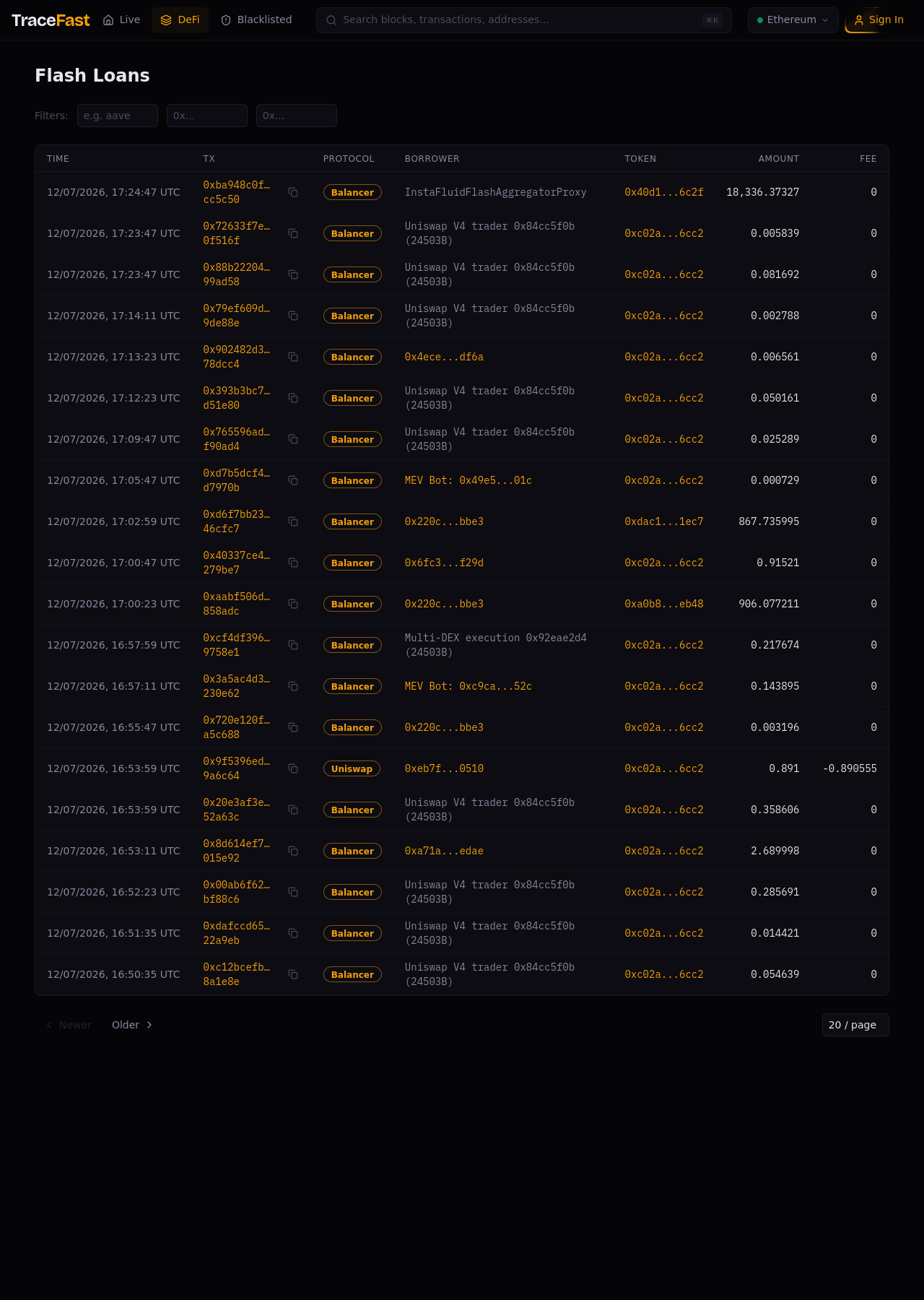
Flash Loans is one of the four DeFi sections. It decodes flash-loan events into a chronological feed: time, transaction, protocol, borrower (labeled where known — MEV Bot recurs often), token, amount and fee. Three filters narrow it: protocol, borrower address, and token address.
One transaction at a time
A single transaction can carry several flash loans, and reading them together is what makes the choreography legible. In the feed, the transaction hash opens the transaction page and the protocol opens its DEX protocol dashboard. The per-transaction view lives at /defi/flash-loans/by-tx/0x… — put the hash in the address — and lists every flash loan in that transaction, one row per event, with the log index, protocol and version, borrower, initiator, token, amount (both formatted and raw) and fee.
How to read it
Flash loans power three very different activities, and telling them apart is the point:
- Arbitrage — borrow, trade across venues, repay, keep the spread. High frequency, moderate size, boring — and healthy for markets.
- Liquidations and refinancing — capital-efficient position management by sophisticated actors.
- Attacks — most DeFi exploits use a flash loan as their opening move, because it turns "attacker with $1M" into "attacker with $100M" for one transaction.
A flash loan wildly out of scale with its protocol's norm, followed by unusual pool activity, is the signature worth investigating. Open the transaction and read its trace — the call tree shows the full choreography: borrow, the moves in the middle, repay.
Related pages
- DeFi Overview — how the section is laid out
- Pools & Liquidity — where flash-loan liquidity comes from
- Transactions — token transfers complete the trace
- Failed Transactions — failed flash loans land here
Last updated 22 Oct 2026, 08:06 UTC · verified against TraceFast v1.0.261 · Markdown