Smart Contracts
Open the contract explorer in TraceFast →
The contract inventory
The contract list is an inventory of everything ever deployed, newest first, headed by four KPIs: total contracts deployed (with the self-destructed count), ERC-20 and ERC-165 counts, EIP-1167 minimal-proxy clones and their share of all contracts, and deployments in the last 24 hours and 7 days.
Each row carries the contract address, deployment block and age, deployer (where the deploy lineage was captured), detected type, code size, selector count, balance and transaction count.
A contract's own page
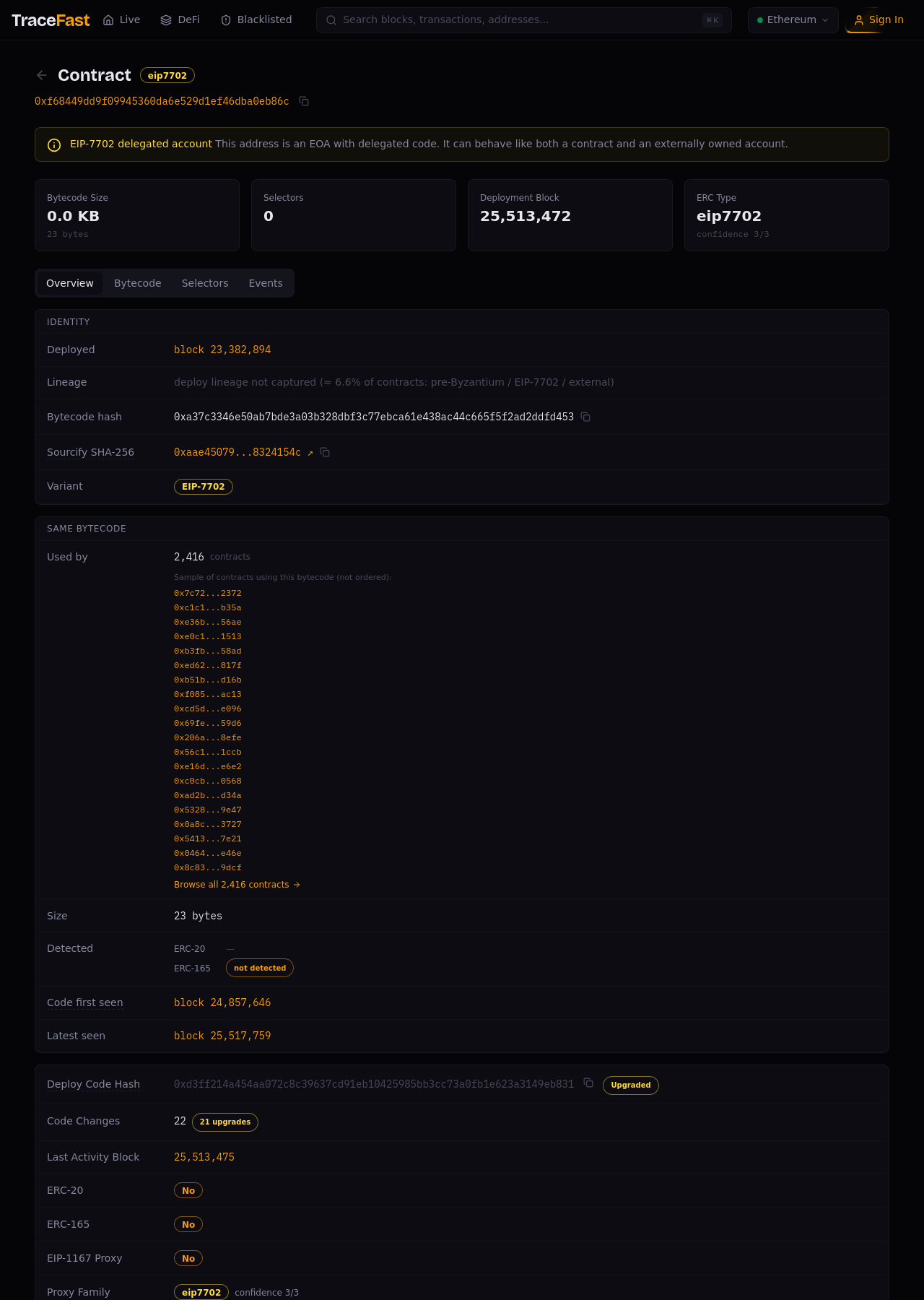
A contract opens at /entity/{address} — the same page every address gets, and
the Entity Page documents it in full. Two of its sections
answer what this contract is, as opposed to what it did:
- Chain facts — the proven statements about the code: which ERC interfaces it presents, whether it is a proxy and of which family, whether the implementation slot is mutable, which privileged surfaces (mint, pause, blacklist, emergency withdraw) exist in the code that executes, and which of them have actually been used. Each fact carries the block it was observed at and states what it does not claim.
- Relationships — who deployed it and in which transaction, the implementation it currently delegates to, every implementation before that as block intervals, the accounts that delegate to it under EIP-7702, contracts running byte-identical code, and — on an implementation — the proxies that have delegated to it.
Its behaviour is on the same page under Transactions: the calls it received, the events it emitted, the storage slots it wrote.
:::info Detection is structural, not a verification Type and proxy detection come from analysis of deployed bytecode and on-chain behaviour. They describe shape — ERC interface presence, proxy family, upgradeability — and never assert source correctness. They are not source verification and not a security audit. :::
Bytecode families
Identical bytecode across many addresses is itself a signal: factory deployments and clone patterns show up as families of contracts sharing one bytecode hash. A contract's page states how many others run byte-identical code; the cluster itself lives at /bytecodes/{codeHash} and lists them.
EIP-1167 minimal proxies dominate this picture — they account for roughly 45% of all contracts ever deployed on Ethereum.
Deployers
Every contract records who created it: the Deployed by relationship names
the deploying account and the transaction that executed the CREATE, and the
contract inventory carries a Deployer column you can scan. Where the lineage
was never captured — pre-Byzantium deployments, EIP-7702 delegations,
externally created code — the row says so rather than guessing.
From the other end, a deployer's own page lists what it created on its Deployments tab — opcode, deploying transaction, shared or unique deploy-time bytecode, minimal-proxy shape — and states how much of its history the list covers.
The standalone deployer view (/deployers/{address}) is retired along with the
other per-kind pages; a deployer is an address like any other and opens at
/entity/{address}.
Proxy implementations
Proxied contracts (the dominant pattern for upgradeable protocols) separate the stable address from the logic behind it, and TraceFast reads that link from both ends — both of them in Relationships on the contract's page:
- From the proxy: the implementation it delegates to now, and Implementations before — every implementation it has stood on, as block intervals. An interval with no end was still open at the edge of the platform's coverage.
- From the implementation: Used by proxies — the proxies that have delegated to this contract. It is a sample rather than a count, and the page says so.
This is essential context, since what a contract does can change even when its address doesn't. Delegatecall-heavy patterns also show up in Storage Analytics as high delegatecall write shares.
Related pages
- Top Contracts by Gas — today's busiest contracts
- Top Method Calls — what's being called network-wide
- Storage Heatmap — who writes state
- Entity Page — the page a contract opens into
- Addresses & Labels — the identity layer on top of it
Last updated 22 Oct 2026, 08:06 UTC · verified against TraceFast v1.0.261 · Markdown