Tokens & Collections

A token contract gets the same entity page as any address,
plus the two tabs that only make sense for an asset — Holders and
Pools — and a price where one can be established. The header says which
kind it is: Token, NFT token or Multi-token.
Price and price history
The Price number carries its own provenance: the source it came from, a confidence, and how long ago it was observed. A stablecoin priced from its peg and a thin token priced from its last swap are not the same claim, and the card says which one you are reading.
Price history charts 7, 14 or 30 days with the change across the window in both absolute and percentage terms. USD figures elsewhere on the page follow the platform-wide rule: a past event is priced at the hour it happened, never at today's price, and where no hourly price exists no dollar figure is shown.
Holders
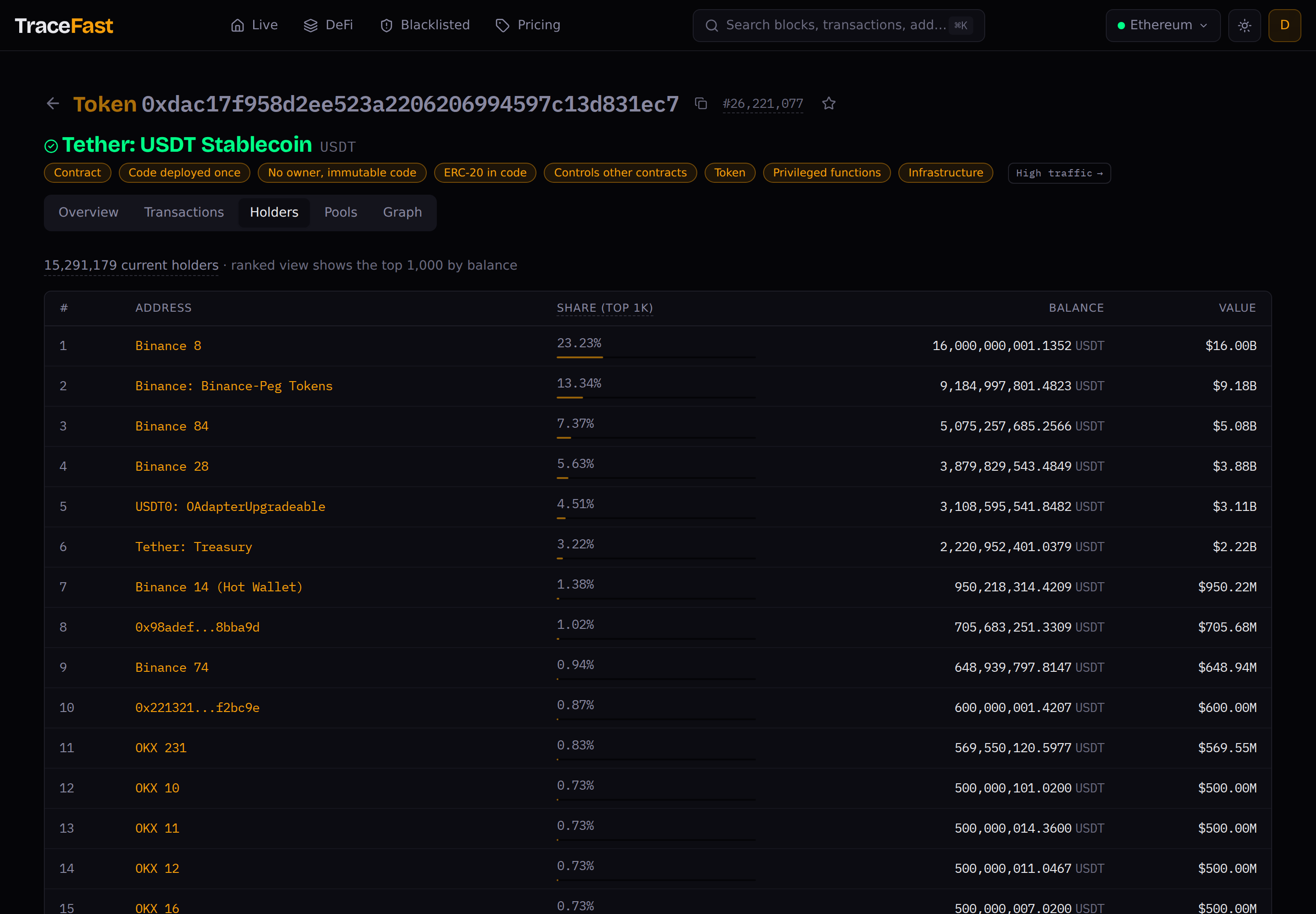
The current holder table: rank, address (labeled where known), share of the top 1,000, balance, and USD value where the token has a price. The heading states the full holder count and that the ranked view shows the top 1,000 by balance — the rest of the tail exists, it is simply not ranked.
"Current holders" means addresses with a positive balance today. It is a smaller number than everyone who has ever held the token, and the two answer different questions: current distribution versus lifetime reach. For a token so new that TraceFast has only its token record yet — usually its first minutes — the header's metric row carries a holder tile: Holders, the holders now, where they are counted; otherwise Holders (all-time), every address that has ever held the token — the case for NFT collections. With neither number there is no tile.
Holders are counted for fungible tokens. NFT collections are not covered yet: their Holders tab says Holders aren’t counted for this token, so there is no list to show. That means the collection is outside the holder data, not that nobody holds it — a covered token with nobody holding it says No holders found for this token instead. Once a collection is covered, the balance column is a count of items rather than an amount, and the value column stays empty instead of inventing a per-item price.
Pools

Every DEX pool the token trades in. Above the table: DEX volume · last 7d with the total and the swap count — the window is named in the heading on purpose, so a total is never read against a column measured over a different period. The chart switches between volume in USD and swap count, and the protocol chips narrow it to one venue (Uniswap v2 / v3 / v4, Curve, Balancer, PancakeSwap, SushiSwap …).
The table lists each pool with its counterpart asset, protocol and version, 7-day volume, fee tier and creation block. A brand-new pool with no volume yet shows a dash rather than a zero: nothing has traded, which is not the same as "we measured zero".
What the chain facts say about an asset
The Asset group of Chain facts is where a token stops being a name and becomes evidence:
- Fungible token / NFT collection / Multi-token collection — which interface the executing code presents, and that at least one transfer of that shape was observed. It says what the interface is, never whether the token is legitimate.
- Transfers state-backed — the token's
Transferevents are backed by matching balance changes in its own storage. This is the normal shape of a real token. - Transfers event-only — it emits transfer events with no matching balance state behind them. That is the signature of address-poisoning campaigns, and also of designs that keep balances off the emitting contract; the fact names the observation, not the intent.
- Transfers only at deploy and No direct calls since deploy — the deploy-block bait shape: everything "moved" in the block the token was born and nothing ever called it again.
Each fact carries the block it was observed at. Absence means not proven, never "no" — see the address attribute dictionary for the full vocabulary and the ids behind these labels.
Lookalikes
A token that impersonates a well-known asset is named as such, and the relationship is stated from both ends: the fake says what it impersonates, and the genuine asset's page lists the addresses impersonating it. The transfers you see on a lookalike are real on-chain events of a fake contract — they are not the asset being imitated, and they carry no value.
Live dashboard boards take the stricter route: Top Tokens ranks only verified tokens, so a clone cannot climb it.
Related pages
- Entity Page — the page all of this lives on
- Tokens — the network-wide leaderboard and transfer feed
- Transaction feeds — the token's own transfers and events
- Pools & Liquidity — pools as their own subject
- Address attribute dictionary — the asset facts over the API
Last updated 22 Oct 2026, 08:06 UTC · verified against TraceFast v1.0.261 · Markdown