Signals
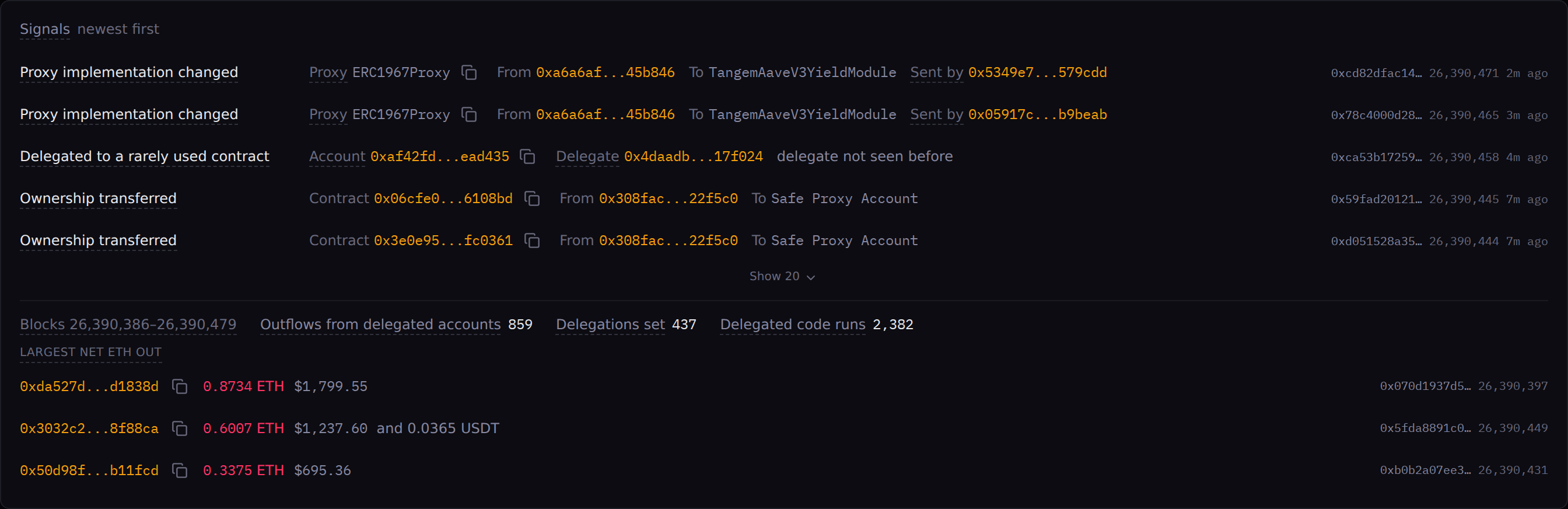
What it shows
Changes to who controls a contract or an account, and unusual market events, spotted within seconds of each block: a proxy now runs different code, a contract has a new owner, a Safe wallet gained a module, an account delegated its code under EIP-7702, a wallet paid a look-alike of an address it paid before, a pool lost half its liquidity. Each event is one card, newest first.
The tab has three views — hover a view's name for what it holds:
- Security — control and delegation changes on any contract or account, value that left an address after such a change, look-alike addresses and emptied wallets, and the window's EIP-7702 counts.
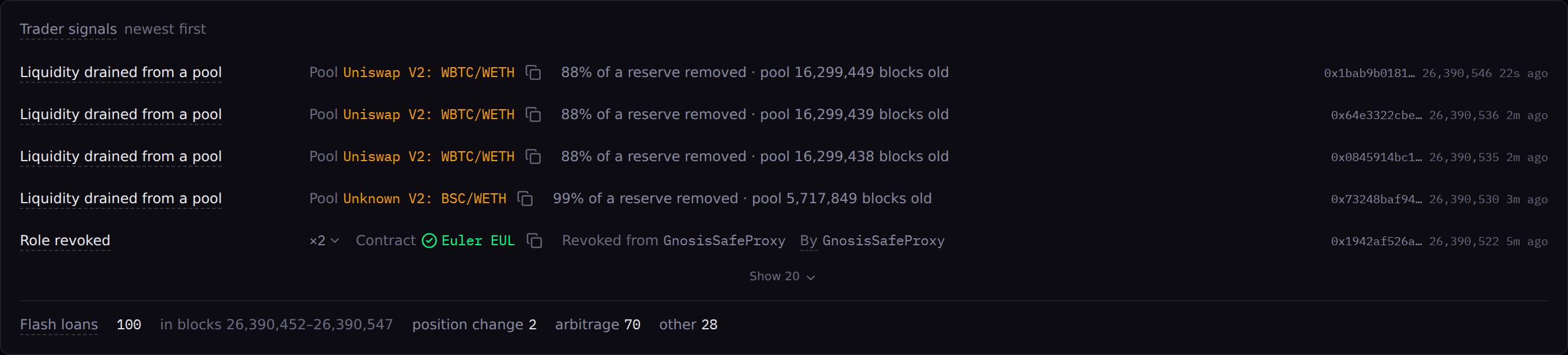
- Trader — market events around tokens and pools, and the control changes of the Security list when they happen on a token that trades: a proxy upgrade of a traded token is filed here, not under Security. This view is a trial, and the app says so: what it shows may change or go.
- Messages — text that senders wrote into their transactions, shown as quotes — see Messages.
Filtering
On Security and Trader, two filters sit above the cards:
- Filter by kind opens chips of every signal the view can show, grouped — Code delegations, Safe wallets, Owners, roles, pauses, Proxies, Look-alike addresses, Emptied wallets, Liquidity, Launches and more; hover a group's name for what it covers. Choose one or several; All clears the choice. New cards arriving live follow the same choice. When a chosen kind's coverage is not known yet, the filter says so: an empty list then does not mean none happened.
- Filter by address keeps the cards that name the address — as their subject or anywhere on the card. A value that is not an address filters nothing, and the app says so.
The page address carries both filters, so a filtered view can be shared.
A signal is an observation, not a verdict. A proxy upgrade, an ownership transfer or a new Safe module is most often routine maintenance; the card says what changed so you can judge who changed it. Follow the addresses to their entity pages — the risk marks and labels there are what TraceFast states about them.
A signal can disappear. Signals are read before a block is fully processed; if the block is dropped from the chain in a reorg, its signals go with it.
Reading a card
A card has a title — what happened — then the address it is about, named by its role (the subject), the other addresses involved with their roles, short facts, and the transaction and block. Hover the title for what the change means, and a role for what that address is.
| Role | Who it is |
|---|---|
| Account | the account that set or cleared an EIP-7702 delegation |
| Delegate | the contract whose code the account now runs |
| Proxy | the proxy contract: it forwards calls to the code it points to |
| Safe | the Safe multi-signature wallet the change is about |
| Contract | the contract whose owner, roles, pause state or initialization changed |
| From, To | the old and the new value — implementation, admin, beacon, singleton, guard, handler, owner, authority |
| Owner | the Safe owner added or removed; on an emptied wallet, the address whose own transactions moved the assets out |
| Granted to, Revoked from | the address that was given, or lost, a role |
| Module | a Safe module: it can move the Safe's funds without owner signatures |
| Spender | the address many owners allowed to move their tokens |
| Executor | the address that moved tokens out of the owners' accounts |
| Recipient | where those tokens went |
| Caller | the address that called a contract's initialize step |
| Pool, Token | the pool or the token a market event is about |
| Address | the address whose control changed, and that the value left |
| Went to | where the value went — the first recipient when there are several |
| Payer, Paid, Resembles | the address that paid; the look-alike it paid; the address it paid before, which the look-alike resembles |
| Planted by, Planted with, Through | who sent the transfer that put the look-alike into the payer's history, the token that transfer used, and the contract it went through |
| Sender | the address whose transactions planted look-alikes on many owners |
| Into | the address an emptied wallet's assets went to. It had never sent a transaction |
| Paid with | the token the buyers of a new token paid with |
| By | the address that made the change |
| Sent by | the address that sent the transaction — often not the same as By |
An address without a name is shown by its short form, with the whole address on hover. A role granted or revoked whose name is not known is shown by a short id, with the full id on hover.
Links go to the exact place the change shows: the transaction's Events tab when the contract announced it with an event, its State tab when only storage changed, its Token Transfers tab for tokens that moved, its Trace tab for a refused sell. When one transaction raises the same signal several times on the same address, the card shows it once with ×N, and expands to list each.
A proxy upgrade is easiest to judge against the proxy's own history — for example the implementations USDC has stood on, in its Relationships.
Every signal
EIP-7702 delegations
| Signal | Subject | What it means | What the card adds |
|---|---|---|---|
| Delegated to a rarely used contract | Account | The account set its EIP-7702 delegation to a contract that few or no accounts have delegated to before. From now on the account runs that contract's code when called | the Delegate; delegate not seen before, or how many accounts delegated to it before; delegate deployed in the same block; sent by another address when someone else submitted the authorization |
| Delegation removed | Account | The account cleared its EIP-7702 delegation: it no longer runs another contract's code | the transaction and block |
A delegation to a widely used wallet contract is everyday activity, so it is counted, not listed — see Counted, not listed.
Proxies
| Signal | Subject | What it means | What the card adds |
|---|---|---|---|
| Proxy implementation changed | Proxy | The contract the proxy forwards its calls to was replaced: the proxy now runs different code | From and To — the old and the new implementation; Sent by; set to the zero address; no upgrade event when the change was made in storage without the usual event |
| Proxy admin changed | Proxy | The address allowed to upgrade this proxy was replaced | From, To, Sent by |
| Proxy beacon changed | Proxy | The beacon this proxy reads its code address from was replaced | From, To, Sent by |
Safe wallets
| Signal | Subject | What it means | What the card adds |
|---|---|---|---|
| Safe singleton changed | Safe | The code this Safe runs (its singleton) was replaced. An official Safe version is a normal upgrade; any other code is not | From, To, Sent by; official Safe 1.4.1 (with its version), or not an official Safe singleton |
| Safe owner added · Safe owner removed | Safe | An owner was added to, or removed from, the Safe | the Owner; owners 3 → 4; Sent by |
| Safe threshold changed | Safe | The number of owner signatures the Safe needs to act was changed | threshold 2 → 3, owners 5 → 5; Sent by |
| Safe module enabled · Safe module disabled | Safe | A module was enabled or disabled. A module can move the Safe's funds without owner signatures | the Module, Sent by |
| Safe guard changed | Safe | The guard — a contract that checks every transaction of the Safe — was changed | From, To — the old and the new guard; Sent by |
| Safe fallback handler changed | Safe | The fallback handler — the contract that answers calls the Safe does not know — was changed | From, To — the old and the new handler; Sent by |
| Safe owners changed without an event | Safe | The owners or the signature threshold changed in storage, and the Safe did not announce it with its usual event | threshold 2 → 1, owners 3 → 1; Sent by |
| Safe guard changed without an event · Safe fallback handler changed without an event | Safe | The guard or the fallback handler changed in storage, without the Safe's usual event | From, To; Sent by |
A change "without an event" is worth a second look: a Safe that works as designed announces these changes.
Ownership, roles and pauses
| Signal | Subject | What it means | What the card adds |
|---|---|---|---|
| Ownership transferred | Contract | The contract's owner changed. The owner can usually call its admin functions | From, To |
| Ownership renounced | Contract | The owner gave up ownership: no one can call the owner-only functions any more | From — the previous owner |
| Owner changed without an event | Contract | The owner changed in storage, and the contract did not announce it with its usual event | From, To |
| Owner changed · Authority changed | Contract | For contracts built on the DSAuth pattern: the owner changed, or the authority — the contract that decides who may call it — changed | To |
| Role granted · Role revoked | Contract | An address was given, or lost, a role. A role allows calls to the functions it guards | the role's name where known — default admin for the top role — or its short id; Granted to or Revoked from; By |
| Contract paused · Contract unpaused | Contract | Functions that check the pause stopped working, or work again | By — the account that paused or unpaused |
| Pause state changed without an event | Contract | The pause state changed in storage, and the contract did not announce it with its usual event | now paused or now unpaused |
| Contract initialized late | Contract | A contract that was not created in this block or the few before it was initialized only now. Whoever initializes a contract usually becomes its owner or admin, so this can be a planned setup — or someone taking over a contract left uninitialized | Caller, Sent by; created N blocks earlier; the initialized version; proxy settings also changed in the block, owner also changed in the block |
Token approvals and pulls
| Signal | Subject | What it means | What the card adds |
|---|---|---|---|
| Many owners approved one spender | Spender | Many different owners approved the same spender to move their tokens within a short span of blocks. It can be a popular new app — or a campaign that asks for approvals | N owners in M blocks; how many approvals were unlimited; token later moved out of N owners by someone else; the tokens |
| Tokens pulled from many owners | Executor | One executor moved tokens out of many owners' accounts within a short span of blocks, using allowances or signatures they had given. If most owners had just received the token, this is usually an exchange or app sweeping deposits | the Recipient; N owners in M blocks; N% of the owners had just received the token; the tokens |
These two read together: many approvals to one spender, then that spender pulling from many owners, is the shape of both an exchange's deposit sweep and an approval-phishing drain. The share of owners who had just received the token is what usually tells them apart.
After a control change
| Signal | Subject | What it means | What the card adds |
|---|---|---|---|
| Funds left after a control change | Address | Value left this address within 7 days after one of the signals here said control over it changed — Safe owners or modules, a proxy implementation, ownership. Raised when it is the first outflow since, a large ETH outflow (at least half the balance), or a transfer to a fresh address. A fact, not a verdict | the control change it follows, linked to its block; in the same block or N blocks later; first outflow since; at least half of its ETH; to a fresh address; the ETH out of the balance before; how many tokens left; Went to, N recipients in all; Sent by |
Look-alike addresses
A look-alike shares its first and last four characters with an address an owner paid before. Wallets often show only those characters, so an owner who copies an address from their history may pick the look-alike — the pattern of address poisoning.
| Signal | Subject | What it means | What the card adds |
|---|---|---|---|
| Payment to a look-alike of a recent payee | Payer | This address paid a look-alike of an address it paid before, and a transfer naming that look-alike had appeared in its history shortly before. A different payee that happens to share those characters looks the same — a fact, not a verdict | Paid and Resembles, both in full; the amount paid; same first and last four characters; when the transfer naming the look-alike appeared and the block it paid the address it resembles; what the planted transfer showed, Planted by, Planted with, Through |
| Sender planting look-alikes on many owners | Sender | Transactions from this sender put transfers naming look-alikes into the histories of many different owners within a short span of blocks. A fact about these transfers, not a verdict about the sender | look-alikes planted on N owners in M blocks; how many look-alike addresses and transfers; N look-alikes already paid by the owner it was planted on; the top contracts it went Through and the Tokens used, with counts |
The planting token's own symbol is never printed — it is its author's text, often a phishing line; its address is shown instead.
Emptied wallets
| Signal | Subject | What it means | What the card adds |
|---|---|---|---|
| Wallet emptied into an address that never sent a transaction | Owner | The owner's own transactions moved all of two or more assets — ETH, tokens — to one address that had never sent a transaction, within a few blocks. A drained wallet looks like this, and so does an owner moving to a new wallet of their own — a fact, not a verdict | Into; the assets emptied with their amounts; a new address when it had never even received; in one block or over N blocks; how many transactions the owner had sent before; how many owners emptied into the same address, and from how many addresses it collected in 7 days |
Market events — the Trader view (trial)
| Signal | Subject | What it means | What the card adds |
|---|---|---|---|
| Liquidity removed from a pool | Pool | One removal of liquidity took at least half of one of the pool's reserves. An ordinary provider leaving a small pool looks the same — it is a fact about the pool, not a verdict about who removed it | N% of a reserve removed; by a deployer of one of its tokens; pool N blocks old; the same sender added liquidity to another pool in the same block; the same transaction added the liquidity it removed |
| Token refused a sell | Token | The token's own transfer into its pool reverted: its code refused the sale, not the exchange. A fact about this transfer, not a verdict that the token cannot be sold | the Pool; seller is the token's deployer; the other sells of the token in the blocks before — how many went through and how many were refused. None refused is said only when every transaction of those blocks could be checked; reverted with no reason when the token's code gave no message — many ordinary refusals give none either |
| Trading opened / limits lifted | Token | A token that already has a market called one of the usual launch switches: trading was opened, or the per-transaction or per-wallet limits were removed. An ordinary step of a launch — a fact, not a verdict | trading opened or limits removed, with the function called; called by the token's deployer; By; whether the pool was created or liquidity added in the same transaction, or how many blocks earlier the first pool appeared; the swaps that followed in the same block |
| Many buyers in the first trading block | Token | In the block of a new pool's first trade, at least 5 different senders bought its token. A popular launch draws trading bots into its first block, and a launch bought through many wallets of one team looks the same — a fact, not a verdict | N buyers in M transactions; buyers who bought more than once; the share of the supply bought; how many blocks after the pool was created; buyers also first in other launches of the last day; the Pool, and Paid with or paid in ETH |
Counted, not listed
Some events are too frequent to list one by one. They are counted over a window of recent blocks named in the caption — Blocks 26,390,301–26,390,395 — and when not every block of the window has been processed yet, the caption says how many have, once, for all counts.
On the Security view:
- Outflows from delegated accounts — transactions sent by someone other than the account in which ETH or tokens left an account that runs delegated code;
- Delegations set — accounts that set a code delegation;
- Delegated code runs — transactions in which an account ran the code it delegates to.
Largest net ETH out lists the delegated accounts whose ETH balance fell the most over one transaction sent by someone else — the balance before minus after, fee included, with its USD value at the ETH price of that hour, and any tokens that left the account beside it. A delegated account drained by a transaction its owner did not send is the pattern this list exists to surface.
On the Trader view, Flash loans — transactions that borrowed from a lending protocol and repaid in the same transaction — are counted over their own block window (Flash loans 100 in blocks 26,390,452–26,390,547), not listed: most are ordinary trading bots. The count is broken down by what their events did: liquidation, position change, arbitrage, other, and kind not stated. The kind describes the events; it does not vouch for the transaction — an exploit can look like arbitrage or a liquidation.
Messages
The Messages view lists text that senders wrote into their transactions — the transaction's input read as text. Messages from or to an address named by one of the recent signals come first, marked Sent by a party of a signal, Sent to a party of a signal or Linked to a signal, with the signals they link to. One sender writing to at least five recipients within about a day is shown as one mass mailing with its latest text; a sender seen many times carries ×N.
Every message is marked Third-party on-chain message: TraceFast did not write it and does not endorse it, and links in it are not clickable — do not visit them. Characters that do not show themselves (direction overrides, zero-width and similar) are removed from the quote, and the card says how many; a message longer than 2 KB is cut. A link on each message opens the transaction's trace, where the whole input is shown.
Data & update cadence
New cards arrive with each block (~12 s). The tab keeps the newest cards of each view; Show N opens the rest. When nothing was spotted over a whole day of covered blocks, the Security view says No signals in the last day of blocks; before a day is covered it says No signals listed yet. Names are shown to signed-in users — a free account is enough; without a session the cards show the same signals by address.
Other signals in TraceFast
The Signals tab is about control changes and market events. Other pages raise signals of their own:
- Blocks — block signals mark unusual blocks against a recent baseline: failure spike, deployment burst, blob-heavy, full block, high log density, risky recipient, large value, low activity.
- LP Liquidity — outflow signals for large liquidity removals.
- Token Freezes and Blacklisted — USDT and USDC freezes as they happen, and every token blacklist.
Related pages
- Live Dashboard — the other tabs
- Contracts on the entity page — proxy implementations, owners and code of a contract
- Smart accounts — EIP-7702 delegations on an account
- Transactions — the Events, State and Trace tabs a card links to
Last updated 19 Nov 2026, 11:46 UTC · verified against TraceFast v1.0.332 · Markdown